Texas Tidbits

Posted: 1/19/07

Texas Tidbits

Hispanic Mission Network to debut. Leaders of Hispanic Texas Baptist churches that are engaging members in missions—along with representatives from Baptist University of the Americas, WorldconneX and Buckner International—will launch a Hispanic Mission Network at the Hispanic Evangelism Conference, Feb. 2-3 in San Antonio. Participants plan to conduct a global/local mission project within the network’s first year that could provide a model for Hispanic church involvement. About 30 Hispanic leaders and missions practitioners met at Baptist University of the Americas recently for a Plaza Global two-day event to discuss the network and explore emerging trends in global missions.


Hardin-Simmons, ETBU athletic trainers honored. The athletic training staffs at Hardin-Simmons University and East Texas Baptist University each were named by their peers as division winners of the American Southwest Conference athletic training staff of the year awards for 2005-06. Hardin-Simmons was presented the west division award, and ETBU took the east division honor. The University of Mary Hardin-Baylor won the west division honor the previous academic year.


Baylor receives gift for Brooks Village chapel. Brooks Village—a new residential community under construction at Baylor University—will have its own chapel, thanks to a gift from William and Mary Jo Robbins of Houston. The university did not disclose the amount of the gift in keeping with the donors’ wishes. At 252,000 square feet, Brooks Village will accommodate 700 students in two new residential quadrangles. University officials expect the $42.8 million Brooks Village project to be completed in the fall.


Land gift yields multiplied benefits for Wayland. A land gift originally valued at $65,000 recently yielded more than $535,000 for Wayland Baptist University’s endowment. In 1958, Burton and Annie Craig gave Wayland 653 acres in Sunray. The Craigs placed the land in a trust with the Baptist Foundation of Texas with the stipulation that it would provide monthly benefits for them until their deaths. The trust has remained in investments since it was deeded. Craig died in 1962, and his wife died last October. At that point, when the trust fund came to Wayland, it was valued at $535,129.


Christian student leaders to meet at Howard Payne. Chris Seay, pastor of Ecclesia Church in Houston, Bo Pilgrim of the Pilgrim’s Pride Corporation and Vicki Vaughn of the Richard Jackson Center for Evangelism in Brownwood will speak at the ninth annual Christian Association of Student Leaders conference, Jan. 25-27 at Howard Payne University. The event is expected to attract more than 200 students from Dallas Baptist University, East Texas Baptist University, Hardin-Simmons University, Houston Baptist University, the University of Mary Hardin-Baylor and Wayland Baptist University, as well as Hannibal LaGrange College and Louisiana College.


HPU meets fundraising milepost. Howard Payne University has crossed the $20 million mark in its Sharing the Vision capital campaign, approaching its $25 million goal. The fundraising campaign already made possible many campus enhancements and has provided funding for endowments and scholarships. 


News of religion, faith, missions, Bible study and Christian ministry among Baptist churches, in Texas, the BGCT, the nation and around the world.


TOGETHER: If Baptists were ‘too much like Jesus’

Posted: 1/19/07

TOGETHER:
If Baptists were ‘too much like Jesus’

Baptists across North America are saying with a clear voice that it is time for a “Jesus agenda.”

What does it mean to pursue a Jesus agenda?

Look at what Jesus did when the synagogue leaders gave the scroll of Isaiah to him and asked him to read. He could have chosen any passage, but he picked this one:

“The Spirit of the Lord is upon me, because he has anointed me to preach good news to the poor. He has sent me to proclaim release to the captives and recovering of sight to the blind, to set at liberty those who are oppressed, to proclaim the acceptable year of the Lord” (Luke 4:18-19 and Isaiah 61:1-2).

wademug
Executive Director
BGCT Executive Board

A Jesus kind of church and a Jesus people will put the priorities and passion of Jesus at the heart of their lives and work. They will ask, “Where would Jesus go, to whom would Jesus minister, and what would he say if he came to our town?” When we answer that question, we know where we need to be this week.

Those verses in Luke and Isaiah speak of Jesus’ mission to the poor, the captives, the blind and the oppressed. You can easily see a spiritual meaning in each phrase, but Jesus also clearly cared about those who were physically poor, captive, blind and oppressed.

We have that same two-pronged work today, allowing Christ to meet the spiritual and physical needs of those in need through those of us who have pledged to be his disciples.

Baptists from across North America will gather in Atlanta Jan. 30-Feb. 1, 2008, to say with a great voice, “We believe it is worth our lives to be Jesus people and for our churches to be Jesus kind of churches.”

We are ready to be about Jesus’ agenda:

• We want to be instruments of healing and liberty to the broken and frightened.

• We are willing to share with and advocate for the hungry, thirsty, homeless, sick and incarcerated.

• We have good news, and it is clearly a sin if we keep quiet.

There has never been a Baptist gathering like the one that will be held in Atlanta. Not since 1845 have the Baptists of America gathered in one place, in a unified spirit, to answer a call to be about missions and evangelism, justice and righteousness. But at that time, there were only a few black Americans represented, and no Canadian, Mexican or Asian Baptists.

Now, 163 years later, Baptists of every language, race, ethnicity, national background, men and women, from North, South, East and West will gather with hearts yearning to be united around Jesus’ agenda for the sake of a lost world. We will present to God an offering of praise that will give a new voice to our Baptist people and will draw people to Jesus because they see how these Christians love one another.

Right now, I ask you to begin praying for the Spirit of God to fall on this meeting and to circle those dates on your calendar and do all you can do to be there.

When Jesus read from Isaiah, he really kicked over a hornet’s nest in his hometown. Wouldn’t it be exciting if Baptists could stir up a hornet’s nest today for being too much like Jesus?

We are loved.

Charles Wade is executive director of the Baptist General Convention of Texas Executive Board.

News of religion, faith, missions, Bible study and Christian ministry among Baptist churches, in Texas, the BGCT, the nation and around the world.


BGCT intercultural mission trip slated for Vancouver

Posted: 1/19/07

Up to 40,000 Japanese call Vancouver home, and Pastor Yutaka Takarada wants Texas Baptists to partner with Canadian Baptist counterparts to reach them.

BGCT intercultural mission
trip slated for Vancouver

By Barbara Bedrick

Texas Baptist Communications

DALLAS—When Yutaka Takarada flew to Vancouver, British Columbia, last year, he found ample salmon, Japanese restaurants and views of the harbor.

But what he didn’t see worried him. Even though Vancouver has a sizeable Japanese population, the president of the Japanese Southern Baptist Churches of America couldn’t find many Japanese Baptist churches.

“There are 10 times as many Japanese residents living in Vancouver as in Dallas,” said Takarada, pastor of Japanese Baptist Church of North Texas. “We have about 3,000 Japanese in the Dallas area, but there are 30,000 to 40,000 Japanese residents there. Yet there are few Japanese churches.”

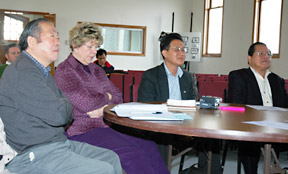
Pastors and mission workers reflecting several ethnic groups gather to discuss ways to work together in sharing the gospel in Vancouver.

Many of the Baptist churches in Vancouver are young churches similar to the church Takarada started 23 years ago. Its first Japanese Baptist church was started only a year ago.

Those numbers have prompted Takarada to action. Most importantly, he wants to let Japanese Baptist leaders in Canada know they are not alone, he said.

“We want them to know we care,” Takarada said. “And that we are praying for them.”

A multicultural mission trip coordinated by the Baptist General Convention of Texas could help spread the message.

Patty Lane, BGCT intercultural ministry director, is planning a trip to Vancouver, along with Southwest Chinese Baptist in Houston, Ethiopian Baptist Evangelical Church in Garland, Laotian Baptist Church in Dallas, Japanese Baptist Church of North Texas in Dallas and Iranian Baptist Church in Dallas.

Once in Vancouver, the mission team will share the gospel, help equip church leaders, start new churches and work on college campuses. Lane expects to take 35 to 40 workers on the trip, slated for July. It will be the first BGCT-sponsored intercultural mission trip.

“The churches (in Vancou-ver) are extremely eager to partner with others in the States and want relationships,” Lane said.

Jair Campos, pastor of Central Brazilian Baptist Church in Dallas, is leading the Vancouver missions emphasis.

“I believe the partnerships here will energize passion in both groups and strengthen … relationships,” he said. “We encourage congregations of all ethnicities to consider this mission project. We already have some Anglo churches who are considering sending workers.”

For more information about the intercultural mission trip, call Campos at (817) 800-4604 or Lane at (214) 828-5372.

News of religion, faith, missions, Bible study and Christian ministry among Baptist churches, in Texas, the BGCT, the nation and around the world.


Childless young adults want ministry, not sympathy

Posted: 1/19/07

Childless young adults
want ministry, not sympathy

By David Briggs

Religion News Service

CLEVELAND (RNS)—Tina Barta and many of her evangelical peers do not like the term “single.” In church and in society, single implies a person who is not whole, not complete, they say.

“That’s such an awful way to look at it,” said Barta, 27, who believes fulfilling her spiritual destiny is not dependent on meeting a man. “I am in a relationship with Christ. Yes, I’m single, but I’m pursuing Christ, and he’s pursuing me.”

Barta and her friends at the Sevenoseven young adult ministry at Cuyahoga Valley Community Church in suburban Cleveland are not alone.

They are one segment of a demographic—men and women of childbearing age without children—that nearly doubled in 24 years, from 10 percent of the population in 1976 to 19 percent in 2000.

This generation has not abandoned organized religion, according to a new national study of 8,450 young adults by Michelle Fugate, a sociologist at Loyola University in Chicago.

Within Protestant churches, parents on average report attending services more than twice a month; childless young adults attend just less than twice a month.

What childless young adults struggle to find, however, are spiritual homes where they feel accepted and included. They don’t want to be harassed about their status in houses of worship that often emphasize families with children as the norm.

“Fitting in” is important to childless young adults, Fugate found.

They don’t want a childless ministry, she said. They want to serve in different roles in the church, and they want congregants to understand each individual has a vocation.

What drove some people away from churches, Fugate said, was the way women in particular were grilled about their childless status. One childless woman told Fugate that a pastor actually asked her, “What’s wrong with you?”

In a conversation before a recent Sevenoseven service, six young women said the study’s results reflected many of their experiences.

Barta, whose father is a pastor, grew up in a small church where she “did feel a definite pressure” to marry and begin a family at an early age.

But since graduating from college and becoming involved with the Sevenoseven ministry, Barta said, she has felt freer “to pursue my relationship with Christ and not my relationship with a guy” as a priority.

Jessica Harnegie, 27, said many singles in family-oriented churches find themselves wondering, “Where do I fit in? I have nowhere to go.” She said churches should recognize the growing generation of people in their 20s and 30s who are childless and welcome these people into ministries from readers to Sunday school teachers to leaders of Bible study groups and mission projects.

Being single “doesn’t mean we’re lepers,” she said. “Single women still need that affirmation.”

Many singles and childless couples gravitate toward larger churches, which offer a range of adult ministries and a less homogenous population where young adults without children feel more comfortable.

Ministries such as Sevenoseven, which offers contemporary services and small groups for young adults, are attractive. Here, young adults are the norm.

“God wants us to be relational, not just with men but with everything,” said Melissa Smith, 24.

“Female relationships build character and purpose.”

The women said they would like to find the right husband and have a family, but they also recognize “just being what God created you to be is all you need to be,” Smith said.

Churches should think in terms of integration, not segregation, Barta insisted.

“It’s not a singles ministry and a couples ministry,” she said. “It’s the body of Christ. We are one.”


David Briggs writes for The Plain Dealer in Cleveland.

News of religion, faith, missions, Bible study and Christian ministry among Baptist churches, in Texas, the BGCT, the nation and around the world.


Cybercolumn by Berry D. Simpson: Search for understanding

Posted: 1/19/07

CYBER COLUMN:
Search for understanding

By Berry D. Simpson

I have a friend who has effectively separated himself and his family from the world, from their church and from their family.

They closely guard their children’s exposure to the outside world, which includes their own cousins. They won’t go to church, even the church he grew up in, but instead have home church. They won’t send their children to school, but instead home school. They most recently opted out of their larger family’s Christmas celebration; I’m not sure if it was to guard against commercialization and secularization of a holy day or simply to save money. Either way, they missed out on the joy that always surrounds this family at such an important time.

Berry D. Simpson

I’m sure he has reasons for doing all this, and I’m sure he thinks they’re wise and holy reasons, but it’s hard for me to understand.

My friend’s story reminded me of a scene from The Last Battle, the final book of C.S. Lewis’ seven-part Chronicles of Narnia. The world of Narnia is coming to its final days in a struggle of false worship and warfare and deception and intrigue. One by one, the inhabitants of Narnia are punished by being thrown into a small, dark shed that appears to contain an evil spirit. Once inside the shed, most discover it to be bigger on the inside than on the outside, for the inside opened up to Aslan’s world and led to, well, heaven itself.

But some who were thrown into the shed never saw Aslan (who represents God in the books) or the beautiful world. All they saw was darkness. To them, the inside remained nothing but a small, dark shed that smelled of barnyard animals. They rebuffed all attempts to open their eyes to the truth. Certain that they’d been deceived by false leaders who claimed to speak for Aslan, they were determined to never be deceived again. They decided never again to believe anyone but each other. “Dwarfs are for dwarfs,” they said, and would not listen to anyone else. Lewis wrote that even Aslan could not reach them because they had “traded cunning over belief.”

It’s so easy to be like those dwarfs. Ensuring that we won’t be taken in by the evils of the world, we trade cunning over belief.

There’s a danger in thinking we’re the ones who know it all. In fact, as an engineer, I must deal with the occupational hazard of assuming I’m the smartest person in the room. I’ve told my wife, Cyndi, that most engineers come by this opinion honestly, but she just rolls her eyes. And while I may be smart, I have to make it a point to keep my ears open and stay teachable. One of my favorite writers, Natalie Goldberg, wrote, “Don’t always expect to get full understanding from yourself.” We need help from each other.

I’m also at risk of self-delusion, being a guy who reads a lot of books and listens to a lot of sermons and does a lot of research. It’s easy to convince myself I’m the one who knows everything because I’ve done the work. What does anyone else have to offer me? I continually have to ask God to keep my eyes and ears open to new ideas and approaches. It’s one reason I intentionally read a variety of writers and listen to many speakers. I want to make sure I’m not isolating myself from a message God is trying to send.

The search for understanding isn’t a small thing. Jesus said, “Make every effort to enter through the narrow door, because many will try to enter and not be able to” (Luke 13:22-30). It’s important to get it right. It’s a scary thought that many will try but few will enter. Yet every day, we hear people talk about spiritual things but never mention Jesus. They’re walking down a spiritual path, but it isn’t the narrow path that leads to Jesus.

Our men’s group has hiked to the top of Guadalupe Peak several times, and there is a trail junction just after the Pine Springs trailhead that’s easy to miss. To the left leads up to the peak and to the right leads up the Tejas Trail. We’ve taken the wrong trail on more than one occasion, a whole string of guys stopping on the wrong trail and reversing our steps to rejoin the correct trail. We caught our mistake quickly; no harm done.

But if we’d continued on the wrong path, it would’ve taken us further and further from the direction we wanted to go. Finding the correct trail is crucial to a successful hike. And so, in our spiritual search for understanding, we must keep our ears open and listen to each other for advice and direction as we try to navigate the correct path to Jesus.


Berry Simpson, a Sunday school teacher at First Baptist Church in Midland, is a petroleum engineer, writer, runner and member of the city council in Midland. You can contact him through e-mail at berry@stonefoot.org.


News of religion, faith, missions, Bible study and Christian ministry among Baptist churches, in Texas, the BGCT, the nation and around the world.


RIGHT or WRONG? Geneva conventions

Posted: 1/19/07

RIGHT or WRONG?
Geneva conventions

Appeals have been made to the Geneva Conventions regarding prisoners of war. What is the basis for such assertions? And what reference material is available?


A number of prisoners at Guantanamo Bay have made appeals to the Geneva Conventions to be considered prisoners of war. Those making the appeals are being held by the United States, but they have not necessarily been afforded the rights given to prisoners of war in the Geneva Conventions. Some have claimed these individuals should not be considered POWs because the regime for which they fought did not uphold the “laws and customs of war,” which include cooperating with international authorities and refusing to harbor terrorists.

The Geneva Conventions outline specific care that should be given to prisoners, including food, shelter, medical care and sanitation, at the same level as the armed forces of the country in which a prisoner is being held. Specific rights are afforded to POWs in the Geneva Conventions, however. Some of the rights in question are related to being prosecuted for war crimes. A higher burden of proof is required for conviction that demonstrates personal involvement in the crime, not merely association with others involved. In addition, POWs may not be interrogated, and they must be allowed to go home when the conflict has ended.

Detainees who appeal to the Geneva Conventions for protection as prisoners of war might base their assertion on one particular clause from article 5. It states, “Should any doubt arise as to whether persons, having committed a belligerent act and having fallen into the hands of the enemy, belong to any of the categories enumerated in Article 4, such persons shall enjoy the protection of the present convention until such time as their status has been determined by a competent tribunal.” Prisoners making appeal may ask for a tribunal to determine their status. This is particularly true for those who have been characterized as combatants but who were fighting as a part of or alongside armed forces of a regime no longer in control.

The Geneva Conventions are long and difficult to interpret, but a number of resources are available to simplify and explain the basic principles of the conventions. The International Committee of the Red Cross website provides not only the full text of the Geneva Conventions, but also fact sheets, answers to frequently asked questions and essential rules of the conventions. To access these resources, visit www.icrc.org. A number of free publications also are available. One of particular interest to this subject is the pamphlet “International Humanitarian Law: Answers to Your Questions,” which contains a new chapter on terrorism. Publications may be downloaded or ordered directly: International Committee of the Red Cross, Distribution Sector 19, Avenue de la Paix, CH 1202 Geneva, Switzerland.

Although your question is primarily educational in nature, as Christians, we must grapple with the question of what it means to love both our neighbor and our enemy. We must struggle both to “turn the other cheek” and to “do unto others as we would have done to us.” When seeking answers about the treatment of prisoners and civilians alike, we must ask ourselves not only what the law requires, but also what the love of Christ compels.


Emily Row-Prevost, team leader/coordinator leader

Communications/Spiritual Formation Specialist

Baptist General Convention of Texas

Dallas

Right or Wrong? is sponsored by the T.B. Maston Chair of Christian Ethics at Hardin-Simmons University’s Logsdon School of Theology. Send your questions about how to apply your faith to btillman@hsutx.edu.


News of religion, faith, missions, Bible study and Christian ministry among Baptist churches, in Texas, the BGCT, the nation and around the world.


BaptistWay Bible Series for January 28: God prunes with a wise, loving hand

Posted: 1/18/07

BaptistWay Bible Series for January 28

God prunes with a wise, loving hand

• John 15:1-17

By David Wilkinson

Broadway Baptist Church, Fort Worth

The first section of John 15 focuses on yet another in the series of “I am” statements from Jesus—this time, however, with a corresponding “you are” statement: “I am the true vine,” says Jesus, “and my Father is the vinegrower” (v. 1) and again “I am the vine, you are the branches (v. 5).

The vinegrower tends to the vineyard, and part of that care is to prune the plants. Notice that the gardener not only prunes the unhealthy branches but every branch that does not bear fruit. Further, the purpose of the pruning is to produce more fruit (v. 2). For that reason, both unproductive and productive branches may be pruned.

Jesus’ metaphor can be difficult. I doubt plants, if they could speak, would stare at the pruning shears gleaming in the sun and say to the gardener, “Great, I just can’t wait for you to lop off a few branches!” If given the choice, we would probably say to God: “No thanks. I’ve got some branches that may be unproductive, and I’ve got others that are unhealthy or even dead or dying, but I think I’ll pass on the pruning.”

On the other hand, when the pruning is done, the wisdom of the process is clear in retrospect. The evidence comes in the form of new blossoms and the promise of more fruit.

A kind of paradox is at work here. We are the branches, connected to the vine or the trunk represented by Jesus who in turn is connected to God. We might well envision a plant with three, intertwined branches—the Holy Trinity—serving as the stem or trunk to which every limb is connected.

There is another helpful perspective on this Johannine figure of pruning. Pruning our lives seems difficult and harsh, but pruning can also be an act of repairing. Elaine Emeth says this pruning metaphor makes sense “when she thinks of God as a gardener who grieves while watching a violent storm rip through a prized garden. Afterward, the gardener tenderly prunes the injured plants to guarantee survival and to restore beauty and harmony. Pruning is clearing away the debris of our messy lives.”


Relationship as key

The key to this image is relationship. The relationship of the branch to the vine is expressed through Jesus’ repeated use of the word “abide.” Already in this Gospel this verb has become “a rich and full word to describe a relationship of trust, love, knowledge and that oneness characteristic of God and Christ. Here, however, the word reaches its peak in frequency of use and in intensity of meaning,” theologian Fred Craddock notes. “Abiding” in Jesus means being and staying intimately connected. Through this connection the life-giving sap, the nourishment of God’s love, flows into each limb, enabling it to produce fruit.

Returning to a frequent theme in these farewell addresses, Jesus emphasizes again that the nature of this relationship finds expression through obedience (vv. 10, 17; and also 13:34-35; 14:15, 21, 23). Obedience is rooted in love—first, in God’s love for us and then in our love for God. Indeed, all that describes our relationship with God through Jesus—abiding, obeying, bearing fruit—is tied inextricably to self-giving love (vv. 12-13).


Related as friends

Jesus further defines the quality of this relationship in his remarkable words encouraging the disciples to call him Friend (vv. 13-15). The Master who earlier in the evening had taken a basin of water and a towel and knelt as a slave to wash his disciples’ feet now “wipes away all distinctions, all self-abnegations, all false humility, and declares ‘friendship’ to be both the source and the goal of the divine intention for us,” Church of England priest Sarah Coakley noted in a sermon.

“I chose you,” Jesus reminds them (v. 16). Earlier he had promised he would not leave them orphaned (14:18). For an orphan, there is nothing like hearing the words from an adoptive parent, “I chose you.” Again, these are words for all Jesus’ disciples. We have not been abandoned. We have been chosen.

Further, we have been chosen for a purpose. Returning to the image of the vine and branches, Jesus reminds the disciples they have been “appointed” to “go and bear fruit—“indeed, fruit that will last.” And the Father, the vinegrower, will provide whatever is needed for that to happen (v. 16).


Abide in Christ

J. Hudson Taylor, the great 19th century missionary to China, captured the meaning of what it means to “abide” in Jesus’ love, just as a branch finds life in the intimate connection to the vine: “The branch of the vine does not worry, and toil, and rush here to seek for sunshine, and there to find rain. No; it rests in union and communion with the vine; and at the right time, and in the right way, is the right fruit found on it. Let us so abide in the Lord Jesus.”

No words could apply more fittingly to our study of this passage from John’s Gospel: “Let us so abide in the Lord Jesus.”


Discussion questions

• What significance do Jesus’ words “abide in me” and “abide in my love” have for you?

• In what ways can we embrace Jesus’ meaningful image of “abiding”?

• Wallace Charles Smith comments on the image of pruning in John 15: “God will continue clipping until so-called Christians repent of racism and bigotry; until Skid Rows are replaced by avenues of compassion and streets of hope; until child neglect is replaced by child nurture. … God will keep on clipping until everyone who wants work will find it; until black, white, red or brown will have access to full, productive lives. … God will keep on clipping until the kingdoms of this world become the kingdoms of God.” How do you respond to Smith’s commentary?

News of religion, faith, missions, Bible study and Christian ministry among Baptist churches, in Texas, the BGCT, the nation and around the world.


Bible Studies for Life Series for January 28: Faith can conquer chaos

Posted: 1/18/07

Bible Studies for Life Series for January 28

Faith can conquer chaos

• Genesis 11:1-9: Proverbs 28:2-5; 29:2-4

By Kenneth Lyle

Logsdon School of Theology, Abilene

A glance at the nightly news or a brief reading of the morning newspaper may prompt the thinking, caring person to ask, “Is there really any hope for society?”

This week’s lesson completes the unit titled “Creation Faith: Living by God’s Design,” and places the emphasis on the relationship between God and society. As Christians, we should be vitally interested in how God seeks to relate to society and how society responds to God’s initiatives. Moreover, as Christians we should supplement the question “What hope is there for society?” with the further question “What hope do we offer society?”

Genesis 11 provides one of the great transitions in the biblical narrative. To this point, the Bible story has focused on all of creation as seen through the eyes of key individuals. Adam and Eve, Cain and Abel, Noah and his sons have been the focal characters placed against the backdrop the whole of creation.

In chapter 10, the so-called Table of Nations gives an account of the descendants of Noah’s sons and offers an explanation for the differences among people and the populating of the entire earth (v. 32).

In chapter 12, the narrative begins to focus on one single man, Abram, and the story of his family. The story moves from a focus on all the people of the earth in chapter 10, to a focus on one man and his faithful response to God in chapter 12.

Between the Table of Nations and the call of Abram, the focal passage for today’s lesson tells the familiar story of the tower of Babel. Clearly, one of the main functions fulfilled by this story is a biblical explanation for the origin of different languages. However, the more important message seems to relate to the hubris and folly of humanity that sees itself as independent from God.

The facts of the story are well known. The story begins with the assertion that all people “had one language and a common speech (11:1). As people migrated east they settled on a “plain in Shinar,” learned to bake bricks and use mortar to build a city and a tower (vv. 3-4). Located within the Fertile Crescent near the Tigris and Euphrates rivers, we know this plain of Shinar as Babylonia.

The building of a city and tower in and of itself does not seem to be the main cause of God’s judgment. Rather, the motivation of these people to “make a name for ourselves and not be scattered over the face of the whole earth” (v. 4) prompts God to observe and to act. It is hard to imagine that God finds the advancement of civilization troubling or that the cooperation between people goes against God’s interests; however, the motivation for this “civilized cooperation” is the elevation of human interests at the expense of God’s desires.

God’s undoing of this human enterprise involves the confusion of language and the scattering of people over the face the earth (vv. 6-9).

It is easy to imagine the cacophony of voices trying to communicate with each other as the human plans for glory and greatness fall to pieces. The Bible identifies the site of this undoing of language as Babel, which some commentators suggests sounds like the Hebrew word for “confused.” The attempt of humanity to control its environment and its destiny apart from God’s direction and guidance results in confusion and chaos. This principle is no less true today.

The cacophony of voices we hear in the world today about almost every issue imaginable comes primarily because of the inability of humans to consistently and correctly seek and discern God’s will for all of creation. Like-thinking, well-meaning people still have difficulty communicating with one another about all sorts of issues because there is no consensus about what God desires in every situation. To say nothing of the discord between people who do not believe in God or who worship other gods. Is this God’s intention? Is there any hope for society? The Christian response should be a resounding “Yes!”

Hope for society comes, as it does in the biblical story, when individuals and groups seek God’s will and act upon it. The biblical story does not end in the confusion and chaos of Babel but continues in a far away land, because Abram chose to exercise faith in what God had planned for him and his family.

The biblical story comes to its apex at the cross and empty tomb, because Jesus chose to exercise that same kind of faith in God’s plan to offer the hope of salvation to all humanity. The biblical story continues at Pentecost, because the church in the power of the Holy Spirit undid the confusion and chaos of Babel and offered a message of hope to all people everywhere, and “each one heard them speaking in his own language” (Acts 2:6).

It is easy to point out the towers of confusion and chaos that the secular world attempts to build. Society puts its confidence in political power, economic might and educational superiority. All of these “mighty towers” are demonstrably fleeting. Governments rise and fall, economies fail and rebound, knowledge changes and grows.

Perhaps the greater challenge comes when we seek to find those towers of confusion and chaos that exist in the church. Do we build our own towers of Babel when we attempt to rely on our own abilities rather than on God? Do we attempt to “make a name for ourselves” when we become overly competitive about what our church is doing versus what some other church is doing? Most importantly, when we become overly concerned with making a name for ourselves, do stop offering hope to the world around us?


Discussion questions

• What evidence can you cite of society’s need for a message of hope?

• How does God offer hope to society? What role does the church play in offering hope to society?

• How do we avoid building towers of confusion and chaos inside the church?


News of religion, faith, missions, Bible study and Christian ministry among Baptist churches, in Texas, the BGCT, the nation and around the world.


Explore the Bible Series for January 28: It is important to keep commitments

Posted: 1/18/07

Explore the Bible Series for January 28

It is important to keep commitments

• Nehemiah 13:1-18

By Howard Anderson

Diversified Spiritual Associates, San Antonio

Nehemiah left Jerusalem in the 32nd year of Artaxerxes, circa 433 B.C., and returned to Persia as he promised. During his absence, the people returned to their former ways, led by the high priest Eliashib. Such a defection called for the needed reforms.

It was during Nehemiah’s absence that Malachi also wrote his prophetic book indicting both priests and people for their sinful defection. Possibly having heard of Eliashib’s evil, Nehemiah returned.

Christians must integrate our commitments to God by honoring God’s house, by tithing and by keeping the Sabbath.


Honor God’s house (Nehemiah 13:1,4-5, 8-9)

On the day of dedication of the walls, “they read in the book of Moses.” The first area of backsliding for the Jewish people was their relationship with foreigners. They were confronted with areas in which their thinking and practice had wavered from the Scriptures, specifically with regard to the requirements of Deuteronomy 23:3-6. They separated the mixed multitude, “Ammonite and Moabite” from the temple worship.

The second major area of backsliding was that the high priest Eliashib was allowing God’s enemy to live in God’s house. Eliashib had allied with Israel’s enemy for personal gain and taken it to such an extreme as to desecrate the house of God. He allowed Tobiah to stay in a large room of the temple previously used for storing grain. In fact, Tobiah had been given access to several rooms of the temple.

Tobiah was one of the men who had tried to stop the building of the wall (Nehemiah 2:10).

When Nehemiah returned to Jerusalem, he immediately initiated reforms. He removed Tobiah’s furniture from the chamber and then ordered the room cleaned. When the washing, scouring and sprinkling with blood were completed, the chamber was once again filled with “vessels” and the other items that had been there before.


Bring God’s tithes (Nehemiah 13:10-12)

“Contended” is a term often used by the prophets to refer to God bringing a legal case against his errant people (Jeremiah 2:9). Nehemiah was acting like a prophet, bringing a legal case against an apostate person. He contended for what was right.

“Then brought all Judah the tithe.” The people finally were bringing the gifts that should have been brought earlier.

The tithe belongs to God. There can be no free-will offering without the tithe. Our tithe is a means of thanking God for his provisions and for the church to carry the gospel message to the uttermost parts of the earth.


Keep the Lord’s Day (Nehemiah 13:15-18)

Another difficulty Nehemiah faced concerned the sabbath. The Jewish people in Judah were working on Saturday. People were buying and selling produce in Jerusalem. “Men of Tyre” brought fish and other things to be sold both in Judah and Jerusalem. The people had put their business ahead of obedience to God’s command about their day of rest.


Discussion questions

• What compromises have been made in your life?

• How do those compromises interfere with your pursuing the path God has set before you?

News of religion, faith, missions, Bible study and Christian ministry among Baptist churches, in Texas, the BGCT, the nation and around the world.


Belmont subpoenas church records in Tennessee Baptist lawsuit

Posted: 1/18/07

Belmont subpoenas church
records in Tennessee Baptist lawsuit

By Lonnie Wilkey

Tennessee Baptist & Reflector

BRENTWOOD, Tenn. (ABP)—Belmont University has subpoenaed giving records from 100 Tennessee Baptist Convention churches in an ongoing legal dispute with the convention over control of the school’s assets.

The subpoena asks for records on churches’ giving to the Cooperative Program—the unified budget of the Southern Baptist Convention and its affiliated state conventions—between 1951, when the school became affiliated with the convention, and 2005, when Belmont trustees removed the school from convention control.

In a Jan. 3 letter accompanying the subpoenas, Belmont trustee chairman Marty Dickens asked if, “in making those gifts, the churches knew about or relied upon the 1951 document that is the focus of the (Tennessee Baptist) Executive Board’s lawsuit against Belmont.”

The reference was to a once-forgotten document convention officials are relying on in the suit, filed last year. The agreement says that, should the school ever remove itself from convention control, it would owe the convention for all the Cooperative Program funds it has received.

Belmont representatives have said the agreement has been superseded by at least two other documents and is no longer effective.

Belmont apparently mailed its letter to all Tennessee Baptist churches, not just to those that received subpoenas. In the letter, Dickens wrote: “We are not serving subpoenas on all of the affiliated churches of the Tennessee Baptist Convention. Rather, we are serving them on the largest donors to the Cooperative Program because Cooperative Program funds are at the center of the Executive Board’s claims against us.”

Convention leaders responded to the Belmont action in a three-page letter that was mailed to churches across the state Jan. 12.

The convention response was signed by Executive Director James Porch and Clay Austin, pastor of First Baptist Church, Blountville, and chairman of a convention committee that has been studying the Belmont situation.

The letter said: “During 2005 Belmont University acted to terminate its affiliated relationship with the Tennessee Baptist Convention through a charter change. The Executive Board and TBC did not want to have to initiate litigation against Belmont and, to that end, tried for many months to persuade Belmont to honor the promise it made to Tennessee Baptists in 1951.

“That promise, as many of you know, is memorialized in a written document, the Repayment Agreement, which was signed by a former president of Belmont.”

Porch and Austin observed that the Repayment Agreement “contains a simple and clear promise from Belmont that it would repay all monies given to it by the Executive Board in the event that the TBC ever lost the right to elect the directors/trustees of Belmont. It does not take a lawyer to understand the promise made by Belmont in 1951 in the Repayment Agreement,” they wrote.

“By steadfastly refusing to acknowledge, much less honor, its promise to us, Belmont, not the Executive Board or the Belmont Study Committee, forced this matter into the courthouse,” the letter stated.

In the Belmont letter, Dickens noted the request for information was “necessitated by the lawsuit filed against Belmont by the Executive Board” and also wrote that “we do not wish this request to create a costly or burdensome task for the churches and do not believe that it will, but we have been informed by the Executive Board’s attorneys that they do not represent the churches. Unfortunately, this means that rather than seeking this information directly from the Executive Board, Belmont must request it from individual churches by sending them subpoenas.”

In response to that assertion, Porch and Austin noted that “the unfortunate reality is that the information sought by the subpoenas is irrelevant to the lawsuit. None of the churches are parties to the Repayment Agreement. Furthermore, the Executive Board is seeking repayment of Cooperative Program funds only, not funds contributed by churches directly to or for the benefit of Belmont.”

The letter from Tennessee Baptist leaders also challenged an assertion that the request for information by Belmont from the subpoenaed churches will not be costly or “burdensome.”

“Mr. Dickens states that Belmont does ‘not wish’ for and does ‘not believe’ that its request will ‘create a costly or burdensome task for the churches.’

“If your church had few books and records since 1951, then responding to the subpoena should not be costly or burdensome. If, however, your church has extensive books and records for the period of time in question, then this could be a monumental task for your staff,” Austin and Porch wrote in the letter.

They noted that “at the very least, Belmont’s subpoena requires each church to conduct a review of its 55-plus years of books and records. The review task must be undertaken by each church staff even if no documents responsive to Belmont’s specific questions exist,” they wrote.

“In any event, we can say from experience that the review task alone will fully consume and exhaust the administrative staff of most, if not all, churches,” the convention leaders wrote.

Belmont has requested the churches that received subpoenas to mail their responses to the school’s attorneys by Feb. 15. Tennessee Baptist leaders informed churches in the letter that, “since Belmont has chosen to utilize subpoenas, each of the 100 churches which received a subpoena is compelled by law to respond accordingly.”

The Belmont letter stressed that Belmont leaders “believed that a resolution of the disagreement between the Executive Board and the university could be reached within the Christian family without resorting to a secular court.

“We regret the decision of the Executive Board to take this matter to court,” Dickens wrote. “We continue to desire to mediate this matter believing that this alternative is consistent with our faith,” he continued.

News of religion, faith, missions, Bible study and Christian ministry among Baptist churches, in Texas, the BGCT, the nation and around the world.


Carter, Clinton use convocation to call Baptists to compassion

Posted: 1/09/07

Carter, Clinton use convocation
to call Baptists to compassion

By Marv Knox & Greg Warner

ATLANTA—Baptists from across North America will convene in Atlanta early next year to emphasize compassion rather than the racial, theological and social conflict that has divided them for 160 years.

Headed by former U.S presidents Jimmy Carter and Bill Clinton—two of the world’s most famous Baptist laymen—about 80 leaders of 40 Baptist organizations gathered at the Carter Center in Atlanta Jan. 9 to announce the Celebration of a New Baptist Covenant. The event is tentatively set for Jan. 30-Feb. 1, 2008.

The convocation will be “one of the most historic events, at least in the history of Baptists in this country, maybe Christianity,” Carter predicted.

See Related Articles:
• Carter, Clinton use convocation to call Baptists to compassion
Planned 2008 convocation grows from desire for ‘new Baptist voice’
Texas Baptist leaders applaud call for inclusive convocation’
Baptist leaders insist covenant offers chance to heal racial wounds’

Baptist harmony in the United States was broken in the mid-1800s when Baptist division over race and slavery overwhelmed the missionary spirit that previously brought them together, Carter said.

“We hope to recertify our common faith without regard to race, ethnicity, partisanship and geography,” he added.

Participants in the recent meeting reflected his wish. They included representatives of groups connected to the North American Baptist Fellowship, a 20-million-member regional affiliate of the Baptist World Alliance. Leaders of the four predominantly African-American National Baptist conventions also attended, as did leaders of U.S.-based Hispanic, Japanese, Laotian and Russian-Ukrainian Baptist groups, plus Canadian Baptists and heads of Baptist conventions in Missouri, Texas and Virginia.

They planned to demonstrate Baptist harmony based on the themes Jesus preached in his inaugural sermon, which was recorded in the book of Luke. Quoting the Prophet Isaiah, Jesus said: “The Spirit of the Lord … has anointed me to bring good news to the poor. He has sent me to proclaim that captives will be released, that the blind will see, that the oppressed will be set free, and that the time of the Lord’s favor has come.”

Those themes comprise the core of the North American Baptist Covenant, drafted last April in a meeting at the Carter Center and attended by about 20 of the Baptists who announced the 2008 event. At the time, they announced their intention to rally Baptists around Christ’s compassion for the people he described as “the least of these” in society.

In two meetings since, leaders have acknowledged a potential for division over their history of racial tension and theological dissension. But they that agreed Jesus’ mandate, as well as their shared heritage and core commitments, provide a platform for working together.

The overall endeavor is the brainchild of Carter and Bill Underwood, an attorney and professor who became president of Mercer University last summer.

“Baptists—North and South; from the U.S. and Canada and Mexico; black, white and brown; progressive, moderate and conservative in theology—can focus on issues that bind us together as followers of Christ,” Underwood said.

The 2008 convocation in Atlanta will build on the theme of the North American Baptist Covenant. Leaders expect about 20,000 people to attend the convocation, which will feature sermons and testimonies on the themes Jesus outlined in the gospels, Jimmy Allen said. Allen was Southern Baptist Convention president in the late 1970s and is chair of the program-planning team.

Plenary sessions will address general issues, and breakout seminars will offer specific application ideas to solving and resolving the issues, Allen added.

Topics in the breakout sessions will include prophetic preaching, ecology, sexual exploitation, racism, religious liberty, poverty, HIV/AIDS, finding common ground with other faiths, public policy, youth, evangelism, stewardship and spiritual discipline.

“In the process, we will be looking at ways to network,” Allen said. “Every person who comes ought to be able to find some specific way to put their faith into action.”

Clinton said he hoped the meeting would become “a movement” among Baptists. He also offered his foundation’s resources to help participants become actively involved in the issues to be discussed in Atlanta.

“This is an attempt to answer: ‘What would our Christian witness require of us in the 21st century?’” Clinton said. “It is a part of our faith obligation. But it also is a part of our common life. … This is an important event in the history of Christianity—how faith should react on public life.”

William Shaw, president of the National Baptist Convention USA, Inc., a predominantly African-American group, echoed Clinton’s observations.

“One of the challenges this places before us as Baptists and as believers is to live up to our faith,” Shaw said. “God is moving to make faith real, addressing the issues we face in a non-political ways and non-partisan ways, but in prophetic ways. We look forward to this with tremendous celebration.”

T. DeWitt Smith, president of the Progressive National Baptist Convention, said the Old Testament prophet Micah is a guide for the 2008 convocation.

“If we say we love God, we will ‘do justice and love mercy,’” Smith said. “Lip service is fine, but we are looking for ways to put feet to our faith. It is possible to be together and differ on opinions.”

The convocation will move Baptists forward, Carter stressed.

“Our goals are completely positive … and all-inclusive,” he said. “We call on all Baptists who share these goals to join with us.”

Conspicuously absent from the gathering were representatives of the 16-million member Southern Baptist Convention, the largest single Baptist body in the world. Although SBC leaders were not invited to the Atlanta meeting, Carter and Clinton said they could join in the movement.

For years, some fundamentalist and independent Baptists have shunned such cooperative ventures for fear of theological compromise and loss of independence. Southern Baptists recently withdrew from the Baptist World Alliance and its North American Baptist Fellowship because of alleged liberalism—a charge the broader Baptist organizations denied.

SBC officials were not invited because the North American Baptist Fellowship’s membership provided the core of the Carter Center gathering, Underwood said. “But it’s important to say that a number of people here are Southern Baptists,” he added.

Carter noted Southern Baptist officials participated in meetings he initiated in the 1990s to try to reconcile Baptist factions.

And both Carter and Clinton said they were encouraged by the conciliatory tone struck by the new SBC president, Frank Page of Taylors, S.C.

“We’d be thrilled to have [Southern Baptists],” Clinton said.

“Our goal will be to extend an invitation to all Baptists,” Carter said.

Underwood emphasized that Carter and Clinton were not speaking in their capacity as political leaders or as Democrats, but as Baptist Christians. And they agreed that enlisting conservatives and Republicans will be important to the endeavor.

“We anticipate that there will be other Baptists who will participate in this endeavor who happen also to be Baptists but also happen to be Republicans,” Underwood said.

News of religion, faith, missions, Bible study and Christian ministry among Baptist churches, in Texas, the BGCT, the nation and around the world.


Explore the Bible Series for January 21: Every person is intimately known by God

Posted: 1/12/07

Explore the Bible Series for January 21

Every person is intimately known by God

• Psalm 139:1-24

By Howard Anderson

Diversified Spiritual Associates, San Antonio

Psalm 139 is attributed to David and describes the attributes of the Lord not as abstract qualities, but as active qualities by which he relates himself to his people. God’s omniscience, omnipresence and omnipotence allow him to know everything about us.


Unique knowledge (Psalm 139:1-6)

God is active to search and test his servants. He knows our motives, desires and words before they are expressed. The real truth, God knows his servants completely.

Verse 5 makes it clear the purpose of his intimate knowledge of his servants is protective and helpful, not judgmental and condemning—God’s omniscience. Such knowledge of God about me, my reasons, idiosyncrasies, tendencies, issues of life and secret traits is beyond me.


All-encompassing plan (Psalm 139:7-16)

“Whither shall I go” is a celebration of God’s mercy in that there was no place in all creation where David, the servant of God, would find himself separated from God’s presence. “Thy hand” in verse 10 speaks of God’s helpful presence and protection.

“Darkness” refers to death or hell (Psalm 16:10). This is an expansion of the words of verse 8, “If I make my bed in hell, behold, thou art there.” God’s personal body is not in hell and never has been there except to create it (Matthew 25:41); however, his presence is everywhere. We cannot escape God’s omnipresence.

“For thou hast possessed my reins: thou hast covered me in my mother’s womb.” David affirms the work of God in his life extended back to his development in his mother’s womb. The Hebrews believed the reins (inward parts. literally kidneys) were the first part of the human fetus to be formed—laying the foundation of being.

“I am fearfully and wonderfully made.” The development of the fetus was something quite mysterious to the ancients. To them, it was as though the fetus were being developed in the middle of the earth. “My substance” indicates the embryo. The skeleton, external covering of muscular flesh, tendons, veins, arteries, nerves, and skin were “curiously wrought.”

“In thy book” is a figure of speech that likens God’s mind to a book of remembrance. The omnipotent God sovereignly ordained David’s life before he was conceived.


Perfect guidance (Psalm 139:17-24)

“How precious also are thy thoughts unto me, O God! How great is the sum of them! If I should count them, they are more in number than the sand: when I awake, I am still with thee.” David expresses his amazement at the infinite mind of God as compared to the limited mind of humankind, especially as it relates to the physiology of human life (vv. 13-16).

David desires a world in which there is no more evil, no more distraction and no more destruction. The enemies of God are David’s enemies because his life and thoughts are so closely tied to the Lord.

“Search me, O God.” In light of verses 19-22, David invites God to continue searching his heart to root out any unrighteousness, even when it is expressed against God’s enemies that he might enter into “everlasting life.”


Discussion questions

• What are you glad that God knows about you?

• Are you glad he knows your sin, or do you wish you could hide it away?

News of religion, faith, missions, Bible study and Christian ministry among Baptist churches, in Texas, the BGCT, the nation and around the world.