Yearbook notes membership declines for Catholics, Southern Baptists

NEW YORK (ABP) — The nation's two largest Christian denominations are experiencing slight but statistically significant membership declines, according to the latest edition of the National Council of Churches' Yearbook of American & Canadian Churches.

Released Feb. 23, the 77th annual compilation of church statistics reports membership in the Roman Catholic Church declined 0.59 percent last year. It also reported a and a 0.24 percent drop in the Southern Baptist Convention's membership.

Roman Catholics are still America's largest denomination, with 67 million members. Southern Baptists still rank second, with
The 2009 Yearbook of American & Canadian Churches is now available for order from the National Council of Churches.

16.2 million. Given the groups' respective sizes, neither decline is earth-shattering, authors of the study said. But the report raises eyebrows because both groups have in the past grown steadily but now may be joining virtually every mainline church in experiencing persistent membership decline.

According to the 2009 Yearbook, just four the 25 largest faith groups grew last year. The Church of Jesus Christ of Latter-day Saints is up 1.63 percent, to 5.8 million members in North America. The Assemblies of God are up 0.96 percent, to 2.8 million members. Jehovah's Witnesses grew 2.12 percent and now number 1.09 million. The Church of God (Cleveland, Tenn.) is up 2.04 percent, to 1.05 million.

According to membership figures compiled by churches in 2007 and reported to the Yearbook in 2008, the Catholic Church lost 398,000 members in a year, while Southern Baptists lost nearly 40,000.

Churches with the highest rate of membership loss include the United Church of Christ (down 6 percent,) the African Methodist Episcopal Zion Church (down 3.1 percent) and the Presbyterian Church (USA), down 2.79 percent.

While still losing members, the American Baptist Churches USA cut its previous decline rate in half, from 1.82 percent to 0.94 percent.

Overall membership in the top 25 groups declined 0.49 percent, to about 146 million.

Eileen Lindner, editor of the 2009 Yearbook, said the annual ranking is often viewed as gauge for relative vitality of communions reporting either increases or declines in membership, but in reality counting those numbers "is a rather imprecise art."

Some churches, Lindner said in a title essay published in the new Yearbook, count children who are baptized as infants as members, while others wait until they are confirmed. Still others rely on a "born-again" experience or "believer's baptism" for counting members.

Some churches, particularly Orthodox and African-American communions, estimate their membership based on numbers of their constituents living in a community. The National Baptist Convention, U.S.A., Inc., sixth-largest faith group with 5 million members; National Baptist Convention of America, Inc., with 3.5 million members and ranked No. 8; and Progressive National Baptist Convention, Inc., ranked 11th with 2.5 million members, all fall under that category.

Further complicating the picture, Lindner said, many church members relocate, join other congregations or drop out of church without removing their names from the rolls. Some traditions, by assessing dues based on the number of parishioners, encourage local churches to cull their membership rolls regularly. But others, like those that reward numerical growth, encourage padding.

Non-denominational and megachurch congregations often permit or encourage people to attend but not join. Emergent-church fellowships don't always place emphasis on formal membership, but may instead measure church effectiveness by the number of meals served or other forms of ministry.

Studies show younger generations are either mistrustful of institutions or find them irrelevant, making them less likely to join a church.

Lindner said all this calls for rethinking church membership as a measure of congregational health.

In the 1960s, for example, growth of evangelical churches while mainline churches declined prompted some to believe that conservative churches grow because they maintain traditional teaching and place high expectations on members while liberal churches, by nature, become secularized and tepid.

Later studies attributed those patterns to demographics, suggesting that higher birth rates and younger memberships explain growth and decline better than theology.

Still others said declining numbers forecast a gradual secularization of American culture similar to what happened in Europe following World War II.

"Today it appears that another dimension of this discussion has been opened," Lindner wrote. "Now a variety of expressions of church has become a part of the American religious landscape, and these expressions have begun to alter, once again, the place of numerical assessment of patterns of religious affiliations."

"Whether or not church membership counts remain the most common measure of church vitality in the long term may be open to question," she wrote. "There is little doubt that the topic of church membership and its meaning are undergoing a review in the life and organization of many church bodies."

She said Rick Warren, for example, a Southern Baptist megachurch pastor and author of The Purpose Driven Life, has reasserted the importance of membership by developing an elaborate "Covenant of Membership" for those who would affiliate with his Saddleback Church in Lake Forest, Calif.

The 2009 Yearbook of American and Canadian Churches is available for order at http://www.electronicchurch.org/

-30-

Bob Allen is senior writer for Associated Baptist Press.


Yearbook notes membership declines for Catholics, Southern Baptists

NEW YORK (ABP) — The nation's two largest Christian denominations are experiencing slight but statistically significant membership declines, according to the latest edition of the National Council of Churches' Yearbook of American & Canadian Churches.

Released Feb. 23, the 77th annual compilation of church statistics reports membership in the Roman Catholic Church declined 0.59 percent last year. It also reported a and a 0.24 percent drop in the Southern Baptist Convention's membership.

Roman Catholics are still America's largest denomination, with 67 million members. Southern Baptists still rank second, with

The 2009 Yearbook of American & Canadian Churches is now available for order from the National Council of Churches.

16.2 million. Given the groups' respective sizes, neither decline is earth-shattering, authors of the study said. But the report raises eyebrows because both groups have in the past grown steadily but now may be joining virtually every mainline church in experiencing persistent membership decline.

According to the 2009 Yearbook, just four the 25 largest faith groups grew last year. The Church of Jesus Christ of Latter-day Saints is up 1.63 percent, to 5.8 million members in North America. The Assemblies of God are up 0.96 percent, to 2.8 million members. Jehovah's Witnesses grew 2.12 percent and now number 1.09 million. The Church of God (Cleveland, Tenn.) is up 2.04 percent, to 1.05 million.

According to membership figures compiled by churches in 2007 and reported to the Yearbook in 2008, the Catholic Church lost 398,000 members in a year, while Southern Baptists lost nearly 40,000.

Churches with the highest rate of membership loss include the United Church of Christ (down 6 percent,) the African Methodist Episcopal Zion Church (down 3.1 percent) and the Presbyterian Church (USA), down 2.79 percent.

While still losing members, the American Baptist Churches USA cut its previous decline rate in half, from 1.82 percent to 0.94 percent.

Overall membership in the top 25 groups declined 0.49 percent, to about 146 million.

Eileen Lindner, editor of the 2009 Yearbook, said the annual ranking is often viewed as gauge for relative vitality of communions reporting either increases or declines in membership, but in reality counting those numbers "is a rather imprecise art."

Some churches, Lindner said in a title essay published in the new Yearbook, count children who are baptized as infants as members, while others wait until they are confirmed. Still others rely on a "born-again" experience or "believer's baptism" for counting members.

Some churches, particularly Orthodox and African-American communions, estimate their membership based on numbers of their constituents living in a community. The National Baptist Convention, U.S.A., Inc., sixth-largest faith group with 5 million members; National Baptist Convention of America, Inc., with 3.5 million members and ranked No. 8; and Progressive National Baptist Convention, Inc., ranked 11th with 2.5 million members, all fall under that category.

Further complicating the picture, Lindner said, many church members relocate, join other congregations or drop out of church without removing their names from the rolls. Some traditions, by assessing dues based on the number of parishioners, encourage local churches to cull their membership rolls regularly. But others, like those that reward numerical growth, encourage padding.

Non-denominational and megachurch congregations often permit or encourage people to attend but not join. Emergent-church fellowships don't always place emphasis on formal membership, but may instead measure church effectiveness by the number of meals served or other forms of ministry.

Studies show younger generations are either mistrustful of institutions or find them irrelevant, making them less likely to join a church.

Lindner said all this calls for rethinking church membership as a measure of congregational health.

In the 1960s, for example, growth of evangelical churches while mainline churches declined prompted some to believe that conservative churches grow because they maintain traditional teaching and place high expectations on members while liberal churches, by nature, become secularized and tepid.

Later studies attributed those patterns to demographics, suggesting that higher birth rates and younger memberships explain growth and decline better than theology.

Still others said declining numbers forecast a gradual secularization of American culture similar to what happened in Europe following World War II.

"Today it appears that another dimension of this discussion has been opened," Lindner wrote. "Now a variety of expressions of church has become a part of the American religious landscape, and these expressions have begun to alter, once again, the place of numerical assessment of patterns of religious affiliations."

"Whether or not church membership counts remain the most common measure of church vitality in the long term may be open to question," she wrote. "There is little doubt that the topic of church membership and its meaning are undergoing a review in the life and organization of many church bodies."

She said Rick Warren, for example, a Southern Baptist megachurch pastor and author of The Purpose Driven Life, has reasserted the importance of membership by developing an elaborate "Covenant of Membership" for those who would affiliate with his Saddleback Church in Lake Forest, Calif.

The 2009 Yearbook of American and Canadian Churches is available for order at http://www.electronicchurch.org/

-30-

Bob Allen is senior writer for Associated Baptist Press.


Missouri church committed to be in the city—for good and for God

ST. LOUIS, Mo.—With 12,000 theatre seats, 12 galleries and museums and more than 1,500 cultural events each year, St. Louis’ Grand Center is an art-lovers dream. In the heart of the historic downtown neighborhood stands Third Baptist Church, a church dedicated to be “in the city for good.”

Third Baptist Church is near Grand Center, which boasts 12,000 theater seats, 12 galleries and museums and more than 1,500 cultural events each year.

Third Baptist is a place of diversity. On any given Sunday, the congregation includes everyone from the homeless to millionaires, a variety of colors and ages. “It’s not something we advertise or try to be,” Pastor Warren Hoffman said. “It’s just who we are.”

The church has stood on the corner of Grand and Washington nearly 125 years. At its beginnings, the church was on the far west end of town, said Leslie Limbaugh, minister of students and communication.

Since that time, the church has watched the demographics of the neighborhood change several times—from the bustling days of 1920 to1950 when streetcars passed the church, which grew to over 6,000 under the pastorate of C. Oscar Johnson, to the decline of the area, when folks flocked to the suburbs, to the rebirth of the district during the ’80s and ’90s.

In the midst of decline, the church received an offer of land in the suburbs but voted to remain in the city. “We suffered with the city as it bled,” Hoffman said.

The church’s history of commitment to the city influences what it is today. “It’s in the DNA of this congregation; there is more elasticity,” Hoffman said.

Today, Grand Center describes itself as “a playground for the senses, full of exotic sights, amazing sounds, tantalizing smells and tastes and overwhelming feelings. We are the center of all that feeds the mind, body and soul.”

Third Baptist believes their role at Grand and Washington is to be a good neighbor, providing the “fragrance of Christ.”

To accomplish that role, the church practices hospitality. “We want people to feel welcome here, no matter their station in life. We want to be a safe and worshipful place,” Limbaugh said.

This means that members and visitors don’t stress about what to wear, what is put in the offering plate or what others pay for supper.

{youtube}NpcHkRcgcbw{/youtube}
St. Louis's KETC-TV featured Third Baptist Church on its "Living St. Louis" segment.

There is no “looking over the shoulder of self-righteousness,” Hoffman said. “After four or five years ago,” when the church was in survival mode after years of decline, “we don’t have the luxury of that.”

If an individual or family can’t pay for Wednesday night dinner or a church activity, a wink or nod from the pastoral staff will signal their ability to participate.

“We don’t make a big deal out of it, but we make it (participation) happen,” Limbaugh said. “We work to make sure everyone feels included and engaged. I’m sure it doesn’t always work, but most of the time we are successful.”

Limbaugh said she likes the fact that the lines and tables during Wednesday night suppers display the church’s diversity. “This is what God’s kingdom will look like,” she said.

Hospitality isn’t limited to people attending church functions, however. Church staff partner with Grand Center and other community organizations to keep a finger on the pulse of the neighborhood.

“When we hear of somebody else doing something, we ask ‘couldn’t we walk alongside and do this,’ or ‘could we piggyback on this event and do that?’”

The church offers their building for community events, sometimes as a concert venue or art space, other times as a place for dance troupes to change clothes. “We have a big space on prime real estate,” Limbaugh said. “Grand Central looks for venues for events, and sometimes we can provide that.”

During these events, volunteers from the church will act as greeters, security, crowd control and concession workers.

Hoffman acknowledges that most of those who participate in the Grand Center events never will come to church, but by being hospitable, Third is displaying the fragrance of Christ.

“We are still a missional place,” he said. “We see the call to serve right around us, not just to send dollars to others to do it for us.”

The church is home to a tutoring program, staffed mainly by local college students. Third has also served as a host for the local elementary school’s summer school program. This past summer, the church offered to provide an hour of arts education for each day of summer school. Third utilized its connections in the neighborhood to introduce various forms of music, performance and visual arts.

Hoffman invited the school principal to participate in the Sunday morning service on several occasions, to emphasize the church’s commitment to the school. Recently, the principal came forward to join the church. “That was totally unexpected,” Hoffman said.

With the variety of programs and partnerships with neighbors, “the building is well-used again,” said Hoffman. The church was able to re-open an entire wing of the church that had been closed due to lack of use. “We need the space.”

This year, for the first time in several decades, the church gained more members than it lost. “We knew the church had reached a turnaround, but this was a demonstrative display,” Hoffman said. While he has no “grandiose vision of thousands” in worship, he believes the church will continue to grow.

Both Limbaugh and Hoffman agreed Third Baptist is what it is today because the church stays true to who it is.

In worship, that means being a “different type of contemporary.” Praise and worship songs may not find a home in the service, but the church pulls from contemporary traditions such as taizé, modern art music and jazz. The sanctuary features a full pipe organ and once a month the pastors wear clerical robes.

“I don’t preach from the lectionary, but we do follow the church calendar,” Hoffman said, quick to note that they aren’t tied to any one thing.

“We are still Baptists,” he said. “We are free to do it (wear clerical robes and follow the church calendar), and we are free not to.”

“The niche is smaller, but you have to be who you are,” he said. The church history and building does limit what the church can be, but it also opens up a lot of possibilities.

Limbaugh said the church really is blessed to have the facility that past generations built and maintained. “We are able to say: ‘We have this building. What can we do here?’”

“This is who we are and where we are,” she said. “And we’re having fun.”

“People know where they are loved,” Hoffman added. “There is an oasis, a family here. It’s hard to describe, but it feels good; it feels right.”


Missouri church committed to be in the city—for good and for God

ST. LOUIS, Mo.—With 12,000 theatre seats, 12 galleries and museums and more than 1,500 cultural events each year, St. Louis’ Grand Center is an art-lovers dream. In the heart of the historic downtown neighborhood stands Third Baptist Church, a church dedicated to be “in the city for good.”

Third Baptist Church is near Grand Center, which boasts 12,000 theater seats, 12 galleries and museums and more than 1,500 cultural events each year.

Third Baptist is a place of diversity. On any given Sunday, the congregation includes everyone from the homeless to millionaires, a variety of colors and ages. “It’s not something we advertise or try to be,” Pastor Warren Hoffman said. “It’s just who we are.”

The church has stood on the corner of Grand and Washington nearly 125 years. At its beginnings, the church was on the far west end of town, said Leslie Limbaugh, minister of students and communication.

Since that time, the church has watched the demographics of the neighborhood change several times—from the bustling days of 1920 to1950 when streetcars passed the church, which grew to over 6,000 under the pastorate of C. Oscar Johnson, to the decline of the area, when folks flocked to the suburbs, to the rebirth of the district during the ’80s and ’90s.

In the midst of decline, the church received an offer of land in the suburbs but voted to remain in the city. “We suffered with the city as it bled,” Hoffman said.

The church’s history of commitment to the city influences what it is today. “It’s in the DNA of this congregation; there is more elasticity,” Hoffman said.

Today, Grand Center describes itself as “a playground for the senses, full of exotic sights, amazing sounds, tantalizing smells and tastes and overwhelming feelings. We are the center of all that feeds the mind, body and soul.”

Third Baptist believes their role at Grand and Washington is to be a good neighbor, providing the “fragrance of Christ.”

To accomplish that role, the church practices hospitality. “We want people to feel welcome here, no matter their station in life. We want to be a safe and worshipful place,” Limbaugh said.

This means that members and visitors don’t stress about what to wear, what is put in the offering plate or what others pay for supper.

{youtube}NpcHkRcgcbw{/youtube}
St. Louis's KETC-TV featured Third Baptist Church on its "Living St. Louis" segment.

There is no “looking over the shoulder of self-righteousness,” Hoffman said. “After four or five years ago,” when the church was in survival mode after years of decline, “we don’t have the luxury of that.”

If an individual or family can’t pay for Wednesday night dinner or a church activity, a wink or nod from the pastoral staff will signal their ability to participate.

“We don’t make a big deal out of it, but we make it (participation) happen,” Limbaugh said. “We work to make sure everyone feels included and engaged. I’m sure it doesn’t always work, but most of the time we are successful.”

Limbaugh said she likes the fact that the lines and tables during Wednesday night suppers display the church’s diversity. “This is what God’s kingdom will look like,” she said.

Hospitality isn’t limited to people attending church functions, however. Church staff partner with Grand Center and other community organizations to keep a finger on the pulse of the neighborhood.

“When we hear of somebody else doing something, we ask ‘couldn’t we walk alongside and do this,’ or ‘could we piggyback on this event and do that?’”

The church offers their building for community events, sometimes as a concert venue or art space, other times as a place for dance troupes to change clothes. “We have a big space on prime real estate,” Limbaugh said. “Grand Central looks for venues for events, and sometimes we can provide that.”

During these events, volunteers from the church will act as greeters, security, crowd control and concession workers.

Hoffman acknowledges that most of those who participate in the Grand Center events never will come to church, but by being hospitable, Third is displaying the fragrance of Christ.

“We are still a missional place,” he said. “We see the call to serve right around us, not just to send dollars to others to do it for us.”

The church is home to a tutoring program, staffed mainly by local college students. Third has also served as a host for the local elementary school’s summer school program. This past summer, the church offered to provide an hour of arts education for each day of summer school. Third utilized its connections in the neighborhood to introduce various forms of music, performance and visual arts.

Hoffman invited the school principal to participate in the Sunday morning service on several occasions, to emphasize the church’s commitment to the school. Recently, the principal came forward to join the church. “That was totally unexpected,” Hoffman said.

With the variety of programs and partnerships with neighbors, “the building is well-used again,” said Hoffman. The church was able to re-open an entire wing of the church that had been closed due to lack of use. “We need the space.”

This year, for the first time in several decades, the church gained more members than it lost. “We knew the church had reached a turnaround, but this was a demonstrative display,” Hoffman said. While he has no “grandiose vision of thousands” in worship, he believes the church will continue to grow.

Both Limbaugh and Hoffman agreed Third Baptist is what it is today because the church stays true to who it is.

In worship, that means being a “different type of contemporary.” Praise and worship songs may not find a home in the service, but the church pulls from contemporary traditions such as taizé, modern art music and jazz. The sanctuary features a full pipe organ and once a month the pastors wear clerical robes.

“I don’t preach from the lectionary, but we do follow the church calendar,” Hoffman said, quick to note that they aren’t tied to any one thing.

“We are still Baptists,” he said. “We are free to do it (wear clerical robes and follow the church calendar), and we are free not to.”

“The niche is smaller, but you have to be who you are,” he said. The church history and building does limit what the church can be, but it also opens up a lot of possibilities.

Limbaugh said the church really is blessed to have the facility that past generations built and maintained. “We are able to say: ‘We have this building. What can we do here?’”

“This is who we are and where we are,” she said. “And we’re having fun.”

“People know where they are loved,” Hoffman added. “There is an oasis, a family here. It’s hard to describe, but it feels good; it feels right.”


Eye-catching, eco-friendly church structure turns heads in North Carolina city

RALEIGH, N.C. (ABP) —Pullen Memorial Baptist Church, which celebrates its 125th anniversary in 2009, is turning heads with a new eco-friendly building addition that eases overcrowding, allows for expanded missions and establishes a strong architectural presence along a prominent business and cultural thoroughfare in Raleigh, N.C.

On Feb. 1, the church dedicated a metal-shingled 9,800- square-foot addition affectionately nicknamed the “shiny diner” tied in with Pullen’s original brick-and-mortar sanctuary built in 1923.

“We’ve been holding Sunday school in the hallways for more than 15 years, so it was clear the church needed a solution,” said Nancy Petty, the church’s co-pastor.

Pullen Memorial Baptist Church is turning heads in Raleigh, N.C., with a new eco-friendly building addition.

More than 200 people have joined Pullen Memorial since 2000, according to the church website, bringing the church membership to 700 and active participants to more than 1,000.

Youth and children make up a large part of the growth. Youth Sunday school classes previously scattered throughout three floors now have their own classrooms alongside a new nonprofit Hope Center to minister to the community’s homeless, jobless and marginalized.

A 2003 master plan set goals of making the building more welcoming and accessible and expanding the church’s mission. “The more we discussed it, the clearer it became that we also wanted to have as ‘green’ a structure as we could,” said Regina Parham, chair of the church’s design and construction committee.

Building “as green as can be” while remaining affordable in a flagging economy provided a major challenge.

Since heating and cooling account for 30 percent of an average building’s energy consumption and power plant emissions contribute significantly to air pollution, Pullen Memorial opted for a geothermal heating, ventilation and air conditioning system.

Composed of 20 wells drilled to a depth of 375 feet to tap Raleigh’s average soil temperature of 64 degrees, the HVAC unit cost $170,000 more than a regular heat-pump unit, but church leaders believe the system, with a 50-year lifespan, will begin paying for itself after 10 years.

The system is expected to save $6,000 a year at current energy costs, and will stop more than 250,000 pounds of carbon emissions into the atmosphere—the equivalent of taking 22 cars off the road each year.

Other green features include orienting the building and placing windows to make best use of natural light. The design provides sunlight to 80 percent of the new space, including work and dining areas.

The addition also implements a “green roof”—covered with vegetation and soil over a waterproofing membrane—expected to reduce storm-water runoff, the No. 1 source of water pollution, by 25 percent. An underground cistern captures runoff from three areas, including the original church roof. The water will be used for landscape irrigation. Waterless urinals, dual-flush toilets and water-consider appliances will further cut water use and save costs.

Recycled building materials were used where possible. The wall and roof shingles are made from recycled metal and never will need painting, while flooring is made of renewable resources.

Pullen Memorial has a high-profile location on Hillsborough Street, a historic Raleigh thoroughfare viewed as a front door to North Carolina State University and corridor to the State Capitol, but primary access to the old building was from a smaller side street.

The new addition opens up access to Hillsborough Street, and a contemplation garden of preserved trees and replanted treasured flowers, shrubs and bushes, adds a touch of green space open to the public to a crowded urban space.

The addition also allows Pullen Memorial to expand services to the working poor, an emphasis that characterized the congregation at its founding in 1884. Created for people who fall through the gaps in social services, the Hope Center holds two offices for staff, a multipurpose space with computers to aid job-seekers, expanded space for tutoring and restrooms with showers and laundry facilities for the down and out.

New Raleigh magazine described the architecture as “simple,” “confident” and “sensitive.”

“This addition to a historic building melds the slope of the earth with new and redefined usable spaces,” the magazine said. “The lower story of the building addition cuddles up to the existing structure and acts to negotiate all of the elements of the project: a new chapel and fellowship hall, a roof garden, and a new entrance to the church. A courtyard space outside of the original sanctuary on the Cox Avenue side continues around to the rear of the building and becomes the vegetative roof of the new spaces. This exercise in placemaking yields an elegant transition that weaves the building and its surrounding landscape into a singular architecture.”

Another conscious decision involved forgoing construction on undeveloped land. Instead of adding parking, Pullen Memorial members reduced their 28 parking spaces to 14, meaning most worshippers will continue to park at nearby businesses or on the street.

The new building cost $3.7 million. A three-year capital campaign raised $2.2 million in gifts and pledges. An unexpected bequest in 2008 left just 20 percent of total costs to be financed with a bank loan.


Eye-catching, eco-friendly church structure turns heads in North Carolina city

RALEIGH, N.C. (ABP) —Pullen Memorial Baptist Church, which celebrates its 125th anniversary in 2009, is turning heads with a new eco-friendly building addition that eases overcrowding, allows for expanded missions and establishes a strong architectural presence along a prominent business and cultural thoroughfare in Raleigh, N.C.

On Feb. 1, the church dedicated a metal-shingled 9,800- square-foot addition affectionately nicknamed the “shiny diner” tied in with Pullen’s original brick-and-mortar sanctuary built in 1923.

“We’ve been holding Sunday school in the hallways for more than 15 years, so it was clear the church needed a solution,” said Nancy Petty, the church’s co-pastor.

Pullen Memorial Baptist Church is turning heads in Raleigh, N.C., with a new eco-friendly building addition.

More than 200 people have joined Pullen Memorial since 2000, according to the church website, bringing the church membership to 700 and active participants to more than 1,000.

Youth and children make up a large part of the growth. Youth Sunday school classes previously scattered throughout three floors now have their own classrooms alongside a new nonprofit Hope Center to minister to the community’s homeless, jobless and marginalized.

A 2003 master plan set goals of making the building more welcoming and accessible and expanding the church’s mission. “The more we discussed it, the clearer it became that we also wanted to have as ‘green’ a structure as we could,” said Regina Parham, chair of the church’s design and construction committee.

Building “as green as can be” while remaining affordable in a flagging economy provided a major challenge.

Since heating and cooling account for 30 percent of an average building’s energy consumption and power plant emissions contribute significantly to air pollution, Pullen Memorial opted for a geothermal heating, ventilation and air conditioning system.

Composed of 20 wells drilled to a depth of 375 feet to tap Raleigh’s average soil temperature of 64 degrees, the HVAC unit cost $170,000 more than a regular heat-pump unit, but church leaders believe the system, with a 50-year lifespan, will begin paying for itself after 10 years.

The system is expected to save $6,000 a year at current energy costs, and will stop more than 250,000 pounds of carbon emissions into the atmosphere—the equivalent of taking 22 cars off the road each year.

Other green features include orienting the building and placing windows to make best use of natural light. The design provides sunlight to 80 percent of the new space, including work and dining areas.

The addition also implements a “green roof”—covered with vegetation and soil over a waterproofing membrane—expected to reduce storm-water runoff, the No. 1 source of water pollution, by 25 percent. An underground cistern captures runoff from three areas, including the original church roof. The water will be used for landscape irrigation. Waterless urinals, dual-flush toilets and water-consider appliances will further cut water use and save costs.

Recycled building materials were used where possible. The wall and roof shingles are made from recycled metal and never will need painting, while flooring is made of renewable resources.

Pullen Memorial has a high-profile location on Hillsborough Street, a historic Raleigh thoroughfare viewed as a front door to North Carolina State University and corridor to the State Capitol, but primary access to the old building was from a smaller side street.

The new addition opens up access to Hillsborough Street, and a contemplation garden of preserved trees and replanted treasured flowers, shrubs and bushes, adds a touch of green space open to the public to a crowded urban space.

The addition also allows Pullen Memorial to expand services to the working poor, an emphasis that characterized the congregation at its founding in 1884. Created for people who fall through the gaps in social services, the Hope Center holds two offices for staff, a multipurpose space with computers to aid job-seekers, expanded space for tutoring and restrooms with showers and laundry facilities for the down and out.

New Raleigh magazine described the architecture as “simple,” “confident” and “sensitive.”

“This addition to a historic building melds the slope of the earth with new and redefined usable spaces,” the magazine said. “The lower story of the building addition cuddles up to the existing structure and acts to negotiate all of the elements of the project: a new chapel and fellowship hall, a roof garden, and a new entrance to the church. A courtyard space outside of the original sanctuary on the Cox Avenue side continues around to the rear of the building and becomes the vegetative roof of the new spaces. This exercise in placemaking yields an elegant transition that weaves the building and its surrounding landscape into a singular architecture.”

Another conscious decision involved forgoing construction on undeveloped land. Instead of adding parking, Pullen Memorial members reduced their 28 parking spaces to 14, meaning most worshippers will continue to park at nearby businesses or on the street.

The new building cost $3.7 million. A three-year capital campaign raised $2.2 million in gifts and pledges. An unexpected bequest in 2008 left just 20 percent of total costs to be financed with a bank loan.


Upsurge of urban ‘creative class’ poses challenges to evangelicals

WASHINGTON (ABP)—If ever there were an archetypal hangout for what author and urban-studies theorist Richard Florida calls the “creative class,” Busboys and Poets at 14th and “V” Streets NW in the nation’s capital is it.

Busboys and Poets offers affordable gourmet meals and a performance venue to edgy artists, sells books on political topics and provides a chic meeting space for activist groups.

The combination bookstore-bar-bistro-coffeehouse-theater sits near the heart of a neighborhood that has become multicultural hipster central in recent years. Opened in 2005 by an Iraqi-American restaurateur and community activist, Busboys’ mission includes offering affordable gourmet meals to the hordes of young do-gooders who make Washington their home, providing a performance venue to edgy artists, selling books on political topics and offering a chic meeting space for activist groups.

The restaurant and its neighborhood—like many gentrifying ones in large cities around the country—are thriving. One-bedroom condos in the building that houses Busboys still sell for upwards of $400,000, despite the nationwide housing bust that has sent the economy into a tailspin.

If ever there were a place that would seem less natural a hangout for your average Baptist, Busboys and Poets also is it.

Therein lies the rub for those seeking to minister to the rising class of young, educated professionals who are revitalizing once-blighted urban neighborhoods—but largely bypassing their struggling churches.

“One of the most significant challenges is that (neither) many churches nor communities really understand each other,” said Ron Johnson, an urban-missions professor at Mercer University’s McAfee School of Theology in Atlanta.

“The churches often have attitudes and assumptions about the communities that are incorrect because so many churches have not had conversation with the community in such a long time. And the community often prejudges the silence of the church as being simply an outdated religious institution and not connected with the real world.”

The once-blighted Chinatown neighborhood around Washington’s Calvary Baptist Church has experienced explosive growth.

University of Toronto professor Florida argued in his groundbreaking 2002 book, The Rise of the Creative Class, that the young, urban creative types who are revitalizing cities tend to be far more socially liberal and tolerant of diversity than the average evangelical. Florida asserted in the book and works that have followed it such diversity and tolerance helps build the “creative capital” that in turn fuels economic growth and creates thriving, successful cities in today’s economy.

“I think Florida’s right; that diversity is innately attractive to them,” said Peter Brown, a senior vice provost and philosophy professor at Mercer’s main campus in Macon, Ga. Brown, who has studied the urban-planning school known as “New Urbanism” under one of its founders at the University of Miami, said he thinks many traditional conservative evangelical churches in urban settings simply will be “left behind” by the trend of young professionals choosing big cities—or urban parts of smaller cities—over the suburbs.

Amy Butler was called as pastor of Calvary Baptist Church in Washington, D.C., in 2003.

“I think the folks that they have reached out to and have continued to reach out to are the people who feel alone and lost in the urban world, and … the churches at least around here continue to move out to the suburbs,” Brown, who has directed Mercer’s community-development work with blighted Macon neighborhoods near its campus, said.

“But I think this new demographic we’re talking about, they don’t feel the same. They enjoy the rootlessness; they like being mobile. … They like that excitement and that diversity, and I’m not sure that evangelicals respond to that or know how to respond to it or know what the gospel means in terms of those folks,” he said. “They’re seekers, but they’re not necessarily seeking … what the evangelical religion has typically offered, which is a combination of community and clarity or certainty.”

Amy Butler could sense the once-blighted Chinatown neighborhood around Washington’s Calvary Baptist Church was poised for explosive growth when she was called as the church’s pastor in 2003. She was right.

“I remember my first visit to the church and walking around and seeing that sort of edginess and sort of sensing that things were on an upturn. And I had this feeling that, you know, there was nowhere to go but up,” she said. “Our congregation is moving in. So, really, it’s just been about positioning the church in such a way that we become accessible to our neighbors.”

But that could mean difficult change for a church that had been in decline for years and most of whose middle-aged or elderly congregants drove in from the suburbs, Butler added.

“The tough thing … is that institutions are not particularly compliant, they don’t change particularly easily. And in order to be the church here and now, we have to adjust.”

Some of those adjustments have been ideological. The church developed a motto—complete with logo—heralding that it was “a different kind of Baptist church.”

But the church faced less obvious adjustments as well, Butler noted. One was actively marketing itself, adopting what she called “a consumer approach to church.”

“On one hand, many churches have taken this approach of, ‘We’ll have a coffee shop, or we’ll give people what they want to bring them in,’” Butler said. “I have been very resistant to that because that’s not how I understand my ecclesiology. But I agree that that has to be a reality, and here in D.C., it was easy to identify from the very beginning that the thing that we can give them —that is our marketing niche—is community. You know, people are lonely in this city. It’s a transient city.”

Much of the suburbanization of the United States in the 1950s was a result of young couples looking for idyllic communities in which to raise their children, noted Charles Tolbert, chair of the sociology department at Baylor University. But many of the grandchildren of those couples are moving back into cities to find communities they find idyllic in a different way, because they are diverse, sustainable, walkable and green.

“There’s a little irony there in the sense that that 1950s America was really full of strong community and, in fact, that strong community is being reproduced in these new urban settings by different kinds of people,” he said.

Tolbert said much of modern-day white American evangelicalism is obsessed with recreating the kinds of communities they imagine existed in that era. The irony is that the new communities don’t necessarily reflect their predecessors’ social mores.

“What they wish they had actually exists (in new urban communities), but I’m sure there’s a sense that, well, ‘That’s not our kind of people,’” he said.

But Butler said her church’s adjustment to its community, although difficult at times, has been worth it.

“I mean, we have a good product; I think the gospel of Jesus Christ is a good product,” she said. “And if we build a community that genuinely reflects Jesus’ mandate to love God and love others, I think people are going to notice that.”


Upsurge of urban ‘creative class’ poses challenges to evangelicals

WASHINGTON (ABP)—If ever there were an archetypal hangout for what author and urban-studies theorist Richard Florida calls the “creative class,” Busboys and Poets at 14th and “V” Streets NW in the nation’s capital is it.

Busboys and Poets offers affordable gourmet meals and a performance venue to edgy artists, sells books on political topics and provides a chic meeting space for activist groups.

The combination bookstore-bar-bistro-coffeehouse-theater sits near the heart of a neighborhood that has become multicultural hipster central in recent years. Opened in 2005 by an Iraqi-American restaurateur and community activist, Busboys’ mission includes offering affordable gourmet meals to the hordes of young do-gooders who make Washington their home, providing a performance venue to edgy artists, selling books on political topics and offering a chic meeting space for activist groups.

The restaurant and its neighborhood—like many gentrifying ones in large cities around the country—are thriving. One-bedroom condos in the building that houses Busboys still sell for upwards of $400,000, despite the nationwide housing bust that has sent the economy into a tailspin.

If ever there were a place that would seem less natural a hangout for your average Baptist, Busboys and Poets also is it.

Therein lies the rub for those seeking to minister to the rising class of young, educated professionals who are revitalizing once-blighted urban neighborhoods—but largely bypassing their struggling churches.

“One of the most significant challenges is that (neither) many churches nor communities really understand each other,” said Ron Johnson, an urban-missions professor at Mercer University’s McAfee School of Theology in Atlanta.

“The churches often have attitudes and assumptions about the communities that are incorrect because so many churches have not had conversation with the community in such a long time. And the community often prejudges the silence of the church as being simply an outdated religious institution and not connected with the real world.”

The once-blighted Chinatown neighborhood around Washington’s Calvary Baptist Church has experienced explosive growth.

University of Toronto professor Florida argued in his groundbreaking 2002 book, The Rise of the Creative Class, that the young, urban creative types who are revitalizing cities tend to be far more socially liberal and tolerant of diversity than the average evangelical. Florida asserted in the book and works that have followed it such diversity and tolerance helps build the “creative capital” that in turn fuels economic growth and creates thriving, successful cities in today’s economy.

“I think Florida’s right; that diversity is innately attractive to them,” said Peter Brown, a senior vice provost and philosophy professor at Mercer’s main campus in Macon, Ga. Brown, who has studied the urban-planning school known as “New Urbanism” under one of its founders at the University of Miami, said he thinks many traditional conservative evangelical churches in urban settings simply will be “left behind” by the trend of young professionals choosing big cities—or urban parts of smaller cities—over the suburbs.

Amy Butler was called as pastor of Calvary Baptist Church in Washington, D.C., in 2003.

“I think the folks that they have reached out to and have continued to reach out to are the people who feel alone and lost in the urban world, and … the churches at least around here continue to move out to the suburbs,” Brown, who has directed Mercer’s community-development work with blighted Macon neighborhoods near its campus, said.

“But I think this new demographic we’re talking about, they don’t feel the same. They enjoy the rootlessness; they like being mobile. … They like that excitement and that diversity, and I’m not sure that evangelicals respond to that or know how to respond to it or know what the gospel means in terms of those folks,” he said. “They’re seekers, but they’re not necessarily seeking … what the evangelical religion has typically offered, which is a combination of community and clarity or certainty.”

Amy Butler could sense the once-blighted Chinatown neighborhood around Washington’s Calvary Baptist Church was poised for explosive growth when she was called as the church’s pastor in 2003. She was right.

“I remember my first visit to the church and walking around and seeing that sort of edginess and sort of sensing that things were on an upturn. And I had this feeling that, you know, there was nowhere to go but up,” she said. “Our congregation is moving in. So, really, it’s just been about positioning the church in such a way that we become accessible to our neighbors.”

But that could mean difficult change for a church that had been in decline for years and most of whose middle-aged or elderly congregants drove in from the suburbs, Butler added.

“The tough thing … is that institutions are not particularly compliant, they don’t change particularly easily. And in order to be the church here and now, we have to adjust.”

Some of those adjustments have been ideological. The church developed a motto—complete with logo—heralding that it was “a different kind of Baptist church.”

But the church faced less obvious adjustments as well, Butler noted. One was actively marketing itself, adopting what she called “a consumer approach to church.”

“On one hand, many churches have taken this approach of, ‘We’ll have a coffee shop, or we’ll give people what they want to bring them in,’” Butler said. “I have been very resistant to that because that’s not how I understand my ecclesiology. But I agree that that has to be a reality, and here in D.C., it was easy to identify from the very beginning that the thing that we can give them —that is our marketing niche—is community. You know, people are lonely in this city. It’s a transient city.”

Much of the suburbanization of the United States in the 1950s was a result of young couples looking for idyllic communities in which to raise their children, noted Charles Tolbert, chair of the sociology department at Baylor University. But many of the grandchildren of those couples are moving back into cities to find communities they find idyllic in a different way, because they are diverse, sustainable, walkable and green.

“There’s a little irony there in the sense that that 1950s America was really full of strong community and, in fact, that strong community is being reproduced in these new urban settings by different kinds of people,” he said.

Tolbert said much of modern-day white American evangelicalism is obsessed with recreating the kinds of communities they imagine existed in that era. The irony is that the new communities don’t necessarily reflect their predecessors’ social mores.

“What they wish they had actually exists (in new urban communities), but I’m sure there’s a sense that, well, ‘That’s not our kind of people,’” he said.

But Butler said her church’s adjustment to its community, although difficult at times, has been worth it.

“I mean, we have a good product; I think the gospel of Jesus Christ is a good product,” she said. “And if we build a community that genuinely reflects Jesus’ mandate to love God and love others, I think people are going to notice that.”


Survey: Crisis has some churches slashing budgets, more worried

DALLAS (ABP) — Churches that aren’t cutting their budgets due to the economic downturn are, by and large, taking measures to curb expenses, according to a survey the National Association of Church Business Administration has done of its members.

The organization — the professional society for church administrators of all denominations — released the study Feb. 20. It found that 57 percent of the congregations represented by members surveyed had experienced a slowdown in contributions.

Thirty-two percent of the churches’ administrators said the dip was “not common for our congregation this time of year,” while 25 percent could not say for certain whether the downturn was due to the economy.

Phill Martin (PHOTO/NACBA)

Meanwhile, 30 percent of the respondents said their churches were “doing okay” but “not seeing strong growth in financial support.” Twelve percent said their giving was “strong” and continuing to grow, while only 1 percent said their financial support was “very strong.”

Twenty percent of the respondents said their churches had been forced to lay off employees and 26 percent said they had postponed a major capital project. Nearly half — 47 percent — said they had reduced or frozen staff compensation packages.

Phill Martin is NACBA’s deputy chief executive and a veteran Baptist church administrator. He said the 32 percent of members who believed the economy had definitely affected their congregations was much higher than the 14 percent who thought so when they answered a similar survey in August.

“I think we are starting to see more pain felt — although nothing like in the private sector,” Martin, who is also a member of Wilshire Baptist Church in Dallas, said.

Martin noted that it is often more difficult for churches than businesses or secular non-profits to judge whether the economy is responsible for a dip in contributions or if it owes to some other factor, such as church conflict or the a lack of a pastor.

“Our local ABC [TV] affiliate came and asked me to give them the names of five churches in [economic] trouble,” he said. “But I can give you five churches in trouble when the economy’s in good shape."

He also noted the differences in local economic effects are causing differences between metropolitan areas and regions of the country in how particular churches fare.

“If we look at North Dallas, things are pretty good,” he said Feb. 19, noting he had just come from a meeting with 40 local church administrators and that they simply “had a good dialogue” about the state of the economy. “But [members of] our chapter in Phoenix are really struggling because so many people there have lost their jobs because of downsizing.”

That’s the case in Dalton, Ga., a small city about an hour northwest of Atlanta where floor-covering manufacturers dominate the local economy.

“There have been layoffs in almost all of the major carpet companies located in Dalton,” said Debra Haney, administrator at First Baptist Church of Dalton. “These layoffs have been necessary due to reduced need for floor covering. Of course, this need is directly tied to the declining housing market.”

Haney said the church has cut its 2009 budget by more than 11 percent — across all budget categories and including reductions in working hours for some staff.

Bill Wilson, the church’s pastor, is a member of the Associated Baptist Press board of directors.

The cuts may only be the beginning. The economy shows no obvious signs of a quick recovery, and many economists are predicting a multi-year recession.

Martin pointed to a study by the Christian research organization Empty Tomb, Inc., showing that there has not necessarily been a correlation between nationwide recessions and declines in annual per-capita giving to churches in the last 40 years.

However, Martin noted, between 1968 and 2005, church giving declined in three of the 10 years that showed one month or more of economic contraction. Out of those three years of drops in church giving, two were the last year of recessions that stretched over multiple years.

“What I got out of that is that a lot of times multi-year recessions tend to catch up with the church; they’re not instantly affected,” he said. “And so I think it is a wise caution that churches are displaying.”


–Robert Marus is managing editor and Washington bureau chief for Associated Baptist Press.


Survey: Crisis has some churches slashing budgets, more worried

DALLAS (ABP) — Churches that aren’t cutting their budgets due to the economic downturn are, by and large, taking measures to curb expenses, according to a survey the National Association of Church Business Administration has done of its members.

The organization — the professional society for church administrators of all denominations — released the study Feb. 20. It found that 57 percent of the congregations represented by members surveyed had experienced a slowdown in contributions.

Thirty-two percent of the churches’ administrators said the dip was “not common for our congregation this time of year,” while 25 percent could not say for certain whether the downturn was due to the economy.

Phill Martin (PHOTO/NACBA)

Meanwhile, 30 percent of the respondents said their churches were “doing okay” but “not seeing strong growth in financial support.” Twelve percent said their giving was “strong” and continuing to grow, while only 1 percent said their financial support was “very strong.”

Twenty percent of the respondents said their churches had been forced to lay off employees and 26 percent said they had postponed a major capital project. Nearly half — 47 percent — said they had reduced or frozen staff compensation packages.

Phill Martin is NACBA’s deputy chief executive and a veteran Baptist church administrator. He said the 32 percent of members who believed the economy had definitely affected their congregations was much higher than the 14 percent who thought so when they answered a similar survey in August.

“I think we are starting to see more pain felt — although nothing like in the private sector,” Martin, who is also a member of Wilshire Baptist Church in Dallas, said.

Martin noted that it is often more difficult for churches than businesses or secular non-profits to judge whether the economy is responsible for a dip in contributions or if it owes to some other factor, such as church conflict or the a lack of a pastor.

“Our local ABC [TV] affiliate came and asked me to give them the names of five churches in [economic] trouble,” he said. “But I can give you five churches in trouble when the economy’s in good shape."

He also noted the differences in local economic effects are causing differences between metropolitan areas and regions of the country in how particular churches fare.

“If we look at North Dallas, things are pretty good,” he said Feb. 19, noting he had just come from a meeting with 40 local church administrators and that they simply “had a good dialogue” about the state of the economy. “But [members of] our chapter in Phoenix are really struggling because so many people there have lost their jobs because of downsizing.”

That’s the case in Dalton, Ga., a small city about an hour northwest of Atlanta where floor-covering manufacturers dominate the local economy.

“There have been layoffs in almost all of the major carpet companies located in Dalton,” said Debra Haney, administrator at First Baptist Church of Dalton. “These layoffs have been necessary due to reduced need for floor covering. Of course, this need is directly tied to the declining housing market.”

Haney said the church has cut its 2009 budget by more than 11 percent — across all budget categories and including reductions in working hours for some staff.

Bill Wilson, the church’s pastor, is a member of the Associated Baptist Press board of directors.

The cuts may only be the beginning. The economy shows no obvious signs of a quick recovery, and many economists are predicting a multi-year recession.

Martin pointed to a study by the Christian research organization Empty Tomb, Inc., showing that there has not necessarily been a correlation between nationwide recessions and declines in annual per-capita giving to churches in the last 40 years.

However, Martin noted, between 1968 and 2005, church giving declined in three of the 10 years that showed one month or more of economic contraction. Out of those three years of drops in church giving, two were the last year of recessions that stretched over multiple years.

“What I got out of that is that a lot of times multi-year recessions tend to catch up with the church; they’re not instantly affected,” he said. “And so I think it is a wise caution that churches are displaying.”


–Robert Marus is managing editor and Washington bureau chief for Associated Baptist Press.


The challenge of the new urbanism

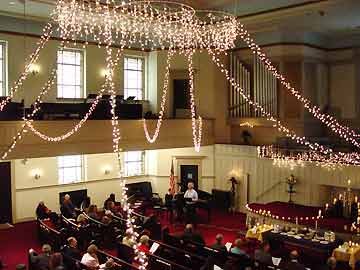
Lights strung from a sanctuary’s ceiling at Epiphany. Art galleries and exhibits. Bicycle repair seminars. Cafes and coffee houses. Worship gatherings in downtown music venues.

In meeting the challenges of revitalized urban neighborhoods across the country, urban churches are rethinking the ways they connect with their adjacent communities, combining an eclectic mix of edgy art and ancient Christian traditions.

Urban churches reach out to the ‘creative class’ with edgy art, ancient traditions.

In meeting the challenges of revitalized urban neighborhoods across the country, urban churches are rethinking the ways they connect with their adjacent communities, combining an eclectic mix of edgy art and ancient Christian traditions.

For some 20 years, America’s cities have seen a reverse migration from the suburbs to increasingly vibrant downtowns, where the new urban dwellers are finding an array of lofts and condominiums, restaurants and clubs, lively street festivals and vibrant art and music. The urban neighborhoods are attracting artists, musicians and others of what sociologist Richard Florida calls the “creative class,” as well as professionals, students and retirees—all seeking the energy and spontaneity often missing in the suburbs.

It’s new territory for many Christian congregations who fled deteriorating downtowns in the 1960s for more fruitful fields of harvest in the burgeoning suburbs—and now see a growing and culturally influential class of creative people populating inner cities.

“I wouldn’t say we’re going after a niche market,” says Winn Collier, pastor of the new All Souls Church, a Virginia Baptist congregation ministering in Charlottesville’s lively downtown not far from the University of Virginia. “We want to be a church for the whole city. But one of the cultures that we have a deep resonance with and in which we want to see the gospel take root is the artistic, progressive urbanite.”

Tabernacle Baptist Church in Richmond is an established church transitioning to meet the New Urban challenges of its very popular in-town neighborhood, the Fan. Lights are strung throughout the sanctuary during Ephiphany.

“These people have an incredible cultural, as well as social and economic, influence,” said Pastor Jonathan Dodson of Austin City Life, a Baptist church in the Texas capital’s downtown. “They can help renew the social fabric of the city, and if they are brought to redemption, they can apply those redemptive elements to the city as well.”

To connect with the new urbanites, churches in their midst reflect a potent blend of artistic integrity, authentic community and groundedness—a sense of place that might surprise suburban dwellers—while also navigating the tricky terrain of increased diversity and toleration.

“The creative class moves around a lot, and so they’re attracted by the idea of being rooted,” said Chris Backert, co-pastor of Imago Dei, a new church gathering people from Richmond’s Fan and Museum districts. “That’s why you find them in older, renovated urban neighborhoods, because they find there a sense of rootedness.”

That rootedness often is expressed in worship that closely follows ancient Christian traditions—with a contemporary twist. “We need to be in touch with the broader church,” said Collier, whose Charlottesville church follows Celtic Christian patterns of worship.

Doves displayed at Pentecost is a response to Tabernacle Baptist Church in Richmond's encouragement of its members to use their artistic sensibilities to highlight the liturgical season.

“We cross geographic lines, and we need to cross historical lines as well. We’re asking less and less what radical new things must be done (in worship), but asking what have God’s people, when they have been faithful, done to incarnate the gospel in worship time and time again. What are the common themes and strands?”

“We are drawn to the traditions of the ancient church and the teachings of St. Benedict and the desert fathers,” said Don Vanderslice, pastor of Mosaic, an Austin church with Texas Baptist ties. “There is a strong contemplative and liturgical strain that informs our worship, and we follow the Christian calendar and the lectionary.”

A sense of community, especially across social and economic barriers, also is key, Dodson added. “I think the idea of the new urbanism, apart from making it a more attractive city to live in, is to create more community within the city. The church has a big part to play in that.”

At Ecclesia, a Baptist congregation in Houston’s Montrose district, Pastor Chris Seay has tried to create community by finding the places where “people naturally connect.” Identifying those places is “the postmodern equivalent of knocking on doors,” he said. It also led Ecclesia to operate Taft Street Coffee.

“When you create space for people to talk and drink coffee, allow a place for people to converse, it creates community,” Seay says. “We really believe that to be salt in our society, we need to begin the conversation.”

That led Seay, when Ecclesia was first gathering a congregation, to “office” at a local coffee house and bar with a regular supply of tickets to Houston Astros games in his pocket—and invite people he met to join him at the stadium.

“Baseball’s slow pace is beautiful. It allows for conversation and eating in a relaxed atmosphere,” he explained.

The result was a number of additions to the church’s faith community, including two bartenders who invited friends from their extensive network.

Community often comes out of churches’ artistic endeavors, said Sterling Severns, pastor of Tabernacle Baptist Church, a 118-year-old congregation in Richmond’s Fan District. Last year before Pentecost, the church printed photographs of its history and of current ministries and church members, cut the photographs into the shapes of doves and asked members to write prayer requests on the back. For Pentecost Sunday, dozens of the doves hung on strings from the sanctuary’s ceiling.

“That creative exercise took a group of people who didn’t really know each other and helped transform them into the community that people are longing for,” said Severns. “By finding a creative way for people to express themselves, it facilitated people getting to know each other.”

An artistic vision drives worship at Austin City Life as well. “We very much reflect our surroundings of music,” says Dodson, whose church meets in a music venue on Austin’s Sixth Street. “We have three worship leaders, all remarkable musicians, all write their own music. We delight in seeing these musicians growing in their faith and seeing how it influences their art, and that way it influences the community.”

At Mosaic, which maintains an art gallery, “We had to make a conscious decision about how to use limited space, which is valuable,” said Vanderslice. “To dedicate space to an art gallery is a strong statement.”

The diversity and tolerance that allows art to flourish also stretches churches seeking to engage those who practice and value that art. “We believe the church doesn’t exist to be anti-culture,” said Dodson. “Some churches begin with sin; we try to begin with the gospel, which of course addresses sin. But it’s a hopeful beginning, not a condemning one. We’re trying to take the redemptive approach, though we don’t run away from issues.”

“The foundation we stand on is respect,” Severns said. “It’s not that we’re opening the doors to encourage diversity but that who- ever walks through the doors deserves respect. It’s not diversity for diversity’s sake; all God’s people deserve respect—period.”

“Diversity is a tough question and stretches us in ways that are messy,” Collier said. “It comes down to authenticity. If we are a community of faith living out a believer’s lifestyle, then a lot of things happen in the context of relationships, and acceptance comes bottom up, not top down.”

Vanderslice agreed authenticity is critical. “In our worship (at Mosaic) we’re not very smooth. … But we’re OK with mistakes, with the fact that it’s not an air of professionalism but of genuine authenticity. There’s a draw there for artists because they know the creative process is not a smooth process. There are lots of mistakes, lots of do-overs. … I think that the liturgy rings true for our people because the liturgy seems creative. It can be messy, but in the end, something beautiful has been created.”


The challenge of the new urbanism

Lights strung from a sanctuary’s ceiling at Epiphany. Art galleries and exhibits. Bicycle repair seminars. Cafes and coffee houses. Worship gatherings in downtown music venues.

In meeting the challenges of revitalized urban neighborhoods across the country, urban churches are rethinking the ways they connect with their adjacent communities, combining an eclectic mix of edgy art and ancient Christian traditions.

Urban churches reach out to the ‘creative class’ with edgy art, ancient traditions.

In meeting the challenges of revitalized urban neighborhoods across the country, urban churches are rethinking the ways they connect with their adjacent communities, combining an eclectic mix of edgy art and ancient Christian traditions.

For some 20 years, America’s cities have seen a reverse migration from the suburbs to increasingly vibrant downtowns, where the new urban dwellers are finding an array of lofts and condominiums, restaurants and clubs, lively street festivals and vibrant art and music. The urban neighborhoods are attracting artists, musicians and others of what sociologist Richard Florida calls the “creative class,” as well as professionals, students and retirees—all seeking the energy and spontaneity often missing in the suburbs.

It’s new territory for many Christian congregations who fled deteriorating downtowns in the 1960s for more fruitful fields of harvest in the burgeoning suburbs—and now see a growing and culturally influential class of creative people populating inner cities.

“I wouldn’t say we’re going after a niche market,” says Winn Collier, pastor of the new All Souls Church, a Virginia Baptist congregation ministering in Charlottesville’s lively downtown not far from the University of Virginia. “We want to be a church for the whole city. But one of the cultures that we have a deep resonance with and in which we want to see the gospel take root is the artistic, progressive urbanite.”

Tabernacle Baptist Church in Richmond is an established church transitioning to meet the New Urban challenges of its very popular in-town neighborhood, the Fan. Lights are strung throughout the sanctuary during Ephiphany.

“These people have an incredible cultural, as well as social and economic, influence,” said Pastor Jonathan Dodson of Austin City Life, a Baptist church in the Texas capital’s downtown. “They can help renew the social fabric of the city, and if they are brought to redemption, they can apply those redemptive elements to the city as well.”

To connect with the new urbanites, churches in their midst reflect a potent blend of artistic integrity, authentic community and groundedness—a sense of place that might surprise suburban dwellers—while also navigating the tricky terrain of increased diversity and toleration.

“The creative class moves around a lot, and so they’re attracted by the idea of being rooted,” said Chris Backert, co-pastor of Imago Dei, a new church gathering people from Richmond’s Fan and Museum districts. “That’s why you find them in older, renovated urban neighborhoods, because they find there a sense of rootedness.”

That rootedness often is expressed in worship that closely follows ancient Christian traditions—with a contemporary twist. “We need to be in touch with the broader church,” said Collier, whose Charlottesville church follows Celtic Christian patterns of worship.

Doves displayed at Pentecost is a response to Tabernacle Baptist Church in Richmond's encouragement of its members to use their artistic sensibilities to highlight the liturgical season.

“We cross geographic lines, and we need to cross historical lines as well. We’re asking less and less what radical new things must be done (in worship), but asking what have God’s people, when they have been faithful, done to incarnate the gospel in worship time and time again. What are the common themes and strands?”

“We are drawn to the traditions of the ancient church and the teachings of St. Benedict and the desert fathers,” said Don Vanderslice, pastor of Mosaic, an Austin church with Texas Baptist ties. “There is a strong contemplative and liturgical strain that informs our worship, and we follow the Christian calendar and the lectionary.”

A sense of community, especially across social and economic barriers, also is key, Dodson added. “I think the idea of the new urbanism, apart from making it a more attractive city to live in, is to create more community within the city. The church has a big part to play in that.”

At Ecclesia, a Baptist congregation in Houston’s Montrose district, Pastor Chris Seay has tried to create community by finding the places where “people naturally connect.” Identifying those places is “the postmodern equivalent of knocking on doors,” he said. It also led Ecclesia to operate Taft Street Coffee.

“When you create space for people to talk and drink coffee, allow a place for people to converse, it creates community,” Seay says. “We really believe that to be salt in our society, we need to begin the conversation.”

That led Seay, when Ecclesia was first gathering a congregation, to “office” at a local coffee house and bar with a regular supply of tickets to Houston Astros games in his pocket—and invite people he met to join him at the stadium.

“Baseball’s slow pace is beautiful. It allows for conversation and eating in a relaxed atmosphere,” he explained.

The result was a number of additions to the church’s faith community, including two bartenders who invited friends from their extensive network.

Community often comes out of churches’ artistic endeavors, said Sterling Severns, pastor of Tabernacle Baptist Church, a 118-year-old congregation in Richmond’s Fan District. Last year before Pentecost, the church printed photographs of its history and of current ministries and church members, cut the photographs into the shapes of doves and asked members to write prayer requests on the back. For Pentecost Sunday, dozens of the doves hung on strings from the sanctuary’s ceiling.

“That creative exercise took a group of people who didn’t really know each other and helped transform them into the community that people are longing for,” said Severns. “By finding a creative way for people to express themselves, it facilitated people getting to know each other.”

An artistic vision drives worship at Austin City Life as well. “We very much reflect our surroundings of music,” says Dodson, whose church meets in a music venue on Austin’s Sixth Street. “We have three worship leaders, all remarkable musicians, all write their own music. We delight in seeing these musicians growing in their faith and seeing how it influences their art, and that way it influences the community.”

At Mosaic, which maintains an art gallery, “We had to make a conscious decision about how to use limited space, which is valuable,” said Vanderslice. “To dedicate space to an art gallery is a strong statement.”

The diversity and tolerance that allows art to flourish also stretches churches seeking to engage those who practice and value that art. “We believe the church doesn’t exist to be anti-culture,” said Dodson. “Some churches begin with sin; we try to begin with the gospel, which of course addresses sin. But it’s a hopeful beginning, not a condemning one. We’re trying to take the redemptive approach, though we don’t run away from issues.”

“The foundation we stand on is respect,” Severns said. “It’s not that we’re opening the doors to encourage diversity but that who- ever walks through the doors deserves respect. It’s not diversity for diversity’s sake; all God’s people deserve respect—period.”

“Diversity is a tough question and stretches us in ways that are messy,” Collier said. “It comes down to authenticity. If we are a community of faith living out a believer’s lifestyle, then a lot of things happen in the context of relationships, and acceptance comes bottom up, not top down.”

Vanderslice agreed authenticity is critical. “In our worship (at Mosaic) we’re not very smooth. … But we’re OK with mistakes, with the fact that it’s not an air of professionalism but of genuine authenticity. There’s a draw there for artists because they know the creative process is not a smooth process. There are lots of mistakes, lots of do-overs. … I think that the liturgy rings true for our people because the liturgy seems creative. It can be messy, but in the end, something beautiful has been created.”