Holiday visit with Kenyan orphans changed students’ perspective on world

Posted: 1/24/07

UMHB students Terah Sellers (left) and Katie Speckman sit with all the boys who live at the Good Hope Children’s Home in Nairobi, Kenya, while visiting for Christmas.

Holiday visit with Kenyan orphans
changed students' perspective on world

By Jennifer Sicking

University of Mary Hardin-Baylor

BELTON—Instead of spending her Christmas with her family, University of Mary Hardin-Baylor senior Katie Speckman opted to spend it with 40 children in Africa.

“It was really hard. It was the first time I’d ever done it,” said Speckman, an elementary education major from New Braunfels, about spending the holiday away from home.

Yet, even with troubles she and her friend encountered on the way, she said it was the right decision to travel to Nairobi, Kenya, in late December.

“It was totally worth it giving 40 kids who never had a Christmas a gift on Christmas morning,” she said.

Speckman first encountered Kenya in 2005 when she and other college students, many from UMHB, traveled there for a mission trip. After leaving, she felt compelled to return and set up another mission trip for summer 2006. At the Good Hope Children’s Home in Nairobi, she did chores while the students attended school. She also helped lead worship and morning devotions.

After returning for her last year at the university, Speckman and her friend Terah Sellars began thinking about taking Christmas to the children at the home.

“They don’t have anything,” said Sellars, a sophomore art major from Kingwood.

With the support of Oakwood Baptist Church in New Braunfels, Speckman’s home church and the place where Sellars interned during the 2006 summer, the girls’ dream became a reality.

“They were awesome about it,” Sellars said. “We told them our idea and everyone jumped on board.”

The youth group held a car wash to raise money. Adults pitched in with gifts.

In the end, the girls packed tennis shoes, toothpaste, toothbrushes, watches, toys and UMHB Welcome Week T-shirts for each of the children. However, getting there and other aspects of the trip, did not go smoothly.

“It was actually a disaster,” Speckman said. “It took four days to get there instead of one. Satan really worked hard to keep us away.”

Sellers’ bags with the shoes, T-shirts and watches finally arrived in Nairobi in mid-January.

“The director will hand them out soon,” Speckman said about the gifts. “Hers were part of the 10,000 bags mixed up in London while we were there.”

Sellers and Speckman are still recovering from ingesting the ecoli bacteria and contracting ringworm while they were there. Yet, the children made the trip worth it, they said.

“The kids were awesome,” Sellers said.

They spent their days playing soccer with them and performing skits. They also took them swimming, a treat for the children who rarely leave the orphanage.

“You go over there to serve these kids. They serve you 10 times more,” Speckman said. “They’re the perfect example of servanthood.”

The children often do their own cooking and cleaning as well as reaching out to others.

“Their stories are heartbreaking,” she said. “Yet they’re so thankful to have a home. You can’t help but want to be there.”

It also made the girls thankful for their homes.

“I’ve heard this all my life: If you go to a third world country, it will change your life, change your perspective,” Speckman said. “It makes you thankful for what you have in your life.”

News of religion, faith, missions, Bible study and Christian ministry among Baptist churches, in Texas, the BGCT, the nation and around the world.


Authorities investigating fires at North Carolina churches

Posted: 1/22/07

Authorities investigating fires
at North Carolina churches

By Hannah Elliott

Associated Baptist Press

GREENVILLE, N.C. (ABP)—Suspicious fires damaged two Baptist churches and a break-in was discovered at a third in Greenville, N.C., the night of Jan. 13.

Memorial Baptist Church and Unity Free Will Baptist, located near each other in the city about 50 miles east of Raleigh, burned in fires that authorities have labeled “suspicious.” Losses are estimated at $ 1 million, according to local reports.

Police are also investigating the break-in at Oakmont Baptist Church, which is located near the other two churches. As of the afternoon of Jan. 16, they had yet to say if they believe the three events are connected. No injuries were reported in connection with the events.

According to Associated Press reports, witnesses saw a person running away from Memorial Baptist right after the fire started. The North Carolina Bureau of Investigation and the federal Bureau of Alcohol, Tobacco, Firearms and Explosives are also helping with the case.

The fire gutted Memorial’s main educational building and its 90-foot steeple suffered heavy damage. The adjacent sanctuary suffered mainly water and smoke damage, according to reports and a photo on the website of the Daily Reflector newspaper.

The fire also destroyed a wing of the facility that housed Memorial’s large child day-care program. Four other Greenville churches have offered their space for the program to use while the building is repaired.

Founded in 1827, Memorial was the first Baptist congregation in Greenville. According to a history on the church’s website, the church relocated in the late 1970s from a historic downtown location to its current campus in the city's eastern section. Memorial is affiliated with the Southern Baptist Convention as well as the Cooperative Baptist Fellowship and the Baptist State Convention of North Carolina. Oakmont is also affiliated with CBF.

Unity Free Will Baptist belongs to the National Association of Free Will Baptists. The fire there was contained to only one room.

Staff members at the burned churches were unavailable for comment for this story.

In February 2006, arsonists destroyed several Baptist churches in central Alabama over a two-week period. Authorities later charged three young men—two of them college students in Birmingham—with the crimes.


Robert Marus contributed to this story.

News of religion, faith, missions, Bible study and Christian ministry among Baptist churches, in Texas, the BGCT, the nation and around the world.


SBC officials accuse Carter of ‘voodoo ecumenism’

Posted: 1/22/07

SBC officials accuse Carter
of ‘voodoo ecumenism’

By Greg Warner

Associated Baptist Press

ATLANTA (ABP)—Southern Baptist officials harshly rejected Jimmy Carter’s effort to unite all Baptists in North America under a compassion agenda, calling the ambitious plan “voodoo ecumenism” and a thinly veiled Democratic strategy to woo values voters.

But other Southern Baptists, including some reform-minded younger conservatives, called the SBC response un-Christ-like and prejudicial criticism from “fundamentalist elites.”

On Jan. 9, leaders of 40 Baptist denominations and organizations in the United States and Canada—led by Carter and “cheered” on by Bill Clinton—announced a commitment to put aside social and theological differences to unite behind an agenda of compassionate ministry. The effort will begin with a Celebration of a New Baptist Covenant, a gathering set for January 2008.

The presence of two former Democratic presidents at the forefront of the ambitious plan triggered allegations that a political motive lurks behind the talk of Baptist unity.

SBC ethics official Richard Land said most Southern Baptists voted against Clinton and Carter, as well as failed presidential candidate Al Gore—all Baptist Democrats.

“I suspect that Mr. Carter and Mr. Clinton are upset about that,” Land, president of the SBC’s Ethics and Religious Liberty Commission, told the Atlanta Journal-Constitution.

Noting most Southern Baptists disagree with Democratic support for abortion rights, Land said the Carter-led Baptist coalition “might be the ‘Pro-choice Baptist Convention.’“

In an editorial in Baptist Press, the SBC’s communications arm, seminary dean Russell Moore called the Carter-Clinton effort “voodoo ecumenism.”

“The unity of which news reports speak is a unity based on social action and ethical engagement,” said Moore, theology dean of Southern Baptist Theological Seminary.

“Even apart from questions of (Clinton’s) personal ethics and about the long-ago debates over alleged high crimes and misdemeanors, what about the official social agenda of the former president? This is, after all, a man who vetoed legislation protecting unborn infants from partial-birth abortion, and then blamed his abortion-rights ideology on what he says he learned from his former pastor at a Little Rock Southern Baptist congregation.”

Southern Baptist blogger Jerry Grace, a Republican layman from Satartia, Miss., was one of many commentators who dismissed the New Baptist Covenant as the political machination of the two former presidents.

“To be consistent, I despise both of these men,” Grace wrote Jan. 11 on sbcouthouse.blogspot.com. “Jimmy Carter may be the most naïve man on the planet. … Bill Clinton is far smarter than that, with every word coming out of his mouth either designed to promote his need for power or to pick up women.”

“None of us need to speculate about its content,” Grace said of the New Baptist Covenant, a statement based on Jesus’ compassion agenda in Luke 4. “It will be a reflection of the Democratic Party platform designed to promote other great religious leaders like Jesse Jackson and Al Sharpton to deliver the black vote to Hillary Clinton, that torchbearer of maternal virtue and humble leadership.”

The Southern Baptist Convention rooted out its moderate leaders in the 1980s and more recently severed ties with the pan-Baptist global network known as the Baptist World Alliance because of allegations of liberal influence. As with the independent and fundamentalist Baptist groups, Southern Baptists are skeptical of any pan-Baptist coalition that would include more progressive members.

So the leaders who joined Carter to launch the New Baptist Covenant, representing an estimated 20 million believers, were resigned to the fact—and somewhat relieved—that the Southern Baptist Convention won’t be making the journey with them.

Those leaders steered clear of criticizing the Southern Baptist Convention while publicly offering an olive branch to individual Southern Baptists or others who want to join the cause. Still, they said, America needs “a broader Baptist witness” that is known more for compassionate ministry than “negative” pronouncements.

Southern Baptist leaders rejected that implied criticism and signaled the 16 million-member SBC, easily the continent’s largest Baptist denominational group, is happy to go it alone.

In the official SBC response, released through Baptist Press Jan. 10, chief executive Morris Chapman and current president Frank Page said the Southern Baptist Convention already is ethnically diverse, is ministering to the needy, and enjoys favorable public opinion.

“Instead of engaging in a war of words, let’s do a reality check,” said Page, pastor of First Baptist Church in Taylors, S.C. “Word games are fine, but reality says Southern Baptists are presenting a positive life-changing message, impacting our culture with our ministries and sharing the Good News of Jesus Christ.”

Added Chapman: “Zogby International conducted a survey for the SBC that showed adults view Southern Baptists favorably, equally to their views about Catholics and United Methodists.”

Chapman said Carter, who left the SBC in 2000 to join the moderate Cooperative Baptist Fellowship, “has been one of the most vocal critics of Southern Baptists, using ‘fundamentalist’ as a pejorative and drawing a caustic comparison between Ayatollah Khomeini’s rise to power in Iran and the resurgence of conservative leadership being elected in the SBC.”

Chapman said the SBC has a good record of addressing social needs, citing the denomination’s $5.8 million donation in 2006 to fight world hunger. “The great difference in our approach from liberals is that in ministering to the body, we do not neglect the needs of the soul…,” he added.

Not all Southern Baptists were ready to dismiss the New Baptist Covenant and the effort to reunite the fractured Baptist family, however.

Wade Burleson, a leader in the network of reform-minded conservatives who elected Page as president, said Chapman’s and Page’s criticisms are uncalled-for.

While not familiar with Covenant and its leaders, Burleson said, “It would be difficult for me to criticize any evangelical Christian movement whose stated goals are to live out the gospel through doing justice and loving mercy.”

“There comes a time when we as Southern Baptists should simply remain silent if we cannot say anything supportive of other Baptist attempts at addressing pressing social and cultural issues in a prophetic manner,” said Burleson, an Oklahoma pastor.

“To provide a public defense of our convention’s record, while at the same time criticizing others, seems to be acting in a manner contrary to the spirit of our Lord and the good of his kingdom at large. I wish nothing but success for all Baptists who seek to live out the gospel for a world in need of a Savior.”

Ben Cole, another leader of the young reformers and a blogger at baptistblog.wordpress.com, also criticized his SBC colleagues.

“I am not surprised to see a response movement beginning to develop to provide balance to the fundamentalist tire-slashers who have managed to arrest the microphone of public witness among Southern Baptists,” Cole said. “Neither am I surprised to read the prejudicial criticisms already being lobbed at Carter and Clinton by some of my fundamentalist brethren.”

“Southern Baptists had better be careful when it comes to criticizing efforts to unite people of faith who seek social justice for the poor and oppressed,” said Cole, a Southern Baptist pastor in Arlington. “The role of the Levite or the priest in Christ’s parable of the Good Samaritan is not one to be preferred. It could be that men whom the Southern Baptist fundamentalist elites regard as undesirable are the very ones who gain heaven’s blessing in their efforts to bind up the wounds of those in our society who have fallen among thieves.”

Cole said he shares the Covenant group’s desire for more Baptist voices to be heard.

“The Southern Baptist Convention has gained a great deal of media attention in the last quarter-century, and our spokesmen have not always reflected with fairness the diversity of Baptist identity on issues of political or social importance,” he said.

David Dockery, a Southern Baptist supporter and president of Union University in Jackson, Tenn., likewise was hesitant to question Carter’s motives.

“I think everyone admires President Carter’s ongoing efforts to promote unity among Baptists,” he said. “I believe it truly reflects his heart. Even when people disagree with Mr. Carter, I think they still admire him as a person of integrity.”

Dockery, who participated in Carter’s previous attempt to reconcile Baptists, said the New Baptist Covenant echoes some of the themes of that 1998 effort. But he predicted few Southern Baptists will join the latest movement.

“To the degree that Baptists can work together in the areas of racial reconciliation, in promoting compassion, and Christian unity, we should do so,” Dockery said. “Those themes, however, it seems to me need to be balanced by a renewed commitment to truth in an age of relativism and religious pluralism, to doctrinal fidelity, and to faithfulness to the Christ-centered message of the gospel.

“Unfortuantely, the harsh words that President Carter has used on occasions about Southern Baptists since 2000 seem to me to make it hard for most Southern Baptists to join in these efforts with him. If this “new covenant” effort is used of God to advance the gospel and to extend the kingdom of God, we should all give thanks to God.”

Organizers of the New Baptist Covenant predicted the movement may achieve unity among Baptists in North America for the first time in a century and a half. With Southern Baptists on the sideline, however, the Covenant may also reveal the clearest division yet between Baptists on the left and right.

News of religion, faith, missions, Bible study and Christian ministry among Baptist churches, in Texas, the BGCT, the nation and around the world.


Planned 2008 convocation grows from desire for ‘new Baptist voice’

Updated: 1/19/07

Former Presidents Jimmy Carter (at podium) and Bill Clinton (behind him) with Mercer University President Bill Underwood (right) introduce a gathering of more than 30 Baptist leaders at The Carter Center. The group is calling for a convocation of Baptists next year. (CBF Photo by Billy Howard)

Planned 2008 convocation grows
from desire for ‘new Baptist voice’

By Robert Marus & Greg Warner

Associated Baptist Press

ATLANTA (ABP)—The nation’s two living Baptist ex-presidents have called for a historic convocation in Atlanta next year, intended to improve the negative image of Baptists in North America and unite the majority of Baptists into a loose-knit network to address social ills.

President Jimmy Carter and President Bill Clinton will announce the 2008 convocation in a Jan. 9 press conference in Atlanta, following a meeting of about 80 diverse Baptist leaders at the Carter Presidential Center.

See Related Articles:
Carter, Clinton use convocation to call Baptists to compassion
• Planned 2008 convocation grows from desire for ‘new Baptist voice’
Texas Baptist leaders applaud call for inclusive convocation’
Baptist leaders insist covenant offers chance to heal racial wounds’

The 2008 convocation is a result of Carter’s initiative to create a new Baptist “voice” to counter what he and others say is a negative and judgmental image of Baptists in North America.

Last April, many of the same Baptist leaders signed the North American Baptist Covenant to counter the often-combative pronouncements of many of the nation’s most prominent Baptist leaders. That meeting included representatives of the Baptist World Alliance, American Baptist Churches, National Baptist Convention USA, Canadian Baptist Ministries, Cooperative Baptist Fellowship and other groups.

The covenant expressed the participants’ “desire to speak and work together to create an authentic and genuine prophetic Baptist voice in these complex times.”

It also reaffirmed their commitment to “traditional Baptist values, including sharing the gospel of Jesus Christ and its implications for public and private morality.”

Organizers expect the convocation, to be held Jan. 30 to Feb. 1, 2008, to draw more than 20,000 Baptist participants from throughout the United States and Canada.

Bill Underwood, president of Baptist-affiliated Mercer University, helped Carter organize the April 2006 summit and the Jan. 9 press conference. He told Baptist leaders he hopes the 2008 convocation will be a way to draw attention away from “the Baptists who have the microphone” currently.

Underwood—former interim president of Baylor University—said the only image most North Americans have of Baptists comes from ultra-conservative leaders who frequently appear on television news shows or other media. They represent some of the most negative rhetoric, most conservative political views and most fundamentalist theology among the broad range of Baptist denominations and congregations.

“They are increasingly defining the Baptist witness in North America,” he said.

“North America desperately needs a true Baptist witness,” Underwood told leaders of the 30-plus Baptist denominational entities, which range from conservative to progressive. “There’s no organization in this room that has a strong enough voice … but the organizations in this room together do have a strong enough voice.”

Baptists need to be known for feeding the hungry, healing the sick and working for justice, Underwood said.

The organizations represented by meeting participants comprise about 20 million Baptists in North America, the event’s organizers noted. That’s more than the 16 million members claimed by the Southern Baptist Convention, the largest Baptist group in the world, whose leaders have moved sharply to the political and theological right in the last 25 years.

While official SBC representatives have not been involved in the Carter initiative so far, organizers say they hope the convocation can include SBC leaders and other conservatives who are open to working with an array of Baptists more ideologically diverse than the denomination’s leadership.

Carter and Clinton, both of whom will speak at the 2008 convocation, have identified with more progressive Baptist groups, but organizers said the convocation will include conservative speakers as well.

In the April meeting, Carter, a former Southern Baptist, said he feels a need to create such a voice because of the schism the SBC experienced in the 1980s.

“The most common opinion about Baptists is we cannot get along. … I have been grieved by the divisions of my own convention,” he said at the time.

Carter has been a longtime member, deacon and Sunday school teacher at Maranatha Baptist Church in his hometown of Plains, Ga. The church recently ordained his wife, Rosalynn, as a deacon—a move many Southern Baptist leaders oppose.

Clinton has recently joined Carter in lending his star power to the pan-Baptist effort. Although he attended Washington’s Foundry United Methodist Church with his Methodist wife, Hillary, during his years in the White House, Clinton is a longtime member of Immanuel Baptist Church in Little Rock, Ark.


Editor Marv Knox contributed to this story.

News of religion, faith, missions, Bible study and Christian ministry among Baptist churches, in Texas, the BGCT, the nation and around the world.


Ad hoc group monitors progress on church-starting changes

Updated: 1/19/07

Ad hoc group monitors progress
on church-starting changes

By John Hall

Texas Baptist Communications

DALLAS—An eight-person group appointed to monitor the timely implementation of investigator-recommended steps to prevent further misuse of Baptist General Convention of Texas church-starting funds met for the first time Jan. 5.

Jim Nelson, chairman of the group, said he was pleased with the five-hour-plus meeting, during which members addressed all related motions approved by the BGCT Executive Board. They included:

• Fully implement the investigative team’s recommendations in a timely manner.

• Revise church-starting guidelines and elevate them to policy status. Policies are mandatory provisions established by the Executive Board that can be modified only by the board, whereas guidelines are developed by staff and can be revised by the chief executive officer.

• Create an internal audit function.

• Direct the executive director—in consultation with legal counsel—to evaluate the advisability of referring the investigative team’s findings to legal authorities.

• Direct the executive director—in consultation with attorneys, the BGCT president and the BGCT Executive Board chairman—to consider all appropriate and practical avenues to recover misappropriated church-starting funds.

In October, BGCT-commissioned investigators found Texas Baptists gave more than $1.3 million in church-starting funds to three pastors in the Rio Grande Valley between 1999 and 2005. The investigators presented evidence that up to 98 percent of those churches no longer exist and some never existed, except on paper.

Fred Roach, a member of the ad hoc group, said people shared their thoughts openly during the meeting.

“I think it went great,” he said. “I think there was a full discussion. Everyone got to express themselves.”

Members of the eight-person group asked questions of Baptist General Convention of Texas staff leaders, including Executive Director Charles Wade, Chief Operating Officer Ron Gunter and Chief Financial Officer David Nabors. The group then discussed the staff’s progress among themselves.

Nelson said the convention’s staff is moving forward with the implementation of all the Executive Board’s directives.

“I was pleased by the attention the staff has given to this thus far, and I was very pleased with the thoroughness of the concern of the group’s members,” he said.

News of religion, faith, missions, Bible study and Christian ministry among Baptist churches, in Texas, the BGCT, the nation and around the world.


Faith leaders tell Congress: Deliver on promises made to values voters

Updated: 1/19/07

Faith leaders tell Congress: Deliver
on promises made to values voters

By Hannah Elliott

Associated Baptist Press

WASHINGTON (ABP)—Faith leaders are calling for members of Congress to deliver on promises made to values voters during the 2006 mid-term elections.

In a Jan. 9 panel discussion, representatives from Sojourners/Call to Renewal, the National Hispanic Christian Leadership Conference, Let Justice Roll, Christian Peace Witness for Iraq, the National Association of Evangelicals and the National Religious Campaign Against Torture asked Congress to “deliver concrete gains on issues of deep concern to religious voters.”

Jeff Carr of Sojourners/Call to Renewal said a “cross-fertilization” of religious groups has led to a newfound range of voter diversity on the religious front. And those voters want newly elected leaders to put their money where their mouth is.

“One of the things we learned in this last election is that if you look at some of the polls … Americans said poverty and economic justice (are) the most urgent moral crises in American culture,” he said. “It’s clear that many folks—governors on both sides of the aisle—are committed in states to overcoming poverty.”

Indeed, 62 percent of voters between the ages of 18 and 29 said the most important crises in America are economic justice, poverty and greed, according to a poll commissioned by Faith in Public Life and Catholics in Alliance for the Common Good.

To that end, successful candidates during the 2006 campaign spoke early and often about personal faith. Not surprisingly, Democrats gained popularity among previously Republican-leaning faith voters.

As the religious debate expands within partisan politics, people of faith must address the nation’s “unconscionable” minimum wage, said Paul Sherry, national coordinator of the Let Justice Roll Living Wage Campaign. He called the minimum wage “the foremost values issue” of the last election.

Raising the minimum wage to a “livable wage” has enormous public support within the faith community and beyond, he said, adding that it is both a moral issue and an economic issue.

“A job should keep you out of poverty, not keep you in it,” Sherry said.

Let Justice Roll played a major role in state minimum wage increases in Ohio, Arizona, Colorado, Missouri and Montana in 2006. The current federal minimum wage is $5.15 per hour. The group has proposed an increase to $7.25 per hour.

In addition to discussing the minimum wage, panelists urged Congress to address immigration reform. Sam Rodriguez, president of the National Hispanic Christian Leadership Conference, said Hispanic Evangelicals should demand comprehensive immigration reform legislation.

Immigration reform had a significant role in the 2006 elections, but not in the way many experts predicted, he said. In fact, Republican candidates lost many Hispanic votes because they had no plan for comprehensive reform.

“We are seeing our country torn apart again as many on the fringe elements of this issue are attempting to polarize and divide our nation,” Rodriquez said. “We need to pass comprehensive immigration reform that will stop illegal immigration, protect our boarders, (and) provide an earned pathway to citizenship for those who are already here. … Then we can secure our boarders, secure all of our families, and secure the American dream.”

Like poverty and immigration, voters of faith also have a moral obligation to address creation care, said Paul de Vries, president of New York Divinity School and a board member of the National Association of Evangelicals.

“We are very eager to see Congress act on a number of things, including raising standards of fuel efficiency, pollution reduction, sustainable use of natural resource and proper care of wildlife and their natural habitat,” de Vries said. He said many companies receive financial benefits from “bankable ecology,” or using business resources in ways that emphasize efficiency, recycling of used materials, and reduced waste products.

“We’re passionate about creation care,” he said. “Ecology has to be a priority. We’re people lovers, but we can be tree lovers at the same time. We’re people huggers and tree huggers.”

While the panel discussion focused on prompting work done in Congress, those leaders weren’t the only ones called upon. Speakers also appealed to President Bush as they put emphasis on “kitchen table” issues.

“Along with poverty, historically war and peace issues have been at the center of our agenda,” Carr said. “What we’re not looking for from the president is more of the same. We’d really like to see the president take a more thoughtful approach to … de-escalate this war, not escalate it. I fear that that’s not what we’re going to see.”

Rick Ufford Chase of Christian Peace Witness for Iraq agreed. His group is planning a worship service in March at the National Cathedral and an all-night prayer vigil at the White House asking for a “clear plan” to remove troops from Iraq.

“We’re really concerned at this point that there is a clear moral imperative to end the war. That was clearly backed up by a political imperative” which is now being ignored, he said. “We are clear that what we are looking for is a clear plan to end the war in Iraq. … The only way to create true security is to build those solid, right relationships that cross boundaries.”

Turning from war and torture in favor of “right relationships” will foster justice both abroad and in the United States, he said.

News of religion, faith, missions, Bible study and Christian ministry among Baptist churches, in Texas, the BGCT, the nation and around the world.


BGCT president’s wife donates building to Lubbock ministry

Updated: 1/19/07

BGCT president’s wife donates
building to Lubbock ministry

By John Hall

Texas Baptist Communications

LEVELLAND—Donna Vernon is donating a Texas Baptist Men-constructed building she won in a drawing at the Baptist General Convention of Texas annual meeting to My Father’s House, Lubbock.

TBM volunteers had constructed the building on-site at the BGCT annual meeting as an exhibition of the organization’s church-building ministry.

Vernon, whose husband, Steve, is the BGCT president and pastor of First Baptist Church in Levelland, said she decided to donate the building after realizing she could not find a place on her church’s land to showcase it properly.

TBM volunteers constructed this building on-site at the BGCT annual meeting. Now it's headed for My Father's House ministry in Lubbock.

“I just thought it would be better utilized over there,” she said. “It would have better visibility. It would be used every day.”

The building will be turned into a prayer chapel for My Father’s House, Lubbock, a residential ministry that teaches parenting and vocational skills to unemployed or underemployed women. One aspect of the program is Christian Women’s Job Corps, a ministry of Woman’s Missionary Union supported in part by the Mary Hill Davis Offering for Texas Missions.

Since the building had to be disassembled for transport, Texas Baptist Men volunteers will reassemble it Jan. 29 and finish out its interior.

Vernon hopes the building serves as a sanctuary for the women at My Father’s House, Lubbock. There they will be able to focus on their spiritual health.

“I’d really hope it would be meaningful to the women who live at My Father’s House and help them develop spiritually,” she said.

Shirley Madden, executive director of My Father’s House, Lubbock, said the building will be a welcome addition to the ministry’s campus.

“We are a ministry that was birthed and grew and succeeds because of prayer,” she said. “Adding a prayer chapel outside continues to announce to the world who we are.”

News of religion, faith, missions, Bible study and Christian ministry among Baptist churches, in Texas, the BGCT, the nation and around the world.


Students learn to own their faith during college years

Updated: 1/19/07

Students grow up, learn to make
faith their own during college years

By Teresa Young

Wayland Baptist University

PLAINVIEW—A teenager might have been the leader of the pack at the church youth group during high school. Or maybe she was the quiet, loyal one who showed up every Sunday and every fellowship. Or maybe he wasn’t very interested at all in church things.

Regardless how involved in church teens were before high school graduation, things are certain to change somewhat when they reach college, whether they’re living in the same town or miles away. But Gary Manning, professor of religion at Wayland Baptist University, insists parents have no reason to panic.

Campus religious events, such as the weekly Plumbline worship service held at Wayland Baptist University, are intended to help students explore their faith and grow spiritually while in college.
Related Articles:
• Students learn to own their faith during college years
Young adults will leave church if they’re overlooked, study says

“Anytime children leave our presence, there is fear—terror for some,” said Manning, who specializes in youth ministry issues. “Parents sometimes think they can buffer their children, and nothing will happen to them. But that’s just not true.”

Instead, parents need to realize they have enormous influence on their children before they leave home and use that influence to educate them about dangerous behaviors and the consequences, he said. Modeling commitment to church involvement and spiritual growth is the key to keeping them on that road when they leave home for college, he added.

“Children need to own their faith and their response to God,” Manning said. “Part of the growing-up process is making their faith their own, and it may be very different from what they grew up with.

“A good approach to letting children go is to have open, honest discussions about what is out there and ensure them that no matter what they do, they are always loved and welcomed home. But you need to say outright that you don’t want them to do those things and give them encouragement for getting out of a bad situation. And if they do get in trouble, it’s not valuable for parents to try to spare them from the consequences of their actions. They’ll never learn if they don’t let them experience those and your love and God’s love.”

Research from the National Study of Youth and Religion found that after that time of searching and asking and introspection, students’ religious commitment generally will mimic their parents’ commitment, Manning noted. That’s good news for some parents and bad news for others, he said.

Still, when students leave for college and don’t immediately join a local church—or quit going altogether—parents understandably may worry.

Manning advises parents of college students to be honest in conversations, realizing their major influence on the students has waned significantly, and avoid preaching or bugging them about the situation.

He offers these tips:

Realize students are adults and must be talked to like adults. Instead of nagging them or telling what they must do, Manning encourages asking simple questions about how local church services have been and whether you can pray about anything specific for them. Praying with them before tests and in stressful times—even over the phone—can go a long way toward modeling the importance of prayer and the spiritual perspective, he said.

Know that each student’s experience is different and some go through the soul-searching process earlier in their college career, some later and some even after they graduate from college. The key is being intuitive, listening with an open mind and not, as Manning said, “pushing the panic button.”

Talk about your own spiritual journey to your student. Rather than barraging students with questions about why they haven’t been to church or what they are doing instead, having honest conversations about your own spiritual experiences and what is going on at the home church can model the importance of that lifestyle, Manning said. It also may prompt honest talk about the spiritual struggles they may be facing if they know you as the parent still face challenges and struggles of your own. The point is that you talk about it.

Realize that just because your student may have chosen a Christian institution, they are not shielded from struggle. This time in their life is typically a soul-searching time in many aspects of life, not just about religion and faith, and that likely would happen at any institution. The benefit at a Christian school is that students are more likely to find faculty and staff concerned about their spiritual growth and will encourage them in the process, he noted.

News of religion, faith, missions, Bible study and Christian ministry among Baptist churches, in Texas, the BGCT, the nation and around the world.


Young adults will leave church if they’re overlooked, study says

Updated: 1/19/07

Young adults will leave church
if they’re overlooked, study says

By Libby Lovelace

LifeWay Christian Resources

NASHVILLE, Tenn. (BP)—More young adults are falling away from church and finding church irrelevant to their lives because their needs are not being met, new statistics released by LifeWay Christian Resources revealed.

In 1980, more than 100,000 people age 18 to 34 were baptized in Southern Baptist churches. But in 2005, that number fell to 60,000—a drastic drop considering the United States population has climbed above 300 million.

Research Project Results:
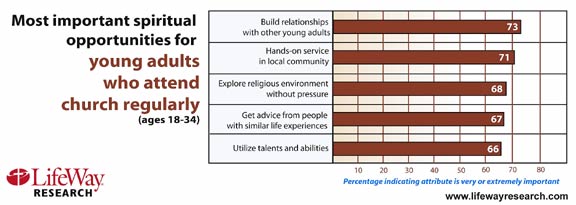
Most important spiritual opportunities for young adults who attend church regularly

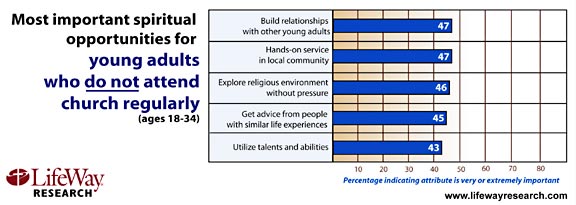
Most important spiritual opportunities for young adults who do not attend church regularly

Related Articles:
Students learn to own their faith during college years
• Young adults will leave church if they’re overlooked, study says

What’s the problem? Why are young adults not finding church relevant for their lives? LifeWay Research sought to find answers by conducting an eight-month research project that included interviews with unchurched adults, regular church attenders and church leaders from geographical regions throughout the United States.

Churchgoers or not, the study results indicate young adults are longing for community and fellowship with peers, looking for ways to reach people in need and circling the church but not always finding a home in it.

Seventy-three percent of church members and 47 percent of nonaffiliated young adults indicated community with other young adults is extremely important in their lives.

The lack of opportunity for connection within the church proves to be a frustration point for young adults. One study participant said, “After graduation, they give you a pat on the back and say, ‘When you start a family, we’ll be here for you.’”

Another respondent said: “Young adults are in the middle—not married, not old enough, not in high school. (We’re) in this ‘ugh’ stage.”

The second-most -mportant thing for young adult churchgoers is participation in small-group meetings to discuss life application of Scripture, according to 71 percent of the respondents. Both churchgoers and those not affiliated said they want to participate in Bible study that minimizes finding pat answers in the exploration of Scripture.

One study respondent indicated it’s not always about one person with all the answers because there is value in the combined knowledge and experiences of others. Another study participant put the importance of small-group meetings this way: “What draws people is a climate of honesty. We don’t come and say we’re going to hide from each other … and give Sunday school answers.”

The small-group atmosphere also is where this generation can find “advice from individuals with similar experiences,” the respondent said, which is one of the top five most important things to both churched and unchurched young adults, with 68 percent and 45 percent, respectively, saying it’s very important.

Some young adults are finding such advice through connection with adults in their 50s, 60s and 70s.

Another high-ranking priority of today’s young adult population is the opportunity to meet the needs of others through social action on a regular basis. Sixty-six percent of churchgoers rated this as extremely important in their lives, and 47 percent of non-churchgoers said the same.

The study indicates social action is a big entryway to the church for young adults. In fact, social action is cited as the major reason unchurched young adults would consider being part of a church.

News of religion, faith, missions, Bible study and Christian ministry among Baptist churches, in Texas, the BGCT, the nation and around the world.


Texas Baptist leaders applaud call for inclusive convocation

Updated: 1/19/07

Texas Baptist leaders applaud
call for inclusive convocation

By Barbara Bedrick

Texas Baptist Communications

ATLANTA—Texas Baptist leaders affirmed former President Jimmy Carter’s call for an inclusive convocation of North American Baptists next year.

Baptist General Convention of Texas Executive Director Charles Wade joined Carter and more than 80 leaders of about 40 Baptist groups in announcing plans for convocation, tentatively slated for Jan. 30-Feb.1, 2008, in Atlanta.

See Related Articles:
Carter, Clinton use convocation to call Baptists to compassion
Planned 2008 convocation grows from desire for ‘new Baptist voice’
• Texas Baptist leaders applaud call for inclusive convocation’
Baptist leaders insist covenant offers chance to heal racial wounds’

Some BGCT leaders joined representatives from the Baptist World Alliance, American Baptist Churches, National Baptist Convention USA, Canadian Baptist Ministries, Cooperative Baptist Fellowship and other groups last April in signing the North American Baptist Covenant, a document that reaffirms traditional Baptist values and calls for cooperation.

“There was a time when Baptists in America worked together across the nation,” Wade said. “That unity was lost in the middle 19th century. It was a thrilling experience to see Baptists of every race and ethnicity in North America working together and affirming a Baptist covenant to speak biblically and prophetically to our cultures. This is a call for Baptists to address the needs of the world.”

BGCT President Steve Vernon also voiced his support for the new Baptist alliance, which unifies Baptists across racial, geographical and theological lines into a network to address social ills and share the gospel.

“It excites me. I see it as a positive thing that will help the cause of Baptists and of Christ across the nation,” Vernon said. “I think what has happened is that across the nation the voice of Baptists has been perceived as the Southern Baptist Convention. The new national alliance will broaden the voice of Baptists and be more inclusive of all strains of Baptists. This alliance is more reflective of who Baptists are.”

News of religion, faith, missions, Bible study and Christian ministry among Baptist churches, in Texas, the BGCT, the nation and around the world.


Baptist leaders insist covenant offers chance to heal racial wounds

Updated: 1/19/07

Baptist leaders insist covenant
offers chance to heal racial wounds

By Greg Warner

Associated Baptist Press

ATLANTA (ABP)—Advocates of the New Baptist Covenant championed by former presidents Jimmy Carter and Bill Clinton predicted it will help heal the racial divide that has separated Baptists in America since before the Civil War.

William Shaw, president of the National Baptist Convention USA, said a New Baptist Covenant championed by former President Jimmy Carter holds the potential for Baptists across racial lines to address issues in “nonpartisan … (but) prophetic ways.” (RNS file photo by Aimee Jeansonne)

Speaking on behalf of 40 Baptist denominations and organizations in the United States and Canada Jan. 9, Carter and Clinton—two of the world’s most famous Baptist laymen—announced the groups had committed to put aside more than a century and a half of social and theological differences to unite behind an agenda of compassionate ministry.

See Related Articles:
Carter, Clinton use convocation to call Baptists to compassion
Planned 2008 convocation grows from desire for ‘new Baptist voice’
Texas Baptist leaders applaud call for inclusive convocation’
• Baptist leaders insist covenant offers chance to heal racial wounds’

The effort will begin with a Celebration of a New Baptist Covenant, a gathering set for late January 2008, which Carter called “one of the most historic events at least in the history of Baptists in this country, maybe Christianity.”

Baptist harmony was broken, at least in the United States, in the mid-1800s. That’s when divisions between Baptists in the North and South overwhelmed the missionary spirit that previously brought them together.

“Probably not since 1845 has this kind of effort been made to bring together Baptists black and white … and of diverse theological and regional backgrounds,” said Bill Leonard, a Baptist historian and dean of the Wake Forest Divinity School. “And that means it is terribly historic.”

Most Baptists in the United States came together in 1814 to form a missionary society known as the Triennial Convention. Southern Baptists broke away over the slavery issue in 1845. Since then, Baptists have splintered even further.

“For the healing of the nation and the healing of the world, we as Baptists have to experience our own healing,” said Daniel Vestal, national coordinator of the Cooperative Baptist Fellowship. “And I think this represents a step, an effort, a commitment to bring healing between us, renewal between us—black and white Baptists, North and South Baptists, and, frankly, conservative and moderate Baptists. There is great power in that healing.”

In recent years, the four largest of the predominantly African-American Baptist conventions began meeting jointly. They plan to do so again in 2008 in Atlanta, then join with Baptists of many stripes a few days later for the Celebration of a New Baptist Covenant.

“We could not do this in this way without the kind of commitment that the African-American Baptist groups have brought to the table,” said Leonard, one of the participants in the Carter Center planning meeting. “That’s what makes this historic.”

“There is a cry for healing,” said Roy Medley, general secretary of the American Baptist Churches USA. The vision of Baptists coming together could encourage American Baptists soured by their denomination’s fragmentation over homosexuality, Medley said.

“For a lot of our young people, they are very disenchanted at the church breaking apart and splintering,” he said. “This is a chance for us to reach out to them and say this ideal of love that Christ has given us is something that we really want to be operative in the life of the church as well. And that can help us bridge differences that are genuine differences.”

No one expects the convocation to produce a merger of the myriad Baptist groups in North America. But the prospect of collaboration around evangelism and social causes—as described by Jesus in Luke 4: 18-19—left many Baptists assembled in Atlanta Jan. 9 euphoric.

“This is an exciting time for us to be Baptist,” said David Goatley, current president of the North American Baptist Fellowship—a regional affiliate of the Baptist World Alliance. Goatley is also executive secretary of the Lott Carey Baptist Foreign Mission Society, a historic African-American Baptist ministry. “We stand at the threshold of something unprecedented.”

“What you are seeing here today at the Carter Center is a historic demonstration of Baptist unity,” said Mercer University President Bill Underwood who, with Carter, spearheaded the initiative. “Baptists made an important decision here today, a decision to focus on issues that bind us together as followers of Christ rather than dwell on the differences that surely exist among us.”

Clinton told reporters that those who “did not have both the privilege and the burden to be raised in the Baptist church cannot possibly appreciate” how unique such cooperation is. “This is an attempt to bring people together and say, “What would our Christian witness require of us in the 21st century?’” he said.

“We will be addressing issues in nonpartisan ways but in prophetic ways,” said William Shaw, president of the National Baptist Convention USA, one of the largest African-American denominations.

“We are looking for ways to put feet to our faith,” said Dewitt Smith, president of the Progressive National Baptist Convention, the African-American body founded by Martin Luther King and others.

“It is possible to be together and to differ on our opinions. When it comes to the things that will help humanity, we must take a prophetic stance—we must take a strong social-action agenda and make it work. I believe what is happening here today is an indication that this will work.”

“I was just glad to see Baptists do something together in a unified way and especially to set a positive image for who Baptists are,” said Emmanuel McCall, an African-American pastor from Atlanta and BWA officer who currently serves as moderator of the mostly white Cooperative Baptist Fellowship.

Daniel Vestal, national coordinator of the CBF, said the Carter initiative fills a need for “a broader Baptist witness that is committed to social justice as well as evangelism.”

The 2008 convocation will connect participants with ministries and resources on such topics as prophetic preaching, ecology, sexual trafficking, racism, religious liberty, poverty, HIV/AIDS, religious diversity, public policy, youth issues, evangelism with integrity, stewardship and the spiritual disciplines.

Leonard, the historian, said such collaboration for ministry “mirrors those (19th century) societies that the Baptists founded, where they chose to work not so much on the basis of how much they agreed but on what they wanted to do.”

While the Baptists who came together in Atlanta Jan. 9 were thrilled to have the support of two former presidents—both Democrats—they also recognized their movement will be limited if only moderate and progressive Baptists, and only Democrats, get on board.

Mercer’s Underwood told reporters at the Atlanta announcement that Carter and Clinton “are not here in their capacity as political leaders, they are not here in their capacity as Democrats. They are here today in their capacity as Baptists. We anticipate that there will be many other Baptists participating in this endeavor who also happen to be public officials that happen to be Republican.”

McCall agreed: “I think it’s very important so that it doesn’t come off as a political thing. It would be easy to interpret, with the two Democratic presidents, that it was a political thing. I think it’s important to find other Republican Baptists and bring them into it.”

“If this is seen as a Democratic agenda, that won’t benefit any of us,” said ABC’s Medley. “And if it doesn’t do the pan-Baptist thing, then it will have failed. I hope we do have conservative folk there, as well as progressive and moderate folk. Regardless of where we may be in political parties and things like that, these are things that we’re committed to as the body of Christ, and that agenda is larger than a political agenda.”


News of religion, faith, missions, Bible study and Christian ministry among Baptist churches, in Texas, the BGCT, the nation and around the world.


Reyes sees move to Buckner as natural progression

Updated: 1/19/07

Reyes sees move to Buckner as natural progression

By Marv Knox

Editor

Although Albert Reyes’ recent career change caught many Texas Baptists by surprise, he sees it as the next step in God’s plan for his life: An opportunity to minister to millions of orphans whose lives may make an impact on the world.

Nearly eight years ago, Reyes became president of Baptist University of the Americas, a multi-cultural training school for ministers in San Antonio. Under his leadership, BUA multiplied its enrollment, gained certification to grant academic degrees, earned national accreditation and launched a campaign to construct a new campus.

Albert Reyes

Reyes, 48, soon became one of Texas Baptists’ most visible leaders. He served as the first Hispanic president of the Baptist General Convention of Texas. Then he landed on almost anyone’s short list of candidates to succeed Charles Wade as BGCT executive director when Wade retires.

So, many people expressed shock when Reyes decided to join Buckner International as president of Buckner Children & Family Services Jan. 1.

“I saw that this would be a natural progression of what I have been doing—doing something with the life I have left and giving aid to the poorest of the poor,” he reflected.

Actually, Reyes’ new job clearly complements his life mission statement: “To develop kingdom leaders from my circle of influence to the ends of the earth.”

See Related Articles:
Hall: Still a lot for me to do at Buckner
• Reyes sees move to Buckner as natural progression

When he was a young church planter in El Paso, Reyes sought to fulfill that mission by leading people to faith in Christ, discipling them and training them to lead others.

At the time, he thought he would retire there, in Texas’ fourth-largest city and a vast Hispanic mission field. “I said, ‘We can do this for the rest of our lives,’” he recalled.

But the presidential search committee from Hispanic Baptist Theological Seminary, as BUA then was called, challenged that notion. Reyes eventually concluded he could fulfill his mission more rapidly by heading the school for Christian leaders. Rather than starting with non-Christians, he would be working with Christians who already knew God wanted them to be ministers.

Reyes hit the ground running in San Antonio. He guided the school through a name change, accreditation, faculty and student expansion, and the first steps of a move to a new, larger campus.

“I was prepared to do whatever I could to ensure our Hispanic community had the opportunity every Baptist has in Texas,” he said. “We had provided non-accredited, non-degreed education (to Hispanics) for 60 years. Why not provide accredited theological education at the undergraduate level focused on cross-cultural Christian leadership? Our students’ challenge never has been intelligence, but opportunity. I went fast because we needed to catch up. We need wave after wave of leaders to come forward.”

Once again, Reyes thought he was set for life. Once again, he thought again.

The process began during his term as BGCT president, when he preached to the convention’s Executive Board about a “Jesus agenda”—ministry to the poor, the children, the widows, the world’s disenfranchised.

But during a BUA chapel service, Reyes acknowledged to himself, “I don’t know if I even know any poor people.” He concluded his ministry at BUA provided new bridges for under-served young people with dreams for higher education and leadership … for those who were economically challenged. 

“For most of my ministry, I had been focusing on the seeds of the gospel—on faith—but not on the deeds of the gospel,” he conceded. “But when I learned of the Buckner opportunity, I felt this was doing Jesus’ mission full-throttle, personally impacting the poorest of the poor, children who don’t even have parents.”

That meant turning loose of his leadership at BUA—leadership many of the school’s supporters have felt is vital to its academic and financial success. But Reyes believes this is his time to go.

“God is the one who makes things grow,” Reyes said of the school’s recent transformation and potential for training cross-cultural leadership. He sees his own gifts as being a “catalytic person” who lays the foundation for change. “I’m in my best zone when I’m reformatting, re-engineering, reorganizing a ministry.”

That process has been completed at BUA, he added. “We don’t need a new vision. We pretty well have a pattern set. I feel like I’m finished; I’m done. It’s time to get out of the way” and allow someone with other gifts to fulfill the vision.

Some of Reyes’ friends and admirers have questioned his sense of timing, wondering why he wouldn’t stay at BUA a bit longer, opening the possibility that he could become the BGCT executive director, staff leader of the state convention.

“I’m extremely flattered,” Reyes said of that idea. “Maybe I’m just a bit naïve, but I respond to the opportunities that are there and to the sense of God leading me at the time. I’m not being asked to lead the BGCT; I’m being asked to lead Buckner.”

“The BGCT has tremendous potential,” he noted. “We are going through a transition, a change of identity as a denomination at this critical time in missions history. The future will require a leader who can present a compelling vision of how we can thrive in a postmodern, postdenominational, post-Christian world.”

At this juncture, Reyes interprets his new Buckner responsibility as an opportunity to fulfill his life mission statement all the way “to the ends of the earth.”

He will serve alongside Ken Hall, president of Buckner International, the parent organization that includes Buckner Foundation, the fund-raising component; Buckner Retirement Services, a ministry to senior adults and their families; and Buckner Children & Family Services, which includes a range of ministries to children and their families, including adoption, foster care, emergency and relief care, support for overseas orphanages, and ministry to at-risk children and their families.

“My unique assignment will be to transform Buckner from a Texas-based, Baptist-related institution with national and international ministries, to be a nationally based ministry to children and families with a global reach,” Reyes said.

“Right now, Buckner ministers in cities across the United States and in many cities around the world. The difference will be that we will broaden our base of support and participation across the nation. We will mobilize Christians, churches, colleges and universities, and raise up Christians to say, ‘Let’s bless the nations.’”

Quoting missions researcher Phillip Jenkins, Reyes stressed: “The Third World doesn’t need the gospel. They have the gospel. They need the incarnational gospel. They need our resources, so the presence of Christ can impact their societies.”

Reyes’ eyes light up when he talks about the presence of Christ impacting global societies.

“Think about the leadership potential of 143 million orphans in the world,” he commanded. Buckner doesn’t touch them all, but it touches many.

“We take care of their needs. They are fed, given shoes and, to the best of our ability, provided clothes and foster families,” he said. “I want to push the envelope a bit more and say: ‘What if we were to focus on the leadership potential of those children in those countries? What about their educational opportunities, with nine (Baptist) universities in Texas and others across the country?’ What if we were to say, ‘We will do something about the educational threshhold of these children?’”

The answer to those questions lies in understanding God’s will for American Christians in a hurting world, Reyes observed. “How long is the God of redemptive history and justice going to allow us to have everything? Buckner can be a galvanizing tool to demonstrate what we can do with educational systems, economic strategies and congregational connections so we can fulfill our responsibility to those children.”

Similarly, Buckner’s responsibility is to help children live with families, he added, noting any design to build orphanages for all the world’s orphans is not a good business plan.

“Can we provide (foster and adopted) families for those children?” he asked. The best plan is to develop an economic strategy that will enable families in orphan children’s communities and regions to care for them, he explained.

In addition to education, economics and healthy families, Buckner must help provide churches that will enable all those children to experience the love of Christ, Reyes said.

“We need outposts for the kingdom of God,” he insisted. “Once you do the other (provide education, economic investment, care and families for the children), you’re not going to have any trouble starting churches.”

The key to fulifilling that global vision is working with churches, Reyes reported.

“What is happening in missions today is churches everywhere have said, ‘We have a local identity and a global identity, and we’re going to get on with it,’” he said. “Churches are already taking the lead on mission.”

So, the challenge for missions agencies such as Buckner is to catch up with the churches and enhance their ministries, he added. “It’s not just coming alongside the congregation, but tapping the potential of the members. Most churches only recognize the local half of their identity. The other half is global. Many laypeople already have global resources and connections. How can we connect those resources to what we’re doing?”

Collaboration with churches will produce an effective and efficient—and redemptive—model for bringing the presence of Christ into direct contact with the world’s poorest and most needy people, he predicted.

When Reyes thinks about how much God has blessed Texas Baptists and other U.S. Christians, he recalls Psalm 67. That Scripture says God is gracious to and blesses God’s people so God’s ways will be known on all the earth and so the nations may be glad.

“There is a reason we have what we have: So we can be a blessing to others,” he said. “The nations will be glad when God’s people bless them. We’ve been blessed; we’ve been forgiven; we’ve been given God’s favor. Why? So God’s ways will be known. And if God’s ways are known, then the nations will be glad. …

“Buckner is uniquely positioned to do what Psalm 67 says. And anybody who wants to join is welcome. We’re ready. We’re trying to catch up with what God’s doing.”

And for Reyes, that activity expands Buckner’s ministry all the way “to the ends of the earth.”

News of religion, faith, missions, Bible study and Christian ministry among Baptist churches, in Texas, the BGCT, the nation and around the world.