Accrediting agencies asked to probe seminary’s dismissal of female prof

Updated: 2/02/07

Accrediting agencies asked to probe
seminary’s dismissal of female prof

By Hannah Elliott

Associated Baptist Press

FORT WORTH (ABP)—A supporter of a professor who lost her job at Southwestern Baptist Theological Seminary—allegedly due to gender discrimination— has filed complaints with the Southern Association of Colleges and Schools and Association of Theological Schools, asking them to investigate “a serious breach” of accreditation guidelines.

Sheri Klouda pictured at Southwestern Seminary's convocation August 29, 2002, affirming her adherence to the 2000 Baptist Faith and Message. (The photo appeared on Wade Burleson's blog).

Benjamin Cole, pastor of Parkview Baptist Church in Arlington, filed the complaints. He joined Oklahoma pastor Wade Burleson and prominent blogger Marty Duren in calling attention to Sheri Klouda’s case. Burleson is the pastor of Emmanuel Baptist Church in Enid, Okla. Duren leads New Bethany Baptist Church in Buford, Ga.

Cole’s letter of complaint outlined a timeline of events leading to Klouda’s dismissal, beginning with an April 2002 seminary trustee meeting in which trustees approved her as a tenure-track professor to teach biblical languages in the theology school.

In 2003, Paige Patterson, who recently had been hired as the school’s president, personally assured her the change of administration would not jeopardize her position teaching Hebrew, Klouda said.

Since that time, however, the seminary has toughened its interpretation of the Southern Baptist Convention’s 2000 Baptist Faith & Message doctrinal statement, which says that “while both men and women are gifted for service in the church, the office of pastor is limited to men….”

Patterson and Southwestern now interpret that to mean only men can instruct future pastors, a seminary official explained.

After learning in 2004 she would not get tenure at the school, Klouda’s contract was terminated in December of 2006. She since has received a teaching position at Taylor University in Upland, Ind.

“I was told this (dismissal) was a non-issue, and I couldn’t say anything about it, and if I did say something about it, it would cause problems for my job,” Klouda said. “Then it was, ‘Well, take all the time you need' to find other employment to ‘Well, we’re going to terminate your contract on such-and-such a date.’ It was disappointing to find out that the rules keep changing.”

Van McClain, chair of the school’s board of trustees, has refuted the claims of dismissal, explaining in a letter posted on Duren’s blog “she did not have tenure and, like hundreds of professors around the U.S. every year, was told that she would not be awarded tenure.”

Other school representatives did not return requests for comment.

Cole decided to take up the Klouda case because he thinks a “gross injustice” has been done to Klouda due to the “lax oversight of seminary trustees and the violations of seminary procedures and policies by the school’s administration.”

“Southern Baptists must hold to the highest standards of academic integrity if we are to retain our position as leaders in theological education and ministry training,” he said in an e-mail. “Actions taken by the president at Southwestern Baptist Theological Seminary have continued to jeopardize the seminary’s good reputation, and it does not appear that the trustees are willing to address the matter.”

Cole sent formal letters of complaint to the seminary’s two accrediting agencies Jan. 24 and 25.

As support for the complaints, Cole’s letters noted that the pronouns used in the seminary’s policy manual reflect “the gender diversity of faculty status and the equity of tenure review for both male and female professors at Southwestern Baptist Theological Seminary.”

The manual also “makes no gender distinction between the various schools of music, evangelism, theology and educational ministries relevant to the selection of tenure-track faculty,” he added.

“Quite frankly, Southwestern trustees appear to regard the interests of the school’s president over the interests of the school’s reputation. I regret that an accreditation review could jeopardize the degrees of all Southwestern students, but it is the administration’s actions rather than my exposing those actions that has brought the school to potential academic shame.”

ATS officials were not available to say if Cole’s complaint would trigger an investigation by the agency. Earlier, a spokeswoman said ATS would respond if a complaint was filed by Klouda, another faculty member, a staff member or student. Cole, who previously worked for Patterson, said he is a part-time student at the seminary.

Nancy Merrill of ATS said, if a complaint was filed, the agency would allow the seminary to respond before determining if ATS’ membership criteria or accreditation standards, or the school’s own faculty policies, had been violated.

ATS standards require that faculty hiring at member schools be “attentive to the value of diversity in race, ethnicity and gender,” but they do not specifically prohibit hiring or firing based on gender. Procedures for faculty retention and dismissal must be stated and followed, the guidelines add, but ATS does not stipulate what those procedures should be.

Cole maintains Southwestern’s guidelines require men and women on faculty be treated equally. If ATS agrees, and Southwestern is determined to have violated those guidelines, punitive action is possible.

Klouda said she did not harbor resentment against the institution, but added: “I expected the best of Dr. Patterson and that he wouldn’t do something like this. I believed him when I talked to him when he said I didn’t have anything to worry about and that he was okay with what I was teaching. I was very disappointed later … when he contradicted what he had said.”

Klouda said she didn’t know whether she will file her own complaints to the Equal Employment Opportunity Commission or accrediting bodies.

News of religion, faith, missions, Bible study and Christian ministry among Baptist churches, in Texas, the BGCT, the nation and around the world.


WMU suffers from mission board funding cuts

Updated: 2/02/07

WMU suffers from mission board funding cuts

By Steve DeVane

North Carolina Biblical Recorder

RICHMOND, Va. (ABP)— Woman’s Missionary Union of the Southern Baptist Convention, which has seen its annual revenues drop precipitously in the last eight years, now stands to lose hundreds of thousands of dollars more from one of the two mission boards it helps support.

The SBC’s International Mission Board is phasing out unrestricted funding to WMU beginning this year. WMU records show the IMB sent between $200,000 and $325,000 a year in such funds over the last 20 years.

IMB spokesperson Wendy Norville said the mission board has given WMU $250,000 annually for the past three years. This year, that amount will decrease to $200,000. Next year, it will drop to $100,000 before being eliminated completely in 2009.

WMU raises more than half the IMB’s annual budget by promoting an annual missions offering. Considered an auxiliary of the SBC, WMU is governed independently of the SBC and receives no funding from the denomination’s budget for its educational and social service ministries.

The Alabama-based WMU’s budget comes from sales of missions-education materials to churches and other Baptist organizations, as well as individual and church donations, conference fees and other revenue sources.

The fundamentalists who wrested control of the SBC leadership in the 1980s have long had tensions with WMU’s more moderate leadership. Previous attempts to exert more SBC control over the auxiliary have failed. However, the WMU has suffered declines in its revenue and other forms of support in recent decades, as younger women in many churches increasingly eschew traditional WMU groups in favor of women’s ministries that focus more on individual development than missionary support.

Income from WMU’s periodical subscriptions has dropped from about $9.2 million in 1999-2000 to about $6.76 million in 2005-2006.

Norville said IMB will continue reimbursing WMU for promoting the annual Lottie Moon Christmas Offering for International Missions—named for a celebrated female Southern Baptist missionary to China. The IMB has sent national and state WMU organizations about $350,000 a year to cover the costs of producing and shipping offering materials, she said.

Julie Walters, a WMU spokesperson, said the reimbursements cover the costs of printing and mailing the materials but not the salaries of WMU employees who write and design them. WMU has not sought money to cover those costs, she said.

Stopping the payments is part of a move by the mission board to do away with such grants, Norville explained. Similar contributions to other groups also are being eliminated in favor of specific contractual arrangements, she added.

IMB will consider increasing funding to WMU if there are other expenses related to promotion of the offering, Norville said.

“We continue to value our partnership with WMU and intend to continue to work together to promote the Lottie Moon Christmas Offering,” she said.

WMU owns the trademark to the offering’s name, but all funds collected go to IMB. Since the agency first began collecting the offering in 1888, it has provided approximately $2.5 billion to Southern Baptist international missionaries.

WMU leaders said that despite WMU’s financial challenges, they are excited about the organization’s future and remain committed to engaging Christians in missions.

“It is through missions education that preschoolers, children, youth, and adults develop missions awareness that leads to a lifestyle of commitment and obedience to the Great Commission,” said WMU Executive Director-Treasurer Wanda Lee and WMU president Kaye Miller in a statement.

“We firmly believe that this is what God has called us to do since our inception in 1888—to challenge Christian believers to understand and be radically involved in the mission of God. While our purpose had not changed in 118 years, some of the delivery approaches and methods have to ensure relevance for today.”

WMU records show its expenses have exceeded revenues five out of the past 11 years. In three of those years, WMU had a deficit of more than $2.3 million. Including investment gains and losses, WMU’s expenses have exceeded revenues by about $5.08 million since 1995.

“We are doing everything we can proactively to turn that around,” the WMU’s Walters said.

WMU also has lost funding from the other SBC missionary agency it promotes, the North American Mission Board, in recent years.

Gifts to WMU from NAMB and its predecessor, the Home Mission Board, have dropped from more than $450,000 in the late 1980s and early 1990s, to $50,000 a year for the last three years. The two biggest one-year decreases were from more than $414,000 in 1995 to about $230,000 in 1996 and from more than $181,000 in 2001 to about $78,000 the next year.

Some of the contributions from NAMB were unrestricted gifts, while others were given to pay for specific projects, Walters said.

NAMB also reimburses WMU for expenses related to promotion of its offering, the Annie Armstrong Easter Offering.


Robert Marus of ABP contributed to this story

News of religion, faith, missions, Bible study and Christian ministry among Baptist churches, in Texas, the BGCT, the nation and around the world.


Group soliciting signatures for letter to Executive Board

Updated: 2/02/07

Group soliciting signatures
for letter to Executive Board

By Ken Camp

Managing Editor

A blogger-led coalition of Texas Baptists who met recently in Mesquite to discuss concerns with the Baptist General Convention of Texas have posted an open letter to the BGCT Executive Board on the Internet, and they are soliciting signatures for it.

At their meeting, the group expressed frustration with a ruling by the chair at the 2006 BGCT annual meeting in Dallas.

One of the groups’ organizers, David Montoya of Calvary Baptist Church in Mineral Wells, made a motion at the annual meeting that the convention—rather than the BGCT Executive Board—request a criminal investigation of mismanaged BGCT church-starting funds in the Rio Grande Valley.

Michael Bell of Fort Worth ruled the motion out of order, saying the Executive Board has sole authority to act in the interim between annual meetings of the convention. Board action at a closed-door session immediately prior to the annual meeting “pre-empted any action” by the convention messengers, he said.

In a letter posted on Montoya’s blog site at spiritualsamurai.typepad.com, the group called the ruling “an unnecessary and dangerous step” that essentially “renders the messengers to the annual convention mute.”

The letter states, “As concerned Baptist Christians, the undersigned respectfully request the Executive Board incorporate language into our constitution and by-laws that will not only remedy the immediate damage done by this ruling but will also protect us from such a ruling from the presiding officer in the future.”

Four days after the letter was posted, 14 people had indicated online their desire to sign it as drafted, and a few other people posted comments.

BGCT Executive Director Charles Wade said the Executive Board already plans at its Feb. 26-27 meeting to deal with the issue and clarify decision-making authority. The convention in session holds final authority, and the board only has authority the convention delegates to it between annual meetings, he said.

News of religion, faith, missions, Bible study and Christian ministry among Baptist churches, in Texas, the BGCT, the nation and around the world.


Host families urgently needed to care for Indonesian burn victims

Updated: 2/02/07

Host families urgently needed
to care for Indonesian burn victims

By Jenny Pope

Buckner International

HOUSTON—Two host families are needed to care for Indonesian burn victims Ralita, 18, and Asima, 13, when they receive medical treatments at the Shriner’s Hospital burn unit in Galveston, beginning in March.

The girls will undergo extensive reconstructive surgery and will need to travel to Galveston up to twice each week for physical therapy.

Two host families are needed to care for Indonesian burn victims Ralita, 18, and Asima, 13, as they receive medical treatments at the Shriner’s Hospital burn unit in Galveston, Texas beginning in March.

Buckner Children and Family Services will help financially and emotionally support the host families throughout the girls’ six-month and 12-month stays.

“We really need to find a family with a sense of calling that sees this as a ministry opportunity,” said Greg Eubanks, executive director of Buckner Children and Family Services in Southeast Texas.

“Buckner is committed to supporting these families, but we need to find families in the Houston/Galveston area who are committed to loving these girls.”

Because Ralita and Asima’s treatments are so significant, there needs to be at least one member of the family who is available throughout the day to provide for their needs, Eubanks said.

Ralita, who comes from an indigenous farming family in the mountains of Indonesia, received extensive burn damage on her torso after an earthquake caused an oil lamp to fall on her during her sleep. She was only 7 years old.

Ralita will receive at least three reconstructive surgeries, each requiring a seven-day hospital stay. She also will require weekly physical therapy.

Asima received burns on both legs and feet at the age of 6 months when she was placed near an open-flame cook stove which caught her clothes and blankets on fire.

Asima will receive reconstructive surgery on her right leg and foot, and she will be fitted for a prosthetic for her left leg and foot. She, too, will require weekly physical therapy, Eubanks said.

“In addition to finding families for these girls, we’re looking for people who want to support them in other ways, too,” Eubanks added.

“Maybe you aren’t the right family to host Ralita or Asima, but you would like to support them financially or provide respite for their host families on the weekends. We need all kinds of support.”

For more information, contact Buckner in Beaumont at (409) 866-0976 or email geubanks@buckner.org

News of religion, faith, missions, Bible study and Christian ministry among Baptist churches, in Texas, the BGCT, the nation and around the world.


TBM chainsaw teams offer relief in northeastern Oklahoma

Updated: 2/02/07

The entire city of McAlester, Okla., was without power for more than a week, and 18,000 people sought the relief provided by Texas Baptist Men volunteers.

TBM chainsaw teams offer
relief in northeastern Oklahoma

By Barbara Bedrick

Texas Baptist Communications

PRYOR, Okla.—Amid an ice storm that crippled much of Oklahoma, prayers permeated the air as Texas Baptist Men volunteer chainsaw crews finished another project for victims.

Jack Macy called the volunteers “angels.” More than 100 families like Macy’s found solace from the ice storm in the disaster relief provided by TBM volunteers.

“They’re wonderful,” Macy said. “They worked so fast and so hard.”

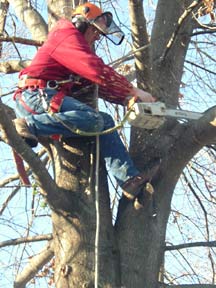
Mike Bailey, a Texas Baptist Men volunteer from Collin Baptist Association, cuts ice-damaged limbs in Oklahoma.

Former Pryor Fire Chief David Harrison felt blessed the TBM crews helped his family.

“I think it’s great,” Harrison said. “This is the worst ice storm I’ve seen in 29 years here. We’ve been without electricity for five days.”

About100 TBM volunteers converged on McAlester and Pryor to help residents weather an ice storm that threatened homes and claimed at least 32 lives. Nearly 4,000 people were treated at hospitals for weather-related injuries.

Seventy-seven counties have been declared federal disaster areas. Oklahoma’s emergency operations center remained activated due to the extreme winter weather conditions. In McAlester, the entire community was without electric power. Many struggled to stay warm and nourished.

A team of TBM volunteers prepared at least 10,000 meals for storm victims in Grove, north of Pryor. Volunteers man the 18-wheeler state feeding unit loaded with enough food to make 50,000 meals.

Volunteer chainsaw crews faced treacherous footing in the ice and pelting sleet, but they trudged ahead.

Team leaders called it one of the most dangerous and most difficult missions yet for the TBM chainsaw crews. Chainsaw team volunteers put into practice techniques they had never used before as the limbs of many trees stretched precariously toward electrical lines.

Watch a short video on TBM’s ice storm cleanup.

“This is our first time to do ice work,” said Joe Detterman, a TBM volunteer from Collin Baptist Association. “My team does a lot of climbing. When you start climbing a tree with ice, it’s a lot more difficult. The wood is brittle and it breaks when you don’t expect it or when you don’t want it to.”

TBM team members spend hours in chainsaw disaster training and climbing techniques, wear protective chaps and gloves to prevent the blades from cutting them and don OSHA-recommended ear protection and hard hats, but even with all their preparation, they still were challenged by what they experienced in northeastern Oklahoma.

Grateful for the work by Texas Baptist Men chainsaw teams in McAlester, Frink Baptist Church member Helen Stovaugh, her husband and grandson were without power for more than a week.

“I am amazed at the size of the damage,” said Duane Bechtold, unit director of the TBM Collin Baptist Association unit. “It’s really unbelievable the amount of tree damage caused by an ice storm.”

The storm left 4,500 electric utility poles down and tens of thousands of residents in Pryor and McAlester without electricity for more than a week. More than 200 utility crews attempted to upright downed power lines toppled by the ice storm. Red Cross volunteers came from as far away as New York to set up shelters, serve meals and aid storm victims.

“It’s devastating,” said Red Cross volunteer Joy Merrick-Vogel. “It’s something I’ve never seen before. What nature can do is just phenomenal. It’s just miles and miles of ice.”

Helen Stovaugh, who attends Frink Baptist Church in McAlester, described how she and her husband could not stay at home because they had no heat. Fortunately, their son has a fireplace and a generator, so they moved in until power was restored.

“We’re much in prayer about the situation,” she said. “We’re concerned about our friends and neighbors and the whole city. … It’s quite an ordeal. We’re trusting in the Lord to get us through this.”

Residents who remained at home found comfort in the ministry of the TBM volunteers. “We do this for one purpose, and that’s to share the love of God,” Detterman stressed.

“When you show Jesus’ love in a real way, it means more to the homeowners.”

Every job by the chainsaw teams ends in prayer. After completing their tasks, the volunteers ask to pray with the homeowners.

Despite the freezing temperatures and slippery work, the volunteers found they received more than they gave.

“It’s all about Jesus,” said Mike Bailey, volunteer of the TBM Denison unit. “It’s not about getting out here and working. It’s about helping people. I’ve been with TBM for a couple of years, and it’s been a blessing ever since.”


News of religion, faith, missions, Bible study and Christian ministry among Baptist churches, in Texas, the BGCT, the nation and around the world.


IMB trustee investigation rejects allegations of board impropriety

Posted: 2/02/07

IMB trustee investigation rejects
allegations of board impropriety

By Robert Marus

Associated Baptist Press

ONTARIO, Calif. (ABP)—The Southern Baptist Convention’s International Mission Board, following an internal investigation, has rejected a trustee’s accusations of impropriety and unauthorized tightening of doctrinal parameters.

The board reportedly approved a report, based on its own executive committee’s investigations into the charges, Jan. 31. There was no recorded dissent or discussion regarding the report at the meeting, which took place in Ontario, Calif.

The committee said the board retains “the prerogative and responsibility of further defining the parameters of doctrinal beliefs and practices of its missionaries.” That came in response to a request to investigate why trustees had instituted two requirements for missionary candidates that go beyond the doctrinal parameters of the 2000 Baptist Faith & Message, the denomination’s official confession of faith.

The investigation came in response to a motion, made by trustee Wade Burleson, during the SBC’s 2006 annual meeting in June. Burleson asked for an investigation by the SBC Executive Committee into several areas of IMB business for which the board recently had come under criticism.

The Oklahoma pastor’s motion called for an investigation into five allegations:

1. The alleged “manipulation of the nominating process of the Southern Baptist Convention during the appointment of trustees for the IMB.”

2. “Attempts to influence and/or coerce the IMB trustees, staff, and administration to take a particular course of action by one or more Southern Baptist agency heads other than the president of the IMB.”

3. “The appropriate and/or inappropriate use of forums and executive sessions of the IMB as compared to conducting business in full view of the Southern Baptist Convention and the corresponding propriety and/or impropriety of the chairman of the IMB excluding any individual trustee, without Southern Baptist Convention approval, from participating in meetings where the full IMB is convened.”

4. “The legislation of new doctrinal requisites for eligibility to serve as employees or missionaries of the IMB beyond the 2000 Baptist Faith and Message.”

5. “The suppression of dissent by trustees in the minority through various means by those in the majority, and the propriety of any agency forbidding a trustee, by policy, from publicly criticizing a board approved action.”

When Burleson made his motion during the SBC meeting, then-SBC President Bobby Welch referred the motion to the IMB. That practice is typical when motions pertaining to a particular SBC agency are presented at convention meetings.

Burleson’s motion grew out of particularly contentious time for the IMB, when the board’s leadership attempted to rebuke him for his public criticism of previous board actions placing on missionaries theological restrictions that he—and other Southern Baptists—said go beyond SBC doctrinal consensus.

One policy bans the appointment of new missionaries who practice a “private prayer language.” Jerry Rankin, IMB president, has said he previously practiced the controversial prayer practice, related to glossolalia, or speaking in tongues.

The other policy placed new restrictions on what modes of baptism would count as acceptable for missionary candidates.

The IMB investigators said the board had the right to enact those new restrictions, even if they go beyond the parameters of the convention’s confessional document.

“While the Baptist Faith and Message represents a general confession of Southern Baptist beliefs related to biblical teachings on primary doctrinal and social issues, the IMB retains the prerogative and responsibility of further defining the parameters of doctrinal beliefs and practices of its missionaries who serve Southern Baptists with accountability to this board,” the report said.

Burleson, in a Feb 1 response posted on his blog, kerussocharis.blogspot.com, said that aspect of the report “causes me the most concern.” However, he declined to comment further on the subject until two separate, ad hoc IMB committees appointed to review the controversial policies report back to trustees at the board’s March meeting.

However, other Southern Baptists were highly critical of the report.

“The end of this is simply that the (board of trustees) of the IMB does not think the SBC as a whole should be telling them what to do and how to do it,” wrote Art Rogers, another Oklahoma pastor who operates the Twelve Witnesses blog at www.twelvewitnesses.com. “This should surprise no one. We already knew that the (board) felt that they had a better grasp on their agency than the general population of the SBC and especially better than the blogger-informed crowd that seemed to support this motion.”

He continued: “As far as my expectations go, this is pretty much what I was ready to receive. When you ask an agency to police itself against accusations that it is failing to police itself, then you can’t expect much else.”

Burleson also accused trustees of bending to undue influence from SBC leaders outside the board and alleged that members of the convention’s nominating committee had attempted to place people with hidden agendas as IMB trustees.

In response to those aspects of Burleson’s motion, the IMB committee said it had no authority to investigate actions by other SBC bodies—in this case, the convention’s nominating committee and other SBC bodies.

“It is assumed that any and all heads of SBC entities are concerned about the effectiveness of all entities in order for the SBC to fulfill its kingdom task in the world,” the IMB investigators said. “While the IMB may exercise authority over its own president and elected staff, we are not in a position to question or investigate the actions and motives of heads of other entities.”

Burleson, responding to that determination, said it was precisely the reason he asked the SBC for an external investigation of the IMB in the first place.

“This is why I asked for the Executive Committee of the Southern Baptist Convention to look into the matter,” he wrote. “The IMB is not in a position to question or investigate the motives of heads of other entities, but somebody sure should be in a position to demand that an agency head stop undermining the work, vision and agenda of a fellow agency head—and that somebody is the Executive Committee of the Southern Baptist Convention or the SBC herself.”

In response to the other two aspects of Burleson’s motion—the accusation that trustees had improperly conducted business in closed forums and suppressed dissent among trustees—the investigators said the board was conducting its business properly.

“The IMB does not allow formal business to be transacted in its closed trustee forums, but uses this time for prayer, personal testimonies and preliminary questions and discussions regarding issues of mutual concern between senior staff and trustees,” the investigators wrote.

Burleson said he agreed that the IMB’s business had been conducted in a more appropriate manner since the board’s leadership changed hands and new trustees joined the body in June.

“Thank God that (trustee) forums are now filled with praise reports, testimonials and prayer. This is the way it should be, but my personal experience, as well as that of others, is that this kind of forum has not always been the case,” he wrote.

“I have consistently and repeatedly advocated that the business of any agency of the Southern Baptist Convention be done in full view of the entire convention through plenary sessions. But for the safety of missionaries in security three zones or extraordinarily sensitive personnel matters, all the business of the IMB is appropriate for public viewing. I think every trustee now understands this point and is doing everything to insure that closed doors be spent in prayer and testimony and not politics.”

The investigators also said any IMB trustee has ample opportunity to express dissent throughout the board’s decision-making process.

“All board-approved actions result from a process of committee, and sometimes multiple committees, consideration before they are brought to a plenary session for adoption,” the report said.

“All trustees have opportunity in the committee process and plenary session to express and advocate minority opinions. As in any democratic body, once the majority has determined the action to be taken, the board feels that the action should receive the unified public support of all trustees for the sake of effectively moving forward to fulfill our mission task.”

Burleson said he agreed, but “with one caveat—if the policy violates Scripture, then no matter how strong anyone’s desire for unity is, it cannot become a stumbling block to seeking correction. Further, even if some refuse to see that their views are based on tradition and not Scripture, and if their interpretations are regarding doctrines that are beyond the Baptist Faith & Message 2000, then though it may be the trustees prerogative to demand doctrinal conformity on these tertiary doctrines, the more appropriate question may be, ‘Should they?’”

News of religion, faith, missions, Bible study and Christian ministry among Baptist churches, in Texas, the BGCT, the nation and around the world.


Christian faith unites opposing Super Bowl coaches

Posted: 2/02/07

Christian faith unites
opposing Super Bowl coaches

By Hannah Elliott

Associated Baptist Press

MIAMI (ABP)—While much has been made about NFL head coaches Tony Dungy’s and Lovie Smith’s skin color, they’ve got a stronger bond than being the first African-American head coaches to lead their teams to the Super Bowl.

The bond of their common Christian faith is becoming increasingly evident as media scrutiny intensifies surrounding the nation’s highest-profile sporting event.

“The Lord set this up in a way that no one would believe it,” Dungy told reporters after his Indianapolis Colts beat the New England Patriots to qualify for Super Bowl XLI. “The Lord tested us a lot this year, but he set this up to get all the glory.”

Smith has also long credited God with directing his life, even before his Chicago Bears enjoyed much success. Back in 2004, Smith said he had no complaints about his life, despite growing up in a small East Texas town with an alcoholic father.

“I don’t have a lot of complaints about what’s happened to me,” he told NFL.com. “I know I’ve been blessed. I’m a God-fearing man who knows that God has a plan for me. And every day getting a little closer to that ultimate plan.”

For Dungy, despite his athletic success as a player and a coach, the 51-year once considered leaving coaching to work in prison ministry. He is known—unlike most professional football coaches—for never swearing at players. He regularly attended Bible studies at Idlewild Baptist Church in Tampa, Fla., when he served as coach of the Tampa Bay Buccaneers.

Jeffrey Singletary, a pastor at Idlewild, prays on the phone with Dungy before every game. While the congregation is not planning any corporate event for watching Sunday’s game, Singletary said various families will hold parties of their own.

Singletary, who occasionally served as chaplain for the Bucs under Dungy, described the coach as “very intellectual, quiet, and strong.”

Singletary will be in Miami to watch the Feb. 4 Super Bowl. The Friday before, he plans to meet with Dungy to pray and prepare for the game.

“After the game with the Patriots, Tony said that God did it in such a way that he could get the glory,” Singletary said. “That’s our prayer—that God would be glorified. That God would be honored. That he would do it in such a way that only (God) can get the glory.”

Singletary added that he and Dungy always pray for protection for the players and “at the end of the game, that everybody walks away healthy and safe.”

This game has been a long time coming for both teams. The Colts, then located in Baltimore, last won the Super Bowl in 1971. The Bears last won it in 1986. Prior to the current season, neither had played in a conference championship since then.

This year, the Bears finished the season with a 13-3 record. Smith led them to a 39-14 victory against the New Orleans Saints in the Jan. 21 NFC Championship game. That same day, the Colts defeated the Patriots 38-34 to become AFC champions. After trailing 21-3, the Colts won in the largest comeback in the history of NFL conference championships.

Since their move north, the Dungy family has attended Northside New Era Missionary Baptist Church in Indianapolis. While church leaders don’t have any particular events planned for the big day, member Michelle Kirk said large groups of church members have planned to get together to watch the game.

“It feels great. We’re all excited,” she said. “We haven’t done any special prayers for him in church, and we’re just going to have a normal service on that Sunday, but we’ve been praying a lot on our own.”

Born in Jackson, Mich., to parents who were educators, Dungy played football for the University of Minnesota, the Pittsburgh Steelers and San Francisco 49ers. He then coached as an assistant with the Steelers, Kansas City Chiefs and Minnesota Vikings. He became head coach at Tampa Bay in 1995 and the Colts’ head coach in 2002.

Despite his commitment to football, Dungy continues to maintain strong family ties. He and his wife, Lauren, have two daughters and three sons. One of those sons, 18-year-old James, struggled with depression and committed suicide in 2005. Northside New Era handled funeral donations for James Dungy on behalf of the Colts. The memorial service was held at Idlewild.

Dungy spoke about God’s love at an Athletes in Action meeting just weeks after his son’s death. He also worked as a speaker for the Fellowship of Christian Athletes and supported charities like Brothers/Big Sisters, Boys and Girls Club, the Prison Crusade Ministry, foster parenting organizations and Family First.

Smith, 48, grew up attending Brown’s Chapel C.M.E. Church, a small Methodist congregation in Big Sandy. The tiny building Smith knew decades ago has since been replaced with a brick sanctuary—largely paid for by Smith’s donations.

On Feb. 4, the local Church of God is planning a free chili feed, complete with a big projector screen, to celebrate the game. They’ll have room for 1,000 people to watch —roughly the number of people who lived in Big Sandy during Smith’s childhood. It isn’t much bigger now.

Smith told the New York Times that much of his Christian upbringing came from his mother, who pushed the family to attend church and live with integrity.

“If I don’t make it, it’s going to be on me,” Smith said his mom taught him. “It’s not going to be about color or where I came from, how much money we had growing up. It’s about what I wanted to do. There are no limits to what I can do.”

Smith was the third of five children and was named after his great aunt Lavana. He attended the University of Tulsa where he was a two-time football All-American.

After college, Smith coached high school and then college football. He began his NFL career working as an assistant coach under Dungy and the Buccaneers. The Bears hired Smith as head coach in 2004.

Smith has said he focuses his coaching strategy on “being a teacher instead of screaming and yelling, all that stuff.” Dungy taught him coaches don’t have to belittle and intimidate players in order to win, he told the Associated Press.

“I could spend the rest of the day talking about Tony Dungy and what he means to me,” Smith said. “We have similar beliefs, and to see him through the storms and see he’s the same person is truly encouraging.”

As for some church members, the choice between two God-fearing coaches might be a tough one. Singletary said he’s sure some Idlewild members might secretly be rooting for the Bears. And Clarence Moore, senior pastor of Northside New Era, likened the decision to answering a question in elementary school.

“You want to raise your hand. Maybe somebody else has the answer, but you want to be the one,” he told the Indianapolis Star. “I think it is very appropriate. Let God decide who he wants to bless.”

News of religion, faith, missions, Bible study and Christian ministry among Baptist churches, in Texas, the BGCT, the nation and around the world.


One year later, burned Alabama churches rise from ashes

Posted: 2/02/07

One year later, burned Alabama
churches rise from ashes

By Greg Garrison

Religion News Service

BIRMINGHAM, Ala.(RNS)—A year has passed since nine Alabama churches were set on fire by three Birmingham college students, but a lot of rebuilding remains to be done.

By late 2007, those nine churches expect to be restored or have larger, more modern facilities.

“It’s been a great struggle, and there is a lot still to do,” said Robert Murphy, pastor of Pleasant Sabine Baptist Church in Bibb County.

Of the three churches in Bibb County burned to the ground Feb. 3, 2006, Pleasant Sabine was the first to rebuild, but it has experienced unexpected delays recently on interior work. The congregation now hopes to move in by spring.

Two other churches, Rehobeth Baptist and Ashby Baptist, still are planning their structures. A few miles away from Pleasant Sabine, land has been cleared and a sign posted, “Future Home of Ashby Baptist Church,” but construction hasn’t begun there yet.

Two other churches in Bibb County—Old Union Baptist and Antioch Baptist—sustained minor damage and were able to resume worship in their facilities.

Four churches that were set ablaze four days later, on Feb. 7, 2006, in three neighboring counties have made progress. Morning Star Missionary Baptist in Boligee, Dancy Baptist in Aliceville and Galilee Baptist in Panola were destroyed. Spring Valley Baptist in Gainesville was damaged but has been repaired.

Galilee had a groundbreaking in November and has begun construction.

Dancy Baptist recently repaired its gutted interior. Morning Star recently broke ground and plans to move in by summer.

Morning Star Baptist had no insurance, no money and didn’t own the property the church had stood on for 94 years. But three anonymous donors are leading efforts to rebuild the church and have persuaded an architect, contractor and others to donate their time and materials. They are trying to raise an additional $200,000 to finish the church.

Indeed, much of the rebuilding for the churches has been paid for with donations.

“A lot of people have come together on this,” said Lane Estes, executive assistant to Birmingham-Southern College President David Pollick. “It was a heart-rending story.”

The arsonists—Matthew Cloyd, Russell Debusk and Ben Moseley—pleaded guilty and face seven to eight years in federal prison. The three met as students at Birmingham-Southern; Cloyd had transferred and was a student at nearby University of Alabama at Birmingham at the time of the fires.

It has been a harsh lesson for them and other students, Estes said.

“Students are probably more aware that their actions have consequences,” Estes said. “That’s a sobering aspect of the whole thing.”

The victimized churches have sympathy for the arsonists, said Murphy, of Pleasant Sabine Baptist.

“They made a big mistake in life,” Murphy said. “It’s hard for them to replace what they’ve lost and deal with what they’ve done for the rest of their lives. We wish that had never happened. Unfortunately, it did. They realize the mistake they made.”

Meanwhile, Birmingham-Southern has tried to set a redemptive example, Estes said.

“There are things we can do to show that this is an anomaly for our students,” he said.

“A lot of good has come out of the bad. The churches certainly have suffered greatly. Our attitude has been, ‘Let’s acknowledge it and see what we can do to help.’“

The school helped administer a coordinated fund to aid the churches. The six churches destroyed by fire received $53,000 each, a total of $318,000.

The remaining $50,000 of the $368,000 raised was divided among four churches that had comparatively minor damage.

“Alumni, friends of the college, students and faculty have stepped forward to help,” Estes said.

The churches appreciate that people have helped turn a challenge into hope, Murphy said.

“We’ve done well with what we had to deal with,” he said. “We thank God for that. We can’t change that. All we can do is deal with the present.”


Greg Garrison writes for The Birmingham News in Birmingham, Ala.


News of religion, faith, missions, Bible study and Christian ministry among Baptist churches, in Texas, the BGCT, the nation and around the world.


New school rises near site of Amish killings

Posted: 2/02/07

A construction crew works at the site of a new Amish school in Nickle Mines, Pa. The school it replaces was torn down last year after a gunman entered and killed five children and wounded five others. (RNS photo by Gary Dwight Miller/The Patriot-News)

New school rises near site of Amish killings

By Monica Von Dobeneck

Religion News Service

NICKEL MINES, Pa. (RNS)—An Amish one-room schoolhouse takes shape in a field at the end of a private drive behind a row of houses, within walking distance of the site of the school where a gunman shot 10 Amish girls Oct. 2, killing five of them.

An Amish man who did not give his name said the construction crew expects to open the school in March but would not comment further. The Amish community knocked down the original schoolhouse Oct. 12.

“We just want to be left alone,” he said.

Nickel Mines became the center of worldwide media attention after Charles Carl Roberts IV, 32, lined up 10 girls and shot them after releasing the boys in the school. He then killed himself.

The boys and four of the surviving girls are attending classes in a garage. The fifth girl is disabled.

Mike Hart, treasurer of the Nickel Mines Accountability Committee, said Amish families whose children attended the old school will bring their children to the construction site several times while the building is going up to ease the transition to the new school.

“From what I’ve heard, it’s a bittersweet thing,” Hart said. “This is the final part of the process of moving on.”

At the nearby Bart Township Volunteer Fire Company, 60 percent of the firefighters are Amish, but they don’t talk about the shootings much, Chief Curt Woerth said.

“It’s been a tough couple of months. We’re just trying to move on,” he said. “I would say this is a new start, a way to leave the past behind. … Their strong faith has gotten them through it.”

A “comfort quilt” hangs in the front of the firehouse. It was made by children at a school in Ohio who sent it to children affected by the Sept.11 terrorist attacks in New York. From there, it went to comfort children affected by Hurricane Katrina. Now, it is in Nickel Mines.

Woerth said it will be passed on if there is another national tragedy affecting children—so for that reason, he hopes it never leaves.

Contributions are trickling into the Accountability Committee from people around the world who were touched by the shootings and the Amish reaction to them, which included forgiving the gunman and welcoming his widow.

The $3.6 million raised is being used for medical bills, counseling and transportation for the affected families. Some of the money will go toward the schoolhouse.

“The Amish school board has not presented us with the bills yet, but we don’t want that to be a burden to anyone,” Hart said.

The firehall gets about 100 letters a week from well-wishers, Woerth said. Immediately after the shootings, it received 800 letters a day.

“It’s amazing, the support of the world,” he said. “But there’s also something the Amish gave the world.”

Hart hopes the world doesn’t forget the Amish message of forgiveness.

“This has changed a lot of people’s lives,” he said. “Hopefully, the message is not a short-lived one.”


Monica Von Dobeneck writes for The Patriot-News in Harrisburg, Pa.

News of religion, faith, missions, Bible study and Christian ministry among Baptist churches, in Texas, the BGCT, the nation and around the world.


Around the State

Posted: 2/02/07

Around the State

• The University of Mary Hardin-Baylor College of Christian Studies and church relations office are partnering with Bell Association to present a seminar titled “Avoiding the Rattlesnakes: Integrity in Ministry.” The seminar will begin at 8:30 a.m. Feb. 10 at Memorial Church in Temple. Featured speakers include Bill Carrell, dean of the College of Christian Studies; David How-ard, director of the Marriage and Family Christian Counseling Center; and Tom Henderson, director of missions for Bell Association. For more information, call (254) 295-4606.

• The seventh annual Baylor University Sacred Harp Singing is set for Feb. 10 in the Great Hall of Truett Theological Seminary. Singing school led by Donald Ross will be held from 9:30 a.m. until 9:50 a.m. The singing will be held from 10 a.m. until 3 p.m. with a break for lunch. For more information, call (254) 644-2181.

The University of Mary Hardin-Baylor Writers’ Festival afforded participants a variety of opportunities, including poetry workshops, a chance to share their work with others and an art class. About 75 writers participated in the weekend gathering. Authors Myra McLarey and Michael Lythgoe and reader Scott Cairns were the keynote speakers. The festival, in its 10th year, brought together writers from across the country.

• Dallas Baptist University has announced a doctoral program for educators—the Ed.D. in educational leadership. It will include both higher education and K-12 study tracks. The 60-hour program will require about three years to complete.

• Howard Payne University has announced the addition of five faculty members. Full-time faculty are Bill Fowler, assistant professor of Christian studies; and Derek Smith, assistant professor of physical science. Adjunct faculty additions include Donna Bowman, Christian studies; Peggy Hickey, modern languages; and Debra Powell, business administration.

• Twenty-one East Texas Baptist University students will be included in the 2007 edition of Who’s Who Among Students in American Universities and Colleges.

• Betty Donaldson, vice president for institutional advancement at Wayland Baptist University since April 2004, has announced her retirement. Donaldson received a master’s degree from Wayland in 1989 and the Distinguished Alumni Award in 2003. During her tenure at Wayland, giving has steadily increased.

Anniversary

• Don Hessong, 15th, as pastor of Union Valley Church in Nixon, Jan. 7.

• Candido Gonzales, 40th, as pastor of Emmanuel Church in Bay City, Jan. 20.

Retiring

• Larry Heard, as director of missions of Top O’ Texas Association, Dec. 31. He served the association 20 years and was in ministry 50 years. Prior to serving the association, he was pastor of Rockdale Church in Stamford, First Church in Wellman, First Church in Matador, First Church in Bovina and First Church in Idalou. He and his wife, Ann, have moved to Amarillo, and he is available for supply and other ministry at (806) 355-3599.

Deaths

• James Bozeman, 89, Nov. 27 in Amarillo. He surrendered to preach in 1949 out of the oilfields of West Texas. He was asked by First Church in Kermit to be the first pastor of North Side Mission, later North Side Church. He then was pastor of Fullerton Church in Andrews, Inspiration Point Church in Fort Worth, First Church in Plains and Temple Church in Hereford, where he retired in 1980. He and his wife, Evelyn, participated in several mission trips and served several churches as interim in retirement, including International Church in Harrogate, England. He was preceded in death by his first wife in 1999. He is survived by his wife, Thelma; daughter, Ann Heard; three grandchildren and four great-grandchildren.

The Heights Church in Richardson is offering a 10-week music program for infant to toddler children. They can interact with a parent or grandparent in a time of music and movement. A class for babies birth through 17 months meets on Tuesdays from 9:30 a.m. until 10:20 a.m., and a class for toddlers 18 months through 3 years meets the same day from 10:30 a.m. until 11:20 a.m. Registration is required for the classes that begin Feb. 13. The cost is $35 per child. For more information, call (972) 231-6047, ext. 266.

• Jack Harris, 77, Jan. 9 in Rockport. A retired Baptist pastor, his last pastorate was at First Church in Hutto. He was preceded in death by his daughter, Michelle Harris; and brothers, Zane, Hazen and Kenneth. He is survived by his wife, Virginia; sons, Trey and Craig; daughters, Patti Malone and Carla Barron; brother, Don; sisters, Jewel Faught and Margie Frizzell; nine grandchildren; and three great-grandchildren.

• Bruce McKinley Sr., 85, Jan. 20 in Houston. He was a deacon 56 years, serving as chairman of deacons at Little York Church in Houston for many of those years. He was preceded in death by his grandson, Phillip McKinley; and great-granddaughter, Paige McKinley. He is survived by his wife of 64 years, Louise; sons, Bruce Jr., Ron and Joe; daughter, Debbie Douglas; 11 grandchildren; and nine great-grandchildren.

• Tom McMillan Sr., 75, Jan. 21 in Fairfax Station, Va. A career missionary with the Foreign Mission Board of the Southern Baptist Convention, he served in Tanzania from 1959 until 1984. He twice served as missionary-in-residence at Hardin-Simmons University, first during the 1976-1977 school year and again during the 1981-1982 year. He was presented with an honorary doctorate from the school in 1984. Trustee James Parker established an endowed scholarship at HSU to honor McMillan and his wife in 1993 to benefit the children of missionaries. He was preceded in death by his first wife, Marilyn. He is survived by his wife, Linda; son, Tom Jr.; daughters, Melody Misu and Deborah Pillow; step-sons, Jason and Travis Mustain; step-daughter, Erin Mustain; and four grandchildren.

Events

• First Church in Dallas, in cooperation with the Dallas Area Parkinsonism Society, will host free weekly group exercise therapy beginning Feb. 8 at 10 a.m. For more information, call (214) 969-2452.

• Southwest Chinese Church in Stafford held an appreciation dinner for retired International Mission Board missionaries as a part of a winter emphasis on missions. The missionaries also told the congregation how they could best pray for missionaries. Mission-aries taking part and their places of service included Bob and Joan Caperton, Colombia; Titus and Fulga Dan, Australia; Doris Barnes, Kenya; Sam and Marian Longbottom, Vietnam and Taiwan; Todd and Doris Hamilton, Philippines; Gayle and Norma Stimson, France; Norman and Jeannie Wood, Africa; Vincente and Chonchita Co, Taiwan; Buddy and Sherry Gregg, Philippines and Europe; and Peter and Grace Huen, China. Peter Leong is pastor.

• First Church in Grapevine will host “Double Vision” Feb. 23-24. The conference encourages churches to embrace the vision of doubling Sunday school or small-group attendance within two years. Help is offered with outreach, fellowship, ministry and teaching. Church growth expert Josh Hunt will be the speaker for the adult track. Children and student tracks also will be available. Cost for the conference is $25, and includes a pizza dinner Friday night, continental breakfast on Saturday, and a copy of Hunt’s book You Can Double Your Sunday School in Two Years or Less. Discounts are available for groups of 10 or more. Register or get more information at www.fbcgrapevine.com. Mike Mowery is pastor

Revival

• First Church, Victoria; Feb. 24-25; evangelist, Michael Gott; pastor, Jim Shamburger.

News of religion, faith, missions, Bible study and Christian ministry among Baptist churches, in Texas, the BGCT, the nation and around the world.


Beatles’ spiritual journey followed long & winding road

Posted: 2/02/07

Beatles’ spiritual journey
followed long & winding road

By Bob Carlton

Religion News Service

WASHINGTON (RNS)—Rock music writer Steve Turner grew up in a Christian home in Daventry, England. Like other teenagers who came of age in the 1960s, Turner was a huge Beatles fan.

“At that time, Christians weren’t too keen on rock and roll music, so people in the church generally weren’t too keen on the Beatles,” Turner said. “Yet, after a few years, the Beatles became interested in religious topics, so there was this interplay between religion and rock music that I became interested in.”

Forty years after John Lennon made his infamous and often misunderstood comment that the Beatles were “more popular than Jesus”—spawning ban-the-Beatles protests—Turner explores the Fab Four’s spiritual quest in his latest book, The Gospel According to the Beatles.

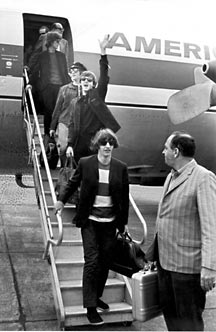
Beatles (from top) George Harrison, John Lennon, Paul McCartney and Ringo Starr arrive in Portland, Ore., for a concert in 1965.

The 57-year-old Turner first wrote about the Beatles in 1969, and has since written A Hard Day’s Write: The Stories Behind Every Beatles Song; The Man Called Cash: The Life, Love and Faith of an American Legend; and Trouble Man: The Life and Death of Marvin Gaye.

Although more than 1,000 books have been written about the Beatles, Turner says none has looked at their religious influences and insights as in-depth as his does.

The Beatles weren’t banned in Turner’s house when he was growing up—in fact, his parents bought him a copy of Beatles for Sale for Christmas in 1964—but they weren’t em-braced, either.

“I suppose my parents were like most parents at the time,” he recalled. “They thought their hair was too long, their heels were too high, their trousers were too tight and their music was too loud.”

Long before they became the Fab Four, though, each of the Beatles was influenced by religion—Paul McCartney and George

Harrison in the Roman Catholic Church and Lennon and Ringo Starr in the Church of England, Turner said. As he grew older, Turner embarked on a spiritual odyssey of his own, and he found inspiration in the music of the Beatles.

“They sort of validated the search for God, if you like,” he said. “For a long time, it seemed like rock music or pop music was almost like an alternative to religion.

“Religion seemed sort of dull and conformist, and rock and roll was sort of shiny and exciting, and the two didn’t seem to meet at all. Then when the Beatles started asking questions about meaning and singing songs like ‘Nowhere Man,’ they actually investigated religion.

“You had George Harrison quoting bits of the Bible—the kingdom of heaven is within, and things like that—and I was thinking, ‘Hmm, I think I’ve heard that before.’

“It seemed like the Beatles were suddenly on to something that you’ve been on to for a long time.”

“Nowhere Man,” which was off the Rubber Soul album, was “kind of the beginning of the (spiritual) quest” for the Beatles, Turner said.

“The music up until Rubber Soul had been sort of jaunty, I-love-you, you-love-me type of songs,” he said. “Then they started asking questions about the meaning of life, so you get ‘Nowhere Man,’ which is all about not having anything to believe in.

“Then there’s ‘Let It Be,’” he adds. “That has a reference to Mother Mary. Paul McCartney’s mother was called Mary, but he was aware that it had, I think he called it, a quasi-religious sort of gloss to the song.”

For the Beatles, and Turner, it was another step along a long and winding road.

“The Beatles were doing such great things,” he says. “I thought if you could absorb whatever the Beatles were absorbing, you could probably be as great as they were.”


Bob Carlton writes for The Birmingham News in Birming-ham, Ala.

News of religion, faith, missions, Bible study and Christian ministry among Baptist churches, in Texas, the BGCT, the nation and around the world.


Texas CP 2006 receipts up slightly

Posted: 2/02/07

Texas CP 2006 receipts up slightly

By John Hall

Texas Baptist Communications

DALLAS—Texas Baptists’ giving to the Baptist General Convention of Texas Cooperative Program increased by 2 percent in 2006.

Texas Baptists contributed nearly $40.9 million to the Texas Cooperative Program in 2006, enabling the BGCT to reach 99 percent of its adopted budget.

Giving to worldwide mission efforts through the BGCT also increased last year from $15.63 million to $15.85 million. Texas Baptist churches gave $13.9 million to the Southern Baptist Convention, $1.51 million to the Cooperative Baptist Fellowship and nearly $796,000 to BGCT worldwide causes.

The number of Texas Baptist churches following the BGCT adopted giving plan in 2006 increased 2.2 percent to 42.6 percent of BGCT-affiliated congregations.

“This is a continuation of a trend we’ve seen over the past four or five years that more churches are embracing the Texas adopted plan,” said David Nabors, BGCT chief financial officer.

Giving to Texas Baptist offerings also increased in 2006. Texas Baptists increased giving to the Mary Hill Davis Offering for Texas Missions 12.5 percent. They donated almost $4.9 million to the offering, just short of the $5.1 million goal.

Giving to the Texas Baptist Offering for World Hunger increased 10 percent in 2006 to about $738,000, which is slightly below the goal of $750,000.

News of religion, faith, missions, Bible study and Christian ministry among Baptist churches, in Texas, the BGCT, the nation and around the world.