Faith-based positions of presidential hopefuls compared

Posted: 4/16/07

Faith-based positions of
presidential hopefuls compared

By Robert Marus

ABP Washington Bureau

WASHINGTON (ABP) — Perhaps the only thing more mind-boggling than the quantity of presidential hopefuls in 2008 is the array of faith-based views represented among the candidates themselves.

Consider profiles of the top candidates in each major party. The profiles include notes about their faith background, their perception among conservative religious voters and their positions on selected major issues that interest religious voters of all ideologies.

Compare the Candidates:
Republicans
John McCain
Mitt Romney
Rudolph Giuliani

Democracts
Hillary Clinton
Barack Obama
John Edwards

View as a graphical chart

See Related Stories:
• Faith-based positions of presidential hopefuls compared

Democratic presidential race features more faith than usual

GOP presidential race again features faith, but new dynamics

Current Republican front-runners

Arizona Sen. John McCain

Faith background: McCain was raised in the Episcopal Church and still calls himself an Episcopalian. However, he and his wife reportedly are long-time attendees at North Phoenix Baptist Church, a large Southern Baptist congregation in Phoenix.

Relationship with Religious Right: McCain has amassed a voting record that is, overall, strongly socially conservative. Still, his efforts on campaign-finance reform long angered some conservative leaders who feared his plan could reduce the effectiveness of anti-abortion groups. He angered the Religious Right with a 2000 speech during his first presidential run in which he assailed broadcasters Jerry Falwell and Pat Robertson as “agents of intolerance” who were bad for religion and politics.

Last year, in a move widely viewed by political observers to be an attempt to mend fences before for his 2008 presidential run, McCain delivered a speech at Falwell’s Liberty University in Lynchburg, Va. It was reportedly well received.

On abortion: McCain opposes legalized abortion in most cases and supports overturning Roe v. Wade, the 1973 Supreme Court decision that legalized abortion. He also has voted in favor of bills expanding federal funding for embryonic stem-cell research. Many anti-abortionists view such research as tantamount to abortion because the extraction of stem cells kills the embryos.

On gay rights: McCain’s record on gay rights is somewhat mixed. While he voted to kill a proposed federal constitutional amendment banning same-sex marriage, he endorsed a similar amendment on the state level in Arizona. He has said he believes the issue should be settled by the states.

For the last three two-year sessions of Congress, McCain received scores of 33 percent (109th Congress), 25 percent (108th Congress) and 14 percent (107th Congress) from the Human Rights Campaign. The gay-rights group rates members of Congress based on their votes on gay-related issues. A higher percentage indicates more gay-friendliness than a lower percentage.

On Iraq: McCain voted to authorize President Bush to go to war in Iraq. While he has sometimes criticized how Bush has conducted the war, he remains one of the staunchest opponents of pulling American troops out of Iraq.

On the relationship between church and state: While McCain has voted to uphold government endorsements of religion, he has also decried some of the Religious Right’s rhetoric. He has voted to confirm all of President Bush’s picks for the federal courts— including several about whom church-state separationist groups expressed concerns. McCain also has been a longtime supporter of expanding the government’s ability to fund social services through churches and other religious charities. McCain has been a strong supporter of government-funded voucher programs that include religious schools.
Back to Top

Former Massachusetts Gov. Mitt Romney

Faith background: Romney is a member of the Church of Jesus Christ of Latter-day Saints. He would be the first Mormon nominated for the presidency by a major party.

Relationship with Religious Right: The former governor of one of the nation’s most liberal states campaigned for his previous offices by expressing views decidedly to the left of some he currently espouses. Some conservative evangelical leaders have expressed discomfort over his history. In addition, several evangelical groups—notably, the Southern Baptist Convention—have denounced Mormonism as a cult or a deviation from Christianity. Polls show that somewhere between a quarter and a third of potential voters would not vote for a Mormon president.

On abortion: In a recent speech to a group of South Carolina Democrats, Romney declared himself “firmly pro-life.” However, he has come under withering criticism from Democrats and those in his own party for his changing stances on abortion rights. In his campaigns for Massachusetts governor, he said he would enforce a woman’s right to choose abortion.

On gay rights: In a failed 1994 Senate campaign to unseat liberal stalwart Sen. Edward Kennedy (D-Mass.), Romney famously wrote a letter seeking support from the gay group Log Cabin Republicans. In it, he said, “We must make equality for gays and lesbians a mainstream concern” and promised to do more to advance gay rights in the Senate than Kennedy would.

More recently, Romney has been hailed as a celebrity in resistance to gay rights. After Massachusetts became the first state in the nation to legalize same-sex marriage in 2005, Romney led efforts to pass a state constitutional amendment to revoke the practice. He has spoken around the country in support of two failed efforts to pass a similar amendment to the federal Constitution. In the past, he has said gay marriage should be decided by the states.

When the 1994 Log Cabin letter came to light late last year, Religious Right leaders expressed suspicion.

“This is quite disturbing,” said Tony Perkins, president of the Family Research Council, according to the conservative website NewsMax.com. “This type of information is going to create a lot of problems for Gov. Romney.”

On Iraq: Romney supports Bush’s Iraq policy, including his decision to “surge” the number of U.S. troops in Iraq by more than 20,000. He has offered some criticisms of the way Bush has handled the war, but they have been more muted than McCain’s critiques.

On the relationship between church and state: Romney has supported government endorsements of religious faith, including keeping religious slogans and items on currency and government property. He has also been a supporter of government funding for religious charities.
Back to Top

Former New York Mayor Rudolph Giuliani

Faith background: Giuliani is a lifelong Roman Catholic, although many of his social views are at odds with the church’s official teachings. In a 1994 speech on religion, delivered shortly after he became mayor, Giuliani said Catholicism provided a moral and intellectual framework for his life.

“The church has built the road that allows my intellect to traverse to the outer reaches of what is comprehensible and, at that point, the church offers a leap of faith to carry me where my intellect cannot go,” he said, according to the New York Times. “For me, being a Catholic is not limiting but liberating.”

Relationship with Religious Right: Religious Right leaders have viewed Giuliani with great suspicion because of his moderate-to-liberal views on several social issues. Religious Right leaders have also expressed dissatisfaction with Giuliani’s personal life, which includes three marriages—the second of which ended in a messy, public way while he was still mayor —and strained relationships with his children.

However, a recent poll of evangelical Republican voters by the Pew Forum on Religion and Public Life showed Giuliani besting other GOP hopefuls.

And, in an echo of McCain, Giuliani was scheduled to speak April 17 at Regent University, the Virginia Beach, Va., school founded by Pat Robertson.

On abortion: Giuliani’s long-stated position is similar to that of many Democrats. He has said that, while he personally disapproves of it, he believes it should nonetheless remain legal. In a recent Fox News interview, he said of abortion, “I hate it.” He added: “I think abortion is something that, as a personal matter, I would advise somebody against. However, I believe in a woman’s right to choose.”

Nonetheless, he has also reportedly begun telling Republican audiences in presidential primary states that he would appoint only “strict constructionist” judges to the federal judiciary. Many abortion opponents take that as an indication that he would appoint judges likely to believe that Roe v. Wade was wrongfully decided and that the Constitution does not protect abortion rights.

On gay rights: Giuliani opposes legalizing same-sex marriage, but he has been a strong supporter of gay rights in almost every other respect. Among the gay-rights provisions he supported was a domestic-partnership law that provides gay New York couples with similar protections and responsibilities as married couples. He has also marched in gay-pride parades. According to multiple news reports, during his second divorce he temporarily lived with a gay couple who were his close friends. He opposes a federal constitutional ban on same-sex marriage.

On Iraq: Giuliani, like McCain and Romney, supports Bush’s troop surge and opposes pulling the troops out anytime soon.

On the relationship between church and state: Giuliani has spoken little about his support for government expressions of religion or government support for religious charities. In a debate during his 2000 senatorial bid—he withdrew from the contest after a cancer diagnosis—he defended the Ten Commandments as an integral part of Western history. He has also said he opposes government-sanctioned prayer in public schools.

In the 1994 speech, he called for believers and non-believers alike to tolerate each other in civil society: “I will work as hard to protect someone’s right to believe in God … (as) not to believe in God, because I realize that my right to practice my religion depends completely on my commitment to defend someone else’s right to practice theirs.”

As mayor, Giuliani advocated a school-voucher plan that included religious schools.
Back to Top

Current Democratic front-runners

New York Sen. Hillary Clinton

Faith background: Clinton is a cradle-roll Methodist and has been active in the United Methodist Church most of her life. She is also reportedly a regular participant in one of the many small-group Bible studies comprised of members of Congress. The top-secret meetings are closed to outsiders and the press.

Relationship with Religious Right: While evangelicals have been highly suspicious of Clinton and her husband, she has made some attempts to reach out to them in preparation for her presidential bid.

On abortion: Clinton is a longstanding supporter of abortion rights, but she has attempted to moderate her public rhetoric on the issue. In a widely reported 2005 speech on abortion rights, Clinton continued to endorse legalized abortion but also called it a “sad, even tragic, choice to many, many women” and appealed to anti-abortion groups and abortion-rights supporters to find “common ground” on ways to reduce the number of abortions.

Most anti-abortion groups were critical of the speech. They noted that Clinton still opposes banning a late-term abortion procedure pro-lifers label “partial-birth abortion.”

On gay rights: Clinton opposes full same-sex marriage, but she supports the legal equivalent— known as “civil unions.” However, she has also said she would not oppose a New York state law legalizing gay marriage if it wins the support of a majority of state legislators. She opposes a federal constitutional amendment banning gay marriage.

On Iraq: Clinton was one of the Democratic senators who voted in favor of authorizing Bush to go war in 2002. Despite demands from anti-war Democratic activists, she has declined to apologize for that vote, saying Bush misled her and her colleagues into believing the war was justified because Iraq threatened the United States.

She has advocated a gradual “phased redeployment” of American troops in Iraq in order to get them out of the war zone. She also opposed Bush’s “surge” plan.

On the relationship between church and state: Clinton supports using religious groups to provide secular social services but has opposed some of Bush’s attempts to expand their ability to do so. In a 2005 speech, she reportedly said some politicians had created a “false division” between supporting church-state separation and supporting the provision of non-religious public services by religious groups.

In her 2000 senatorial campaign, she opposed the posting of the Ten Commandments in public schools, saying it would violate the Constitution.

Back to Top

Illinois Sen. Barack Obama

Faith background: Obama has said he was raised in a secular household, the child of a Kenyan immigrant father who was a Muslim-turned-atheist and an irreligious mother whose parents were non-practicing Protestants. After working as a community organizer with African-American churches on Chicago’s South Side, he made a conscious decision to become a Christian and join Trinity United Church of Christ.

He said he had doubts about some aspects of Christian doctrine. “But, kneeling beneath that cross on the South Side (of Chicago), I felt I heard God’s Spirit beckoning me,” he said, noting that he realized all humans were sinful and had intellectual doubts about God.

Relationship with Religious Right: Older, more established Religious Right leaders have been highly critical of Obama’s support for abortion rights. However, he has enjoyed a positive relationship with younger and more progressive evangelicals. He gave a highly publicized speech last year to a Christian anti-poverty conference in which he called on progressives to reclaim a moral vocabulary when talking about economic justice.

Later in 2006, Obama was one of the headlined speakers at an evangelical conference on preventing the spread of AIDS hosted by evangelical superstar Rick Warren, pastor of one of the nation’s largest congregations. While several conservative evangelical leaders wrote a public letter criticizing Warren for allowing a pro-choice politician to speak from the pulpit of his Saddleback Church near Los Angeles, Warren and Obama both brushed off the criticism.

“While we will never see eye to eye on all issues, surely we can come together with one voice to honor the entirety of Christ’s teachings by working to eradicate the scourge of AIDS, poverty and other challenges we all can agree must be met,” Obama said, in a statement responding to the critique.

On abortion: Obama supports abortion rights and voted against a statewide ban on “partial-birth” abortions when he was in the Illinois Legislature. In his campaign autobiography, The Audacity of Hope, he told a story from his 2004 Senate campaign about encountering an abortion protester who told him, “‘I pray that you have a change of heart.’“

Obama continued: “Neither my mind nor my heart changed that day, nor did they in the days to come. But that night, before I went to bed, I said a prayer of my own—that I might extend the same presumption of good faith to others that had been extended to me.”

On gay rights: Like Clinton, Obama opposes full same-sex marriage and supports civil unions. However, he wrote in The Audacity of Hope that he remains “open to the possibility that my unwillingness to support gay marriage is misguided … I may have been infected with society’s prejudices and predilections and attributed them to God.”

He also opposes a constitutional ban on same-sex marriage.

On Iraq: Obama opposed the war from its inception, when he was still a state senator. He also campaigned for the U.S. Senate in 2004 as an anti-war candidate. He has introduced a bill in Congress that would withdraw the vast majority of U.S. troops from Iraq within a year.

On the relationship between church and state: Obama has said he believes in church-state separation but doesn’t believe in separating religious beliefs from public life. In his 2006 speech to Christian anti-poverty activists, he said, “To say that men and women should not inject their ‘personal morality’ into public-policy debates is a practical absurdity. If we progressives shed some of these biases, we might recognize some overlapping values that religious and secular people share.”

Back to Top

Former North Carolina Sen. John Edwards

Faith background: Edwards was raised and baptized in a Southern Baptist church in North Carolina. His parents remain active members of the First Baptist Church in Robbins, N.C. Edwards became a Methodist as an adult. In a recent Beliefnet interview, he said he and his wife, Elizabeth, attended church regularly after they married, but their faith didn’t become an intense daily activity until after the death of their 16-year-old son, Wade, in a 1996 automobile accident.

Now, Edwards said, “It’s important in my case to have a personal relationship with the Lord, so that I pray daily and I feel that relationship all the time.”

Relationship with Religious Right: Edwards’ views on abortion rights have won him few fans among conservative Christian leaders, despite his Baptist connections. However, Clemson University political scientist Laura Olson said Edwards has demonstrated an ability to “speak ‘evangelical-ese’“ and use religious language to talk about “the immorality of poverty.”

“If he can bring that back, that is absolutely the kind of thing that is going to … play pretty well with religious Americans, regardless of what religious tradition you are part of,” she said. “I mean, evangelicals care about poverty.”

On abortion: Edwards is a long-time supporter of abortion rights; he opposed the federal partial-birth abortion ban. In 2003, NARAL Pro-Choice America, one of the nation’s largest abortion-rights groups, gave him a perfect 100 percent pro-choice rating for his voting record on abortion.

On gay rights: Like Obama and Clinton, Edwards has said he personally opposes legalizing gay marriage but supports civil unions. During his 2004 presidential bid, he reportedly said he believes gay marriage should be an issue decided by the states. While in the Senate, he opposed a federal constitutional amendment banning same-sex marriage.

In a speech late last year in New Hampshire, he said he had struggled mightily with his opinion on legalizing same-sex marriage. “Civil unions? Yes. Partnership benefits? Yes,” he said, according to the Associated Press. “But it’s a jump for me to get to gay marriage. I haven’t yet got across that bridge.”

On Iraq: In the Senate in 2002, Edwards voted to authorize going to war. Since then, he has apologized for that vote and proposed withdrawing all U.S. troops from the war zone within a year and a half.

In a 2005 Washington Post opinion column, Edwards said, “The world desperately needs moral leadership from America, and the foundation for moral leadership is telling the truth.” He urged America to admit it was wrong to go to war. “While we can’t change the past, we need to accept responsibility, because a key part of restoring America’s moral leadership is acknowledging when we’ve made mistakes or been proven wrong— and showing that we have the creativity and guts to make it right,” he wrote.

On the relationship between church and state: In his Beliefnet interview, Edwards staked out a position on moral and religious impulses informing policy much like Obama’s.

“I do believe in the separation of church and state. But I don’t think separation of church and state means you have to be free from your faith,” he said. “My faith informs everything I think and do. It’s part of my value system. And to suggest that I can somehow separate and divorce that from the rest of me is not possible.”

However, he added, “I would not, under any circumstances, try to impose my personal faith and belief on the rest of the country.”

Back to Top


News of religion, faith, missions, Bible study and Christian ministry among Baptist churches, in Texas, the BGCT, the nation and around the world.


Blogger-activist pastors to press SBC to deal with sexual abuse

Posted: 4/16/07

Blogger-activist pastors to press
SBC to deal with sexual abuse

By Hannah Elliott

Associated Baptist Press

ARLINGTON (ABP)—With increasing national attention on Baptist churches’ problems with clergy sex abuse, two pastors with an Internet following have said they intend to push for more comprehensive ways to address the problem in the 16-million member Southern Baptist Convention.

Oklahoma pastor Wade Burleson and Texas pastor Benjamin Cole intend to present a motion and resolution regarding the abuse problem at the annual SBC meeting, set for June 12 and 13 in San Antonio. The two have gained convention-wide attention in the past year for their blog-driven efforts to reform the denomination.

Burleson, pastor of Emmanuel Baptist Church in Enid, Okla., will bring a motion calling for a study on the possibility of developing a database of Southern Baptist ministers convicted of sexual harassment and abuse. The motion will ask the SBC Executive Committee to report results from the study at the 2008 annual meeting, scheduled for Indianapolis.

See Related Articles:
TV news magazine investigates sexual abuse in Protestant churches

SBC response to ABC 20/20 segment on sexual predators in ministry

• Blogger-activist pastors to press SBC to deal with sexual abuse

Cole, who leads Parkview Baptist Church in Arlington, will introduce a resolution titled “On Clergy Sexual Abuse.”

“Southern Baptists have not fully explored every option to protect our churches and our children from the threat of potential victimization and abuse at the hands of predatory clergy,” the resolution says. It also calls upon SBC-affiliated churches to “pursue every possible avenue in determining the moral character and ethical conduct of ministry candidates.”

Cole’s proposal also urges convention agencies, institutions and commissions to “take bold steps to educate Southern Baptists concerning the indications associated with and the reporting of child victimization.”

A segment on the April 13 edition of the ABC News program 20/20 focused on clergy sex abuse in the SBC and other denominations. Prior to airing the report, ABC producers said the story explored the unique problem that the Baptist style of church government— whose cornerstone is the autonomy of the local church—poses to denomination-wide efforts to combat the problem.

SBC president Frank Page was interviewed for the 20/20 segment. He wrote an open letter to Southern Baptists addressing the state of the problem, which he said is not “systematic and large-scale” in the denomination.

In the April 2 letter, Page said even one instance of sexual abuse is too much and urged local churches to take action against predators. He also called on churches to require background checks on national and state levels and to conduct “thorough reference checks” on when hiring ministers and other church staff.

“The local church is where accountability must be enforced,” he said. “I call upon every local church to develop written policy guidelines for the care of children and youth. I call upon every church to have a system or policy in place to deal with any accusations made. … Simply put, there is no place in the church for persons who would take advantage of these relationships.”

Page has said the autonomy of the local church is a biblical mandate, so local churches must take it upon themselves to avoid, uncover and prosecute predators.


News of religion, faith, missions, Bible study and Christian ministry among Baptist churches, in Texas, the BGCT, the nation and around the world.


TV news magazine investigates sexual abuse in Protestant churches

Posted: 4/18/07

TV news magazine investigates
sexual abuse in Protestant churches

By Hannah Elliott

Associated Baptist Press

NEW YORK (ABP)—ABC’s 20/20 examined the problems with clergy sexual abuse in the Southern Baptist Convention April 13, warning that some convicted “preacher predators” remain on an SBC’s list of ministers available for employment.

Featuring interviews with Southern Baptist Convention president Frank Page and clergy sex-abuse-survivor-turned-activist Christa Brown, the program investigated how denominations without hierarchical authority can protect vulnerable parties from abuse by ministers.

See Related Articles:
• TV news magazine investigates sexual abuse in Protestant churches

SBC response to ABC 20/20 segment on sexual predators in ministry

Blogger-activist pastors to press SBC to deal with sexual abuse

The show also featured footage of Ken Ward, a former Southern Baptist preacher from Texas who admitted to molesting 40 boys during his tenure. Ward served five years in prison and is now under house arrest.

He said he knows that other predators think the same way he does.

“You look for a vulnerable child,” Ward said. “You look for a child that is needy and lonely, because you take the father’s place.”

Parents have it all wrong when it comes to protecting their children from sexual abuse, he said. Instead of fearing strange men in dark alleys, they should be wary of trusted figures with unsupervised access to children— such as Sunday school teachers or youth leaders who can manipulate children’s emotional attachments to them.

“People saw me as someone that would never harm their child,” he said. “What I would do as a pastor is I would start youth groups. Parents should be aware of a youth-group leader who is too attached to particular children.”

Brown, a longtime advocate of reforming the way the SBC deals with abuse allegations, echoed Ward’s warnings. Her efforts stem from her own experience with clergy abuse, which she said happened in 1968.

“There is no place where teens are more exposed and more vulnerable than when they speak their hearts to God,” Brown said, adding that she loved church life as a child.

“What’s so terrible about this crime is that the weapon is the kid’s faith,” she said.

One unidentified victim of clergy sexual abuse spoke in the 20/20 segment. The boy, who was molested by music minister Shawn Davies in a Kentucky Baptist church, said he felt betrayed by God after the abuse.

“I felt betrayed by everybody, and I hated everybody. And I hated myself the most,” the boy said. “I wanted to die. I didn’t want to be alive.”

In an interview with reporter Jim Avila, the boy’s father said church members “turned their heads” when they learned about the abuse. Davies is now serving 20 years in prison for molesting children at churches in Missouri and Kentucky.

Lee Orth, who was involved in helping churches recover after the Davies case, said even one phone call from one of the churches that harbored Davies could have prevented at least two instances of abuse in churches that subsequently employed him.

Page, the SBC president, has exhorted churches to make that call. On 20/20, he said even one instance of sexual abuse is too much. And because the denomination’s churches are completely autonomous, local church leaders must police themselves, he said.

Despite the absence of a conventionwide database of sexual molesters, Avila pointed out to Page that six convicted and jailed “preacher predators” were on a list of eligible ministers on the SBC website. Page encouraged churches to investigate such problems.

“If it would help to have some kind of national database, I know we’re looking into that,” Page later said.

Benjamin Cole, an Arlington pastor who intends to present a resolution regarding clergy sex-abuse at this year’s annual SBC meeting, said he was pleased with Page’s willingness to speak publicly about the issue. The president’s leadership at “this critical juncture in the life of our convention” is essential, Cole said.

Southern Baptists watched as Catholics scrambled to respond to the growing crisis of predatory clergy but were “far too busy noticing the splinters in our neighbor’s eye when motes were lodged in our own,” he said.

“We can no longer claim ignorance or indifference to this crisis,” Cole said. “It remains to be seen how aggressive our efforts will become to protect those who are most defenseless in our churches.”

Cole said he was also moved by Brown’s testimony.

Brown said her abuse was “profoundly painful”—something about which she takes no joy in publicly speaking.

“My constant hope and prayer is that, by doing so, I may help people in the pews to understand the extent of the problem so that they will insist on effective denominational action to make kids safer,” she said.

Sadly, Brown said, 20/20 highlighted only the most recent cases of clergy sex-abuse—“the tip of the iceberg.”

“Because of the nature of the trauma, most people who were sexually abused in childhood and adolescence do not speak of it for many, many years,” Brown said. “When they do finally speak, it is usually too late for criminal prosecution. The denomination must find a way to effectively address those sorts of clergy-abuse reports.”

And if such reports are treated seriously only when perpetrators earn criminal convictions, then far too many kids will continue to be physically and spiritually abused, she said.

Such a scenario is all too familiar in many of the recent Southern Baptist abuse cases. Ward, the pedophile under house arrest, said many abusers fly under the radar for years.

“Anybody could have talked to the churches I was with, and they would have praised me,” Ward said. “I suspect not much has changed.”


News of religion, faith, missions, Bible study and Christian ministry among Baptist churches, in Texas, the BGCT, the nation and around the world.


SBC response to ABC 20/20 segment on sexual predators in ministry

Posted: 4/16/07

SBC response to ABC 20/20 segment
on sexual predators in ministry

By D. August Boto

NASHVILLE, Tenn. (BP)–Unfortunately, the 20/20 report last Friday had the effect of misleading at least some of its viewers to believe that the Southern Baptist Convention somehow condones, hides or denies sexual offenses committed by ministers in SBC-affiliated churches. The convention does none of those things. Quite the contrary.

The report included accurate assertions, certainly. For instance, it is true that Southern Baptist ministers have been charged and/or convicted of sexually abusing children. It is true that in some of those instances, abuse had occurred earlier at churches where those men had been previously employed. It is apparently true that at least in one case a church previously employing a sexual predator and the church employing the offender at the time of his ultimate arrest, did not communicate with each other in a way that disclosed any earlier indication of moral failure. It may be true that other churches have similarly failed to communicate.

See Related Articles:
TV news magazine investigates sexual abuse in Protestant churches

• SBC response to ABC 20/20 segment on sexual predators in ministry

Blogger-activist pastors to press SBC to deal with sexual abuse

It is not true, however, that the Southern Baptist Convention has qualified or endorsed any minister a church has chosen. There is an explicit statement saying as much on the same page the interviewer used to locate the ministers he named. So it is the local churches which do the qualifying, not the SBC. 20/20 referred to the list of ministers as "the list of available ministers." It would have been more accurate to refer to it as the "list of serving ministers." The convention merely shares information provided by its affiliated churches.

It is ironic that a news service would find fault in the SBC's reporting of a fact. Imagine what 20/20 would have said had the convention NOT included the names of those men in its list of present church ministers. Whether 20/20 approves of the practice or not, we believe it is best to report openly, for the benefit of everyone INCLUDING VICTIMS, the names of ministers our affiliated churches are employing.

The ABC report also left a misperception regarding what the convention "would allow." By posing the question to President Page as the interviewer did, and editing out the bulk of the interview and Dr. Page's responses, the report left the impression that the convention was being arbitrary in "not allowing" women ministers or homosexual ministers, and yet "allowing" ministers who are convicted or suspected sexual predators.

The fact is the convention does not control a church's employment of its ministers on ANY basis. A church is free to employ anyone it wishes as pastor. All the convention says is that if the church employs a gay person as pastor then the convention will no longer consider that church to be in friendly cooperation with the convention, but that does not mean the convention can control whom a church employs as its pastor.

Additionally, as is always the case when alarming, but misleading information is first reported, public reaction is to call for correction. Unfortunately, the solutions being offered often relate to the misperception that was received, and therefore many of those solutions are either inappropriate or unproductive.

For instance, the suggested solution of producing a list of sex offenders at the convention level overlooks the fact that, in most of the cases being cited, the perpetrators had no criminal record.

Additionally, the 20/20 report made the point that in the cases cited, including the egregious cases involving Ken Ward and Shawn Davies, the churches where those men initially committed their crimes did not report them.

The quality and ameliorative ability of any national database would be directly proportional to the quality of the input. In neither of those cases would a national database have been of any help at all because it would have contained no report on either of those men. Nevertheless, we are still examining possibilities of that option. But any solution which is of no real benefit holds no appeal for us, especially if it operates to create a false sense of security as people depend on it.

I do, however, see a major benefit to the airing of the 20/20 segment — that it significantly raised the level of apprehension and wariness among Southern Baptists who have responsibilities in qualifying volunteers and perspective employees.

Significant impact in reducing instances of sexual abuse must start at the local level. The authority is there, the children are there, the applicants are there, the circumstances are understood better there, and the child's most motivated defenders are there — their parents.

D. August Boto is general counsel and vice president for convention policy with the Executive Committee of the Southern Baptist Convention.


News of religion, faith, missions, Bible study and Christian ministry among Baptist churches, in Texas, the BGCT, the nation and around the world.


Volunteers provide relief when tornado hits North Texas

Posted: 4/16/07

Texas Baptist Men chainsaw team volunteers Joel Bachman (left) and Ken Hullperch precariously atop a Haltom City home damaged by a tornado, seeking to remove a tree limb.

Volunteers provide relief
when tornado hits North Texas 

By Barbara Bedrick

Texas Baptist Communications

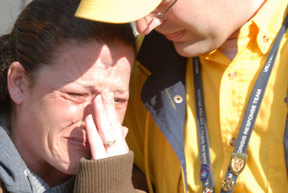
HALTOM CITY—As tears streamed down her face, Ruth Gunson found relief after a tornado, thanks to volunteers from Texas Baptist Men Disaster Relief and Victim Relief Ministries.

Gunson and her family are trying to pick up the pieces after a tornado uprooted trees and sent limbs more than five-feet in circumference into her house, leaving two gaping holes in its roof. 

“We have no electricity and no insurance, but we’re alive,” Gunson said.

Haltom City storm victim Ruth Gunson sheds tears as Texas Baptist Men remove storm damage and Victim Relief Ministries offer comfort after an April 13 tornado hit North Texas.

High winds, severe storms, heavy rain and a tornado killed two people and damaged more than 150 homes in Tarrant County.

Haltom City, just north of Fort Worth, experienced some of the worst damage. The storm left two churches in shambles, tore roofs off homes and heavily damaged a grocery store. Gunson, her husband and their 17-year-old daughter live in a house located almost directly behind the supermarket.

“We were watching Channel 4, and I saw (the tornado) … was going to hit the (Texas Motor Speedway) racetrack. I told my daughter to call her friend and warn him, because he was there,” Gunson said. “As soon as she got on the phone with him, I looked out the window and all of sudden it hit … real quick.”

She remembers shutting a back window, then running towards the front of the house to shut one there.

“But we didn’t have time. I ran back to the bedroom and pulled a mattress over us, and then my husband reached around for another mattress, and it was over,” she recalled.

Frantic and worried about her other children who were not at home, Gunson couldn’t get a phone signal to find out.

The day after the tornado, Gunson’s daughter stood on the street holding an empty plastic cereal container with a sign that read “Donations for Family.” Many motorists stopped to donate money for the family, who lack insurance.

The family found solace and hope in a team of Texas Baptist Men volunteers who spent hours strategically working to remove the huge tree limbs from their rooftop and cover the holes. Victim Relief Ministry chaplains assisted with clean-up efforts and provided counseling and pizza for the displaced family.

A volunteer team from Lake Pointe Church in Rockwall led by Joel Bachman worked atop damaged roofs removing huge tree limbs that dangled precariously. With climbing gear and special protective clothing, Bachman and teammate Ken Hull carefully maneuvered the trees down to the ground safely before sawing the wood into smaller sizes that volunteers could help remove.

The Sunday after the tornado touched down in Haltom City, more Texas Baptist Men volunteers moved in to help other storm victims.

“We had about 25 TBM volunteers turn out to help from Collin and Dallas Baptist Associations, including Plymouth Park Baptist Church in Irving,” said Gary Smith, TBM disaster relief director, noting volunteers from Tarrant Baptist Association also helped. “They manned chainsaws and helped families in Tarrant County remove tree limbs and other debris from the neighborhood.”


News of religion, faith, missions, Bible study and Christian ministry among Baptist churches, in Texas, the BGCT, the nation and around the world.


The Well Community singular in goal to work with mentally disabled

Posted: 4/18/07

The Well congregation has provided individuals with mental disabilities a place to worship and fellowship. (Photo courtesy of The Well)

The Well Community singular in
goal to work with mentally disabled

By Vicki Brown

Associated Baptist Press

DALLAS (ABP)—Joel Pulis, a Baylor University graduate now living in Dallas, recently was featured in People magazine for leading his church in a relatively new and singular mission—to reach poor people with mental disabilities.

Pulis, 33, refers to his flock of 50 at The Well Community not as a congregation but as a community of believers. His says his ministry focuses on being “a family, a people” for those suffering from brain dysfunctions like bipolar disorder and schizophrenia.

The Well Community began in 2002 with help from a grant from the Baptist General Convention of Texas. Pulis, who grew up attending the nearby Cliff Temple Baptist Church, has no specialized training for helping people with mental illness, but, after graduating from college, he soon realized there was a need for just that.

“We felt Cliff Temple could reach middle-class Baptists. The well metaphor drove us … to look at the people, not the church,” Pulis said. He was a minister to young adults at Cliff Temple before starting The Well.

Pulis found that a high percentage of Dallas residents with brain disorders live in Oak Cliff, Cliff Temple’s inner-city ministry area. Most live in public housing apartments or in overcrowded boarding homes.

The Well is first and foremost “a place where they know someone cares about them,” Pulis said. About 40 percent of the congregation is white, 40 percent is African-American, and 15 percent is Hispanic. Asians and Native Americans make up much of the rest.

Cliff Temple provided use of its fellowship hall and classroom space for a ministry area on Saturdays. The Well now rents space from the church in the community life center, which offers area for support groups, Bible study, recreation and vocational training. A café and a clothes closet are part of the community’s outreach as well.

Dallas-area Sunday school classes from Park Central Baptist Church, Park Cities Baptist Church and Forest Meadow Baptist Church have prepared and served meals for community members.

Pulis, who has been featured in the Dallas Morning News and CliffDweller magazine, says the community is not designed to give clinical help to members but to provide a support system of friends. According to a 2004 article in the Baptist Standard, the Well Community is the country’s only faith-based organization focused exclusively on low-income people living with mental illness.

The need is great. According to the Mental Health Association, Texas has 2.6 million mentally ill adults, many of whom have annual incomes of $10,000 or less.

Because they have trouble connecting to reality, individuals with mental disabilities often exhibit peculiar or inappropriate behavior that offends and repels many people.

“They are disenfranchised from themselves because they are not connecting to the world,” Pulis said. “They are psychiatric orphans … pushed away by family, either by something they did or because others don’t understand.”

People with mental disabilities become spiritual orphans for the same reasons. They are uncomfortable in a standard church service, and traditional congregations often are uncomfortable with their participation.

Pulis and his staff do what they can to make everyone comfortable. Housing is a Well Community priority—the ministry helps individuals find suitable apartments, and it currently operates one home for seven men. According to the Dallas Observer blog, the community operates on a budget of $190,000, which comes mostly from private donations.

The small budget seems not to inhibit the church’s effectiveness.

“There are many who had come looking for a hand-out who are now ministers themselves,” Cliff Temple Pastor Glen Schmucker said. The two congregations worship together a couple of times each year and partner in children and youth programs.

“They are wonderful people and have overcome many stereotypes,” Schmucker said. “They are very much a part of our identity, and we are a part of theirs.”


Hannah Elliott contributed to this story.


News of religion, faith, missions, Bible study and Christian ministry among Baptist churches, in Texas, the BGCT, the nation and around the world.


Virginia Tech students gather for prayer at Baptist campus center

Posted: 4/18/07

Virginia Tech students gather
for prayer at Baptist campus center

By Jim White

Virginia Religious Herald

BLACKSBURG, Va. (ABP)—As the sun began to set and the wind continued to howl over a wounded campus and city April 16, Virginia Tech students gathered for prayer, comfort and counseling at the school’s Baptist student center.

Blacksburg, the small city that houses the university’s 26,000-plus students, was even quieter than usual the night after a massacre unprecedented in American history. The gunman, who police said shot 32 students and professors and then took his own life, had also silenced the usually bustling activity on the commercial strips around the sprawling campus’s edges.

One of the few signs of life at Virginia Tech was an evening gathering at the school’s Baptist Collegiate Ministry Center, a ministry of the Baptist General Association of Virginia.

Although barraged with requests from national and foreign news outlets, Darrell Cook, the lead Virginia Baptist campus minister, focused his attention on the needs of students. By mid-afternoon the day of the shootings, he had invited two of the school’s other major Christian campus groups—Intervarsity and Campus Crusade for Christ—to join in prayer for the surviving victims and loved ones of those who died.

Before the gathering, Cook and ministry associate Mark Appleton counseled with the students who dropped by the Baptist center in search of solace or simply for a safe-feeling place to hang out.

Members of area churches began stopping by with pizza for the students. Some reported that the owner of the pizzeria didn’t want to accept payment for the pizzas. They insisted on paying.

Area pastors were on the scene, too, bringing a sense of calm to a chaotic time. Tommy McDearis, pastor of Blacksburg Baptist Church, who is also chaplain of the local police force, spent much of the day at the hospital. The church is located directly across the street from the Tech campus, and has served as the church home for generations of Hokie students, faculty members and administrators.

When it was time for the prayer service to begin, students began to drift in, in groups of twos and threes, slowly at first and then in a virtual torrent of troubled young men and women. They grouped themselves naturally into fives and sixes throughout the center. The first question on nearly everyone’s lips was: “Is anybody missing?”

Most of the students had spent a large part of the day tracking down friends and acquaintances making sure they were all right. When their own groups proved intact, they then began to expand their circle of concern to include classmates. As the evening progressed, names of people not accounted for began to surface—referred to simply as “the missing.”

As of 6 p.m. the day of the shooting, Appleton said he was not aware of any students involved in the Baptist campus ministry who had been killed or injured.

Officials later identified the gunman as 23-year-old English student Cho Seung-Hui.

As the groups of students at the ministry center dissolved and re-formed, sharing information and concern, some students openly wept. Many prayed. All hugged. They needed, it seemed, not just to be “in touch” with friends but actually, physically to hold on to each other.

The most common reason students gave for wanting to attend the gathering was: “I just wanted to be with people I care about.” Other students spoke of their need to support other students and be supported by them.

One student remarked that he had come just to be quiet. He had spent the day furiously tracking down his friends and answering his cell phone assuring family members, friends from home, and campus acquaintances that he was safe. Now, at the end of the day, he needed to sit on the floor with two of his friends and be quiet.

Greg Alexander, a collegiate ministry strategist, and Darrell Fletcher, a Virginia Baptist field strategist, circulated among students along with Cook and Appleton. Two crisis-ministry volunteers were there to provide comfort.

Members of Northstar Church, a Baptist congregation in Blacksburg , also were there, helping as they could. Jennifer Kincaid, director of the church’s women’s ministries, coordinated the food. Matt Morris, who earned his doctorate from Virginia Tech and works as a family therapist, counseled informally. Others were simply available to listen to students when they felt like talking.

Some students spoke of how difficult it will be to return to class and how their sense of serenity and security has been destroyed. Not surprisingly on a campus renowned for its engineering program, some shared a perspective expressed by senior Kevin Prussia. He referred to the statistical unlikelihood of such an unspeakable tragedy every taking place on the Tech campus again.

As the service began in the center’s chapel, student who could get in sat on the floor while others stood in the back, filling the aisle and doorways. Many others, unable to get close enough to hear or see, continued their conversations in other parts of the center.

Even after the worship time ended, students continued to talk well into the night. Many stayed at the center while others returned, usually in groups, to dorm rooms, apartments or area restaurants.

Over sandwiches and ice cream, the president-elect of Tech’s Baptist Campus Student Ministries strategized with two friends about how to answer questions students will inevitably ask. Chad Wallace, a junior and member of First Baptist Church of Newport News, Va., and his friends also wondered how to best share their faith in the aftermath of the campus tragedy.

“I’ve seen Christians take advantage of people’s grief, and I don’t want to do that,” Wallace said. “I want to respect them and what they are going through, but I also want to point them to Christ.”

Cook, Appleton, Wallace and area church ministers are not sure what will happen in the aftermath of the massacre. But they said they are ready to respond with the love of Christ.


Robert Marus of ABP contributed to this story.


News of religion, faith, missions, Bible study and Christian ministry among Baptist churches, in Texas, the BGCT, the nation and around the world.


Texas Baptist Forum

Updated: 4/16/07

Texas Baptist Forum

God & Allah

Please let me add my two cents’ worth to the discussion concerning God and Allah

Letters are welcomed. Send them to marvknox@baptiststandard.com; 250 words maximum.

“Our humanity is diminished when we have no mission bigger than ourselves. … We discover who we are in service to one another, not the self.”
Bono
U2 frontman, urging aid and debt relief for Africa (Time)

“Many evangelicals are boarding a new train. It runs along tracks defined by the broad demands of their faith, not by some party’s political agenda.”
E.J. Dionne
Washington Post columnist, writing about how some evangelicals are in the midst of a “New Reformation” that separates them from partisan politics (RNS)

“Every politician says, ‘God bless America.’ But do you really mean that? If you don’t, maybe we should start saying, ‘Have a good day,’ or something like that.”
J. Randy Forbes
U.S. congressman, R-Va. (Washington Times/RNS)

To me, it’s quite simple. In Exodus 3:6, God identifies himself to Moses: “I am the God of your fathers, the God of Abraham, the God of Isaac and the God of Jacob.”

Do Muslims worship this God? Clearly, they do not, because they worship the God of Ishmael, not Isaac.

I can accept the idea that Christians and Jews worship the same God. Most Jews simply don’t yet recognize Jesus as God the Son, the Messiah. But Christians and Muslims do not worship the same God. Allah is not God.

Larry Burner

McKinney


Not so Sweet

I cannot keep silent about Leonard Sweet’s “mantra” that God is “defragging and rebooting” the church and we are to “deal with it, get over it or get help” (March 5). Sweet even purported that “culture has rejected traditional institutions, so the church must change”!

It is alarming how fast “postmodern” churches are buying in to this skewed philosophy as they sweat to keep up with today’s culture. In come coffee bars and ATMs, out go hymnals and denominational name, programs replace prayer meetings and “ministry” is tagged onto everything from entertainment to vacations. Pastors are often CEOs, and sermons are often orchestrated presentations based on the latest best-seller with anemic references to Scripture. We sing repetitious ambiguous words devoid of true theology, and we applaud the performances of man rather than the God of our salvation. Naming sin is taboo, and our pews are playpens for baby Christians who have been nursed on easy-believism.

Rather than change with the culture, the church must influence culture. That influence will be felt when America’s pastors stand firm, fear God and faithfully proclaim salvation’s story unapologetically. The Apostle Paul’s fundamental admonition to Timothy is still true: “Preach the word; be instant in season and out of season,” regardless of the climate of the ever-changing “culture.”   

To use a variant of Sweet’s verbiage, God may be getting ready to “defrag and reboot” the pulpit. It is certain that culture will not change the day of reckoning.

God help our pastors!

Karen Stebbins

Garland

Carter & Covenant

Proponents of the coming January 30-February 1, 2008 “Celebration of a New Baptist Covenant” are displaying a great deal of faith . . . in former President Carter, that is. The only thing more disconcerting to me as a Baptist than being identified with a new Carter-called Baptist movement would be to have the fomer President teaching my Sunday School class.

When recently asked by Newsweek magazine, “Do you think a Mormon is a Christian?”, Carter's reported reply was, “Yes, I do. I have a cousin who is a Mormon and she married one of the Marriott family. I don't know anyone who's more devout in their faith than she and her family. I admire them very much.”

In the same interview, Carter indicated that teaching religion in public schools “to compare Christianity with Judaism and Islam and Hinduism and so forth, would be constructive. It would show that there is a compatibility among them all. I can't claim to be a scholar, but when our hostages were being held by Iran when I was president, I read the Quran, and I had Islamic scholars come and talk to me. The basic human-behavior principles were the same. The Islamic Bible, the Quran, teaches peace and justice and care for one's neighbor and helping the poor.”

Will a distinct Baptist witness be heard in this new movement? To me, it sounds like Carter's new “prophetic Baptist voice” could just as well be Isamic or Mormon.

Chuck Pace

Lake Jackson


News of religion, faith, missions, Bible study and Christian ministry among Baptist churches, in Texas, the BGCT, the nation and around the world.


Board fires Missouri Baptists’ embattled executive director

Updated: 4/14/07

Update: Embattled Missouri exec
fired in closed meeting

By Vicki Brown

Associated Baptist Press

JEFFERSON CITY, Mo. (ABP) – In a split 44-7 vote, the Missouri Baptist Convention Executive Board fired its top administrator, David Clippard, April 10.

Clippard, who assumed duties as executive director Sept. 9, 2002, was terminated in a four-hour, closed-door session — the culmination of a growing rift between two conservative factions within the state convention.

According to people in the meeting, convention attorney and spokesman Michael Whitehead summed up the reason for Clippard’s termination as a lack of confidence in his ability to continue in the top position. The attorney said that although the decision did not come as a complete surprise to the executive director, Clippard was still “hurt and shocked” by the outcome.

David Clippard

A meeting of the board in September turned into a showdown between Clippard and Roger Moran, the convention's fundamentalist powerbroker and leader of the Missouri Baptist Laymen’s Association, which is credited with steering the Missouri convention's rightward shift.

Convention president Michael Green, pastor of Calvary Baptist Church in Republic, Mo., referred all questions to Whitehead. The attorney would not release information about a severance agreement. He noted that an official statement was to be offered later that evening. However, nothing had been posted on the convention’s website or on its news journal’s site as of April 11.

An edited version of the committee’s report is supposed to be released before the end of the week. Individual names and sensitive personnel and legal information will be removed from the report, Whitehead explained.

In a brief meeting with reporters, the attorney characterized board members as “very passionate” but “respectful” during the executive session.

Before closing the meeting to outsiders, Green reminded board members that he would not tolerate rude and disrespectful behavior, referring to the raucous September session concerning Clippard, in which members shouted at one another.

“We are not going to act like a bunch of monkeys in the St. Louis zoo…. I am not going to let people get away [with similar behavior]…. We have got to work together,” the president said.

Board member Don Denney urged the Executive Board to override Green’s decision to close the meeting to the public. But after Whitehead reminded them that personnel issues, including a legal contract, were involved, board members affirmed the chair.

Associate executive director David Tolliver was named as interim executive effective immediately. A search committee for Clippard's replacement was not named.

Tolliver met privately with convention staffers for about half an hour to inform them of the board’s decision before the announcement was made public in an afternoon open session. Although open to other news writers, the Associated Baptist Press representative was not allowed to attend that meeting.

Some 25 to 30 Missouri Baptist pastors, directors of missions, and laypeople in attendance were not allowed to speak before the meeting was closed, even though board member Wayne Isgriggs urged Green to allow them to do so. The board also did not give them an opportunity to speak during the open session.

Clippard had been at odds with some Executive Board members, as well as Moran, for more than a year. Some Clippard critics were upset that the executive director opposed an Executive Board decision last April to tap reserve funds for a $200,000 contribution to Midwestern Baptist Theological Seminary.

Some were reportedly upset that Clippard also opposed the board’s commitment of up to $150,000 for the convention's Christian Life Commission to oppose a stem-cell-research amendment to the state’s constitution, which Missouri voters approved in November.

The executive director also drew some ire for allegedly firing Bob Baysinger, managing editor of the convention news journal, The Pathway, after the paper revealed details of a secret contingency contract to sell the Baptist Building property to Cole County in August 2004 for the site of a new justice center. The deal fell through when county voters turned down a proposed tax increase to fund the project.

Last April, the Executive Board stripped Clippard of supervision of The Pathway editor Don Hinkle, placing him under board control. That move also upset some Clippard supporters.

Settlement of a harassment suit filed by former convention controller Carol Kaylor in 2003 and misunderstandings with Missouri Woman’s Missionary Union also contributed to Clippard’s firing.

According to several sources, battle lines between Clippard and Moran supporters became more apparent following Clippard’s 2006 evaluation in July. The evaluation committee called for a meeting between the executive director and Moran, who served as chair of the convention’s powerful 2006 nominating committee.

Billed as a “unity and reconciliation meeting,” Executive Board members and a few selected former convention presidents met with Moran and Clippard behind closed doors Sept. 22.

The growing rift between conservative factions took a public turn at the 2006 annual meeting in Cape Girardeau in October when a move was made to replace outgoing president Ralph Sawyer, a nominating committee selection to the Executive Board, with former convention president Gerald Davidson.

Although Davidson removed his name from consideration, he later called for an end to Moran’s Missouri Baptist Laymen’s Association, the organization credited with the convention’s conservative turn.

Despite his termination, board members credit Clippard with restructuring and streamlining convention operations, with improving the convention’s financial position and with focusing on evangelism and church planting.

In a brief interview, Tolliver said he plans to continue the evangelism and church planting focus.

“This is another time of life that I feel like … I’m not ready for the task,” he said. “My goal is to have staff and convention unification, to unify the staff and to work for unifying the convention.”


—Vicki Brown is a free-lance reporter working for Associated Baptist Press. This story updates one released by ABP April 10.


News of religion, faith, missions, Bible study and Christian ministry among Baptist churches, in Texas, the BGCT, the nation and around the world.


Southwestern Seminary files motion against dismissed professor’s suit

Posted: 4/16/07

Southwestern Seminary files motion
against dismissed professor’s suit

By Hannah Elliott

Associated Baptist Press

FORT WORTH– Southwestern Baptist Theological Seminary has filed a motion in federal court to dismiss the gender-discrimination lawsuit that former professor Sheri Klouda brought against the school.

The motion argues the suit should be dismissed because seminary officials’ decision to dismiss Klouda is protected by the First Amendment.

“The seminary’s relationship with its professors has been held by the Fifth Circuit Court of Appeals to be the same relationship as a church with its ministers,” the motion said. “Any decision the seminary may take regarding the employment of one of its professors is an ecclesiastical decision, which this court is bound to accept out of deference for the free exercise of religion, protected by the First Amendment.”

The motion also refuted each of Klouda’s claims of breach of contract, fraud, defamation, and promissory estoppel

Klouda, who was hired in 2002 to teach Hebrew in a tenure-track position at the Fort Worth school, lost her job last year, allegedly because of her gender. She sued the school March 8.

In the suit, Klouda said Paige Patterson, who became Southwestern’s president in 2003, personally assured her the advent of his administration would not jeopardize her position. However, school officials told her in 2004 she would not get tenure.

Van McClain, chair of the school’s board of trustees, explained in a letter posted on a Southern Baptist blog that Klouda “did not have tenure and, like hundreds of professors around the U.S. every year, was told that she would not be awarded tenure.”

Public outcry at the dismissal, reported not only in Baptist news outlets but also in the Dallas and Fort Worth daily newspapers, the Associated Press and Religion News Service, has given the issue unexpected national prominence.

The seminary terminated Klouda’s contract in December 2006, and she now teaches at Taylor University in Upland, Ind.


News of religion, faith, missions, Bible study and Christian ministry among Baptist churches, in Texas, the BGCT, the nation and around the world.


Mission Waco volunteers offer pure water, living water

Updated: 4/13/07

Workers drill a new water well for Ferrier, Haiti. A new drilling rig should arrive within a few weeks, thanks primarily to Woman’s Missionary Union and its Pure Water Pure Love initiative. (Photos courtesy of Mission Waco)

Mission Waco volunteers
offer pure water, living water

By Ken Camp

Managing Editor

WACO—Sixteen Mission Waco volunteers recently provided food, medical care and a source of clean water for a village in Haiti and—just as important to the mission trip’s sponsors—gained a new perspective on ministry among some of the poorest people in the Western Hemisphere.

“Our mission is two-fold. We want to provide holistic, relationship-based programs that empower the poor and the marginalized. We also want to mobilize middle-class Americans to become more compassionately involved in ministry among the poor,” said Mission Waco Executive Director Jimmy Dorrell.

Waco physician Rafael Perez worked with local health-care providers and Mission Waco to provide a clinic in Ferrier, Haiti, where medical professionals treated more than 100 patients in three and a half days.

“These exposure trips are always high impact, and certainly this one was transformative for those who went,” including a half-dozen college students from Baylor University, Texas Tech and at least one school in Alabama, he noted.

Mission Waco makes annual treks to Haiti, and it also offers mission exposure trips to Mexico City and to India, where volunteers work among a largely unchurched people group.

The recent Mission Waco team served in Ferrier, a village where Dorrell and his wife, Janet, lived in the mid-1980s and worked closely with Texans Ed and Mary Brentham of Belton. They used the same drilling rig Brentham secured more than 20 years ago to drill a new water source for the village.

“Clean water is one of the most precious commodities for this nation that often resorts to bacteria-infested river water to drink,” Dorrell said.

But in the near future, Christian workers in the area should find it easier to provide additional water sources. Within the next month, new drilling equipment should arrive in Haiti, thanks largely to grants from Woman’s Missionary Union and its Pure Water Pure Love initiative, he noted.

Waco physician Rafael Perez worked with local health-care providers and Harry Porter, a pharmacist who serves with the Medical Ambassadors International missions organization, to provide a clinic where they treated more than 100 patients in three and a half days. They also delivered more than $20,000 worth of donated medicine and served beans and rice to more than 600 people.

Volunteers also led classes at Berraca Baptist Church on nutrition, basic hygiene and how adherence to biblical standards of sexual behavior could virtually eliminate the risks of HIV/AIDS and sexually transmitted diseases.

“Haiti is second only to sub-Saharan Africa in terms of the high infection rate of HIV/AIDS,” Dorrell noted.


News of religion, faith, missions, Bible study and Christian ministry among Baptist churches, in Texas, the BGCT, the nation and around the world.


Evangelical leaders join broad coalition urging immigration reform

Updated: 4/13/07

Evangelical leaders join broad
coalition urging immigration reform

By Robert Marus

ABP Washington Bureau

WASHINGTON (ABP)—A bipartisan array of Congress members and evangelical leaders exhorted their colleagues March 29 on the moral necessity of immigration reform.

Leaders from across the ideological spectrum—from Sens. Edward Kennedy, D-Mass., and Lindsey Graham, R-S.C., to Southern Baptist public policy agency executive Richard Land—held a Capitol Hill press conference to call on Congress and President Bush to institute immigration reform.

They said any such reform should both secure American borders and treat justly the estimated 12 million illegal immigrants currently living in the United States.

“At the bottom of this whole debate and discussion, this is a moral issue—a moral question, deeply moral,” said Kennedy, who called the Capitol Hill press conference and who has led a long fight for immigration reform.

“One of my very favorite provisions in the Bible is Matthew 25, when the good question that is put by the Lord is, ‘What have you done for the least of these?’“ Kennedy said, noting that Jesus calls his followers to aid “the stranger.”

He also noted passages in the Old Testament law in which God commanded ancient Hebrews to welcome “aliens among you.”

Congress took up immigration-reform legislation last year, but it became bogged down from internal struggles in the then-Republican majority.

The party was torn between anti-immigration hardliners and those, including President Bush, who wanted more comprehensive reform.

The comprehensive reform would have included opportunities for undocumented workers in the United States to earn permanent status and start the process toward citizenship.

Some conservatives have objected to such provisions in Bush’s plan. They call such plans “amnesty” for illegals.

But Land, president of the SBC’s Ethics and Religious Liberty Commission, told reporters such terminology clouds the debate.

“The idea that you would call having to learn to read and write and speak English and you would have to go through a series of processes … to earn legal status and citizenship—it does great harm to the English language to call that ‘amnesty,’“ he said.

Legislators at the press conference expressed hope that a reform bill will make it through the new Congress.

Reps. Luis Gutierrez (D-Ill.) and Jeff Flake (R-Ariz.) have introduced a bipartisan bill in the House. Kennedy said he believes the Senate will take up similar legislation when the chamber returns from its Easter recess.

Graham, a Southern Baptist, told reporters Congress is closer than he’s ever seen to passing immigration reform.

“I am more encouraged than I ever have been on this particular issue that the Congress is coming together, with help from the administration, to create some legislation that will make America safe (and) secure, and we can still say at the end of the day that we’re America,” he said.

“There is a way to hold people accountable for breaking the law and still have a just result. Because if the law doesn’t render justice, what good is it?”

The Gutierrez-Flake bill is known as the “Security Through Regularized Immigration and a Vibrant Economy Act of 2007,” or the STRIVE Act. It is H.R. 1645.


News of religion, faith, missions, Bible study and Christian ministry among Baptist churches, in Texas, the BGCT, the nation and around the world.