Mercer conference focuses on ending modern slavery

MACON, Ga. (ABP)—In the face of the world’s fastest-growing crime—the enslavement of an estimated million people every year—Lauran Bethell had some simple advice for participants at Mercer University’s recent conference on human trafficking: “Just show up.”

Bethell, an American Baptist Churches USA global-ministry consultant, said advocates must begin with the victims, ministering to their greatest immediate need and working on that until they can work on the next need, and then the next. Victims have a spark within them, she said, and the resiliency of the human spirit will help to heal them if they can be reached and given hope for the future.

“The healing process is long, it is arduous and there are often many, many, many curves along the path, but we must continue to simply show up in the lives of people, to accept them, to care for them, to listen to them no matter what,” Bethell said. “For no matter how long it takes, no matter how things don’t go the way that we wish. No matter what: just show up.”

Participants listen to anti-human-trafficking activists during a recent Mercer University conference. (PHOTO/Mercer)

Bethell, recipient of the Baptist World Alliance Human Rights Award, spent the past 20 years fighting sex trafficking — first in Thailand, then in Eastern Europe. She told the audience she had stayed sane despite working some of the “darkest situations on Earth” by following the example of her leader, Jesus, who went to the dark places of his time because it was the right thing to do. Using the Bible’s example of the “woman of ill repute,” to whom Jesus ministered in Samaria and who later became one of his greatest advocates, Bethell said Jesus was the ideal example of showing up — as was his Samaritan apostle.

“She’s an example of showing up. Showing up in places where even the disciples raised their eyebrows,” Bethell said. “What would Jesus’ solution be in our time, in our century, of modern-day slavery? I know one thing: He’s sure pleased with what you have all done today, just shown up. He’s sure pleased with what we have seen today, people sacrificing time and energy to learn from each other and participate together in seeking solutions.”

A diverse group of more than 800 people were following her advice in attending the conference, held March 19-20 on Mercer’s Macon, Ga., campus. They came to learn about the problem of modern-day slavery and how they could help defeat it. The student-led conference, titled “STOP Sex Trafficking: A Call to End 21st Century Slavery,” included presentations by anti-trafficking advocates from around the state, the country and the world.

According to the State Department, more than a million women and children are trafficked into sex slavery each year — often forced by economic circumstances into prostitution’s horrors. Nearly 20,000 are trafficked annually into the United States, and many of these victims are trafficked into the Southeast. Mercer students in STOP, the Sex Trafficking Opposition Project, organized the conference to counter the growing worldwide crisis.

Lauran Bethell

Among the presenters were trafficking survivors Kika Cerpa and Joana Santos. In a pattern typical of trafficking, both were lured to the United States under false pretenses and told they owed large debts for their transportation after they arrived.

Santos, who was pregnant and had paid for most of her own trip, managed to hold off her tormentors and free herself. In the process, she brought down the ring that had enslaved other girls from her native Brazil.

Cerpa, who accrued a debt from her trip to New York from Venezuela, was not as lucky. She endured terrifying years as a sex slave in brothels around New York City — including three convictions for prostitution — only escaping after she got a judge to listen to her harrowing story.

“I was punished by the system and by society,” Cerpa said, highlighting a major issue in trafficking, particularly in the United States: that the legal system is only beginning to recognize that women like Cerpa are being pimped to pay false debts, rather than working by choice as prostitutes.

The system needs to change its focus in regards to trafficking, said Dorchen Leidholdt, co-executive director of the Coalition Against Trafficking in Women and Sanctuary for Families, the group that helped Cerpa.

“Most states have laws against prostitution that are often used against prostituted people. That is the problem with people who are trying to access the criminal-justice system,” Leidholdt said. “Most states have laws against patronizing a prostitute. Those laws are, generally, rarely enforced. All of the energy of our criminal-justice system — all of the resources — go to arrest prostituted people.”
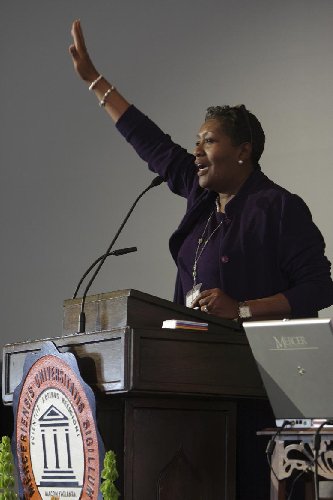
Alesia Adams

Addressing those disparities, particularly in the United States, is the goal of the Polaris Project. Bradley Myles, deputy director of Polaris, presented some ways to target the problem. The approach to sex trafficking is three-fold, he said, focusing on prevention by targeting the men who frequent brothels, adding protection for the victims and increasing punishment for traffickers.

Myles explained that the legal definition of sex trafficking includes both transporting victims for sex and simply coercing someone into sex with others. He also highlighted some of the myths about trafficking.

“Don’t get boxed into thinking it’s just foreign people [who are trafficked in the United States] or that trafficking requires transportation,” Myles said.  “The term trafficking simply denotes trade — buying or selling.”

One of the areas that has the highest incidence of trafficking in the United States is Atlanta, and the problem there often involves American teenagers who are runaways. Girls at homeless shelters are approached by a pimp within the first 72 hours, according to city officials. Alesia Adams, who is the sexual-trafficking-prevention coordinator for the southern U.S. region of the Salvation Army, said it is important to realize the problem isn’t just international. “This isn’t a Third-World problem anymore; it’s in your backyard,” Adams said. “Dropping your child off at the mall alone has become the same as dropping them off at Beirut.”

The issue is also one of basic human rights, said Donna Hughes, a professor of women’s studies at the University of Rhode Island and a longtime anti-trafficking advocate. In approaching new ways to fight human trafficking, Hughes said focusing on perpetrators would be the best way to go forward, which would take the burden off the victims and stop the judgment inherent with any case of prostitution.

“We need to add a perpetrator-focused approach,” Hughes said.  “We need to reform our laws so that we are targeting the perpetrators’ activities.”


–Mark Vanderhoek is director of media relations at Mercer University.

Related ABP stories:

Modern slavery global scourge, speakers tell CBF supporters (6/23/2008)

Missionary visits red-light district in Prague to pray with prostitutes (2/22/2007)


Death penalty opponents hope book will help end executions

NEW YORK (RNS)—Religious opponents of the death penalty hope a new book about a Texas death row case by a best-selling author can help their efforts to end the practice of state-sanctioned executions.

Thomas Cahill’s just-published book, A Saint on Death Row, chronicles the life of Dominique Green, who at age 30 was executed by lethal injection in 2004 for his role in a robbery that resulted in one man’s death. The victim’s family asked that Green’s life be spared, but he was executed anyway.

“Dominique Green’s was one of the many needless Texas executions,” said Cahill, the author of such best-selling books as How the Irish Saved Civilization and The Gifts of the Jews.

Among those championing the case of Green, who underwent what has been described as a sincere embrace of the principles of nonviolence, was Archbishop Desmond Tutu, the Nobel Peace Prize laureate.

Tutu, long a proponent of nonviolence and forgiveness, became a hero to Green and visited the young man while Green was on death row.

At a recent appearance with Cahill at New York’s Riverside Church, Tutu upbraided the United States for its continued practice of the death penalty. The South African cleric noted the United States, were it a European country, could not join the European Union because the EU bars membership to nations that condone the death penalty.

“Why do you do this?” Tutu asked. “What are you doing to yourselves, you wonderful, generous people? You are brutalizing yourselves. … It is making you an obscene nation.”

David Atwood, founder of the Texas Coalition to Abolish the Death Penalty, told the Riverside audience he and other death penalty opponents in Texas, many acting out of religious convictions, realize they are fighting an entrenched “system of death,” but remain hopeful that ultimately the death penalty will end in Texas.

Texas leads the nation in the number of executions. Atwood said 435 have been carried out in the state since 1982. Twelve have been carried out this year, with the latest occurring the day Cahill and Tutu spoke at Riverside.


Death penalty opponents hope book will help end executions

NEW YORK (RNS)—Religious opponents of the death penalty hope a new book about a Texas death row case by a best-selling author can help their efforts to end the practice of state-sanctioned executions.

Thomas Cahill’s just-published book, A Saint on Death Row, chronicles the life of Dominique Green, who at age 30 was executed by lethal injection in 2004 for his role in a robbery that resulted in one man’s death. The victim’s family asked that Green’s life be spared, but he was executed anyway.

“Dominique Green’s was one of the many needless Texas executions,” said Cahill, the author of such best-selling books as How the Irish Saved Civilization and The Gifts of the Jews.

Among those championing the case of Green, who underwent what has been described as a sincere embrace of the principles of nonviolence, was Archbishop Desmond Tutu, the Nobel Peace Prize laureate.

Tutu, long a proponent of nonviolence and forgiveness, became a hero to Green and visited the young man while Green was on death row.

At a recent appearance with Cahill at New York’s Riverside Church, Tutu upbraided the United States for its continued practice of the death penalty. The South African cleric noted the United States, were it a European country, could not join the European Union because the EU bars membership to nations that condone the death penalty.

“Why do you do this?” Tutu asked. “What are you doing to yourselves, you wonderful, generous people? You are brutalizing yourselves. … It is making you an obscene nation.”

David Atwood, founder of the Texas Coalition to Abolish the Death Penalty, told the Riverside audience he and other death penalty opponents in Texas, many acting out of religious convictions, realize they are fighting an entrenched “system of death,” but remain hopeful that ultimately the death penalty will end in Texas.

Texas leads the nation in the number of executions. Atwood said 435 have been carried out in the state since 1982. Twelve have been carried out this year, with the latest occurring the day Cahill and Tutu spoke at Riverside.


Do churchgoers like Web porn? Not on Sunday, study reveals

BOSTON (ABP)—According to a new study, people who live in states with high church-attendance rates buy as much Internet pornography as their more secularized counterparts—but they are less likely to subscribe to an adult website on Sundays.

Researcher Benjamin Edelman said subscriptions to a top-10 seller of online adult entertainment he studied are not statistically different in pious states from subscription rates elsewhere, but significantly fewer subscriptions in religious states are purchased on the Christian Sabbath.

“This analysis suggests that, on the whole, those who attend religious services shift their consumption of adult entertainment to other days of the week, despite on average consuming the same amount of adult entertainment as others,” Edelman, an assistant professor of business administration at Harvard Business School, wrote in the study.

Studies of Americans’ beliefs generally reveal some of the highest levels of religiosity in the developed world. For example, 68 percent of Americans say the Bible is the word of God and is to be taken literally. At the same time, social critics have argued the rise of Internet pornography is contributing to a coarsening of American culture.

Edelman, an expert in electronic commerce, set out to learn if consumption patterns of adult entertainment would reveal two separate Americas, or if porn consumption is widespread regardless of factors such as moral conservatism and religious conviction.

Edelman analyzed anonymous credit-card purchases of online porn by ZIP codes and factored in the availability of broadband Internet access in the surveyed areas. Broadband connections allow faster downloading of images and video, and broadband users outnumber narrowband customers on adult sites 18 to 1.

Edelman found online porn more prevalent in states whose residents tended to express conservative religious views in studies, such as agreeing with the statements, “I never doubt the existence of God.”

“Some of the people who are most outraged turn out to be consumers of the very things they claimed to be outraged by,” Edelman said in an article in New Scientist magazine.

The biggest per-capita consumer of online porn is Utah, home of the Church of Jesus Christ of Latter-day Saints. That state averaged 5.47 adult-content subscriptions per 1,000 home-broadband users.

Six of the top-10 states for porn-subscription rates are familiar territory for Baptists.

Mississippi, the state with the highest concentration of Southern Baptist churches, ranked third with 4.30 subscribing homes per 1,000, between Alaska at 5.03 and Hawaii at 3.61. Oklahoma ranked fifth at 3.21, followed by Arkansas at 3.12, North Dakota at 3.05, Louisiana and Florida at 3.01 and West Virginia at 2.94.

The study said Americans spend $2.8 billion a year for online porn.


Do churchgoers like Web porn? Not on Sunday, study reveals

BOSTON (ABP)—According to a new study, people who live in states with high church-attendance rates buy as much Internet pornography as their more secularized counterparts—but they are less likely to subscribe to an adult website on Sundays.

Researcher Benjamin Edelman said subscriptions to a top-10 seller of online adult entertainment he studied are not statistically different in pious states from subscription rates elsewhere, but significantly fewer subscriptions in religious states are purchased on the Christian Sabbath.

“This analysis suggests that, on the whole, those who attend religious services shift their consumption of adult entertainment to other days of the week, despite on average consuming the same amount of adult entertainment as others,” Edelman, an assistant professor of business administration at Harvard Business School, wrote in the study.

Studies of Americans’ beliefs generally reveal some of the highest levels of religiosity in the developed world. For example, 68 percent of Americans say the Bible is the word of God and is to be taken literally. At the same time, social critics have argued the rise of Internet pornography is contributing to a coarsening of American culture.

Edelman, an expert in electronic commerce, set out to learn if consumption patterns of adult entertainment would reveal two separate Americas, or if porn consumption is widespread regardless of factors such as moral conservatism and religious conviction.

Edelman analyzed anonymous credit-card purchases of online porn by ZIP codes and factored in the availability of broadband Internet access in the surveyed areas. Broadband connections allow faster downloading of images and video, and broadband users outnumber narrowband customers on adult sites 18 to 1.

Edelman found online porn more prevalent in states whose residents tended to express conservative religious views in studies, such as agreeing with the statements, “I never doubt the existence of God.”

“Some of the people who are most outraged turn out to be consumers of the very things they claimed to be outraged by,” Edelman said in an article in New Scientist magazine.

The biggest per-capita consumer of online porn is Utah, home of the Church of Jesus Christ of Latter-day Saints. That state averaged 5.47 adult-content subscriptions per 1,000 home-broadband users.

Six of the top-10 states for porn-subscription rates are familiar territory for Baptists.

Mississippi, the state with the highest concentration of Southern Baptist churches, ranked third with 4.30 subscribing homes per 1,000, between Alaska at 5.03 and Hawaii at 3.61. Oklahoma ranked fifth at 3.21, followed by Arkansas at 3.12, North Dakota at 3.05, Louisiana and Florida at 3.01 and West Virginia at 2.94.

The study said Americans spend $2.8 billion a year for online porn.


Ministries offer help for Christians with porn addiction

FRESNO, Calif. (RNS)—Every February, SouthPoint Foursquare Church reminds young members that “True Love Waits,” as part of a global campaign launched by Southern Baptists that stresses abstinence until marriage.

A few days after Valentine’s Day this year, 80 teenagers and some parents attended the church’s weekly youth night to hear a related message: Jesus loves porn stars, but looking at pornography makes it much harder to find him.

“We feel that church should be the first ones to talk to you guys about this. If you have a problem with porn, you’ve got to talk to God, and you’ve got to go to someone you can trust,” said Brandon Piety, the guest speaker from XXXChurch, an organization aimed at helping Christians overcome pornography addictions.

About half of the traffic to the organization’s website comes from people who are searching for a different kind of XXX experience, which leaders considers a good outreach strategy.

Brandon Piety of XXXChurch, a Christian group that tries to help people overcome pornography addictions, spoke about his mission at SouthPoint Foursquare Church in Fresno, Calif. (RNS PHOTO/Nicole Neroulias)

Previous generations had to seek out magazines or movies, but now hardcore content is available anytime, free of charge, to anyone with Internet access.

Responding to this increased accessibility, affordability and anonymity, faith-based organizations now offer their own strategies for overcoming pornography addictions, targeting evangelicals and others who consider the images sinful.

According to statistics compiled by Baylor University, about half of observant Christians consider pornography a major problem in their households. The problem is not limited to lay members; a 2002 survey of pastors by Rick Warren of California’s Saddleback Church found in one month, 30 percent had viewed pornography.

Some Christians consider just having lustful thoughts shameful, let alone spending hours viewing X-rated images.

This makes them especially vulnerable, both as potential addicts and as people too embarrassed to seek help, said Roderick Hetzel, a psychologist at Baylor, which launched a pornography resource at its counseling center three years ago.

“Whatever you’re keeping secret tends to control you,” he said. “In the past, churches either just condemned the behavior and therefore the people, or ignored the issue.”

It’s hard to say whether more Christians are addicted to pornography now, or just more comfortable admitting their problems due to the growing outreach efforts, he added.

While Internet companies have offered filtering programs for years, Christian anti-pornography groups such as XXXChurch and Covenant Eyes have pioneered software that creates “accountability partners”—such as a pastor or spouse—who receive an e-mail report when the user visits an adult-oriented website.

Mark Larson, 29, a youth leader at SouthPoint, endorses this method, and he and his wife have offered to serve as accountability partners for the church’s teens. As pornography becomes more prevalent in society, he said, teenagers and preteens must be taught to avoid it, through prayer and counseling.

Business has boomed for Freedom Begins Here, the 3-year-old organization that sells toolkits with video testimonials, Covenant Eyes software and other anti-porn information to churches and Christians across the country.

About 400 groups and more than 1,000 individuals across the country have purchased the kits; they expect to sell 20,000 more this year, said Pastor Ted Cunningham, a spokesman for the Arkansas-based organization.

“People believe that the church protects us from sexual addiction, but it doesn’t,” he said. “The church is finally getting to a point where we realize we’ve got to start talking about this.”

The advanced software programs, video testimonials and dedicated church events are long overdue, agree recovering porn addicts like Pastor Bernie Anderson, who struggled in silence during the 1990s.

He ended up getting help through Every Man’s Battle, a book and workshop, but said the options available today make it easier to seek out help.

Anderson, 38, a minister at the Wasatch Hills Seventh-day Adventist Church in Salt Lake City, Utah, chronicled his seven-year addiction in his book, Breaking the Silence: A Pastor Goes Public about His Battle with Pornography. In his sermons, he stresses the need to talk about sexual addictions openly, as a preventive measure.

“Christian communities in general have avoided the topic of sex and sexuality, and it’s made us more susceptible to some of these issues,” he said.

In addition to the faith-based resources available, Hetzel recommends that porn-addicted Christians seek professional counseling to get to the root of their problems.

“Sexually addictive behaviors usually aren’t just about sex,” he said.

“A lot of people have underlying fears about intimacy and vulnerability that they need to work through. That person would need more than a filtering system or an accountability partner.”


Ministries offer help for Christians with porn addiction

FRESNO, Calif. (RNS)—Every February, SouthPoint Foursquare Church reminds young members that “True Love Waits,” as part of a global campaign launched by Southern Baptists that stresses abstinence until marriage.

A few days after Valentine’s Day this year, 80 teenagers and some parents attended the church’s weekly youth night to hear a related message: Jesus loves porn stars, but looking at pornography makes it much harder to find him.

“We feel that church should be the first ones to talk to you guys about this. If you have a problem with porn, you’ve got to talk to God, and you’ve got to go to someone you can trust,” said Brandon Piety, the guest speaker from XXXChurch, an organization aimed at helping Christians overcome pornography addictions.

About half of the traffic to the organization’s website comes from people who are searching for a different kind of XXX experience, which leaders considers a good outreach strategy.

Brandon Piety of XXXChurch, a Christian group that tries to help people overcome pornography addictions, spoke about his mission at SouthPoint Foursquare Church in Fresno, Calif. (RNS PHOTO/Nicole Neroulias)

Previous generations had to seek out magazines or movies, but now hardcore content is available anytime, free of charge, to anyone with Internet access.

Responding to this increased accessibility, affordability and anonymity, faith-based organizations now offer their own strategies for overcoming pornography addictions, targeting evangelicals and others who consider the images sinful.

According to statistics compiled by Baylor University, about half of observant Christians consider pornography a major problem in their households. The problem is not limited to lay members; a 2002 survey of pastors by Rick Warren of California’s Saddleback Church found in one month, 30 percent had viewed pornography.

Some Christians consider just having lustful thoughts shameful, let alone spending hours viewing X-rated images.

This makes them especially vulnerable, both as potential addicts and as people too embarrassed to seek help, said Roderick Hetzel, a psychologist at Baylor, which launched a pornography resource at its counseling center three years ago.

“Whatever you’re keeping secret tends to control you,” he said. “In the past, churches either just condemned the behavior and therefore the people, or ignored the issue.”

It’s hard to say whether more Christians are addicted to pornography now, or just more comfortable admitting their problems due to the growing outreach efforts, he added.

While Internet companies have offered filtering programs for years, Christian anti-pornography groups such as XXXChurch and Covenant Eyes have pioneered software that creates “accountability partners”—such as a pastor or spouse—who receive an e-mail report when the user visits an adult-oriented website.

Mark Larson, 29, a youth leader at SouthPoint, endorses this method, and he and his wife have offered to serve as accountability partners for the church’s teens. As pornography becomes more prevalent in society, he said, teenagers and preteens must be taught to avoid it, through prayer and counseling.

Business has boomed for Freedom Begins Here, the 3-year-old organization that sells toolkits with video testimonials, Covenant Eyes software and other anti-porn information to churches and Christians across the country.

About 400 groups and more than 1,000 individuals across the country have purchased the kits; they expect to sell 20,000 more this year, said Pastor Ted Cunningham, a spokesman for the Arkansas-based organization.

“People believe that the church protects us from sexual addiction, but it doesn’t,” he said. “The church is finally getting to a point where we realize we’ve got to start talking about this.”

The advanced software programs, video testimonials and dedicated church events are long overdue, agree recovering porn addicts like Pastor Bernie Anderson, who struggled in silence during the 1990s.

He ended up getting help through Every Man’s Battle, a book and workshop, but said the options available today make it easier to seek out help.

Anderson, 38, a minister at the Wasatch Hills Seventh-day Adventist Church in Salt Lake City, Utah, chronicled his seven-year addiction in his book, Breaking the Silence: A Pastor Goes Public about His Battle with Pornography. In his sermons, he stresses the need to talk about sexual addictions openly, as a preventive measure.

“Christian communities in general have avoided the topic of sex and sexuality, and it’s made us more susceptible to some of these issues,” he said.

In addition to the faith-based resources available, Hetzel recommends that porn-addicted Christians seek professional counseling to get to the root of their problems.

“Sexually addictive behaviors usually aren’t just about sex,” he said.

“A lot of people have underlying fears about intimacy and vulnerability that they need to work through. That person would need more than a filtering system or an accountability partner.”


Families: Redeeming the Time

In tight economic times, families should recognize making memories doesn’t mean breaking the bank, family ministry experts agree.

In tight economic times, families should recognize making memories doesn’t mean breaking the bank, family ministry experts agree.

Dream vacations to Disney World can be meaningful memory-building times for families, but so can shared trips to a store or afternoon drives down country roads.

The times that just happen can be as meaningful as the fancy vacations—and maybe more so,” said Diana Garland, dean of the Baylor University School of Social Work.

“Fun does not have to be expensive.”

Sometimes, carefully planned trips fail to live up to expectations, but time spent together eating a meal, doing household chores, shopping at the grocery store or learning some new skill—like playing a musical instrument or a new game—offer unbeatable family memories, she noted.

“Quality time is not really scheduled as much as it is something that happens in the middle of the quantity of time spent together. Some of the most precious moments happen in the middle of just living life together,” Garland said.

Meaningful family times don’t require big budgets or elaborate timetables, but they do demand some intentionality, said Cathy Anderson, children’s minister at First Baptist Church in Marietta, Ga.

“I’m a big fan of the designated family night,” Anderson said. Scheduling a night each week for a family activity and sticking to that schedule demands discipline when coaches call extra practices, extra-credit school assemblies are offered and opportunities for overtime at work arise.

“Parents have to decide they really want to do it,” she said, pointing to one family she knows who designated 6 p.m. Saturday to 6 p.m. Sunday as their family Sabbath time.

“That’s the time they committed to turn off all the electronics and spend time together without all the background noise,” she said.

Parks, museums and historical sites offer opportunities for families to have fun and learn things together at little or no cost, Anderson added.

“Pretend like you’re a tourist in your hometown,” she suggested.

Significant time together as a family may be accomplished by something as simple as setting one evening each week as “family night in the kitchen,” said Diane Lane, preschool and children’s ministry specialist with the Baptist General Convention of Texas.

“Choose something easy like spaghetti,” she suggested. Give each member of the family some assignment—cooking the main dish, preparing a side dish or dessert, setting the table and cleaning up after the meal. And then rotate the assignments so nobody has to do the same thing two weeks in a row.

Time spent making simple crafts together also can be precious, Lane noted. Parents with young children can find easy craft projects with spiritual applications at no cost online from BaptistWay Press, she suggested.

Some of the time-management principles in Stephen Covey’s Seven Habits of Highly Effective People apply directly to busy families who struggle to find ways to spend time together, said Keith Lowry, BGCT family ministry specialist.

Lowry quotes Covey: “The key is not to prioritize what’s on your schedule but to schedule your priorities.” That means paying attention to crucially important matters—like family—first when making plans.

“If you want to be happy with the life you’ve built, you’ve got to be in charge during construction,” Lowry said.

“If you don’t decide, and decide now, someone or something else will decide for you. Don’t look back at the end of your life and wish you had made different decisions. Make those decisions now. … Leave a path you won’t be sorry to see your children and grandchildren follow you down.”

Ministry experts agreed family service projects strengthen faith development and family relations.

“Children develop faith and character in relationships with the adults in their lives,” Anderson said.

Parents do well when they set a good example for their children, modeling service to others. But they do even better when they involve their children in working alongside them, Garland stressed.

“It’s important for children to learn about serving outside themselves. It’s especially important for children and adolescents to realize the importance of who they are and what they do now,” she emphasized. “Too often, we ask children what they want to do when they grow up, as if we don’t value who they are now.”

Service activities can be as simple as an older child reading to a preschooler or families visiting nursing home residents, she noted.

Family mission trips—whether to a remote location or close to home—require some advance planning, said Chris Boltin, short-term assignments and partnerships manager with Cooperative Baptist Fellowship Global Missions. Families should begin by discovering their passions and interests, he recommended.

“Spend some time as a family discussing things that you already like to do together,” Boltin said. A family that enjoys working outdoors might do the yard work for an elderly neighbor, or a family that enjoys playing board games might volunteer for an activities time at a local convalescent center, he suggested.

Family mission trips may involve international travel, but they also may be to an unfamiliar part of town, he noted.

“Something as simple as traveling across town may be a difficult cultural journey,” Boltin observed. “You want this to be a fun, productive and meaningful time together. By taking the time to truly know your family, potential problematic issues can be avoided.”

Obviously, a full-fledged mission trip to a remote location demands participants do their homework—checking age restrictions, requirements regarding special expertise and estimated costs.

Families should have a clear understanding of expectations and responsibilities in advance, he added.

“Be sure every member of your family understands their individual roles and importance to the trip,” Boltin said. “Nothing can replace the feeling that you have been a part of something greater than yourself and have made a difference in the world around you.”

Richard Singleton, a counseling program supervisor with STARRY, part of Children At Heart Ministries in Round Rock, suggested several ways families can create meaningful memories:

Focus on Scripture. “God loves to shower families with blessings built on the foundation of his word,” he said. “Take a familiar passage for a test drive under the summer skies. ‘The heavens declare the glory of God; the skies proclaim the work of his hands’ would be a great verse for a picnic in the park. Dole out the bologna sandwiches and lemonade, recline on the checkered blanket, stare into the sky. Recite your verse and play the old tried-and- true game of finding shapes in the clouds. Truly, the heavens will declare glory.”

Don’t spend a lot. “Good memories come in all shapes and sizes—and mostly without the need for money,” he stressed. “Take pictures, play board games, create a scrapbook, share walks, build a temporary fort out of some of that stuff that you’ve been threatening to throw out of the garage. My grandpa made me a dilapidated little tree house one summer. I thought it was the best tree house on the planet. I still do!”

Worship together. “Creating family memories doesn’t demand that families miss church,” he observed. “Many families check out of church for the summer. But church is an especially important component of a healthy summer.”

Serve side-by-side. “Volunteer for meaningful service projects that allow you and your child to spend valuable summer time together,” he advised. “Participate in backyard Bible clubs, Vacation Bible School and other endeavors that promote knowledge, fellowship and an opportunity for saving faith to be sparked by the Spirit of God. For many, summer has often been the most formative time for faith to blossom and flourish.”

Take it easy. “Plan for significant times of rest and relaxation,” he said, remembering fondly an old porch swing that served as an informal gathering place for his family. “Each summer, our family would gather, clutching sweet tea in mason jars, feet swinging in the air and stories flowing as if from the land of milk and honey. We paused. We rested. We grew closer to God and each other.

Unplug. “Bless your children or grandchildren with a Sabbath away from all the gadgets, gizmos and games,” he recommended. “Go slow. They won’t like it at first, but if you find a way to make it meaningful, they’ll remember it for a lifetime.”


Family missions involvement raises children’s awareness

Getting a young family involved in missions might seem impossible, but there are several possibilities available to help children and parents serve the needy locally or overseas.

Violetta Alvarado, volunteer coordinator at Buckner International, offered a number of ideas for families to consider, including creative opportunities to raise children’s awareness of others’ needs.

Three boys from Mary Moss Elementary sort shows for Orphan Souls at the Buckner Center for Humanitarian Aid. For more information, call Violetta Alvarado at (214) 321-4534.

“A family could set aside a couple of days and create a certain theme,” she said. “For example, they could talk to an international adoption agency and pray for the children from a specific country. Then the family could learn about their culture by eating some of their food or seeing a movie that was made there. They could also write a note and send it to adoption workers to let them know that they are praying for them.”

Other local options could include visiting a retirement community, or hosting a drive to collect books, clothing, or coats in the winter.

“Families can pray together over their donations before giving them to their church or a local charity,” she added.

Susan Williams, office manager for Buckner missions, said families serving together often can help a child form a broader appreciation for missions and service.

“When I was a child, I remember that my mom had an elderly neighbor that we used to drive to the store because she wasn’t able to drive herself,” she said. “I also remember Mom taking me over to her house to visit with her. Things like that make such a huge impression, watching your parents serve and experiencing it with them; family mission trips are a great opportunity for that.”

Although Buckner normally doesn’t offer international mission trip opportunities for children under age 12, Williams said many churches offer opportunities for families to serve together.

“Taking a child on a mission trip, whether locally or internationally, will change their world view,” she said.

Buckner offers a summer mother/daughter mission trips for girls and their moms. This summer’s trip to Guatemala, July 7-12, still has openings, she added.

Marty Lewis, minister to children at Park Cities Baptist Church in Dallas, noted the importance of involving children in service and said the children in his church are active in local service projects.

10-year-old Cassidy Clark holds a baby at an orphanage in Guatemala, where she went on a mother-daughter mission trip with her mom and grandmother.

“Just yesterday, (children from Park Cities) made sandwiches for some children at a community center,” Lewis said. “The children love it. We’ve been working with Cornerstone Academy, a school of Cornerstone Baptist Church, and they are putting together something for the children to be more comfortable during reading. So Girls in Action (the missions program for girls in grades one through six) made some pillows for them.

“Our boys recently did something called Hoops for Missions, which helped raise money for the Texas Baptist Men by shooting hoops.”

Jillian Zeiger is the volunteer coordinator at the Buckner Center for Humanitarian Aid in Dallas. Many families will spend a day, or sometimes an entire weekend, sorting shoes together for international shipment to orphans because children as young as 4 or 5 can help, she noted.

The children work together with their parents to process shoes by taking tags and trash out, sorting them and separating them by size, she said.

“Local mission trips can be a good idea because of the economy. And volunteers can make a huge difference in just a couple of hours of work. It isn’t that going afar isn’t good, but this allows kids to know that they can have an impact right here, too. It also makes it easier to bring friends,” Zeiger said.

“Another advantage is safety. It is really difficult for anyone who has been on an airplane to go through the process with children. Staying somewhere local means they can avoid the airport system. It also saves children the trouble of having to adjust to time zone changes.”

Children also can serve by feeding the homeless in their community, she added.

“I got the chance to do that as a child,” Zeiger said. “I was in third grade and lived in Michigan. … It hit my heart, and so I told my mom and we went as a family. It was a great experience that I will always carry with me and helped mold me into who I am today. That’s why I know it’s really important for children to have opportunities to do missions like that.”


Family missions involvement raises children’s awareness

Getting a young family involved in missions might seem impossible, but there are several possibilities available to help children and parents serve the needy locally or overseas.

Violetta Alvarado, volunteer coordinator at Buckner International, offered a number of ideas for families to consider, including creative opportunities to raise children’s awareness of others’ needs.

Three boys from Mary Moss Elementary sort shows for Orphan Souls at the Buckner Center for Humanitarian Aid. For more information, call Violetta Alvarado at (214) 321-4534.

“A family could set aside a couple of days and create a certain theme,” she said. “For example, they could talk to an international adoption agency and pray for the children from a specific country. Then the family could learn about their culture by eating some of their food or seeing a movie that was made there. They could also write a note and send it to adoption workers to let them know that they are praying for them.”

Other local options could include visiting a retirement community, or hosting a drive to collect books, clothing, or coats in the winter.

“Families can pray together over their donations before giving them to their church or a local charity,” she added.

Susan Williams, office manager for Buckner missions, said families serving together often can help a child form a broader appreciation for missions and service.

“When I was a child, I remember that my mom had an elderly neighbor that we used to drive to the store because she wasn’t able to drive herself,” she said. “I also remember Mom taking me over to her house to visit with her. Things like that make such a huge impression, watching your parents serve and experiencing it with them; family mission trips are a great opportunity for that.”

Although Buckner normally doesn’t offer international mission trip opportunities for children under age 12, Williams said many churches offer opportunities for families to serve together.

“Taking a child on a mission trip, whether locally or internationally, will change their world view,” she said.

Buckner offers a summer mother/daughter mission trips for girls and their moms. This summer’s trip to Guatemala, July 7-12, still has openings, she added.

Marty Lewis, minister to children at Park Cities Baptist Church in Dallas, noted the importance of involving children in service and said the children in his church are active in local service projects.

10-year-old Cassidy Clark holds a baby at an orphanage in Guatemala, where she went on a mother-daughter mission trip with her mom and grandmother.

“Just yesterday, (children from Park Cities) made sandwiches for some children at a community center,” Lewis said. “The children love it. We’ve been working with Cornerstone Academy, a school of Cornerstone Baptist Church, and they are putting together something for the children to be more comfortable during reading. So Girls in Action (the missions program for girls in grades one through six) made some pillows for them.

“Our boys recently did something called Hoops for Missions, which helped raise money for the Texas Baptist Men by shooting hoops.”

Jillian Zeiger is the volunteer coordinator at the Buckner Center for Humanitarian Aid in Dallas. Many families will spend a day, or sometimes an entire weekend, sorting shoes together for international shipment to orphans because children as young as 4 or 5 can help, she noted.

The children work together with their parents to process shoes by taking tags and trash out, sorting them and separating them by size, she said.

“Local mission trips can be a good idea because of the economy. And volunteers can make a huge difference in just a couple of hours of work. It isn’t that going afar isn’t good, but this allows kids to know that they can have an impact right here, too. It also makes it easier to bring friends,” Zeiger said.

“Another advantage is safety. It is really difficult for anyone who has been on an airplane to go through the process with children. Staying somewhere local means they can avoid the airport system. It also saves children the trouble of having to adjust to time zone changes.”

Children also can serve by feeding the homeless in their community, she added.

“I got the chance to do that as a child,” Zeiger said. “I was in third grade and lived in Michigan. … It hit my heart, and so I told my mom and we went as a family. It was a great experience that I will always carry with me and helped mold me into who I am today. That’s why I know it’s really important for children to have opportunities to do missions like that.”


Faith Digest: Faith lowers stress, research suggests

Canadian researchers have discovered strong religious convictions can lower stress and enhance the performance of basic tasks. A team in Toronto put 28 students through tests measuring both levels of religious observance and stress caused by making mistakes on a test. The newly published study by professors at the University of Toronto and York University points to religious believers out-performing nonbelievers on cognitive tasks. Using electrodes, researchers monitored brain activity and found subjects with high levels of religious observance experienced less activity in the part of the brain that governs anxiety and helps modify behavior. The more religious zeal individuals showed, the better they did on the test.

Mainline ministers growing more liberal. Over the last decade, mainline Protestant clergy have inched leftward, a recent survey shows. The “Clergy Voices” survey builds on similar studies conducted in 1989 and 2001, according to scholars at Public Religion Research in Washington. Fifty-six percent of the 1,000 ministers surveyed self-identified as Democrats, compared to 53 percent in 2001 and 1989. More than three-quarters of mainline clergy say the federal government should be more involved in solving problems like poverty, low-income housing and unemployment, compared to 68 percent who said the same in 2001. Nearly 70 percent of mainline clergy called for more environmental protection, up from 60 percent in 2001. Two-thirds favor outlawing capital punishment, a jump of 8 percentage points from 2001. In August 2008, when the survey was conducted, nearly eight in 10 clergy said gays and lesbians should have the same rights and privileges as other Americans, up 9 percentage points from 2001. Conducted by mail, the survey is composed of a random sample of 1,000 senior clergy from each of the seven largest mainline Protestant denominations. With 2,658 clergy responding to the survey, the margin of error is plus or minus 2 percentage points.

Fireproof wins top Movieguide award. Fireproof and The Christmas Choir captured the two $100,000 Epiphany Prizes at the 17th annual Movieguide Faith and Values Awards Gala in Beverly Hills, Calif. Fireproof depicts the reconciliation of a troubled marriage while The Christmas Choir follows homeless men who refocus their lives by singing Christmas carols. The Epiphany Prizes for Inspiring Movies and TV are awarded to the movie and television program whose aim is to increase love and comprehension of God. WALL-E, beating out nine other films, was awarded the Best Family Movie. The comic book action flick Ironman received the Best Movie for Mature Audiences. Expelled: No Intelligence Allowed won the Faith & Freedom Movie Award for promoting positive American values. John Adams and The Medal tied in taking the Faith and Freedom Television Award for promoting positive American values. The annual Movieguide Faith and Values Gala recognizes films promoting family values and biblical principles.


Faith Digest: Faith lowers stress, research suggests

Canadian researchers have discovered strong religious convictions can lower stress and enhance the performance of basic tasks. A team in Toronto put 28 students through tests measuring both levels of religious observance and stress caused by making mistakes on a test. The newly published study by professors at the University of Toronto and York University points to religious believers out-performing nonbelievers on cognitive tasks. Using electrodes, researchers monitored brain activity and found subjects with high levels of religious observance experienced less activity in the part of the brain that governs anxiety and helps modify behavior. The more religious zeal individuals showed, the better they did on the test.

Mainline ministers growing more liberal. Over the last decade, mainline Protestant clergy have inched leftward, a recent survey shows. The “Clergy Voices” survey builds on similar studies conducted in 1989 and 2001, according to scholars at Public Religion Research in Washington. Fifty-six percent of the 1,000 ministers surveyed self-identified as Democrats, compared to 53 percent in 2001 and 1989. More than three-quarters of mainline clergy say the federal government should be more involved in solving problems like poverty, low-income housing and unemployment, compared to 68 percent who said the same in 2001. Nearly 70 percent of mainline clergy called for more environmental protection, up from 60 percent in 2001. Two-thirds favor outlawing capital punishment, a jump of 8 percentage points from 2001. In August 2008, when the survey was conducted, nearly eight in 10 clergy said gays and lesbians should have the same rights and privileges as other Americans, up 9 percentage points from 2001. Conducted by mail, the survey is composed of a random sample of 1,000 senior clergy from each of the seven largest mainline Protestant denominations. With 2,658 clergy responding to the survey, the margin of error is plus or minus 2 percentage points.

Fireproof wins top Movieguide award. Fireproof and The Christmas Choir captured the two $100,000 Epiphany Prizes at the 17th annual Movieguide Faith and Values Awards Gala in Beverly Hills, Calif. Fireproof depicts the reconciliation of a troubled marriage while The Christmas Choir follows homeless men who refocus their lives by singing Christmas carols. The Epiphany Prizes for Inspiring Movies and TV are awarded to the movie and television program whose aim is to increase love and comprehension of God. WALL-E, beating out nine other films, was awarded the Best Family Movie. The comic book action flick Ironman received the Best Movie for Mature Audiences. Expelled: No Intelligence Allowed won the Faith & Freedom Movie Award for promoting positive American values. John Adams and The Medal tied in taking the Faith and Freedom Television Award for promoting positive American values. The annual Movieguide Faith and Values Gala recognizes films promoting family values and biblical principles.