Smorgasbord religion on the grow throughout United States

WASHINGTON (RNS)—Friday afternoons find Ann Holmes Redding at the Al-Islam Center in Seattle, reciting Muslim prayers. Come Sunday, she heads about two miles south to kneel in the pews of St. Clement’s of Rome Episcopal Church.

“My experience and my call is to continue to follow Jesus,” said Redding, an Episcopal priest for the past 25 years, “even as I practice Islam.”

Redding insists she is both Christian and Muslim, fully following both faiths.

And for that, Redding expects to be defrocked by the Episcopal Church, which has warned the 57-year-old to renounce Islam or leave the priesthood.

Some Episcopalians are urging the church to take a similar stand against Kevin Thew Forrester, who was elected bishop of the sparsely populated Diocese of Northern Michigan in February. The only candidate on the ballot, Thew Forrester, 51, has practiced Zen meditation for a decade and received lay ordination from a Buddhist community.

Incense and a candle burns during a Zen Buddhist meditation group led by Sister Rose Mary Dougherty in Silver Spring, Md. Dougherty says the meditation does not conflict with her Catholic faith. (RNS PHOTO/David Jolkovski)

Conservatives are outraged at the election of this “openly Buddhist bishop,” as they call him, charging him with syncretism—blending two faiths and dishonoring both.

The bishop-elect and the Lake Superior Zendo that ordained him say the angst is misplaced. The ordination simply honors his commitment to Zen meditation, they say. He took no Buddhist vows and professed no beliefs that contradict Christianity.

“I am not a Buddhist, nor an ordained Buddhist priest,” he said in an interview. “I am an Episcopal priest who is grateful for the practice of Zen meditation.”

While people like Redding, who claim membership in two religions, are quite rare, scholars say the number of Americans who borrow bits from various traditions is multiplying.

Current sociological surveys, with their one-size-fits-all categories, don’t tell us exactly how many Americans hybridize their spiritual lives.

Sociologist Barry Kosmin, co-author of the recent, massive American Religious Identification Survey, said “the tendency of academics and everyone else is to try to disabuse them of this syncretism.”

For sure, “syncretism” is a dirty word to many Western monotheists; in Asia, “multiple religious belonging,” as scholars call it, is common.

Kendall Harmon, an Episcopal theologian from South Carolina, argues that Thew Forrester is a greater threat to his church than the openly gay bishop whose 2003 election has led four dioceses to secede.  

“It’s the leadership of this church giving up the unique claims of Christianity,” Harmon said. “They act like it’s Baskin-Robbins. You just choose a different flavor and everyone gets in the store.” 

The store, in this metaphor, is that big ice-cream parlor in the sky.

Fewer than three in 10 Americans claim their religion is “the one, true faith leading to eternal life,” according to data from the Pew Forum on Religion & Public Life, and 44 percent say they’ve switched religious affiliations since childhood.

At the same time, traditional religious boundaries are falling and interfaith marriages are rising, meaning Americans increasingly are likely to attend a grandmother’s church funeral and a cousin’s bar mitzvah.

It’s little surprise then, that people who pledge allegiance to two traditions are proliferating.

John Berthrong, a Boston University scholar whose book, The Divine Deli, explores multiple religious belonging, said: “While churches are still having formal discussions about religious pluralism, the laity has bolted down the street to a Buddhist temple where they’re learning meditation.”

Sometimes those temples house Catholic nuns like Sister Rose Mary Dougherty, who leads a multifaith group of Zen students in Silver Spring, Md.

A nun for 50 years, Dougherty also is a sensei in the White Plum Lineage of Zen Buddhism, meaning she is entrusted to teach meditation to others.

Like many Christians who practice Zen, she uses its meditation techniques to clear the mind and focus on the present moment, but she doesn’t consider herself a Buddhist.

But at a recent conference in Boston on multiple religious belonging, theologian Catherine Cornille argued it’s logically impossible to adhere to more than one religious tradition.

“It just doesn’t make sense to say you’re fully Buddhist and fully Christian. They make completing claims,” said Cornille, a professor at Boston College and editor of Many Mansions? Multiple Religious Belonging and Christian Identity.


Financial downturn hasn’t sparked overall boost in church attendance

WASHINGTON (RNS)—When the economy heads downward, pastors sometimes expect the pews to get a little more crowded. But an analysis of polling data by the Pew Forum on Religion & Public Life indicates that—in general—worshippers are not reporting a corresponding increase in attendance as the stock market has fallen.

While the stock market has dropped precipitously over the last two years, the percentage of Americans attending worship services at least weekly has stayed relatively stationary, Pew researchers found.

In January 2007, 39 percent of Americans said they attended religious services at least weekly; that figure remained exactly the same two years later.

Worshippers are not reporting a corresponding increase in church attendance as the stock market has fallen.

“What we see is that there’s really a steady number of people who tell us that they attend religious services on a weekly basis,” said Greg Smith, research fellow at the Washington-based Pew Forum. “That’s true among the public overall. That’s also true among the different income brackets.”

Slightly more than a third—37 percent—of people making less than $30,000 attended services weekly in early 2007, compared to 42 percent in 2009.

Middle income and higher income respondents reflected even smaller changes: from 39 percent to 38 percent for those making between $30,000 and $75,000, and from 37 percent to 38 percent for those with salaries higher than $75,000.

Still, Dave Travis, managing director of Leadership Network, a Dallas-based church think tank, said pastors of churches affiliated with his organization often report growth in attendance.

“I work with aggressive churches, and they’re reporting attendance growth of about 10 percent, which is roughly the same as they’ve reported for the last few years,” he said of his mostly evangelical clientele.

The Pew data and his network’s findings are based on two different ways of seeking attendance information, he noted. The Pew findings do not indicate growth or decline of individual congregations.

“Without question, these data don’t speak at all as to whether attendance is up or down at any particular parish or congregation,” he said. “It may well be that there are congregations out there that are seeing an increase, and there are others that are seeing a decrease. These data can’t speak to that.”


For the Bible tells me so

Last year, sacred music composer Christopher Teichler noted a disturbing paradox.

The widely observed decline in biblical literacy among American Christians has paralleled a growing interest in developing new and enriched ways of worshipping.

"How can these two events—biblical illiteracy and a great passion for worship—be happening at the same time?” asked Teichler, who teaches at an evangelical university in the Chicago area and blogs on music issues.

“If biblical literacy is so low at this point in Western history, then the God of the Bible is not the god being worshipped but rather a shallow and incomplete version of him.”

Many church leaders believe they’ve found an antidote to biblical illiteracy—injecting worship with a bracing dose of Scripture,

Many church leaders who share Teichler’s concern believe they’ve found an antidote—injecting worship with a bracing dose of Scripture, through systematic readings, carefully selected musical texts and thoughtfully crafted sermons.

“I gained a new perspective on the problem when I was teaching religion to college freshmen,” said Jim Somerville, pastor of First Baptist Church in Richmond, Va. “Even at a Baptist college, there was a high rate of biblical illiteracy.”

The trend isn’t new. In his 2007 book, Religious Literacy: What Every American Needs to Know— And Doesn’t, Stephen Prothero traces the decline in biblical knowledge not to the cultural upheavals of the late 1960s or the Supreme Court’s prayer rulings of the early 1960s but to the postwar Christian revivals of the 1940s and 1950s.

For the spiritually fervent, the unprecedented leap in church—and synagogue—membership represented a distinctive kind of American identity, especially in the face of godless Communism. Seeking common ground to face the threat, church members jettisoned content, and the result was a sort of nebulous common faith that President Dwight Eisenhower called “the Judeo-Christian concept.” Eisenhower encapsulated the spirit exactly when he famously said, after meeting with a Soviet official in 1952, “Our form of government has no sense unless it is founded in a deeply felt religious faith, and I don’t care what it is.”

The result was a loss of biblical memory and that legacy of illiteracy continues, in part, Somerville believes, because churches present Scripture “in bits and fragments throughout the year.”

“One Sunday you might hear Hebrews 13 in Sunday school, then the next week it’s Jeremiah, chapter 1,” he said. “You’re not building any kind of synthesis, or any constructive way to understand how the pieces fit together.” Without the connections, biblical literacy is hard to maintain, he said.

Somerville tries to correct the trend by following the lectionary, both in public readings in worship and as a basis for his sermons. “When you flip through the readings, you can get a sense of how the lectionary committee was trying to get the full story of Scripture into the congregation,” he said. “It’s like a nutritionist trying to put together a balanced biblical diet for the church.”

Somerville crafts sermons in the context of the larger biblical pattern, to help his listeners make connections among texts. “Unless I do a good job of establishing context, then that passage of Scripture will be untethered and floating around above the congregations’ heads. And that’s not helpful in figuring out how the whole thing holds together.”

At Preston Trail Community Church, a Baptist General Convention of Texas-affiliated congregation in Frisco, Pastor Jim Johnson finds his youthful congregation successfully absorbs Scripture through both an exposure to large portions of it in a relatively short time and smaller segments over a longer period.

“We’re trying to be culturally relevant in all that we do,” said Johnson, whose church worships in a contemporary style. “As we started reaching people, we realized we were attracting not just Baptists but people across the board denominationally. Now we have a ton of people who don’t know the (biblical) story. We had to ask how do we help people get the stories?”

Last summer, he and Co-pastor Paul Basden used each Sunday’s worship to relate stories from the Old and New Testaments.

“We went through all the narratives of the Bible,” Johnson said. “People found it fascinating and discovered models of discipleship.”

This winter and spring—January through May—the two pastors are spending five months on the Sermon on the Mount, “couching it in a contemporary package that will meet people at their point of need.”

Keith Herron, pastor of Holmeswood Baptist Church in Kansas City, Mo., thinks congregations’ retention of Scripture would increase if pastors would “step up to the plate more in the way we handle it.”

“There have been some taboos we’ve stayed away from—complicated things we’re afraid to address,” he said. “Our congregation won’t go anywhere we’re not already headed.”

The Old Testament especially is where pastors “shy away from an adult reading of the Scripture story,” Herron said. “The Noah narrative is one that we continue to tell and teach as if we were speaking to preschoolers. … We just don’t handle it in a way that’s challenging and speaks to adult needs.”

In its worship services, Holmeswood practices lectio divina, an ancient Christian practice intended to engender communion with God and increase knowledge of God’s word by studying, pondering, listening to and praying the Scripture.

“For many of us, it’s a new way of praying and a new way of absorbing the Bible,” said Herron. “We invite quietness into our worship service to meditate on Scripture instead of thinking that some activity has to happen all the time.”

Biblical literacy also will increase when Scripture is sung, agreed the ministers, but vetting the texts is essential.

“We use a lot of contemporary music at Preston Trail, and the songs are very biblically based,” said Johnson. “They’re Psalms or portions of Psalms. It’s coming straight out of Scripture.”

Tom Ingram, coordinator of church music and worship for the Virginia Baptist Mission Board, said singing “gives people an opportunity to remember something much longer – to internalize it.”

But he added, “I would certainly be very aware of the texts that are sung. Sometimes the texts of musical pieces used in hymns or choruses, or choral anthems or duets or solos just have very poor theology. And sometimes they aren’t biblical at all. They just express a nice sentiment.”

Ingram, who serves on a committee developing a new hymnal to be released next year by Mercer University Press, said, “Music has always been a teaching tool. But Baptists have not always done a good job of explaining why we sing what we sing. Many worshippers never understand what’s happening (in worship) or why it’s happening.”

Herron said his church’s biblical literacy has increased with its use of world music, a growing trend in hymnody. “There’s a richness in seeing the world as God’s work and joining in unity with Christians of other countries and languages and cultures. That’s a biblical worldview.”

A church’s aim in offering the full range of Scripture is to “lay out the meal” and “lead people to the buffet,” said Herron. “That offers an opportunity for people to become more in tune with the rhythm of Scripture and make the connections. The themes of our faith are carried in the stories.”


Author seeks to offer ‘eyewitness’ account of Christ’s life

KELLER—More than a dozen years ago, computer programmer Frank Ball became consumed with a passion—to tell the story of Jesus in a compelling way for a contemporary audience.

“Just tell the story first. It causes people to live the event and learn by that experience,” he said.

So, Ball set out to do exactly that—retell the story of Christ’s life in chronological sequence in a simple, engaging way that would remain true to the Scriptures and serve as an effective evangelistic tool.

Ball wanted to make the story of Jesus more real to a modern audience.

Ball’s 12-year project led to a three-year stint as pastor of biblical research and writing at Anchor Church in Keller, and it resulted in Eyewitness: The Life of Christ Told in One Story, a slim volume Winepress Publishing has produced in multiple editions—paperback, leather-bound, large-print and audio-book.

“I looked at this project with the basic assumption that something happened, we don’t know exactly what, and we’re not going to know by studying just one report,” Ball said.

To a casual reader—and even to the sizeable percentage of churchgoers who don’t read the Scriptures in a serious and systematic way—four accounts of the same story by Matthew, Mark, Luke and John seem difficult to reconcile, he concluded.

Ball consulted every harmony of the Gospels he could find, comparing their similarities and differences, trying to merge them into something understandable. In the process, he decided that rather than contradict each other, the four distinct viewpoints of the Gospel writers add a richness and depth to the story of Jesus when put together.

He spent four years simply compiling a cut-and-paste account of Christ’s life, using the New International Version.

“That was just not good enough,” he concluded. “It needed to read like a novel.”

But Ball wanted to make the story of Jesus more real to a modern audience, not fictionalize it. So, he set out to create his own retelling of the life of Christ—adding nothing, but relying only on the Gospel accounts and about 250 related Old Testament Scriptures to provide background information.

“I didn’t feel qualified,” said Ball, who had no background in biblical languages. “There are a lot of good translations out there, and I didn’t want to recreate the wheel.”

Instead, he wanted to offer something not available elsewhere—a chronological account of the life of Christ told in a way “the average Joe on the street could understand,” he said.

With BibleWorks software and translators’ handbooks from the American Bible Society, Ball worked verse by verse through the Gospels. After he finished his book, Ball hired Donald Davis, a retired linguist with Wycliffe Bible Translators, to review and critique his work.

“I shied away from adding words that were not in the original,” he said.

But Ball didn’t hesitate to prune away any perceived redundancy. For instance, his book includes one account of Jesus cleansing the Jerusalem temple. He sets the event at the beginning of Christ’s public ministry as John’s Gospel records it, rather than a few days prior to his crucifixion as presented in the Synoptic Gospels.

Ball builds his whole chronology around the framework of John’s Gospel, assuming since it was the last written that its purpose must have been to clarify previously existing misunderstandings. That’s opposite the approach many biblical scholars take in assuming the primacy of Mark’s Gospel.

Ball readily concedes he lacks any professional credentials as a translator, and he could be mistaken at some points in the details of the way he has retold the story of Jesus. But he’s thoroughly convinced it’s a story worth telling.

“I want people to realize that Jesus was God in the flesh,” he said. “Jesus put a face on God for us. Jesus revealed the character of God.”


Author seeks to offer ‘eyewitness’ account of Christ’s life

KELLER—More than a dozen years ago, computer programmer Frank Ball became consumed with a passion—to tell the story of Jesus in a compelling way for a contemporary audience.

“Just tell the story first. It causes people to live the event and learn by that experience,” he said.

So, Ball set out to do exactly that—retell the story of Christ’s life in chronological sequence in a simple, engaging way that would remain true to the Scriptures and serve as an effective evangelistic tool.

Ball wanted to make the story of Jesus more real to a modern audience.

Ball’s 12-year project led to a three-year stint as pastor of biblical research and writing at Anchor Church in Keller, and it resulted in Eyewitness: The Life of Christ Told in One Story, a slim volume Winepress Publishing has produced in multiple editions—paperback, leather-bound, large-print and audio-book.

“I looked at this project with the basic assumption that something happened, we don’t know exactly what, and we’re not going to know by studying just one report,” Ball said.

To a casual reader—and even to the sizeable percentage of churchgoers who don’t read the Scriptures in a serious and systematic way—four accounts of the same story by Matthew, Mark, Luke and John seem difficult to reconcile, he concluded.

Ball consulted every harmony of the Gospels he could find, comparing their similarities and differences, trying to merge them into something understandable. In the process, he decided that rather than contradict each other, the four distinct viewpoints of the Gospel writers add a richness and depth to the story of Jesus when put together.

He spent four years simply compiling a cut-and-paste account of Christ’s life, using the New International Version.

“That was just not good enough,” he concluded. “It needed to read like a novel.”

But Ball wanted to make the story of Jesus more real to a modern audience, not fictionalize it. So, he set out to create his own retelling of the life of Christ—adding nothing, but relying only on the Gospel accounts and about 250 related Old Testament Scriptures to provide background information.

“I didn’t feel qualified,” said Ball, who had no background in biblical languages. “There are a lot of good translations out there, and I didn’t want to recreate the wheel.”

Instead, he wanted to offer something not available elsewhere—a chronological account of the life of Christ told in a way “the average Joe on the street could understand,” he said.

With BibleWorks software and translators’ handbooks from the American Bible Society, Ball worked verse by verse through the Gospels. After he finished his book, Ball hired Donald Davis, a retired linguist with Wycliffe Bible Translators, to review and critique his work.

“I shied away from adding words that were not in the original,” he said.

But Ball didn’t hesitate to prune away any perceived redundancy. For instance, his book includes one account of Jesus cleansing the Jerusalem temple. He sets the event at the beginning of Christ’s public ministry as John’s Gospel records it, rather than a few days prior to his crucifixion as presented in the Synoptic Gospels.

Ball builds his whole chronology around the framework of John’s Gospel, assuming since it was the last written that its purpose must have been to clarify previously existing misunderstandings. That’s opposite the approach many biblical scholars take in assuming the primacy of Mark’s Gospel.

Ball readily concedes he lacks any professional credentials as a translator, and he could be mistaken at some points in the details of the way he has retold the story of Jesus. But he’s thoroughly convinced it’s a story worth telling.

“I want people to realize that Jesus was God in the flesh,” he said. “Jesus put a face on God for us. Jesus revealed the character of God.”


Train up a child: It takes parents and churches working together

Parents must take the lead in guiding children to love and learn the Bible, but the church should help, according to specialists in children’s ministry.

The process begins at birth, directing children toward God long before they even know about the Bible, explained Teri Shipley, family minister at Cornerstone Baptist Church in Lee’s Summit, Mo.

“I’m a big believer in starting a child’s spiritual development from the moment the child is born,” Shipley said. “When we’re rocking babies …, we tell them: ‘God made you special. … God gave you fingers and toes.’

“As a child gets older, we can begin to talk about themes: ‘God loves us. God created us. We are to love one another.’ The goal is to get children to understand God loves them.”

Parents and children’s Sunday school teachers are partners in helping children know and love the Bible—God’s story.

Such comprehension of God’s love forms a foundation for receptivity to knowing the Bible—God’s story, she said.

Parents and children’s Sunday school teachers are partners in helping children know and love that story, added Diane Smith, children’s ministry strategist for the Virginia Baptist Mission Board in Richmond.

“We are working together,” Smith said, noting most congregations provide take-home materials for children’s classes, and parents can use that material to reinforce their children’s Bible study at home.

But the foundation for teaching the Bible to children is simple—read it to them, Smith stressed.

“Read Bible stories to them. Read the Bible to them,” she said. “And don’t quit. Parents often stop reading with children when the children learn to read. Don’t stop. Keep on reading.”

Diane Lane, the preschool/children’s ministry specialist for the Baptist General Convention of Texas in Dallas, echoed that advice.

“Parents need to be reading the Bible at home,” Lane said, advocating parents practice the same techniques for reading the Bible with their children that also are used to build basic literacy.

For example, “hold the younger ones when you’re reading the Bible to them,” she said. This provides a sense of comfort and security, which children need. And when they feel comfortable and secure hearing the Bible, they transfer those positive feelings to their own feelings about the Bible.

Also, as children learn to read, parents should sit down with their own Bibles and read along as their children read from their personal Bibles, she said.

That points to another important step in developing love for the Bible, Lane said. Children should receive their own Bible “as early as age 3, if not earlier.”

Another significant tool for helping children learn about the Bible is reading from Bible storybooks.

Smith particularly advises parents who are new Christians to read to their children from a good Bible storybook. “As you read to the children, you, too, learn those stories. And you make them part of your life,” she explained.

Parents should supplement readings from Bible storybooks by reading the same stories directly from the Bible, Lane said. “Parents need to take the child’s own Bible and say, ‘Here is the story in our Bible.’ This helps children make the connection” between Bible stories and the Bible.

And whether children are hearing the Bible read to them or reading it themselves, they need a translation they understand, she advised.

“If they don’t understand it, they won’t continue,” she warned.

Children should be expected to take their Bibles with them to church, Lane said, noting children learn to understand the Bible is important when parents carry their own Bibles to church and instruct children to do the same.

Beyond carrying and reading the Bible, children should memorize Scripture, Smith suggested. “Children can learn a verse a week, and then you can talk about it—about how we live it out,” she said.

Incorporating Bible stories and Bible knowledge into daily life is enormously important, Shipley urged.

“Constantly talk to your children (about God’s love and Bible themes) as you go about your day,” she said, noting this is a central concept in the Old Testament book of Deuteronomy, which says: “These commandments that I give you today are to be upon your hearts. Impress them on your children. Talk about them when you sit at home and when you walk along the road, when you lie down and when you get up.”

Talking with children about faith is vital, Smith concurred. Children need to hear adults discuss their faith in terms of the issues and stresses of life. And they need to hear caring adults pray about those concerns. Faith can permeate every kind of discussion, she added.

Building biblical literacy and forming faith in children “means teaching about God’s love in everyday life,” Shipley said. “This sounds simplistic, but loving others isn’t simple, and letting God love you is not simple.”

A significant aspect of training children is helping them focus on God’s love and care, not on rules and judgment, she added.

“Rules make us feel comfortable, but they can put us in a judgmental frame of mind,” she said. “It’s important to teach children not to be judgmental.”

And teaching them to love and care for others can come naturally, she observed.

For example, when children hear a siren, teach them to pray for the people who must be hurting. “When someone approaches a door, open it for them. Learning to live out God’s love in their daily lives is going to make God’s love real for them,” she said.

Smith also encouraged churches to conduct a joint Bible study for adults and children in grades one through six, at least quarterly. This provides children and their parents with “common language” for discussing important topics, like baptism, the Lord’s Supper and tithing.

“Perhaps they will have the same language, and this will help them talk about these things at home,” she explained.

Materials for parent/child Bible studies include “Firm Foundations for Families,” produced by the Virginia Baptist Mission Board, and “Take it Home,” published by Gospel Light, she said.

If children are going to become biblically literate, then churches must teach parents how to teach their children about the Bible, Smith said.

“Think about faith formation: Seven-eighths of Christian education happens outside the church walls. The average ‘churched’ child receives 37 hours of Bible study in church per year, compared to 5,480 waking hours. … We can’t separate (the education of) children from their parents.”


Train up a child: It takes parents and churches working together

Parents must take the lead in guiding children to love and learn the Bible, but the church should help, according to specialists in children’s ministry.

The process begins at birth, directing children toward God long before they even know about the Bible, explained Teri Shipley, family minister at Cornerstone Baptist Church in Lee’s Summit, Mo.

“I’m a big believer in starting a child’s spiritual development from the moment the child is born,” Shipley said. “When we’re rocking babies …, we tell them: ‘God made you special. … God gave you fingers and toes.’

“As a child gets older, we can begin to talk about themes: ‘God loves us. God created us. We are to love one another.’ The goal is to get children to understand God loves them.”

Parents and children’s Sunday school teachers are partners in helping children know and love the Bible—God’s story.

Such comprehension of God’s love forms a foundation for receptivity to knowing the Bible—God’s story, she said.

Parents and children’s Sunday school teachers are partners in helping children know and love that story, added Diane Smith, children’s ministry strategist for the Virginia Baptist Mission Board in Richmond.

“We are working together,” Smith said, noting most congregations provide take-home materials for children’s classes, and parents can use that material to reinforce their children’s Bible study at home.

But the foundation for teaching the Bible to children is simple—read it to them, Smith stressed.

“Read Bible stories to them. Read the Bible to them,” she said. “And don’t quit. Parents often stop reading with children when the children learn to read. Don’t stop. Keep on reading.”

Diane Lane, the preschool/children’s ministry specialist for the Baptist General Convention of Texas in Dallas, echoed that advice.

“Parents need to be reading the Bible at home,” Lane said, advocating parents practice the same techniques for reading the Bible with their children that also are used to build basic literacy.

For example, “hold the younger ones when you’re reading the Bible to them,” she said. This provides a sense of comfort and security, which children need. And when they feel comfortable and secure hearing the Bible, they transfer those positive feelings to their own feelings about the Bible.

Also, as children learn to read, parents should sit down with their own Bibles and read along as their children read from their personal Bibles, she said.

That points to another important step in developing love for the Bible, Lane said. Children should receive their own Bible “as early as age 3, if not earlier.”

Another significant tool for helping children learn about the Bible is reading from Bible storybooks.

Smith particularly advises parents who are new Christians to read to their children from a good Bible storybook. “As you read to the children, you, too, learn those stories. And you make them part of your life,” she explained.

Parents should supplement readings from Bible storybooks by reading the same stories directly from the Bible, Lane said. “Parents need to take the child’s own Bible and say, ‘Here is the story in our Bible.’ This helps children make the connection” between Bible stories and the Bible.

And whether children are hearing the Bible read to them or reading it themselves, they need a translation they understand, she advised.

“If they don’t understand it, they won’t continue,” she warned.

Children should be expected to take their Bibles with them to church, Lane said, noting children learn to understand the Bible is important when parents carry their own Bibles to church and instruct children to do the same.

Beyond carrying and reading the Bible, children should memorize Scripture, Smith suggested. “Children can learn a verse a week, and then you can talk about it—about how we live it out,” she said.

Incorporating Bible stories and Bible knowledge into daily life is enormously important, Shipley urged.

“Constantly talk to your children (about God’s love and Bible themes) as you go about your day,” she said, noting this is a central concept in the Old Testament book of Deuteronomy, which says: “These commandments that I give you today are to be upon your hearts. Impress them on your children. Talk about them when you sit at home and when you walk along the road, when you lie down and when you get up.”

Talking with children about faith is vital, Smith concurred. Children need to hear adults discuss their faith in terms of the issues and stresses of life. And they need to hear caring adults pray about those concerns. Faith can permeate every kind of discussion, she added.

Building biblical literacy and forming faith in children “means teaching about God’s love in everyday life,” Shipley said. “This sounds simplistic, but loving others isn’t simple, and letting God love you is not simple.”

A significant aspect of training children is helping them focus on God’s love and care, not on rules and judgment, she added.

“Rules make us feel comfortable, but they can put us in a judgmental frame of mind,” she said. “It’s important to teach children not to be judgmental.”

And teaching them to love and care for others can come naturally, she observed.

For example, when children hear a siren, teach them to pray for the people who must be hurting. “When someone approaches a door, open it for them. Learning to live out God’s love in their daily lives is going to make God’s love real for them,” she said.

Smith also encouraged churches to conduct a joint Bible study for adults and children in grades one through six, at least quarterly. This provides children and their parents with “common language” for discussing important topics, like baptism, the Lord’s Supper and tithing.

“Perhaps they will have the same language, and this will help them talk about these things at home,” she explained.

Materials for parent/child Bible studies include “Firm Foundations for Families,” produced by the Virginia Baptist Mission Board, and “Take it Home,” published by Gospel Light, she said.

If children are going to become biblically literate, then churches must teach parents how to teach their children about the Bible, Smith said.

“Think about faith formation: Seven-eighths of Christian education happens outside the church walls. The average ‘churched’ child receives 37 hours of Bible study in church per year, compared to 5,480 waking hours. … We can’t separate (the education of) children from their parents.”


God wrote a book: How the Bible was made

My first Bible was a red King James Version New Testament given to me by the Gideons when I was in the fifth grade. I took it home and read its first words: “The book of the generation of Jesus Christ, the son of David, the son of Abraham. Abraham begat Isaac; and Isaac begat Jacob; and Jacob begat Judas and his brethren.”

I asked my parents what “begat” meant, but they wouldn’t tell me. So began my experience with the word of God.

I had other questions as well: How do we know this is God’s word? Did God write it himself? If he didn’t, why do we call it “God’s word”? How did it get from heaven to earth?

Who decided what books should be in the Bible? Their Author. The same Holy Spirit who inspired biblical revelation led God’s people to the books he inspired.

I’m not the first or last person to wonder how the Bible was made. Skeptics sometimes claim the Bible was fabricated by church officials meeting centuries after Christ. Many Christians would struggle to explain the creation of God’s word.

It is an astounding fact: God wrote a book you can read today. How did he do it?


Making the Hebrew Bible

We are exploring the creation of the “canon”—from the Greek word for “rule”—the “measuring rod” of our faith. Our story starts with 39 books we usually call the “Old Testament,” the Bible of Jesus and Paul.

First came the “Law,” called Torah or “instruction” by the Jews—the regulations and early history of Judaism. This section was eventually divided into five parts, called the “Pentateuch” (“five books”)—Genesis, Exodus, Leviticus, Numbers and Deuteronomy.

Next came the “Prophets,” called Nebiim by the Jews—prophetic writings and histories. The first four books were called the “Former Prophets”—Joshua, Judges, 1-2 Samuel, 1-2 Kings. (Samuel and Kings were each a single book.) The last four books were called the “Latter Prophets”—Isaiah, Jeremiah, Ezekiel and “the Twelve.” The “Twelve” are our “minor” prophets, given this unfortunate name because they are shorter books.

Last came the “Writings,” called Ketubim by the Jews. The Hebrew Bible lists 11 books in this section—Psalms, Proverbs, Job, Song of Solomon, Ruth, Lamentations, Ecclesiastes, Esther, Daniel, Ezra-Nehemiah and 1-2 Chronicles.

These books were copied with extreme care and discipline. Scribes gave their lives to this task. The “Masoretic Text”—the Hebrew Bible copied by Masoretic scribes—has been preserved with very little change from the biblical era to today.

According to Jewish tradition, a council of rabbis and scholars met at Jamnia—or Jabneh—on the Mediterranean coast of western Judea, in A.D. 90 and again in A.D. 118. The Jamnia councils finalized the list of Hebrew Scriptures, recognizing what their people had accepted as God’s word for centuries. According to Josephus, the first-century Jewish historian, “We have not an unnumerable multitude of books among us, disagreeing and contradicting one another, but only 22 books (his arrangement includes the 24 books of the Hebrew Bible), which contains the records of all past times; which are justly believed to be divine.”


Making the New Testament

Justin the Martyr (executed around A.D. 165) was one of Christianity’s early heroes. He provides our oldest nonbiblical description of Christian worship: “On the day called Sunday, all who live in cities or in the country gather together to one place, and the memoirs of the apostles or the writings of the prophets are read, as long as time permits; then, when the reader has ceased, the president verbally instructs, and exhorts to the imitation of these good things.”

The “writings of the prophets” refers to the Hebrew Bible, while “memoirs of the apostles” refers to our New Testament. How did Christians choose these books?

First, the book must be written by an apostle or based on his eyewitness testimony. Second, the book must possess merit and authority in use. It was easy to separate writings which were authoritative from those which were not. For instance, The First Gospel of the Infancy of Jesus Christ tells of a man changed into a mule but converted back to manhood when the infant Christ was put on his back (7:5-27). It was obvious that such books did not come from the Holy Spirit.

Third, a book must be accepted by the larger church, not just a particular congregation. This fact may help explain why Paul’s letter to the Laodiceans (Colossians 4:16) was not preserved in the biblical canon, while 13 of his other letters were. By the mid-second century, the Gospels of Matthew, Mark, Luke and John were accepted universally, as quotations from Christians of the era make clear. The rest of the New Testament soon gained wide use as well.

Last, a book was approved by church leaders. Lists were compiled as early as A.D. 200. The canon we have today was set forth by Athanasius, bishop of Alexandria, in his Easter letter of A.D. 367. This list was approved by church councils meeting at Hippo Regius in 393 and Carthage in 397. By the time these councils approved the books of our New Test-ament, they already had served as Scripture for generations of believers.

Biblical scholar F.F. Bruce has written: “What councils did was not to impose something new upon the Christian communities but to codify what was already the general practice of these communities.” Biblical commentator William Barclay agrees: “The Bible and the books of the Bible came to be regarded as the inspired word of God, not because of any decision of any synod or council or committee or church, but because in them mankind found God. The supremely important thing is not what men did to these books, but what these books did to men.”


Making the Apocrypha

The “Apocrypha”—meaning “hidden” or “obscure”—are 15 books which some accept as scriptural and others reject. They probably were written at the end of the Old Testament era, following Malachi (ca. 400 B.C.). All are in Greek, although the book of Sirach may have had a Hebrew original. Jews living in Alexandria, Egypt accepted them as part of divine revelation, but Jews living in Palestine did not. All are rejected by Judaism today.

Jerome included these books in his Latin Bible, completed in A.D. 405, giving them entry to the Roman Catholic Church. When the Protestant Reformation began, the reformers noted that no Apocryphal book is quoted specifically in the New Testament, and they cited early theologians who distinguished between the Hebrew Bible and these Greek additions. They concluded that these books, while informative, should not be considered divine revelation.


Conclusion

Who decided what books should be in the Bible? Their Author. The same Holy Spirit who inspired biblical revelation led God’s people to the books he inspired. J.I. Packer describes the Bible as “God preaching.” The next time you open its pages, you’ll hear the voice of your Father. This is the promise, and the invitation, of God.


James C. Denison is president of the Center for Informed Faith and theologian-in-residence with the Baptist General Convention of Texas.


Church-state group opposes state funds going to Baptist school

WASHINGTON (ABP) — A church-state watchdog group says the Kentucky Supreme Court should strike down a $10 million state appropriation to build a pharmacy school at Baptist-owned University of the Cumberlands, claiming it uses taxpayer funds to advance a particular religion.

Americans United for Separation of Church and State filed a friend-of-the-court brief March 31 urging the commonwealth's high court to uphold a March 2008 ruling by a special judge that the funding constitutes "a direct payment to a non-public religious school for educational purposes." Such payments, the judge concluded, are not permitted by the Kentucky Constitution.

The AU brief traces the development of the doctrine of church-state separation in the United States in general and Kentucky in particular. It says the Kentucky Constitution is "clear and unambiguous" that government cannot show preference to religious institutions or appropriate public funds for educational purposes at private religious schools.

"The Kentucky Constitution is clear on this matter," said AU Executive Director Barry Lynn. "Tax money may not be used to subsidize religious schools. We expect the court to uphold that important principle."

Formerly called Cumberland College, the University of the Cumberlands is affiliated with the Kentucky Baptist Convention. Founded by Baptist ministers in 1889, the school has historically served students primarily from the collective mountain regions of Kentucky, Tennessee, West Virginia, Virginia, Georgia, North Carolina, South Carolina, Ohio and Alabama traditionally known as Appalachia.

In 2006 Kentucky's General Assembly appropriated funds to begin a school of pharmacy there, so students from the area wouldn't have to travel as far to get a pharmacological education. Legislators reasoned the action would also make it more likely they would remain close to home to pursue their careers.

The idea quickly lost popularity with some lawmakers, however, after the school kicked out a student for moral misconduct after he posted on a social-networking site that he was gay and dating a student at another school.

Sen. Ernesto Scorsone, D.-Lexington, an openly homosexual member of the General Assembly, said unless funding for the pharmacy school is stopped, "We will have a state benefit that is only available to heterosexuals."

Cumberlands President Jim Taylor responded with a statement saying students know before they come to the university they are expected to maintain different standards than in society in general.

"University of the Cumberlands isn't for everyone," Taylor said. "We are different by design and are non-apologetic about our Christian beliefs."

Proponents of the funding argue it is constitutional to grant tax dollars to religious organizations as long as they are intended for the health and welfare of all citizens.

The AU brief, however, contends that the proposed funding would constitute an "educational" benefit going directly to the university and its students, which the commonwealth's charter forbids, as opposed to a "public health" benefit like a hospital, which is open to anyone.

The University of the Cumberlands describes its mission as producing "men and women with Christian values."

One of the plaintiffs in the lawsuit challenging funding for the pharmacy school is Paul Simmons, a Baptist minister and president of the Americans United board of trustees

Simmons, former longtime professor of Christian ethics at Southern Baptist Theological Seminary, told Associated Baptist Press that some of the people pushing for the pharmacy school also support recent "conscience" laws enacted in some states that allow pharmacists to refuse to dispense birth-control pills to women on moral grounds.

Simmons said such measures particularly affect reproductive choices of poor women, who are less likely to be able to go somewhere else if their pharmacist refuses to fill their prescription.

Currently clinical professor of ethics and professionalism at the University of Louisville School of Medicine, Simmons pointed out in an article for the Oates Journal that such protections apply to all oral contraceptives and not just those designed to abort an embryo after fertilization.

Simmons said that means if a woman believes there is nothing morally wrong with contraception but goes to a pharmacist who disagrees on theological grounds, the pharmacist has power to trump her individual conscience.

"It is unjust to force any woman to live by another person's religious beliefs and moral judgments regarding procreative decisions," Simmons said in his paper.

Recent guests at University of the Cumberlands include the so-called "Ten Commandments Judge," former Alabama Chief Justice Roy Moore, who spoke at a "moral leadership" program in 2006, and former Sen. Zell Miller (D-Ga.), the only person ever to give keynote speeches at both the Democratic and Republican national conventions, for a "patriotic leadership" event in 2007.

The university's non-discrimination policy includes "race, color, nationality, ethnic origin, sex, age or handicap." That could become another issue if a future pharmacy school were to seek accreditation. The Accreditation Council for Pharmacy Education amended its standards in 2007 to add sexual orientation to discrimination guidelines.


–Bob Allen is senior writer for Associated Baptist Press.

Related ABP stories:

Despite lawsuit, Ky. governor holds funds in gay student case (4/25/2006)

Gay student’s expulsion spawns uproar at Kentucky Baptist school (4/11/2006)


Faith Digest: Court rules against student group

Court rules against Christian legal student group. A federal appeals court has upheld an “open membership” rule for student organizations at a University of California law school, making a Christian student group ineligible for recognition because the group requires adherence to a faith statement and denies membership to gays. The Christian Legal Society at the university’s Hastings College of the Law had sought official recognition and school funding as a student organization but was denied because of its membership requirements.

Democrats stake claim on Robertson’s campus. A Democratic student group has formed at Regent University, the school founded by conservative televangelist Pat Robertson, who sought the Republican nomination for a White House bid in 1988. “Here, it is definitely a startling idea,” said Kalila Hines, a government major and one of the founding members of Regent Democrats. Regent, where Robertson is president and chancellor, has long had a student Republican group. The university approved Regent Democrats as an official student organization in late January, and the group now counts about 30 members.

Study Bible wins publishers’ award. The Evangelical Christian Publishers Association named the ESV Study Bible the “Christian Book of the Year,” marking the first time the honor has been given to a study Bible. The English Standard Version Bible includes study notes from evangelical Christian scholars and other reference materials. Published by Crossway, it also won in the best Bible category. The award was announced at the 2009 Christian Book Expo in Dallas. The Christian Book Awards, which previously were known as the Gold Medallion Book Awards, were established in 1978 to recognize Christian books for excellent content, design and literary quality.

French physicist wins Templeton Prize. Bernard d’Espagnat, a renowned French physicist whose research has centered on hidden realities “beyond our possibilities of description,” has won the 2009 Templeton Prize, valued at $1.42 million. D’Espagnat, 87, becomes the latest in a series of physicists and cosmologists whose work at the intersection of religion and science has won the Templeton Prize, the world’s single largest annual award given to an individual. A professor emeritus of theoretical physics at the University of Paris-Sud, d’Espagnat is perhaps best known for his research into what he terms “veiled reality”—a domain that underlies energy, matter, space and time—and the ways science can help reveal the nature of reality. The Templeton Award honors a living person “who has made an exceptional contribution to affirming life’s spiritual dimension, whether through insight, discovery or practical works,” according to the John Templeton Foundation, based in West Conshohocken, Pa. Previous winners include evangelist Billy Graham, the late Mother Teresa and the late Russian author Aleksandr Solzhenitsyn.


Faith Digest: Court rules against student group

Court rules against Christian legal student group. A federal appeals court has upheld an “open membership” rule for student organizations at a University of California law school, making a Christian student group ineligible for recognition because the group requires adherence to a faith statement and denies membership to gays. The Christian Legal Society at the university’s Hastings College of the Law had sought official recognition and school funding as a student organization but was denied because of its membership requirements.

Democrats stake claim on Robertson’s campus. A Democratic student group has formed at Regent University, the school founded by conservative televangelist Pat Robertson, who sought the Republican nomination for a White House bid in 1988. “Here, it is definitely a startling idea,” said Kalila Hines, a government major and one of the founding members of Regent Democrats. Regent, where Robertson is president and chancellor, has long had a student Republican group. The university approved Regent Democrats as an official student organization in late January, and the group now counts about 30 members.

Study Bible wins publishers’ award. The Evangelical Christian Publishers Association named the ESV Study Bible the “Christian Book of the Year,” marking the first time the honor has been given to a study Bible. The English Standard Version Bible includes study notes from evangelical Christian scholars and other reference materials. Published by Crossway, it also won in the best Bible category. The award was announced at the 2009 Christian Book Expo in Dallas. The Christian Book Awards, which previously were known as the Gold Medallion Book Awards, were established in 1978 to recognize Christian books for excellent content, design and literary quality.

French physicist wins Templeton Prize. Bernard d’Espagnat, a renowned French physicist whose research has centered on hidden realities “beyond our possibilities of description,” has won the 2009 Templeton Prize, valued at $1.42 million. D’Espagnat, 87, becomes the latest in a series of physicists and cosmologists whose work at the intersection of religion and science has won the Templeton Prize, the world’s single largest annual award given to an individual. A professor emeritus of theoretical physics at the University of Paris-Sud, d’Espagnat is perhaps best known for his research into what he terms “veiled reality”—a domain that underlies energy, matter, space and time—and the ways science can help reveal the nature of reality. The Templeton Award honors a living person “who has made an exceptional contribution to affirming life’s spiritual dimension, whether through insight, discovery or practical works,” according to the John Templeton Foundation, based in West Conshohocken, Pa. Previous winners include evangelist Billy Graham, the late Mother Teresa and the late Russian author Aleksandr Solzhenitsyn.


Mercer conference focuses on ending modern slavery

MACON, Ga. (ABP)—In the face of the world’s fastest-growing crime—the enslavement of an estimated million people every year—Lauran Bethell had some simple advice for participants at Mercer University’s recent conference on human trafficking: “Just show up.”

Bethell, an American Baptist Churches USA global-ministry consultant, said advocates must begin with the victims, ministering to their greatest immediate need and working on that until they can work on the next need, and then the next. Victims have a spark within them, she said, and the resiliency of the human spirit will help to heal them if they can be reached and given hope for the future.

“The healing process is long, it is arduous and there are often many, many, many curves along the path, but we must continue to simply show up in the lives of people, to accept them, to care for them, to listen to them no matter what,” Bethell said. “For no matter how long it takes, no matter how things don’t go the way that we wish. No matter what: just show up.”

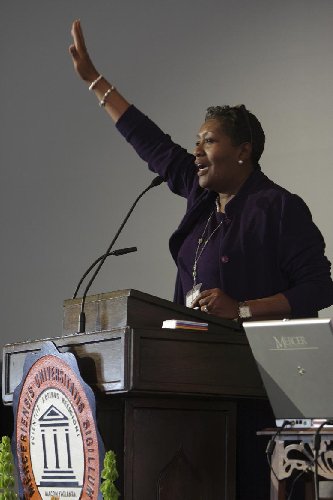
Participants listen to anti-human-trafficking activists during a recent Mercer University conference. (PHOTO/Mercer)

Bethell, recipient of the Baptist World Alliance Human Rights Award, spent the past 20 years fighting sex trafficking — first in Thailand, then in Eastern Europe. She told the audience she had stayed sane despite working some of the “darkest situations on Earth” by following the example of her leader, Jesus, who went to the dark places of his time because it was the right thing to do. Using the Bible’s example of the “woman of ill repute,” to whom Jesus ministered in Samaria and who later became one of his greatest advocates, Bethell said Jesus was the ideal example of showing up — as was his Samaritan apostle.

“She’s an example of showing up. Showing up in places where even the disciples raised their eyebrows,” Bethell said. “What would Jesus’ solution be in our time, in our century, of modern-day slavery? I know one thing: He’s sure pleased with what you have all done today, just shown up. He’s sure pleased with what we have seen today, people sacrificing time and energy to learn from each other and participate together in seeking solutions.”

A diverse group of more than 800 people were following her advice in attending the conference, held March 19-20 on Mercer’s Macon, Ga., campus. They came to learn about the problem of modern-day slavery and how they could help defeat it. The student-led conference, titled “STOP Sex Trafficking: A Call to End 21st Century Slavery,” included presentations by anti-trafficking advocates from around the state, the country and the world.

According to the State Department, more than a million women and children are trafficked into sex slavery each year — often forced by economic circumstances into prostitution’s horrors. Nearly 20,000 are trafficked annually into the United States, and many of these victims are trafficked into the Southeast. Mercer students in STOP, the Sex Trafficking Opposition Project, organized the conference to counter the growing worldwide crisis.

Lauran Bethell

Among the presenters were trafficking survivors Kika Cerpa and Joana Santos. In a pattern typical of trafficking, both were lured to the United States under false pretenses and told they owed large debts for their transportation after they arrived.

Santos, who was pregnant and had paid for most of her own trip, managed to hold off her tormentors and free herself. In the process, she brought down the ring that had enslaved other girls from her native Brazil.

Cerpa, who accrued a debt from her trip to New York from Venezuela, was not as lucky. She endured terrifying years as a sex slave in brothels around New York City — including three convictions for prostitution — only escaping after she got a judge to listen to her harrowing story.

“I was punished by the system and by society,” Cerpa said, highlighting a major issue in trafficking, particularly in the United States: that the legal system is only beginning to recognize that women like Cerpa are being pimped to pay false debts, rather than working by choice as prostitutes.

The system needs to change its focus in regards to trafficking, said Dorchen Leidholdt, co-executive director of the Coalition Against Trafficking in Women and Sanctuary for Families, the group that helped Cerpa.

“Most states have laws against prostitution that are often used against prostituted people. That is the problem with people who are trying to access the criminal-justice system,” Leidholdt said. “Most states have laws against patronizing a prostitute. Those laws are, generally, rarely enforced. All of the energy of our criminal-justice system — all of the resources — go to arrest prostituted people.”

Alesia Adams

Addressing those disparities, particularly in the United States, is the goal of the Polaris Project. Bradley Myles, deputy director of Polaris, presented some ways to target the problem. The approach to sex trafficking is three-fold, he said, focusing on prevention by targeting the men who frequent brothels, adding protection for the victims and increasing punishment for traffickers.

Myles explained that the legal definition of sex trafficking includes both transporting victims for sex and simply coercing someone into sex with others. He also highlighted some of the myths about trafficking.

“Don’t get boxed into thinking it’s just foreign people [who are trafficked in the United States] or that trafficking requires transportation,” Myles said.  “The term trafficking simply denotes trade — buying or selling.”

One of the areas that has the highest incidence of trafficking in the United States is Atlanta, and the problem there often involves American teenagers who are runaways. Girls at homeless shelters are approached by a pimp within the first 72 hours, according to city officials. Alesia Adams, who is the sexual-trafficking-prevention coordinator for the southern U.S. region of the Salvation Army, said it is important to realize the problem isn’t just international. “This isn’t a Third-World problem anymore; it’s in your backyard,” Adams said. “Dropping your child off at the mall alone has become the same as dropping them off at Beirut.”

The issue is also one of basic human rights, said Donna Hughes, a professor of women’s studies at the University of Rhode Island and a longtime anti-trafficking advocate. In approaching new ways to fight human trafficking, Hughes said focusing on perpetrators would be the best way to go forward, which would take the burden off the victims and stop the judgment inherent with any case of prostitution.

“We need to add a perpetrator-focused approach,” Hughes said.  “We need to reform our laws so that we are targeting the perpetrators’ activities.”


–Mark Vanderhoek is director of media relations at Mercer University.

Related ABP stories:

Modern slavery global scourge, speakers tell CBF supporters (6/23/2008)

Missionary visits red-light district in Prague to pray with prostitutes (2/22/2007)