DOWN HOME: Fox-in-a-bottle outwits squirrel

Posted: 9/29/07

DOWN HOME:
Fox-in-a-bottle outwits squirrel

Joanna noticed the dead spot first.

While everything else on our lot still shimmered brilliant green, the top eight or 10 feet of the center branch in our favorite maple in the middle of the backyard turned bitter brown.

Not golden amber or rustic crimson, like you might expect of a maple in North Texas six weeks or two months from now. Just bitter brown. Dead brown. This-branch-ain’t-coming-back brown.

We craned our necks to see what had happened up there, near the top of the third-most-stately tree on our property. (I’m partial to the bald cypresses.) We saw a strip of bare, withering trunk where bark used to be.

My thoughts turned to the “tree doctor” we paid to cut webworms out of most of our trees.

When he answered his cell phone, I told him one of his workers must’ve scraped the bark off our tree and killed the big center branch.

He didn’t seem surprised. “Is the bark stripped off all the way around?” he asked.

“Sure is,” I told him.

“Mr. Knox, what you’ve got is a boar squirrel,” he explained. “This is probably his first mating season. See, he climbed up there and stripped that bark off and ‘sprayed’ the spot to mark his turf. Next, he’ll come back to get those dead leaves for his nest so it’ll be all ready when his baby squirrels arrive.”

Now, I don’t believe in haunted houses. But if someone told me squirrels really are ghosts, then I’d say our house is haunted. We’ve just been in it a year, but we’ve already had our share of squirrel nuisances.

Last winter, a squirrel screamed and scraped in the wall between our kitchen and dining room for, oh, “40 days and 40 nights”—or a really long, long time—until he, as they say, gave up the ghost. This spring, a marauding band of punk squirrels acted like our attic was a rodent theme park until we re-covered all the fan vents with wire mesh. And now the squirrel version of Don Juan is trimming our tree to spruce up his lair.

“Mr. Knox, what you need is a bottle of red fox urine,” the tree doctor told me. Anticipating my profound inquiry—“Huh?”—he continued: “The red fox is the natural predator and enemy of your boar squirrel. So, if you can make him think a red fox lives in your backyard, he will leave your maple tree alone.”

Turns out, my friend Peter had half a bottle of the stuff in his garage, and he gave it to me. Now, our puppy, Topanga, has this strange sense she is not alone when she runs out into the backyard. I just hope our little tree-tearing friend feels the same way.

Oh, and lest you think the turf-marking mannerisms of our squirrel and red-fox-in-a-bottle are confined to the animal kingdom, just watch what happens when a visitor to your church sits in the pew that “belongs” to a longtime member.

Fur may fly.

–Marv Knox

News of religion, faith, missions, Bible study and Christian ministry among Baptist churches, in Texas, the BGCT, the nation and around the world.


EDITORIAL: If we don’t change, this is just Round 1

Posted: 9/29/07

EDITORIAL:
If we don’t change, this is just Round 1

Painful and dispiriting as it was, the Baptist General Convention of Texas Executive Board’s recent vote on the 2008 budget was both secondary and inevitable.

The board voted 52-28 to recommend a $50.1 million budget, which will be considered by messengers to the BGCT annual meeting in Amarillo Oct. 29-30.

Obviously, $50 million is serious money. It will fund a vast array of ministries. Lives will be changed because Texas Baptists invested in them. This is substantial.

knox_new

But the 2008 goal represents a decline of almost $500,000 from this year’s budget. That’s a major reduction, especially when our state is growing, needs are expanding and the cost of ministry is increasing. The 2008 budget also points to pain. It means eliminating 25 to 30 Executive Board staff positions.

You need to read the report on the budget debate. The tension, anxiety and frustration reflected in that article was palpable and wrenching.

The budget vote was secondary because it followed a more tangible and irrepressible vote. Ballots in that initial vote have been cast every time a church decides how much to contribute to the BGCT Cooperative Program. While the Executive Board votes in speculation about a future budget, churches vote with authority about the present budget. And the truth is that many churches have voted negatively by reducing the amount of their money they are willing to invest in the state convention. For multiple reasons, their confidence in the Cooperative Program has declined, and they’re putting that money elsewhere.

The tightness of funds, of course, made the angst and pain of the Executive Board’s debate and vote inevitable. When any group—whether a family, a church or a convention—is strapped for cash, priorities are tested. Visions for the future are thrown into competition. Turf wars erupt.

Unfortunately, the approved budget and the amendments the board also considered represent only stop-gap measures. We may enter 2008 with a “balanced” budget, but if the BGCT does not change substantially in the next 12 months, we’ll be looking at more layoffs and a smaller budget for 2009. Here are three places to start:

We need a real budget based on real priorities. No one truly believes a reduced-staff Executive Board can conduct all its current ministries effectively. We need to prioritize based on the needs of churches and lost and hurting people. We must start with the highest priorities and fund them so we succeed. Without question, we will eliminate some programs in order to conduct our priorities with excellence. If Texas Baptists seriously want to accomplish the lower-priority ministries, they will have to pay for them.

We need to capitalize on the strength of our institutions. We must support them better, while they renew their focus on cooperatively meeting the needs of the churches as well as their specific ministries. And for this renewed support, they should be expected to promote the Cooperative Program through their extensive constituencies, so that it reaches new heights.

We must embrace and include all who truly love and support the BGCT. Too many Texas Baptists feel left out, on the margins of our convention. Mostly, this has to do with their support for the Southern Baptist Convention. While they do not have the right to force others to feel the same way or to force the convention as a whole to violate its conscience regarding the national convention, if they love, respect and support the BGCT, they deserve to participate and to feel loved and respected in return.

For all our present challenges, the BGCT still possesses enormous resources—financial, human and spiritual. If we are willing to embrace the painful process of wise and disciplined change, we can emerge stronger and more vibrant.


News of religion, faith, missions, Bible study and Christian ministry among Baptist churches, in Texas, the BGCT, the nation and around the world.


Faith Digest

Posted: 9/29/07

Faith Digest

Game designed to foster understanding. A mechanical engineer from Lincoln, Neb., has designed a question-and-answer game to promote interfaith awareness. John Cooper created “7th Heaven,” a game that tests players’ knowledge of Judaism, Islam and Christianity in a way intended to help people junior high school age and older enjoy learning about different religious practices. Cooper began thinking about the concept a couple of years ago after he met some Iraqi refugees while volunteering at the People’s City Mission in Lincoln. Conversations with refugees and others led him to explore common themes shared by the three faiths.


Insurer rejects pro-homosexual church. A United Church of Christ congregation’s pro-gay stance puts it “at a higher risk” of litigation and property damage, a leading U.S. church insurer said in refusing to offer coverage to a Michigan congregation. Brotherhood Mutual, a Fort Wayne, Ind.-based insurance company, turned down the business of the West Adrian United Church of Christ after learning the church publicly endorses same-sex marriage and gay clergy. “Based on national media reports, controversial stances such as those … have resulted in property damage and potential for increased litigation among churches that have chosen publicly to endorse these positions,” wrote Marci J. Fretz, a regional underwriter for Brotherhood Mutual, in a July 30 letter to the West Adrian Church. Brotherhood Mutual declined to offer a quote to the church located in Adrian, Mich. Another insurer covered the church.


Pentagon ends probe of Muslim chaplain. The Pentagon’s inspector general has concluded a review of a former Muslim chaplain who was detained and later cleared of espionage charges, saying the Department of Defense acted properly in investigating the Army chaplain. “We found that DOD officials acted in good faith and within applicable standards in ordering Chaplain (James) Yee’s initial and continued pretrial confinement and Chaplain Yee was not targeted because of his religious affiliation,” reads a two-page executive summary of the review involving former Army Chaplain (Capt.) Yee. He was held at a military brig for 76 days, and the charges against him were dropped in March 2004. The inspector general said an investigation determined in May 2004 that Yee possessed 54 documents with secret information when he was arrested in 2003.


Catholic diocese pays millions to settle abuse cases. The Roman Catholic Diocese of San Diego has agreed to pay $198 million to 144 alleged victims of sexual abuse by clergy or other church employees—the second-largest such settlement since the abuse crisis exploded five years ago. The settlement follows four years of negotiations and a threat from a U.S. bankruptcy judge to dismiss the diocese’s Chapter 11 claim if a settlement was not reached by a Sept. 11 deadline. In the wake of the Archdiocese of Los Angeles’ record-setting $660 million settlement in July, the San Diego agreement brings to more than $2 billion the total amount the U.S. Catholic church has paid in sexual abuse-related matters since 1950.


News of religion, faith, missions, Bible study and Christian ministry among Baptist churches, in Texas, the BGCT, the nation and around the world.


Use ‘moral imagination’ in addressing global warming, expert says

Posted: 9/29/07

Richard Cizik, vice president of the National Association of Evangelicals, talks to students at Hardin-Simmons University’s Logsdon School of Theology about creation stewardship. (Photo/Victor Cristales/Abilene Reporter News)

Use ‘moral imagination’ in
addressing global warming, expert says

By Ken Camp

Managing Editor

BILENE—“Premillenial pessimism” and blind allegiance to politicians backed by big oil companies contribute to evangelicals’ relative silence about the threat of global warming, said Richard Cizik, the National Association for Evangelicals’ vice president for governmental affairs.

In a Hardin-Simmons University chapel address, Cizik challenged students to use “moral imagination” in exercising stewardship of the world God created.

“I believe global warning threatens everything,” he said, echoing a position that came close to costing him his job earlier this year.

See related articles:
It's not easy being green
• Use 'moral imagination' in addressing global warming, expert says
Energy-efficient green churches have more money for ministry
Some evangelicals go green, but skepticism lingers
10 steps to help save the world
Providing clean water is life-giving work, biologist says

In March, about two-dozen high-profile Religious Right figures—including James Dobson of Focus on the Family—called on the NAE board either to silence or fire Cizik for his public statements on global warning.

They insisted an emphasis on environmentalism would dilute evangelicals’ political clout and take their focus off issues such as abortion and gay marriage.

But Cizik, an ordained Presbyterian minister, insisted environmental degradation is a pro-life issue, and global climate change presents a threat to all of God’s creation.

“It’s not the devil’s diversion. It may be God’s way of getting our attention,” he said.

A theology of creation care means Christians strive to “bring the sustainable values of heaven to this earth,” he told students in Abilene.

“We’re not using resources for heavenly purposes but for our own selfish interests,” he said. “Our dependence on foreign oil means we’re transferring wealth to Middle Eastern religious dictators and importing oil to fuel a lifestyle that serves only our own interests.”

In part, creation care requires responsible lifestyle changes by individuals.

“We are living in sin, and we need to repent,” he said. “Unless we change, we are doomed.”

Recycling, driving hybrid cars and making homes more energy-efficient will help, but it won’t make enough difference, Cizik insisted. Citizens must demand public policy change—a difficult chore when politicians owe favors to big energy companies, he stressed.

“Are you going to save your friends or are you going to save the planet? I think, in effect, the president has said he will save his friends at the expense of the planet,” he said.

Evangelicals motivated by a sense of stewardship to God’s creation need to “bridge outward” and find common cause with scientists and secularists who may find reason to effect environmental change on the basis of public health or national security arguments, Cizik said.

“On this issue, we are all at peril. We must all work together,” Cizik said.

“Everything is at stake—the future of the planet even,” he continued.

At that point, a student interrupted Cizik to ask, “If we know the world will end in fire anyway, what does it matter?”

Cizik responded by pointing to the New Testament image of the new heaven and new earth as a renewed and restored creation, and he stressed the stewardship responsibility given to God’s people.

“It’s not about eschatology. It’s about theology,” he said.

In an interview after his chapel sermon, Cizik noted the student’s question represented a viewpoint prevalent among many evangelicals.

“The premillenial dispensational view has produced a pessimism about the earth that is frankly unbiblical,” he said.

A theology that teaches an end-times doomsday scenario has contributed to evangelical preachers’ unwillingness to address the environment as a moral and ethical issue. He compared it to how, in most evangelical circles, “churches opted out and preachers were silent” during the Civil Rights Movements of the 1950s and 1960s.

“I believe climate change and global warming is the civil rights issue of the 21st century,” he said. “We’re at a historically defining moment.”

Society does not have to choose between job creation and a clean environment, he insisted. Global warming and a dirty environment endanger both the working poor in the United States and people living in Third World poverty.

“Hundreds of millions of people of color” could be negatively affected by global climate change, he insisted.

Cizik sees the potential for a “convergence of concern” over global warming that could build bridges between people of faith and the secular scientific community.

Ironically, some high-profile Religious Right figures have used global warming as a wedge issue.

Cizik, who identifies himself as a “conservative Republican who voted for George W. Bush twice,” believes opposition to creation care grows out of fear that concern for environmental issues could drive some evangelicals into the arms of the Democrats.

“They’re interested in preserving the relationship between big business, particularly big oil, and evangelical conservatives—the two wings of the Republican Party,” he said in an interview.

“I don’t believe in conspiracy theories. It’s not a secret conspiracy. It’s right out in the open.”

That seems to reveal misplaced allegiance by some Christian conservatives, he added.

“It appears they care more about the welfare of the Republican Party than they do about the kingdom of God,” he said. “If that’s not the case, then they should say so.”


News of religion, faith, missions, Bible study and Christian ministry among Baptist churches, in Texas, the BGCT, the nation and around the world.


Energy-efficient green churches have more money for ministry

Posted: 9/29/07

Energy-efficient green churches
have more money for ministry

By George Henson

Staff Writer

WALKERTOWN, N.C.—Churches gradually are becoming more environmentally conscious about their facilities—and that green-consciousness is growing.

In some cases, business people in churches have seen the economic benefits that come with energy efficiency at work. Some members have heard news coverage about global warming and the need to conserve natural resources. Other congregations have members interested in the creation care movement that teaches God gave people responsibility of caring for the environment, and it is time to do a better job.

See related articles:
It's not easy being green
Use 'moral imagination' in addressing global warming, expert says
• Energy-efficient green churches have more money for ministry
Some evangelicals go green, but skepticism lingers
10 steps to help save the world
Providing clean water is life-giving work, biologist says

All that translates to more churches feeling an urge to do a better job with energy efficiency, said Bob Adams, a church consultant with the JH Batten design/building firm in Walkertown, N.C.

Adams, who for 23 years served on church staffs in Kentucky, Georgia and North Carolina, offers another reason—every dollar saved through energy efficiency can be spent on ministry.

“It’s really a stewardship issue,” he asserted.

Because of that, congregations need to investigate the most efficient way to build new buildings. The considerations are different than they were in the past.

“There are many more ways to build a church than there were 20 years ago and many more choices of building materials. And in some cases, all those choices can lead to more confusion,” he admitted.

A key for new church construction is flexibility.

“The utilization of a church building is much broader than it was 15 years ago. They once were used strictly as worship and education space for a few hours a week, but churches are becoming more of a community center and need to be designed as flexibly as possible to facilitate those uses,” Adams said.

Many churches are used for ministries not in place at the time of construction, he said. Since there is no way to foretell exactly how the building may be used, it needs to be adaptable to multiple possibilities.

As green churches and green buildings in general constitute a larger segment of the construction business, Adams said the cost of constructing energy-efficient buildings has gone down. As what was once a small niche grew larger, more companies and newer technologies have driven down prices.

While he admits the initial construction costs still are a little higher for green buildings, he counsels taking a more far-reaching look.

“Churches are notorious for thinking about the initial costs and forgetting about the operational costs. Businesses have seen the flaw in this for a long time, but churches are still drawn to lower initial costs and having to pay more in the long run,” Adams said.

“Also, the constant introduction of new products and technologies are bringing costs down quickly and the payback period for recouping those costs is being reduced.”

Churches wishing to do a better job with the buildings they have should start with lighting. Simply changing fluorescent light bulbs to smaller diameter energy-efficient bulbs can save dollars. Also, motion-sensitive switches can be installed that turn off lights when no one has been in a room for a pre-determined time.

Replacing mechanical ballasts with electrical ballasts also will help recoup costs in a short time.

Another way to help maintain energy efficiency and keep costs down is to maintain a regular cycle for changing filters on air-conditioning and heating units.

Also, make sure toilets and water fountains are functioning properly—not continuing to run and using excess water.

“Really, it’s your home environment times 10,” Adams said. “The same things that we should take care of in our homes, we need to make sure are done in our churches.”

A good resource is an energy cost analysis included in an 86-page document written especially for churches by the U.S. Environmental Protection Agency, he noted. The document can be downloaded at www.energystar.gov/congregations at no charge.


News of religion, faith, missions, Bible study and Christian ministry among Baptist churches, in Texas, the BGCT, the nation and around the world.


Some evangelicals go green, but skepticism lingers

Posted: 9/29/07

Some evangelicals go
green, but skepticism lingers

By Adelle M. Banks

Religion News Service

WASHINGTON (RNS)—When Harry Jackson saw melting glaciers and devastated forests on a recent trip to Alaska, he decided global warming should be a higher priority on his list of key issues for evangelicals.

“I thought the globe was warming, but I thought that there was a whole lot of hype attached and there were not a lot of practical solutions presented,” said Jackson, pastor of a megachurch in Beltsville, Md.

Rob Bell is pastor of Mars Hill Bible Church in Grandville, Mich. He says evangelicals need to take greater action on the environment. (RNS photo/Zondervan)

The trip to Alaska was a bit of a road-to-Damascus moment for Jackson, a leading voice among conservative black pastors. Earlier this year, he had gone on CNN to question environmentally friendly evangelical leaders and joined a protest against Richard Cizik, the green-minded vice president of the National Association of Evangelicals.

But now, after traveling with scientists and evangelicals on a weeklong trip last month sponsored by Harvard Medical School and the NAE, Jackson is ready to work to bring evangelicals from the left and right together to address reducing carbon emissions and oil use.

“I believe we can kind of come to a working agreement on an environmental agenda,” he said.

Some evangelical leaders, often one by one, have similar conversion stories, moving them from merely being concerned about creation toward a sense that they should do something to protect it. One group, the Evangelical Climate Initiative, says its number of supporters has inched up from 86 early last year to 106 today.

But the support that’s slowly growing in some circles is nuanced at best, and there are many evangelicals who remain unconvinced.

Religious broadcaster Pat Robertson made headlines during last summer’s heat wave when he remarked, “I have not been one who believed in this global warming, but I tell you, they’re making a convert out of me with these blistering summers.”

See related articles:
It's not easy being green
Use 'moral imagination' in addressing global warming, expert says
Energy-efficient green churches have more money for ministry
• Some evangelicals go green, but skepticism lingers
10 steps to help save the world
Providing clean water is life-giving work, biologist says

But Robertson’s spokeswoman said he still hasn’t joined one or the other side of the climate change debate.

“Pat has not made any new comments since last summer, and he hasn’t joined any organizations regarding global warming … and continues to weigh all the facts and arguments,” said Angell Vasko.

Jackson, though moved by the sight of an Eskimo village losing island homes to storm surge erosion, remains hesitant to embrace some energy-reducing recommendations, but he admits he’s a changed man who better understands the need for “environmental justice.”

“You’re not going to change this problem by turning lights off so many hours a day,” said Jackson, who also flew over forests eaten up by spruce bark beetles, whose reproductive rates have increased with warmer temperatures. “The personal impact is not as heavy as the corporate im-pact of transitioning fuel sources.”

While Rob-ertson and Jackson have-n’t, others have signed onto the Evangelical Climate Initia-tive, hoping to be role models.

“I wanted to take a public stance and be an encourager to others to get serious about our responsibility to care for creation,” said Paul Corts, president of the Council for Christian Colleges & Universities, who added his name this spring.

“And signing the ECI was a simple but significant way I could encourage others.”

Other evangelical leaders are being outspoken in other ways. Progressive evangelical pastor Rob Bell, who leads Mars Hill Bible Church in Grandville, Mich., recently concluded a summer sermon series on “God is Green.”

Bell, who’s preached on the environment for five years and made family lifestyle changes such as downsizing from two cars to one and swapping a clothes dryer for a clothesline, said he was surprised that a statement from the Evan-gelical Climate Initiative was even necessary.

“To me, it’s just obvious,” said Bell. “It’s sad to me that they would even need to state the obvious.”

Richard Land of the Southern Baptist Conven-tion’s Ethics & Religious Liberty Commission, is among those who remain unconvinced humans are the major cause of global warming.

“It’s certainly going to be an uphill battle to get a significant number of evangelicals to support the Evangelical Climate Initiative because it’s wrong-headed,” Land said.

“Science is not near as clear as liberal arts theologians are.”

Rusty Pritchard, national outreach director of the Evangelical Environ-mental Network, said despite continuing criticism, there is a “transformation in the conversation,” with people asking how to answer skeptics rather than being skeptical themselves.

“It’s an uphill battle,” he said. “But I feel like the wind is at our backs.”


News of religion, faith, missions, Bible study and Christian ministry among Baptist churches, in Texas, the BGCT, the nation and around the world.


10 steps to help save the world

Posted: 9/29/07

10 steps to help save the world

By Hannah Elliott

Associated Baptist Press

NEW YORK (ABP)—With all the talk of global warming, environmental degradation and increase in pollution-caused disease, it’s easy to get overwhelmed. But experts say changing just a few daily habits can help alleviate some of those problems. And if enough people make those changes, it’ll benefit the whole world.

Here are 10 simple things everyone can do to go green—and improve their own quality of life in the process.

1. Replace incandescent light bulbs with compact fluorescent light bulbs. The fluorescent bulbs cost a little more than the conventional ones, but they use only 25 percent of the electricity and last years longer. Found in practically every home store, the fluorescent bulbs are often labeled “Energy Savers” or have the “Energy Star” label.

2. Recycle. Every three months, Americans throw away enough aluminum to rebuild the nation’s entire commercial air fleet, according to the Recycler’s Handbook. Recycling re-sources like aluminum, glass and paper saves energy and slows global warming. It also reduces water pollution, acid rain and soil erosion. Churches can get in on the act by setting up corporate recycling bins in offices and parking lots. To find a local recycling center, call 1-800-CLEANUP.

3. Garden with friends or neighbors. Green plants remove carbon dioxide from the air and then release oxygen through photosynthesis. Vegetable and herb gardens provide healthy, inexpensive food, and working on a garden is a great bonding opportunity for families or churches and neighborhoods. Avoid synthetic fertilizers and pesticides. And use homemade mulch or compost.

4. Support local markets and merchants rather than chain stores. Farmers’ markets provide the perfect opportunity to support local growers, many of whom produce their wares in environmentally conscious ways. Independently owned stores, too, are firmly rooted in the community, which usually means they carefully protect local resources. Chain stores, on the other hand, have no such stake in local environs.

5. Vote with your money. Support environmentally responsible companies. Buy products with a high recycled content. And fix broken items instead of buying new ones.

See related articles:
It's not easy being green
Use 'moral imagination' in addressing global warming, expert says
Energy-efficient green churches have more money for ministry
Some evangelicals go green, but skepticism lingers
• 10 steps to help save the world
Providing clean water is life-giving work, biologist says

6. Winterize your house and car—and help others in your church do the same. Rusty Pritchard of the Evangelical Environmental Network suggests churches help senior citizens caulk and weather-strip all doors and windows. Also check fluid and air levels in cars in order to conserve energy through the winter months.

7. Walk more; drive less. Motor vehicles release a third of all the carbon dioxide in the U.S. and Canada each year. Walking reduces energy consumption, noise pollution and air pollution. It also saves gas money. And residential property values go up when traffic goes down.

8. Use energy-saver appliances, and use them less often. A study by Cambridge University’s Institute of Manufacturing found 60 percent of energy associated with clothing comes from washing and drying. Instead, hang clothes on a clothesline. Wait to run dishwashers until they’re completely full. Turn off computers and lights when not using them.

9. Open the windows. When possible, allow windows, curtains and blinds to regulate temperature rather than the thermostat. Every degree turned up in the summer and down in the winter can save up to 5 percent in air conditioning and heating costs.

10. Buy green power. According to a recent report by Time magazine, more than 600 utilities in 37 states offer green energy. Visit eere.energy.gov/ greenpower to learn which companies provide the service.

In general, it’ll take a transformation of hearts and minds to bring real change, experts say.

Like many people in developed nations, Christians too easily can adopt a culture of commercialism, Pritchard insists.

But people of faith should have a direct—even leading—role in effecting change by living lives of simplicity, contemplation, conservation and compassion.

“How many Christians actually take a Sabbath and rest and don’t consume?” he asked.

“We’ve got to think of ways to slow down and think of things that are eternal, spending more time in God’s word and more time in prayer. They help immunize us against … consumerism.”


News of religion, faith, missions, Bible study and Christian ministry among Baptist churches, in Texas, the BGCT, the nation and around the world.


Providing clean water is life-giving work, biologist says

Posted: 9/29/07

Providing clean water is
life-giving work, biologist says

By Melissa Browning

Cooperative Baptist Fellowship

ATLANTA (ABP)—When Darrell Smith explains the development work he does in Macedonia, he often tells the story from Luke’s Gospel of Jesus cleansing the lepers.

“Jesus healed them simply because they asked,” said Smith, a mission worker with the Cooperative Baptist Fellowship. “They did not have to listen to a sermon. They were not required to do anything in order to receive healing. In fact, Jesus knew that 90 percent would never say thank you or give him a second thought. But he healed them anyway.”

By working to provide clean water, Darrell Smith is able to share about the faith in Christ that motivates his work. (Photo/CBF)

This is how the native Texan sees his own work of providing clean water, working with farmers and participating in disaster-response relief work.

For Smith, providing clean water is the most life-giving part of his work. He started to sense his own calling when the Berlin Wall fell. At the time, Smith was working as a biologist for the U.S. government, and he began to feel a spiritual burden for Eastern Europe. Now living with his family in Mace-donia, Smith uses his doctorate in ecology to make contacts within the scientific community there.

And he is able to work with the Macedonian government in what he calls “creation care.”

Smith says Macedonia faces many environmental challenges, but he has been able to improve the water quality of a dying lake, help clean a polluted river and establish new nature preserves in the region.

See related articles:
It's not easy being green
Use 'moral imagination' in addressing global warming, expert says
Energy-efficient green churches have more money for ministry
Some evangelicals go green, but skepticism lingers
10 steps to help save the world
• Providing clean water is life-giving work, biologist says

It isn’t only about clean water. The environmental work provides a chance for Smith to share his faith—a faith that motivates his work.

For instance, he recently was sitting in a restaurant with a local village leader and a civil engineer. The engineer’s firm had just completed a design plan for a village sewage system, which primarily was paid for by CBF. As they were discussing the plan, the engineer turned to Smith and said: “I know you’re a Christian and have helped us a great deal on this project.”

Smith said he was thrilled to realize a door had opened for the three friends to talk about their faiths.

“What an opportunity it was for us to build bridges through our mutual compassion for the villagers, who had been living with contaminated drinking water and sewage flowing in the street for so many years,” Smith said.

That conversation and others like it especially are important, Smith said, because it was only a few years ago that Christian Serbs had tried to exterminate the Albanians of Kosovo.

Clean water not only gives health to families who need it, but in Macedonia, it builds peace, he stressed. It is a reminder of reconciliation.


News of religion, faith, missions, Bible study and Christian ministry among Baptist churches, in Texas, the BGCT, the nation and around the world.


It’s not easy being green

Posted: 9/29/07

It's not easy being green

By Hannah Elliott

Associated Baptist Press

This isn’t your mother’s environmentalism.

Footage of polar bears on shrinking glaciers and hummingbirds in sparse rainforests used to have a prominent place in films about the need to “go green.” But now some Christian environmentalists are engaging believers with a new message: Humans actually suffer the most when economic exploitation afflicts the environment.

Fostering sustainable development is just as much a human-rights issue as an environmental issue, they say. Many economic advances aren’t at all mutually exclusive with environmental protection, they insist.

See related articles:
• It's not easy being green
Use 'moral imagination' in addressing global warming, expert says
Energy-efficient green churches have more money for ministry
Some evangelicals go green, but skepticism lingers
10 steps to help save the world
Providing clean water is life-giving work, biologist says

These Christian environmentalists say human industry and environmental stewardship actually should go hand-in-hand. Rusty Pritchard, the national director of outreach for the Evangelical Environmental Network, says Christians play an important role in leading the charge because “so many other groups focus on God’s creation but forget people.”

An economist based in Atlanta, Pritchard said he views the environment primarily as a sustainer of human needs. Managing it responsibly inevitably leads to economic gain, he said.

“There’s a huge overlap between environmental stewardship and economic stewardship,” Pritchard said. “When you think about it, God created the world so that we depend on it for our material existence. That includes the natural environment and all the stuff that we build from the natural environment. He allows us to make a living from it, and when we take care of it well, we prosper.”

Many researchers say that when people profit at the expense of the environment, the heaviest burden falls on those least able to cope—the poor.

Diseases like cholera, malaria and AIDS have environmental components to them, Pritchard said. Over-fishing hurts families in the Pacific Northwest who depend on fish for their livelihood. Particles released into the air by bitumen factories and chemical plants in Mexico City cause asthma and lung disease in children. And chemical waste dumped into rivers and buried in the ground contaminates entire watersheds.
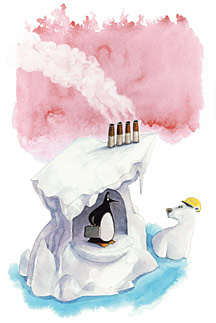
(Newhouse News Service illustration by Ted Crow)

“More or less people could be hurt depending on how we handle the climate system. We do things right, and fewer people are going to be harmed,” Pritchard said. “We can really decrease the amount of impending human suffering if we start to manage our resources well. It’s going to be a huge task, but I think God in his grace wants us to do it.”

Christians—with their faith-based moral conscience and biblical mandate for compassion—should be at the forefront of sustainable development, some ethicists say.

But many have been slow to accept that message. Some religious conservatives have feared creation care would somehow align them with the New Age movement. And for years, political and social conservatives resisted jumping on the environmental bandwagon out of concern that economic stability and blue-collar industry would suffer in the name of saving some obscure bird or fish.

Last year, the Interfaith Stewardship Alliance—recently renamed the Cornwall Alliance for the Stewardship of Creation—issued a lengthy paper on the subject titled “A Call to Truth, Prudence and Protection of the Poor: An Evangelical Response to Global Warming.”

“Because energy is an essential component in almost all economic production, reducing its use and driving up its costs will slow economic development, reduce overall productivity and increase costs of all goods, including the food, clothing, shelter and other goods most essential to the poor,” the document said.

And some academics who view global warming with skepticism insist the industrial West wants to protect itself against an unproven threat without regard for the impact it could have on developing nations.

“It is by burning fossil fuels that the West has gotten rich and redressed the mass structural poverty which had been the fate of its masses for millennia,” wrote Deepak Lai, professor of international development studies at the University of California at Los Angeles, in an article published by the Heartland Institute.

“The same opportunity is now available to the developing countries. But the Greens in the West, in serving their dubious cause of halting global warming, want to deny the same means for the developing world’s poor to climb out of poverty.”

Truth to tell, some environmental initiatives have hurt some industries. Logging corporations in the Pacific Northwest vehemently have opposed establishing off-limit zones that would protect endangered spotted owls—business leaders say the reduction in logging will hurt families dependent on the industry for survival.

But just because a particular industry may suffer in the name of creation care doesn’t mean human rights should take a back seat, some experts say. The abolition of slavery ended an enormous network of industry, but that doesn’t mean it shouldn’t have been done, said Gordon Aeschliman, the president of Target Earth.

More recently, the closure of coal and vermiculite mines—revenue sources that supported entire towns—saved countless workers and their children from developing lung cancer, mesothelioma and asbestosis.

“My first guiding thought as a Christian is, ‘Am I pursuing economic development as a form of personal wealth development in a way that harms other human beings?’” Aeschliman said. He leads his Arizona-based Christian organization to buy endangered land, reforest ravaged terrain, and provide food and shelter for locals in 15 countries.

“If the way we develop our economic wealth hurts the environment in a way that harms people, we’ve already broken a moral law, in (my) opinion.”

Plus, economic development is not a single idea—some types of it are healthy and others aren’t, Aeschliman said. For example, Christians don’t support the prostitution industry because it morally bankrupts people, but capitalism that exploits the environment morally bankrupts people as well, he said.

Joel Hunter, pastor of Northland Church in Longwood, Fla., believes further distinction should be made between capitalism and “super-capitalism.”

Hunter, an early and strong advocate for environmental issues, pointed out that major companies have gone green in recent years and made huge profits. That’s capitalism, he says, and it’s definitely compatible with fostering economic wealth while valuing human rights.

But what about developing countries like China and India? Should they be forced to establish green initiatives while undergoing an Industrial Revolution—so-called “super-capitalism”—of their own?

No, even though it’s a lot tougher for them than for wealthier countries, Hunter said.

“The global competitive advantage is becoming more and more difficult,” he said. “And so what is happening is that industry is trying everything it can do to get the best product for the cheapest price. China has almost no environmental policy. They don’t want to temper down their economic growth, so they are making things at a high cost to the environment, a high cost to human rights.”

Leaders in such countries will have to choose whether they’ll focus solely on economic growth or human rights, Hunter said.

“The question the church has is a very different question from the question secular society has,” Aeschliman said. “Christians have to ask the question ‘Does how I make my money matter?’ We consume one-third of the world’s resources and produce one-third of the world’s trash … and we have to say, ‘If that’s what economic development does, maybe it’s immoral.’”

An appropriate approach for wealthy countries concerned about global pollution is to work with developing nations, not against them, Hunter said.

“First of all, we can’t just let China … put in one electrical plant per week,” Hunter said. “It’s just too high a cost to the world. It affects the health of the world. On the other hand, I think there can be a trade in technologies that helps them leapfrog parts of the Industrial Revolution.”

Pritchard agreed. It is up to wealthy nations to develop technologies that reduce the industry-induced problems in the first place, he said.

“The American enterprise system is integrated enough to provide…the necessary transitions in the developing world.”

In general, people of faith should strive to live simple lives unencumbered by consumerism, waste and excessive wealth, Christian environmentalists say. Jesus himself lived simply, and God created a world that can support all his creation—if it’s managed correctly, Aeschliman said.

“God didn’t make it so all people could live in a luxury liner,” he said. Environmental exploitation “is naive idea that doesn’t recognize that when we harm the earth, we harm the poor.”

Hunter, an early and strong advocate for environmental issues, pointed out that major companies have gone green in recent years and made huge profits. That’s capitalism, he says, and it’s definitely compatible with fostering economic wealth while valuing human rights.

But what about developing countries like China and India? Should they be forced to establish green initiatives while undergoing an Industrial Revolution—so-called “super-capitalism”—of their own?

No, even though it’s a lot tougher for them than for wealthier countries, Hunter said.

“The global competitive advantage is becoming more and more difficult,” he said. “And so what is happening is that industry is trying everything it can do to get the best product for the cheapest price. China has almost no environmental policy. They don’t want to temper down their economic growth, so they are making things at a high cost to the environment, a high cost to human rights.”

Leaders in such countries will have to choose whether they’ll focus solely on economic growth or human rights, Hunter said.

“The question the church has is a very different question from the question secular society has,” Aeschliman said. “Christians have to ask the question, ‘Does how I make my money matter?’ We consume one-third of the world’s resources and produce one-third of the world’s trash … and we have to say, ‘If that’s what economic development does, maybe it’s immoral.’”

An appropriate approach for wealthy countries concerned about global pollution is to work with developing nations, not against them, Hunter said.

“First of all, we can’t just let China … put in one electrical plant per week,” Hunter said. “It’s just too high a cost to the world. It affects the health of the world. On the other hand, I think there can be a trade in technologies that helps them leapfrog parts of the Industrial Revolution.”

Pritchard agreed. It is up to wealthy nations to develop technologies that reduce the industry-induced problems in the first place, he said.

“The American enterprise system is integrated enough to provide … the necessary transitions in the developing world.”

In general, people of faith should strive to live simple lives unencumbered by consumerism, waste and excessive wealth, Christian environmentalists say. Jesus himself lived simply, and God created a world that can support all his creation—if it’s managed correctly, Aeschliman said.

“God didn’t make it so all people could live in a luxury liner,” he said. Environmental exploitation “is a naive idea that doesn’t recognize that when we harm the earth, we harm the poor.”


News of religion, faith, missions, Bible study and Christian ministry among Baptist churches, in Texas, the BGCT, the nation and around the world.




‘In God We Trust’ motto still mints controversy after 50 years

Posted: 9/29/07

‘In God We Trust’ motto still
mints controversy after 50 years

By Adelle Banks

Religion News Service

WASHINGTON—Fifty years after “In God We Trust” first appeared on U.S. paper currency, those four little words have proven to be the source of big debate in the courts.

Michael Newdow, the California atheist known for trying to strip “under God” from the Pledge of Allegiance, has asked the 9th U.S. Circuit Court of Appeals to declare “In God We Trust” an unconstitutional mingling of church and state. In Indiana, the American Civil Liberties Union has gone to district court, arguing it’s unfair for the state not to charge administrative fees for “In God We Trust” license plates when a plate advocating for the environment carries extra fees.

Why, decades after the words were made the nation’s official motto and printed on our dollar bills, do they still inspire ire?

“A great many Americans are angry … when the government promotes religion, and a great many other Americans believe that this is not promoting religion—they’re just representing who we are as a nation,” said Charles Haynes, senior scholar at the Freedom Forum’s First Amendment Center. “That divide is an old story in American history and will probably continue way into the future.”

Long before the words were printed on paper money, they first appeared on coins after a Pennsylvania minister wrote to the secretary of the treasury in 1861, suggesting God’s name should be featured on U.S. coins.

“This would relieve us from the ignominy of heathenism,” M.R. Watkinson wrote to Treasury Secretary Salmon P. Chase in 1861, according to the website of the U.S. Treasury Department. Three years later, U.S. coins began to bear the words “In God We Trust.”

It wasn’t until 1956 that Congress declared those words to be the national motto. On Oct. 1, 1957, they began appearing on the back of dollar bills under the words “The United States of America.”

Newdow, whose case was dismissed by a lower federal court last year, said the words referring to a deity divide society by making non-believers “second-class citizens.”

“The issue is not one of people who believe in God versus people who don’t believe in God,” he said. “It’s people who believe in equality versus people who don’t believe in equality. That’s what this litigation is about.”

Jay Sekulow, chief counsel of the conservative American Center for Law and Justice, has filed a brief opposing Newdow on behalf of dozens of members of Congress.

“It reflects the heritage of the country,” he said of the debated motto. “It’s something the founding fathers recognized, that our rights and liberties were endowed by a creator. You recognize the source of these rights.”

A 2003 Gallup Poll found 90 percent of Americans approve of the inscription “In God We Trust” on U.S. coins. A survey released earlier this month by the First Amendment Center found 65 percent of Americans think the nation’s founders intended the country to be a Christian nation, and 55 percent think the U.S. Constitution establishes it as a Christian country.

“That suggests that a great many people have deeply misunderstood the Constitution,” said Haynes. “The framers clearly wanted to establish a secular nation where anyone of any faith or of no faith could hold public office—and that’s a far cry from a Christian nation.”

About a dozen states have passed laws declaring public schools can post the motto. Five years ago, the American Family Association was involved in a campaign that shipped hundreds of thousands of posters to supporters so they could send them to local schools.

“I think we need to be constantly reminded and, although I don’t look at my coins and my paper money day by day, there is a great satisfaction knowing that it’s there and knowing that our government still recognizes God,” said Randy Sharp, director of special projects for the American Family Association, based in Tupelo, Miss.


News of religion, faith, missions, Bible study and Christian ministry among Baptist churches, in Texas, the BGCT, the nation and around the world.


State Department reports Iraqi insurgency hurts religious freedom

Posted: 9/29/07

State Department reports Iraqi
insurgency hurts religious freedom

By Adelle Banks

Religion News Service

WASHINGTON (RNS)—The continuing insurgency in Iraq is significantly harming the freedom of worship in that country, the State Department said in its 2007 International Religious Freedom Report.

The recently released report lists Iraq among 22 countries it notes for either particular abuses or positive steps related to religious freedom.

“The ongoing insurgency significantly harmed the ability of all religious believers to practice their faith,” the report’s executive summary states.

It notes that lawlessness by insurgents, terrorists and criminal gangs affected a range of citizens but particularly had an impact on religious groups.

“Many individuals from various religious groups were targeted because of their religious identity or their secular leanings,” the summary said. “Such individuals were victims of harassment, intimidation, kidnapping and killings. In addition, frequent sectarian violence included attacks on places of worship.”

The report said the deteriorating conditions were “not due to government abuse.”

“For the most part, people are getting caught in the crossfire,” said John Hanford, the ambassador-at-large for international religious freedom. “In the case of these minorities, though, there have been cases where it’s clear that certain groups have been targeted.”

Last November, the State Department designated Uzbekistan on its list of “countries of particular concern” regarding religious freedom violations and removed Vietnam from that list.

Asked about the most significant development in the new report, Hanford said the Vietnamese government has made progress by granting more religious freedom and permitting places of worship that had been forced to closed to reopen.

“They’ve registered whole new religions that weren’t even legal before,” he said. “Nevertheless, there are still groups which are banned or where there are leaders which are under house arrest.”


News of religion, faith, missions, Bible study and Christian ministry among Baptist churches, in Texas, the BGCT, the nation and around the world.


Couple brings joy to nursing home, children’s hospital patients

Posted: 9/29/07

Couple brings joy to nursing
home, children’s hospital patients

By Jessica Dooley

Communications Intern

PAIGE—John and Dianne Jones have no easy answer for why they launched a ministry that serves patients in nursing homes, Alzheimer’s facilities and children’s hospitals in a three-county area of South Central Texas.

“I have no clue why we started, except God led,” Jones said.

Jones—now pastor of Ridgeway Baptist Church in Paige—and his wife, Dianne, started Disciples Mission Ministries two years ago.

Every week, they visit the nursing homes to share the gospel through old hymns and preaching. At the children’s home, they teach through music and storybooks.

They find special satisfaction in their interaction with Alzheimer’s patients.

“It’s a moment of joy when they realize that people do remember them,” Jones said. “Even if they forget about the visit in two hours, it’s still worthwhile, because for that amount of time they are able to experience joy in Christ.”

Now Disciples Mission Ministries is trying to expand its scope to help patients with transportation needs.

“We found out this was a big need when my wife broke her ankle, and we had a hard time getting her to the doctor appointments because I was at work,” Jones explained.

“It was in the waiting room that we were able to talk with other patients and discover they had the same problem with transportation issues.”

But limited funds, rising gas prices and the challenge of finding a vehicle with a lift have hampered their ability to meet that need—at least so far.

While they are facing challenges in expanding their ministry, the Joneses are grateful for the blessings they are convinced God has bestowed on them.

“I get so much love, so much joy and an incredible sense of peace,” Mrs. Jones said. “It makes you feel wonderful. I don’t know how to express it any more than this.”


News of religion, faith, missions, Bible study and Christian ministry among Baptist churches, in Texas, the BGCT, the nation and around the world.