For financial planning guru, sour economy has an upside

EDMOND, Okla.—In a gloom-and-doom economy, Christian financial guru Dave Ramsey fashions himself a prophet of hope.

Part stand-up comedian, part economics professor, Ramsey built a multimillion-dollar business by dispensing simple financial advice: Live on a budget. Don’t spend more than you make. Start an emergency fund. Get out of debt. And stay out of debt.

One of his favorite Scriptures is Proverbs 22:7: “The rich rule over the poor, and the borrower is servant to the lender.”

Christian financial expert Dave Ramsey prepares to address live simulcast near Oklahoma City. His advice is gaining interest amid the economic crisis. (PHOTO/RNS/Erik Tryggestad)

Now, with the nation in what Ramsey characterizes as “complete freak-out mode” over the recession, the faith-based approach he touts seems to be resonating even more, he said.

“I would not say that business is booming during the recession, but this economic downturn has made people realize that now is the time to turn their financial life around,” the 48-year-old money-management expert said.

As evidence of the significant interest in the one-time bankrupt real estate salesman who turned around his financial life based on biblical principles, consider the scene near Oklahoma City recently when about 1,500 people showed up at Life Church to hear Ramsey give a history of capitalism and explain why he believes the economy will survive the current woes.

But the crowd that saw the syndicated talk-show host in person was far from alone.

His free, nationwide “Town Hall for Hope” meeting was simulcast live to more than 6,000 churches, businesses and military bases—10 times more venues than Ramsey initially thought might participate, he said.

“The one thing America needs right now is hope,” Ramsey said. “All we’re hearing in the news is how bad things are, and no one is talking about hope for the future. The truth is, fear is running rampant in America today, and people are making bad decisions based on that fear.”

Ramsey said he almost bought into the fear himself. But then he prayed.

“I talked to my Dad, and the fear left me,” he said, referring to God. “Fear is not a fruit of the Spirit.”

Ramsey’s message: “Hope doesn’t come from Washington. Hope comes from you and me. Hope comes from God.”

Three time zones and roughly 3,900 miles from Oklahoma City, Ted Manolas and fellow church members watched Ramsey on big screens in Chugiak, Alaska, northeast of Anchorage.

“You could say that I’ve joined the Dave Ramsey cult,” joked Manolas, director of finance and administration at The Crossing Church at Birchwood, before the simulcast began.

As a result of Ramsey’s teachings, Manolas said, he paid off all his debts—including his home.

The Alaska church has taught Ramsey’s “Financial Peace University,” a 13-week video series, to more than 150 families, Manolas said.

Nationally, 750,000 families have completed the course, according to Lampo Group, Ramsey’s Brentwood, Tenn.-based company, which has more than 200 employees. Lampo is the Greek word for “light,” referring to the passage in the Gospel of Matthew calling for Christians not to hide their faith.

Ramsey’s fans—who swear off credit cards like alcoholics do liquor—include listeners of his daily radio show carried by more than 400 stations and his nightly cable show on Fox Business.

Ramsey is not without his critics. Some financial experts take issue with what they consider to be his overly simplistic notion of becoming financially secure. Others question how he can charge people already in debt for most of his live events and online resources.

But Chris and Tami Burke of Edmond, Okla., said Ramsey’s common-sense approach helped them eliminate more than $23,000 in debt. The advice they received from Ramsey was worth every cent, they said.

Now, the Burkes, who that attend Life Church, drive used cars and give more money to church.

“In the past, many people were just blowing and going, just spending a lot of money,” said Chris Burke, a hospital administrator who arrived more than an hour early to hear Ramsey speak.

“Now, more than ever, you have companies downsizing and people losing their jobs. … So, now’s a better time than ever to really look at your finances and really buckle down.”

Organizers insisted Ramsey’s 90-minute event was no political rally, nor an investment seminar. Nonetheless, the self-proclaimed capitalist—an outspoken critic of the federal bailout of big business—spent considerable time railing against Washington politicians and offering his advice on everything from the real-estate market to the disadvantages of investing in gold.

Despite the serious subject matter, he sprinkled his comments with homespun humor.

“When things were going really good, any idiot could make money,” he said. “Even a turkey can fly in a tornado, y’all.”

Concerning President Obama’s call for a new credit-card law protecting consumers, Ramsey said he used “plastic surgery” to deal with the debt he racked up with Visa and MasterCard.

“I legislated the credit-card companies that were in my life with a pair of scissors,” he said.


Financial management grads cite spiritual, as well as monetary, gains

NASHVILLE, Tenn. (BP)—Completing an in-depth study of biblical financial management not only dramatically improves a person’s financial position, but it also benefits their walk with Christ, family relationships and contribution to church life, according to research recently conducted by Crown Financial Ministries.

A survey of 1,429 people who had completed Crown’s Biblical Financial Study indicated, on average, the following results within three years:

• Personal debt, down 38 percent

• Savings and investment, up 58 percent

• Closer relationship to Christ, 35 percent

• Prayer frequency, up 46 percent

• Bible reading frequency, up 64 percent

• Stronger marital relationships, 78 percent

• Giving to church, up 70 percent

• Service to church, up 47 percent.

Of the 1,429 graduates surveyed, 11 were unbelievers but came to Christ either during the class or afterward and reported a close walk with Christ.


Faith Digest: Charity drops ‘Christian’ from name

Charity drops ‘Christian’ from name. Christian Children’s Fund, an organization that helps needy children across the globe, has decided to change its name to ChildFund International as part of its plan to broaden its outreach. The charity was founded in 1938 by a Presbyterian minister and originally called China’s Children Fund. One of the first organizations to offer sponsorships of individual children, it changed its name to Christian Children’s Fund when it broadened its work beyond China. The new name change will take effect July 1. 

Scots consider virtual ministers. To stem a nationwide shortage of full-time clergy, the Church of Scotland is considering using “virtual ministers” who would preach over a live video link to congregations that do not have a permanent minister. The Orkney presbytery, which has 21 congregations spread over more than 10 islands, will be used to test the program by linking four congregations in the archipelago with technology similar to video conferencing. There are presently an estimated 190 full-time vacancies for clergy across Scotland, which has a population of 5.1 million. If successful, church officials say a number of congregations in some of the most remote parts of Scotland would be able to take part in the same service.

Islam on upswing among Canadian teens. More teenagers in Canada identify themselves as Muslim than with the Anglican, Baptist and United churches combined, a recent survey revealed. Project Kids Canada, which has tracked thousands of youth in an ongoing survey since 1984, polled more than 5,500 teenagers. Research showed the number of teens who identified themselves as members of “Other Faiths”—including Islam, Buddhism, Judaism, Hinduism, Sikhism and aboriginal spirituality—grew to 16 percent last year, compared with 3 percent in 1984. Muslims accounted for 5 percent of that group. While exactly half of teens in 1984 identified themselves as Roman Catholic, that number fell to 32 percent in 2008. During the same time period, young people who reported being members of the United Church of Canada dropped to just 1 percent last year, compared with 10 percent in 1984. Atheism is on the rise, with nearly a third reporting “no faith at all” in 2008, compared with 12 percent in 1984.

Britons debate cost of hospital chaplains. A British secularist group has called on the government to end public support for hospital chaplains, saying the government has no business paying the salaries of clergy. The National Secular Society sent a report to Britain’s Health Minister Alan Johnson calling for a review of hospital chaplaincy services with a view to ending taxpayer funding for them. The amount of money spent paying chaplains could pay for 1,300 nurses or more than 2,300 hospital cleaning staff, said Keith Porteous Wood, chief executive of the National Secular Society. The debate comes at a time when the major political parties in Britain are making predictions of hefty public service cutbacks in years to come because of the massive debt the government has built up.


Some churches help Christians view culture through spiritual lenses

What does it mean to participate with God in “making all things new”?

Many feel the answer to that question is key to the life and liturgy of the church. “We think of ‘creating culture,’” said Winn Collier, one of the pastors at All Souls in Charlottesville, Va. “We are part of—and contributing to—our culture. The question is whether we are doing it faithfully, purposefully and well.”

Geoge Mason

Brad Andrews, worship arts coordinator for Missouri Baptist University, agrees. People live in culture, he said. “We’re doing a disservice if we don’t help our people connect the dots and see culture through spiritual lenses.”

He cautions against churches using popular culture to seem culturally relevant, however. He feels many churches have gone too far, forcing contextualization in ways that are both inauthentic and unwise.

Andrews visited one church that used a Saturday Night Live skit in worship. Not only did the skit not connect to the rest of the service, it also was poorly executed.

“You have to be honest with yourself in your ability to pull something off,” he said. Churches must use discernment and follow their giftedness.

George Mason emphasizes the need to interact with pop culture, but not allow it to take the lead. Mason, pastor at Wilshire Baptist Church in Dallas, points out that the gospel has a culture of its own. Pop culture is sometimes in conflict with gospel culture but often depicts some of the basic longings of creation.

“I love books, movies and music,” he said. “I think it is valuable to watch and read and listen for those places culture is getting it right and doesn’t know it.”

Biblical literacy is key, he feels. People must first know their own story—the gospel—otherwise they are likely to be drawn into another story.

“If our people don’t know their story, anything that sounds spiritual or religious, they’ll think is the same,” he said.

Convergence in Alexandria, Va., tries to influence, rather than mimic, culture.

“One thing that we have seen is that churches that strive to be relevant to culture tend to be behind,” pastor Todd Cullop said. “By the time they examine and evaluate culture, find ways to emulate it in their programs and style, and implement something, the culture has continued to change and the church is already behind.”

Convergence provides space for studios, concerts, rehearsals, performances, workshops, meetings, classes, artist salons and exhibits.

“We try to connect with emerging artists, those who will create and influence culture in the future, not necessarily in the present,” Cullop added. It is so much a part of community that transforming culture’s values through the work of emerging artists is in Convergence’s vision statement.

The Luminary, an art gallery at The Journey Church’s Tower Grove location in St. Louis, Mo., has a similar approach. Director James McAnally said the church views the Luminary’s role as service.

“It’s a way to serve the people around us,” he said. Some churches serve by starting soup kitchens. “We felt strongly the need to serve artists by finding out what they need and try to provide in meaningful ways.”

The Luminary provides space for artists to work and helps provide resources for aspiring artists to network and become professionals.

An artist’s work is incredibly personal, he said. “By showing them we care about them and what they do, we are serving where it is most personal; it’s a tangible way to speak of the gospel.”

All echo that engaging culture is an essential part of faith. Collier believes influencing culture is theological in nature.

“Creating a culture that lives in line with kingdom reality is an act of Christian obedience,” he said. “God meant what he said—he intends to ‘make all things new.’ He is in the work of creation and recreation. Do we believe that and join him, or do we stay about our own narrow agenda?”

All Souls is planning film nights and book events to help identify the art forms’ inherent value.

“Our conviction is that God speaks in all sorts of ways—and we actually short-circuit the subversive and wildly true nature of the gospel when we try to manipulate everything,” Collier said. “And in truth, with that kind of shortsighted mentality, we often miss the truth that form is offering us.”


Religious people make better citizens, but youth are increasingly secular

WASHINGTON (RNS)—People of faith are better citizens and better neighbors, and America is “amazingly” religious compared to other countries, Harvard University professor Robert Putnam said.

But young Americans are “vastly more secular” than older citizens, he continued, adding, “Some of them are going to get religious over time, but most of them are not.”

Harvard University political scientist Robert Putnam’s upcoming book, American Grace, says religious Americans are more involved in civic activities than nonreligious people. (RNS PHOTO/ Courtesy Robert Putnam/Harvard University)

A celebrated political scientist, Putnam has long been concerned with declining participation in American civic life, as described in his best-selling book, Bowling Alone: The Collapse and Revival of American Community. When civic organizations lose members, the ties that bind civil society unravel, Putnam argues.

But religious people may be God’s gift to civic engagement, Putnam and University of Notre Dame scholar David Campbell argue in their book, American Grace: How Religion is Reshaping our Civic and Political Lives, scheduled to be released next year.

Putnam and Campbell unveiled some of their research at a recent conference in Key West, Fla., hosted by the Pew Forum on Religion & Public Life.

The scholars say their studies found religious people are three to four times more likely to be involved in their community. They are more apt than nonreligious Americans to work on community projects, belong to voluntary associations, attend public meetings, vote in local elections, attend protest demonstrations and political rallies, and donate time and money to causes—including secular ones.

At the same time, Putnam and Campbell say their data show religious people are just “nicer”: they carry packages for people, don’t mind folks cutting ahead in line and give money to panhandlers.

The scholars say the link between religion and civic activism is causal, since they observed that people who hadn’t attended church became more engaged after they did.

They noted the reason for the increased civic engagement is the relationships people make in their houses of worship that draw them into community activism.

Putnam calls them “supercharged friends,” and the more people have, the more likely they are to participate in civic events, he says. And if someone from your “moral community” asks you to volunteer for a cause, it’s really hard to say “no.”

The effect is so strong, people who attend religious services regularly but don’t have any friends there look more like secularists than fellow believers when it comes to civic participation, the scholars discovered.

“It’s not faith that accounts for this,” Putnam said. “It’s faith communities.”

But many of those faith communities are dwindling, according to numerous studies of religious membership in the United States, and those pews are not being replenished by young Americans, Putnam and Campbell said.

The 1950s was “probably the most religious period in American history,” according to Putnam, when 55 percent of Americans attended religious services regularly. Cultural changes led to a massive decline in religious observance in the 1960s, the scholars said.

Religion—particularly evangelicalism—bounced back in the 1970s and the 1980s, but began to drop off again in the 1990s after the political ascendance of the Religious Right, according to Putnam and Campbell.

“That so-called politicization of religion triggered great hostility toward religion,” leading to a “dramatic growth in secularism and ‘none’s”—sociologists’ term for people who claim no religious affiliation.

As many as a quarter of young people would be in church—many say they still believe in God—but they’re turned off by how political American religion has become, according to Putnam.


Foundation website seeks to bridge religion and science

WASHINGTON (RNS) —A year after stepping down as director of the Human Genome Project, Francis Collins is embarking on a new venture—one that may be even harder than deciphering DNA.

Collin’s new BioLogos Foundation aims to be a bridge in the debate over science and religion and provide some answers to life’s most difficult questions.

Francis Collins, former director of the Human Genome Project, hopes his new BioLogos Foundation will help bridge the divide between evangelicals and science. (PHOTO/RNS/Peter Sachs)

Through an interactive website (www.biologos.org), gatherings with pastors and scientists, and possibly developing science curricula for Christian schools, Collins aims to tell others about the deep compatibility he sees between Christianity and science.

Q: What led you to this new project?

A: After my book (The Language of God) I got thousands of e-mails from people, many of them troubled, many of them excited, many of them puzzled by what they heard. They wanted to engage in a further discussion that would drill more deeply.

I tried to keep up with those letters and quickly found out there was no way I could. I felt bad because the point was to start a conversation, and I wasn’t holding up my end. There needed to be a place to provide some kind of responses to the questions that came up over and over again, and that sounds like a website.

Q: Where does the name Bio-Logos come from?

A: It’s a word that I made up, which means basically “life, by God speaking it into being.” Bios is the Greek word for life, and Logos is from John 1:1: “In the beginning was the Word (Logos).”

Q: What kind of answers will the website give?

A: Many of those questions do not have straightforward answers, and we’re not trying to come at them as if they’ve never been asked before. We’ve distilled some possibilities into essays of three or four pages that an interested person might find helpful. They present options for serious believers who also trust science to give reliable data, all of which are consistent with both Scripture and science. It’s not like we pound the table and say there is only one answer, and here it is.

Q: What’s the goal for this website and foundation?

A: My hope would be that we are hub of activity. There are other groups that have been pursuing these kinds of questions and trying to seek harmony instead of conflict, but they are relatively few and not all that visible. If there’s something we can do to try to help build those links, we’d love to do that.

Q: Can you give an example of the kinds of questions the website will be addressing?

A: What role did God have in evolution? Are there divine action possibilities in evolution? Or is it one of those things where God started the process and then stepped back and hoped it would all turn out right? That doesn’t sound exactly correct for a believer. So, how does God actually get involved in the process of evolution?

Q: Is your target audience fellow evangelicals?

A: That’s our primary audience because I think that’s where the greatest stir is going on. But I would hope that skeptics and seekers and believers of other faiths would also find this an interesting place to go.

Q: Is the site interactive in the sense that people can pose questions that will be answered?

A: We very much want to have interaction. So if you pose a question that we don’t have up there, or you want to challenge an answer, you are welcome to do that. We are not quite clear what the volume will look like, but we are prepared to take it on.

Q: What about other BioLogos projects?

A: There will be an event in New York that will be the first of its kind—a conversation between theologians, scientists and (mainly evangelical) pastors.

A continuing effort to reach out to pastors is going to be crucial because they’re in the hot seat. Many are trying to teach about Genesis and may have scientists in their congregation who say, “Now wait a minute, you don’t really understand what the evidence is here.” We need to empower pastors to not be afraid of those conversations.

There will be opportunities for summer courses for students and faculty at Christian colleges, and developing curricula for Christian schools to try to present an alternative to the young-earth creation (theory), which is often the only thing that science classes in Christian high schools teach. It sets those students up for a potential crisis when they get to university and realize that the data for young-earth creationism is just not there.


Christian radio ads urge support for climate change legislation

WASHINGTON (ABP) — Radio ads in eight states will encourage Christians to view climate change as both a moral issue and a matter of national security.

A media campaign by the American Values Network will saturate Christian radio stations in key Southern and Midwestern districts in Georgia, Florida, North Carolina, Mississippi, Alabama, Louisiana, Virginia and Ohio, said Katie Paris, program and communications director for Faith in Public Life, a progressive group for advancing faith in the public square.

"This campaign provides a moral and national security framework for supporting action on climate change, and it demonstrates that the faith and military communities will stand behind and encourage undecided members of Congress to support a climate bill that protects the most vulnerable and makes America more secure," she said in a conference call with reporters May 5.

Along with radio ads, the campaign includes emails to more than 5 million evangelicals and Catholics in four states.

"Security and our values are connected in this issue of climate change, because America is strong when we remain true to our values," said Jim Ball, president and CEO of the Evangelical Environmental Network.

An ordained Baptist minister, Ball praised efforts by Congressmen Heath Shuler (D-N.C.) and Tom Perriello (D-Va.) to work for legislation that reflects values of fairness, compassion and freedom.

"If there is a problem that the county must tackle like climate change, then we must share any burdens together," Ball said. "No group or regions should be disproportionately impacted when solving the problem."

Ball said compassion means "as a country we help those in need." 

"Climate change will hit the poor and poor countries the hardest, and remaining true to the compassion within us means helping the most vulnerable adapt or cope with the consequences of climate change," he said. "We are a compassionate people and we should address this problem of climate change precisely because we are compassionate."

Ball said climate change is an issue of freedom because its impact on the poor "will rob them of opportunities to create better lives for themselves and their children."

"Overcoming global warming is the next great cause of freedom, and we need legislation that reflects these values," he said.

Ball, a graduate of Baylor University who graduated with a master of divinity degree from Southern Baptist Theological Seminary in 1987, is best known for media coverage of his 2003 multi-state tour in a Toyota Prius emblazoned with signs reading "What Would Jesus Drive?"

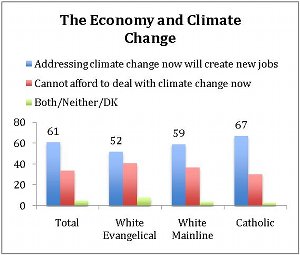
The new radio campaign coincides with a national survey commissioned by Faith in Public Life and Oxfam America that reveals strong support among Christians for laws that address climate change and protect vulnerable people.

According to the poll, conducted by Public Religion Research, majorities of Americans, including majorities of Catholics and Evangelicals, believe dealing with climate change will create new jobs and help avoid more serious economic problems in the future.

Nearly seven in 10 agree climate change is making it harder for the world's poorest people to support their families, and three quarters support helping poor people adapt to food and water shortages caused by rising global temperatures.


–Bob Allen is senior writer for Associated Baptist Press.


Poll says Americans moving rightward on social issues

PRINCETON, N.J. (ABP) — A week after releasing a poll for the first time showing a majority of Americans describe themselves as pro-life, the Gallup Organization reported new numbers showing public opinion moving to the right on a number of other social issues as well.

In a May 20 poll, fewer Americans said it is morally acceptable to clone humans, have an abortion or conduct stem-cell research using human embryos than those polled a year earlier.

A majority still finds stem-cell research morally acceptable, but support for such research dropped five points to 57 percent. Just one in three Americans (36 percent) believes abortion is morally acceptable, down four points in the last year. Support for human cloning fell from 11 percent to 9 percent.

A slight majority said sex between an unmarried man and woman (57 percent) or having a child out of wedlock (51 percent) is morally acceptable, both four percentage points lower than last year.

Divorce, gambling 

While nearly two-thirds said divorce is morally acceptable (62 percent) the number is down from 70 percent in May 2008. Five percent fewer Americans now view gambling as morally acceptable (58 percent) compared to a year ago.

Most Americans (62 percent) view the death penalty as moral, same as last year, and just under half (49 percent) approve of gay or lesbian relationships, up one point. On the question of buying and wearing clothing made of animal fur, 61 percent said it is moral, an increase of seven points from 54 percent who said so last year.

The survey said most movement toward the right occurred for Republicans. Support for stem-cell research declined nine points among Republicans, to 41 percent, while the percentage of Democrats finding it moral remained steady at 74 percent.

Democrats' attitude toward divorce also remained unchanged, with 74 percent finding it morally acceptable, while among Republicans that view dropped from 64 percent a year ago to 52 percent now.

Both Republican and Democrats increasingly expressed doubts about the morality of gambling, but the drop was faster among Republicans. Among Democrats, acceptance of gambling dropped from 67 percent to 64 percent, while among Republicans it dropped six points to 55 percent.

Morality of abortion

Half of Democrats (52 percent) accept the morality of abortion, compared to fewer than one in four Republicans (23 percent).

Nearly twice as many Democrats (66 percent) as Republicans (35 percent) affirm same-sex relationships.

Few Americans view a married man and woman having an affair as moral (6 percent). About the same number (7 percent) said it is moral for a man to be married to more than one woman at the same time.

Fifteen percent said suicide is morally acceptable, the same percentage as last year.

The survey was based on telephone interviews with 1,015 adults conducted May 7-10. The margin of error is 3 percent.


-Bob Allen is senior writer for Associated Baptist Press. 

Previous article:

Gallup poll finds ‘pro-life’ majority for first time, but some question results  (5/15)


If war can be justified, what about torture?

WASHINGTON (RNS)—While elected officials and pundits have debated whether torture of suspected terrorists is effective, legal or constitutional, a moral question has loomed in the background: Is torture ever justified?

Most Americans say “yes.” A Pew Research Center survey of 742 Americans in April found 71 percent believe torture of suspected terrorists is justified, at least on rare occasions. Solid majorities of every subgroup, including religious affiliation and worship attendance, said torture could be justified.

Ethicists and other thinkers are weighing under what conditions—if any—torture could be acceptable. What’s emerging is a rough outline of what could be termed a “torture doctrine,” vaguely reminiscent of Christianity’s Just War theory. But with torture, the query centers not so much on when it’s just as when it might be needed and defensible.

An image of “water torture” circa 1556 bears a stark resemblance to photos of U.S. interrogators using “enhanced interrogation techniques” against suspected terrorists. (RNS IMAGE)

Just War theory starts with a number of questions: Is war really necessary? Is it likely to succeed? Are there other alternatives? Here’s how similar questions might apply to moral dilemmas surrounding torture:

Is torture ever permissible?

No, according to Richard Killmer, executive director of the National Religious Campaign Against Torture, a coalition of more than 250 religious organizations. Torture “is a violation of the respect and honor that every human being is entitled to,” Killmer said.

Others disagree. Michael Levin, a philosopher at City University of New York, said he stands by his 1982 essay, “The Case for Torture.” In it, he argues, “there are situations where torture is not merely permissible but morally mandatory.”

Is the detainee conspiring to commit a heinous crime, such as mass murder?

John Kleinig, director of the Institute for Criminal Justice Ethics at John Jay College in New York City, posed a hypothetical scenario: What if a bomb were sure to go off and kill many unless officials were able, through the use of torture, to obtain information essential to defuse it?

“We are never going to be in position to know what the ticking-bomb argument requires that we know,” Kleinig said. Officials would have to know, for instance, that a real bomb will certainly go off unless defused, but he expects such certainty isn’t ever going to transpire in real life.

Would torture yield better information than any other method?

The notion that torture generates useful information is widely contested. President Obama, among others, has rejected the idea on the grounds that the tortured will presumably say almost anything to make the pain stop.

But even those who oppose torture on moral grounds say they nonetheless consider the prospects of securing high-quality information in certain cases.

“If I were the mother or grandmother of a child who might have been saved had information been garnered concerning a bomb placed in a school, I would no doubt be very angry that harsh things weren’t done,” said Jean Bethke Elshtain, a University of Chicago political philosopher.

Would innocent lives likely be saved as a result of torture?

Levin argues, “the lives of the innocents must be saved, even at the price of hurting the one who endangers them.” He compares torture to assassination and pre-emptive attack—that is, “an acceptable measure for preventing future evils.”

Some worry, though, about an ends-justify-the-means mor-ality that legitimizes something reprehensible on the grounds it could save innocents. Ronald Hallman, director of the criminal justice program at Roberts Wesleyan College in Rochester, N.Y., observed, “It’s hard for me to morally justify actions that torture, injure or potentially kill people, except under the most extreme conditions.”

Is there no alternative?

Torture is morally wrong because it violates another person’s God-given dignity, Hall-man said. But he left open the door for a hard-to-imagine case when it might be both wrong and necessary—torture as the lesser of two evils. He says torture might be warranted “when there is no alternative—which doesn’t happen very often, but it is possible.”


Preachers’ sermons resonate even from beyond the grave

WASHINGTON (RNS)—On the Sunday after Easter, famed Southern Baptist preacher Adrian Rogers appeared on Trinity Broadcasting Network, asking his congregation in suburban Memphis to turn to a passage of the Gospel of John.

Within hours, D. James Kennedy was on Ion Television, comparing Americans who have drifted away from God toward secular humanism to the New Testament’s prodigal son.

Both evangelical preachers, along with radio broadcaster J. Vernon McGee, have something in common. They all died years—and in McGee’s case, decades—ago.

Evangelist J. Vernon McGee, seen here in an undated photo, has been dead since 1988, yet his messages still can be heard on the radio and the Internet though his Thru the Bible Ministries. (RNS PHOTO/Courtesy Thru the Bible Ministries)

But their messages continue via TV, radio and the Internet, even as some listeners probably don’t even know they’re long gone.

“McGee, of course, is king of the hill,” said Frank Wright, president and CEO of the Virginia-based National Religious Broadcasters. “He is today the most widely listened-to Christian broadcaster anywhere in the world.”

The three broadcasters, Wright said, remain on the airwaves because of their knack for telling “timeless stories” and their focus on the unchanging texts of the Bible.

When Wright worked at Kennedy’s Center for Christian Statesmanship in Washington 14 years ago, he would listen to McGee on the radio as he drove to the commuter-train station.

“I listened to the guy for 3 1/2 years before I knew he was dead,” Wright recalled. “I was captivated by his kind of homey preaching style and had no idea that he had gone on to be with the Lord.”

Leo Karlyn, president of McGee’s Thru the Bible Radio Network in Pasadena, Calif., said the ministry, which began in 1967, has expanded to the Internet and added a Facebook page a few months ago. He expects McGee would be surprised the ministry continues.

Both Kennedy, who died in 2007, and Rogers, who died in 2005, set up separate broadcast ministries that have continued even as their pulpits have been filled by successors.

Tullian Tchividjian, grandson of evangelist Billy Graham, has been in Kennedy’s pulpit at Coral Ridge Presbyterian Church in Fort Lauderdale, Fla., since Easter, but Kennedy is the one seen on the television program, “The Coral Ridge Hour.”

Quentin Schultze, a Calvin College communication professor and editor of Understanding Evangelical Media: The Changing Face of Christian Communication, said the Internet, especially, has given religious broadcasters a second lease on life, even as the first lease expired.

“In the age of the Internet, such ministers will not likely survive on pricey broadcast media,” he said. “But they will continue to be available online and through computer downloads to iPods and other personal players.”

Bill Skelton, president and CEO of Love Worth Finding, said the Tennessee ministry founded by Rogers runs on about 13,000 U.S. television outlets and 1,800 radio stations worldwide. His Internet sermons were downloaded 1.7 million times last year.

“His own words were, ‘While the messenger’s gone home, the message must continue,’” said Skelton, who also is chairman of the NRB board.

“It may sound a little bit macabre to say this: I think as long as people turn on their radio and turn on their television sets and hear somebody teaching and preaching truths that are relevant to this life, the fact that he is alive or not is really not the important thing.”


Parents look inward, not upward, for guidance

NASHVILLE, Tenn. (BP)—Most American parents believe their parenting skills and family lives are pretty good, but they are reluctant to describe their homes as peaceful, relaxed or joyful. They say their daily family time consists mostly of eating dinner and watching television, according to a new study from LifeWay Research.

While most parents are trying to improve their skills, far fewer look to the church or the Bible for help, the researchers reported.

The national survey of 1,200 parents with children under 18 at home was conducted by LifeWay Research, an arm of LifeWay Christian Resources of the Southern Baptist Convention. The study found 96 percent of parents agree they consistently try to be better parents. Fifty-eight percent agreed strongly and 38 percent agreed somewhat with this statement.

“Parents claim they are trying hard to be better parents, but they are not welcoming outside guidance or advice,” Scott McConnell, associate director of LifeWay Research, said. With Rodney and Selma Wilson, McConnell is co-author of The Parent Adventure.

Sixty percent of parents look a lot to their own experiences growing up as their source of guidance on parenting and another 31 percent do so to some extent. By comparison, 21 percent indicated they receive a lot of guidance from a sacred text, and 15 percent said they depend a lot on a church. A full 61 percent completely ignore parenting seminars, and 53 percent have no use for books by religious parenting experts.

Only 14 percent indicated they are very familiar with what the Bible has to say about parenting, LifeWay Research reported.

Twenty-seven percent of Protestant parents said they are very familiar with what the Bible has to say about parenting, compared to only 7 percent of Catholic parents. Among parents with evangelical beliefs, 52 percent said they are very familiar with the Bible’s parenting advice.

A large majority—74 percent—of the parents described their home environment as supportive; 71 percent as positive; 69 percent as encouraging; and 69 percent as active. Only 53 percent reported that they pray together at least monthly, and just 31 percent reported having religious devotionals or studies together at least monthly.

More than 80 percent of parents rate family life—the quality of family communication, time spent with each other, treating each other with respect—as good to excellent. Thirty percent, however, indicate their family’s spiritual life is only fair or poor.

A full 92 percent of parents agreed they need encouragement, the study found. Almost 10 percent said they need help with parenting, and 11 percent indicated they have nowhere to turn for encouragement.

Among parents who attend religious worship services weekly, 38 percent indicated they get no encouragement from a sacred text such as the Bible, Torah or Quran. And 24 percent reported getting no encouragement from their church or place of worship.

Forty-three percent of Protestant parents and 85 percent of Catholic parents said they do not receive encouragement from a sacred text.

As for their church, 39 percent of Protestant parents and 71 percent of Catholic parents said it is not a source of encouragement as a parent.


In gauging successful parenting, few consider faith

NASHVILLE, Tenn. (BP)—The vast majority of parents hope their children grow up to live good lives. But, for many, parental success does not include faith in God—even among parents who are evangelical Christians, according to a new study from LifeWay Research.

The national survey of 1,200 adults with children under 18 at home found the most common definitions of successful parenting include children having good values at 25 percent, being happy adults at 25 percent, finding success in life at 22 percent, being a good person at 19 percent, graduating from college at 17 percent and living independently at 15 percent. Being godly or having faith in God is mentioned by 9 percent of respondents.

Parents who attend religious services weekly particularly are likely to emphasize faith in God, but only 24 percent of them identify that as a mark of parenting success, the research found.

“We are seeing an ever-widening gulf in American believers between private faith and a faith that is passed on,” said Scott McConnell, associate director of LifeWay Research. “Instead, we too often see an emphasis on guiding children to a social morality and toward an as-yet undefined ‘happy’ life.”

While the vast majority—83 percent—believes parents should be most responsible for a child’s spiritual development, only 35 percent say their religious faith is one of the most important influences on their parenting, according to the study. This leaves nearly half—48 percent—who acknowledge their role in their child’s spiritual development, but fail to consider their own religious faith among the most important influences on their parenting.

Pushing out to either end of the religious spectrum, the study found almost a third of all parents either have no religious faith or say religious faith has little or no influence on their parenting. Conversely, among born-again Christians, 29 percent say faith is not among the most important influences on their parenting.

“When self-identifying Christians are not able to say that faith is a priority for parenting, we should not be surprised at the prevalence of church dropouts in the younger generation,” said Ed Stetzer, director of LifeWay Research.

Asked if they have a written plan or goal for what they want to accomplish as parents, 33 percent say they have no plan or goal at all. Among those who attend religious services weekly and evangelicals, 76 percent say they have a plan, either written or unwritten.

In contrast to visions of success, many parents are fearful for their children’s futures and some harbor regrets about their parenting, according to the research. Eighty-two percent agree they feel fearful when they think about what kind of world their children will face as adults. Asked if they feel a lot of regret about what they’ve done as parents, 28 percent of parents agree, although only 5 percent feel strongly about it.

Six out of 10 parents indicate they want their children to experience pain and disappointment so they can learn from it, but about three in four parents say they try to keep their own pain hidden from their children.

One in three parents—34 percent—say they worry when they think about their children “leaving the nest.” Fifteen percent say the prospect of their children growing up and leaving home is simply too painful to think about.

Only 14 percent of all parents say they feel they are very familiar with what the Bible has to say about parenting, even though 77 percent identify themselves as Christians. Among those who attend religious services weekly, that number rises to 36 percent.

“One of parents’ ultimate responsibilities is to prepare their children for adulthood,” McConnell said. “This study may hint at why many young adults are spiritually underdeveloped—their parents have given little focus to matters of faith.”