





WASHINGTON (RNS)—About 4,000 young Christians packed into a convention center in Palm Springs, Calif., to hear preachers tell them that they are totally depraved, incapable of doing the right thing without a mighty hand from God, and—most importantly—have no control over their eternal fate.
The mind behind that message is John Calvin, the 16th-century Refor-mer often better known for condemning sinners and heretics than for igniting evangelical zeal. But as Presbyterian and other Reformed churches have prepared for the 500th birthday of their spiritual godfather this summer, young American evangelicals increasingly have taken up his theological torch.
Young evangelicals are scooping up books by neo-Calvinist authors, packing churches and conventions led by Calvinist preachers and studying at staunchly Calvinist seminaries. They’re blogging their way through Calvin’s behemoth Institutes of the Christian Religion, setting up Facebook fan clubs and opening Twitter feeds.
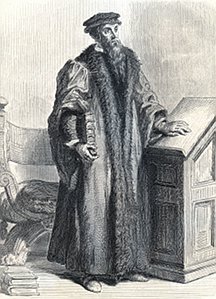
Protestant Reformer John Calvin, whose 500th birthday is being celebrated around the world this summer, is an inspiration and guide to many young evangelicals. (RNS GRAPHIC)
|
Earlier this year, Time magazine served notice that “The New Calvinism” is one of “10 ideas that are changing the world right now.”
In other words, Calvinism has moved out of the Puritan meetinghouse and into the megachurch.
Though he often is portrayed as a dour, prickly Puritan, Calvin was a sensitive pastor with a thankless task, said Karin Maag, a professor of history at Calvin College in Grand Rapids, Mich.
“He had the complicated and painstaking job of creating a new church,” Maag said. So, while Martin Luther fired up the masses, Calvin, essentially, gave them new rules.
As a Protestant leader in a Catholic territory, Calvin lived under the constant threat of siege, Maag said.
American neo-Calvinists say they similarly are besieged by the forces of secularism. And while the ministers and churches of their youth kept them entertained, they didn’t offer the kind of intellectual firepower many find in Calvinism.
“Most of them grew up in some kind of church, but they were not taught much doctrinal formation; they played youth-group games,” said Collin Hansen, author of the 2008 book Young, Restless, Reformed: A Journalist’s Journey with the New Calvinists. “When they went to college, the games didn’t seem worth it.”
Calvinism, Hansen and others say, provides a time-tested doctrinal anchor to keep young evangelicals from being swept away by the mainstream.
But Calvin also can be a profoundly divisive figure. The Calvinist belief that Jesus died only for an elect few has split Christians for centuries, said Peter J. Thuesen, a professor and author of a forthcoming book called Predestination: The American Career of a Contentious Doctrine.
“That idea has upset so many different religious groups, the backlash against it gave rise to some of the denominational diversity in the United States,” as churches split from each other over predestination debates, Thuesen said.
In fact, Baptists still are fighting over Calvin. About 30 percent of young Southern Baptists consider themselves Calvinists, according to a survey by the denomination’s research arm. Pastor Tom Ascol, executive director of the pro-Calvin Founders Ministries, considers that evidence the rising generation is “awakening to a fresh vision of God’s sovereign majesty over every square inch of earth.”
But former Southern Baptist Convention President Jerry Vines said Calvinism inhibits evangelism and missionary work, which is the lifeblood of the SBC, the nation’s largest Protestant denomination. If Jesus died only for the elect, then what’s the point of trying to reach others, said Vines, who co-organized a conference last year dedicated to refuting Calvinism.
“I do believe it is possible to be a five-point Calvinist and be evangelistic and missionary-minded,” Vines said. “But their evangelism and missionary work is in spite of their Calvinism, and not because of it.”







We seek to connect God’s story and God’s people around the world. To learn more about God’s story, click here.
Send comments and feedback to Eric Black, our editor. For comments to be published, please specify “letter to the editor.” Maximum length for publication is 300 words.