In Rosa Parks’ estate, evidence of a lifelong quiet faith

NEW YORK (RNS)—Civil rights icon Rosa Parks used to jot notes in her church bulletins, noting sermon titles and song selections. She kept a postcard sent by Martin Luther King Jr. two years after she refused to give up her seat to a white man on a bus in Montgomery, Ala.

And among the clothes she left behind when she died in 2005 was a simple white stewardess dress and black stewardess hat that she wore when she prepared Communion at her African Methodist Episcopal church in Detroit.

Parks, a private woman best known for her one act of public defiance 50 years before her death, spent her life holding onto treasures and tidbits of her own history, both religious and cultural.

A photo of civil rights icon Rosa Parks with the late Pope John Paul II is one of thousands of items from Parks’ estate that will be auctioned by Guernsey’s, a New York auction house. (RNS photo courtesy Guernsey’s)

There are her 1996 Presidential Medal of Freedom and the 1999 Congressional Gold Medal, keys to numerous cities, and hundreds of tributes from schoolchildren.

Now thousands of Parks’ personal items have been inventoried by Guernsey’s, the Manhattan auction house that has handled the possessions of celebrities from President John F. Kennedy to Elvis Presley.

The collection offers an intensely personal view into the rather ordinary life of a laywoman who was actively involved in her church, and who kept several Bibles and worship programs with her personal notes jotted down over the decades. In 1976, she noted that the minister at her church, St. Matthew AME Church, preached on “Conquering the Storm.” In 1983, it was “The Inherent Power of Friendship,” and in 1997, “We are God’s children.”

On the back of some 1980s stationery from the Rosa Parks Art Center, she wrote: “Spiritual message: I will greet this day with love in my heart. Expecting nothing as all things are already in my possession.”

A Michigan probate court has asked Guernsey’s to find a new owner for the entire collection of Parks’ belongings. The proceeds of the sale—which could total $10 million—will be divided between a Detroit institute named for Parks and family members.

Leaders of the AME Church were on a conference call with Guernsey’s president Arlan Ettinger recently to express their interest in the collection. Other interested parties include some organizations from Parks’ native Alabama.

The AME Church, at its quadrennial General Conference this summer, passed a resolution calling on church leaders to “do whatever is necessary to protect the legacy of Deaconess Rosa Parks and the role of the AME Church in the modern day civil rights movement.”

Bishop Carolyn Tyler Guidry, chair of the AME Church’s Social Action Commission, said church leaders are considering the possibility of purchasing the collection.

“We feel that without Rosa Parks, the movement would not have been as intense as it was,” she said. “Even Martin Luther King Jr. himself might not have been thrust into the public stage as soon as he was. It is because of Rosa Parks that the movement escalated when it did.”

The collection contains writings from around the time of her famous 1955 protest and the subsequent Montgomery bus boycott that show she drew on her faith in troubled times.

In an account written neatly in pencil, she recalled learning that King’s house had been bombed on a January night in 1956 and his wife and baby daughter had escaped safely.

“We do not know what else is to follow these previous events, but we are trusting in God and praying for courage and determination to withstand all attempts of intimidation,” she wrote to supporters.

The collection is striking for it being at turns noteworthy and normal.

On the back of a 1997 invitation to be honored as a trailblazer by the Michigan Conference of the AME Church, Parks writes an apparent “to do” list: “Cocoa buter (sic), Cream, Panty hose, Rolaids.”

Said Ettinger: “Perhaps more than any archive that I’m aware … that exists anywhere, this reflects on her whole life.”

There are hoods she received with honorary doctoral degrees and a recipe for “featherlite pancakes” with melted peanut butter. There are old Ebony magazines and the NAACP Image Award for her supporting actress role playing herself in the CBS drama Touched by an Angel.

The one-time seamstress wrote many of her words of historical note on the back of stationery of civil rights organizations, demonstrating her frugality.

“You do see her as a full human being,” said Carolyn Salter, Guernsey’s senior archivist. “Not just the woman on the bus, not just the seamstress, but everything.”


Poll on race stresses need for ‘sacred conversations’

NEW YORK (NCC)—A recent New York Times/CBS News poll revealing deep national divisions along racial lines is an urgent reminder of the need for “sacred conversations on race,” the head of the National Council of Churches said.

The poll indicated that a large majority of African Americans—nearly 60 percent— believe race relations in the United States are “generally bad,” the Times reported today. Forty percent of blacks said racial discrimination is as bad as ever, while one out of four whites said there is too much emphasis on discrimination. Seventy percent of blacks and half of Latinos said they have been targets of racial discrimination.

“These figures are discouraging but not surprising,” said Michael Kinnamon, general secretary of the NCC. “Last April our churches called for a ‘sacred conversation on race’ in American pulpits, and this poll shows how badly those conversations are needed.”

The call for sermons on race was issued earlier this year by John H. Thomas, general minister and president of the United Church of Christ, and promptly endorsed by Kinnamon and other church leaders. Thomas made the call as church leaders gathered on the steps of Chicago’s Trinity United Church of Christ and defended Jeremiah Wright, then the target of a storm of criticism for remarks deemed unpatriotic and radical by critics.

Wright attracted attention because Democratic presidential candidate Sen. Barack Obama was a member of Trinity, and media reports fanned the flames of rumors about what Wright and church members believe.

At the time, Kinnamon dismissed notions that Trinity’s congregation is a “radical sect” as “nonsense,” and pointed out that many of Wright’s criticisms of American racism were accurate. “This country has made important strides in confronting its racist past. But, surely, no one thinks that racism has been eradicated,” Kinnamon said.

Kinnamon noted Sterling Cary, a UCC clergyman who was NCC president in the early 1970s, has warned that Obama’s successful campaign for the Democratic presidential nomination obscures the fact that there are still “huge problems” among races in the U.S.

In an interview last month with NCC News, Cary said the racism Wright preaches about “is still with us. My greatest concern about the current presidential campaign is that the rhetoric gives people the impression that they can ignore the past and celebrate the future, but there are a lot of serious problems that cannot be glossed over—and this is especially pronounced in terms of race."

The Times/CBS poll showed marked divisions in voter preference for president. Nearly 90 percent of black voters favored Obama while 2 percent favored Republican Sen. John McCain. White voters chose McCain over Obama by 46 percent to 23 percent. Latino voters chose Obama by 62 to 23 percent.

“Many white Americans tend not to recognize the racism that persists in our society while persons of color say they feel it acutely and persistently,” Kinnamon said. “It’s very painful to realize how divisive race continues to be, but it’s a reality the churches cannot ignore. We have to confront racism honestly, directly, and in Christ’s spirit of love and reconciliation.”

Originally the Sunday designated for sacred conversations on race was May 18, Trinity Sunday.

“But the pain of racism continues and the sacred conversations must continue,” Kinnamon said.


A good man is hard to find at church

DALLAS (ABP)—Men are disappearing from the church.

According to the Barna Research Group, there are 11 million to 13 million more American women who are born again than there are born-again men. While nine out of 10 senior pastors are men, a majority of regular church attenders are women.

Not only are women the majority of born-again American Christians, the Barna Group reports, “Women are the backbone of the Christian congregations in America.”

Perhaps indicative of women’s sense of spirituality, 41 percent of women said they have set specific spiritual goals they hope to accomplish in the coming year or two. Only 29 percent of men have identified such spiritual goals.

“Women, more often than not, take the lead role in the spiritual life of the family,” said George Barna, president of the research group. “Women typically emerge as the primary—or only—spiritual mentor and role model for family members. And that puts a tremendous burden on wives and mothers.”

Pam Durso, associate executive director of the Baptist History & Heritage Society, agrees women play a major role in families as spiritual mentors. “One aspect of that is that mothers generally are the ones who do the scheduling of events and the planning of activities, including church attendance and church-related programs.”

But that’s nothing new, Durso argues. Historically, women have dominated the membership of Baptist churches.

“Here is something to think about: Is 61 percent for female participation really a change for Baptists? Over the years, many Baptist churches have had a majority of female members,” Durso said.

At First Baptist Church of America, in Providence, R.I.—the premier Baptist congregation in the New World—59 percent of the members from 1730-1777 were women, Durso noted. From 1779-1799, that percentage dropped by only 1 percent to 58 percent.

“So, perhaps the question is not where have all the men gone, but is instead where have men been all these years?” Durso said.

David Murrow, author of Why Men Hate Going to Church, believes the way churches market themselves affects the demographics of their memberships. According to Murrow’s Church for Men website, a typical congregation draws an adult crowd that’s 61 percent female and 39 percent male.

“It’s widely believed, and rarely spoken of, that men feel church is something for women, children and grandparents,” Murrow said. “If a man becomes involved (in a church), then he is less manly.”

Murrow believes this trend began during the Industrial Revolution in the 1840s. Harsh economic conditions drove men to seek jobs in mines, mills and factories. While men worked, families were left behind for longer periods of time. The only people to be found in congregations were women, children and older men. Women began to add socials like teas, quilting circles and potluck dinners.

“The able-bodied man all but disappeared from the church,” Murrow said.

Murrow mentions on his website, www.churchformen.com, that many who have grown up in the church don’t recognize the “feminine spirituality.” But to the masculine mind, it’s obvious as the steps in front of the door.

“He may feel like Tom Sawyer in Aunt Polly’s parlor. He must watch his language, mind his manners and be extra polite. It’s hard for a man to be real in church because he must squeeze himself into this feminine religious mold,” Murrow writes on the site.

The tendency of targeting women has grown with the increased popularity of contemporary worship, Murrow added.

Hymns used to be tuned into the masculine heart by alluding to God as a mighty fortress, Murrow noted. Songs such as “Onward Christian Soldiers” spurred men in their faith.

“But now worship sounds like a Top-40 love song,” Murrow said. “They are wonderful and biblical, but it’s not the sentiment that will rally a bunch of men.”

Romantic music is a response to the market of single women, Murrow added. “They provide a Jesus image who wants to steal away with them … which doesn’t appeal to men.”

“Are we going to allow the market to drive the church, or the Bible to drive the church?”

Murrow suggests there’s nothing wrong with the gospel—just the way Christians present it. “We just need to change the culture container that we are delivering it in and should be willing to follow the example of churches who succeed in reaching men,” he said.

A leading example is Christ Church of the Valley in Phoenix, Ariz. The church markets to men through the events promoted, down to the colors and design of the building. The church even changes the range of the worship songs so men can feel comfortable singing.

“Everything we do when it comes to marketing is geared toward men in the 25-45 range … an underserved demographic in the church market today,” said Michael Gray, communications coordinator of Christ Church of the Valley.

The church offers activities like motorcycle and sport groups. One of the groups is called The Edge. There men can rappel down cliffs, jump out of airplanes and bungee jump off bridges. The purpose is to cause men to take a step of faith and stretch their comfort zones. The ministry is a spiritually challenging group, not just physically challenging. While the group focuses on adventurous activities, their ultimate goal is to lead people into an adventure with Jesus Christ.

“The Edge helps get men plugged into the church and hanging out with other men, outside a church setting,” Gray said. “It shows that we are men’s men, and we don’t just sit in shirt and tie on Sundays with our leather-bound Bible”

There is more than one way to present the gospel in a way that contemporary men will respond to, Murrow said. But it begins with the congregation understanding it must make an intentional effort to reach out to men.

“People have to realize it’s a problem. They need to wake up and look (at) how magnetic Jesus was to men. We have a 70-to-80 percent failure to boys. I don’t think that’s (God’s) will.”


Heal the Sick: Chaplains, charity care set faith-based hospitals apart

What distinguishes religiously affiliated hospitals from their secular counterparts? Chaplains and charity care top the list, administrators of faith-based, nonprofit health care institutions agree.

“Every morning at 5 a.m., a chaplain goes into our surgical unit where he has the opportunity to encourage patients who are facing surgery and offer them the opportunity for prayer. You don’t find that in every hospital in America,” said Glenn Robinson, president and chief executive officer of Hillcrest Health System in Waco.

A technician at Hillcrest Health Care in Waco prepares a patient for a CT scan. (Photos courtesy of Hillcrest Health Care)

Hospitals that are not religiously affiliated may have a chaplain on staff or on call. But at a faith-based institution, pastoral ministry staff members are viewed as an integral part of the healing team, helping to meet spiritual and emotional needs while physicians respond to medical concerns, he added.

Hospitals with denominational ties also offer a different level of clinical pastoral education through their chaplaincy programs, Robinson noted. Hillcrest works closely with Baylor University’s Truett Theological Seminary, as well as other divinity schools, to offer pastoral ministry experience and training.

“For many Baptist hospitals in particular, the chaplains’ office and CPE program are not just there to provide pastoral care, but also to provide education for pastoral care providers,” said Mike Williams, chief executive officer of Community Hospital Corporation.

Churches benefit from that service—a fact not lost on denominational organizations. In Texas, churches affiliated with the Baptist General Convention of Texas historically have supported healthcare institutions through their Cooperative Program unified giving plan.

At one time, those funds provided some operating expenses, particularly for charity care. But as healthcare costs skyrocketed and the BGCT allocation to hospitals became an increasingly minute fraction of their total operating budgets, the state convention shifted toward designating funds to pastoral ministry at the institutions.

In recent years, Texas Baptists have provide more than $1.2 million annually to support chaplaincy and pastoral ministry programs in five BGCT-affiliated healthcare systems.

Each year, the Hillcrest Health Care system provides about $70 million in uncompensated care for people in Central Texas—about $20 million that clearly could be characterized as charity care and more than $50 in uncompensated care resulting from bad debt, including from people who don’t qualify for charity care but who cannot pay their medical bills.

But while the ability of denominations to provide direct financial support for charity care in their affiliated hospitals has lessened, the healthcare systems have maintained a commitment to providing medical attention for poor people in their communities.

More than any other single factor, that commitment sets faith-based nonprofit hospitals apart from secular for-profit healthcare providers, Williams insisted.

“The biggest issue is the mission of faith-based hospitals to provide health care to all people, regardless of their ability to pay for it,” he said. “Not-for-profits are the safety net hospitals in our country—the institutions that provide the vast amount of uncompensated care for the uninsured or underinsured.”

That sense of mission—to make sure all people had access to medical care—prompted Baptists in the United States to enter the institutional healthcare arena in the mid-1880s. That’s when William H. Mayfield, a physician, called on Third Baptist Church of St. Louis, Mo., to help him launch the Missouri Baptist Sanitarium and later the Mayfield Sanitarium. Ultimately, the fledgling entry into healthcare grew to become Missouri Baptist Medical Center.

In 1903, George W. Truett, pastor of First Baptist Church in Dallas, challenged a group of North Texas community leaders by asking, “Is it not now time to begin the erection of a great humanitarian hospital, one to which men of all creeds and those of none may come with equal confidence?”

Truett joined R.C. Buckner, who had pioneered a small-scale hospital in an annex of the Buckner Orphans Home in east Dallas, and wealthy Dallas layman C.C. Slaughter in giving birth to the Texas Baptist Memorial Sanitarium in Dallas—predecessor of what is now Baylor Health Care system.

“That sense of justice and equality expressed by George Truett is a guiding principle,” said Jim Walton, vice president and chief equity officer for Baylor Health Care System.

A pediatric nurse comforts a patent at Hillcrest Health Care in Waco.

“It starts at the top and works its way down. It makes a difference when it comes to making decisions about how to allocate resources. As a mission-based organization that enjoys tax-exempt status, it’s expressed in our commitment to take care of the medically underserved population.”

More than 60 percent of the hospitals in the United States are nonprofit. Many were founded by religious groups or denominations, but a significant number have loosened or severed those religious ties. And in the process, some—but not all—have lessened their commitment to providing charitable care.

As ranking member of the Senate Finance Committee, Charles Grassley, R-Iowa, has led the charge to make sure hospital that enjoy the tax benefits of nonprofit status provide significant charity care for their communities.

An IRS report released in July 2007 showed nearly one-fourth of the nation’s nonprofit hospitals spend less than 1 percent of their revenue on charity care, and nearly half spend 3 percent or less. The study showed one nonprofit hospital in five spent 10 percent or more of revenue on care for the uninsured poor.

In contrast, some Baptist hospitals that have maintained strong denominational ties report devoting anywhere from one-fifth to one-fourth of total revenue to uncompensated care for poor patients—assuming that all parties involved define terms the same way.

“About 25 percent of our total business falls into the category” of unreimbursed care, Robinson said regarding Hillcrest Health System in Central Texas. “That amounts to $70 million every year in uncompensated care to our community.”

Of that total, $20 million clearly falls into the category of charity care in the strictest sense, said Richard Perkins, executive vice president and chief financial officer at Hillcrest. More than $50 million of the uncompensated care results from bad debt.

“As you know, most of the bad debt is generated by persons who don’t qualify for charity’—or don’t provide the information to confirm that they do—but don’t have the ability to pay either the entire bill or the portion that is their responsibility, even if they have insurance,” Perkins said.

Neonatal care at Hillcrest Health Care in Waco.

“This problem is growing annually as many employers are either dropping coverage, raising the employee premiums to unaffordable levels or increasing the copays and deductibles to amounts which most people are not able to pay.”

Similarly, a community services report posted on the Baylor Health Care System website notes: “Baylor’s community benefit expenditures in fiscal year 2006 accounted for nearly 21.3 percent of its net patient revenue, reaching a record $407 million in unreimbursed costs. The vast majority, or nearly $395 million of the expenditure, went to provide care for charity patients and patients enrolled in government programs such as Medicare and Medicaid. Payments from these federal and state agencies are far below the actual cost of the care delivered. The remaining $12 million provided for unreimbursed costs of medical education and research, as well as more than 200 community benefit programs.”

Faith-based nonprofit hospitals, almost by definition, serve their communities better than for-profit hospitals, Williams insisted. While the quality of care in for-profits may be high and some for-profit hospitals operate out of a sense of mission, their bottom line remains the bottom line, he said.

“If they are an investor-owned operation, they have to return a dollar benefit to their shareholders,” he said.

Still, charity care and chaplaincy programs are not the exclusive domain of denominationally related nonprofits. When Vanguard Health Systems—a for-profit healthcare corporation—acquired Baptist Health System in San Antonio several years ago, officials pledged to continue the hospital’s historic faith-based mission.

Vanguard hired George Gaston, who served 25 years as pastor of Texas Baptist churches, as regional vice president of ministry for Baptist Health Systems. Under his leadership, the health care system’s pastoral care team maintains 11 full-time chaplains and five part-timers who handle on-call work over the weekends. Two clinical pastoral education supervisors work with six residents and a dozen interns. Baptist Health Systems reported providing $17.8 million in charity care during the 2006-2007 fiscal year and more than $19.6 million in 2006-2007.

Just because a hospital system pays taxes, that doesn’t mean it can’t operate by Christian values, Gaston maintains.

“People think that when you sell a nonprofit, that you give up the ability to render Christian care. We have not done that at all,” he said. “We have strengthened and built upon what was done before us. We’ve got a wonderful ministry here.”


Candidates’ health-care plans reflect different visions for government

WASHINGTON (ABP)—Differences in presidential candidates John McCain’s and Barack Obama’s plans for reforming the American health-care system reflect their differing views on the proper role of government.

Whether or not one of the plans more closely resembles Christian principles of justice and charity, however—or whether either will work at all—also may depend on how individual Christians view the proper role of government.

Both of the major-party presidential candidates’ plans are—like the industry they seek to reform—massive and complex.

McCain plan would rely less on government 

In a nutshell, McCain’s plan focuses on using market forces to drive down health-care costs, therefore shrinking the estimated 47 million Americans who do not have health insurance by several million. Obama, by contrast, envisions a stronger government role in expanding access to health insurance for the working poor as well as placing more responsibility on consumers, the insurance industry and employers alike for reforming the system.

“Without question, there are two distinct approaches on display by McCain and Obama,” said Kevin Schmiesing, a research fellow with the Michigan-based Acton Institute, in an e-mail interview. “To their credit, both recognize that no single element of reform is going to save the day; instead, the platform of each contains a number of reform proposals operating on a number of different fronts. Both recognize the need to control costs, to address the problem of the uninsured, and to improve the quality of delivery. Yet McCain’s proposals, on the whole, are striving for a system characterized by more competition, more choice, and more freedom; while Obama’s tend toward greater government intervention.”

The core of McCain’s plan involves what could be the beginning of the end of the employer-based system that many Americans—and particularly those in white-collar jobs—have become accustomed. Instead of exempting the costs of employer-paid insurance premiums from individual income taxes, McCain would instead give an annual tax credit of $2,500 to individuals and $5,000 to families. The funds would go to purchase health insurance.

Any funds left over after insurance is purchased could be deposited in health-savings accounts to reimburse taxpayers for any deductibles or other non-covered health expenses. In addition, the plan would include the self-employed, who currently get no tax benefits when they purchase health insurance.

However, it currently costs the average American family approximately $12,000 annually to have comprehensive health insurance. McCain’s plan aims to reduce the costs of insurance plans with a number of incentives—such as allowing insurers to sell their products across state lines—that would increase competition and consumer choice.

McCain advisers have said they hope to reduce the number of uninsured Americans by approximately 20 million with this plan, but some economists have said 7-10 million is more realistic.

Obama would expand Medicaid 

Obama’s plan, meanwhile, focuses more on a mixture of market reforms and government subsidies, and aims to reduce the number of uninsured Americans far more dramatically. In particular, Obama would require that all children be insured. He would dramatically expand the State Children’s Health Insurance Program, known as SCHIP, to increase the numbers of children form lower-middle-class families who would be eligible. He would also expand Medicaid to cover more children.

Obama would also allow people who are not insured by their employers but who make too much for SCHIP or Medicaid to participate in the same federally-subsidized insurance program that government workers use. He would also allow the self-employed or small businesses that currently can’t afford to buy private insurance for their workers to participate in the plan.

Finally, Obama’s plan would create a National Health Insurance Exchange for private insurers. Insurers participating in the exchange would have to meet certain standards for deductibles and services, could not turn away customers with pre-existing conditions and would be regulated in other ways by the government. Companies would have to disclose costs of procedures to consumers, and consumers would be able to compare the benefits of various plans participating in the exchange.

Schmiesing, whose Acton Institute is a Christian think tank that advocates for free-market capitalism, said he prefers McCain’s plan because he distrusts government’s ability to improve the situation through more subsidies and regulation. The core of the problem with the current health-care system, he claimed, is that it is overused.

“People need to be encouraged to consume just the amount of health care they really need—or can personally afford—and not any more,” he said. “This is what we naturally do in every other area of our lives. This can only be accomplished by returning responsibility for payment directly to the consumer—not routing it through a third-party, be that an employer or a government. McCain’s plan moves us in this direction; therefore, I believe it to be the most economically realistic over the long term.”

But, critics of free-market approaches to the health-care crisis have argued, health care is not like other goods and services.

Is healthcare a commodity or a right? 

“The commodity-based approach to health care is fundamentally flawed,” says a position paper from the Human Right to Health Program, a coalition that advocates for universal health care as a human right.

“It restricts access to health care to those who can afford to buy it and assumes that prices will be reasonable because supply and demand are linked. With most products, consumers limit their demand based on price. But in the case of health care, demand is not price sensitive. When you are sick you don’t have a choice.”

Schmiesing acknowledged McCain’s plan would leave significant gaps in the numbers of people who have access to affordable, high-quality health care. But he said that churches and other private organizations should embrace their role as healers to make up for the difference.

“Where people cannot afford the health care they need, that is where other institutions—families, communities, churches, and sometimes government—will need to intervene,” he said. “It’s no accident that many hospitals bear names reflecting their current or former religious affiliation. Some people on the margins of society will simply never be able to afford the level of health care that they need.”

Scott Morris agrees. Morris is a physician and United Methodist minister who founded the Church Health Center in Memphis, Tenn., in 1987. The ecumenical organization operates a clinic that serves about 36,000 patients a year in one of the nation’s poorest major cities. It aims its services at the working poor, and couples clinical care with programs that use faith communities as vehicles for encouraging better health practices among vulnerable populations.

“I think, No. 1, that people in the church and churches in general—and at a local level is what I’m talking about—have to care about these issues and se them as fundamentally issues of faith. Historically the church has done that,” Morris said.

A role for churches 

“This is fundamentally a theological idea. … So the first step is to say that the body matters, that God breathed the breath of life and the spirit into a human body. As Christians, we believe in the resurrection of the body. Jesus, in our Eucharistic settings, it’s all about a physical body and blood that we are partaking of, so first we’ve got to cross this line to say we care about that stuff.”

Churches, Morris continued, should take care of improving the health of their communities at a local level—by offering healthier congregational meals, for instance.

“If you’ve got to have fried chicken to draw a crowd, there’s something wrong with your message,” he said.

As for the candidates’ plans, Morris said neither is realistic—nor likely to make it, intact, through Congress regardless which party is in charge.

“The politics of it is brutal, and poor people have very little power in this mix. And somebody has to foot the bill. Health care in America is very expensive, and when people start figuring out who pays for all of this, that for me is when the rubber hits the road,” he said.


See for yourself …

Side-by-side comparison of McCain and Obama health-care proposals from the Kaiser Foundation


Faith Digest: Airport renamed for civil rights pastor

The Birmingham Airport Authority has voted to rename Alabama’s largest airport for civil rights leader Fred Shuttlesworth. Shuttlesworth, 86, grew up in Birmingham and was pastor of Baptist churches in Birmingham and Cincinnati. He helped Martin Luther King lead demonstrations that led to the Civil Rights Acts of the mid-1960s, as well as change racial attitudes nationwide.

Audio Bible wins Christian Book of the Year award. For the first time in its 30-year history, the Christian Book of the Year award from the Evangelical Christian Publishers Associa-tion is going to a Bible and an audio product. The Word of Promise New Testament Audio Bible , produced by Nashville, Tenn.-based Thomas Nelson Inc., took home the award. The New Testament dramatization features the voices of actors Jim Caviezel, Stacy Keach, Louis Gossett Jr. and Marisa Tomei, among others.

British clerk wins discrimination claim. A city clerk who refused to conduct same-sex partnership ceremonies because they violated her Christian beliefs has won her legal action claiming discrimination against supervisors who threatened to fire her. Lillian Ladele declared it a “victory for religious liberty” when an employment tribunal found the Islington Council in London guilty of religious discrimination, degradation and hostility. Ladele, who has held the job nearly 16 years, testified she “felt harassed and victimized” by the council when she insisted she would not carry out gay ceremonies as a matter of religious conscience.

Church postpones gun giveaway. An Independent Fundamentalist Baptist church in Oklahoma City canceled plans for a gun giveaway at its annual youth conference, but officials said the contest will resume next year despite criticisms. Windsor Hills Baptist Church canceled the gun giveaway and a shooting competition after a local television station announced an AR-15 assault rifle would be given away as part of the shooting contest. In a statement released on the church’s website, Youth Minister Bob Ross said the giveaway was canceled because Pastor Emeritus Jim Vineyard injured his foot and would be unable to attend the event. Ross told the local ABC affiliate the gun giveaway is a marketing strategy to attract young people to the youth conference.

EEOC issues new religion manual. Citing changing demographics and a steady increase in complaints from people of faith, the U.S. Equal Employment Opportunity Commission released an updated compliance manual on religious discrimination in the workplace. It provides safeguards for workers who request time off for religious observances and protects workers whose faith requires they wear specific religious garments, such as a hijab, a head covering worn by some Muslim women. Allegations of religious discrimination still make a small fraction of the total number of complaints reported each year. Last year, just 3.5 percent of cases handled by the agency were religious in nature.


Musician Chapman & family discuss how God sustained them through tragedy

NASHVILLE, Tenn. (BP)—Two months after the tragic accident that claimed the life of his 5-year-old daughter Maria Sue, Steven Curtis Chapman appeared with his wife and three oldest children on CNN’s Larry King Live to testify to the home they find in Christ.

Chapman, a Grammy-winning Christian musician, said he deals with the loss of the youngest of his three adopted Chinese daughters “sometimes in intervals of about 15 minutes at a time.”

Steven Curtis Chapman and his wife, Mary Beth, discuss the loss of their 5-year-old daughter Maria on CNN’s Larry King Live. (BP Photo)

One of the most pressing questions King asked was whether Chapman lost his faith at any point during the ordeal.

At the moment of his daughter’s death, Chapman said, he was “crying out to … my Father.”

King wanted to know if Chapman was angry.

“I really wasn’t angry at God,” he said. “And until you walk through that, I think I’m not sitting here saying, you know, ‘I’m so—we’re so strong and I made even a choice to do that.’ It was just my immediate natural reaction was—I mean I know I heard myself saying a lot, ‘God, You can’t ask this of me. You can’t ask this of my family. This is too much. We can’t do this.’”

Chapman was standing on the front porch of his home in Franklin, Tenn., May 21 when he saw his 17-year-old son Will Franklin coming up the driveway in an old SUV. Chapman said he believes it was providential that God allowed him to see that Will was driving uncharacteristically slow and wasn’t talking on his cell phone.

Will drove around to the back of the house, and as he was turning the corner, he didn’t see his little sister run into his path. Immediately he knew he had hit something, and he stopped, only to find something that would forever change his life.

“Right after the accident, I started just running because I just didn’t know what else to do,” Will said, referring to what he did after making sure other family members were responding to Maria.

“I just wanted to run and just be away—as far away from the site of the accident as possible—and just started running and was planning on just running as far as I could.

“And then Caleb, not too long after that, just kind of ran and tackled me and just kind of jumped on me,” he said of his 18-year-old brother. “… And it was just like, ‘You can’t leave, you can’t leave.’ (Caleb ) … was just on top of me saying, ‘Everything’s going to be OK. We love you. You can’t leave.’ And … that was super important.”

The Chapmans had adopted Maria and two other girls from China. (BP Photo)

Chapman said his memory of the immediate aftermath is foggy.

“I do remember running around to the back of the house and finding my wife, of course, just in hysterics,” he said. “… It was a lot of blood. And I, you know, of course, began … reminding God of all the great things he had done through history and that he could … give her life again. He could breathe life back into her.”

Maria had been on the playground in the backyard with her two sisters, and she ran toward her brother when she saw him coming in the SUV because she wanted him to lift her onto the monkey bars, Chapman said.

As they waited for medical personnel to arrive, Chapman and his wife performed CPR on Maria to no avail. The girl was flown by helicopter to Vanderbilt Children’s Hospital in Nashville, where she was pronounced dead on arrival.

Will and the other children have been meeting with trauma counselors in order to work through their grief, their mother, Mary Beth, said while opening up about her own reaction to losing a child.

“I’ve been mad. I’ve been sad,” she said. “I’ve jumped up and down. I’ve crawled under my bed. I’ve gone in my closet. You name it; I’ve done it. And I know that I will never understand, this side of eternity, why Maria, why Will. I have a list of questions in my journal, you know, ‘Why?’”

"Your father loves you" 

The family agreed that they have never been angry at Will for the accident, and they rallied to show him their support. As Chapman was being driven to the hospital, he stopped in the yard to tell his son, who was doubled over in agony, ‘Will Franklin, your father loves you.”

Chapman told about a discovery he made in the hours after the accident that has provided comfort in the days since.

“Maria had the morning of the accident drawn a picture of a flower and had written a word that she had never written before. She knew how to write her name. That was all I had ever seen, and maybe ‘I love Dad’ or ‘I love Mom,’” Chapman said. “But she had never written any other words.

“And when she first died, Caleb and I, especially, kept saying if we could just see, if we could just have a dream, something, God, we’d believe it. If we could just see something that would tell us that she’s OK.

“And the day after the accident, we went home to get some clothes for the funeral, for the memorial. Sitting on the art table was this little picture that Maria had drawn the morning of the accident. She had drawn a six-petaled flower, and only one petal was colored in. We have six children. Only one is whole now, we believe, in the arms of Jesus.

“She wrote the word S-E-E. She wrote the word see. And she had never written that before. She was saying, ‘See, I’m good. I’m OK.’”

A promise to honor God

Caleb told King that the night Maria died, the family gathered around her body and made an oath that they would honor Maria by honoring God who gave her to them.

“And so the way I’m going to live my life from here on out is not be ashamed of what I’ve been created to do, and that’s just share the gospel, share Maria’s story, and by sharing Maria’s story, I get to share the hope that I found through tragedy,” Caleb said.

The Chapmans took questions from viewers who called and sent e-mails to the show, and one woman asked how she could minister to her close friends who had recently accidentally hit their 2-year-old neighbor with their car. Chapman said his family has learned a lot about what not to do if they ever “walk into someone else’s journey of grief.”

“I would say be really slow to feel like you have to say anything,” he said. “In fact, the most comforting things that we heard—and that’s probably the best way for me to answer it—is when people would say: ‘You know what, there are no words. I’m not going to try to put words to this. I’m not going to try to say comforting things. I’m just going to sit with you in the grief.’”

A hope in Christ 

Chapman said he chose to appear on CNN and on ABC’s Good Morning America the day before because he has a hope in Christ to share with people. Just days before Maria’s death, Chapman and his wife were sitting in an airport in China, having worked with some orphans. They got word that part of the country had been rocked by a major earthquake and thousands had died.

“Even as we were in the emergency room grieving the immediate news of Maria going to heaven, I immediately thought of the people of China and I thought, ‘We have a comfort,’” he said on CNN. “We don’t have words. We don’t have an explanation, as we’ve fumbled over trying to explain how, why, all that. But we do have a comfort and we do have a hope.”

Chapman has begun touring again, and he said the tragedy of losing Maria has given him more confidence as he sings.

“I know a lot less about God, but the things I know about God, I know a whole lot more, for sure,” he said.

As a tribute to God’s faithfulness, Chapman wrote another verse to “Yours,” a song that originally appeared on his album “This Moment,” released last year:

“I’ve walked the valley of death’s shadow/So deep and dark that I could barely breathe./

I’ve had to let go of more than I could bear/And questioned everything that I believe./But still even here in this great darkness/A comfort and hope come breaking through/As I can say in life or death/God, we belong to you.”


Analysis: ‘The Dark Knight’ raises issues of free will

BUIES CREEK, N.C. (ABP)—Three of my friends and I were among the record-breaking crowd that appeared with money in hand to see The Dark Knight opening weekend. The second installment of the new Batman series from Warner Bros. and Legendary Pictures, which sold over $158 million in tickets the first weekend, set a new record for most money made in the first three days.

The Dark Knight is superior to Batman Begins in many ways—plot-development, suspense, action, effects and, of course, villainy. One cannot help but think that the premature death of actor Heath Ledger had something to do with the buzz surrounding the new film. But let that not take away from his performance. He played a wickedly unpredictable Joker.

As we pulled into the theater parking lot Friday night, my friends and I were engaged in a heavy discussion. Of all things that could be discussed before seeing a Batman flick, we were talking about free will. I have no idea how we got onto the topic, and I certainly could not have known how relevant our exchange was to the movie we were about to see.

Nick was saying free will is tied to intention: knowingly choosing one thing over another. Free will is necessary because all of us are responsible before God for our actions. This implies that we somehow have a choice with regard to those actions. How can you be responsible for something you did not choose or something you were unaware of choosing?

Wes did not buy Nick’s argument that we can exercise real choice with eternal consequences. Wes contended that God had already made the greater choice—for forgiveness, salvation and eternal life. God’s choice was to redeem the world and not count our sin against us; any insistence on our part that we can escape or opt out of the love of God is illusory.

Choice is a key component of The Dark Knight. Every character is confronted by choices. Among the minor characters, Rachel Dawes (Maggie Gyllenhaal) must choose between two men. Alfred Pennyworth (Michael Caine) must decide what to do with a certain letter. Lucius Fox (Morgan Freeman) must decide whether or not to help Batman by using morally objectionable technology. And Lt. Gordon (Gary Oldham) must choose between aligning himself with the vigilante caped crusader or arresting him.

Among the main characters, Harvey “Two-Face” Dent (Aaron Eckhart) sees all choices as a matter of random chance, a flip of a coin. The Joker is a nihilist for whom all choices are absurd. Batman/Bruce Wayne (Christian Bale) walks a razor’s edge as Gotham’s unelected but semi-official vigilante, choosing to protect the innocent, do justice and (in his words) inspire goodness while trying to avoid his own personal vendettas and emotions. Bruce Wayne’s choice is even more complicated by his acknowledgment that vigilantism is not a good substitute for law and order, and if there was a way he could support the justice system without his bat suit, he would.

In The Dark Knight, more than a few characters—Batman/Bruce Wayne, Harvey Dent, Lt. Gordon, the mobsters and the people of Gotham—are faced with impossible choices. The Joker revels in creating situations that force people to act against their moral commitments, against the law, against their better natures, and against their best interests. Director Christopher Nolan said in a Newsweek interview: “The Joker gets pleasure from taking somebody’s rule set—their ethics, their morals—and turning them against each other. Paradox is the way you do that—giving people impossible choices.”

Image At first glance, one might say that, through his macabre “games,” the Joker is the champion of choice and the true believer in free will. He certainly gives everyone plenty of choices to make. But, his choices are demented: choosing one life at the expense of another or saving oneself by ruining someone else.

The Joker is not after money, fame or even control. He says he simply wants to “introduce a little anarchy,” “upset the established order.” But, in a twisted way, isn’t this the triumph of free will—choice that has been unmoored from the safe docks of law and order and morality?

As it turns out, what the Joker offers is not freedom or even choice. The characters in the movie act most freely when they can get around the Joker and outwit his false “choices.” But when they cannot, their actions become involuntary. They act out of compulsion, fear and necessity. Even the Joker seems to be driven by an unrelenting anarchical agenda from which he derives no pleasure or relief. He is a prisoner of his own design, or perhaps his own madness.

The Joker has brought to life Friedrich Nietzsche’s dream and St. Paul’s nightmare. Nietzsche, that notorious 19th-century German challenger of Christianity, declared that moral systems of good and evil, noble and ignoble, right and wrong, were nothing more than human constructions, social conveniences and silly customs. Rules of ethics are no more true or absolute or eternal than rules of etiquette. They are manmade and arbitrary, and for these reasons should be consigned to the flames.

According to Nietzsche, humankind must forge ahead, beyond good and evil: “What is strong wins. That is the universal law. To speak of right and wrong per se makes no sense at all. No act of violence, rape, exploitation, or destruction is intrinsically ‘unjust,’ since life is violent, rapacious, exploitative, and destructive and cannot be conceived otherwise.”

Survival of the fittest. What is strong wins. But, the game is given away in the last line of this passage, “and cannot be conceived otherwise.” Why not? Who says? Here we glimpse the rigid determinism and unquestionable dogmatism that lies just under the surface of Nietzsche’s so-called liberation of the will. There is no place for any alternative to the unswerving law of nature.

When Harvey “Two-Face” Dent becomes “liberated” and uninhibited, the result is monstrous. He looks and acts less than fully human, more like a rabid animal or a machine programmed for vengeance.

For Paul, the worst of all possible conditions is finding that “I do not do what I want, but I do the very thing I hate” (Romans 7:15). These are exactly the kind of options the Joker (and Satan) supplies: the kind that we can only hate. Sin, selfish behavior and disobedience to the law are not Promethean feats of free will but signs of slavery. According to Paul, disobedience, rebellion, and sin do not liberate us to “do whatever we want,” as we might suppose, but trap and imprison our wills. We become “slaves to sin” (Romans 6:17).

Freedom, according to Paul and the Christian tradition, is not something we naturally possess and exercise. It is not our right or ability. Rather, like life itself, freedom is a gift. “For the wages of sin is death, but the free gift of God is eternal life in Christ Jesus our Lord” (Romans 6:23). And a little further, “For the law of the Spirit of life in Christ Jesus has set you free from the law of sin and death” (Romans 8:2).

True freedom is not being able to do whatever we want any more than it is a choice between two options. True freedom means finding out who we really are, what we were created to be, and who our true family is. It does not mean declaring independence from all things, severing all ties to kin and kith, breaking all rules, and striking out on one’s own. It means being redeemed: identified in the pile, picked up, cleaned off and given a home. “But to all who received him, who believed in his name, he gave power to become children of God” (John 1:12).

The Dark Knight poses dilemmas of choice and free will well worth pondering. But, the distance between Gotham and Jerusalem is considerable. In the world of Batman, choice is always tainted, plagued, tragic and maybe even absurd. In the free country of Zion, by contrast, choice is gift, adoption, recognition and—surprisingly—even love.


Adam English is assistant professor of theology and philosophy at Campbell University in Buies Creek, N.C.


Celebrity Christians: Are their ups and downs more significant than ours?

RICHMOND, Va.—“Stay out of the limelight.”

That’s Amy Grant’s advice to celebrities who don’t want their personal failures aired in public.

The successful Christian pop singer should know. After her very public divorce in 1999, details of her marital troubles appeared in print and cyberspace across the country, leading some Christians to stop listening to her music and even question her faith.

“I feel protective of young women who are celebrities today, because somebody makes a decision, and then the whole world discusses it, and it’s a top story on the news,” Grant told the Internet religious news service beliefnet in a recent interview. “And I want to go, ‘Would you do that to your child, Mr. Anchorman? Would you want the whole world discussing your young 20-something when they screwed up?’ Because we all did it. Who has not made a bad decision?”

What is it about high-profile Christians that leads some believers to accord them celebrity status—and what is it about their missteps that rivets the attention of their less-public fellow believers?

What is it about high-profile Christians that leads some believers to accord them celebrity status—and what is it about their missteps that rivets the attention of their less-public fellow believers?

“I think we like high-profile Christian leaders for much the same reasons we like any celebrity in entertainment, sports or politics,” noted Scott Spencer, professor of New Testament at Baptist Theological Seminary at Richmond (Va.).  “We like the glitz and glamour of the spotlight on certain charismatic figures.  We like being ‘performed for’ and entertained. And in most cases, very popular Christian leaders are public performers and entertainers. 

“By and large, I think our attraction to Christian celebs is rather naive and superficial.”

Part of the appeal is that Christians who succeed in the culture seem to legitimize their faith, added George Mason, senior pastor of Wilshire Baptist Church in Dallas.

“Despite Jesus’ assurances that the world will sometimes reject us and even hate us, no Christian likes to feel that their convictions make them odd or strange or marginal in the wider society,” Mason explained. “Some forces in society do contribute to those feelings—scientific snobbery about religion in general, media disregard for moral standards, and pluralism, to name a few. When celebrities come out in public with personal Christian claims, ordinary Christians feel a bit vindicated that they have people on their side in the culture.”

Seeking absolutes 

Keith Herron, senior pastor at Holmeswood Baptist Church in Kansas City, Mo., thinks high-profile Christians—especially pastors—appeal to believers seeking absolutes.

“It comes as the price we pay for our need for someone powerful who can reassure us in an anxious time to speak authoritatively in the void of standing strong in faith,” Herron said. “The anxiety we feel in this new, complicated world is compensated by our need for certitude. Power and authority is offered by those in need of this false sense of security, and in exchange, power and authority are accepted by the pastor in the form of self-gratification.”

Widespread adulation of Christian celebrities may in part have replaced earlier Christians’ honoring of well-known saints, whose virtues believers were encouraged to emulate.

Now, those role models are found in popular culture.

“Theologically, we look for role models because we are created in the image of God and therefore are looking for our own reflection in the faith of others so created,” Mason said. “We don’t find it merely in shared ideas, because ours is an embodied faith. And so we look to behavior and example.

“We look to celebrities in part because we have lost the sense of spiritual mentoring that the church used to make a deliberate part of discipleship. And since we are inveterate imitators as human beings, we join the tabloid buyers and look for our role models there instead of in the church’s ordinary saints.”

But relying too much on those high-profile models to strengthen faith creates its own problems, Herron cautioned.

A sense of neediness 

“It’s easy to see how a sense of neediness by either can be unhealthy for both,” he said. “Likewise, it takes courage on behalf of the church to have its own resources of strength and assurance without having to borrow these characteristics from some significant ‘other,’ such as from a pastor.”

Some Christian celebrities—like vocalist Bono of the rock band U2, a believer who has been prominent in efforts to eliminate poverty and AIDS—use their influence to impact the world, and that’s a good thing, Spencer said.

In contrast to superficial celebrities, “I would quickly bracket out those rare dynamic public Christian leaders—Martin Luther King springs readily to mind—who, while popular to a point and able to rally the masses, dare to challenge the people and speak truth to power,” he added. “They incite as many as they inspire.  ‘Prophet’ is a good designation for such truly Spirit-driven leaders—and prophets make poor celebrities.”

So, is it fair to hold Christian celebrities to a higher moral or theological standard?

“Not really,” Spencer conceded. “Christian standards should apply to all Christians, and human frailty and fallibility will apply to all Christians.

“It should perhaps be said, however, that high-profile Christian leaders should hold themselves to a higher vigilance—given the extra pitfalls they may face and wider scope of people they encounter.”

Live from the inside out 

“Celebrities are often used to living from the outside in, instead of from the inside out,” Mason said. “And so they are not always well prepared for the role into which they are cast. Scrutiny of one’s Christian life is intensified for those in the public eye. Failure is inevitable, given both their humanness and exposure.”

And that results in repercussions for their admirers, Herron observed.

“Once star power has been established and defined, it’s hard to come to grips with the humanity of our celebrities,” he said. “Part of the power of having a star system is how we idolize such figures and yet put such distance between us and them. I guess it’s our way of expressing our own self-uncertainty by elevating someone else beyond our reach.”

Although at times it may shake a Christian’s confidence, the impact of a high-profile lapse can be a mixed blessing.

“The high profile ‘fall from grace’—with all the negative press it generates—can affect the faith of average believers, and non-believers, adversely and confirm the flawed nature of the whole celebrity system,” Spencer said. “But then, I’m less inclined to follow the next big thing after one falls—and that’s a good thing. I’ve got enough to worry about dealing with my own flaws and spiritual ups and downs.”


The Gospel According to the Boss

BOSTON (RNS)—To millions of fans, he’s “the Boss,” the blue-jeaned troubadour of the American heartland who finds nobility in the grind of daily life.

Across 35 years in dozens of rock anthems, from Born to Run to Glory Days to Born in the U.S.A., Bruce Springsteen has chronicled lost souls, haunted war veterans, gritty factory workers and highways jammed with broken heroes. But he also advanced themes of redemption, hope and keeping the faith.

Rock icon Bruce Springsteen, seen here in a 2007 concert in Hartford, Conn., is the subject of a new book, The Gospel According to Bruce Springsteen. (RNS file photo by David Molnar/The Star-Ledger of Newark, N.J.)

It’s been a rich vein of spiritual motifs, and the politically progressive 58-year-old singer/songwriter has given voice to society’s dispossessed. His work of late has been bleak, brooding and introspective, even grieving.

But the Boss as spiritual guidepost?

Jeffrey Symynkywicz, a minister on Boston’s South Shore and dedicated Springsteen fan, has pored over the singer’s rich, multi-layered lyrics and viewed them through a theological lens.

The result is the new The Gospel According to Bruce Springsteen , the latest addition to a crowded genre that mines the spiritual in pop culture.

A Harvard Divinity School graduate, Symynkywicz stresses he’s not out to peddle the First Church of Bruce. His admiration for Springsteen is rooted more in the inspirational and empathetic than the theological.

“What’s inspiring about him is that he has so much to say about different life stages that we all go through,” Symynkywicz said from his church in suburban Stoughton, Mass. “The thing I really like about his music as I’ve gotten older is that he gets older too. His music deepens and matures, and he sings like a grown-up.”

It’s been a frenzied, often frightening time—one Springsteen has faced unflinchingly—and he’s brought the rest of us along for the ride.

“When we discern that Springsteen is there for us—when we feel as though he is addressing us directly and personally in his songs,” Symynkywicz writes, “his work seems to put down strong roots in our own experience. His music helps us to make sense of the sometimes tangled, often disparate threads of our lives.”

At its foundation, Symynkywicz adds, it’s a religious undertaking, a ministry of healing—a task that gets to the very meaning of the word “religion.” But Springsteen’s canon is neither sufficiently creedal nor doctrinaire to stand up as theology, Symynkywicz emphasizes.

“What he does for me is help me discern my own traditions, my own personal theology and faith—but more deeply.”

So it’s more like good news—“the affirmation that no principality or power—no forces seen or unseen, no terror-mad souls or devilish plots—can ever separate us from the love that is in our souls.”

Religious imagery 

The Boss himself does not shy away from overt religious imagery.

“Jesus was an only son as he walked up Calvary Hill,” he sang on 2005’s Devils & Dust. Springsteen was raised a Roman Catholic in New Jersey and attended a parochial school where, according to one biography, he clashed with both the nuns and other students.

He told the New York Times a couple of years ago that he isn’t a churchgoer.

But it’s not so much Springsteen’s personal faith in which Symynkywicz finds comfort; it’s in the singer’s working-class roots.

“It was very much like the working class family I grew up in … the same kinds of fights with my father,” the author said. “That’s why I recognize in him the reality of when he sings about working people and (their) limited horizons, but also the palpable reality of real life. It’s authentic.”

Symynkywicz, 53, chuckles when asked whether his church members are accustomed to Springsteen-infused sermons.

“They’re probably sick of hearing it,” he said. He’s seen the Boss in concert seven times, which makes him a far cry from being a “Tramp”—diehards who follow the singer around everywhere.

Still, the author does what few fans have accomplished: dissect Springsteen’s 250-song catalogue over 14 studio albums, starting with 1973’s Greetings from Asbury Park, N.J. to last year’s Magic. He unearths a treasure-trove of hard-knock life lessons, analogues to biblical passages and other spiritual writings, and examples of redemption, courage, hope and love.

Finding the spiritual in pop culture 

Symynkywicz’s book is the latest in a niche that looks for, and sometimes finds, the spiritual in the pop landscape, ranging from Peanuts to The Simpsons, Harry Potter, Seinfeld and Buffy the Vampire Slayer.

“Writers, singers, filmmakers and TV producers are the mythmakers for our times,” the author explained. “People don’t just want to consume popular culture—though some people do—they want to discern what’s deeper in there and what meaning it gives their lives.”

Ultimately, Symynkywicz sees a kind of rough, defiant hope in Springsteen’s songs.

“He’s hopeful rather than optimistic. ‘Everybody has a reason to begin again,’ he sings in Long Walk Home. There’s always a reason to go on.

“But it’s a tough hope in a tough world—a world that isn’t, on the surface, getting better. There is a hopefulness there—that we can turn things around and move in a more progressive direction.”


Oprah’s unorthodox spirituality comes under scrutiny

WASHINGTON (RNS)—Oprah Winfrey has become a catalyst for a new journalistic project and increasing news coverage by conservative Christians questioning and criticizing her spiritual beliefs.

Some evangelical Christians have voiced alarm Winfrey is introducing the 46 million viewers who watch her each week to nontraditional spirituality they consider unbiblical.

In May, two-dozen Christian newspapers pooled their resources to publish an article titled “Oprah’s ‘gospel’” that prompted higher readership and more letters to the editor than any story some of the individual papers ever published.

Evangelicals increasingly have questioned Oprah Winfrey’s unorthodox spirituality, noting concern about her influence on her 46 million weekly viewers. (RNS photo by M. Kathleen Kelly)

In a first-of-its-kind venture, the evangelical newspapers hired Colorado writer and editor Steve Rabey to write the story.

“For some Christians who have considered themselves part of Oprah’s electronic family, her sins against evangelical orthodoxy have increased in number and seriousness,” Rabey said.

In recent months, some Southern Baptist newspaper editors have written editorials declaring “It’s time for Christians to ‘just say no’ to the big ‘O’” and calling her a source of “foolish twitter and twaddle.” And Charisma, a prominent charismatic and Pentecostal magazine, ran a story in its July issue with the headline “Oprah’s Strange New Gospel.’”

Lamar Keener, publisher of the Christian Examiner regional newspapers in California, came up with the idea to work with a dozen “mom and pop” publishers to address Winfrey’s theology.

“Our point is we want our readers to be aware that what she is teaching does not represent traditional, historical Christianity, according to the Scriptures,” said Keener, who also is president of the Evangelical Press Association.

Twenty-three monthly papers from across the country and Canada published the story and distributed 500,000 copies to churches, Christian bookstores, doughnut shops and other outlets.

Keener was inspired after viewing a video titled The Church of Oprah Exposed , which has had more than 7.2 million hits on YouTube.

“It’s taking actual clips off programs,” Keener said. “That’s what got my attention.”

One of Winfrey’s quotes highlighted in the story is her belief that “there couldn’t possibly be just one way” to God.

“One of the mistakes that human beings make is believing that there is only one way to live,” Winfrey said.

A spokesman for Winfrey’s Harpo Productions said the celebrity is a Christian.

Raised a Baptist 

“Oprah was raised Baptist and has stated many, many times that she is a Christian and that she believes in only one God,” said the spokesman, who asked not to be named. “She has also said, ‘I’m a free-thinking Christian who believes in my way, but I don’t believe it’s the only way, with 6 billion people on the planet.’”

The spokesman noted Winfrey is hardly alone; 70 percent of Americans said “many religions can lead to eternal life” in a recent survey from the Pew Forum on Religion and Public Life .

Part of the evangelicals’ concern stems from Winfrey’s embrace of Eckhart Tolle’s A New Earth as the first spiritual book she included in her hugely popular book club. In the July issue of O, The Oprah Magazine, she said the book’s advice on “putting the ego in check” had a “profound impact” on her.

“Spirit to me is the essence of who we are,” she said. “That essence doesn’t require any particular belief. It just is.”

Charisma editor J. Lee Grady has long thought Winfrey did not embrace “an orthodox belief in Jesus Christ,” but he thinks other Christians may just be starting to draw that conclusion, sparked in part by what they learn about her on the Internet.

More 'New Thought' than New Age 

“There’s definitely an alarm because so many people watch her, that she could lead people into New Age belief or deception,” he said.

Religion writer Marcia Nelson, author of The Gospel According to Oprah, said criticism of Winfrey by conservative Christians dates to 1998 when she included a spiritual emphasis on her TV show.

“Back then she got pretty much lambasted the way she is being lambasted now, for telling us what to believe and telling us the wrong thing to believe in, according to conservative Christians,” said Nelson.

But Nelson, who studied a year of Winfrey’s shows, differs with those who call Winfrey’s spiritual ideas “New Age.” Winfrey would be more related to the more mainstream “New Thought” movement, Nelson said, which focuses on positive thinking as a spiritual tool rather than crystals, for example.

“I absolutely regard her as a Christian but … she’s one of those capacious Christians,” Nelson said.


Sports announcer moves from press box to pulpit

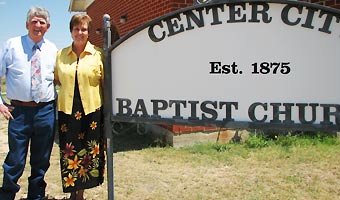
CENTER CITY—Dallas Huston has learned a lesson: never say never.

A well-known radio sports voice in Central Texas for five decades, Huston had settled into what he considered his more important role as a part-time preacher. Most Sundays were booked as a guest preacher at various Baptist churches throughout the area. He also led two or three revivals a year.

By serving as a traveling fill-in preacher, Huston could reach a larger audience. He had grown as comfortable in that role as he had in the football radio booth that bears his name at Gordon Wood Stadium in Brownwood.

Sportscaster Dallas Huston calls a Brownwood High School football game at Gordon Wood Stadium. Huston has been the voice of Howard Payne University and Brownwood High School football and basketball since the mid-1960s. (Photo courtesy of Linda Huston)

One place where Huston served as a guest preacher a dozen times over the past year was Center City Baptist Church, a small rural congregation 10 miles east of Goldthwaite that went 16 months without a pastor.

Huston flatly rejected initial inquiries by Center City’s three deacons and assorted members who approached him about becoming their pastor.

“Absolutely not,” Huston told them. “Other churches had talked to me about becoming their pastor, and I emphasized to them, like I did the folks in Center City, that I would never, ever pastor a church. Period.”

Huston never attended college or a seminary so, to him, becoming pastor of a church seemed beyond his qualifications. Being responsible for an entire church and the ongoing spiritual care of its members seemed daunting.

Then, Huston said, God came calling a couple of months ago.

“The Lord told me under no uncertain terms that he wanted me to pastor a church,” Huston said. “I said, ‘OK, let me pick out a couple of churches I might like.’

“Then he told me as plain as day, ‘I want you to pastor at Center City.’ I said, ‘Are you sure?’”

At first, Center City appeared to be a small stage for a big local celebrity. The rural church has 48 active members and on any given week, worshippers number between 25 and 40.

Huston has been the voice of Howard Payne University and Brownwood High School football and basketball since the mid-1960s. In March, he called five playoff games for the Howard Payne women’s basketball team on its way to winning the NCAA Division III national championship.

Huston has been named the best sportscaster in the state by Texas Monthly magazine. He also is a member of the Big Country Sports Hall of Fame in Abilene, as well as the Howard Payne Sports Hall of Fame.

His celebrity status, radio-voice delivery and graphic honesty about his battles with alcoholism and living “46 years on the edge of hell,” made Huston a charismatic speaker. His down-to-earth sermons drew emotional responses and large crowds at churches of all sizes.

On the surface, having a regional celebrity like Huston toiling in the obscurity of a small country church didn’t appear to be a good fit. But such an assumption couldn’t be further from reality.

Dallas and Linda Huston serve Center City Baptist Church, a rural congregation 10 miles east of Goldthwaite. (Photo by Mike Lee)

Heeding what he was convinced was God’s calling, Huston asked the Center City deacons if the offer to become pastor of their church was still good. They couldn’t say “yes” fast enough.

“We were real fortunate to get him. It’s really too good to be true,” said 80-year-old James “Potty” Carter, who was baptized at Center City 70 years ago. “He’s a bang-up nice fellow. Everybody likes him.

“We’re mainly a bunch of older folks. What you see is what you get with us. He keeps it low-key instead of being fancy.”

Some Center City Baptist members knew Huston as a radio sportscaster. Some didn’t. It didn’t matter to any of them.

“It doesn’t matter because he can relate to them. That’s all they care about,” deacon Gene Burton said. “He gets his point across, and then, he’s through. He doesn’t go over it again and again and lecture you. He’s so plain. He fits in so well with a country church.

“Some people that have accomplished what he has on the radio would want to brag about it, but not Dallas. He’s very humble. He’s just telling us what the Lord has done for him.”

Huston said while he likes being recognized at times, he prefers a situation where people haven’t heard of him.

“It’s kind of exciting to go some place, and all I am to them is a preacher. I’m not a sportscaster trying to preach,” Huston said. “A few in Center City know I’m a sportscaster, but I can tell you that none of them care. I’m their pastor, and they could care less if I do football or basketball games.”

Pastor Dallas Huston preaches at Center City Baptist Church. (Photo by Mike Lee)

On Sunday mornings, Huston and his wife, Linda, make the 45-mile drive from their home in Brownwood to Center City, which in 2000 had a population of 15 and is listed on the Internet among Texas ghost towns.

But the Brownwood native couldn’t be more at home than at the remote country church.

“Generally, the smaller the church, the friendlier they are,” Huston said. “Two friends of mine from Brownwood went to separate services at Center City, and they both called me later and said, ‘Dallas, that’s the friendliest church I’ve ever been to. Everybody there either shook my hand or patted me on the back.’

“The people in Center City, they love the Lord and they love each other. You can’t ask for much more than that. If I can get them to like me, there’s no telling what’ll happen.”

During the June 22 service at Center City Baptist Church, Huston celebrated his 20th spiritual birthday by sharing his testimony with the congregation. He told of how he smoked for 27 years, began drinking at age 12 and tried “every drug that was placed before me.”

“I’m a recovering alcoholic, and I was as sorry a human being as you can imagine,” Huston said. “I had no spiritual foundation.”

Huston said he mistreated his wife in the early years of their relationship, but she never gave up on him. “She prayed and prayed for me. Now, I’m not talking about for a weekend or even a week. She prayed for me for 10 years,” Huston said.

At age 46, Huston was baptized.

“I was lucky to still be alive,” he said. “The Lord gave me another opportunity and I took it. People that should have thrown rocks at me for what I’d done and what I’d been instead came up and hugged me.

“I’m one of the greatest examples I’ve seen of the Lord being able to use anybody—of taking the weakest of the weak and doing good things with them.”

Huston said God is using his past experiences—in the press box and on the rocks—to allow him to reach spiritually lost people.

“With men’s gatherings, they know my name from sports, and perhaps more will show up to see the person behind the voice. And by sharing the story of my prior life, it can reach out to others—especially men— who have had to deal with some of the same things.”

Huston said he keeps preaching separate from sportscasting, but being a born-again Christian has put sports in perspective.

“Sports was one of my gods,” he said. “I lived and died with sporting events. Now, sports aren’t even in the top five of my priorities in life. Sports are important for the kids and the fans, and those are the two reasons I still do games.

“I can tell you with all honesty that the greatest game I’ve ever called doesn’t compare with the worst sermon I’ve preached. Calling the Lady Jackets winning the national championship was a once-in-a-lifetime thrill. But I can’t put it in the same category as preaching.”

Huston said at 65, he didn’t take the Center City position as a steppingstone to a larger church. “I’ll be there until the Lord tells me to leave or until the people there get rid of me,” he said.

Center City Baptist has grown a bit since Huston became pastor in mid-May, adding a half-dozen new members. The only problem is where to baptize them.

“They tell me they’ve always performed baptisms down at the (North Bennett) creek just before you get into town,” Huston said. “I told them I wasn’t going to do that unless someone came with a gun to shoot the snakes.

“We may have to find a bathtub and use it. We’ll come up with something.”