Faith Digest

Posted: 1/18/08

Faith Digest

Evolution and religion compatible, scientists insist. A top panel of scientists has published a new book asserting that belief in the theory of evolution and religious faith “can be fully compatible,” and creationism has no place in science classes. The 88-page Science, Evolution, and Creationism, produced by the National Academy of Sciences and the Institute of Medicine, is an updated version of two previous books supporting evolution scholarship. The 2008 version is different, according to the 15-person committee that designed it, because it is aimed at clergy and school board members and discusses the role of faith in human knowledge. “Science and religion address separate aspects of human experience,” the book says.


‘In God We Trust’ will move from edge to surface of coins. By popular demand, the national motto “In God We Trust” will move from the edge of new dollar coins honoring U.S. presidents to the front or back of the currency. A provision in the $555 billion domestic spending bill for 2008 calls for the change to take place “as soon as is practicable.” The U.S. Mint began producing presidential one-dollar coins in 2007. The words “In God We Trust” were placed along the edge of the coins, as instructed by Congress. But critics complained about the placement and thought the words belonged on the front or back of the coins instead. The dies already have been produced for the 2008 coins, so those will still have the motto along the edge. But the motto will be moved on 2009 coins.


Polls should count evangelical Democrats, advocates insist. Several influential evangelical leaders have called on pollsters to ask Democrats—and not just Republicans—if they are evangelicals when future primaries occur. Nine evangelical spokesmen, including Sojourners founder Jim Wallis and Christianity Today editor David Neff, sent a letter to polling and political directors of media outlets that are represented by the National Election Pool, which supplies poll data to ABC, CBS, CNN, Fox, NBC and the Associated Press.


Two Georgia ministries not cooperating with probe. Two of the six ministries with finances under investigation by Sen. Charles Grassley, R-Iowa, have been unwilling to cooperate, citing privacy rights and questioning Grassley’s focus on groups that preach the “prosperity gospel.” Creflo Dollar Ministries in College Park, Ga., and Eddie Long’s New Birth Missionary Baptist Church in Lithonia, Ga., have refused to submit financial records first requested by Grassley last November. Dollar’s attorney had told Grassley the church would not comply by the original Dec. 6 deadline. In an op-ed column in Atlanta Journal-Constitution, Long’s attorney James M. Hunter called Grassley’s inquiry an “inquisition.” Two of the six ministries—Kenneth Copeland Ministries in Newark, near Fort Worth, and Joyce Meyer Ministries in Fenton, Mo.—have provided materials that are being reviewed by Senate staff, Grassley said. Two other ministries—Without Walls International Church in Tampa, Fla., and Benny Hinn Ministries in Grapevine—have sent mixed signals about their plans to cooperate.


News of religion, faith, missions, Bible study and Christian ministry among Baptist churches, in Texas, the BGCT, the nation and around the world.



Redeemed Klansman reunites with long-ago victim

Posted: 1/18/08

Redeemed Klansman reunites with long-ago victim

By Roy Hoffman

Religion News Service

MOBILE, Ala. (RNS)—Stan Chassin, a 59-year-old investment counselor, had been nervous all day. He had heard a bully from his youth was coming back to town.

Tommy Tarrants had terrorized Chassin in high school by cursing him for being Jewish, grabbing him by the throat and threatening to kill him.

Chassin had watched from afar as Tarrants left school, joined the Ku Klux Klan and was wounded in a police ambush while attempting to blow up the home of a Jewish man in Meridian, Miss.

Stan Chassin, who was terrorized as a high school student by white supremacist Tommy Tarrants, discovers a swastika spray-painted on a wall near his alma mater in Mobile, Ala. The two recently reunited when Tarrants, now a Christian, spoke at a local church about his conversion. (RNS photo/John David Mercer/The Press-Register of Mobile, Ala.)

See related article:
Former Klansman reflects on how God’s grace redeemed a life of hate

“I realized he could have killed me,” Chassin said.

Tarrants, now 60, was returning to Mobile not as a Klansman but as a profoundly changed man. Years before, he had published a memoir, The Conversion of a Klansman, and a decade ago had become president of the C.S. Lewis Institute, a Washington, D.C., organization dedicated to helping people grow spiritually.

Tarrants was to be the guest speaker at a dinner at Spring Hill Presbyterian Church. Chassin, wary about what he had heard of Tarrants’ transformation, wanted to see for himself.

“My father always taught me to confront my fears,” Chassin said. “I had a chance to unload my demons. But the closer I got to that day, I wondered, ‘Do I have the internal fortitude to go through with this?’“

When he walked into the fellowship hall at Spring Hill Presbyterian Church and saw Tarrants, Chassin had a flashback to high school. “I thought: ‘He’s not so big. I could have taken him!’”

Tall and slightly stooped, Tarrants had no hint about him of the long-ago teenager’s swagger or rant. As Tarrants was introduced by Pastor Norman McCrummen, Tarrants seemed to Chassin “almost frail.”

With his gently modulated voice, and touches of a dinner speaker’s humor, Tarrants spoke of his slide toward militant bigotry, how he learned to despise blacks and loathe Jews. He talked about sin as “a cancer” that had come into his body and heart.

He told of being in a prison cell, of reading classical philosophy and Scripture, of a profound change in his heart as he came to understand the true meaning of God in his life. He spoke of grace and forgiveness.

After Tarrants finished his speech, he asked for questions. Chassin hesitated. Then he stood.

“It’s hard facing you,” he told Tarrants.

Chassin recounted the story of how Tarrants had grabbed him by the throat at school, cursed him, called him “a kike” and swore, “If I ever see you again, … I’ll kill you.”

A few others in the audience were worried, at first, what Chassin might do—getting even after all these years for the long-simmering aggression.

As Chassin’s voice got stronger, he grew calmer. As he spoke, he saw a look of pain on Tarrants’ face. McCrummen, watching, said he saw Tarrants “almost crumble. It was so obvious, the remorse of the memory.”

Chassin recalled how a few weeks earlier, sitting in synagogue on Yom Kippur, the Day of Atonement, he had heard the voice of God.

“God told me: ‘You have to forgive him for what he did to you. And then, for all the hatred and disgust you felt toward him, you have to ask Tommy to forgive you.’” Chassin said, his voicing breaking.

The hall fell silent. Quietly, Tarrants answered: “I appreciate you being so gracious and forgiving. I’m very grateful, Stan, for your having the courage to come and share your forgiveness.”

Chassin walked forward and held out his hand to shake. The two men embraced. Chassin was weeping.

Tarrants, who had never had anyone approach him from his past like this, felt anguished to know of the pain he had inflicted on Chassin all these years. He wondered who else from his past might still be carrying old wounds, who else he must still reconcile with.

McCrummen returned to the podium, tears in his eyes at the extraordinary event he had just witnessed.

“In the fullness of your love, you give us a heart and a mind, to recognize this,” McCrummen prayed. “Thank you for seeing us and hearing us and not giving up on us.”

Chassin said his life has been changed.

And Tarrants said the encounter “‘raises questions that may lead to a new phase” in his own life, “a new journey.” What more can he do to combat racism and anti-Semitism? “Where will this lead me?” he asked.

Several weeks later, Chassin returned to his old high school to walk the grounds and recall the encounter that “joined our lives.” He, too, spoke of reconciliation, of God’s presence, of “a new phase of my life.”

Then he turned a corner on an alley and spotted a swastika spray-painted on a wall. For a moment, Chassin is taken aback.

“It makes me so sad,” he said.

He realized what lies ahead for him. His mission now, like that of Tarrants, is to further education about hatred and about forgiveness.

“The ignorance,” he said, “never goes away.”


News of religion, faith, missions, Bible study and Christian ministry among Baptist churches, in Texas, the BGCT, the nation and around the world.


Trial date set for suit by dismissed female prof

Posted: 1/18/08

Trial date set for suit by dismissed female prof

By Hannah Elliott

Associated Baptist Press

UPLAND, Ind. (ABP)—Sheri Klouda sparked denominational—and national—debate when she cried foul last year over her dismissal from teaching at Southwestern Baptist Theological Seminary, allegedly because of her gender.

Ten months later and anticipating a year of legal proceedings, media interviews and medical procedures for her ailing husband, the professor says she hopes to come out of it with “resolution and closure—having a final decision made on the matter and a righteous and just decision being rendered.”

She’ll get her first taste of the decision, whatever it may be, when Klouda v. Southwestern Baptist Theological Seminary begins trial proceedings June 2.

Preliminary work on the case began in March 2007, when Klouda filed a cause of action in federal court against the Fort Worth school and its president, Paige Patterson. The suit charged fraud, breach of contract and defamation.

By Sept. 14, United States District Judge John McBryde had denied Southwestern’s motions to dismiss the suit and accepted an amended complaint that added “sex discrimination” to the charges. He also ordered Klouda, Patterson and their advisers to discuss settling the case.

Klouda requested $1.1 million to settle the lawsuit, Patterson refused to counter-offer or settle, and the parties now await the verdict on a request for a summary judgment. That means the judge would decide the case without a jury trial.

If, upon review, McBryde decides a jury could possibly side with Klouda, he will reject the summary-judgment request and proceed with plans for a full trial. It is not clear how much Klouda’s attorneys will seek in damages should the case go to trial.

Experts say the case will hinge on whether the seminary falls under the free-exercise clause of the First Amendment, which prevents the government from interfering in the employment relationships between churches and ministers.

Should the courts decide that a seminary is not technically a church—or that its faculty members are not ministers—Klouda could come away with a big win.

Klouda said she thinks governments should have no jurisdiction over churches, but a seminary is not a house of worship.

“The seminary would have been well within its rights not to hire me in the fist place,” she said. But, since Southwestern hired her and allowed her to teach for several semesters “and then turned around and decided it was against its faith tradition, that is contradictory.”

“Defendant Patterson, based upon his social and/or personal beliefs, disingenuously used religion as a pretext for (his) actions in failing to renew her contract,” the complaint said. “Southwestern itself and by and through its agents intentionally engaged in unlawful employment practices involving (Klouda) because she is female. Patterson, using his social belief but calling it ‘religious interpretation,’ blatantly discriminated against Dr. Klouda based on her gender.”

Another complication, Klouda argues, has to do with the Southern Baptist Convention’s 2000 Baptist Faith & Message statement. It says women should not serve as pastors.

But Southwestern’s website lists 11 women, including librarians and Dorothy Patterson, wife of the president, as faculty members. Should seminary officials claim all faculty are ministers—in an attempt to fall under the free-exercise clause—the school might be hard-pressed to explain to a secular jury how “ministers” are different from pastors, and how some women are qualified to teach, while Klouda’s gender bars her from doing so.

In addition to the lawsuit, Ben Cole—a former Arlington pastor—filed complaints last January with the Southern Association of Colleges and Schools and Association of Theological Schools, asking them to investigate “a serious breach” of accreditation guidelines by Southwestern. An ATS spokesperson said her agency’s policy is not to investigate a complaint while the complainant is engaged in a civil suit against a member school.

Southwestern officials repeatedly have failed to respond to requests for comment on the Klouda matter since it began last year.

In the meantime, Klouda continues to teach at Taylor University in Upland, Ind. She and her husband have since sold their home in Texas and taken out a loan on her retirement funds to help pay for a house they’re renting in Indiana.

News of religion, faith, missions, Bible study and Christian ministry among Baptist churches, in Texas, the BGCT, the nation and around the world.


Texas Baptist Forum

Posted: 1/18/08

Texas Baptist Forum

Happy-clappy or ‘Amen’?

What a marvelous letter from Richard Berry concerning banning “applause-attracting” parts of the worship service (Jan. 7).

Jump to online-only letters below
Letters are welcomed. Send them to marvknox@baptiststandard.com; 250 words maximum.

“I’m an optimist—by choice. It’s because of Christ in me, the hope of glory, that I can chose to be an optimist rather than a cynic, which is much easier. It is because of that hope that I still run, that I still love, that I still play.”
Berry Simpson
Sunday school teacher, petroleum engineer, writer, runner and member of the Midland city council (http://berry.voxtropolis.com)

“The success I’ve had has given me a platform to try to let people know what’s really important in life. If you’re not feeding the poor, not looking out for the troubled kid on the block, not giving yourself away, you’ve totally missed it.”
Michael W. Smith
Contemporary Christian singer (Associated Press/RNS)

“There is a self-righteousness, a glibness in their writing. They are too sure of themselves. They've backed themselves into a fundamentalist mode.”
Bill Hamilton
A leader of the “death of God” theological movement of the 1960s, describing recent books by militant atheists (RNS)

It will never happen, because our folks are so entrenched in the “entertain me” philosophy they will never be able to admit the truth that we gather to worship God, not to please and entertain ourselves.

For years, I have been dismayed by the “Christian artists,” the happy-clappy services and the hand-clapping, finger-snapping presentations that draw attention to themselves rather than to an omnipotent God. I recently saw a clip on TV where a young boy did a “cannonball” into the baptistry to the surprise of the preacher. Everyone thought it was hilarious.

We now have “contemporary services,” “alternative worship,” etc. Why? To please and satisfy folk, that’s why. Why don’t we forget “performance,” “artists” and other such words and get back to the very serious business of focusing on a wonderful God?

Where is that church? Help me find it. I know it is out there.

Charles Downey

Conroe


We believe in church autonomy, so why do some folks continually try to tell another congregation how to worship?

Applause is like saying “amen” in our culture today. One cannot limit the Holy Spirit to one form of worship.

Have you heard the quote “dry as a sermon”? Worship should not be dry or void of emotion. Worship should be God-centered. God is our focus. We offer our worship to God, for he is the audience. Sometimes, that might lead to an overflow of the heart that leads to applause. I know it can be overdone, but still I believe one must be careful, for he might quench the Holy Spirit by not allowing this form of expression in worship. Let’s choose our battles wisely.

Doug Simon

Grand Prairie


True discipleship

Thank you for suggesting it is time to revamp our discipleship programs (Jan. 7). However, we must remember it is not our training programs that prepare men and women to be fruitful disciples. Only a special relationship with the Lord can accomplish that goal.

We need to return to the same principles Jesus used while preparing his first disciples. He simply said, “Come, follow me.” That is, “Come, let us develop a close relationship by spending time with each other.” The disciples accepted that offer of relationship. They recognized only by being in close contact with Jesus could they become like him. They established a relationship with him that would last forever, and so can we.

In time, Jesus returned to heaven, but then the Holy Spirit returned to Earth at Pentecost. He filled his disciples with his presence and power, and they became like him. Jesus continues to empower his servants through his presence within them.

Our new discipleship programs must major on the believer’s relationship with the Lord. Only in partnership with Jesus can any believer be fruitful in his service.

Jesus expressed this principle in John 15:5: “Without me, you can do nothing.”

So, whatever else our new programs might teach, the major emphasis must be on the believer’s relationship with the Lord Jesus and the atmosphere in their lives that is produced by that relationship.

Dan Keeney

San Angelo


No ‘hirelings’

In my first pastorate in 1938, I never heard the term “hired a pastor.” For 46 years, I was pastor of some Baptist church. Not once did I send any church a resume. Not once did I ask any person to recommend me to any church. I always figured if God wanted me to be pastor of a church, he could manage it his way. And he did!

I could write volumes of experiences that God has given me and other like-minded men whom God called to the pastorate.

It is said that a committee came to George W. Truett seeking help in finding a pastor. “What are you seeking in a pastor”? he asked. “Oh, someone under 40 who is a premillennialist,” they said. In the parlance of the day, the old pastor countered, “Has it ever occurred to you that instead of a pre-38, God might want you to have a B-29?”

Does anyone doubt the terribly critical condition our country and the world is in today? It will never be solved by the hireling (John 10:13).

Marvel Upton

Orangevale, Calif.


What do you think? Send letters to Editor Marv Knox by mail: P.O. Box 660267, Dallas 75266-0267; or by e-mail: marvknox@baptiststandard.com. Maximum length is 250 words.

News of religion, faith, missions, Bible study and Christian ministry among Baptist churches, in Texas, the BGCT, the nation and around the world.


Oklahoma Baptist feels called to minister in global hot spots

Posted: 1/18/08

Oklahoma Baptist feels called
to minister in global hot spots

By Ken Camp

Managing Editor

BARTLESVILLE, Okla.—Day 27 of a planned 40-day fast, in a cabin on Michigan’s upper peninsula, Kevin Turner believes God called him to ministry—specifically in war zones, disaster areas and places where Christians are persecuted.

“I believe we’re sent into the hot spots of the world,” said Turner, president of Strategic World Impact, based in Bartlesville, Okla. “Our approach is to get in, be part of the solution, make an impact and get out safely. We’re not doing long-term development. It’s a stopgap ministry to touch the lives of people who are standing on the brink of eternity.”

A child peers out of a hut not far from Nyala, a village affected by violence in southern Darfur. (RNS photo/Chris Herlinger)

Over the last decade, that mission has taken Turner and his staff to about two-dozen nations, including multiple trips to Sudan and Eritrea. This month, Strategic World Impact is sending a 20-member medical missions team to Darfur.

See Related Articles:
Responding to the Luke 4 mandate
• Oklahoma Baptist feels called to minister in global hot spots
Hands-on missions in Africa
Caring for the poor: Whose job is it –church or state?

The United Nations estimates about 400,000 people have died as a result of conflict in Darfur since 2003, and more than 2 million have been displaced.

The Stategic World Impact team—including five physicians associated with In His Image International in Tulsa, one dentist and several nurses, paramedics and disaster relief specialists—plans to deliver 1,000 kits containing tarps, mosquito netting, eating and cooking utensils and hygiene items to displaced people in the war-torn area.

The volunteers, who plan to fly into southern Darfur by way of Kenya on a cargo plane, also will deliver a donated solar-powered water purifier, as well as Bibles for distribution.

“We bring in Bibles because the Christians there ask for them,” said Turner, an ordained Baptist minister. “We never do the kind of distribution where people are told they have to take a Bible in order to get something else they need. … Nobody can accuse us of manipulating people in their time of need.”

Travel costs are significantly higher for this trip than for most missions Strategic World Impact undertakes, Turner noted. The cost of the cargo plane alone is about $34,000, and the organization still lacks about $13,500 to cover expenses, he noted.

“But the Lord always has been faithful to provide, and we’re trusting him,” he said. “This is our chance to get in to Darfur, and we never know how long the opportunity will be available.”

Last April, Turner conducted an on-site assessment in Darfur. He encountered displaced women, children and elderly people who lacked food and water and needed medical attention.

“I saw people walking or crowded onto the back of gravel trucks, fleeing through the desert. There were people who had traveled three days on foot since their last water supply in up to 130-degree temperatures,” he recalled.

Turner acknowledged the safety concerns inherent in ministering in places like Darfur, but he noted Strategic World Impact trains staff and volunteers in how to minimize risks. Still, as the father of three children—ages 11, 14 and 17—he recognizes the danger.

“In our case, the kids haven’t ever known anything else,” he said, noting he and his family lived more than four years in Bosnia, and they also lived in Cairo. “It’s all in what you become accustomed to. It’s a different lifestyle.”

Even so, while he avoids placing himself or anyone else in a risky situation without proper preparation, Turner added, “There’s nothing that can be taken from you when it’s all surrendered to the Lord.”


News of religion, faith, missions, Bible study and Christian ministry among Baptist churches, in Texas, the BGCT, the nation and around the world.


Hands-on missions in Africa

Posted: 1/18/08

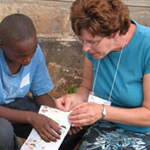
Andrew Bentley, a member of Green Acres Baptist Church in Tyler, examines a young resident of the Ministry of Mercy orphanage in Otutulu, Nigeria. Cathy Steenhoek from Pella, Iowa, works with a boy during a Buckner International mission trip to Kenya.

Nancy Stretch, a nurse practitioner from Wilshire Baptist Church in Dallas, examines a child in Busia, Kenya. Wilshire has an ongoing partnership in Busia through Buckner.

Hands-on missions in Africa

When needs become names and epidemics emerge as faces

By John Hall 

Texas Baptist Communications

USTIN—When she made her first trip to Congo, situations Laura Seay was studying in books became real to her. And soon, it grabbed her heart as the country became part of her life.

As a University of Texas doctoral student, Seay is studying the infrastructure of Congo. Each day, Seay—a member of First Baptist Church in Austin—looks for signs of hope and places where Baptists can aid people in need. Most often, she finds them in churches that have begun shouldering the load of providing social services such as medical care.

Jon Cannon, a member of First Baptist Church in Amarillo, comforts a baby after the child receives an injection at a medical clinic at the Baptist Children’s Center in Nairobi, Kenya, a ministry of Buckner International. (Photo/Courtesy of Jeff Raines)

“I have been in some danger in the Congo, and I have seen horrible, unspeakable atrocities, suffering and poverty that’s 10 times worse than what you witness elsewhere in the developing world,” she said.

“It’s impossible to come away from encounters with 6-year-old victims of gang rape or mothers who are starving to death and not be affected by the situation. The pain of what people endure is unbearable sometimes, and I’m only a witness to it. The temptation is always to turn away, say a prayer of thanksgiving that it’s not me, and move on with life. 

See Related Articles:
Responding to the Luke 4 mandate
Oklahoma Baptist feels called to minister in global hot spots
• Hands-on missions in Africa
Caring for the poor: Whose job is it –church or state?

“But it wouldn’t be right to turn away from these realities. All those Scriptures about taking up our crosses and going out of our way to help those in need point to the idea that the life of a disciple of Christ isn’t always going to be easy. The paradox, of course, is that by taking up these burdens, we’re set free to love without condition and to sacrifice everything, maybe even our own comfort and safety—and maybe our lives—to follow God’s call.”

In recent years, Africa’s needs have been thrust toward the forefront of social consciousness, and Baptists have taken note. The Baptist General Convention of Texas has a partnership with the Nigerian Baptist Convention. Texas Baptist Men and Virginia Baptists have missions partnerships with Baptists in South Africa.

At least five BGCT-affiliated institutions—Baptist Child & Family Services, Baylor Health-care System, Baylor University, Buckner International and Wayland Baptist University—have ministries in Africa.

The Texas Baptist Offering for World Hunger supports a variety of efforts across Africa, as does the Cooperative Baptist Fellowship Global Missions Offering and the Southern Baptist International Mission Board’s Lottie Moon Christmas Offering.

A 12-church network is ministering in Ethiopia. A network of churches, including Texas Baptist congregations, is working across denominational lines to serve in North Africa. Several associations have taken mission trips to Africa, and some plan to develop longer partnerships.

Like Seay, many of the groups serving in Africa are drawn to render aid in a continent dominated by political, economic and social strife. Where Buckner serves in Kenya, about 40 percent of the people have AIDS. Five African countries continue to top the list of worst human-rights offenders. In Nigeria, Baptists have focused on assisting the Baptist hospital and seminary.

“They have such overwhelming needs that we can’t ignore,” said Steve Akin, minister of missions at First Baptist Church in Athens, which is serving in Ethiopia. “We’ve ignored it too long.”

The needs draw Baptists to Africa, but the people they encounter keep them involved there, participants agreed. A volunteer is no longer helping orphans with AIDS, but loving a child she is holding in her arms. A doctor isn’t just providing medical attention in a needy area; he is saving the life of a man from what in the West is an easily curable disease. Causes become families, needs turn into names, and epidemics emerge as faces.

“I can hardly begin to explain the attachment our congregation has developed for 50 Kenyan orphans, whom most of us never have met,” said Mark Wingfield, associate pastor of Wilshire Baptist Church in Dallas. “We have sent Christmas presents, clothes and medical supplies. In addition to the initial commitment to build the child development center, we have added a kitchen and a medical clinic.

“Vaccines and other essential medicines are available through the government in Kenya, but Busia is one of those places where the government had no distribution point. Our clinic is becoming that distribution point. With help from an individual donor and the BGCT, a water well was installed near the child development center. This one water well has changed the lives of everyone who has access to it.”

Baptists who serve in Africa often say they are blessed by the experience.

“For me, it was worshipping with the people, just the vibrancy of the churches there, the Christian witness there in the midst of great need,” said Jeff Raines, associate pastor of First Baptist Church in Amarillo, which had a partnership in Uganda and now has one in Kenya.

The emotional connections have fueled multi-year partnerships between Texas Baptists and African Christians. And the ministry appears to be making a difference as part of a concerted evangelical effort in the continent. A recent Christianity Today article noted Christianity is growing faster in Africa than anywhere else in the world. Christians now make up 46 percent of the continent’s population and outnumber Africa’s Muslims.

But despite more than $600 billion in aid sent to Africa in the last 50 years, living conditions remain difficult in most areas. Africa’s estimated income per person is less than 5 percent of that in the United States. The continent continues battling genocide, AIDS and divisions based on politics, ethnicity and economics.

Bryan Houser, Amarillo Area Baptist Association director of missions and former missionary in Africa, doesn’t expect the statistics to change much. While people talk about Africa as a whole, it is a diverse continent with complicated, multi-faceted issues that are difficult to solve—too big for one church.

Fortunately, God isn’t calling one congregation to change a continent by itself, Houser said. God calls churches to minister and share the gospel in specific ways in specific places. If a congregation is obedient, the life of a person, a family and maybe even a community will be changed.

“The needs of Africa will swallow you up very, very quickly,” Houser said.

“You’ll never make a dent in the problems in Africa. What you can do is make a difference locally in a few people’s lives.”


News of religion, faith, missions, Bible study and Christian ministry among Baptist churches, in Texas, the BGCT, the nation and around the world.


Caring for the poor: Whose job is it–church or state?

Posted: 1/18/08

Caring for the poor:
Whose job is it–church or state?

By Marv Knox

Editor

Care for people Jesus called “the least of these” requires response from both congregations and government, according to specialists who focus on ministry to the poor and on church/ state relations.

As participants in both church and state, Christians should minister directly to the poor and also advocate to the government on their behalf, specialists stressed.

Danica Simmons, a registered nurse at Mission East Dallas, treats Francisco, a patient at the ministry’s clinic. Launched by Shiloh Terrace Baptist Church, Mission East Dallas provides medical care for uninsured and underinsured people—particularly the working poor—in eastern Dallas County. (PHOTO/Angela Best)

Christians are “citizens of two kingdoms”—God’s kingdom and the nation in which they live, said Stephen Reeves, legislative counsel for the Texas Baptist Christian Life Commission.

“As churches, we should be following Jesus’ model. Doing things to help the least among us is following his model,” Reeves said.

“As American citizens, we have the opportunity to influence policies and our elected officials. In being good citizens of both God’s kingdom and the United States, you can do that by advocating in the political realm.”

First and foremost, ministry to the poor is a Christian concern, specialists said.

“Jesus urges the (church) community to be involved in the needs of ‘the least of these,’” explained Fritz Gutwein, a lifelong Baptist who works as field coordinator for the National Council of Churches. “If we want to live in community with one another, we must be concerned about ‘the least of these.’”

But people who say only the church, and not the government, should care for the needs of poor people aren’t thinking clearly, added Jimmy Dorrell, executive director of Mission Waco, a faith-based community ministry in Waco.

See Related Articles:
Responding to the Luke 4 mandate
Oklahoma Baptist feels called to minister in global hot spots
Hands-on missions in Africa
• Caring for the poor: Whose job is it –church or state?

“Practically, it’s fallacious to believe the church can do what the government does for the poor,” Dorrell said. He cited research that shows each church, synagogue and mosque in America would have to contribute $300,000 each year to fund the basic poverty-relief programs provided by the government.

“People say, ‘The church should be doing it,’ but we’ve lost that battle,” he reasoned. “We’re giving only about one-half of 1 percent of each congregation’s budget to meet the needs of the poor.”

Besides, the scale of need is just too massive for the church alone, Gutwein added.

“There are needs that can only be met by government; the church is just not capable of doing it,” he said. “Think about healthcare, or feeding the hungry. Those are huge tasks. They’re similar to infrastructure: We wouldn’t expect the church to pave all the roads between a person’s home and church.”

Melissa Rogers, an attorney and visiting professor of religion and public policy at Wake Forest University Divinity School in Winston-Salem, N.C., echoed that theme, stressing church and government should tend to their appropriate roles.

“There are some things that essentially only the government can do—like building and rebuilding levees in New Orleans or ensuring every Amer-ican has healthcare,” Rogers said. “And there are some things only religious communities can do—like spreading the gospel and meeting other spiritual needs.

“And an additional part of the religious community’s job is to call on the government to do what only it can do—like maintaining a safety net for people in particular need of assistance, and making sure they’re safe and secure in the wake of disasters.”

Some Christians also need to get over the erroneous notion that government can’t be trusted to do something good, like helping poor people, Dorrell added.

“We’ve determined the government and society are evil, and we’re good,” he said. “That’s bad theology. Government was ordained by God; it’s the structure God created to take care of people. We as faith-based people should be the corrective force. Clearly, (government) goes off course. It’s the role of Christians to navigate back to a biblical viewpoint.”

So, if both church and state are involved in helping people in need, how do people of faith negotiate the fault line between the two potent institutions?

A key is how the work is focused and financed, explained Cynthia Holmes, an attorney from Clayton, Mo., who has served on the boards of several First Amendment organizations.

“The government needs to engage in social programs, but it doesn’t need to do the work of the church or the mosque or the synagogue,” Holmes said. “The Good Samaritan didn’t say: ‘Hang on. I’m going to get a government grant to take care of you.’”

And even though the tasks are enormous, congregations must keep their focus and identity clear, Rogers added. Congregations “should always maintain their independent and prophetic voice and not be encumbered by government rules and regulations.”

“As Christians, if we ask the government to do our ministry for us, that ministry is diminished,” Holmes noted. “A cup of water given in the government’s name is not the same as Jesus’ name.”

Both Holmes and Rogers suggested if churches wish to set up programs that receive government funding, they should create completely separate corporations.

“Churches should never seek or accept government funding for what they do,” Rogers urged. Churches that want to engage ministry that receives government grants can “spin off separate religiously affiliated organizations,” but even then, the lines between what is done for the general good and what is religiously oriented should be bright and wide.

“Don’t use (government) money to proselytize,” Holmes stressed. “Don’t ask the government to do for you what it wouldn’t do for others and discriminate against others. … And don’t feel discriminated against just because the government won’t advance your religion.”

A church goal in this kind of ministry should be “transforming culture,” Dorrell said. That involves calibrated collaboration—working and interacting with both private and public sectors, including the government, whose services meet the needs of the poor and disenfranchised. “We collaborate, but we’re not beholden to,” he noted.

Rogers offers similar advice to faith-based ministries.

“Religion and government should be in conversation about these issues. But neither one should be commanded, controlled or co-opted by the other,” she said. “Conversation is always good. Coop-eration is sometimes good. But having either the government or religion trying to command, control and co-opt the other is never good.”

An important part of conversation is advocacy on behalf of the poor, Reeves said.

“It is legitimate to look at our government’s budgets, to see that they reflect our Christ-ian values,” he said. “Advocate and vote for folks who will be good stewards of our tax dollars.”

And churches should bear witness to that advocacy with their actions, Gutwein insisted. “You can’t do one without the other. You can’t be involved in advocacy without being involved with the homeless who are on the street corners,” he said.

Besides, involvement may not only serve the needy, but it just may save the church, he added. “It’s important for churches to be involved if they’re going to survive,” he explained.

“People don’t come to church because of orthodoxy, but because of what churches do. … The primary thing is what the church is doing, not what they believe. People get the orthodoxy after they come to church.

“And churches are getting it, too. First, they’re concerned about charity, but then they become concerned about the root causes of poverty, so they start doing economic development. Then, seeing the root causes that impact development, they get involved in advocacy.

“Charity, development, advocacy and justice. To meet the needs of ‘the least of these’ in society, we have to be involved in doing them all.”


News of religion, faith, missions, Bible study and Christian ministry among Baptist churches, in Texas, the BGCT, the nation and around the world.


Responding to the Luke 4 mandate

Posted: 1/18/08

Responding to the Luke 4 mandate

By John Hall

Texas Baptist Communications

For some Christians, listening to the news is like hearing a prayer list. More than 2 million people displaced in Sudan. More than 1.5 million Iraqi children left homeless. Residents of Southeast Texas and Louisiana still rebuilding two years after hurricanes Rita and Katrina.

Nearly every story is a reminder of the pain and suffering that remains in the world. And God uses many of them to call people and churches to serve around the globe.

LaKedra Robertson from Washington, D.C., shares Christ’s love with a child in Kenya during a Shoes for Orphan Souls trip sponsored by Buckner International. (Buckner Photo)

An increasing number of Christians are responding to global issues, noting biblical calls for such action. They commonly cite Luke 4:18-19—when Jesus announced the inauguration of his public ministry by quoting an Old Testament passage about good news for the poor. They also point to Micah 6:8 and other verses that call for compassion toward the poor and the need for God’s people to seek justice for the vulnerable.

The call to social justice particularly appeals to young evangelicals. According to a 2006 Cone Inc. survey of people across faith backgrounds born between 1975 and 1985, 72 percent had educated others on social/environmental issues, 63 percent volunteered time for social/environmental issues and 64 percent donated money to such causes.

“It seems that the kind of mission projects and trips that interest and excite both students and older Christians are those that offer the opportunity actually to do something to address people’s needs,” said Rob Sellers, the Connally professor of missions at Hardin-Simmons University. 

“I don’t hear as often about evangelistic teams going somewhere as … construction teams, medical teams, literacy teams, or other groups going to do hands-on social ministry. I hope that this seeming trend represents a growing awareness that Christians must re-spond to people’s holistic needs and not just to their spiritual needs.” 

Billy Metcalf from First Baptist Church in Amarillo examines a child during a mission trip to Kenya with Buckner International. (PHOTO/Buckner)

Some churches adopt African villages. Others sponsor children in developing countries. Still others dig wells to provide clean water.

Churches often work together across denominations through parachurch organizations such as WorldVision and Samaritan’s Purse—as well as broad-based Christian agencies with denominational roots, such as Buckner International—that can help coordinate the efforts of multiple groups in a strategic way.

Ron Sider, president of Evangelicals for Social Action, believes evangelical engagement in social issues helps send a clear message about what it means to be a Christian. And that message may result in more people becoming Christians.

“I think if evangelicals were more concerned about the poor and more concerned about the environment, the secular world would be more open to hearing our message,” he said in an interview during a recent speaking engagement at Hardin-Simmons University.

Kelsey Simons, a Baylor University nursing student, helps provide a basic medical exam during a mission trip to Mexico. (PHOTO/Baylor)

Making an impact on big issues is difficult, but it’s possible if a church is focused for a long-term effort. Steve Seaberry, Baptist General Convention of Texas director of Texas Partnerships, encourages a church to have at least a three-year partnership in an area when working with social causes.

Bob Roberts, pastor of Northwood Church, routinely has said it will take at least 30 years to make any significant impact in a situation that needs to be changed drastically. His church focuses on helping build infrastructure in developing countries through long-term partnerships.

Long-term commitment requires the cause to remain in front of the congregation. Members must stay connected to the cause and be inspired to continue serving. The congregation must provide a way for all of its members to participate in the partnership, whether that’s through missions education, trips, giving money or donating items.

“Even for a progressive congregation like ours, there’s a lot of education yet to be done about social justice,” said Mark Wingfield, associate pastor of Wilshire Baptist Church in Dallas. “We have not arrived. Many of the people from Wilshire who have traveled to Kenya will tell you that trip changed their perspective of the world.”

Even if a congregation remains behind the effort, some members of the church are going to be called to service in other places or ministries, noted Jeff Raines, associate pastor of First Baptist Church in Amarillo. Churches have to balance focused mission efforts with the freedom to allow church members to respond to God’s calling upon their lives.

Teens from a youth group at First Baptist Church in Salado work on a Habitat for Humanity housing project in New Orleans. (RNS photo/Ted Jackson/The Times-Picayune in New Orleans)

“I think it’s hard,” Raines said. “It’s a constant tension. I listed Brazil, Mexico, Kenya (as missions emphases). We’ve had some people connected with a missionary in Slovakia. It’s not really staff-driven, but we’ll certainly promote this group is going to Slovakia. … We don’t want to squelch that.”

Sellers believes the tension between a focused effort and allowing individuals to follow God’s calling is a healthy one. The key is involving as many people as possible in the mission work God wants them to do.

“I think that working in multiple places around the globe doing multiple kinds of ministries will engage more people than focusing on one location, which may tend primarily to be one kind of ministry,” he said.

See Related Articles:
• Responding to the Luke 4 mandate
Oklahoma Baptist feels called to minister in global hot spots
Hands-on missions in Africa
Caring for the poor: Whose job is it –church or state?

Taking on social causes also can create a bit of missiological tension within a congregation. When discussing mission work, some socially conscious Christians tend to emphasize Mathew 25, saying God wants Christians to meet human needs. Other Christians focus on the evangelistic Great Commission in Matthew 28 in which Christ commands his followers to go make disciples.

Ideally, Sellers said, congregations will find opportunities to provide humanitarian aid and share the gospel verbally. However, if they aren’t in a situation where that is possible, the tangible aid sends an unspoken message about the people providing it.

“I believe that if a church were to go into a poor African village, for example, and drill a deep well to provide clean water so that babies didn’t die of dysentery, but never got the opportunity to talk about Jesus as Living Water, that they would still be carrying out God’s mission,” he said.

Others—such as Seaberry of Texas Partnerships—stress the importance of a verbal witness. Although he understands there are some situations where open mass evangelism is not possible, he believes sharing the gospel is imperative in missions. That action is central to the exercise of the Christian faith.

“Do you mention Christ?” he said. “If not, what makes you different from a Muslim group? What makes you any different from the United Nations?”

If a church works through the tensions, remains committed to the effort and sees it through a long-term partnership, it must be realistic about its possible impact, Sellers emphasized. A church is not going to put an end to a significant issue like human trafficking by itself. But it can change the lives of a select group.

“Yes, a church can take on a social cause, even a huge one, and still make a difference for individual needy people whose lives they touch,” he said. 

“The expectations should be realistic. Churches should not think that their one- or two-week project in a given country will change grave injustices that are a consequence of a long history of systemic evil in that place.

“But their efforts can help a given poor congregation or a select group of needy individuals, and—perhaps more importantly—the project can open the eyes of American Christians who can return to this country as eyewitnesses to injustice that must be addressed.”

Rebecca Kennedy, Baylor’s director of university missions, said she believes exposing students to the situation in Africa changes their lives. Faculty and staff members help students process what they’re seeing and encourage them to reflect on how they can make a difference in the world around them.

“Because of the places we go in Africa, we see the poorest of the poor,” she said.

“We see poverty, smell it, touch it. It’s real. That’s impacting. We spend a lot of time debriefing, asking questions: ‘What does this mean to you? What different choices are you going to make?’”


News of religion, faith, missions, Bible study and Christian ministry among Baptist churches, in Texas, the BGCT, the nation and around the world.


On the Move

Posted: 1/18/08

On the Move

Kim Bartel to Central Church in Bellaire as associate pastor.

Jack Bourland to First Church in Inez as interim pastor.

Alan Dawson has resigned as children’s minister at Parkside Church in Denison to accept a similar position in Tulsa, Okla.

Tyler Freeze to First Church in Gunter as minister to students.

Bernie Gallagher to Crutchfield Heights Church in Sherman as interim pastor.

Kirk Gentzel has resigned as youth minister at First Church in Sherman to accept a similar position in Austin.

Loris Glenn to First Church in Whitesboro as minister of education intern.

Henry and Ellen Goodson have resigned as music leaders at Memorial Church in Denton to do supply and interim music ministry. They can be contacted at (817) 319-5104.

Dan Gregg to Sandia Church in Albuquerque, N.M., as pastor from Crestmont Church in Burleson.

Michann Heath to First Church in Sherman as children’s minister.

Matt Jeffreys has resigned as young adult minister at First Church in Lewisville to start a church in California.

Kevin Landis has resigned as pastor of Denton County Cowboy Church.

Jerry Lemon to First Church in Waxahachie as interim senior adult minister.

Ruben Mesa has resigned as pastor of Christian Multi-Ethnic Church in Victoria.

John Moore to First Church in Abilene as pastor for missions.

Dean Nichols to RidgeCrest Church in Abilene as interim pastor.

Paul Pierce to Caps Church in Abilene as pastor.

John Reynolds to North Hills Church in Whitesboro as pastor.

Roy Rochell to Georgetown Church in Pottsboro as interim pastor.

Jeff Scott to First Church in Shallowater as associate pastor from First Church in Levelland, where he was youth minister.

John Sursa has resigned as pastor of Forreston Church in Forreston.

Willard White has resigned as pastor of Olivet Church in Celeste.

News of religion, faith, missions, Bible study and Christian ministry among Baptist churches, in Texas, the BGCT, the nation and around the world.


BUA dedicates Piper Village

Posted: 1/18/08

BUA dedicates Piper Village

Baptist University of the Américas President René Maciel marks the opening of school’s Piper Village housing community with a ribbon-cutting, along with (left to right) Teo Cisneros, chairman of the BUA board of trustees; Babs Baugh of San Antonio; Paul Piper Jr. & Shirley Piper of Wilson, Wyo.; Josué Grijalva, former president of the school; and Katy Piper of San Antonio. The 60,000 square-foot, $6.2 million apartment community initially will house more than 180 students and their families. The housing community effectively triples the amount of on-campus housing the university has to offer students.

News of religion, faith, missions, Bible study and Christian ministry among Baptist churches, in Texas, the BGCT, the nation and around the world.


Rob Bell: Christians shouldn’t fear controversy over doctrine

Posted: 1/18/08

Rob Bell: Christians shouldn’t
fear controversy over doctrine

By Drew Nichter

Kentucky Western Recorder

LOUISVILLE, Ky. (ABP)—Precise definitions and formulations of doctrines aren’t necessary prerequisites to evangelism or Christian unity, said author Rob Bell, pastor of Mars Hill Bible Church in Grand Rapids, Mich., who has become an increasingly controversial figure among evangelical Christians.

Bell rose to prominence rapidly after his Mars Hill congregation, founded in 1999, grew to more than 10,000 members in only a few years. He also has a popular video series and has written two best-selling books, Velvet Elvis and Sex God.

Rob Bell

With that success has come plenty of controversy, which Bell maintained he does not pay attention to. “I don’t Google my name,” he said.

If he did, he would find a Rob Bell archive on a website called Apprising Ministries.

The site is the work of Ken Silva, who describes himself as “an ordained (Southern Baptist) minister who has dedicated himself to the study of comparative religions and non-Christian cults.” He touts the site as a “labor, specializing in apologetics and counter-cult evangelism, rooted in classic, historic, orthodox Christian theology.” The website includes more than 100 entries criticizing Bell’s teachings, lectures and ministry.

The criticism most often leveled at Bell is his affiliation with the emergent-church movement. He often is linked to Brian McLaren, a strong proponent of the movement. In 2005, McLaren was invited and then disinvited to speak at Kentucky Baptists’ evangelism conference because of some controversial passages in his book, A Generous Orthodoxy.

When asked whether he is an emergent-church leader or claims any affiliation with the movement, Bell simply said, “No.” But he said he understands the movement to be “simply a conversation asking, ‘What does it mean to be the people of Jesus?’”

Addressing anyone who is critical of such a movement, Bell said: “I wonder whether that person is a Christian. That seems like a conversation they ought to have.”

Another charge leveled against Bell is that his teachings oversimplify the gospel for the postmodern generation. In his lectures, Bell asserts God is not angry and has made peace with all humanity through the death and resurrection of Jesus Christ. This principle prompted backlash and protests outside at least one tour stop.

Jeff Fuson, a longtime youth minister who recently became a church starter, attended Bell’s lecture in Louisville. Fuson agreed that while some of what Bell teaches can be seen as “divisive,” it can help believers think about their faith.

“Even if we don’t agree with (Bell), he still challenges us to think and to pull some things apart and to wonder about our faith,” Fuson noted. “If a person can’t think about their faith, then their faith may be too brittle.”

Bell had much stronger words for those who are frightened by such an approach to theology, comparing them to Pharisees.

“They’re obsessed with absolutely minutiae issues surrounding, ‘What words do you use to define the Bible?’” he said. “They absolutely obsess about people who, in their minds, don’t use the exact proper definitive language they’ve agreed upon somewhere.”

Bell insisted he is not worried about offending fundamentalists, adding that each time he does so, “there are a thousand (new) people who are now listening.”

Fuson emphasized there currently is a “clash of worldviews,” adding that “It’s a very challenging debate right now and it’s way bigger than Rob Bell.”

He said that debate is between those who believe that in order to be a follower of Christ, one must adhere strictly to certain doctrines. On the other side are Bell and other “new thinkers” who are challenging such assumptions.

But Fuson added they’re all on the same team and could learn from one another.

“What the people talking about doctrine are trying to accomplish and what Rob Bell is trying to accomplish are actually the same thing,” Fuson suggested. Both, he said, want “to arrive at a place where you have people who are full-on followers of Christ. Both want the same thing, but they’re attempting different methods. The reality is we probably need to learn from both sides.”

Responding to those he has offended, Bell said he has one question: “What are you scared of?”

“If you trust somebody who died and was resurrected, you’re trusting in somebody who doesn’t fear death,” he declared. “There are no questions that you need to be scared of. There are no new ideas that you need to be fearful of. … There is no fear.”


News of religion, faith, missions, Bible study and Christian ministry among Baptist churches, in Texas, the BGCT, the nation and around the world.


Survey: Unchurched Americans say church is full of hypocrites

Posted: 1/18/08

Survey: Unchurched Americans
say church is full of hypocrites

By Adelle M. Banks

Religion News Service

WASHINGTON (RNS)—Almost three-quarters of Americans who haven’t darkened the door of a church in the last six months think it is “full of hypocrites,” and even more of them consider Christianity to be more about organized religion than about loving God and people, a new survey revealed.

Almost half the people surveyed—44 percent—agreed with the statement: “Christians get on my nerves.”

But the survey of “unchurched” Americans by LifeWay Research also found about 78 percent said they would be willing to listen to someone who wanted to tell them about his or her Christian beliefs.

Researchers, affiliated with Southern Baptists’ LifeWay Christian Resources, defined “unchurched” as Christians who haven’t attended church in six months as well as non-Christians such as Jews, Muslims, Hindus and Buddhists.

The findings echoed a previous study by the Barna Group that found the vast majority of young non-Christians view Christianity as anti-gay, judgmental and hypocritical.

Scott McConnell, associate director of LifeWay Research, said Christians should be challenged by the finding that 79 percent of respondents thought Christianity was more about organized religion than about loving God and people.

“That really needs to cause the church to check themselves a little bit and to say, ‘OK, how can we get back to the main thing?’” he said.

Other findings showed many of those surveyed believed in God but don’t feel the need to express those beliefs within a church building.

Almost three-quarters—72 percent—agreed God “actually exists.” An even larger percentage—86 percent—said they believed they could have a good relationship with God without church involvement.

The study was based on an overall sample of 1,402 adults interviewed by phone in 2007, including 900 ages 18-29 and 502 age 30 and older. It had a margin of error of plus or minus 2.5 percentage points.


News of religion, faith, missions, Bible study and Christian ministry among Baptist churches, in Texas, the BGCT, the nation and around the world.