Faith Digest: AFA ends McDonald’s boycott

AFA says it’s OK to order a Big Mac. The American Family Association has dropped its boycott of McDonald’s after learning a representative of the restaurant chain no longer serves on the board of the National Gay & Lesbian Chamber of Commerce. The Mississippi-based conservative Christian organization called for the boycott last May. William Whitman, a vice president of McDonald’s, said Richard Ellis, a former McDonald’s USA vice president, “made a personal decision to step down” from the board of the Washington-based gay organization after accepting a position with the Canadian branch of the restaurant chain. In a statement announcing the end of its boycott, the AFA said Ellis’ seat on the board would not be taken by another McDonald’s representative and said the company did not have plans to renew its membership, which expires in December. A representative of McDonald’s did not immediately respond to a request to confirm AFA’s understanding of its future role with the chamber.

Court declines case about Bible reading in jury room. The Supreme Court refused to hear an appeal from a Texas death row inmate who says a jury foreman improperly read the Bible to fellow jurors during deliberations. The justices declined to comment on the appeal, letting stand the death sentence of Jimmie Lucero of Amarillo, who was convicted of murdering three neighbors in 2003. During the penalty phase of Lucero’s trial in 2005, the jury foreman read a passage from Romans 13, in which St. Paul writes that a servant of God is “an agent of wrath to bring punishment on the wrongdoer.” Lucero’s lawyers argued the Bible reading violated his Sixth Amendment right to a fair trial. The Texas Court of Criminal Appeals called the Bible reading a “harmless error.” Lower courts have been split on whether introducing the Bible into jury deliberations violates a defendant’s constitutional rights.

Religious leaders urge civility in campaign. In the final days of the presidential campaign, two top U.S. faith leaders are calling Sen. Barack Obama and Sen. John McCain to return to civility. Gregory Palmer, president of the United Methodist Council of Bishops, and Michael Kinnamon, general secretary of the National Council of Churches, sent open statements to McCain and Obama urging a “focus on the critical challenges that threaten the future of our nation and the world.”

Rastafarian files suit against UPS. After being hired as a driver for UPS Freight, Nieland Bynoe, a Rastafarian, attended an orientation meeting last year and was told he would have to shave his beard and cut off his dreadlocks to comply with the company’s grooming policy. Bynoe told company officials the next day that he was prohibited by his religion from doing what the company asked and requested some accommodation, but the company immediately fired him, according to a recent lawsuit filed on his behalf by the U.S. Equal Employment Opportunity Commission. UPS Freight officials did not return repeated calls for comment. A federal judge is being asked to settle the dispute.

Compiled from Religion News Service


Churches try to meet need of developmentally challenged kids

DAMASCUS, Md. (RNS)—On Sunday mornings at Damascus Road Community Church, when most children are dismissed from the sanctuary for Sunday school, another set of children and adults head to “The Haven.”

Up to four dozen people gather in the church gym to play games and review a Scripture lesson on a sheet with fill-in-the-blank answers.

It’s a calm, structured atmosphere where no one seems to notice if a child is a little quiet, or if another writes outside the blanks or a teen or adult hovers close to comfort or coach a participant.

“The Haven” is a ministry for members with developmental disabilities such as autism, Asperger’s syndrome or other conditions that may make sitting through a typical church service difficult or impossible.

Created about 10 years ago by parents with special-needs children, it’s just one example of how churches are trying to welcome families—who otherwise might stay home—into a faith setting that works for them and their children.

“It’s better than everything else in my life,” said Alec Carlson, 15, who has Asperger’s and joined 10 other people on a multicolored mat during the Scripture lesson.

Participants in The Haven, a ministry for special-needs adults and children, play a game earlier this year at Damascus Road Community Church in Damascus, Md. (RNS photo/courtesy of Juli Feissner)

Across the country, new programs and resources are being made available to families with special-needs children. LifeWay Christian Resources, the Southern Bap-tist publisher, introduced a Bible study curriculum called “Special Buddies” last fall. Earlier this year, the National Catholic Partnership on Disability hosted an online seminar to offer strategies for catechism teachers to aid developmentally disabled children.

Experts who consult with Christian educators report in-creased interest in workshops, books and other materials that help them adapt their Sunday school classrooms for children with autism, attention deficit hyperactivity disorder and other conditions.

Carlton McDaniel, a special-needs specialist with LifeWay, said attendance is up at sessions he conducts at annual Sunday school training conferences, and more churches are inviting him to speak.

“We’re finding more families who are coming into our churches and saying: ‘This is where the rest of my family wants to be. Now, what are you going to do for my child?’” he said. “In years past, a family would come in, find out there was nothing for their child and leave.”

While parents speak up for their children and congregations try to reach out, some churches have said their sanctuary is not an appropriate setting for a special-needs child.

Restraining order 

In Bertha, Minn., the Catholic Church of St. Joseph made accommodations for 13-year-old Adam Race for 12 years but obtained a restraining order against the teen, who is now 6 feet tall and weighs about 200 pounds, when safety became a concern. Adam was accused of urinating on a pew and pushing a parishioner.

“I would say that the majority of our parishes do address the … special needs of people, and certainly try to do all they can to welcome them,” St. Joseph spokeswoman Jane Marrin said. “This has been just an unusual situation.”

Adam’s mother, Carol Race, calls the focus on his growth “ridiculous” and has found a church in a neighboring town that the entire family can attend. She’s also started a ministry called Adam’s Pew to encourage more churches to welcome families with special-needs children.

Her group’s website encourages worshippers to “turn and smile” rather than stare when a child makes a minor disruption in a worship service.

“My sense is that if it’s a really easy way to include someone with a disability, churches are generally open,” said Race, whose son needs to get out of the pew during services and sometimes makes a humming noise when he’s nervous.

But “if it involves educating the congregation, if it involves the congregation needing to be tolerant, these are the areas where I think we have a long way to go,” she said.

Different responses 

While some churches offer inclusive or separate Sunday school programs, others are branching out into additional ministries for families with developmentally disabled children.

Terri Kellum, the leader of a disabilities ministry at the nondenominational North Arundel Church in Glen Burnie, Md., conducted the first “Buddy Break” at her church on a recent Saturday. She plans to offer the program, created by a Florida ministry called Nathaniel’s Hope, once a month to allow parents to drop off their special-needs children for three hours of activities with trained volunteers.

“This is a way of reaching out to them, where they can come out and socialize, where they can come and feel accepted, where they can come and know the Lord,” Kellum said.

Ginny Thornburgh, who directs the Interfaith Initiative for the American Association of People With Disabilities, said churches can model the individual education programs that have been developed by public school systems for children with developmental challenges.

Thornburgh said families and churches can determine together what interests, motivates and calms a child, perhaps by incorporating the advice of a teacher who has worked with the child in a secular school setting.

“Do they need a buddy? Do they need a quieter room? Do they need some break time? How is it that we can uniquely serve them?” These are questions Thornburgh says should be asked. “She or he will have particular methods of doing that, and they can easily carry over to the religious school.”


Counselor: Digital age poses pastoral challenges to church

NASHVILLE, Tenn. (ABP) — A mother and son were estranged. She demanded his password for a social-networking website to make sure he wasn't doing anything untoward. He refused because he felt it invaded his privacy. With such an impasse on his mind, Chris Hammon asked a group of fellow counselors what they were doing with pastoral-care issues related to social networking.

"They kind of responded, 'Well, what's social networking?'" Hammon, administrator for online learning at the Wayne E. Oates Institute in Louisville, Ky., told a group of Tennessee ministers Oct. 21. "I knew immediately we were in trouble."

Hammon followed up by trying to find people to write on the topic of social networking and pastoral care and counseling for a special issue of the *Oates Journal,* which he also edits.

Chris Hammon

"I'm having a very, very hard time finding anybody that can address that issue," Hammons said. "This is a big concern area that I'm hearing from young people who are struggling with this, but we don't have a pastoral-care group up to speed on even what it is in a lot of cases."

Speaking at a dialogue on "Crossing the Digital Frontier" co-sponsored by the Oates Institute and Tennessee Cooperative Baptist Fellowship, Hammons said that is just one of the challenges facing churches in a digital age.

Hammon divided history into four separate eras based on the changing ways in which people have received and processed information.

The oral tradition, with its story form that produced the biblical text, gave way around 1500 to print. That in turn spawned the Reformation and led to the modern construct of authorized or official “gatekeepers” of information, such as government sources, religious authorities and newspapers.

Baby Boomers grew up in the broadcast eras of radio and television, with juxtaposed stories that trained their minds in non-linear thinking. Today's younger generation is the first to grow up with computers and by-the-minute news and networking as part of their daily lives.

For the first time, Hammon said, people from three different communication eras now exist in the same community, posing a myriad of leadership issues for today's "five-generation" church.

Today's young people process information like they learn to play a new video game, he said. They jump into the experience, go online for information they can use and network with others who share their interest. That is a far different experience than they find in a traditional church, where they are expected to sit in orderly rows and listen.

One response to that, Hammon said, is the emergent-church movement. But, he added, that doesn't help traditional churches, because if they lose their younger members they are also losing their future leaders.

Retaining them, on the other hand, presents the challenge of the "multi-layered expectations" of a younger generation looking for a church community relevant to them while an older generation that wants to worship the way they always have.

"The worship wars of the 1990s are about to come back with a new vigor," Hammon predicted.

"This group is going to want this, and the ‘digitals’ are going to want to be part of the conversation," he said. "The older people, that's not what they want to happen. So there's some tension there."

Hammon gave an example of one church where about 35 food-service workers who work night shifts and make most of their tips on weekends wanted to meet for a worship service at 1 a.m., after they got off work and before they went home. The church said, "No, we can't do that."

"We've got numbers of people who are working in healthcare and the younger the person the less seniority, and they get that 11-to-7 shift," Hammon said. "Computer technology people work 24/7. Sunday's just not always the best time for their schedule. So what do we do about that?"

"One of the challenges is how we perceive our call in ministry," he said. "Is our calling to do most of the ministry of the church, or is our calling to empower and equip the ministry of the church?"

Many churches, he said, have been educated in the mind-frame that ministers are paid to do the ministry of the church. He said that is going to have to change in a day and age of multi-layered expectations and extra demands coming within religious communities.

"How do we use professional status to equip and empower this collaborative energy that is coming into congregations to help energize and empower these communities so that people are connected with one another and not just sharing space at different times?" he asked.


At an African-American church, a woman’s hat is never just a hat

GRAND RAPIDS, Mich. (RNS)— Dr. Seuss’ character Bartholomew Cubbins and his 500 hats have nothing on Paula Ellis.

For Ellis, a bishop’s daughter and retired sheriff’s deputy in Kent County, Mich., wearing hats—or “crowns,” as they’re sometimes called in African-American culture—to church and other formal events is a sign of respect.

“You could say I’ve traded my browns for crowns,” Ellis joked.

But these aren’t just any hats.

Lorraine Abney of Grand Rapids, Mich., models a traditional church hat in her daughter’s home.

Ellis sells crowns for New York designer and close friend Shellie McDowel, who deals with stars as notable as Oprah Winfrey. These one-of-a-kind bejeweled beauties can cost anywhere from $250 to $1,100—or more.

As she modeled some of McDowel’s crowns on her mother, Lorraine Abney, Ellis began grabbing more extravagant hats.

“I don’t wear the real bling-bling ones,” Abney said as she adjusted a cream-colored, bell-shaped cloche with a $600 price tag. “Now, you know I don’t wear it like that.”

“Well, how do you want it, precious?” Ellis laughed as she adjusted the hat on her mother’s head.

The etiquette of hats dates back to biblical times, to 1 Corinthians where the Apostle Paul calls for women to cover their heads while praying. In African-American culture, the tradition also is traced back to slavery as women wore hats to keep the heat of the sun off their heads and shoulders while working in the fields.

Regina Taylor’s musical “Crowns” explores how hats played a significant role in black history. The show tells of a New York girl sent to the South to live with her grandmother, and who winds up learning about life from gospel-singing church ladies.

It’s about more than just wearing a fancy hat to church, but about walking into God’s house feeling your best both inside and out, said Ellis. And though vanity is one of the seven deadly sins, Ellis insists there’s a fine line between looking presentable during worship and making a fashion statement.

Paula Ellis of Grand Rapids, Mich., arranges a rack of church hats she sells from her home. (RNS photos/Emily Zoladz/The Grand Rapids Press)

“I’ve had statements made to me before where people go, ‘Oh, I can’t get this hat because if I get this hat, God won’t get no glory,’” Ellis said. “It’s when it becomes an obsession and you’re so consumed in yourself that it’s bad. You’re not so caught up in the fact you have on a nice outfit, it’s about your reasoning, your purpose, your conviction.”

However, the tradition—more popular among the older generations—is starting to slow down a bit as wigs and trendy hairstyles grow in popularity and younger women stray from wearing hats to church.

“The value and the real true sense of hats has been diminished,” said Veruynca Williams of Pilgrim Rest Missionary Baptist Church in Grand Rapids, Mich. “They have no idea as to the origin. It’s become more about trend and fashion. It’s not what you wear; it’s what’s inside. Hats are not a strong component to determining a person’s spirituality.”

Hats can give insightful information about an individual based on height, color, fabric type and quality as well as size, Williams said.

“It tells a story; it’s almost an expression of that person,” she said. “But one cannot depend solely upon that, because there are some who do not wear hats.”

Handkerchiefs and lapcloths—to provide coverage for short skirts—are an increasing trend to maintain modesty while attending church services. Hat-wearing has become more of a seasonal tradition. As temperatures warm up, women are more likely to attend formal events hatless.

Abney has more than 100 hats and said crowns are more prevalent in larger cities.

“Here, people are too conservative; it’s according to the area you’re in,” Abney said. “So, they’re not into it as much as you would find in Detroit or Chicago.”

But Williams said some of the styles are too “attention-drawing” for formal wear.

“Some of those hats are absolutely gorgeous,” she said. “But some of those hats remind me of Dr. Seuss.”


Catholic views on abortion, gay marriage depend on frequency of church attendance

WASHINGTON (RNS)—U.S. Catholic voters are split on the issues of abortion and same-sex marriage between those who attend church at least twice a month and those who attend church less often, according to a new survey by the Knights of Columbus.

The survey found that Catholics—73 percent—and non-Catholics—71 percent agreed America needs a “moral makeover.”

Nonpracticing Catholics—defined as those who attend church less than twice a month—were more likely to support abortion rights and same-sex marriage than the American population at large.

“Catholics should not be viewed as undifferentiated,” said Carl Anderson, head of the Knights of Columbus. He said labeling Catholics as a monolithic voting block ignores the disparity between practicing Catholics, who lean more conservative, and nonpracticing Catholics, who tend to be more liberal.

Seventy-five percent of practicing Catholics oppose same-sex marriage, compared to 54 percent of nonpracticing Catholics. Sixty-five percent of nonpracticing Catholics identified themselves as “pro-choice” on abortion, compared to 36 percent of practicing Catholics.

The survey revealed 76 percent of pro-choice nonpracticing Catholics said abortion should be significantly restricted. Anderson said the pro-choice label “needlessly polarizes the discussion of abortion.”

“The term ‘pro-choice’ is obsolete,” he said.

The survey focused on the issues of abortion and same-sex marriage because they are “fundamental values that resonate more strongly among Catholics,” Anderson said. Still, the economy ranked as the top issue, with 60 percent of practicing Catholics saying the financial situation is the most critical issue facing the country.

“It’s an issue of the moment,” Anderson said, but even the financial crisis is a reflection of the nation’s “crisis of character,” he added.

The survey of 1,733 American adults was conducted by the Marist College Institute for Public Opinion. The margin of error for the overall survey was plus or minus 2.5 percentage points, and varied for individual subgroups, including up to plus or minus 6 percentage points for nonpracticing Catholics.


‘Values’ distinguish both candidates and voters

CAMBRIDGE, Mass. (ABP)—“Values voters”—a term popularized by conservative evangelicals after the 2004 elections—may bring a wide array of values to the polls. Here’s a rundown of the two presidential candidates’ views on a number of issues cited by religiously motivated voters on both the left and right, as compiled by the website OnTheIssues.org :

Abortion. John McCain supports overturning Roe v. Wade— the landmark 1973 Supreme Court decision that legalized abortion nationwide—with exceptions for incest and rape. He would prohibit late-term abortion procedures labeled by opponents as “partial-birth” abortion and ban public funding of organizations that advocate or perform abortions. He would prosecute abortion doctors, not the women who get them.

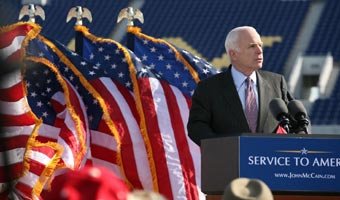
Sen. John McCain

Barack Obama supports Roe v. Wade. He believes common ground can be found by acknowledging there is a moral dimension to the abortion debate and that people of good will are on both sides. He says everyone can agree on working to avoid unwanted pregnancies that might lead someone to consider an abortion.

Capital punishment. McCain supports broadened use of the death penalty, stricter penalties for violent crime and increasing spending to build more federal prisons.

While supporting capital punishment for some heinous crimes, Obama says the death penalty should be enforced fairly and with caution.

Gay marriage. Obama opposes same-sex marriage but supports civil unions for gay couples. He says decisions about same-sex marriage should be left up to the states but opposes California’s Proposition 8, which defines marriage as between a man and woman.

McCain supports Proposition 8 and has supported a statewide ban on gay marriage in his home state of Arizona, but he opposes a similar ban on the federal level, saying it should be left up to individual states.

Global warming. McCain says climate change is real and must be addressed, and nuclear power is the best way to fix it. He also supports alternative fuels like wind, tide, solar, natural gas and clean-coal technology and favors offshore drilling to reduce America’s dependence on foreign oil.

Obama favors nuclear power as one component of the nation’s overall energy mix. He says 20 percent of the nation’s power supply should come from renewable sources by 2020. He believes the Book of Genesis teaches stewardship of the earth and sacrifice on behalf of future generations.

Health care. Obama says health care is a right for every American, and it is morally wrong when the terminally ill must worry about paying their medical bills. He says he would take on insurance companies to drive down health care costs and provide mandatory health care for children.

Sen. Barack Obama

McCain says health care is a responsibility. He says affordable health care should be available to every citizen, but families, rather than the government, should make decisions about health care.

Immigration. McCain says he would restart comprehensive immigration reform only after securing America’s borders. He would deport 2 million people in the country illegally who have committed crimes and says he would veto any bill giving amnesty to illegal immigrants.

Obama says America has nothing to fear from today’s immigrants. He supports immigration reform that secures America’s borders, punishes employers who exploit migrant workers and requires the 12 million undocumented immigrants to take steps to become legal citizens.

Iraq. Obama opposed the war in Iraq from its beginning and says it has distracted the United States from catching Osama bin Laden.

McCain believes in the Bush policy of pre-emptive war. He credits President Bush and the troops for the fact there has not been another major terrorist attack on American soil since 9/11. McCain says America is winning in Iraq. He views “radical Islam” as the greatest challenge facing the 21st century.

Israel. Both candidates support a two-state solution of Israel and Palestine living side-by-side in peace.

McCain wants to move the U.S. Embassy from Tel Aviv to Jerusalem to show solidarity with Israel. Obama says Jerusalem should be a final-status issue resolved between the Palestinians and the Israelis.

Labor. Obama says workers should have the freedom to choose whether to join a union without harassment or intimidation. He says farm policy should benefit families, not corporations. He supports making the minimum wage a living wage and says customers having to pay more for consumer items produced domestically is worth it to keep jobs in the United States.

McCain says Americans are not afraid of foreign competition and supports lowering barriers to free trade.

Race. McCain voted against the federal holiday for Martin Luther King in 1990 but now says it was a mistake. He defended the Confederate flag as a “symbol of heritage” but said South Carolina was wise to fly the flag in front of instead of on top of the state house.

Obama says the Confederate flag belongs in a museum, not on public property.

Schools. McCain says the key to improving the quality of public schools is to promote competition from charters, homeschooling and vouchers for private schools.

Obama supports charter schools but opposes vouchers.

McCain believes virtues contained in the Ten Commandments should be taught in public schools and that school prayer should be allowed but not mandated. Obama supports a stricter separation between church and state.

McCain says whether creationism should be taught alongside evolution is up to local school districts. He says he believes in evolution but sees the hand of God in creation. Obama opposes teaching creationism in public schools.

Stem-cell research. Obama says America owes it to her citizens to explore the potential of embryonic stem cells to treat debilitating diseases like Parkinson’s and Alzheimer’s disease, spinal cord injuries and diabetes.

McCain also supports expanding federal funding of embryonic stem cell research.

Torture. McCain disagrees with the White House position that waterboarding is not torture and says torture is supported only by people without military experience.

Obama says torture should not be used under any circumstance.


Analysis: ‘Thou shalt not bear false witness’ –unless it’s in a campaign ad

WASHINGTON (RNS)—Distortions, stretches, half-truths and omissions are familiar features of political campaigns. But independent fact-checkers and analysts say outright falsehoods in candidates’ ads may be reaching a level not seen since TV commercials entered presidential politics more than a half-century ago.

It is happening, they say, because false advertising has worked; because there are few, if any, penalties for it; and because truth becomes a relative and disputable term in the alternate reality of partisan politics—or as George Costanza once said on Seinfeld,“It’s not a lie if you believe it.”

Sen. Barack Obama addresses a crowd of about 75,000 people in Portland, Ore. (PHOTO/Newhouse News Service/Michael Lloyd)

“They’re drinking their own Kool-Aid,” said Brooks Jackson, director of the nonpartisan FactCheck.org at the University of Pennsylvania’s Annenberg Public Policy Center. “I’ve come to believe that an awful lot of the time they believe the ads. They’ve convinced themselves.”

Political scientist Darrell West examined past patterns in his book Air Wars: Television Advertising in Election Campaigns. The most dubious and misleading ads generally have come from groups independent of candidates, such as those who made the “Swift Boat” ads against John Kerry in 2004, he noted.

“This year, the candidates themselves have really pushed the envelope,” West said. “The 2008 campaign has reached all-time lows in the use of misleading and inaccurate political appeals. Even Karl Rove, the architect of negative ads in previous campaigns, has complained about the tenor of this year’s campaign. When Karl Rove says that, you probably ought to pay attention.”

Sen. Barack Obama has been cited for ads that quoted Sen. John McCain out of context to say he would support “100 years” of war in Iraq or that said McCain would slash Social Security benefits.

Obama’s campaign also aired a higher percentage of negative ads than McCain’s—77 percent to 56 percent—in the first wave of advertising after the conventions, according to a study by the University of Wisconsin Advertising Project.

Republican presidential nominee Sen. John McCain addresses supporters at a campaign rally. (PHOTO/Newhouse News Service/Kimberlee Hewitt)

But negative is not necessarily untruthful. PolitiFact.com, a project of Congressional Quar-terly and the St. Petersburg Times, rated 47 McCain ads and statements from “barely true” to “pants-on-fire” false, compared with 30 for Obama. McCain had six ads in the “pants-on-fire” category. Obama had one.

“McCain is the one who has had the bigger problem in terms of factual accuracy,” West said. The Republican, he added, was the one coming up in the polls until the crisis in financial markets started last month.

Two McCain ads drew particular notice from fact-checkers. One said Obama’s “one accomplishment” was “legislation to teach comprehensive sex education to kindergartners”—misrepresenting his support for teaching them about inappropriate touching by adults, and understating his record.

The other said a “disrespectful” Obama compared Sarah Palin to a pig. Actually, he was talking about McCain’s claim to be a force for change when he said, “You can put lipstick on a pig, it’s still a pig”—using an expression McCain once applied to Hillary Clinton’s health-care plan.

McCain ads have said falsely that Obama would raise taxes on the middle class, when in fact he would exempt families earning less than $250,000 from higher taxes, and that Palin did not seek earmarks as governor of Alaska.

The Washington Post said in a front-page story that after becoming fed up about claims that Palin said “thanks but no thanks” to the Bridge to Nowhere, the Obama campaign broke a taboo and used the “L-word of politics to say that the McCain campaign was lying.”

'Lying' a word you don't hear 

Lying, however, is a word “you don’t hear” from independent analysts, Jackson said. “A lie is an intentional deception. Unless you’re a mind reader, it’s very difficult to prove the intent of anybody.”

Whatever the intent or term, false and negative ads often work very well, said Carolyn Lin, a communications professor at the University of Connecticut. “When it works, it works like a charm, and historically it has worked. That’s why they do it.

“The unfortunate thing about political advertising is that when you tell lies, these lies often stick, and the liars never receive any penalties.”

Studies have shown that debunking falsehoods can have the backfire effect of reinforcing falsehoods by repeating them.

Screening out the facts 

People screen out facts that run counter to broad narratives they accept, and they perceive reality in a way that conforms to their long-held beliefs, said science writer Farhad Manjoo, who writes about the phenomenon in his book, True Enough: Learning to Live in a Post-Fact Society.

By rebutting untruths, meanwhile, a candidate departs from his own message and can risk being seen as weak or complaining.

Legally, candidates have a right to lie to voters just about as much as they want, said FactCheck.org’s Jackson.

The Federal Communica-tions Commission requires broadcasters to run ads uncensored, even if the broadcasters believe they are false. And the Federal Election Commission deals with finances, not ads.

“Ohio has the toughest truth-in-political-advertising law in the nation. And it doesn’t work,” Jackson said. “There’s no fines, no enforcement mechanism.”


Tom Feran writes for The Plain Dealer in Cleveland.


Dads create clean, Christian version of MySpace

HARTSELLE, Ala. (RNS)—About a year ago, Randall Brown started looking for a safe place for kids to hang out—online, that is.

He found out the hard way that MySpace isn’t just for finding friends, networking or listening to cool bands. Companies have hacked into MySpace and spam-slammed it with porn ads and advertisements.

He also looked at Facebook, and although that site has had better luck filtering out porn and advertisements, there are still teenagers being teenagers, posting comments, pictures, graphics and other applications that might be offensive.

So, Brown, 28, of Hartselle, Ala., and friend Michael Smith, 29, of Hatton, Ala., decided to come up with something different—www.christianspaceonline.com.

What makes it different? Christianspaceonline automatically filters out bad language and warns offensive members of improper comments, pictures or graphics. The two men wanted to find a safe space online not only for everyone from teenagers to adults, but also eventually for their kids. Brown has three children, 10, 4 and 2; Smith’s are 6, 4 and a newborn.

“That’s where the thought process came from,” Brown said. “I was getting bombarded with solicitations from different things—pornography, dating sites, that kind of thing.

“You want it to be a safe place, but companies out there hire people to look for websites to solicit. We’ve had it on ours. Here’s the good thing: If you reported things on MySpace, you never heard anything on it. If you report it on ours, it comes to us, and we can delete it and block the IP address.”

The website went public last November. After a slow start, christianspaceonline soon had 996 members—four off the goal of 1,000.

At one point, after getting some exposure at concerts and other events, the site was getting 100 new members a day, and that’s quite a challenge, especially since both Brown and Smith work during the day and lead a weekly ministry. Still, the two men think it’s worth all the hard work.

Randall Brown (center) and Michael Smith (right) discuss their social networking site, Christianspaceonline.com, with Christian radio DJ Jon Walden at WDJC in Birmingham, Ala. (RNS photo/Courtesy of Randall Brown)

“You can go on and look at our blogs,” Brown said. “We had one girl who said: ‘I just accepted Christ and things go on in life that make me question my decision. Because I’m a believer of Christ, why do bad things happen?’”

Brown saw it as an opportunity to minister.

“I sent her an e-mail that said, ‘Just because bad things happen doesn’t mean God isn’t on your side,’” Brown said. “We have pastors who reach out to us and are 100 percent behind it. If there’s a situation where they need to be involved, they will help.”

Of course, there always will be those who push the boundaries of even a Christian site.

“Yeah, we have people who test our language filters,” Brown said. “If you put a curse word on the comments, unless they manipulate the word, we can block it. The good thing about our site is that when it’s reported, we’re right on the spot and can go in and delete the comment. We can do the same thing with pictures.”

If a guy puts up a picture of himself at the beach with no shirt, it’s pulled, Brown said. If a girl puts up one in a bathing suit, it’s pulled. He recalls a mother who was bothered when her 13-year-old son was contacted by a 19-year-old man from Tennessee. The mother couldn’t cite anything offensive, but was uncomfortable, so Brown contacted the 19-year-old and suggested he talk to people more his age.

“We’re never going to be 100 percent perfect, but it’s better than the alternatives,” Brown said. “There’s no guaranteed safety at church or school. We try to keep it as clean as possible.”

Both men say they’re not in the venture to make money, but investors and T-shirt sales help keep the site going. A lot of older adults also enjoy surfing the site.

“You’d be amazed,” Brown said. “We have a lot of 30- to 50-year-olds and a lot in their 70s.”


Megachurches experience growth through multiple satellite locations

WASHINGTON (RNS)—Megachurches known for big buildings, big schools and big crowds continue to grow. But a new study detects shifts in the way they are expanding.

“The general growth pattern is that about 90 percent of mega-churches report that they are growing, and many of them at very fast rates,” said Warren Bird, a researcher at the Leadership Network, a Dallas-based church think-tank, and co-author of the study.

The average megachurch saw a growth of about 50 percent in attendance in the last five years; about 10 percent reported a decline or stagnation.

A service at Houston's Lakewood Church, where Joel Osteen is pastor.

The expansion of many of the nation’s estimated 1,250 mega-churches is occurring through satellite campuses, and they are shifting their training emphasis by running fewer schools and more pastors’ conferences.

“You have a tremendous amount of growth but not … larger and larger buildings,” said study co-author Scott Thumma, a sociologist of religion at Hartford Seminary.

The churches, with worship attendance of 2,000 or more each weekend, increasingly are using satellite locations, with 37 percent using them in 2008, compared to 27 percent in 2005 and 22 percent in 2000.

The researchers found on average, megachurches surveyed this year had offered four services at each of two satellite locations each weekend.

Five percent of megachurches had six or more locations, where between one dozen and two dozen services occur each weekend.

Almost a third of the mega-churches surveyed—30 percent—said they had started using satellite campuses in the last five years.

Outreach magazine, a church leadership publication based in Vista, Calif., reports that for the first time, all the congregations on its list of 100 largest churches in the United States are attended by more than 7,000 people. It notes that experts predict half of all mega-churches will have multiple locations by 2010.

But as they continue to grow, fewer megachurches are involved in TV and radio ministry. The percentage of megachurches with a radio ministry dropped from 44 percent in 2000 to 24 percent in 2008. Likewise, the percentage with television ministries dropped from 38 percent to 23 percent.

Fewer also are operating Christian schools. In 2000, 42 percent of megachurches surveyed said a Christian elementary or secondary school was part of their ministry. This year, that figured dropped to 25 percent. The percentage with an affiliated Bible school or institute dropped from 30 percent in 2000 to 20 percent in 2008.

At the same time, more churches are offering conferences for pastors or other ministry leaders, increasing from 47 percent in 2000 to 54 percent in 2008.

Even though the majority of megachurches are affiliated with denominations, researchers said offering conferences, resources and mission opportunities suggests the rise of “mini-denominations.”

“They are creating alternative ways for churches and for religious people to get resources, to do ministry, to do missions, to connect with other churches,” said Thumma, author of Beyond Megachurch Myths.

“All the things that were typically done … from the national denominational structure are being done at a local-church level.”


FAITH DIGEST: Disputed dinner fails to deliver dialogue

Iranian President Mahmoud Ahmadinejad dined with 300 religious and political leaders in New York, but the controversial event offered far less dialogue than advertised. Ahmadinejad delivered a 45-minute address that cut short any possibility of question-and-answer. The dinner met heavy criticism from the Anti-Defamation League and conservative Christian groups such as the Southern Baptist Ethics & Religious Liberty Commission, who said the Iranian leader was not an honest broker for peace. Leaders of the historic peace churches that helped organize the dinner—including Quakers and Mennonites—rebuffed the criticism, saying Jesus was condemned for dining with sinners in his day.

Muslims allow guide dogs in British mosques. British Muslim authorities have issued a fatwa—a religious edict—that allows guide dogs to enter mosques, even though Islam traditionally teaches that dogs are unclean animals. The ruling by the Islamic Sharia Council stipulates, however, that dogs are not allowed into the prayer room and should be left in a foyer or anteroom. The ruling arose from a request by Mohammed Abraar Khatri, an 18-year-old blind student from Leicester. At the Bilal Jamia mosque where Khatri worships, a special rest area has been set up in the entrance to accommodate his guide dog, Vargo, while he is praying.

Muslim files complaint over handling alcohol. A Muslim worker has launched legal action against Britain’s largest supermarket chain because his warehouse job required him to lift cartons of alcoholic drinks, which he said violates his religious beliefs. Muhammed Ahmed told an employment tribunal in Birmingham, England, he was treated unfairly when his employers at Tesco put him to work loading alcoholic beverages on fork-lift trucks. The dispute mirrors similar fights in the United States, where Muslim cashiers at Target objected to handling pork products—which Islam deems unclean—and taxi drivers at Minneapolis-St. Paul International Airport refused to accept passengers returning from trips with alcohol.

Students suspended for hanging Obama effigy. Four students were suspended from George Fox University after they confessed to hanging a life-size cardboard cutout of Sen. Barack Obama on the Newberg, Ore., campus. A custodial crew at the school, founded by Quaker pioneers in 1891, discovered the Obama likeness hanging by fishing wire from a tree early one morning and tore it down before students arrived for classes. A sign taped to the cutout said, “Act Six reject,” referring to a scholarship program that has brought minority and low-income students from Portland to the school. The four students who confessed to the offense were suspended up to one year, school officials announced. Other sanctions include community service and multicultural education, which must be completed before the students can return to campus, said Brad Lau, vice president of student life. The FBI is investigating possible civil rights violations.


Jesus on Facebook: Churches use social-networking sites

DALLAS (ABP)—Social-networking sites like Facebook and MySpace are redefining the way many Americans build and maintain relationships—and also how their churches communicate.

In the last few years, relating to social contacts through such sites has become practically ubiquitous among the under-30 crowd, and the practice quickly is spreading upward along the demographic spectrum.

Simultaneously, Christian leaders are realizing the sites can be useful tools, particularly for youth ministry and college groups, enabling group members to reach each other consistently and instantaneously.

That’s because social-networking sites are the new coffeehouses and community centers of the Internet. They are places where people can stay connected—in some cases, practically constantly—with what is going on in the lives of their friends, family and colleagues.

People use their online profile pages to post pictures, send messages, create events and invite people to them, and provide status updates to show what is going on in their lives.

Dale Tadlock, the 41-year-old associate pastor at First Baptist Church of Waynes-boro, Va., has been in student ministry 20 years. He stays linked with his students using Facebook.

He even does visitation through the site. When newcomers fill out visitors’ cards at his youth group meetings, many mark “Facebook” as the best way to contact them.

While on the go, Tadlock uses the Internet feature of his “smart phone” mobile device to check Facebook to find out his students’ latest status. Their profiles reveal current activities, pictures they’ve added and other Facebook users with whom they’ve had recent contact.

Tadlock said his colleagues nationwide are using such sites similarly in ministry, although some do so more extensively than others.

Customized add-on for Facebook 

Tim Schmoyer, youth pastor at the Evangelical Covenant Church of Alexandria, Minn., created a Facebook application—basically, a customized add-on program that can be used on the site and added to users’ pages—specifically for youth groups. The application sends news updates from a youth group’s website to Facebook so students know what is going on.

Every 30 minutes, the program checks to see if new information has been added to the website by group members. If so, the program updates a news feed that goes to all members, who will see the news on their Facebook home pages the next time they log in. And young people log in to social-networking sites with great frequency.

Schmoyer said Facebook works as an outreach tool as well, because online friends of the students see updates on what is going on at their friend’s church. If an activity sounds interesting to them, then they might visit.

Like Tadlock, Schmoyer finds Facebook to be a valuable tool for keeping in touch with his students and what is going on in their lives.

What the kids are like outside of church 

“Kids put so much of their lives on there,” he said. “It is really telling (about) what the kid is (like) outside of church.”

Tadlock uses Facebook to send out event reminders to his students. Through the site, he can find out who will be attending, who won’t and who might.

Are Christians relying too much on a commercial site not specifically geared toward their needs? After all—just like other major Internet domain—Facebook, MySpace and other social-networking sites have unsavory precincts.

But, Tadlock said, while other similar sites specifically geared toward Christians are popping up, he has not found them to be as useful. He believes it’s more effective for Christians to reach out to the culture around them by taking the best of that culture and adapting it to holy uses.

But one Christian site that is catching on through word of mouth is MyChurch.org —a social-networking site built around congregations. It has about 21,000 churches on it from across the United States and Canada, and about 150,000 individual members. The congregations range from Baptist to non-denominational to Salvation Army.

“It is kind of a MySpace for churches,” said Jon Suh, one of the founders. The site was created about a year and half ago to fill a need that Suh’s congregation, The River Church in San Jose, Calif., felt.

Online community for churches 

The River was using a variety of online sites—such as Evite, Yahoo! Groups and the photo-sharing site Flickr—to provide online content or to notify members of church activities. Church leaders decided to form an online community that would incorporate all those functions into one site.

MyChurch users can send individual or group messages, announce prayer requests, share photos, share audio files, comment on sermons, and organize and advertise events to others in their congregation.

The only doctrinal requirement that qualifies churches to use the site is their adherence to the Nicene Creed, one of the earliest affirmations of Christian faith.

But MyChurch doesn’t preclude anyone from making member profiles and joining a particular congregation’s page.

Churches police themselves, Suh said. Every church has a moderator that watches the content on the congregation’s page as well as keeping tabs on members’ pages as well.

“We don’t enforce too many hard policies,” he said. “We provide lots of tools for users to report content.”

People already were building networks for their churches on secular sites such as Facebook and MySpace. Suh said he doesn’t have a problem with that, because it’s good for Christians to be out in the secular world, pointing others toward God.

“I think it’s just changed the way we are interacting and the way we are doing things,” Tadlock said. “I think it literally has changed our culture.”


Houston couple feels at home ministering in Mexico

TUXPAN, Mexico—Although Dan and Jolene Tucker were commissioned for service in Tuxpan, Mexico, relatively recently as Cooperative Baptist Fellowship field workers, they are no strangers to their mission field.

Through a relationship between their home church of San Jacinto Baptist in Deer Park and Iglesia Bautista Bethel in Tuxpan, the Tuckers have been taking annual mission trips to the Mexican state of Veracruz since 1994.

Dan and Jolene Tucker of Deer Park feel at home in Tuxpan, Mexico, after making annual mission trips there with their home church since 1994.

They never envisioned permanently relocating to Mexico, but after much prayer, Tucker accepted the call to become pastor of Iglesia Bautista Bethel last year.

Around Easter, the couple packed their belongings into a 6-foot-by-12-foot trailer, drove to Mexico and moved into their new home—an apartment above the church.

The Tuckers insist their days are so filled with plans for church building renovations, improvements to the children’s and youth ministries, and outreach projects—not to mention sermon writing, sermon translation and Spanish lessons—they hardly have time to feel homesick.

“Having strong ties and relationships with the people here has made our transition easy,” Mrs. Tucker said. “Tuxpan has been our second home for quite awhile.”

Lacking the crime of Mexico’s larger cities, Tuxpan is a family-oriented community, with many children and teenagers, the Tuckers noted.

The people of Tuxpan are thirsting for God’s word, Tucker added, and his congregation of about 100 people has a heart hungering for missions. The church’s motto is “transforming lives.”

After years of learning from and serving side-by-side with American teams from San Jacinto Baptist, the members of Iglesia Bautista Bethel want to get to work in the world discipling others.

“They are ready to be goers and givers,” Mrs. Tucker said.

The church recently ap-proved a five-year plan that would plant three new churches and start a school for children.

Recognizing children make up roughly half of Mexico’s population, mission workers Dan and Jolene Tucker of Deer Park plan many activities for Tuxpan’s young people. (CBF Photos/Courtesy of the Tucker family)

“It’s a little bit overwhelming,” Tucker admitted. “We need pastors for the mission churches and suitable plots of land for the church buildings. We also have teaching needs, as far as bringing teachers in for the school and creating the curriculum. We cannot do it ourselves, but we can do it with the people God sends.”

Since roughly half of Mexico’s population is under age 18, the Tuckers plan many activities and outings for Tuxpan’s young people.

In April, they held a Bible study and served cake to children on Día del Niño. In May, Mrs. Tucker took 10 youth on a three-day, out-of-town retreat, and the Tuckers planned a day of Bible study and chaperoned fun on the beach for mission children who rare-ly get to go to the beach. During the summer, they helped their church’s youth praise team plan a community concert with games, music and preaching by a guest speaker.

Over two weeks, the church also held four Vacation Bible Schools. In the first week, 220 children attended programs held at three locations in Veracruz, and 90 percent of the participants were non-members.

One of the VBS locations was in a small community where there had been no Bible school for three years.

“At the end of the week, they pressured us, ‘When are you coming back?’” Tucker said. “The adults would come to the VBS and sit in the back. The first night, we had 40 children. The next, we had 72 children and 30 adults. The response was overwhelming. We told them we’d come back and do a backyard Bible club for the kids and a worship service for the adults on the first Saturday of every month.”

The Tuckers also have discovered the people’s eagerness to learn English.

“Everywhere we go in town, people ask us about English classes. It is connected with economics. If you know English, you are much more marketable,” Tucker said.

“We have heard that a worker can increase his pay by 30 percent if he can speak English.”

Iglesia Bautista Bethel started English-as-a-Second Lang-uage classes in the spring, mostly with church members as students, but members hope to turn the course into an outreach vehicle.

With so much going on, the Tuckers welcome church mission groups, families and individuals who want to minister alongside them in Tuxpan.

“What’s really cool about us being here is that anybody can come participate in ministry with us anytime,” Tucker said.

“We are open year-round to hosting people for a variety of missions opportunities, in-cluding medical work, construction work and teaching. Now that we’re here full-time, we’re better able to connect people in the United States with our group here and plug people in to whatever their passions are.”

“It’s not touristy, and it’s not glamorous, but we’ve got a pretty river and beach, and it’s close enough to the United States that people can come,” Mrs. Tucker added.

“The relationships that are formed here—it’s unexplainable. Everyone who comes says, ‘Man, I’m coming back.’ Christian growth is happening all over Mexico, as well as in the Tuxpan teams and American teams. Lives are being changed on both sides of the border.”