




Posted: 10/19/07
| One of a dwindling number of Iraqi Christians stands before an icon after Sunday Mass at the Church of the Virgin Mary in Baghdad. (RNS photo by James Palmer/The Star-Ledger) |
Iraqi Christians face choice
– flee or live in fear
By James Palmer
Religion News Service
BAGHDAD, Iraq (RNS)—Nabil Comanny and his family endured the dead bodies left to decompose along the road in their southern Dora neighborhood. They accepted the criminal gangs that roamed the area, searching for targets to kidnap. And neither the utility failures nor the mountains of trash in the street could drive them away.
As Christians, the Comannys learned to keep a low profile. They even stayed in their house after many Muslim neighbors fled the daily chaos when sectarian bloodshed between Shiite and Sunni militants broke out in 2006, making this one of Baghdad’s most embattled districts.
But the hand-scrawled note at their door was the final straw. The message commanded the family to select one of these options: Convert to Islam, pay a fee of nearly $300 monthly for protection or leave the area.
Failure to comply with one of the three would result in death.
“We don’t have weapons, and the government doesn’t protect us. What else can we do?” said Comanny, a 37-year-old journalist whose family abandoned its modest home of 11 years.
Extreme Islamic militants increasingly are targeting Christians in Iraq, especially here in the capital.
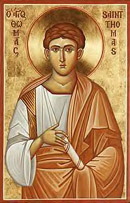 |
| The Apostle Thomas has been traditionally credited with taking Christianity to Mesopotamia. |
As a result, Iraq’s Christian community—long the minority in a largely Muslim country—continues to dwindle.
While meaningful numbers are difficult to come by, the last Iraqi census, conducted in 1987, counted 1 million Christians, although many fled after the United Nations imposed sanctions in the 1990s. Today, national aid groups estimate that between 300,000 and 600,000 Christians remain among an estimated 25 million people.
The first sign of trouble for Commany’s family arrived last spring when Muslim militants imposed Islamic law over the area.
The proclamation came via an 18-point document posted along shops and blast walls. The decree listed stringent rules for all residents.
Among other things, women were required to wear burkahs, which are draped over the head, covering the face and entire body.
“It’s not our tradition,” Comanny said. “How can Christian women be expected to do this?”
In the end, most Christian families decided to pay a bribe, Comanny said, “because it gave them time to prepare to leave. But most can’t afford to keep paying.”
Comanny, who shared a small house in Dora with his mother, three brothers and four sisters, finally decided to move his family on the advice of someone he described as a “sympathetic” insurgent—a lifelong acquaintance.
Because militants in Dora frequently attack families returning home to fetch their belongings, Comanny paid his insurgent contact 1 million Iraqi dinars, or about $800, for safe passage from the neighborhood.
Today, the Comannys live in the New Baghdad section of the capital, where hundreds of Christian families relocated. The families move cautiously among a majority Shiite population who rely on the Mahdi army to protect the area.
In addition to the direct threats, Iraq’s Christians also must cope with subtle obstacles.
William Warda, the founder of Hamorabi, a Christian-led national human rights group in Iraq, said most Christians here no longer feel safe embracing the lifestyle they once enjoyed, such as wearing Western apparel.
Most Christians still in Iraq are Chaldean Catholics who acknowledge the pope’s authority but remain sovereign from the Vatican.
Other denominations include Syrian Catholics, Armenian Orthodox and Armenian Catholics. Small groups of Greek Orthodox and Greek Catholics also practice, as do Anglicans and evangelicals.
One common thread among most of the groups is a concern that church leaders have not spoken out to protect their rights.
“The church is not defending us,” said Bashar Jamil John, a 24-year-old engineering student at the Baghdad Technical Institute. “This is part of the problem.”
Mokhlous Shasha, 32, a first-year priest at the Lady of Our Salvation Syrian Catholic Church in central Baghdad, argued the clergy here are as equally threatened as the ones they serve.
Since 2006, militants have killed three priests and kidnapped 10 others, church officials said.
“Priests live in the same situations as their parishioners,” said Shasha, who added he never walks the streets of Baghdad in his collar.
The one thing most Christians agree on is their view of the future—bleak.
While at least a dozen churches here simply have closed, some seminaries and convents have shifted their bases to the north.
For those still open, such as the Chaldean Catholic Virgin Mary in central Baghdad, attendance at Mass is down by more than half, officials said.
For one, Hamorabi’s Warda predicts a mass exodus of Christians from Iraq if Western countries relax their immigration policies.
“If the U.S. and Europe open their doors, the Christians in Iraq will be finished,” Warda said. “They will all leave.”







We seek to connect God’s story and God’s people around the world. To learn more about God’s story, click here.
Send comments and feedback to Eric Black, our editor. For comments to be published, please specify “letter to the editor.” Maximum length for publication is 300 words.