




Posted: 11/30/07
| A Baylor University team partnered with Texas Baptist Men to bring water filtration systems and water testing to a rural village in northern Mongolia. Pictured are (left to right) Dick Talley, Ron Mathis, and Leo Smith, all from Texas Baptist Men; Governor Khayankhirvaa of Darkhan, Mongolia; and Rene Massengale, Michelle Nemec, and Stacy Pfluger from Baylor University. |
Baylor and Texas Baptist Men bring
clean water to Mongolian town
By Matt Pene
Baylor University
KHONGOR, Mongolia—A village in central Mongolia that suffers from extensive water and environmental contamination soon may see better days ahead, thanks to the work of Baylor University researchers and Texas Baptist Men.
Researchers have completed one phase of the Baylor in Mongolia project. They identified about 1,000 people in Khongor who have been become sick due to environmental contamination from industrial mining. About 70 percent of the households in that town have at least one sick person—a crisis that has drawn attention from the World Health Organization.
“It is significant because Khongor is the first of perhaps many in this region with this same problem,” said Rene Massengale, an assistant professor of biology at Baylor, who is leading the project.
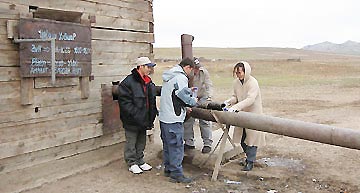 |
| A project by Baylor Univerisy is alleviating extensive water and environmental contamination in the Mongolian town of Khongor. |
“This is a clear human rights and human health issue, because these people were knowingly exposed but never told about it.”
Massengale’s study marked the first comprehensive independent environmental look at the problem in Mongolia, a northern Asian country between China and Russia. The Baylor study found residents had been exposed for more than a year to toxic levels of cyanide, mercury and heavy metals like arsenic due to multiple environmental spills by legal and illegal mining companies searching for gold in the soil. Symptoms include skin rashes, severe headaches, seizures and liver problems among many others.
The Baylor study was commissioned by Khayankhirvaa, the state governor of Darkhan, a region in northern Mongolia; Gunchin Luvsandorj, the presidium president of the Darkhan Aimag; and Batdulam Jambadoo, the foreign affairs officer for the Darkhan Aimag and special assistant to the state governor of Darkhan, after they toured Baylor in 2006.
Massengale acted as one of their Baylor tour guides during the visit. And, after learning of her line of research work, the dignitaries formally asked Massengale to lead a water-quality study in Khongor.
Massengale and her team now are partnering with local government leaders in Mongolia, Lifeqwest Mongolia and Texas Baptist Men to bring medical supplies and individual home water purifying equipment to Khongor. Massengale said those supplies should provide a short-term fix to the problem. Phase two of the project, which should begin in the summer, is a long-term environmental clean-up.
A few weeks ago, Massengale ran more than 2,400 tests on soil and water samples in the village. Tests indicated levels of cyanide and mercury have improved in many wells, but there still were a few wells with elevated levels of contaminants. There also was significant contamination of the soil and the building where the illegal mining took place. The contaminated soil is leaching toxic chemicals into the surrounding area and remains a health hazard to the community, Massengale said.
As the second phase gets under way, Massengale also hopes to set up a permanent Baylor in Mongolia program for students at Baylor and at the National University of Mongolia. The program would establish a permanent water-quality laboratory in Khongor, where students could conduct applied research to identify the needs of area towns and then work to meet those needs by training local Mongolian students about water quality, health and sanitation.







We seek to connect God’s story and God’s people around the world. To learn more about God’s story, click here.
Send comments and feedback to Eric Black, our editor. For comments to be published, please specify “letter to the editor.” Maximum length for publication is 300 words.