





Posted: 6/23/06
| Volunteers and local Kenyan water technicians manually drill a bore-hole well. |
Well-drilling innovation
brings water to Kenyan villages
By Matthew Waller
Special to the Baptist Standard
RABONDO, Kenya—A Baptist missionary’s new drilling technique has been cutting the cost of water wells in third-world countries from several thousand dollars to $100, all while teaching the people there how to drill for themselves. And now the technology has come to Kenya.
Terry Waller, a missionary to Bolivia through World Concern and Southland Baptist Church of San Angelo, went to Kenya recently at the request of Lifewater International, a Chris-tian organization addressing water issues in developing countries. With five other volunteers, Waller drilled two wells and trained eight local water technicians in Rabondo, a community in western Kenya.
He developed the technology on the field in Bolivia in the early ’90s. “We wanted (the drilling technique) to be manual,” Waller said. “We purposely designed it so that local people could drill their own wells. Our idea from the beginning was that we didn’t want it to be something where highly trained technicians had to do the drilling. We wanted either locally trained boys to be the well service providers or have the families themselves be able to drill wells.”
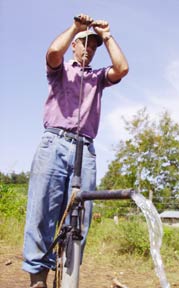 |
| Terry Waller pumps at a finished well. |
The system uses locally made materials. Drill bits are made locally with a sample bit that Waller takes with him, and the rig uses mostly PVC pipe for the drill stem to keep the process lightweight and inexpensive.
Four to eight people use a rope and pulley to quickly lift and release the rig into a water-filled hole, so that the ball-and-dart bit, which acts as a one-way valve, can churn the ground and force the water and cuttings up the pipe and into a settling pond.
Cathy Fitzgerald, the Life-water volunteer who invited and accompanied Waller, has been visiting Rabondo biannually since 2001 to drill with a motorized, mud-rotary rig.
“When we go over with a group, we’re able to drill, but it’s not really self-sustaining,” Fitz-gerald said.
“People can’t afford a truck to move it around; they can’t afford the gas or the oil to run the engine. … We thought that doing the manual well-drilling technique and training some of the water technicians that already know how to drill would enable them not only to do cheaper wells, but also to do it on a year-around basis.”
Peter Midodo, the pastor of a nondenominational church in the Ndhiwa community about 30 miles from Rabondo, said many families in his area walk a mile to haul water.
“They can only carry a small bucket, maybe 15 or 20 liters, and by the time they go and come back, it’s all used up,” Midodo said. “Some children cannot go to school because they have to get water.”
Rabondo Baptist Church Pastor Joseph Owaga said people in the community near his church walk more than a mile to get water from the river, used for bathing and polluted by chemicals used in farming.
“We do not have one well,” Owaga said. “When the rains stop, probably next month, we’ll have a real problem with water.”
Well service providers can charge several thousand dollars for their services.
In February 2006, the African Research and Medical Found-ation spent almost $35,000 on seven wells for about 2,000 people. A Catholic school in nearby Rapogi paid $24,000 for its water system. Fitzgerald’s motorized rig costs $2,000 to drill. Hand-dug wells also cost about $2,000 around Rabondo.
“I don’t think anyone is cheating anybody,” Waller said. “Well drillers have to charge for the risk, they have to transport the machinery. They’re just giving the market price.”
Waller said an experienced crew in his area of Bolivia can dig two 50-foot wells at 60 cents per foot, complete with homemade pumps, in one day. Rabondo’s rocky hills, however, presented more of a challenge.
“Everything that could go wrong did go wrong,” Waller said. An improperly threaded bit broke off after it had passed through a rock layer. Another bit broke from using too much weight to unintentionally drill through bedrock. The local glue occasionally gave out, detaching couplings from plastic pipe and leaving the crew to fish the rig out of the hole.
Despite these problems and others, Rabondo water technician Paul Okelo, who has been with Lifewater since its first visit, said he was impressed with having finished two wells—40 feet and 27 feet—in one trip.
Melchizedeck Okello, a Rabondo technician who professionally makes hand-dug wells, also liked the completion time.
“I found this method very good because it’s saving time,” Okello said. “With this, I can drill a well in three days.” Okello said he takes about three weeks to drill a 20- to 40-foot well.
The manual technique has worked drilling through Bolivia’s Altiplano desert at 12,000 feet; through Nicaraguan hills’ volcanic pumice; through coral and gneiss rock near Sri Lankan beaches; on the sides of hills in Chiapas, Mexico; through the Brazilian Shield’s laterite-rock hills; and through the sand and hard clay of Bolivia’s eastern river valleys, where Waller lives.
On average, wells reach down between 150 and 175 feet, and 1,700 to 2,000 wells have been drilled in Bolivia, Waller said. The deepest manually drilled well went to 250 feet, and a rig using a motor to replace rope pullers went to 350 feet.
Waller organizes the drilling in Bolivia, not only through individual training, but through informal “water well clubs,” people who come together to borrow a rig after learning how to drill and shop for materials. Clubs make a well for each party in the group, handle their own finances and promise to return the rig as received.
“We do clubs so that it’s still neighbors helping neighbors,” Waller said. “Our vision is to empower people to solve their own water problems.”
Water, however, has only been one facet of the Wallers’ ministry. During the day, Waller and his wife, Kathy, help homesteaders develop ways to make a living, and they do church work in the evening.
“We want to minister holistically … to the physical side and the spiritual side,” Waller said. “Families need more than just water to prosper. They also need to have a love relationship with God. … That’s the most important thing.”
Matthew Waller is a Baylor University journalism student who recently accompanied his father, a Baptist missionary with World Concern, to Kenya and Ethiopia.









We seek to connect God’s story and God’s people around the world. To learn more about God’s story, click here.
Send comments and feedback to Eric Black, our editor. For comments to be published, please specify “letter to the editor.” Maximum length for publication is 300 words.