





Posted: 9/08/06
| Luke Loetscher (third from left) is pictured with other members of his summer missions team in the Philippines along with Filipino workers who helped them in various projects. One named Kuya Tata (pictured second from left) was baptized by the group during the summer after receiving Jesus as his savior. |
Student found niche helping
renovate Philippine Baptist camp
By Teresa Young
Wayland Baptist University
PLAINVIEW—There’s something to be said for finding your sweet spot—locating the place you’re meant to be.
For Luke Loetscher, that happened this past summer while he served as a summer missionary in the Philippines. A Wayland Baptist University junior from Cheyenne, Wyo., Loetscher has long had an interest in agriculture and especially in improving processes in farming, using his interest in science. He is also handy with tools, having participated in several construction-related service projects while at Wayland.
When he learned about the opportunity to travel to the Philippines with the Nehemiah Teams of the International Mission Board and work in construction and agriculture, the project sounded right up his alley. It was.
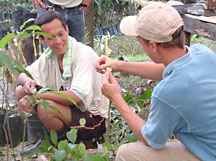 |
| Loetscher grafts a mango tree in an effort to increase the yield for the farmer by improving the root system. |
“This was an affirmation that God was preparing me for this for 20 years,” he said. “I have finally found the lock for my key—my niche. I had an idea before I went but this made it so much clearer.”
Loetscher arrived on the island of Mindanao on June 1 along with several dozen other students all working with Nehemiah Teams. After being split up into smaller teams of seven and sent to various parts of the Philippines, Loetscher’s team traveled to an area near the city of Butuan.
For the first month of their stay, the team did construction work on a camp and convention center owned by the Mindanao Baptist Convention. The camp, used as a retreat center for pastors and others on the island, was in great need of cement work and other projects. The team poured cement slabs for the living areas, built beds, dug a septic tank and built restrooms.
They also planted 200 banana trees and nearly 300 pineapple plants at the camp in order to provide an income-producing resource for the facility, which will no longer receive funding after December 2008 and faces closure.
During the second month, the team worked at an agricultural training center across the road from the camp, helping with usual farm tasks and harvesting.
“The training center incorporates agricultural training with the gospel, and through this, many Filipinos had come to believe in Jesus,” Loetscher said.
| Wayland Student Summer Missions Report • Skiles confronted world needs on NYC internship • 'Auntie Joy' humbled by summer in Malawi • Jalissa King traded basketball for shopping on Asia missions tour • Student found niche helping renovate Philippine Baptist camp • Student's technology skills helped support missions, humanitarian groups |
Assisting the Filipino farmers was satisfying to Loetscher and his team, especially knowing they were providing skills that would increase the profits for the farmers. While working with one particular farmer, the group helped him harvest his corn crop completely by hand. The crop had become small because he had no fertilizer and no way to stop the soil erosion that was threatening his crops.
“We helped him plant hedgerows along the side of the crop to prevent the soil erosion and provide a natural fertilizer for the crops,” Loetscher explained. “After the season, he just has to cut them down and spread them out for the fertilizer.”
Those types of skills and knowledge were what led Loetscher to believe he had found his calling. He’s confident enough that he’s already making plans to return to the Philippines in two years after he graduates to work at the farm and the camp and help them develop fundraising strategies to stay afloat.
“I worked with an agriculture extensionist there on these strategies to help the camp and the farm,” he said. “Our plan is to help support the local economy by buying coconuts, then producing coconut oil to sell there, and teaching others how to make coconut oil for profit.”
Loetscher said by producing the oil fresh instead of using a factory, there is a higher profit margin.
On the weekends, Loetscher and his team did ministry projects in the village of Mabuhay, working with house churches and their members. They became close to one member, a man named Kuya Tata, whom the resident missionary said had been delivered of demons and had come to faith in Christ just a week before. The man was baptized during the group’s visit, a move Loetscher said was a bold display of his newfound faith, given the culture.
Those two months in the Philippines left Loetscher with some valuable lessons he brought back home and to Wayland.
“As I come back, I realize that we’re all on mission. The same things I did in the Philippines we can do here,” he said. “We need to look for what we can do here and now and be on mission where we are.”
Loetscher serves with the Baptist Student Ministries at Wayland, heads the Servants With a Tool ministry—SWAT—and works with local Habitat for Humanity projects.
“My main thing is need-based ministry, looking at not only the physical needs but also the spiritual needs,” he said. “It’s a holistic thing. I want to meet needs at all facets.”
 |
| Luke Loetscher (center with shovel) and other members of the Nehemiah Team spread concrete out in one of the buildings of the camp and convention center at Mindanao in the Philippines. |









We seek to connect God’s story and God’s people around the world. To learn more about God’s story, click here.
Send comments and feedback to Eric Black, our editor. For comments to be published, please specify “letter to the editor.” Maximum length for publication is 300 words.