




Posted: 8/18/06
| A possible ear infection gets medical attention for the CERI foster child in Batticaloa, Sri Lanka. Texas Baptists, through CERI, are providing on-going care for tsunami orphans. |
Sri Lankan violence forces
change of venue for volunteers
By Craig Bird
Baptist Child & Family Services
COLOMBO, Sri Lanka—As Sri Lankan military and Tamil Tiger rebels traded mortar fire and accusations of mass slaughter, a team of volunteers from Baptist Child & Family Services treated the sick, comforted the traumatized and dug septic tanks in the tropical heat.
Two staff members from the Texas Baptist family services agency, four members of Cibolo Creek Community Church in San Antonio, two doctors and a nurse from Tyler and two counselors from Wisconsin worked with Children’s Emergency Relief International, the overseas arm of BCFS.
The only concession the group made to the fighting, which reportedly has left more than 800 people dead this year, was to shift the project from Batticaloa, on Sri Lanka’s eastern shore, to a site on the west coast. In Batticaloa, which straddles the disintegrated cease-fire boundary, BCFS and CERI operate a foster care program for tsunami orphans that now numbers 150 children.
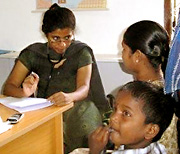 |
| A Sri Lankan doctor questions a CERI foster parent about the medical condition of the children she cares for in a recent clinic in Batticaloa, Sri Lanka. |
“The team was disappointed when we decided we shouldn’t work in Batticaloa like we originally planned,” said Marla Rushing, CERI director for Southeast Asia and Latin America. “We all were looking forward to working directly with the CERI children and their foster families. But returning to the southwest coast (where a CERI team worked last summer) still puts us in the middle of great needs, as well as letting us develop deeper relationships in that part of the country.”
Less than eight hours after the team arrived in Sri Lanka on a typhoon-delayed flight, they staffed a medical clinic and trauma-counseling center in a Colombo relief camp.
“We were immediately mobbed by a crowd of kids who wanted to play ball,” Rushing said. “We set up the medical clinic that treated 100 people, but counseling just meant letting 50 kids draw pictures on the floor together.”
In the days that followed, the team split up. One group participated in a housing construction project in Welligama, started work on a septic tank and organized English classes. Team members with medical or counseling expertise worked in Hikkaduwa. Both towns were devastated by the tsunami.
Rushing, who was in Hikkaduwa, reported lines of people awaited them—including children dressed in white who greeted them with flowers.
“It is pretty much organized chaos,” she admitted. “There were 40 to 50 kids at any time wanting to color or just play, and those of us working with adults were overwhelmed. As soon as one person would get up from talking with us, another one would immediately sit down. I began to feel like Lucy in Peanuts with her ‘Psychiatrist: 5 cents’ sign.
“There was no privacy, so there were at least five people listening in on every conversation. Some wanted money, but others truly wanted to talk about panic attacks and tsunami experiences. What amazing survivors!”







We seek to connect God’s story and God’s people around the world. To learn more about God’s story, click here.
Send comments and feedback to Eric Black, our editor. For comments to be published, please specify “letter to the editor.” Maximum length for publication is 300 words.