




Posted: 6/09/06
| Marsha Jackson lifts her arms in praise at St. Paul Baptist Church in Capitol Heights, Md. This photo of Jackson, a member of the St. Paul Voices Choir, is one of 165 featured in Soul Sanctuary a new book of images of African-American congregational life. (RNS photos courtesy of Jason Miccolo Johnson) |
Photographer captures heart
of African-American worship
By Adelle Banks
Religion News Service
WASHINGTON (RNS)—Alarmed by the rash of church fires that struck the South a decade ago, photographer Jason Miccolo Johnson felt driven to help preserve the vibrancy and history of the nation’s black churches.
His 10-year project resulted in Soul Sanctuary, a hardcover book filled with images he photographed across the country of African-American congregational life. From baptisms to funerals, traditional to contemporary services, communion to church suppers, he finds commonalities despite the range of denominations and locations of these churches.
Johnson hopes his book of black-and-white photos will be a window into a world unseen by some—and a reminder to others who live out the black worship experience every week.
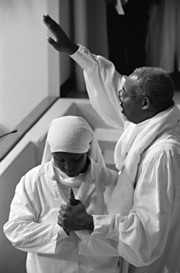 |
| Edward Jackson prepares to baptize a young convert at Alfred Street Baptist Church in Alexandria, Va. |
“What we do as a black church is so unique, so mesmerizing and yet so spiritual that very few people outside of the ethnic group can fully appreciate it,” the 49-year-old freelance photographer said. “Yet we on the inside take it for granted, and that’s a real shame.”
The book follows the order of service found in church bulletins each weekend—a choir marching down the aisle, soloists singing, the offering taken and the sermon preached. Sandwiched between the sets of photos are essays by prominent African-American ministers and theologians that further explain the rituals and celebrations of the black church.
The book’s early pages feature those who help prepare the sanctuary, such as stewardesses dressed in white preparing the altar, and a dimpled little girl passing out church fans.
Those ubiquitous paper fans with cardboard handles to cool warm worshippers demonstrate how some traditions endure for decades in the black church.
“There’ll always be church fans,” Johnson said. “I don’t care how great the air conditioning system or how expensive. Everybody wants their personal air.”
But even as traditions continue, his photos also captured the range of contemporary touches, including step dancers and mimes.
“Refreshingly, there are so many more ministries that take advantage of the talent of the members and put it to good use,” he said, citing drama, mentoring and transportation ministries. “That was a pleasant discovery.”
Later pages depict the post-service handshakes with the pastor and members picking out audiotapes or waiting for rides once the sermon has concluded.
The “day in the life” portrait Johnson has painted in his book began with 30 days of travel in which he arrived unannounced in Southeastern towns.
“I just drove into town, knew no one there, and started looking around for churches,” he recalled. “Most cities, I was only there for two days, a Saturday to scout locations and a Sunday to shoot.”
In the 200 churches he visited, Johnson said, three elements inevitably surfaced—good preaching, good singing and good food.
“In the black church, no matter what the label is or the denomination on the outside, the service is pretty much the same on the inside,” he said. “The style of worship service embodies our Africanness, our soulfulness and our orderliness.”
Though his project initially intended to merely capture black worship life through his camera’s lens, Johnson has greater aims now. Photos from the book—and those that didn’t make it in—are featured in a traveling exhibit that premiered in Boston in conjunction with the release of the book.
Johnson hopes to start workshops on preserving artifacts within black churches. And he’d like to spearhead what he calls “National Church Visitation Day,” during which members of churches attended mostly by a particular racial or ethnic group make intentional appearances at other congregations whose pews usually are filled with people who don’t look like them.
“I want to integrate the churches one day of the year,” Johnson said. “We can learn from them and they can learn from us.”








We seek to connect God’s story and God’s people around the world. To learn more about God’s story, click here.
Send comments and feedback to Eric Black, our editor. For comments to be published, please specify “letter to the editor.” Maximum length for publication is 300 words.