




Posted: 9/29/06
Gardner Taylor still preaching with power at age 88
By Kim Lawton
Religion & Ethics NewsWeekly
RALEIGH, N.C. (RNS)—He’s 88 years old and technically retired. But Gardner Taylor still shows the preaching skills that place him on virtually every list of America’s greatest contemporary preachers.
As a guest preacher in pulpits across the nation, Taylor continues to charm—and enlighten—worshippers as he has for more than six decades. But he says preaching always is a tenuous endeavor.
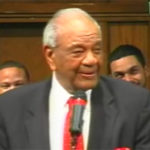
| Gardner Taylor, 88, retired from his Brooklyn church in 1990 but remains a guest preacher in pulpits across the nation. He delivered the E.K. Bailey Memorial sermon at Truett Seminary’s recent conference on “Celebrating the Art of Black Preaching.” (RNS photo courtesy of Religion and Ethics NewsWeekly) |
“It is quickly lost,” he recently told the PBS show Religion & Ethics NewsWeekly.
“It’s uttered, heard and sometimes lost. But it is the mystery of preaching that it survives and that it has survived so much of our bad preaching.”
By most accounts, little bad preaching can be traced to Taylor. “He almost single-handedly has elevated and made visible great preaching,” said Richard Lischer, who teaches preaching at Duke Divinity School in Durham, N.C.
In addition, Lischer said, Taylor “is one of the first (African-American preachers) whose influence crossed over into the realm of white homiletics and white preaching.”
Taylor was born in Baton Rouge, La., in 1918. Growing up, he didn’t want to follow in his minister-father’s footsteps.
“I wanted to be a lawyer, but no person of color had been admitted to the Louisiana bar, ever,” he recounted. “And when I told an old family friend … that I wanted to be a lawyer, he said, ‘Where you gonna practice, the middle of the Mississippi River?’”
Taylor ended up at Oberlin College’s School of Theology in Ohio, where he discovered he had his father’s gift for speaking.
“Both of my grandparents were slaves, and neither could read nor write,” he said.
“But somehow he (his father) had this feeling for the melody of the English language, and I inherited it.”
In 1948, Taylor and his wife, Laura, moved to Concord Baptist Church of Christ in Brooklyn, where he spent the next 42 years until his retirement in 1990. His eloquence and intelligence led to national prominence.
“He manages to keep an enormous range of rhetorical skill under tight, disciplined control, so that when you’re listening to a Gardner Taylor sermon, you feel like something is about to break out or explode,” Lischer said.
During the civil rights era of the 1950s and 1960s, Taylor played a key role in raising money in the North to support the Southern churches’ efforts. Together with Martin Luther King Jr., he pushed the black Baptist establishment to get more involved in the movement. That conflict led to founding a new denomination, the Progressive National Baptist Convention.
Taylor and King were close friends and often spent their vacations together. But King never talked about his personal struggles, Taylor said.
“I did not realize the pressures this man was under,” Taylor said. “There were threats on his life constantly. He lived under that shadow day by day, and as I look back upon his years, I wonder how he managed.”
Taylor was King’s “role model of how one employs the Scripture in order to use its great themes to preach the gospel of freedom for all humanity,” Lischer said.
Even after the great civil rights struggle waned, Taylor remained active in social issues and the political process. Looking back, he admits he at times may have been too involved with partisan politics. But Taylor also worries many contemporary churches have lost their prophetic edge, focusing more on personal prosperity than on issues like poverty and injustice.
“I think the church today in America partakes of the contemporary disease of ‘let me alone, I want to get along, and I don’t want to be bothered with too many things,’ and I think that’s in the churches,” he said. “When the pulpit becomes an echo of the pew, it loses, I think, almost all of its reasons for existence.”
Taylor believes that as he’s aged, his preaching has begun to reflect more about the frailty of human life. That was tragically brought home in 1995, when Laura, his wife of 55 years, died after being hit by a truck. He has since remarried and settled in Raleigh.
This past spring, Taylor taught a preaching class at nearby Shaw University, telling the students: “You do not want to be known as a great preacher. You do want to strive for people to feel when you have tried to preach what a great gospel it is.”
Taylor keeps busy, but in recent years he’s also begun to practice what 19th-century British pastor Alexander Maclaren called “sitting silent before God.”
“This is not praying. It is not reading. It is just opening oneself,” he said. “It’s a mystic kind of thing. But we do so little of it, and we who preach are likely to engage ourselves in so many things and neglect that aspect of being open to what God has to say. I wish to heaven I had practiced this more early on in my ministry.”
The older he gets, he said, the more he relies on God’s promise of eternal life.
“I’m 88, and I lean much more upon the promises, because I need them” he said. “I guess I always needed them, … but I feel the need of them more.”









We seek to connect God’s story and God’s people around the world. To learn more about God’s story, click here.
Send comments and feedback to Eric Black, our editor. For comments to be published, please specify “letter to the editor.” Maximum length for publication is 300 words.