


Posted: 6/09/06
| Park Cities Baptist Church member Laura Hefner mentors fourth-grade student Azul at Dan D. Rogers Elementary School in Dallas. |
BRINGING HOPE:
Mentoring at-risk children
By Jenny Pope
Buckner Baptist Benevolences
DALLAS—Every Thursday morning during the school year, Lana Stanley of University Baptist Church in Arlington made the same trip down the brightly colored hallways of South Davis Elementary School.
She carried a canvas tote bag stuffed with children’s books, pens and crayons, a board game and a special treat.
She arrived at a first-grade classroom and opened the door, greeted by a sea of innocent faces that looked up and stared. But only one face stood out to her—a little Bulgarian girl named Krista.
Without fail, Krista ran across the room for a hug, and then Stanley helped her gather her things and led her away, hand-in-hand, to their special spot in the school library.
Every school day throughout the country, scenes like this occur as part of the Kids Hope USA mentoring program, a church-based initiative where churches train and recruit mentors within their congregation to form one-to-one relationships with at-risk children in neighborhood schools.
“When I first met Krista, she was very quiet—she wouldn’t say a word,” Stanley recalled, remembering when the 6-year-old girl barely knew English.
“Now, I can’t get her to stop talking! We make jokes at each other, and we understand each other. Her reading has improved tremendously, and she is a math whiz. I look forward to seeing her for the first time each week, seeing that big smile, knowing that she’s excited to see me, too.”
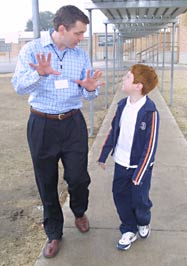 |
| Brad Schwall, Kids Hope USA and HomeWorks director at Park Cities Baptist Church, walks with Kai, a third-grade student at Dan D. Rogers Elementary School, where Schwall coordinates mentors. (Photo by Russ Dilday) |
Buckner Children & Family Services has collaborated with Kids Hope USA to identify and connect churches and schools that could benefit from this relationship. In one year, Buckner enlisted 10 Texas churches. More than 330 schools and churches have partnered nationwide since Kids Hope USA’s inception 10 years ago.
“With Kids Hope USA, we’ve come up with an intervention to complete our mission, to be proactive and protect children before there is a problem,” said Scott Waller, Buckner’s liaison with Kids Hope USA. “If we can empower the local church to be the one to do that, we’re going to go a lot further to impact children and families than if Buckner was just going different places to set up shop.”
Virgil Gulker, executive director and founder of Kids Hope USA, began the program as a research project in 1995. He met with a variety of people who provide support services for children and asked them the same two questions: What are the greatest needs of our children? Is there a role the neighborhood church could play in meeting those needs?
“The answer broke my heart,” Gulker said. “I found that as a country, we’re not doing very well. A high percentage of our children live in poverty, up to 41 percent live in single-parent homes and a whopping 31 percent do not have a significant father figure.”
When he asked them what the church could do to help, “the answer was really in one voice—if the church would mobilize and train its members to form ongoing one-on-one relationships with the youngest children, it would make a profound difference in their lives. And that really became the vision of Kids Hope USA, finding a way to equip the church not just to give stuff to kids, but to form these meaningful relationships.”
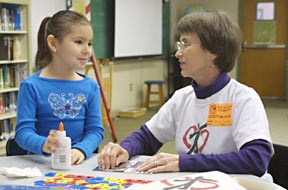 |
| Peggy Mitchell, member of University Baptist Church, mentors Celia, an elementary school student. |
Kids Hope USA has four distinctive characteristics: It is fully owned and operated by participating churches; it works with the youngest children; it’s based on exclusive one-to-one relationships; and it respects the laws regarding separation of church and state.
Shared values, a corporate commitment and a “family of support” encourage church members to maintain a long-term relationship with each child. And logistically, a church can recruit more members and keep them longer for less money than any community organization, Gulker said.
Each church assigns a part-time paid director to administer the program, screen, recruit and train mentors, and coordinate mentor sessions with the school. Each church also must have at least 10 committed mentors to begin.
A recent survey by Kids Hope USA revealed more than 78 percent of mentors have been involved more than two years, and more than 90 percent of churches that have started the program still are participating. That demonstrates Kids Hope USA truly fosters a long-term commitment between mentors and children, leaders noted.
“The more cavalier a mentoring program is, the more damaging it can be to a child,” Waller said. “If there’s no long-term commitment or sustainability to the program, vulnerable children who already feel abandoned end up being more hurt.”
Kids Hope USA focuses on the youngest children and seeks to encourage and support them during formative years. Many states predict the number of prison cells that will be needed in 10 to 12 years by looking at the reading scores of third-grade students today.
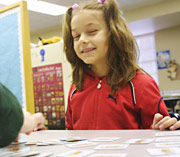 |
| First grade-student Krista studies English and plays Memory with her mentor, Lana Stanley from University Baptist Church in Arlington. |
“A sane society would do whatever is necessary to make sure these kids can read,” Gulker said. “So, we decided that the primary role of Kids Hope USA would be academic tutoring, but principals have told us that the greatest need in almost every incident is the emotional and social. Brain research says that the way to get through to a child’s mind is always through the heart.”
Erma Nichols, principal of South Davis Elementary in Arlington, wanted mentors to work with first-grade students due to behavior problems and academic struggles caused by absent parental support, she said.
“It’s been awesome for my students, who sometimes get a lot of negativity, to have this one person who’s not going to judge them for their behavior or lack of ability in the classroom.”
Gulker said educators have recognized the growing need for children in their schools to experience love and encouragement through a personal, one-to-one relationship with an adult.
“Kids Hope USA has made a huge difference in my students,” said Amanda Fink Russell, fourth-grade teacher at a Kids Hope USA school partnered with Park Cities Baptist Church in Dallas. “It’s given them somebody to have a relationship with, a strong role model, and it’s built self esteem. Because they’re so consistent, they look forward to seeing the mentor each week, and they know they will always be here.”
Each Kids Hope USA mentor is trained to abide by church/state separation laws and respect the rules of the host organization, which means they cannot pray or evangelize within the school. However, each relationship is supported by a behind-the-scenes prayer partner, which Gulker said is critical to the Kids Hope USA program. Mentors are allowed to invite the child to participate in church events or activities if parents grant permission.
Many churches see Kids Hope USA as yet another form of community outreach, he said, and they really strive to form relationships not only with the children, but with the families, too.
First Baptist Church of Richardson began mentoring students at Northrich Elemen-tary School by targeting sibling groups identified as being at-risk. With 19 mentors and prayer partners, Director Carrie Tracy feels they’re halfway there to meeting the needs of families in the school.
“By reaching out to sibling groups, we’re essentially reaching out to the whole family,” she said. “We want to be proactive, and we feel that our work would make an even bigger impact if we targeted an entire family at one time.”
Park Cities Baptist Church connected Kids Hope USA with an already-existing program in their church called HomeWorks, which supplies parents with tools and resources to raise strong children and parent effectively. Through HomeWorks and Kids Hope USA, Park Cities members have permeated Dan D. Rogers Elementary with their presence: They host a monthly workshop and dinner for the families, send out newsletters with tips and advice on parenting and offer “Cool Kid” resources for children to learn how to deal with their feelings and make good choices.
“HomeWorks is the next step to reaching the families of the kids who are being mentored through Kids Hope,” said Brad Schwall, HomeWorks and Kids Hope USA director for Park Cities—and mentor of third-grader Kai.
“It’s our goal, always, to build relationships and meet the needs—perhaps the spiritual needs—of children and families. It’s a chance for us to reach the whole school and maintain an ongoing presence with the families and the schools. That way our ministry isn’t based on just one chance, it’s an ongoing relationship that continues to build.”
Park Cities has reached the point where many churches strive to be—forming close relationships not only with the child, but also with the family. Schwall admits that while resources are important, they are insignificant compared to the close, caring relationships Kids Hope USA encourages. It doesn’t take a mega-church to make Kids Hope USA successful, he said.
“Because it is one church, one school, one child—we don’t have a fear of being overwhelmed by a bigger church or group coming in,” said Greg Deering, Kids Hope USA mentor and pastor of University Baptist, a church with an average attendance around 90 people.
“It’s really just a matter of seeing the potential, and for us, it’s a way for us to move our church members outside of the walls of the church and carry out our ministry into the community.”
Kids Hope USA strives to engage 5,000 churches and reach 100,000 children in the next 15 years. And with the help of Buckner, they hope to engage 250 churches and reach 4,500 children in Texas in the next five years.
“With numbers like this, you’re ultimately talking about a church-based collaboration that could begin to save and influence a generation of children,” Gulker said.
For more information about Kids Hope USA, contact Scott Waller at swaller@buckner.org or (214) 758-8026.








We seek to connect God’s story and God’s people around the world. To learn more about God’s story, click here.
Send comments and feedback to Eric Black, our editor. For comments to be published, please specify “letter to the editor.” Maximum length for publication is 300 words.