





Posted: 3/18/05
 |
|
| Volunteers start framing (left) on more permanent structures for tsunami refugees in Sri Lanka. The finished house (right) is ready for a family to move in. | |
Tsunami response demands
quick start, long process
By Craig Bird & John Hall
Baptist Child & Family Services & Texas Baptist Communications
SRI LANKA (ABP)–Tsunami disaster relief is not a race between the tortoise and the hare. It's more like a relay effort by the two.
Baptist groups that remain deeply involved in helping victims of the catastrophe insist the sprint to keep people alive by providing them emergency food and shelter has given way to the marathon of restoring the communities and hope wiped away by the wall of water Dec. 26.
“This looks like it will be a long-term project, possibly lasting several years,” said Gary Smith, disaster relief off-site coordinator for Texas Baptist Men, which has had teams in Sri Lanka since early January.
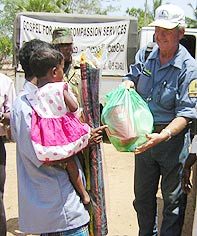 |
| Emergency food aid is giving way to more long-term help in Sri Lanka. |
“Our first crews concentrated on feeding and water purification. But now we are shifting to home construction and even building schools and other permanent structures. I think we will be rotating volunteers in and out of Sri Lanka into 2006, if not beyond.”
Karolyn Southerland of Alice recently went to Sri Lanka as a volunteer to feed tsunami victims. She ended up cleaning wells contaminated by sea water. Nonetheless, she is eager to go back.
“I want to see if I can do more than I did the first time,” she said. “I don't think a feeding unit will go, but maybe I can help build a house. Maybe I can help feed children. I'd go back in a minute.”
Some Sri Lankan families still rely on emergency food provided by Baptist aid workers, said Paul Montacute, director of Baptist World Aid, the hunger and relief arm of the Baptist World Alliance.
Returning recently from the island nation off the southern coast of India, Montacute confirmed the need for more permanent housing for tsunami victims. The emergency tents provided for so many are proving to be too hot for the climate, he said, and people need to move into wood or block accommodations.
The challenge for many aid groups–Baptist and otherwise–is to make the appropriate use of personnel while practicing the best stewardship of an unprecedented outpouring of contributions.
The International Mission Board of the Southern Baptist Convention reports tsunami-relief donations have passed $10 million. The Baptist World Alliance has received $1.5 million and the Cooperative Baptist Fellowship $1 million. Some individual state Baptist conventions also have their tsunami-relief programs. The Baptist General Convention of Texas has received in excess of $1.19 million.
But relief workers will need patience to match the generosity. While some Christian groups have grabbed headlines with over-aggressive evangelism techniques, most Christian groups agree now is a time to build relationships, not churches.
In many Asian countries, there is widespread suspicion among the majority religions that Christian groups are only using tsunami aid as cover to “steal” needy individuals from their traditional faiths.
“It is hard because many of us didn't have experience in countries that aren't open to the normal ways of sharing our faith,” said Kevin Dinnin, president of Baptist Child & Family Services.
“When our assessment team was in Sri Lanka in January, I did what I always do and asked if I could pray for every (refugee) camp we went into. But one of the camps was Muslim, and I didn't know that. When I bowed my head, the leader of the camp got very upset and chased all the children away from us. It took awhile, but I finally convinced him that I was not trying to steal the children but sincerely wanted to ask God's grace and care for them.”
Baptist Child & Family Services has accepted what may be the longest of the long-term projects involving Baptists–partnering with the Sri Lankan government to organize and administer the country's first foster-care program.
“We have been asked … to set up a pilot program, initially involving approximately 50 children, as well as train Sri Lankan government staff in how to do child care and even fund a government employee who will be the liaison between our work and the government,” said David Beckett, Sri Lanka director of BCFS's overseas arm.
“The government leaders see the need but have such limited resources. I admire their wisdom and their courage in asking us to help them in this area.”
“The initial estimates of 10,000 orphans proved to be extremely overstated,” Beckett said.
“And some non-Christian aid groups are resisting our program because they say all the orphans have been placed in homes. But you often have a grandparent or a single mom already living near the poverty level trying to find the energy and resources to care for children they suddenly are responsible for. And there is no system to support them–or to protect the children–in place. The government wants to do the right thing, and we want to help.”
That sentiment is found among Baptist volunteers all across the tsunami area, whether they are doing medical exams, cleaning out wells or helping fishermen acquire new boats.
The tortoises and the hares are working together.








We seek to connect God’s story and God’s people around the world. To learn more about God’s story, click here.
Send comments and feedback to Eric Black, our editor. For comments to be published, please specify “letter to the editor.” Maximum length for publication is 300 words.