





Posted: 10/28/05
 |
|
| Jay Chastain of First Baptist Church in Longview plays with a boy in a Chinese orphanage in Xinjiang Providence after Buckner Orphan Care International volunteers placed new shoes on all the children. Paige Chastain cuddles a handicapped infant in a Chinese foster home. (Photos by Scott Collins) | |
To China with Love
By Marv Knox
Editor
BEIJING, China–The little Chinese girl giggled and squealed as Sherman Hope held her hands, spinning her around, swinging her between his legs and lifting her into the air.
The girl demonstrated her sisterhood with American children and boys and girls all across the globe: If a little fun is good, a lot is great.
So, she refused to let the retired physician quit. On and on they played. Long after his arms tired, he continued smiling and laughing and lifting. And demonstrating the love of his heavenly Father to a little girl who never knew a father.
 |
| Jeff Jones (right) and Ken Hall of Buckner present new shoes to children in Tianjin. |
“She weighed 40 pounds when we started and 70 when we stopped,” Hope said later, still grinning at the memory. Would he do it all over again? Absolutely.
Hope of Brownfield joined 18 other U.S. Christians on a mission trip to five orphanages in China Oct. 13-23. They participated in Buckner Orphan Care International's Shoes for Orphan Souls program, which has distributed about 1.2 million shoes to orphans in 43 countries since 1999. Theirs was one of 45 Buckner trips this year, involving about 740 volunteers.
Buckner Orphan Care International is a ministry of Dallas-based Buckner Baptist Benevolences, one of about two-dozen institutions affiliated with the Baptist General Convention of Texas.
For the volunteers who make the trip, the highlight of any visit to an orphanage is placing new shoes on the children's feet, then playing with them, helping them decorate frames for pictures the volunteers take of the children, and leaving small toys and other gifts.
In Changji, Judi Carmichael of Selma, Ind., quietly wept and Leslie Whitlock of North Richland Hills laughed as they helped disabled children into new shoes. A few moments later, Jay Chastain of Longview played ping pong with three new friends, while Kenton and Mary Keller of Atlanta, Ga., batted a beach ball with a couple of boys, and Laurie St. Denis of Sarasota, Fla., held a child in her lap, silently praying.
Day by day of the weeklong trip, the locations and the children changed, but the ministry and its purpose remained the same.
 |
| Barb Collier of Anderson, Ind., and a little friend prepare to take a picture. |
“Why do we come?” Buckner President Ken Hall asked as he gave the volunteers an overview of the ministry on a tour bus just before it rolled up to the first orphanage, Changji Social Welfare Institute, in Xinjiang Province.
“First of all, we're here to love children,” Hall stressed. “We also come to encourage the workers, who love these children and labor in hard and demanding conditions.
“We want to build relationships with the group (of orphanages) and to earn credibility for our program. But we also come here to improve the conditions of these orphanages, to help them have money to do some things that need to be done.”
Buckner's relationship with child care workers in China began in 2000, when Hall and Mike Douris, vice president of Buckner Orphan Care International, traveled there to see what Buckner could do to help minister to the country's burgeoning orphan population.
Orphans have multiplied in China since 1979, when the government announced its “family plan” to control rampaging birth rates that have pushed the country to about 1.3 billion people–stretching its economic and agricultural systems to the breaking point.
In general, the plan limited each married couple to just one child. But two problems with the plan quickly surfaced.
First, Chinese culture historically values boys more than girls, since boys pass on the family name and sustain their parents in old age. So, many couples began abandoning–and sometimes aborting–baby girls.
Second, couples started seeing children with physical or mental handicaps as defective. Parents abandoned special-needs infants in order to try again for a healthy child.
And while the world adoption market has quickly taken in many healthy Chinese baby girls, the government must scramble to find a place for the children whose imperfections leave them unwanted.
That's why, for example, 92 percent of the children cared for by the city orphanage in Urumqi suffer from either mental or physical disabilities.
Still, that doesn't diminish them in God's sight, and neither should it devalue them in the eyes of Christians, said Jeff Jones, operations director for Buckner Orphan Care International.
“Every child counts,” Jones stressed. “Every one of these children deserves all that any child anywhere deserves.”
And the volunteers' time with the children can make a difference in young lives, he added. “This may be the only time someone directly loves one of these children. We're going to do everything we can to minister to these kids one-on-one with whatever time we're given.”
Buckner's opportunity to help Chinese children is growing steadily, Hall reported.
“We are in a country in transition,” he said. “We are trying in a quiet, gentle way to represent what it means to follow Christ. We don't have a long-term strategy, but simply to be faithful and see how things develop.”
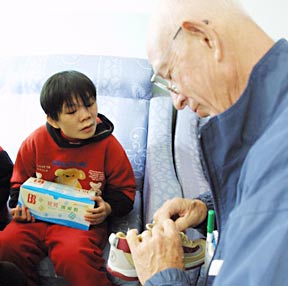 |
| Sherman Hope of First Baptist Church in Brownfield shows Christian love to a child in a Chinese orphanage. |
That concept reflects one of Buckner's guiding principles, he added: “Everything is long term.”
Child-care agencies must receive permission to work in China, and Buckner entered the Asian giant through its partnership with Fort Worth-based Gladney Center for Adoption, which owns a permit to arrange international adoptions of Chinese children.
But since Buckner's ministry extends beyond adoptions–particularly to institutional and foster care–it's consistently working on strengthening its ties to Chinese officials and the orphanages they operate.
“We're still learning in China,” Hall said, acknowledging the relationships with the reserved Chinese have come along slower than in other countries, such as Kenya, Romania, Latvia and Guatemala.
“But we're gaining tremendous credibility in China,” he added. “We're focusing on the underserved. And distinctively, we want to work with the government to promote quality child care that's culturally sensitive.
“The government is trying to improve its (child-care) system. With China's economic boom, poverty has become more pronounced. In contrast to the expanding middle class, the presence of the very poor is more visible than ever. The government is sensitive and trying to respond. We want to help them.”
Buckner's approach in China is to be available and ready, but not aggressive. In meetings with government officials responsible for child care, Hall repeatedly expresses appreciation for the opportunity to serve in China. He focuses on his host's strengths, on the ways they are succeeding with children. And while he is careful not to promise more than Buckner can deliver, he also pledges to respond to opportunities to expand the relationship.
“Since most (orphan) children won't be adopted, you try to improve their situation, so they can reach their full potential,” he added.
And if transitional programs for older teens don't develop, orphans will be pushed out into society at age 18 or 20, ill-prepared to care for themselves or hold down jobs.
So, Buckner works to strengthen orphanages and also move adoptions along, Hall noted. “Buckner's approach is to be sensitive to the orphanages and their needs, to help when asked, but not to interfere.”
And Buckner literally has been willing to take the long route to credibility. For instance, Buckner specifically asked to work with orphanages in Xinjiang Province–a three-hour plane trip across China from Beijing, in the remote northwest corner of the country, much closer to Mongolia and Afghani-stan than China's capital city.
“We've wanted to prove ourselves–to show our Chinese friends that we're willing to do the hard work of caring for children in far-off places,” Jones said, noting Buckner's philosophy echoes a statement on the lips of child-care leaders across China: “Everything is for the children, and for the children we will do everything.”
In addition to the obvious benefit–placing much-needed new shoes on children's feet–the Shoes for Orphan Souls program has provided Buckner with positive exposure to China's child-care leaders.
Feng Li Wei, director of the orphanage in the northeastern port city of Tianjin and newly appointed assistant director of social work and rehabilitation of disabled children nationwide, recently told Hall and the Buckner Shoes for Orphan Souls volunteers, “We have a famous saying in China, 'Everything begins with the foot.'”
Proving her point, Feng praised the Shoes for Orphan Souls program and then invited Buckner to conduct major training conferences for child-care workers from throughout the nation.
That vote of confidence thrilled Buckner leaders, confirming their decision to remain in China, despite slow progress at first.
“There have been times when we contemplated whether we should stay in China,” Jones said, acknowledging they had analyzed Buckner's return on investment in China.
“God continues to give us affirmation,” Hall added. “We struggled about a year and a half ago. But we decided we could not ignore the world's most populous nation that is becoming a super power in every way. We have a commitment to share our Christian witness and to advocate for Chinese children.”
Buckner's stepped-up relationship with Chinese leaders may lead to greater opportunities to serve the nation's children, he said. One possibility would be for Buckner to receive its own permit to process Chinese adoptions. Another would be the chance to take teams on extended visits in individual orphanages. This would give volunteers more time to build relationships with children and to express Christ's love for them directly.
And that's why the volunteers travel almost halfway around the globe.
“The word 'joy' comes to mind on a trip like this,” noted Chastain, whose first Buckner trip also was his first trip to China. “I feel we were in the right place, at the right time, doing the right thing. I feel God is in it.”
Barb Collier of Anderson, Ind., admitted she was disappointed when she learned the Chinese government does not allow Christian groups to teach Bible stories to Chinese children. “I wondered, 'How could we make a difference?'” she recalled.
But then she remembered the creation story in the Old Testament book of Genesis, where the Scripture says the Spirit of God “hovered” over the water. “So, I prayed the Spirit of God would hover over these children while we were with them. And I believe he did. I believe Buckner makes a difference every time.”
That's because “we're a people organization,” explained Hope, a longtime Buckner trustee. “It's what we do with people, by people that makes a difference.”
Buckner has “such a great vision for the children of China,” St. Denis added. “Their deepest desire for these kids is that they will find the hope we have in our Lord and Savior, Jesus Christ. … These children are banished on the edges of society, yet God has a plan for them.”
Quoting Scripture, she noted, God “'raises the poor from the ashes and seats them with the mighty and the kings.' God can do that for these children. He's a mighty, awesome God.”
For their part, Chinese leaders welcome Buckner volunteers with open arms and seem eager to explore new possibilities for partnership.
“Let's hope our friendship with our friends from Buckner lasts forever,” Feng told the Shoes for Orphan Souls team.
And from Buckner's perspective, “forever” could have eternal consequences for China's orphan children.








We seek to connect God’s story and God’s people around the world. To learn more about God’s story, click here.
Send comments and feedback to Eric Black, our editor. For comments to be published, please specify “letter to the editor.” Maximum length for publication is 300 words.