


Posted: 12/02/05
| Robin Jones (left, holding child), national promotions and marketing director for Moody Broadcasting Network, and Buckner volunteer Jana Houston of Tennessee place shoes on the feet of a visually impaired child at a Russian orphanage. (Photo by Felicia Fuller) |
Russia trip marks 10 years
of Buckner's international ministry
By Felicia Fuller
Buckner Benevolences
ST. PETERSBURG, Russia–As the noonday sun beamed across the music room at a Russian orphanage, a silver-haired woman took her seat before an arc of chattering children. Unmoved by the commotion, she smiled knowingly, folded her hands in her lap and waited. At her side, translator Vladimir hushed the youngsters with a wave of his finger.
“My name is Sandy Woody,” she began. “I am a babushka (Russian for 'grandmother'), and I've come to tell you that God loves you. He has a special plan for each one of you. There's nothing you have to do to be good enough for God. He loves you just the way you are.”
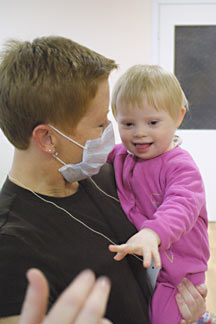 |
| Volunteer Lisa Williams of Louisiana, an internationally adoptive mother, shares a moment with a toddler with Down syndrome. (Photo by Felicia Fuller) |
The concept of Christ's unconditional love was lost on some but not, among others, 9-year-old Olga. In 2004, she was one of 14 Russian orphans who visited Texas for two weeks through Buckner Baptist Benevolences' Angels from Abroad program. During her stay, Dallas doctors donated their services to correct her strabismus–an optic muscle malady that had plagued her since birth, causing her eyes to appear crossed. Today, her brown eyes are balanced and her vision sharp as she throws playful glances at her peers.
Olga represents the countless children who have been touched by mission workers serving alongside Buckner Orphan Care Interna-tional in Russia during the past 10 years. In fact, Buckner's work abroad began at an orphanage in her native St. Petersburg.
Recently, 45 Buckner volunteers returned to that orphanage where the Texas Baptist agency's international ministry began.
“In my life, my eyes were changed, and I was changed,” Olga said. “Now, I may see far away and blink. Before, I couldn't do that. I like math, and I've started to study much, much better than before in my school. I like to sing songs and dance. My eyes help me to do that. I thank Buckner very much.”
Transforming the lives of children like Olga is the foundation upon which Buckner was built, said Mike Douris, vice president and general manager of Buckner Orphan Care International. Orphans are among the most vulnerable of all God's people, he continued, and both Old Testament prophets and New Testament apostles insisted they be properly cared for. “That is what BOCI is called to do.”
As a ministry of the 126-year-old Buckner Baptist Benevolences, Buckner Orphan Care International partners with churches to serve orphans worldwide through humanitarian aid, mission trips, orphanage improvements and social services.
Buckner made its foray into the international arena in 1995, when government officials in Russia sought Buckner's counsel on ways to improve its post-communist orphanage, foster- and-kinship care systems.
Buckner's first international adoption soon followed. By the spring of 1996, Buckner was sending volunteers to work and serve in the orphanages.
Without a viable adoption or foster-care system, orphanages are the default destination for Russian children who, at a rate of 113,000 a year, are abandoned by their parents due to alcoholism, poverty and other problems.
“We found the conditions at these institutions, in a word, deplorable,” said Amy Norton, director of Buckner's international programs. “We worked fervently on ways to improve living conditions for more than 700,000 children who call the orphanages home.”
And the results are apparent.
Today, Buckner Orphan Care International is entrenched in eight countries and sends humanitarian relief to another 30 nations. With legal reforms in Russia allowing for a program of de-institutionalization, Buckner provides training and support for foster families in Russia and, most recently, collaborated with government officials to write a book on methods of placement for homeless children.
In St. Petersburg alone, Buckner maintains a full-time staff of 20 Russian nationals who form a small corps of care and ministry support for orphanages in the region. They also serve as translators to mission groups, including more than 700 volunteers who participated in 42 Buckner international mission trips last year.
As Buckner celebrated a decade of international ministry in St. Petersburg, 45 Buckner volunteers gathered to conduct Vacation Bible School and distribute new shoes, warm winter coats and other aid in 12 area institutions.
Among those institutions was a hospital that sits on five acres in the heart of St. Petersburg. Two years ago, in a Buckner video documentary titled “A Place of Hope,” administrator Anatoly Zheleznov said: “We're short of many things. We do have medical equipment” but “our diagnostic and lab equipment break often, and we don't have the money to replace them.”
Today, Zheleznov proudly points to ramped-up staff, renovated bathroom facilities, new exam rooms, updated medical equipment and a modernized playground. Among the most novel improvements, he said, is a fully staffed and equipped sensory therapy room, where children engage in therapeutic play to identify and relieve stressors that can lead to behavioral problems.
“Buckner is a lifeline. Now we can focus our efforts on serving the children,” he said, adding that a variety of Buckner initiatives, such as the Grandmother Program, which recruits Christian women from Russian churches to spend one-on-one time with motherless children, offer orphans new hope for a brighter future.
When she joined the Buckner follow-up team four years ago, Olga Vlasenko found the delapidated halls of the hospital especially depressing and stressful–so much so that she dreaded weekly ministry visits.
“It was in a terrible state … holes in the walls, metal beds with no mattresses, bad smells, babies with no diapers. The kids called the hospital 'prison.' They said to me, 'Olga, we hate it here.'”
Most haunting, she said, were the plaintive sounds of babies wailing for attention. “There was nobody there to touch them–seven or 10 babies, just one nurse.”
But when Buckner began investing money for reconstruction, medical equipment and additional staff, things changed.
“Now, I ask the children, 'Do you like to be here?' They say, 'Yes, Olga, we want to be here. It's a nice place.' And they are sad when they have to go.”
At Veritsa Orphanage, director Efimova Svetlana said the Buckner-led improvements to the facility are “really a sight to be seen.”
In the early days of her tenure at Veritsa, “the building was in really poor condition,” Svetlana said. “Buckner is doing a terrific job helping with the restoration.”
A sturdy gate now borders the property, and new playground equipment erected in November offers outdoor recreation. The gate, she said, “was extremely important because we had problems with the locals and needed to protect our kids.” An extra measure of protection, a taller fence to surround the playground, now is needed to bar villagers from climbing the embankment near the outer gates.
“We have a big problem with drug users and alcoholism in this village, so we're trying to do the best thing for our kids,” she said, adding Buckner has been a major partner in their efforts through donations of humanitarian aid, money and ministry resources.
Among the most practical gifts, she noted, and especially beneficial this time of year, are the new boilers that funnel hot water to the main building and two outlying structures: one designated for sick and HIV-positive children, the other for girls 16 months to 6 years old.
As she struggled to enumerate the benefits Buckner brings, Svetlana conceded: “It's very hard to remember everything. Buckner is helping a lot–with the medicine, shoes, clothing and all these things.
“We've had the bad experience of some companies from different countries pledging support and then disappearing. I'm not blaming them. They could have their reasons–political or financial or whatever. But Buckner has stayed the course through difficult situations.”
For Douris, leading teams overseas for so many years begs the question: What motivates a missions volunteer.
“The answer is Christians have to love to feel complete,” he said. “Orphans are treasures, and we are tools of God to show them how much God loves them.”







We seek to connect God’s story and God’s people around the world. To learn more about God’s story, click here.
Send comments and feedback to Eric Black, our editor. For comments to be published, please specify “letter to the editor.” Maximum length for publication is 300 words.