Wave of hope sweeps Thailand in months after tsunami

Posted: 12/02/05

Wave of hope sweeps Thailand
in months after tsunami

Children play in their "front yards" after the tide comes in to a "Sea Gypsy" village in southern Thailand. Already poor, the village faced starvation when the tsunami of 2004 destroyed their fishing boats. Missionary Mark Caldwell and local Christians brought help and the love of Christ. (Photo courtesy of IMB)

By Erich Bridges

International Mission Board

Sunset paints a glorious reddish glow across the placid water lapping the beach at Khao Lak, Thailand. The view calms the mind, quiets the heart and and packs in the tourists at posh resorts.

At least it used to pack them in, before the tsunami roared ashore last December.

"It's hard to believe an ocean that beautiful could cause so much destruction,” missionary Mark Caldwell said, gazing wistfully toward the horizon.

Caldwell stood within walking distance of the places where at least 1,000 bodies were recovered after the Indian Ocean tsunami thundered north into the Andaman Sea and laid waste to this stretch of Thailand's southern coastline.

Rebuilding continues to move ahead in the beach resort areas. But in the coastal town of Khao Lak, where the torrent destroyed eight of every 10 buildings, recovery proceeds more slowly. Half-buried in the mud surrounding buildings in various stages of collapse or reconstruction, a child's flip-flop pokes out here, a dress there, a lonely mattress lies just beyond. A 40-foot fishing boat perches inside the ruins of one house–200 yards from shore.

This "Sea Gypsy" child on one of southern Thailand's countless islands shows a sure sign of malnutrition with her reddish brown hair. She's also hungry to know the love of Jesus.

Caldwell serves as a Southern Baptist missionary strategy coordinator “on loan” from his work among the 18 million Isaan people of northeastern Thailand. Earlier this year, he and his wife, Helen, had just returned from United States assignment when an urgent call came for them to coordinate tsunami relief ministry in Thailand's southern region for up to six months.

They hadn't even unpacked. The Isaan work demanded attention. The Caldwells hesitated briefly, then accepted the temporary job.

“I've always rooted for the underdog,” he said. “I've always been interested in helping folks who are down and out, and I like to bring people together.”

“Underdog” applies to the Isaan, a historically oppressed people the Caldwells first encountered in their previous assignment planting churches in Bangkok. It definitely applies to many of southern Thailand's tsunami survivors.

In the Khao Lak area, some 5,000 people still live in temporary camps. Most lost their homes–and their livelihoods–to the tsunami. Caldwell and several missionary colleagues have coordinated Baptist volunteer groups delivering food to camp residents. They've provided aid for Thais to rebuild homes and build new fishing boats so they can get back to work. They've committed to rebuild two schools in the region.

But Caldwell also asks: What will it take to see church-planting movements, led by Thai believers, spread across southern Thailand?

When the tsunami hit, one Southern Baptist missionary couple lived in the region–home to 5 million people. Only one Baptist church exists in the six coastal provinces most affected by the tsunami. As in the rest of Thailand, less than 1 percent of the population is Christian. The vast majority of the people see Christianity as a Western religion.
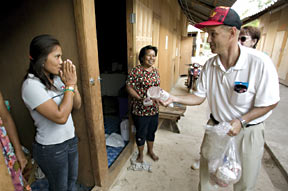
Missionary Mark Caldwell helps deliver fresh meat in one of many camps built for Thais who lost their homes to last year's tsunami.

American volunteers have put a compassionate Christian face on relief efforts.

“But the real goal is to get Thai Christians involved and out front,” Caldwell said. “That breaks down the barrier that to be a Thai, you are a Buddhist.”

Or a Muslim, or an animist, like many of the fishermen who live along the Thai coast.

To that end, Caldwell looks for Thai Christians to aid and encourage, such as Sian Buaket, a pastor in the coastal city of Ranong. Sian had longed for years to reach out to the Mogen people–commonly known as “Sea Gypsies”–living on nearby islands dotting the coastline. But he lacked the opportunity and the resources.

The tsunami provided both.

Volunteers from the Bangkla Baptist Clinic teach Mogen ("Sea Gypsy") children about Jesus while medical workers hold an open-air clinic nearby.

Some of Sian's church youth went out fishing not long after the tsunami. They came upon a Mogen fishing village on an island not far from Ranong and learned of the villagers' plight.

The Mogen people–who are citizens of neither Thailand nor neighboring Myanmar (Burma)–are accustomed to poverty, discrimination and exploitation by criminal “godfathers” in the fishing industry.

When the tsunami came, the Mogen villagers ran to higher ground. They returned to find their long fishing boats on the shore–battered to kindling wood. Local authorities provided a few bags of rice. When villagers appealed for more aid, they were denied. “You're not Thai citizens,” they were told. Without fishing boats or the money to buy new ones, they faced starvation. Some of the villagers went to coastal cities to look for work or beg.

Sian and his people began taking food to the village. Young people began visiting to tell the Mogen children about Jesus. Church members started an open-air school to teach Mogen adults to read. With Caldwell's help–and tsunami aid funds from Baptists in the United States–Sian has helped the villagers buy boats.

“We're better fishermen than the Thai,” a village leader proudly claimed. “We'll survive. We just needed our boats back.”

But they needed something more–Jesus Christ.

The Mogen villagers had long lived with no faith besides animism and a fear of evil spirits. When family members died, they were taken to another island for burial. Loved ones grieved without hope.

That's all changing.

Physician Larry Rodgers examines a child at a medical clinic in an island village off the coast of southern Thailand. It was the first time a doctor had set foot in the village.

“We were like an empty glass; now it is full,” a village leader said. “The tsunami was a tragedy, but for us it brought new hope. If it had never come, we wouldn't know about Jesus.”

On a recent visit, a team of missionaries and Thais from the Bangkla Baptist Clinic–joined by Tennessee Baptist volunteers–arrived in boats packed with medical supplies. It was the first time a doctor had entered the village. The team treated the sick, vaccinated children against diseases, installed a pump to give the village running water and helped Sian's church members share the gospel. Twenty-eight villagers became followers of Christ.

As the team left, tin roofs of village huts glinted like trash can lids in the sun. Sadly, the Mogen people have been cast aside like human refuse for so long. Not anymore.

“They want hope,” Caldwell said. “Who's going to share it with them?”


News of religion, faith, missions, Bible study and Christian ministry among Texas Baptist churches, in the BGCT, the Southern Baptist Convention ( SBC ) and around the world.


Weekend Fest rocks

Posted: 12/02/05

Weekend Fest rocks

About 600 teenagers and others joined in Weekend Fest, a Christian concert featuring Tree63 prior to the Baptist General Convention of Texas annual meeting in Austin. Participants gave more than $400 for mission work through Baptist Student Ministries around the state, and numerous young people made decisions for Christ. The concert also featured several prizes. Woodlawn Baptist Church and Teri Road Baptist Church in Austin each won $500 to help pay for youth mission trips. Melanie Jaramillo of Primera Iglesia Bautista in Austin won a laptop computer, and Belle Ramey, a youth worker at Crestview Baptist Church in Georgetown, won a paid trip to next year's BGCT annual meeting in Dallas.

News of religion, faith, missions, Bible study and Christian ministry among Texas Baptist churches, in the BGCT, the Southern Baptist Convention ( SBC ) and around the world.


Storylist for 11/21/05 issue

Storylist for week of 11/21/05

GO TO SECTIONS:
Around Texas       • Baptists      
Faith In Action

      • Departments      • Opinion       • Bible Study      


Accident changed focus of ETBU athlete Huckaby

Wayland worldwide recruiting effort nets students from Dubai

Tornadoes disrupt Tennessee Baptist meeting

Alabama Baptists urged to lead in racial harmony

Missionary couple helping to reach remote Lencas in Honduras

Kentucky Baptists approve new relationship with college

Tennessee university to elect own trustees


Articles from our 11/21/05 issue:


One family, one mission


BGCT Annual Meeting
Time to 'show up, pay up & speak up,' Bell insists

Resolution reaffirms biblical sexual values but not boycotts

Restructured BGCT designed to offer one-stop shop for Texas

Reyes urges Texas Baptists to share power, resources

Missions Foundation honors four for missions contributions

BWA leader brings more than fraternal greetings to BGCT

Opportunity knocks during CityReach

Prophetic voice absent but still heard at TBC event

Where Have All the Prophets Gone? by Phil Strickland

Hispanic Baptists celebrate family & mission

Work together to accomplish mission, Nguyen urges BGCT


Health Foundation names Elston president

Around the State

On the Move

Texas Tidbits

Previously Posted
BGCT officer elections reflect convention's diversity

BGCT approves sweeping change in governance structure

WMU board cancels Texas Leadership Conference

Texas WMU celebrates 125 years of missions service

Historic Texas Baptist church 'still alive and growing,' pastor reports

Ministers, layman honored at banquet

Varied evangelism methods can be effective, Shuffield says

Worship should unify, not divide, educator insists

Teens illustrate what they need spiritually

BGCT mission and heritage 'not for sale,' Wade insists

Young pastors learn from elders


At long last, Georgians vote to cast out Mercer

Florida signs for marriage

Louisiana veers from recent trends

North Carolina Baptists still may give to Fellowship

Baptist Briefs

Previously Posted
Rogers kept SBC's steering wheel turned to the right


Volunteer uses spiritual gifts in prison


Thanksgiving observances reflect political agendas

Court declines to hear 'In God We Trust' case

Gender testing raises ethical questions

Tiny ceramic shard yields gigantic archaeological find


Cartoon

Classified Ads

Texas Baptist Forum

Around the State

On the Move


EDITORIAL: Texas & the 21st-century Pentecost

DOWN HOME: Do you give thanks for music's aroma

2nd Opinion: Things I learned as a BGCT officer

TOGETHER: Texas Baptists have much work to do

Right or Wrong? Stem Cells (Again)

Texas Baptist Forum

Cyber Column by Jeanie Miley: God is at work


BaptistWay Bible Series for Nov. 20: Wasted potential is a danger all face

Family Bible Series for Nov. 20: Fear of the Lord is the beginning of wisdom

Explore the Bible Series for Nov. 20: When evil closes in, remember God's promises

BaptistWay Bible Series for Nov. 27: Everything is to be subjugated to God's will

Family Bible Series for Nov. 27: Submission to the will of God is an imperative

Explore the Bible Series for Nov. 27: Circumstances can't defeat God's purposes


See articles from previous issue 11/14/05 here.


New court appointee might affect upcoming abortion cases

Posted: 12/02/05

New court appointee might
affect upcoming abortion cases

By Robert Marus

ABP Washington Bureau

WASHINGTON (ABP)—As the Supreme Court took up its first major abortion case in five years Nov. 30, attention focused on the body’s shifting membership and what that might mean for abortion rights in the future.

During oral arguments in Ayotte v. Planned Parenthood of Northern New England, newly installed Chief Justice John Roberts appeared sympathetic to New Hampshire’s efforts to defend a 2003 state law that requires medical personnel to notify parents or guardians 48 hours before their minor daughters can undergo abortion procedures. Lower courts had declared the law unconstitutional.

But the real question over the case lies with someone who isn’t on the court yet—President Bush’s pick to replace retiring Justice Sandra Day O’Connor—and Justice Anthony Kennedy, who could cast the decisive vote in the case if O’Connor leaves before the case is decided.

Bush has chosen a federal appellate judge, Samuel Alito, to replace O’Connor, who generally has been supportive of abortion rights. Writings from Alito’s past as a government lawyer—including one publicized the same day as the arguments—strongly suggest he is not sympathetic to the idea that the Constitution protects a woman’s right to have an abortion.

Although the current case does not directly address that basic right, abortion-rights groups fear it could offer a new anti-abortion majority on the court the chance to chip away at precedents upholding the constitutionality of a woman’s right to choose to terminate her pregnancy.

In 2000, a closely divided Supreme Court said a restriction on a woman’s right to choose an abortion would have to contain an exception for abortions performed to protect a woman’s life or health. The court also has upheld the necessity of such exceptions in other cases following its landmark 1973 Roe v. Wade decision, which legalized abortion nationwide.

In the latest case, an abortion-rights group challenged the New Hampshire law because it does not contain an exception for the health of the minor.

The 1st U.S. Circuit Court of Appeals struck the entire statute down, citing the high court’s 2000 Stenberg v. Carhart decision, as well as other abortion opinions requiring health exceptions in laws restricting abortion rights.

But New Hampshire’s attorney general appealed the circuit court’s ruling, arguing not only that state law already contains sufficient safeguards to protect the health of abortion-seeking minors, but also that the lower courts should not have invalidated the entire law simply because of its lack of an explicit health exception.

Arguing her state’s case before the court, New Hampshire Attorney General Kelly Ayotte repeatedly called “rare” the circumstances under which a minor would need an abortion to protect her health. In such cases, she said, there are sufficient safeguards already in place to ensure that a minor can undergo the procedure.

For instance, the law contains a judicial-bypass feature that allows the girl and her physician to obtain permission for the abortion from a judge if her parents are not reachable or she fears retribution from them if they discovered she was pregnant.

“New Hampshire’s act can be applied to protect a woman’s health,” she told the justices.

But several justices appeared skeptical of that argument, including Kennedy, who wondered aloud how the law can be construed to protect a woman’s health when the narrow majority of state legislators who passed it in 2003 explicitly chose not to include such an exception.

“We need to know what the act says,” Kennedy told Ayotte.

Likewise, Justice Stephen Breyer subjected Ayotte to sharp questioning when she said other provisions of New Hampshire law designed to balance “competing harms” would protect physicians charged with performing emergency abortions on minors.

Breyer raised the hypothetical situation of a young woman in an emergency situation who needs an abortion to protect her health—but some may decide that the harm to the fetus outweighs any potential harm to the mother.

“There are people of good faith on both sides of this argument, so how do we know that that statute is going to do for this particular woman what (an explicit) health exception is going to do?” he asked.

Roberts appeared sympathetic to New Hampshire’s other argument, as echoed by Solicitor General Paul Clement. Clement argued for the law’s constitutionality on behalf of the Bush administration, saying there was no need for the lower federal courts to invalidate the entire statute because of the “one in a thousand” circumstance in which a minor must receive an abortion to protect her health before her parents can be notified and before a judge can grant permission in their stead.

But Jennifer Dalven, who argued the case on behalf of the law’s opponents, said physicians hesitating to consult judges or consider their own legal fates before performing abortions could have dire consequences.

“Delaying appropriate care for even a short period can be catastrophic and can put the teen at risk for liver damage,” sterility, blindness and a host of other significant health consequences, Dalven told the justices. “For some women, every moment is critical.”

Dalven noted that New Hampshire has no system in place for emergency access to judges, and the law also requires magistrates to weigh the evidence and make a reasoned decision before granting permission for the abortion.

“Once a minor arrives in the emergency room, it is too late for her to go to court,” she said.

The justices are likely to render a decision in the case by the time the court ends its 2005-2006 session next summer. If O’Connor has been replaced with Alito by then, the court may choose to re-hear arguments with its new member in place.

If Alito and Roberts vote to uphold the law along with Scalia and Justice Clarence Thomas, while the four justices considered most supportive of abortion rights oppose the law—as some expect—then Kennedy would hold the tie-breaking vote.


News of religion, faith, missions, Bible study and Christian ministry among Texas Baptist churches, in the BGCT, the Southern Baptist Convention ( SBC ) and around the world.


Cybercolumn by Brett Younger: The Great American Christmas Letter

Posted: 12/02/05

Print, cut along the dotted line, and place on your refrigerator.

– – – – – – – – – – – – – – – – – – – – – – – – – – – – – – – – – – – – – –

CYBER COLUMN:
The Great American Christmas Letter

By Brett Younger

Dear Friends, Family & Many Readers of the Baptist Standard Whom I’ve Never Met,

My family is not the kind that writes Christmas letters, but each year I read so many heart-warming epistles from wonderful families that I feel inspired. I have to begin by admitting that none of us are learning to dance, quilt or speak French. I’m sorry to say that we are not earning belts of any color in Tae Kwon Do. I’m embarrassed to confess that we have no new houses, cars, pets or children (and have no desire for any of these). Maybe we should have gone to Disneyworld, but we had a good year.

Graham and Caleb are growing up fast or slow—depending on which parent and which moment you ask. Carol and I enjoy making fun of how other parents brag on their children, but not as much as we enjoy doing so ourselves.

Brett Younger

Caleb, 12 years old, is a sixth grader at William James Middle School. He’s 4’11” and moving up fast. He likes seeing his name in the Baptist Standard. He loves basketball, which rules much of our lives, and has a nice spin move, though he could be better going to his left. Caleb’s Whiz Quiz team is undefeated and outscoring their opponents by 135 a game, but we know that it’s not about winning. He likes to pour tea at the Agape Meal—our church’s weekly meal with the homeless. Eleven pitchers is the record. He’s finally getting to sit in the front seat of the car. We hear he’s playing saxophone in the school band, but haven’t heard him practice.

Graham, 16 years old, is a junior at Paschal High School. He’s 6’0” and we think that’s it. He doesn’t always read the Baptist Standard but knows he should. He plays basketball and particularly seems to enjoy shooting. He knows more physics than the rest of us, though that’s setting the bar pretty low. Graham talks on his cell phone in the backyard a lot. He likes the arguments in his Sunday school class and enjoys working in our church’s clothing room—it’s the closest he comes to shopping. He’s finally getting to sit in the driver’s seat and generously passed down his barely used saxophone to his brother.

Carol is the oldest one in the family, but does not look it (she does have a delightful touch of silver in her hair). She’s still a just-about-perfect 5’5”. She’s given up on keeping her name out of sermons or Baptist Standard cybercolumns. Like the rest of the family, Carol goes to church a lot. She and I preached a tag-team sermon on Abraham and Sarah during a worship service. Everyone said that she did such a great job that I probably won’t ask her to do that again. Carol finally got to a Mary Chapin-Carpenter concert, but Mary didn’t sing This Shirt. We were 200 feet from the stage, so we chose not to yell. Carol lets Graham drive her car and brings joy wherever she goes.

I am 44 and 5’7”—just starting to lose altitude. After almost five years, I still feel privileged to pastor the good people at Broadway Baptist Church—and ignore the rest. If I lived in Fort Worth and wasn’t the pastor, I still would love being a member of Broadway. Most church members don’t know how rare that is. I’m glad that I drive a stick so my son doesn’t borrow my car. I got a book published that my mother said she liked. If I sell two more copies, I can take my family to Wendy’s with the royalties. I framed a letter I got from Bill Moyers, plan to rake the leaves after Christmas and promise to call my parents more.

We wish you and yours a stocking full of good wishes.


Brett Younger is pastor of Broadway Baptist Church in Fort Worth and the author of Who Moved My Pulpit? A Hilarious Look at Ministerial Life, available from Smyth & Helwys (800) 747-3016. You can e-mail him at byounger@broadwaybc.org.


News of religion, faith, missions, Bible study and Christian ministry among Texas Baptist churches, in the BGCT, the Southern Baptist Convention ( SBC ) and around the world.


Right or Wrong? Spare the rod?

Posted: 12/02/05

Right or Wrong?
Spare the rod?

My 5-year-old tends to act out, even in church. One lady, old enough to be my grandmother, told me, “Spare the rod and spoil the child.” What does that mean?

This question demonstrates at least two dynamics at work among us. Both of these move mightily among Baptists. One of these regards what is appropriate behavior in a worship setting. The other relates to parental responsibilities in society.

Consider the worship setting first. I grew up in an era when we became a generation of over-consumers accentuated by the slogans, "Have it your way" (Burger King) and "I love what you do for me" (Toyota). In essence, our over-emphasis upon consumerism created a market-niche concept within ministry. Individuals now shop for churches and choose one based upon that which could most meet personal needs, including our ability to feel good all the time in the setting. We need to remember, though, the church is where we meet and worship the Lord. Yet this worship context is not only filled with joy and gladness. There also can be pain and consternation. Here is where the two dynamics raised by the question interface.

There can certainly be times of discomfort in church. This is true of parents with over-active children who are "sure to do something" during worship. The woman who admonished you has raised the "spare the rod and spoil the child" line to make the situation more comfortable for herself.

A popular way to interpret Proverbs 13:22 (where the statement came from) is spanking is the tried-and-true way to direct a child toward more appropriate behavior. The statement should be understood as a metaphor for a parent implementing care, nurture, discipline and management on behalf of the child until the child can maintain her or his own self-control.

Her linear view of this situation sounds correct, but in essence it is only a symptomatic cure. She thinks spanking the child for his behavior will "solve" the problem. While it may very well prevent him from acting out, it will by no means help him understand the value of worship.

This dilemma can be addressed in two ways: The mother can take sole responsibility for her child and chastise him about his behavior–probably becoming so exasperated that she stops attending. Or the church family can walk with this family through this phase of development. I believe the latter to be most effective. The church can do something. The act of disciplining is truly an act of discipleship, in essence, to bring one under the influence of another for the purpose of aligning with a goal. Athletes discipline their bodies and minds for the task of competition, not merely to endure pain. There is no sense of achievement apart from discipline. Thus, every parent must realize that aligning our children with a standard of life is vital to their developmental and social success.

I believe the aged member's seasoned wisdom is a viable resource to this mother. She could reposition herself to sit with this mother and child, developing an interest in the child. This structural change is sure to yield behavioral consequences. Remember, it is easier to complain about a situation than get involved in it. Jesus stated it best: "Suffer the little children to come unto me and forbid them not." We are not the focus in worship–God is. Worship provides the opportunity to be influenced by the divine presence and repositions us from consumers to participants. Thus, we can honor the divine through becoming aware of the needs of others and realizing "one size" does not fit all!

Kelvin Kelly, pastor

Mount Zion Baptist Church

Abilene

Right or Wrong? is sponsored by the T.B. Maston Chair of Christian Ethics at Hardin-Simmons University's Logsdon School of Theology. Send your questions about how to apply your faith to btillman@hsutx.edu.

News of religion, faith, missions, Bible study and Christian ministry among Texas Baptist churches, in the BGCT, the Southern Baptist Convention ( SBC ) and around the world.


BaptistWay Bible Series for Dec. 11: Continually make yourself available to God

Posted: 11/29/05

BaptistWay Bible Series for Dec. 11

Continually make yourself available to God

• Luke 9:51-62

By Alexia Riggs

Logsdon Seminary, Abilene

People love a good story. In today’s society, we especially love stories about journeys on the open road. Some stories start with “boldly going where no one has gone before.” Everyone can tell you about their first experience behind the wheel.

Luke 9:51-56 is no different. Jesus is beginning a long journey that will lead him to Jerusalem, where we find him in chapter 19. Jesus began by setting out toward a Samaritan village but found he was not welcome—for no reason other than he was heading to Jerusalem. Jesus started a journey only to find right at the beginning of it he was thwarted.

But before Jesus could respond, James and John were furious. They wanted to call on God to avenge the insult. This is not a great start to a long journey. Does an insult create a need for injury? James and John seem to have thought so.

While those two may have been ready to spar with the locals, Jesus rebuked them and led them to another village, where they were accepted. The example illustrates that Jesus did not come to incite violence. Rather, he came to break the cycle of violence by forgiving and dying.

These verses serve to remind us of two things. First, Jesus desired peace. Second, we should not reject God by allowing him to pass us by. When we hesitate or pass up on a chance to know God, it is no different than rejecting him.

“He who hesitates is lost;” an old proverb with meaning that still resonates today. In restaurants, stores and even in church, we make decisions with hesitation and often change our minds. We find ourselves rejecting things simply out of convenience or because we are not sure if it is what we want. It is too easy to go back on our words and simply put something back we decide we no longer want. The Samaritan village missed out on a chance to be ministered to by Christ simply because he was heading to Jerusalem.

In Luke 9:57-62, we see three other cases of hesitation. While each person was willing to follow Jesus, each had an excuse to not follow right away. The first person was willing to go, but Christ reminded him there were no creature comforts ahead. The second needed to bury his father. The third felt the need to say good-bye to family.

It is too easy to say, “I will follow Jesus, but before I commit my life to that completely, there is just one more thing I still need to do.”

The reasons given by the second and third individuals make sense to most of us. We can understand, for example, before going on a mission trip, wanting to stay for a funeral or wanting to say goodbye to everyone we know. These do not seem to be bad or unreasonable requests.

However, Jesus is making a point that his ministry should precede all desires we may have. Comfort, taking care of one’s responsibilities and seeing to the needs of our families do not take precedence over his ministry. Being a disciple of Christ and following Christ exclusively may require that type of sacrifice. We must be willing to forgo other obligations when God calls us to follow him. The matter is not one of abandoning those relationships and responsibilities. Rather, it is one of submitting them to Jesus, our Lord.

When I was called into ministry, I was in the middle of a master’s degree plan and had no desire to leave the program. I did not want to sacrifice everything I had worked for. Ministry could wait until I had finished my obligation at the university. Within a matter of days, my supposed obligation to the school ended abruptly. I found myself in seminary and studying for the ministry. Moving on from that place in my life, I thought, would be too big a sacrifice. Actually, it turned out to be the best thing I could ever do for God. When I refused to sacrifice to follow Jesus, it was because I was following myself and my own needs first.

Acts of following Jesus do not have to be huge. We may find ourselves striking up a conversation with someone in line at the grocery store or an act of ministry to someone at a homeless shelter. Churches, prisons, schools and even (dare we say it) next-door neighbors all could benefit from sharing Christ.

The work of God isn’t always going on a mission trip or a ministry project. Sometimes, the sacrifice God would have us make is a few hours of our day to meet the needs of those around us, including our families. My prayer is that we will follow Jesus (not our own desires) and not hesitate when the next chance to sacrifice comes our way.


Discussion questions

• When was the last time you allowed someone to minister to you?

• Can you recall a time when you could have shared the gospel with someone? If faced with the same situation again, would you change what you chose to do?


News of religion, faith, missions, Bible study and Christian ministry among Texas Baptist churches, in the BGCT, the Southern Baptist Convention ( SBC ) and around the world.


Explore the Bible Series for Dec. 4: People still need to hear the good news

Posted: 11/29/05

Explore the Bible Series for Dec. 11

People still need to hear the good news

• Romans 10:1-4, 8-18, 21

By Trey Turner

Canyon Creek Baptist Church, Temple

Today’s church floats among the masses of other people who are equally media-logged. People reached their saturation point at some earlier time. There is simply too much information from too many sources to comfortably keep up.

So each person chooses his or her sources and then picks and chooses information to explore. From some of these sources people receive good news. I might find out: Grandma came back from her doctor with a good report, our soldier came home, this year we are paying less taxes, it’s taco night, potty-training worked—no more diapers, just saved $300 on car insurance by switching carriers.

My definition of good news might include first hearing how a possibly iffy situation turns good. Add to the previous list of good news what the Apostle Paul says in Romans 1:17: “For in the gospel a righteousness from God is revealed, a righteousness that is by faith from first to last.”

It seems that old news is no news, but there are some who have not heard the really good news—they have heard only about church, possibly about helpful religious practices, but not the news Paul is telling. Some people still carry the weight of the world, and they need something better than the troubles they are carrying.

Christians have that good news. They can bring lost people relief by letting them have the opportunity to respond positively to Christ. So, the church must be reminded of what the Baptist General Convention of Texas’ newly elected president told messengers at the recent annual meeting: “Let’s make a great commotion about the great commission.”


We cannot save ourselves (Romans 10:1-4)

Verses 9:30-33 give insight into why the gentiles can be saved by faith in the grace God has extended. It has nothing to do with who is morally superior, but it does have to do with righteousness. The gentiles put on the righteousness which is not their own—it is Christ’s righteousness. No other righteousness is acceptable to God. Obeying the law as much as humanly possible and yet rejecting God’s offer of salvation in Christ still leaves those people short.


We can be saved by faith (Romans 10:8-13)

As Paul talks about the works of righteousness that are rejected by God, he again tells the way to this righteousness, which is by faith. It is hearing, belief and a faith-response of confession. Salvation by faith in Jesus Christ is an offer that leaves no one out. “Everyone” who calls on this name will be saved.

This is the news people need so badly—news that makes them right with God. They morally twist in the blowing wind trying to work through relationships with others and with their God. Philosophies, religions and the like comfort and offer direction. There is no other way to God or God’s way than through the person of Jesus Christ. (Acts 4:12).


We can encourage others (Romans 10:14-18, 21)

Although some reject Christ, Christians do not stop sharing him. Paul does not write off the Jewish people, saying, “God is finished with them.” Instead, as a strategy, he goes to the synagogues to proclaim Christ and then to the gentiles. Writing them off would be ultimate judgment, and only God judges when they have heard the gospel for the last time.

That is what Jesus means when he says, “Do not judge, or you too will be judged” (Matthew 7:1). Jesus goes on to admonsih people to, deal with the plank in your own eye so you can help a brother or sister get the speck out of his or her eye. Judgment, as Jesus talks about it, writes off the other person.

Paul does not write off the Jewish people. Paul says the content of his preaching is a gospel first proclaimed to the Jews (Romans 1:16). Jewish people individually have had the freedom to respond to Christ; they did, and some still do. As a group, they have been closed to the gospel. Still, the Jewish people must hear, so they can receive God’s good news in Christ. All people need to hear the gospel, so they can respond.


Discussion questions

• What are some reasons Christians offer for not telling people about salvation in Jesus?

• Where are people supposed to hear God’s good news?

• Look at verse 21. Does the image in verse 21 describe your steadfast approach to someone who has needed Jesus Christ?

• Why does it seem Christians lose interest in sharing their faith in Christ? What seem to be the top three reasons they do not?


News of religion, faith, missions, Bible study and Christian ministry among Texas Baptist churches, in the BGCT, the Southern Baptist Convention ( SBC ) and around the world.


Cyber Column by Berry Simpson: Upgraded

Posted: 11/28/05

CYBER COLUMN:
Upgraded

By Berry Simpson

Well, I’m feeling upgraded nowadays. Maybe “updated” is a better word.

I’m driving a new pickup. It’s a 2005 that’s been on the road for a year, but it looks and feels brand new to me—instead of my 1994 SUV.

I’ve been looking at pickups for a long time now with longing in my heart, but I was hesitant to buy one because it seemed too self-indulgent since Cyndi drives an SUV that’s just as old as mine was, and with higher mileage. But Cyndi insisted, and I accepted, and now I’m feeling very modern. Friends might see me driving around town in my new pickup looking for something to haul.

Berry D. Simpson

And not only am I driving a new pickup, but I’m wearing a new pair of designer sunglasses that Cyndi gave to me after she ended up owning two pairs. Cyndi has worn nice sunglasses for years, but I’ve stuck with cheap discount-store copies—mainly because I wasn’t sure I could keep from losing them, and I didn’t know how to carry them around since they won’t fold flat and fit into my shirt pocket, but also because I have such poor vision I wasn’t sure my eyes deserved top-of-the-line sunglasses. But now that I’m older and, I hope, more responsible, I’ve entrusted myself with these very cool shades in hopes that I won’t lose them or break them. I only hope I can live up to them. Maybe wearing them while driving my new bight red pickup will help.

And not only do I have a new truck and new glasses, I’ve been wearing new pants lately that aren’t really so modern or expensive or anything like that but that are NOT made out of denim. They are NOT blue jeans. This was not an easy transition for me. I feel like I’m in a documentary titled “Mrs. Simpson’s boy is growing up.”

And there’s more: I’ve actually been going to a workout class at—a class with 20-plus people in it—rather than sneaking off on my own to work out all by myself. I’m working out in a group, with real-live people, on their schedule, following their rules. Who would’ve thought it?

Come to think of it, all my recent changes have been Cyndi’s idea.

She has a bigger influence on me than she knows.

Or maybe she knows exactly what she’s doing. Maybe this is all part of her master plan coming to fruition after only 25 years together. Maybe these are scheduled steps in her planned husband upgrade program, something she envisioned way back when she was a sweet college girl and saw me as someone she could help out. The only problem with that theory is that 25 years is a long time to plan for someone as spontaneous as Cyndi.

The fact is, significant change usually takes a long time. Not that having a new truck or wearing expensive sunglasses are significant changes, but they are representative of the incremental changes we make—small changes that add up over the course of our lives to make us into new people. As Christians, we hope that the new people we’re being changed into are more Christlike.

We live in an age of instant answers. We want the Lord to reveal God’s plan for us immediately in response to our prayers. We want to know not only the pathway of our lives, but the end result as well. But God’s changes usually come in small increments, and we don’t get to see them in advance. I once read in a devotional book: “God’s purpose for our lives unfolds gradually as a tree grows into fullness.”

It has occurred to me that if God sat me down and laid out his entire plan for all my life … well, I wouldn’t be ready for it. It would be too frightening. If you’d told me 10 years ago where I’d be spending my time and energy today, it would’ve scarred me away. I wouldn’t’ve been ready for it. In the same vein, I believe God has things in mind for my future that I’m not ready to know about yet. Maybe God is waiting to see if I grow up enough to handle them.

Well, before I leave the subject, I’d like to go on record as affirming that Cyndi’s influences on my life have all been good ones. Every single change that she’s brought to my traditional and predictable life has been for the better, and I am grateful for her interest in me. Soon, I’ll be a new man.


Berry Simpson, a Sunday school teacher at First Baptist Church in Midland, is a petroleum engineer, writer, runner and member of the city council in Midland. You can contact him through e-mail at berry@stonefoot.org.


News of religion, faith, missions, Bible study and Christian ministry among Texas Baptist churches, in the BGCT, the Southern Baptist Convention ( SBC ) and around the world.


Prophetic voice absent but still heard at TBC event

Posted: 11/18/05

Prophetic voice absent
but still heard at TBC event

By Craig Bird

AUSTIN–A silent prophet asked Texas Baptists, “Where have all the prophets gone?”

Phil Strickland, longtime director of the Texas Baptist Christian Life Commission was unable to speak at the annual breakfast of Texas Baptists Committed because of illness, but his thoughts dominated the gathering.

His pastor, George Mason of Wilshire Baptist Church in Dallas, spoke from the outline Strickland had prepared in advance.

Read the complete text of Strickland's remarks here.

A Tribute to Phil Strickland

Referencing Pete Seeger's song, Where Have All the Flowers Gone?, Strickland wrote that people can find plenty of flowers in front of many pulpits in Texas Baptist churches, “but not many prophets behind those pulpits.”

Pastors too often fail to address the issues of poverty, he emphasized.

Current legislation in the U.S. Congress that would cut $50 million a year from programs for children to help create a $70 million tax cut, “is not what Jesus meant when he said, 'Suffer the little children,'” Mason read.

But Christians who insist that caring for the poor is not the job of the government don't often line up outside their pastors' offices to demand the church take on the task, he observed.

“Isn't it time we embrace a theology of enough and start asking if we have any walls around what we will spend on ourselves?” Mason said. “It is criminal to take away money from government programs for the poor and do nothing to replace it.”

Frequently before he preaches, Strickland wrote that pastors take him aside to warn, “Now, Phil, this church is not in any condition to deal with anything controversial–remember that when you speak.”

Perhaps pastors, laymen, churches and denominations shrink from speaking prophetic words on behalf of the weak and powerless because they are ambitious or fear conflict, he suggested.

Even so, “All Christians are called to have an element of the prophet in us,” he said.

Pastor-search committees that say they are looking for “a pastor and a preacher” need to expand their criteria to “a pastor, a prophet and a preacher,” he wrote.

News of religion, faith, missions, Bible study and Christian ministry among Texas Baptist churches, in the BGCT, the Southern Baptist Convention ( SBC ) and around the world.


A Tribute to My Friend, Phil Strickland

Posted: 11/23/05

A Tribute to My Friend, Phil Strickland

By David Currie

Executive Director, Texas Baptists Committed

At the Texas Baptists Committed breakfast meeting in Austin, TBC Executive Director David Currie read the following tribute to Phil Strickland, longtime director of the Texas Baptist Christian Life Commission. Strickland had been scheduled to speak at the breakfast event but was unable due to illness. Currie presented a copy of this tribute to Strickland's mother:

You are a brother to me,

And a father to my sons.

You are my mentor and advisor,

And the person most responsible for my success.

You are an example of courage, compassion and integrity,

That all who know you will never forget.

You always put the needs of others and the cause of Christ,

Ahead of personal gain.

You have demonstrated True Christian values to the powers of Government, in word and deed for over forty years.

You have improved the lives of millions of children, Though most of the world is not even aware.

You always relate to the broken and hurting with grace,

And I know this from personal experience.

Most of all, those of us closest to you love you,

Because you love us when we are most unlovable,

And in doing so you saved our lives for use in God’s Kingdom.

We will never forget it. We will always be grateful. And we will always love you for it.

–November 15, 2005


News of religion, faith, missions, Bible study and Christian ministry among Texas Baptist churches, in the BGCT, the Southern Baptist Convention ( SBC ) and around the world.


BaptistWay Bible Series for Dec. 4: Discipleship means…

Posted: 11/21/05

BaptistWay Bible Series for Dec. 4

Discipleship means…

• Luke 9:18-2

By Alexia Riggs

Student, Logsdon Seminary, Abilene

My husband is the king of cutthroat bargaining, and recently he talked a saleswoman into taking 50 percent off of my new tennis shoes that were already on sale. After we saved nearly $40 I was so happy I rewarded my husband by buying him a computer game he had been hinting at. As we got into the car I wondered if maybe, just maybe haggling with the saleslady at the shoe store had served my husband better than it served me?

Often times we are willing to sacrifice anything for a child, a spouse, or a new job. We would go to any lengths to serve the Master, but we think of ways to take care of those responsibilities and still do and have what we desire. It is easy to worship God as Lord and still be the CEO of our day-to-day affairs. However, our reasoning deludes us into thinking that we can have our cake and eat it, too.

In Luke 9:18 – 26, we can see Christ questioning the disciples about how far they would go for him. Jesus asked the disciples to identify who the crowds thought he was and whom the disciples’ thought he was. Without hesitation, Peter identified Christ as “The Messiah of God.” It seemed that, though this is the right answer, the disciples had missed the question completely.

Jesus commanded them to keep silent about His identity and role. Luke closes the passage by giving Christ’s description of a follower of Christ. This description includes daily sacrifice and giving of themselves in service to God. The disciples, then and now, would have to make a decision. How far would they go to follow Jesus?

In Biblical days, the word “messiah” was not a term reserved exclusively for Jesus. “Messiahs” of some form had been popping up ever since the fall of Judea and the Jews’ Babylonian exile. Messiahs could be people struggling to rebuild the cities of Israel or would be warlords or even guerilla style bandits, not unlike Barabbas. When Peter shouted out, “The Messiah of God” we can see Jesus sternly rebuking that rallying cry. It could have destroyed everything that Christ was doing!

Suddenly, the man that the disciples were so sure would rebuild the Kingdom of Israel threw all of the disciples’ beliefs, values, and desires in the dustbin. Following God would lead to public ridicule, political destruction, and certain death. Peter and his fellow disciples had to be silenced, Jesus’ work was too important, and the timing was too delicate to allow for this kind of mistake.

Jesus finished by telling the disciples what following him would cost. It is not a command nor a request. It is just a simple fact that following God costs our very lives and requires us to daily take up our cross. Being ashamed of Jesus’ words and actions would mean that he would be ashamed of them in front of God.

But, it goes deeper still. God’s followers are not limited to the examples given in Luke 9:18-26, nor to the New Testament, not even to the Bible. We also can be followers of Christ, forsaking everything, taking up a cross, and being proud to be counted as a Christian by almost anything we do in our everyday lives. He is our King. We are His Kingdom. Jesus’ victory is complete, but the work of the Kingdom of God continues.

It becomes easy to just sit back and see what wonderful things God has done for us. We often think of Christ’s sacrifice of his life. How often do we think of what we must do for Him? It is easier to reflect on God’s actions to redeem us than it is for us to think of how we are to follow him. It is too easy to forget the cost of being a disciple of Jesus.

Often we find ourselves wanting to bargain with God just as my husband bargained with the saleswoman. However, can we take up our crosses daily and follow him only on Sundays and Wednesdays? Must we really follow God and give our lives completely for Him even on our days off? Christ challenges us to follow him in daily service. It is in the every day that we find our greatest chances to reach out to others with the good news.

God calls us today to be his disciples. We are asked to sacrifice and serve God with not just what we are willing to give, but with everything we are. “Is what we do in our lives a service to God or ourselves?” This becomes a measure for daily life. It is easy to say that Christ is Lord. More difficult is following him in service and putting those words into action. Becoming a disciple of Jesus really does mean following Jesus every day and in all we do.


Discussion questions

• To follow God, what are some things you are willing to sacrifice? What are some things that you do not want to sacrifice?

• What are some things you can do during the week to serve God that you do not usually do?

News of religion, faith, missions, Bible study and Christian ministry among Texas Baptist churches, in the BGCT, the Southern Baptist Convention ( SBC ) and around the world.