Baylor nursing students share gift of life in Uganda_51605
Posted: 5/13/05
| Children wait for their check-up at the children's home in Rakai. (Photos courtesy of Baylor University) |
Baylor nursing students share gift of life in Uganda
By Judy Long
Baylor University
KIWOKO, Uganda–Liz Chang offered a priceless gift while serving at a Uganda hospital as a missions volunteer.
She and her fellow registered nurses were on a lunch break at the small African hospital where Baylor University's Louise Herrington School of Nursing missions team worked. A nurse on the hospital staff stepped into the break room with an urgent request for type O-positive blood. A severely anemic 5-day-old girl, born at home, had just been brought to the hospital.
Without hesitation, Chang volunteered. Once she started donating her blood, the nurse who was supervising the procedure made an unusual request. She asked if Chang would mind if they took a little extra.
“Take as much as you need,” she replied.
 |
| Liz Chang watches a 5-day-old girl who received blood. MIDDLE: Children wait for their check-up at the children's home in Rakai. |
Her donated blood not only saved the infant girl's life but also provided for two other newborns.
Baylor's team of four students, all about to graduate from the family nurse practitioner master's degree program, and their faculty sponsor, Lori Spies, served three weeks in Uganda.
They worked in the Kiwoko hospital and set up clinics, dispensed medicines and tested children for HIV at two orphanages–one in Uganda's capital, Kampala, and one at a rural location in Rakai.
“The hospital's equipment was simple, but sterile,” Spies reported of the laboratory where Chang donated blood. “With the exception of asking to take extra, the experience was like giving blood in a professional lab here. It was a great learning experience.”
Since most of the students work at the Baylor Medical Center in Dallas, they were able to witness an interesting contrast between the two hospitals.
“The physician there practically gave us a one-on-one tutorial in tropical medicine,” Spies said. “But it's a different practice there than in the U.S. It was enlightening,” she said, adding that diseases such as malaria, dengue fever and intestinal worms are seldom seen in the States.
The students study tropical medicine throughout the Baylor program, and the family nurse practitioner degree is designed to prepare them equally to use their nursing skills in developing countries or in the United States.
The student volunteers saw a significant number of malnutrition cases at the hospital.
“They were the worst cases I've ever seen, but the hospital staff handled them well,” Spies reported. “The malnourished children stayed at the hospital a long time, and the nurses taught parents about nutrition and tried to determine what was happening in the home to cause the problem. They engaged in what we consider a high standard of nursing in this country.”
The hospital treated one stage of malnutrition with intravenous rehydration, while a more advanced stage required use of a nasal tube.
“They use the tube if the child is too weak to hold a cup. Sometimes, parents wanted to refuse to allow their child to be treated with the tube because they viewed it as an indication the child would die. But when they heard how quickly a child perked up after insertion of the tube, they consented,” she said.
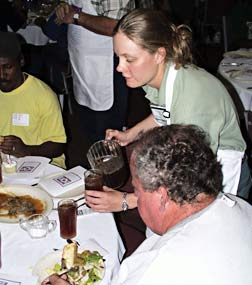
In the rural children's home in Rakai, the team stayed in the orphanage and ate plenty of traditional African food.
“We ate a staple called atokay–a starchy vegetable that they mash and serve with a sauce,” Spies recalled. “It was often served with rice and peanut sauce, or they had meat with broth to pour over the rice. Sometimes they cooked cabbage or greens, and they also had a lot of beans. Part of the fun was knowing we were eating what the kids were eating. It was much more of a natural diet than what many American kids eat.”
At the rural home, the team saw skin disorders, but not as much scabies as they expected. Scabies is a common skin condition caused by a mite. They treated all the children for intestinal worms because those are so common in Africa.
“We also saw ulcers, respiratory infections and more malaria than we saw in the city,” Spies recalled.
Rose Nanyonga, a Ugandan student at Baylor's nursing school, said she was shocked by the reality of the lives of the orphans, even though she grew up in Uganda.
 |
| Rose Nanyonga (l) and Lori Spies care for a special-needs child in the children's home in Kampala. |
“I was not emotionally prepared for it. I grew up there, but I have been so far away for a long time. I was glad that we could make a difference for them. It doesn't take much to make an incredible difference,” she said.
“This trip focused on taking health care to more than 500 children, which was a wonderful gift. A lot of these children had never had a physical examination or seen a health care provider.”
Nanyonga's unusual journey to faith began with childhood training to become a witch doctor, a prestigious career usually reserved for men. Her decision to embrace Christianity at the age of 15 angered her family, and she was forced to flee for her life. Her journey eventually led her to Dallas, where she is completing her master's degree at Baylor and will graduate as a family nurse practitioner this month. After graduation, she plans to return to Uganda to make changes in public health care policy.
Nanyonga has tentatively accepted a job in Uganda as director of nursing at International Hospital in Kampala, founded by the missionary couple who adopted her when she left her tribal home.
“It will take me out of the arena of family nurse practitioning, but it puts me in an area where I am critically needed. I'll be able to use my leadership, teaching and nursing skills,” she said.
“It will be wonderful to work with other Ugandans who care about the practice of medicine. You can do so much with people from other countries, but it would be better for the country if Ugandans–people who speak the language–could manage the health care and coordinate input from other countries.”
Nanyonga hopes to establish a nursing education center where schools from other countries could send people as students and teachers. “But we'll see how it goes,” she added.
Spies believes a yearly trip to Uganda would be the perfect capstone medical mission trip for the family nurse practitioner program.
“It's my plan to return each year with a team of Baylor students to help these children who live in such great need,” she said.
Nanyonga wants to tell others about the children's plight. “I and the others who went on this trip will carry those children and their story in our hearts. We want the children to know they are not forgotten, for there are millions more children like them in Uganda and the world,” she said.
Nanyonga saw her life reflected in the children they served.
“Any one of them could have been me,” she said. “Someone obviously invested in my life for me to have come from where I did and be where I am. I would like to see people to invest in those children's lives. If my life has been touched, I believe it can happen for every one of them.”
 The University of Mary Hardin-Baylor Conservatory of Music is taking enrollment for three Kindermusik Camps. The three camps will take place the week of June 20-24. “Creatures in the Ocean” is for ages 18 months to 3 years old. Students and parents will be introduced to waterfront friends such as the seagull, crab, dolphin, octopus and whale. They will sing to Calypso music and make music with shakers. The class meets from 10 a.m. to 11 a.m. each day, with the caregiver staying the entire time. Cost is $85. “Confetti Days” is for children ages 3 to 5 and costs $115. It will meet from 10 a.m. to 11:30 a.m. Music will be woven throughout with movement, art, language, drama, play and storytelling. Children ages 5 to 7 are offered “Around the World,” a camp meeting from 1 p.m. to 3 p.m. Children will take an imaginary trip to countries around the world. Cost is $140. Call the conservatory office at (254) 295-4868 for more information.
  Greg Solomon, Christy Stanlake and Phil Wilson have been selected as Outstanding Young Alumni at Hardin-Simmons University. Solomon, a 1983 HSU graduate, is president and CEO of the Burleson Area Chamber of Commerce. Stanlake, a 1994 graduate, is a member of the faculty at the United States Naval Academy, teaching a range of theater and English courses. Wilson, a 1990 graduate, is Gov. Rick Perry's deputy chief of staff.