Around the State

Posted: 12/02/05

Iglesia Nueva Vida in Zapata held a groundbreaking service for a 6,000-square-foot building. It will cost approximately $300,000. A barbecue followed the groundbreaking ceremony. Participating in the groundbreaking were Robert Marshall, Joe Ramirez, Jane Cornelius, Pastor Mack Caffey of First Church in Zapata, Director of Missions Mike O'Neill of Coastal Bend Association and Pastor Raul Hernandez of Iglesia Nueva Vida.

Around the State

bluebull Four students from the East Texas Baptist University School of Fine Arts competed in a regional conference of the National Association of Teachers of Singing Student Auditions. Jennifer Howell and Taylor Johnson both advanced to the semifinal round with Johnson finishing fifth. Cortney Brinker and Rachel Farley also competed.

bluebull Baylor University won the top team award for the ninth consecutive year at the Model Organization of American States. The Baylor team also took six of the 14 awards presented. Students from 22 universities assumed the roles of diplomatic representatives to the Organization of American States. Repre-senting various countries, participants researched and debated various issues of concern to the hemisphere, such as decentralization, terrorism, privacy issues, renewable fuels and telecommunications standardization. Baylor's team represented Venezuela and Uruguay.

bluebull The Collegian, Houston Baptist University's student newspaper, was a finalist in the Associated Collegiate Press' 2005 Newspaper Pacemaker competition. Final-ists were selected based on excellence in coverage and content; quality of writing and reporting; leadership on the opinion page; evidence of in-depth reporting; layout/de-sign; and photography, art and graphics. Alice Rowlands, associate professor in mass media, is the publication's adviser.

First Church in Denton ran its annual Judgement House for 11 nights. A total of 3,245 people attended. More than 600 people made spiritual decisions during the performances, including 234 professions of faith in Jesus Christ. Pictured are members of the cast portraying Jesus and angels. Jeff Williams is pastor.

bluebull Penny Poole has been named director of institutional effectiveness at Wayland Bapt-ist University. She and her family are members of Park-view Church in Plainview.

bluebull Cassie Hoyer, a senior Douglas MacArthur Academy of Freedom major at Howard Payne University, was earned the top speaker's award at the Texas Undergraduate Moot Court competition held at Texas Tech University. Forty-four teams from across the state participated in the event. After defeating the other 87 participants, Hoyer was presented a trophy and cash.

bluebull Hardin-Simmons Univer-sity's Acton Master's of Business Adminstration in Entrepreneurship program has been rated among the best in the nation in the 2006 edition of the The Princeton Review. The program was ranked first as “most competitive” in the country and third in the “best professors” category by the New York education services company. About 70 percent of the students who graduated from the program in 2004 had a job within three months with an average salary between $70,000 and $80,000.

bluebull Two Dallas Baptist University athletes, Katie Noss and Amie Morton, have earned All-American honors through their efforts at the National Christian Collegiate Athletic Association's National Cross Country Champion-ships held at Cedarville University in Ohio. Noss placed fifth in the race while Morton placed ninth, both running personal bests.

bluebull The University of Mary Hardin-Baylor chemistry de-partment has been awarded a $75,000 grant from the Robert A. Welch Foundation. The grant is to support chemical research by members of the university's faculty and to provide students with educational opportunities through re-search. It will be paid out in equal installments over a three-year period.

bluebull Four couples with Texas ties have been appointed as missionaries by the Internation-al Mission Board of the Southern Bap-tist Conven-tion. Bill and Dana Blanken-ship will work in central, eastern and South-ern Africa providing field support. Both Texas natives, they consider Cottonwood Church in Dub-lin as their church home. They have three children–Em-ily, Blanton and Ethan. Don and Jennifer Hipp will serve in Middle America and the Carib-bean, where he will work as a strategy coordinator. Longtime employees of Cal Farley's Boys Ranch in Borger, Trinity Church in Am-arillo is their church home. They have four children–Hannah, Mimosa, Isabel and Liberty. Lew and Brandi Johnson will serve in central, eastern and southern Africa as evangelists and church planters. They consider Travis Avenue Church in Fort Worth as their church home. Loren and Susan Robinson will serve as field support in Western Europe. He was minister of education at Robinwood Church in Seagoville from 1986 until 1995. The have one adult son, Michael.

Anniversaries

bluebull Bob Fagan, 25th, as pastor of Memorial Church in Lubbock, Nov. 23.
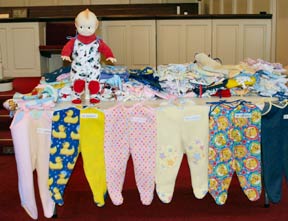
Inspired by the staff of the Baylor University School of Social Work, women at Bedford Baptist Church in Bedford, Va., sewed 121 one-piece rompers for orphans in Romania. The church learned about their need for warm clothing from a Roanoke, Va., pediatric oncologist who is involved in volunteer missions there. Polly Manson, a Bedford Church member and 1954 graduate of the now-disbanded Carver School of Social Work at Southern Baptist Theological Seminary, spearheaded the project after reading a newsletter article about how the Baylor social work staff sewed flannel, one-piece outfits for babies and toddlers in a Ukrainian orphanage rather than exchange gifts with each other last Christmas–a mission project also reported last year in the Baptist Standard.

bluebull Richard White, fifth, as pastor of Fellowship Church in Lubbock, Dec. 3.

bluebull Wil Tanner, 10th, as pastor of Pilgrim Church in Lubbock, Dec. 24.

Retiring

bluebull Bob Cavin, from the Baptist General Convention of Texas staff. He served eight years as growth and new work consultant in the Bible study/discipleship division and an equal amount of time as director of the Texas Baptist Leadership Center. He is executive pastor of Mimosa Lane Church in Mesquite, where his wife, Karen, has served as minister of childhood education the last 12 years.

bluebull Lynn Ashcraft, as pastor of North Orange Church in Orange, Dec. 18. A reception will be held from 7 p.m. to 9 p.m. He has served his present church 32 years and has been in the ministry 46 years. Other pastorates include Watt Church in Watt, Searsville Church in Valley Mills, First Church in Lott and First Church in Troup.

Retiring

bluebull Fred Haddock Jr., 34, Oct. 30 in San Marcos. He was minister of worship at Calvary Church in San Marcos. He is survived by his wife, Rosanna; mother, Loyjean Matlock; brother, Tom; and sister, Angie McCoy.

bluebull Jack Selcraig, 91, Nov. 9 in Houston. He served as an Air Force chaplain and was pastor of several Texas churches before retiring as pastor of Freeway Manor Church in Houston. He was a member of South Main Church in Houston. He is survived by his wife, Vietta; daughters, Marilyn Butler and Elaine Furlow; sons, Jim and David; seven grandchildren; and one great-grandson.

bluebull Billy Copeland, 52, Nov. 9 north of Brownwood, as the result of a traffic accident. The former Aransas County Sheriff's Office deputy and Bangs police chief died after his vehicle was rear-ended. His wife, Cathy, also was hospitalized due to the accident. His daughter, Megan, was in the vehicle but not seriously injured. Copeland served as youth minister at Crossroads Church in Lake Brownwood at the time of his death. In addition to his wife and daughter, he is survived by his sons, John and Matthew; stepson, Shannon Nelson; stepdaughter, Shawna Gonzales; and sisters, Libby Read and Donna Magnon.

bluebull Craig Lawless, 48, Nov. 21 in Dallas. His death was the result of a heart attack, although he did suffer from multiple sclerosis. He was associate pastor/administrator of Lakeside Church in Dallas. He is survived by his wife, Lisa; sons, Chris and Michael; and one granddaughter.

Events

bluebull Prestonwood Church in Plano will present its three-act Dallas Christmas Festival Dec. 7-11. Performances will be at 7 p.m., with additional matinee performances scheduled for 2 p.m. Saturday and Sunday. The festival features the 500-plus member Prestonwood choir and orchestra, and a cast and crew of more than 1,000. Act I of the festival is a traditional American Christmas revue; Act II presents the choir singing holiday favorites; Act III tells the story of the birth, life and death of Christ through the eyes of Peter. Christ's life is portrayed through scenes of the miracles he performed, the Last Supper, the crucifixion, the resurrection and ascension. For more information or tickets, call (972) 820-5040 or go online to www.dallaschrist masfestival.org. Jack Graham is pastor.

bluebull The sixth annual Waco Christmas Celebration will be presented at 1 p.m., 4 p.m. and 7:30 p.m. Dec. 10 and at 4 p.m. and 7:30 p.m. Dec. 11 at Columbus Avenue Church in Waco. The production will feature a cast of more than 200 children, youth, college students and adults. No admission will be charged.

bluebull The choir of Gambrell Street Church in Fort Worth will present two choral works Dec. 11 at 6 p.m.–Christmas Oratorio by Camille Saint-Saens and A Ceremony of Carols by Benjamin Britten. No admission will be charged. For more information, call (817) 926-1785. Clyde Glazener is pastor.

bluebull First Church in Mabank will present “City of Light,” a music and drama presentation, Dec. 17 and 18 at 6 p.m. No admission will be charged. For more information, call (903) 887-3921. James Harms is pastor.

Ordained

bluebull Dean Gartman and Kelly Mann as deacons at Calvary Hills Church in San Antonio.

News of religion, faith, missions, Bible study and Christian ministry among Texas Baptist churches, in the BGCT, the Southern Baptist Convention ( SBC ) and around the world.


Baptist Briefs

Posted: 12/02/05

Baptist Briefs

Carson-Newman College names Elliott distinguished alum. Ralph Elliott, the Old Testament scholar whose book, The Message of Genesis, sparked heated controversy in the Southern Baptist Convention, will be honored by Carson-Newman College in April as a distinguished alumnus. His 1961 book, published by the Broadman Press imprint of the Southern Baptist Sunday School Board, viewed the first 11 chapters of Genesis as symbolic rather than historic. Elliott lost his seminary post when he refused trustee demands that he not republish the work.

Henry plans to hand off Orlando pastorate. Jim Henry–a two-term Southern Baptist Convention president–will step down as co-pastor of First Baptist Church in Orlando March 31. Henry, 67, who has been pastor of the Orlando congregation since 1977, announced his plans in a letter sent to church members. In May, the church called David Uth as co-pastor, grooming him to follow Henry.

LifeWay COO announces retirement. Ted Warren, executive vice president and chief operating officer of LifeWay Christian Resources, will retire Feb. 1 after 12 years with the Southern Baptist publishing house. Warren, 58, joined LifeWay in 1994 as chief financial officer and vice president for the business services group, becoming executive vice president and COO in 1995. Before going to LifeWay, he worked 22 years in the oil and gas industry, serving in the early 1990s as president of Grace Drilling Co. and, prior to that, as executive vice president of Texas Oil & Gas Production Company.

Dakota Baptists cut budget. Messengers to the Dakota Baptist Convention's annual meeting approved a $1.2 million budget for next year–a 12 percent decrease. Bill Savery, pastor of First Baptist Church in Custer City, S.D., was elected president. Other officers are Vice President James Riekeman, pastor of First Baptist Church in Williston, N.D., and Recording Secretary Kathy Harbert of First Baptist Church in New Underwood, S.D. Messengers from 41 of the 88 congregations in the convention attended the meeting.

Montana Baptists honor disaster relief workers. More than 60 disaster relief volunteers who made a 4,000-mile trek to the Gulf Coast to help hurricane victims were recognized at the Montana Southern Baptist Convention's annual meeting in Great Falls, Mont. Messengers also approved a $1.5 million budget–the largest in the state convention's history–and finalized a partnership with the Tennessee Baptist Convention. Montana Baptists elected by acclamation President Darwin Scofield, pastor of Libby Baptist Church in Libby, and Vice President Greg Peterson, pastor of Little Rockies Community Church in Zortman.

Moraga leads CBF Hispanic initiative. The Cooperative Baptist Fellowship has tapped New Mexico pastor and former Texas Baptist church planter Bernie Moraga to serve as field consultant for its national Hispanic initiative. Moraga is pastor of First Spanish Fruit Avenue Baptist Church in Albuquerque, N.M., and has served as volunteer coordinator for the CBF Hispanic network. CBF has set a goal of helping to start 400 Hispanic churches by 2011.

West Virginia Baptist pastors, laymen share top posts. Messengers to the West Virginia Convention of Southern Baptists' 35th annual meeting approved a $2.6 million budget for 2006–roughly equal to the current year's budget–and elected two pastors and two laymen as officers. West Virginia Baptists elected President C.J. Adkins, pastor of Westmoreland Baptist Church in Huntington; First Vice President Tim Kearney, a layman from Good Shepherd Baptist Church in Scott Depot; Second Vice President Seth Polk, pastor of Cross Lanes Baptist Church in Cross Lanes; and Recording Secretary Fred Morgan, a layman from Fairlawn Baptist Church in Parkersburg. Messengers approved resolutions supporting the display of the Ten Commandments on both public and private property and condemning homosexual behavior as "perversion."

News of religion, faith, missions, Bible study and Christian ministry among Texas Baptist churches, in the BGCT, the Southern Baptist Convention ( SBC ) and around the world.


Russia trip marks 10 years of Buckner’s international ministry

Posted: 12/02/05

Robin Jones (left, holding child), national promotions and marketing director for Moody Broadcasting Network, and Buckner volunteer Jana Houston of Tennessee place shoes on the feet of a visually impaired child at a Russian orphanage. (Photo by Felicia Fuller)

Russia trip marks 10 years
of Buckner's international ministry

By Felicia Fuller

Buckner Benevolences

ST. PETERSBURG, Russia–As the noonday sun beamed across the music room at a Russian orphanage, a silver-haired woman took her seat before an arc of chattering children. Unmoved by the commotion, she smiled knowingly, folded her hands in her lap and waited. At her side, translator Vladimir hushed the youngsters with a wave of his finger.

“My name is Sandy Woody,” she began. “I am a babushka (Russian for 'grandmother'), and I've come to tell you that God loves you. He has a special plan for each one of you. There's nothing you have to do to be good enough for God. He loves you just the way you are.”

Volunteer Lisa Williams of Louisiana, an internationally adoptive mother, shares a moment with a toddler with Down syndrome. (Photo by Felicia Fuller)

The concept of Christ's unconditional love was lost on some but not, among others, 9-year-old Olga. In 2004, she was one of 14 Russian orphans who visited Texas for two weeks through Buckner Baptist Benevolences' Angels from Abroad program. During her stay, Dallas doctors donated their services to correct her strabismus–an optic muscle malady that had plagued her since birth, causing her eyes to appear crossed. Today, her brown eyes are balanced and her vision sharp as she throws playful glances at her peers.

Olga represents the countless children who have been touched by mission workers serving alongside Buckner Orphan Care Interna-tional in Russia during the past 10 years. In fact, Buckner's work abroad began at an orphanage in her native St. Petersburg.

Recently, 45 Buckner volunteers returned to that orphanage where the Texas Baptist agency's international ministry began.

“In my life, my eyes were changed, and I was changed,” Olga said. “Now, I may see far away and blink. Before, I couldn't do that. I like math, and I've started to study much, much better than before in my school. I like to sing songs and dance. My eyes help me to do that. I thank Buckner very much.”

Transforming the lives of children like Olga is the foundation upon which Buckner was built, said Mike Douris, vice president and general manager of Buckner Orphan Care International. Orphans are among the most vulnerable of all God's people, he continued, and both Old Testament prophets and New Testament apostles insisted they be properly cared for. “That is what BOCI is called to do.”

As a ministry of the 126-year-old Buckner Baptist Benevolences, Buckner Orphan Care International partners with churches to serve orphans worldwide through humanitarian aid, mission trips, orphanage improvements and social services.

Buckner made its foray into the international arena in 1995, when government officials in Russia sought Buckner's counsel on ways to improve its post-communist orphanage, foster- and-kinship care systems.

Buckner's first international adoption soon followed. By the spring of 1996, Buckner was sending volunteers to work and serve in the orphanages.

Without a viable adoption or foster-care system, orphanages are the default destination for Russian children who, at a rate of 113,000 a year, are abandoned by their parents due to alcoholism, poverty and other problems.

“We found the conditions at these institutions, in a word, deplorable,” said Amy Norton, director of Buckner's international programs. “We worked fervently on ways to improve living conditions for more than 700,000 children who call the orphanages home.”

And the results are apparent.

Today, Buckner Orphan Care International is entrenched in eight countries and sends humanitarian relief to another 30 nations. With legal reforms in Russia allowing for a program of de-institutionalization, Buckner provides training and support for foster families in Russia and, most recently, collaborated with government officials to write a book on methods of placement for homeless children.

In St. Petersburg alone, Buckner maintains a full-time staff of 20 Russian nationals who form a small corps of care and ministry support for orphanages in the region. They also serve as translators to mission groups, including more than 700 volunteers who participated in 42 Buckner international mission trips last year.

As Buckner celebrated a decade of international ministry in St. Petersburg, 45 Buckner volunteers gathered to conduct Vacation Bible School and distribute new shoes, warm winter coats and other aid in 12 area institutions.

Among those institutions was a hospital that sits on five acres in the heart of St. Petersburg. Two years ago, in a Buckner video documentary titled “A Place of Hope,” administrator Anatoly Zheleznov said: “We're short of many things. We do have medical equipment” but “our diagnostic and lab equipment break often, and we don't have the money to replace them.”

Today, Zheleznov proudly points to ramped-up staff, renovated bathroom facilities, new exam rooms, updated medical equipment and a modernized playground. Among the most novel improvements, he said, is a fully staffed and equipped sensory therapy room, where children engage in therapeutic play to identify and relieve stressors that can lead to behavioral problems.

“Buckner is a lifeline. Now we can focus our efforts on serving the children,” he said, adding that a variety of Buckner initiatives, such as the Grandmother Program, which recruits Christian women from Russian churches to spend one-on-one time with motherless children, offer orphans new hope for a brighter future.

When she joined the Buckner follow-up team four years ago, Olga Vlasenko found the delapidated halls of the hospital especially depressing and stressful–so much so that she dreaded weekly ministry visits.

“It was in a terrible state … holes in the walls, metal beds with no mattresses, bad smells, babies with no diapers. The kids called the hospital 'prison.' They said to me, 'Olga, we hate it here.'”

Most haunting, she said, were the plaintive sounds of babies wailing for attention. “There was nobody there to touch them–seven or 10 babies, just one nurse.”

But when Buckner began investing money for reconstruction, medical equipment and additional staff, things changed.

“Now, I ask the children, 'Do you like to be here?' They say, 'Yes, Olga, we want to be here. It's a nice place.' And they are sad when they have to go.”

At Veritsa Orphanage, director Efimova Svetlana said the Buckner-led improvements to the facility are “really a sight to be seen.”

In the early days of her tenure at Veritsa, “the building was in really poor condition,” Svetlana said. “Buckner is doing a terrific job helping with the restoration.”

A sturdy gate now borders the property, and new playground equipment erected in November offers outdoor recreation. The gate, she said, “was extremely important because we had problems with the locals and needed to protect our kids.” An extra measure of protection, a taller fence to surround the playground, now is needed to bar villagers from climbing the embankment near the outer gates.

“We have a big problem with drug users and alcoholism in this village, so we're trying to do the best thing for our kids,” she said, adding Buckner has been a major partner in their efforts through donations of humanitarian aid, money and ministry resources.

Among the most practical gifts, she noted, and especially beneficial this time of year, are the new boilers that funnel hot water to the main building and two outlying structures: one designated for sick and HIV-positive children, the other for girls 16 months to 6 years old.

As she struggled to enumerate the benefits Buckner brings, Svetlana conceded: “It's very hard to remember everything. Buckner is helping a lot–with the medicine, shoes, clothing and all these things.

“We've had the bad experience of some companies from different countries pledging support and then disappearing. I'm not blaming them. They could have their reasons–political or financial or whatever. But Buckner has stayed the course through difficult situations.”

For Douris, leading teams overseas for so many years begs the question: What motivates a missions volunteer.

“The answer is Christians have to love to feel complete,” he said. “Orphans are treasures, and we are tools of God to show them how much God loves them.”

News of religion, faith, missions, Bible study and Christian ministry among Texas Baptist churches, in the BGCT, the Southern Baptist Convention ( SBC ) and around the world.


Bush calls for religious freedom in China

Posted: 12/02/05

Bush calls for religious freedom in China

By Jason Kane

Religion News Service

WASHINGTON (RNS)–Human rights activists praised President Bush's call for religious freedom during his recent visit to China, but they called the Communist government's apparent unwillingness to make concessions discouraging.

The topic came to the foreground during the president's diplomatic swing through East Asia. He visited Japan, South Korea, Mongolia and China, where his appeals for religious freedom were largely ignored by the Chinese government and press.

Nina Shea, director of the Washington-based Center for Religious Freedom, a division of the human rights organization Free-dom House, called China's indifference to the president's requests “disturbing.” She said the appeals haven't “done anything and, in fact, it's been repression as usual.”

A few weeks before the president's visit, the Chinese government sentenced a Beijing underground church leader to three years in prison for selling Bibles. Critics call the action a prime example of China's religious oppression, which they say has included beatings, imprisonment and torture of religious individuals and groups not registered with the government.

Secretary of State Condoleezza Rice said U.S. officials complained “quite vociferously” about such repression in the weeks before Bush's visit.

In private meetings with Chinese President Hu Jintao, Bush emphasized his belief that religious and political freedom “go hand in hand,” he told reporters.

“A society which will recognize religious freedom is a society which will recognize political freedoms as well,” Bush said. “And part of a system which recognizes the right of people to express themselves is a system which also recognizes the right of people to worship freely.”

The Bush administration named China a serious violator of religious freedom in its annual State Department report to Congress.

Michael Cromartie, chairman of the U.S. Commission on International Religious Freedom, said the president's actions in China were an “extremely positive” sign the Bush administration takes international religious freedom seriously. The commission, created by Congress, does not make policy but advises U.S. government officials.

“It cannot hurt that when the president of the United States meets with Chinese leaders, one of the first things he says is that people ought to be free to express their religion,” Cromartie said. “The president should be applauded for linking religious freedom to political freedom and human rights.”

Shea, a member of the U.S. Commission on International Religious Freedom, said China's response makes it clear economic sanctions will be necessary to persuade Chinese officials to make constructive changes.

“Words, no matter how sternly delivered, are not going to make an impact,” Shea said. “That's very distressing for all of us.

News of religion, faith, missions, Bible study and Christian ministry among Texas Baptist churches, in the BGCT, the Southern Baptist Convention ( SBC ) and around the world.


Cartoon

Posted: 12/02/05

Ezekiel had a teenaged son.

News of religion, faith, missions, Bible study and Christian ministry among Texas Baptist churches, in the BGCT, the Southern Baptist Convention ( SBC ) and around the world.


Faithful called to shore up wall of separation

Posted: 12/02/05

Faithful called to shore up wall of separation

By Marv Knox

Editor

Although some Americans want to knock down the “wall of separation” between church and state, people of faith who understand their heritage must resist those efforts, U.S. Rep. Chet Edwards told participants at the T.B. Maston Christian Ethics Awards banquet.

Edwards received the 2005 Maston Award for his stalwart defense of religious liberty, announced Jimmy Allen, chairman of the T.B. Maston Foundation. The organization's namesake was a longtime professor of Christian ethics at Southwestern Baptist Theological Seminary in Fort Worth.

“It is inconceivable that Americans would consider dismantling the wall that separates church and state. But the chisels are out in many forms,” said Edwards, who represents Texas' 17th Congressional District, which stretches from the southern suburbs of Fort Worth, through Waco and parts of Central Texas, down to the Bryan/College Station area.

Edwards addressed the banquet through a videotape and live telephone feed. He originally intended to attend the Nov. 18 banquet in Dallas, but he stayed in Washington to vote in a rare Friday night session of Congress.

He cited several examples of the “chisels” that would knock down or bore holes in the legal/philosophical wall that separates church and state in America.

They include the “so-called faith-based programs” that would impose religious qualifications for some federally funded jobs, he said. Another is a proposal to provide government funding for construction of churches destroyed or damaged by Hurricane Katrina.

And a bill that would allow pastors to endorse political candidates from their pulpits “will divide churches like nothing else,” Edwards predicted. “It would demean the spirit of purity of our houses of worship.”

“The threat against church-state separation is well-funded. It has misled the American people,” he said. The idea of separation between church and state “now has a negative connotation for the majority of Americans,” he noted, adding, “That has frightening implications. …

“'Separation of church and state' doesn't mean keeping Christians out of government, but government out of church.”

Although Christians and others currently find themselves on the defensive, the battle for religious liberty is winnable, Edwards said. He suggested several actions they must take to preserve freedom of religion:

“People of faith must become the face of the defense of religious liberty,” he said. The cause is harmed when atheists and other unbelievers take the lead, he said, insisting many Christians and others of strong religious conviction advocate church-state separation specifically because of those convictions.

bluebull “We need a better-educated public,” he added, recommending the use of public-opinion polls “to find out where our message misses the mark.”

bluebull “We must have a long-term media strategy,” he suggested, noting adversaries of church-state separation are extremely media-savvy.

bluebull “We must create a nonpartisan 'Madison-Jefferson list,'” he urged. Such an index would help religious liberty advocates channel small campaign contributions to like-minded political candidates who are under attack for their views on church-state separation.

bluebull “We need to build a grassroots network in every congressional district,” he said. “We've got to let legislators know there is support for church-state separation.”

News of religion, faith, missions, Bible study and Christian ministry among Texas Baptist churches, in the BGCT, the Southern Baptist Convention ( SBC ) and around the world.


2nd Opinion: ‘Tis the season of God’s extravagance

Posted: 12/02/05

2nd Opinion:
'Tis the season of God's extravagance

By Lisa Price

The Christmas holidays tend to make us reflect on past years, and the most memorable celebrations seem to be indelibly printed on our minds like album snapshots with captions. If I had to choose a caption for the Christmas of 2004, I think it would be “extravagance.”

While the word “extravagance” often is associated with negatives such as materialism and waste, in this case it was not. The extravagance was not related to squandering resources or even to human generosity, but it was the extravagant love of God toward his children. Our family celebrated a Christmas where God's decorations and gifts far outshined anything we could do or even imagine.

My husband had been invited to perform a wedding, and we were privileged to start Christmas week on a beautiful Caribbean island, where we enjoyed aquamarine water, snow-white sand, gorgeous tropical plants and undersea creatures of all kinds. We basked in the warm sun and felt the cool brisas on our faces. The scenes were so breathtaking that we truly felt like we were in a dream. The sights were something you see on a postcard or in a book, but you cannot imagine how it can be real.

And then God's gifts continued in the miracle of a white Christmas on the Texas Gulf Coast. Unbelievable!

We had the same feeling of disbelief that we had felt earlier in the week in Cozumel. God continued to shower us with the beauty of his creation. Everyone reveled in the first flurries during the late afternoon, but God had more in store. When we emerged from the church after the Christmas Eve service, the snow had begun to fall in earnest, and our family hurried home to bundle up and run outside to play. We laughed as we fought over the few pairs of gloves and warm hats we could find buried under swimsuits and shorts. The outdoor fun lasted until well after midnight, and we all fell into bed expecting the miracle to be over by morning.

But at first light, we were amazed to see what God had done to our yard, our town and much of the Gulf Coast. Eight to 10 inches of exquisite, brilliant white coated the ground! When we weren't outside frolicking in the snow, we found ourselves drawn to the windows, gazing in awe-struck wonder. Whenever there was a lull in the conversation, someone would say, “Remember the time it snowed on Christmas?” Then we all would chuckle contentedly.

All over our community, warm beds were empty, paper-wrapped gifts remained unopened, dinners were uncooked or hurriedly eaten, and God's gift of extravagance was all that seemed important.

It reminded me of the ultimate extravagance when God sent his Son to be born. Shepherds left their sheep untended. Magi traveled hundreds of miles from their lives of comfort. And angels left heaven itself to announce the glorious good news. The gift was so extravagant, so wonderful, that life was changed forever. I wonder if the shepherds spent that first Christmas day looking at each other and saying, “Remember the time God came to earth as a beautiful baby?”

How can we ever reciprocate? Of course, we can't!

What God wants is the heart and life of each person. And that is the gift each of us can give him anew for Christmas 2005.

“Now to him who is able to do immeasurably more than all we ask or imagine, according to his power that is in the church and in Christ Jesus throughout all generations, forever and ever! Amen.” (Ephesians 3:20)

Lisa Price is minister of music at First Baptist Church in Sweeny.

News of religion, faith, missions, Bible study and Christian ministry among Texas Baptist churches, in the BGCT, the Southern Baptist Convention ( SBC ) and around the world.


DOWN HOME: He made parenting a ‘bearable’ task

Posted: 12/02/05

DOWN HOME:
He made parenting a 'bearable' task

As if our family weren't traveling through enough transition already, I just learned Stan Berenstain died at age 82.

Our youngest daughter, Molly, is finishing her first semester of college, so Joanna and I still are trying to figure out how to live productively in our “empty nest.” Our oldest daughter, Lindsay, is getting married in less than two weeks, and we're trying to learn how to be gracious and loving in-laws to Aaron. And our dog, Betsy, is declining by the week, and we're beginning to consider end-of-life issues for our beloved pet.

Up-side all that, the death of someone I never met might appear insignificant. Appearances would be deceiving.

For years now, I've felt like Stan and Jan Berenstain helped Jo and me raise Lindsay and Molly, and they even helped with Betsy.

They were our nightly companions as we read at least one book from their Berenstain Bears series to the girls each evening at bedtime.

The Berenstains created a parallel universe populated by Mama Bear, Papa Bear, Brother Bear and Sister Bear (and, after our girls had moved on to “chapter books,” Honey Bear). Although they lived in a tree house “beside a sunny dirt road deep in bear country,” and we lived in brick homes beside paved streets in the city, their daily lives mirrored the events, issues and challenges faced by our young family.

So, not only did Lindsay and Molly prepare for bed and learn to read by listening to Jo and me read about the Berenstain Bears night after night after night, but they also learned moral lessons as well.

The Berenstains filled their books with life issues and right-or-wrong problems.

The Berenstain Bears and the Truth, in which Brother Bear breaks the no-soccer-in-the-house rule, then breaks Mama Bear's favorite lamp and tries to cover it up by telling a lie, helped us all learn the value of telling the truth, even when the consequences are painful.

The Berenstain Bears and the Trouble With Friends, in which Sister Bear gets crossways with her best friend, Lizzy Bruin, taught us how to deal with people and the importance of making up.

In retrospect, although we practically read the cover off of The Berenstain Bears and the Messy Room, I'm not sure Molly learned much from that particular volume.

The news of Stan Berenstain's death caught me by surprise. I hadn't thought much about the Berenstain Bears the past few years. But all of a sudden, I was lying in the middle of Lindsay's bed, a girl in foot pajamas on either side, reading with great expectation as Papa Bear built a bigger bed for Brother Bear so the soon-to-arrive Sister Bear would have someplace to sleep.

Then I thought about all those people, like the Berenstains and Dr. Seuss and Mr. Rogers, as well as teachers and folks at church, plus family and friends and neighbors, who helped Jo and me “train up” our daughters.

Thanks be to God, because parenting is too big of a job for parents alone.

— Marv Knox

News of religion, faith, missions, Bible study and Christian ministry among Texas Baptist churches, in the BGCT, the Southern Baptist Convention ( SBC ) and around the world.


EDITORIAL: Women of Kireka set worthy example

Posted: 12/02/05

EDITORIAL:
Women of Kireka set worthy example

Before long, Time magazine will unveil its Person of the Year for 2005. The editors probably have made their selection already, or at least they have narrowed the field to a group of finalists. If not, they would do well to consider the women of Kireka, Uganda.

Reporter Bruce Nolan of The Times-Picayune in New Orleans told their story on Thanksgiving Day. The Dallas Morning News repeated it in an editorial last week.

Kireka is a slum overlooking Kampala, Uganda's capital city, in west-central Africa. It's a one-industry town: The men strip-mine boulders from quarries on the hillside. The women pound the boulders into stones the size of walnuts, which are used for construction. They work by hand, pulverizing stone by stone. They earn $1.20 per day.

knox_new

Kireka is a refugee colony. Many residents are members of the Acholi tribe, who were run out of northern Uganda by a civil war that has devastated the region for many years. They subsist in Kireka, but their hearts beat far from home.

Most of the women in Kireka also are HIV-infected or have full-blown AIDS. In the early '90s, a quarter of the Ugandan population was exposed to AIDS. And although that percentage has decreased–due in large part to education and to Christian-backed abstinence programs–the consequences of the disease will linger for decades. So, the chronically ill women climb the hillside every morning to break rocks to earn a little money to feed their children.

But although they live in a refugee slum, and their bodies are wasting away because of disease, poverty and inhuman labor, their hearts are huge. They felt the pain of tsunami victims late last year, and they experienced the agony of Hurricane Katrina victims this summer and early fall.

When the women of Kireka heard how Katrina wrecked the U.S. Gulf Coast and scattered other mothers and their children far from home, they wanted to help. They shared their concern with Rose Busingye, a Ugandan nurse who founded a relief agency to assist the residents of Kireka. With Busingye's help, they banded together–200 women strong–to pool their earnings and send them to victims of Katrina.

They collected almost $900. Can you comprehend that sacrifice? It defies the imagination: These Ugandan women make only $1.20 per day and battle disease and malnutrition every waking hour. Yet they care so much for victims of a storm on the other side of the globe that many of them broke rocks for weeks to donate most of their income to people uprooted by Katrina. They gave their money to AVSI, a Catholic Italian aid organization in Kampala, which is channeling the money to the United States.

They did it because they relate closely to people who understand loss, Busingye explained: “Those people who are suffering, they belong to us. They are our people. Their problems are our problems. Their children are like our children.”

For women like Akulla Margaret, who knows she will die of AIDS, the chance to help another sufferer is intensely personal. “When I die, my children will be left like those in America. Someone will have to care for them,” she said. “I want to care for someone also.”

The article and editorial didn't say so, but the women of Kireka most likely were empowered by the Spirit of Christ. According to Operation World, Uganda's population is 89 percent Christian, and these women worked through two Christian relief organizations. At any rate, their gifts reflected Christ's kind of love. It's agape, the willful love that sacrifices so that another is blessed, the selfless love that asks nothing in return, the bountiful love that grows as it is given away.

The Morning News editorial astutely compared these women to the widow, praised by Jesus, whose offering consisted of two copper coins. Jesus declared she had given more than all the big shots who who wrote their offerings on fat checks with many zeroes. “All these people gave out of their wealth,” he said, “but she out of her poverty put in all she had to live on.”

We have reached the time of year when Baptists traditionally give offerings to support foreign missions. This year, many other worthy causes seek our help, particularly those that have provided relief from the disasters that have besieged our world, but also those whose receipts have been down because hurricane relief has been up. We can wring our hands and worry about the magnitude of the need. Or we can adopt the attitude of the women of Kireka.

Marv Knox is editor of the Baptist Standard.

News of religion, faith, missions, Bible study and Christian ministry among Texas Baptist churches, in the BGCT, the Southern Baptist Convention ( SBC ) and around the world.


Falls Creek encampment cancels Texas Week after 2006

Posted: 12/02/05

Falls Creek encampment
cancels Texas Week after 2006

By Ken Camp

Managing Editor

The 2006 Texas Week at Falls Creek Baptist Conference Center marks the end of a tradition spanning more than four decades.

The May 29-June 3 camp will be the final Texas Week at the Oklahoma Baptist encampment, said Dale Berry, pastor of First Baptist Church in Jacksboro and a member of annual event's steering team.

“We kind of knew deep down this was coming, and every year we've asked, 'Will we be able to have Texas Week next year?'” Berry said.

Increased demand by Oklahoma Baptist churches compelled the conference center's leaders to add to the summer schedule an eighth “Oklahoma Week” for youth and move a children's camp into the Texas Week slot, said Falls Creek Manager Gary Fielding.

Last summer, more than 45,500 young people attended one of the seven Oklahoma Week events at Falls Creek, Fielding noted. Falls Creek Baptist Conference Center–a rustic facility in the Arbuckle Mountains that bills itself as the world's largest youth assembly–is owned and operated by the Baptist General Convention of Oklahoma.

Since the first Texas Week at Falls Creek in 1963, more than 85,000 Texas Baptist teenagers have participated in the camp.

Although the numbers participating in Texas Week have declined somewhat in recent years as school schedules have cut into the summer, Berry hopes the final Texas Week will draw churches eager to participate in the landmark event.

The 2006 Texas Week will feature preacher Clayton King and worship leader Carl Cartee, both with Crossroads Worldwide ministry in North Carolina, he noted.

Beyond next year, Texas churches still will be able to participate at Falls Creek youth camps–just not in a week designated specifically for Texas Baptists, Berry explained.

“Texas churches already participate with us, and we hope to have more in the future that blend right into our (Oklahoma) weeks,” Fielding said.

Guidelines posted on the Falls Creek page of the Oklahoma Baptist convention's website say churches not affiliated with the Baptist General Convention of Oklahoma may register for any week of camp by reserving a cabin after Oct. 20. First preference will be given to Oklahoma Baptist churches, and other congregations that wish to participate in the camps must be either “a cooperating Southern Baptist church from another state or an evangelical church that agrees to the basic beliefs of Southern Bap-tists.”

The basic Southern Baptist beliefs are outlined in an abridged version of the Baptist Faith & Message posted on the web page. The article on family, for instance, does not include a controversial statement included in the 2000 version of the document: “A wife is to submit herself graciously to the servant leadership of her husband even as the church willingly submits to the headship of Christ.”

Full information about registration, fees and the process for securing a cabin is available at www.skopos.org.

News of religion, faith, missions, Bible study and Christian ministry among Texas Baptist churches, in the BGCT, the Southern Baptist Convention ( SBC ) and around the world.


International Mission Board seeks to tie tongues

Posted: 12/02/05

International Mission Board seeks to tie tongues

By Robert Marus

Associated Baptist Press

HUNTSVILLE, Ala. (ABP)–The International Mission Board no longer will appoint Southern Baptist missionaries who use a “private prayer language”–a controversial practice related to speaking in tongues and previously practiced by board President Jerry Rankin.

The Southern Baptist Convention agency already excludes people who speak in tongues in public worship from serving as missionaries. But the mission board's trustees voted Nov. 15 to amend its list of missionary qualifications to exclude those who use a “prayer language” in private.

The restriction of “prayer language”–a private version of the charismatic worship practice of tongues-speaking–was approved by a vote of 25-18, according to the mission board's website. Some trustees did not vote on the issue during their Huntsville, Ala., meeting, the agency reported.

International Mission Board President Jerry Rankin

The policy guideline, which applies only to new appointees, states: “In terms of general practice, the majority of Southern Baptists do not accept what is referred to as 'private prayer language.' Therefore, if 'private prayer language' is an ongoing part of his or her conviction and practice, the candidate has eliminated himself or herself from being a representative of the IMB of the SBC.”

The policy interprets New Testament passages dealing with glossolalia–the Greek word for speaking in tongues–as talking about a spiritual gift enabling the bearer to speak a language that “generally is considered to be a legitimate language of some people group,” and adds that a “prayer language as commonly expressed by those practitioners is not the same as the biblical use of glossolalia.”

It also notes that the Apostle Paul's “clear teaching is that prayer should be made with understanding.”

This is not the first time trustees of the agency have addressed tongues-speaking. When Rankin was elected in 1993 as president of the agency–then known as the Foreign Mission Board–some controversy stirred over reports he had engaged in such private prayer practices.

At the time, Rankin reportedly acknowledged he has “prayed in the Spirit” privately. He also interpreted, or translated, a message spoken in tongues at a public worship service in Singapore, where he served as a regional missions director for the agency prior to his elevation to the top spot.

In 1995, two years after he was elected, Rankin and the mission board fired missionaries Charles and Sharon Carroll of Singapore for promoting charismatic practices–despite the fact Rankin condoned the Carrolls' speaking in tongues when he was their Singapore-based supervisor.

Rankin said in 1995 that the Carrolls' practices–which grew to include being “slain in the Spirit”–simply went too far. The Carrolls' termination was considered an early test of Rankin's leadership and his openness to the charismatic movement.

Mission board spokes-person Anita Bowden declined to comment further on Rankin but said the new policy was “obviously not connected to him in some way.” She said Rankin was on vacation and likely not available for comment.

Bowden added the prayer policy will not apply to International Mission Board missionaries appointed before Nov. 15. It also will not apply to Rankin or other nonmissionary personnel at the agency's Richmond, Va., headquarters, she said.

Another agency spokesperson said a full copy of the new guideline was not available because it had been adopted as a framework. “A work group was assigned to work on the final wording of the policy,” Van Payne said.

According to news reports on Rankin's election in June 1993, trustees fully aired the issue of Rankin's prayer practices in an executive session before voting on him.

“He spoke forthrightly on the charismatic issue and convinced a majority of trustees that he is not charismatic and is opposed to the modern charismatic movement, but is very interested in being filled with the Holy Spirit,” said Leon Hyatt, a trustee from Louisiana at the time and a member of the search committee that picked Rankin.

Hyatt, who currently is pastor of Grace Baptist Church in Pineville, La., confirmed that account Nov. 29 as “accurate,” but said he would not elaborate because the committee's discussion of Rankin's prayer practices “was confidential, and I don't think that even after this period of time I should comment on it.”

Hyatt said he had not spoken to Rankin about the issue in the 12 years since his appointment.

Joel Gregory, who was chairman of the search committee and pastor of First Baptist Church in Dallas at the time, said Rankin had convinced the panel his past prayer experiences “would not fall into the category of unknown charismatic utterances.”

Gregory, who now is a visiting professor of homiletics at Truett Theological Seminary at Baylor University, confirmed that account Nov. 29. He also noted the 12-member search committee “represented quite a spectrum, really, at that time–from very moderate people from Virginia to people on the other side of the aisle”–and all members were satisfied with Rankin's answers on his prayer practices.

Also on Nov. 15, International Mission Board trustees elaborated on their policy for the forms of baptism acceptable for missionary candidates.

The new policy declares candidates must have been baptized in SBC-affiliated churches or have received believer's baptism by immersion in another denomination or non-denominational church. If the candidate received baptism in another tradition, it must be viewed as symbolic rather than sacramental or regenerative.

Also, the church or denomination in which the baptism took place must adhere to the doctrine of the “security of the believer,” or the belief that one cannot lose one's salvation.

The vote to approve the baptism policy was approximately two to one, according to the mission board's website.

News of religion, faith, missions, Bible study and Christian ministry among Texas Baptist churches, in the BGCT, the Southern Baptist Convention ( SBC ) and around the world.


Lower Jordan River is open sewage canal, environmentalists say

Posted: 12/02/05

In an event called the "Big Jump," mayors and members of local governments from Jordan, Israel and the Palestinian Authority join hands to call for the rehabilitation of the polluted Jordan River. Friends of the Earth Middle East–a partnership between Israelis, Palestinians and Jorda-nians–has recently stepped up efforts to bring the Jordan River's pollution to world attention. (Photo by Itamar Grinberg, courtesy of Friends of the Earth Middle East/RNS)

Lower Jordan River is open
sewage canal, environmentalists say

By Michele Chabin

Religion News Service

DEGANYA, Israel–At the Alumot Dam on the edge of Kibbutz Deganya, a cooperative community located a couple of miles south of the Sea of Galilee, visitors can smell the Jordan River long before they see it.

Once there, two Jordan rivers come into view. North of the dam, the water is calm and clean enough for swimming, and every year tens of thousands of Christian pilgrims flock to Yardenit, the picturesque baptism site on the Israeli side of the Jordan, the river in which Jesus was baptized.

South of the dam, the river is tainted with untreated and partially treated sewage, saline water and fish pond effluents that tumble from large drainage pipes built into the riverbed. The stench is choking.

This pollution, coupled with the diversion of much of the river's clean water by Israel, Syria and Jordan, is endangering the river–the backdrop of so many biblical narratives–to the point of extinction.

“In the summer, the Lower Jordan River (the river below the Galilee) is dry in certain places, and this is a totally man-made problem,” said Gidon Bromberg, an Israeli environmentalist, as he watched the toxic water drain menacingly into the river, which meanders another 200 kilometers from this junction.

“The Lower River is an open sewage canal, and the sad irony is that the sewage water is keeping the river flowing. Being baptized in the water below the dam–something that takes place on the Jordanian side of the river–cannot be too spiritually uplifting,” said Bromberg, who heads the Israeli branch of Friends of the Earth Middle East.

The Jordan River's main water source is precipitation from Mount Hermon, a snow-covered peak shared uneasily by Israel and Syria in the north. Three streams originating in Lebanon, Israel and the contested Golan Heights also feed the river. On its way to the Dead Sea, its final destination, the Jordan swells the Huleh Lake and the Sea of Galilee, and waters the Jordan Valley.

The river's slow but steady decline began in the 1950s, when Israel started to divert the water for agriculture and other domestic use. Jordan and Syria built a series of dams and canals on the Yarmouk River, the Jordan's main tributary, further cutting the flow to the river. Yet another large Jordanian-Syrian dam is slated to open by 2006, a fact that makes the issue that much more urgent for environmentalists.

Prior to the diversions 50 years ago, the average amount of water that flowed down the Jordan to the Dead Sea each year was 1.3 billion cubic meters, according to environmentalists. Today it's just 50 million to 100 million cubic meters annually.

“In summertime, up to half of that flow is untreated sewage from communities in Israel, Jordan and the Palestinian Authority,” Bromberg noted.

If it were up to environmentalists, local countries would import more produce in order to save the Jordan and other water sources in the water-deprived Middle East.

“Agriculture accounts for just 2 percent of Israel's GDP (gross domestic product), yet it utilizes 30 percent of the fresh water in the country,” Bromberg said, pointing out an Israeli grove of banana trees within sight of the Yarmouk River. “In Jordan, where agriculture accounts for 6 percent of the GDP, 70 percent of the fresh water is used for crops. The economies would benefit more from tourism projects.”

Friends of the Earth Middle East, one of the few successful partnerships between Israelis, Palestinians and Jordanians, has recently stepped up its efforts to bring the Jordan River's sorry state to world attention. One July publicity stunt saw Jewish and Arab mayors from local municipalities jumping into the clean part of the river, hand in hand.

“Water can be a bridge for peace,” Nader Khateeb, the organization's Palestinian director, told a group representing 200 nongovernmental organizations during a seminar at the United Nations. “The water resources are so scarce in the Middle East that we have to work together with our Israeli neighbors in order to help guarantee that we as Palestinians get our fair share of water and all together stop the pollution of the water resource.”

Religious leaders, who also have a stake in the embattled Jordan, say more needs to be done to get the word out.

“The whole Sea of Galilee and Jordan River are in and of themselves a holy site,” said David Parsons, information officer for the International Christian Embassy, an evangelical ministry that brings thousands of Christians to the Holy Land every year. “If this news gets out, I think a lot of Christians will be very concerned.”

News of religion, faith, missions, Bible study and Christian ministry among Texas Baptist churches, in the BGCT, the Southern Baptist Convention ( SBC ) and around the world.