Worship–carefully blended or just bland?_72505

Posted: 7/22/05

Worship–carefully blended or just bland?

By Ken Camp

Managing Editor

Like a blank screen on which people project their own ideas, blended worship has become a catchall term that defies easy definition.

Music Minister Chuck Bridwell of Columbus Avenue Baptist Church in Waco attended a conference for worship leaders a couple of years ago. A seminar leader invited a dozen participants to introduce themselves and tell about the worship styles of their churches.

“All of them said their churches had blended worship,” he recalled. “I knew several of them, and I knew how different they were from each other.”

Clell Wright, head of the church music department at Hardin-Simmons University, teaches aspiring church musicians a variety of styles.Photo courtesy of Hardin-Simmons University

Bridwell, who has been at Columbus Avenue six years, describes worship services at his church as “hymn-based blended.” At University Baptist Church in Coral Gables, Fla., where he served 24 years, the blended service leaned more toward praise and worship contemporary music, with one or two hymns included.

Trent Blackley, minister of music at First Baptist Church in Sunnyvale, described the worship services he helps to plan as blended, but he acknowledged they can vary widely from one week to the next.

If members “hang on long enough,” most will be satisfied one Sunday and have “ruffled feathers” another week, he said.

“I try not to pay attention to counting how many hymns or how many choruses are in any given worship service,” Blackley said. He views different musical styles as varied colors on a palette he can use to paint an environment for worship.

“Most of our services have a central theme. I choose from my palette what I think is the best that can be brought to reinforce the message,” he said.

Randall Bradley, church music professor at Baylor University, prefers that kind of intentionality in blended worship to the lowest-common-denominator approach some churches follow.

“There are all kinds of blends. There's the blend where all of the components retain their distinctive qualities, or there's the kind where it's all mellowed out, bland and colorless,” he said.

“It's the difference between a plate of carrots, peas and other vegetables that retain their distinctive colors and flavors, as opposed to what happens when they're mixed together in a bowl of soup.”

Bradley pointed to the need for connecting elements–a subtle theme, a logical progression and a narrative flow–that bring together diverse worship elements into a unified whole.

“Blended can mean woven together carefully with points of connection. It's like a patchwork quilt of distinctive elements, drawn together into a pattern with connections that bring it all together,” he said. The alternative is “blended as in a blender, where it all comes out as mush.”

Clell Wright, head of the church music department at Hardin-Simmons University, doesn't like the “blended worship” label.

“It indicates a watering down of styles and genres. When you blend ingredients into a cake, you mix them and they lose their identity. It carries a negative connotation of trying to appease a certain group,” Wright said.

“Instead, I believe we should celebrate diversity in worship. Realize the body of Christ worldwide is diverse. Different cultural backgrounds, different ethnic backgrounds all are appropriate and can be used in worship.”

Even so, he does not suggest a wholesale, rapid shift from familiar gospel songs or traditional hymns to a worship style that seems totally alien to a congregation.

“We worship God out of the background of who we are. We are shaped by culture. First, we worship God out of that which is familiar to us,” Wright said.

“We have to be comfortable in the language in which we worship God, and music is a language. … The makeup of the congregation should be reflected in the way they worship.”

Each congregation will express worship in its own way, said Tim Studstill, director of the Baptist General Convention of Texas Center for Music and Worship.

“Each congregation has a different language of worship, and there are many different dialects of worship. Many congregations need to be taught a new vocabulary of worship so that they may more fully express their worship to the Lord,” Studstill said.

“This vocabulary consists of contemporary music, great hymns of the faith, new music that is appropriate for a specific congregation and every style in-between.”

To discover the right blend appropriate for a given congregation, a worship leader must know the congregation well, said Bradley, who serves a worship leader at Calvary Baptist Church in Waco in addition to teaching at Baylor.

“All worship planning is pastoral,” he said. “The task is to bring God to people you know and love deeply. … You can't take worship from church A and impose it on church B. Worship planning needs to be within the context of community. It is for these people on this day at this point in history–not just dropped in.”

News of religion, faith, missions, Bible study and Christian ministry among Texas Baptist churches, in the BGCT, the Southern Baptist Convention ( SBC ) and around the world.


Cowboy churches tweak twangy tunes to share Christ_72505

Posted: 7/22/05

The band at Bull Creek Cowboy Church in Lone Oak shares a gospel message delivered to a familiar country tune.Photo by George Henson

Cowboy churches tweak
twangy tunes to share Christ

By George Henson

Staff Writer

LONE OAK–Many western heritage or cowboy churches are taking a page from history and converting the tunes of the barroom for use in the church house.

“That's the nature of the cowboy church–taking Top 40 country songs and tweaking the words to make them have a Christian message. I think hearing the tunes of songs they are comfortable with makes coming to church much more comfortable for some people,” said Tammy Marler, the band leader at Bull Creek Cowboy Church in Lone Oak.

John David Walters, band leader and lay pastor over music at Ranchhouse Cowboy Church in Maypearl, agreed.


Baptist Standard News by the Ranch House Ranch Hands (length 3:13)

“It's really what you'd call standard operating procedure for cowboy churches,” he said. “I've rewritten 10 to 15 songs myself that we use from time to time.”

For example, on a recent Sunday morning at Bull Creek, the church sang a medley of songs that included “Amazing Grace,” “I Saw the Light” and “When the Saints Go Marching In.” Also included, however, was a song called “Cowboys for the Lord” written by band member Bob Ferguson to the tune of “Ghost Riders in the Sky.” The pop tune “Wind Beneath My Wings” also had some words changed to make it a song that glorified God.

Band member Buk Aucoin sang a song by Cross Canadian Ragweed titled “Faith is Believing.”

Walters strays a little more in his rewrites, with Dr. Hook and the Medicine Show's standard “Cover of the Rolling Stone” converted to “Baptist Standard News,” and the tune of the Charlie Daniels Band's “Long-Haired County Boy” rewritten with the words of “Jesus Did It On His Own.” He also has a completely original tune called “Duct Tape and Baling Wire.”

“I grew up kind of bouncing 'round Baptist and Methodist churches, and the music never grabbed me the way the country music did,” Walters said. “But people will be sitting in the pews and say, 'Wait a minute. I know that song or that tune.' And they'll listen to the message it has.”

“We take a lot of beer-drinking songs and use them to communicate the gospel,” he explained.

Marler said the method is historically sound.

“This isn't really anything new; a lot of the hymns were written to the tune of bar songs,” she said.

Another thing that harkens back to history is that the music is led in large part by talented, but untrained, musicians. Not many cowboy churches use pianos or organs but lean heavily on guitars and other stringed instruments.

Marler said it sometimes takes a little longer to prepare a piece for use on Sunday because most of the musicians play by ear.

All are very talented, Marler said, and the effort is made to allow each of the group of about 10 to showcase his or her talents.

While Marler had a contemporary Christian music ministry and sang in numerous churches over the course of 10 years, she admits that being the lead for the group in the cowboy church was a little unnerving.

“I had grown up in Baptist churches and sang primarily in Baptist churches during my ministry, but this was a different kind of church and a different way of doing things. We had a bunch of cowboys who pretty much led out, and I was a little uncomfortable in the beginning, but it's worked out great,” she said.

While cowboy churches have common traits, they also are as individualistic as the people who sit in the chairs.

“Every cowboy church has its own style and its own way of doing things,” she said. “Here at Bull Creek, we are a very diverse group. Some are really cowboy, and some are just small-town people who feel comfortable with this style of worship. My job is to meet everybody's needs and make them as happy as I can.”

Walters said the most important thing is for the music to communicate the gospel of Jesus Christ.

“If the preacher comes down with laryngitis, the people are still going to get a taste of the gospel,” he said.

News of religion, faith, missions, Bible study and Christian ministry among Texas Baptist churches, in the BGCT, the Southern Baptist Convention ( SBC ) and around the world.


Worship styles reflect cultural differences_72505

Posted: 7/22/05

Worship styles reflect cultural differences

By Ken Camp

Managing Editor

WACO–Critics of separate contemporary and traditional worship services maintain they result in distinct congregations meeting under the same steeple, but a Baylor University music professor insists that's not necessarily a bad choice.

“Doing many different styles of worship is similar to doing multicultural worship,” Randall Bradley said.

The cultural differences reflected in worship styles may be as deep as the differences in language and nationality, he suggested.

“When we have a Korean congregation and a Spanish-speaking congregation using the same facility as a predominantly Anglo church, that's applauded as effectively sharing resources,” he observed.

Even so, expediency and efficiency are not the highest goals, he noted.

“There is value in community,” he said. “Ideally, we decide we are going to be together and respect our differences. We allow the different ways people want to worship, with the understanding we'll honor different people's preferences at different times.”

News of religion, faith, missions, Bible study and Christian ministry among Texas Baptist churches, in the BGCT, the Southern Baptist Convention ( SBC ) and around the world.


DBU launches master’s degree program in worship leadership_72505

Posted: 7/22/05

DBU launches master's degree
program in worship leadership

By Jocelyn Delgado

Communications Intern

The difference between a new master of arts in worship leadership at Dallas Baptist University and any other ministry degree is a focus on worship from a theological, pastoral and practical perspective, university officials agreed.

“A lot of degrees include worship as a component of that particular degree, but this particular degree is specifically on worship,” said Bob Brooks, dean of fine arts at DBU.

To provide another option for students called to the ministry, DBU President Gary Cook wanted to add a program focusing on worship. After a couple years, the idea came to life when Cook asked Larry Ashlock to direct the degree program.

“It's practical theological training for students who aren't able to go to seminary,” Ashlock said.

The program is practical in part because the faculty are experienced in the university classroom and on church staffs as worship leaders, he explained.

Students take 42 hours of courses such as biblical servant leadership, systematic theology and the worshipping life. The program is structured to show worship is more than making music. In fact, the program doesn't include any musical training.

“It is not a music degree at all,” Brooks said. “With this particular discipline, people can come from many other disciplines.”

It appeals to a variety of students, with both a general track and pre-doctoral track.

The program is designed to help students working toward diverse worship careers prepare for their calling, Brooks said.

In the midst of that diversity, students can learn how to avoid becoming casualities in worship wars–heated differences over styles and approaches to worship, he added.

“When people really have an understanding of how we go about worship … all those petty controversies seem to go out the window,” Brooks said.

News of religion, faith, missions, Bible study and Christian ministry among Texas Baptist churches, in the BGCT, the Southern Baptist Convention ( SBC ) and around the world.


Culture wars may be deeper church dividers than worship wars_72505

Posted: 7/22/05

Culture wars may be deeper
church dividers than worship wars

By Ken Camp

Managing Editor

WACO–Culture wars threaten to divide churches in ways that make worship wars pale in comparison, but at the same time, they unite some Christians across denominational lines, a Baylor University professor observed.

Rather than dividing over worship style preferences, Terry York sees Christians in the United States splitting into two camps–“those who want to try to re-establish Christendom and those who refuse to wrap the cross in the flag.”

Terry York

While the division began to emerge more than 25 years ago when the Religious Right took shape, it surged and solidified following the Sept. 11, 2001, terrorist attacks on the World Trade Center and the Pentagon, said York, associate professor of Christian ministry and church music at Baylor University and its Truett Theological Seminary.

The urge to rally around the flag as part of corporate worship cuts across denominational differences and draws all kinds of worshippers, he noted.

“Fighting over what songs we sing pales beside the clash of kingdoms, and this is a kingdom clash,” he said.

Ironically, the rush to wed patriotism and worship has led to alliances across denominations and drawn followers from a variety of worship style traditions, he added.

York sees nationalism reflected in musical selections, symbols in a church's sanctuary and in sermons. “If you're not following the lectionary and the Christian calendar, how about letting Fox News tell you what to preach about this Sunday?”

In contrast, other churches reject the nationalistic approach, and they range from traditional Baptist churches to postmodern emergent churches.

The division between the two church models–nationalistic and non-nationalistic–does not fall entirely along partisan political lines, and many Christians who reject the nationalistic approach to worship are fiercely patriotic, said York, an ex-Marine who grew up in a military family.

“If a military officer came in the room, I would stand up. But if Jesus walked in, I would fall down on my face,” he said. “It's all about knowing the difference between what we stand up for and what we bow down to.”

Nationalistic worshippers confuse respect and reverence “because they live next door to each other in the deepest places of our hearts,” York said. “The things we're willing to go to war for and that which we worship are the extremes, and they live close together.”

News of religion, faith, missions, Bible study and Christian ministry among Texas Baptist churches, in the BGCT, the Southern Baptist Convention ( SBC ) and around the world.


Hymns make a comeback, but they might sound different_72505

Posted: 7/22/05

Hymns make a comeback, but
they might sound different

By Ken Camp

Managing Editor

With contemporary Christian recording artists like Jars of Clay and MercyMe's Bart Millard recording hymn collections, some observers of worship trends have asked if hymns are ready to stage a comeback in churches.

Probably, some music ministers and professors of church music agree, but worshippers brought up on the 1956 Baptist Hymnal might not recognize them.

“I don't see a return to the hymnal. I do see a return to hymns,” said Randall Bradley, church music professor at Baylor University.

Randall Bradley

Instead of singing from a book, worshippers follow words projected on a screen, he noted. The setting and arrangement of the hymn tune may be updated, and instruments used may be a guitar and drums instead of organ and piano.

“The churches that are beginning to embrace hymns are the churches where hymns are seen as fresh and new,” said Bradley, who leads worship at Calvary Baptist Church in Waco. “We're seeing hymns reframed and recast. … The resurgence of hymns is in places where they have been absent.”

These include both postmodern emergent churches that are reclaiming ancient hymns from early church history and some churches that have used mostly contemporary praise and worship choruses.

“In the last 20 to 25 years, there was a rejection of history and heritage” in worship, said David Music, church music professor and director of graduate studies in Baylor University's School of Music.

Worship in emergent churches reflects “a return to respect for heritage, but it's much more ancient” than 19th century gospel songs many Baptists of the mid-20th century grew up singing.

Music sees the “ancient-future” worship style of postmodern churches as a healthy sign.

David Music

“It recognizes Jesus wasn't crucified in 1995. There's 2000 years of church history, and we can draw on the complete heritage,” he said. “That's a welcome sign. It's a return to the idea that we are for all time, but at the same time, it recognizes God is still doing something new with and among us.”

Some churches whith contemporary choruses have begun to find a place for hymns, said Clell Wright, head of the church music department at Hardin-Simmons University.

“As pastors want to improve the depth of services, they realize hymn texts are filled with theology,” he said.

At the same time, even in the praise and worship movement, there has been a movement to incorporate hymn texts into new settings, Wright observed.

“Praise and worship itself is doing more with hymn texts,” he said. “There's been a development in praise and worship music, and the texts have gotten much deeper over the last decade.”

Using familiar texts with contemporary instruments and updated arrangements has been one way some churches have bridged generational divides in blended worship, said Trent Blackley, minister of music at First Baptist Church in Sunnyvale.

“We're finding a lot of common ground with that approach,” Blackley said. “It's working really well for us.”

News of religion, faith, missions, Bible study and Christian ministry among Texas Baptist churches, in the BGCT, the Southern Baptist Convention ( SBC ) and around the world.


Finding our voice_72505

Posted: 7/22/05

Each congregation encouraged
to discover its own voice

By Ken Camp

Managing Editor

WACO–Churches can defuse worship wars by learning to recognize their own voice, a Baptist university professor and a minister of music agree.

(Photo courtesy of Fotosearch/BrandXPictures)

A person can learn to speak a new language and remain true to his identity, but if he tries to mimic the pitch and tone of a native speaker, it seems fake and mocking, said Terry York, associate professor of Christian ministry and church music both in Baylor University's School of Music and Truett Theological Seminary.

Likewise, churches can learn to sing a new song–try a new musical style, change instrumentation or incorporate new media into worship–but they need to do it in their own voice, York said.

“Discover the voice of your congregation. There's room for anything that can be a legitimate expression of worship if it's sung in that voice,” he said. “Where churches get in trouble is when they try to imitate someone else's voice.”

York ex-plores that idea in a new book he wrote along with David Bolin, minister of music at First Baptist Church in Waco. The Voice of Our Congregation: Seeking and Celebrating God's Song for Us will be released in August by Abingdon Press.

Any congregation's voice is not the unison hum of a single note but the “voice of many waters,” Bolin said. “It's not a solo voice. It's many voices in harmony, like a choral piece sung in parts.”

Rather than joining in that anthem in their own voice, some churches yield to the temptation of mimicking the voice of another church that may be drawing larger crowds, York and Bolin agreed.

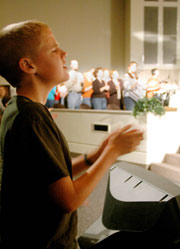
A young boy worships during a revival at a church near Nashville, Tenn. Photo by Lindsay Stavish/BP

Churches stumble when they try to imitate what works in another congregation instead of using the gifts God has given them, York said. “It's chasing after success instead of following behind Christ. Discover who you are and what God has gifted you to be. Plan ac-cording to the giftedness of those whom God has given you, not ac-cording to who has the most people showing up.”

Church leaders fail to be good stewards when they look enviously at the numerical growth of other churches instead of looking within to discover their own gifts, Bolin noted. “It's about looking at what God has given us, taking what he has placed in our hands and asking what we are going to do with it.”

That includes incorporating the gifts and talents of new members into worship, and it means being open to new developments within the congregation as members grow in their spiritual walk, he added.

“If we really are God's workmanship, that means he is continuing to work with us, and there's a tension evident as he is molding and making us,” Bolin said.

Without change–adding new songs to the congregation's repertoire, incorporating new instruments into worship and allowing new people to exercise their gifts–a church grows stagnant, York said.

“To maintain life, there has to be transition,” he said.

York offered several principles to help worship leaders guide churches through transition:

bluebull Know your own story. Examine the church's history to understand how it became what it is now. Understand the key events that shaped the character of the congregation. A change in worship style may reflect a new chapter in that story, but “what we do now must not dishonor the story of who we have been,” York said.

“It doesn't mean there has to be a locked-in repetition to the worship services; it just means if there's something new, it has to make sense here. It may be a new song or different instruments, but it has to make sense for these people in this place. Is this us, or is it not?”

bluebull Listen to the people. If worship leaders try to take the church in a particular stylistic direction, pay attention to the response of lay people who love the church and who want what is best for its future. “Trust the Holy Spirit to speak to the priests in the pew as much as the priest in the pulpit,” York said. “Trust the community under the steeple.”

bluebull Keep scorecards out of the sanctuary. When church members hold differing opinions about worship style, discuss those differences honestly, but limit the discussion to the fellowship hall and the conference room. “We cannot let Sunday morning become a gauge for who is winning and who is losing,” York said.

bluebull Hunt for treasure. “If you could only stick two or three things in your pocket before getting on the boat, what would they be?” York asked. Have church members representative of every age group identify the songs and other elements of worship they value most. Discover the common threads running through those different pieces of the tapestry. “Preserve the treasures in a way that honors community,” he said.

bluebull Give and take. If some members want to incorporate something new into worship that others resist, find out why they object and how it might be made acceptable. That could mean taking a familiar hymn and singing it in a contemporary arrangement at a different tempo.

It might mean singing a contemporary praise chorus with guitars and drums, but turning down the volume on the amplifiers and singing so the words can be understood. “When we come together in community, it's not about me. It's about us,” York noted.

bluebull Mix and mingle. If divisions over worship style seem to develop along generational lines, make sure worship isn't the only cross-generational activity on the church calendar. Schedule mission projects, Bible studies, retreats and fellowship gatherings that bring together every age group in the church.

bluebull Be patient. Avoid a “manufactured urgency,” York suggested. Take time to understand the context and culture of the community. “Slow down and love the people,” he said. “In time, you'll find you can make a withdrawal, but you don't have to go bankrupt in the process.”

News of religion, faith, missions, Bible study and Christian ministry among Texas Baptist churches, in the BGCT, the Southern Baptist Convention ( SBC ) and around the world.


BaptistWay Bible Series for July 31: God’s strength is available to his children_71105

Posted: 7/20/05

BaptistWay Bible Series for July 31

God’s strength is available to his children

• Revelation 14:1-13

By Wayne Smith

First Baptist Church, Lamesa

Last week’s lesson examined Revelation 12 and 13. This passage detailed a vision of a woman giving birth to a child. A dragon (Satan) waited to devour the infant. God carried the infant away as soon as he was born. The dragon then pursued the woman who was protected by God. Later, two other beasts, symbolic of the powers of Rome, join the dragon. Together they seek to destroy the woman’s other offspring. This vision represents Rome’s attempt to destroy the church (symbolized by the woman) and her offspring, representative of early Christians.

This week’s lesson, Revelation 14, presents a dramatically different picture. The entire body of the redeemed stand with the Lamb on Mount Zion, pictured as the New Jerusalem. Seven angels appear as agents of God’s judgment. The angels announce the redemption of those who are God’s people and the judgment and punishment of those who oppose God.


Revelation 14:1-5

John saw Jesus standing on Mount Zion with all of the redeemed Christians. Each is sealed by a mark on his forehead. John heard a sound like rushing water from heaven, accompanied by a peal of thunder. It was the sound of harpists playing as they sang a new song before the throne of God. God is surrounded by 24 elders on thrones and by the four living creatures representing the created world. The song can only be learned and sung by those who have been faithful. The faithful are to be redeemed and will take their place in heaven. They are represented as first fruits (early followers of Jesus) and are offered to God and the Lamb.


Revelation 14:6-13

Three angels appear. The first proclaimed the gospel to every nation on earth. He urged the world to praise God, the creator of all things. Judgment is about to occur. A second angel announced the fall of Babylon (Rome), the evil empire representative of all who have opposed God. A third angel followed and announced the judgment of all who had formed an alliance with Rome.

A voice reassured those who had followed Jesus. Although they are suffering, they must endure. They will be redeemed and blessed with eternal life in heaven.


Revelation 14:14-20

In this passage, four angels appear to announce the final judgment, symbolized as harvest on the earth. Two of the angels are commanded by the other two to harvest the earth and vineyard. The harvest is probably symbolic of God’s judgment against his enemies. The grapes are cast into a wine press from which blood flows out over the world. This wave of blood symbolizes the completion of judgment from which no enemy of God is spared. At the final harvest, the redeemed will be taken away to eternal rest, while those who have opposed God will be placed in eternal torment.

The passage studied in this lesson presents a history of the early Christian church. The Roman Empire had been persecuting Christianity almost 70 years. When John was exiled to Patmos to receive the Revelation, the early church desperately needed a message of hope. Through the Revelation, God presented a picture of the future of the church. Rome would be defeated. God would triumph. The church would survive.

Although evil will eventually be defeated and punished, Revelation presents no time frame. Some prophecies will be fulfilled within a relatively short time after the Revelation. Others will not occur until the end times. In the meantime, Christians must persevere. John’s visions of heaven as the home of the redeemed presented a reassuring picture.

Christians were never admonished to actively oppose Rome with military force. Rebellion would have brought even more wrath directed against the early church. A force stronger than military might was available to Christians.

Christians relied upon their faith as a source of strength. God rewarded their faithfulness. He did not immediately deliver them from persecution and oppression. Instead, he rewarded them with the Revelation, a message from Almighty God. God knew each of them. He had sealed each one for redemption and eternal life in heaven.


Application

Everyone who has received Christ is filled with the same Holy Spirit which indwelled the early Christians. The courage to persevere in spite of overwhelming opposition is available to us, just as it was to them. We fail to utilize our resources because we don’t consider our Christian witness dangerous.

Yet our Christian witness may be every bit as dangerous as that of early Christians. The dangers are more subtle and less physical, but they exist. There may be danger to your job security if you refuse to engage in unethical business practices. Young people run the risk of being unpopular with classmates if they refuse to take part in some activities. Even active church members run the risk of being out of touch with the “real world” because they do not engage in the social use of alcohol.

God is just as real for us as he was to the early Christians. Perhaps our technological advancements keep us from relying on God. We rely more upon our own strength. We need to examine our relationship with God daily and allow him to strengthen us with his promises just as he did those early followers of Jesus.


Discussion question

• Do I take time each day to draw upon the strength of God to apply to my Christian lifestyle?


News of religion, faith, missions, Bible study and Christian ministry among Texas Baptist churches, in the BGCT, the Southern Baptist Convention ( SBC ) and around the world.


Family Bible Series for July 31: Now is the time for the saints to labor_71105

Posted: 7/20/05

Family Bible Series for July 31

Now is the time for the saints to labor

• 2 Thessalonians 3:3-15

By Mitch Randall

First Baptist Church, Bedford

Just the other day, my 7-year-old son asked me, “Dad, who’s your boss?” As the pastor of First Baptist Church in Bedford, the answer seemed evident enough. Wanting to skirt the issue of personnel dynamics within a local church, I tried to explain to him that as a minister within the church, the members and I work together for the glorification of God’s kingdom. We are accountable to one another, which places the responsibility of authority upon us both. We share common visions and goals, culminating in a joint effort to build our church stronger.

Satisfied with my very cautious and calculated answer, I asked my son, “So, does that answer your question?” With a very puzzled look on his face, he said: “No, it really does not. Dad, I meant, who tells you what to do?” Finally understanding the thought process of a 7-year-old, I simply answered, “God is my boss, son. … God is my boss!” And with a big smile, he finally got the answer he was looking for, and said, “I thought so!”

Often in church life, we get so caught up doing what we’re doing, we forget whom we work for in life. As the Creator and Sustainer of this universe and all within it, God created a working environment in which we can thrive. Being laborers for God strengthens the soul and builds the spirit of humanity for all.

In 2 Thessalonians, the Apostle Paul concludes his letter encouraging his fellow believers to work hard for the Lord. In a previous letter to the church in Thessalonica, Paul wrote about the Day of the Lord arriving. Many within the church took his teaching as license to do nothing since the imminent end was upon them. In Paul’s second letter that quickly followed his first, he tried to clarify his statements and motivate the Thessalonian Christians to re-engage in work.

In the beginning of his conclusion, Paul expresses his confidence in the church to keep doing what they had been doing for the Lord (3:4). Much of the church’s ministry dealt with the poor and downtrodden of society. Paul was telling the church that just because Jesus could be expected to return at any time, there was no reason to cease doing what the church had been commanded to do by the Lord himself.

Paul also dissuaded the Thessalonian Christians from associating with those choosing idleness over Christlike labor (3:6). For Paul, labor was a matter of Christian character.

In the book of Genesis, there is a premise established regarding the labor of humanity. Many biblical readers tend to see labor as something negative handed down by God after the fall of humanity. However, after a careful reading of the text, labor is not the punishment, but the pains of work are the consequences of sin. After Adam and Eve are caught in a sinful state, God hands down judgment upon them, birthing for the woman and physical labor for the man. The events were not punishments handed down by God. Yet, the pains associated with BOTHevents would dramatically influence humanity’s attitude towards labor. The woman would suffer great pains during her labor and the man would toil feverishly to grow crops. In the beginning, labor was never seen by God or humanity as something negative but something ordained by God from creation.

When Christians today think about laboring for the Lord, there are mixed emotions. Whether it is trying to persuade church members to teach a Sunday school class, sponsor a youth trip or serve in extended session for the nursery, laboring for the Lord still is a difficult concept for many to embrace. Many Christians want to embrace working for the Lord on their terms. Yet, even more want to sit idly by, as some of the Thessalonian Christians were guilty of doing, while the rest of the church picks up the pieces and presses forward. As followers of Christ, we all are called to work for God. As Paul says in verse 13, we should “not be weary of doing what is right.” Mr. and Mrs. Christian, it is time we rolled up our sleeves and went to work for God.


Discussion questions

• What is the number one reason people do not volunteer at church?

• What excuses do we make for why we cannot work for God?

• Is idleness a sin? Why or why not?

• What can you do to work for the Lord?


News of religion, faith, missions, Bible study and Christian ministry among Texas Baptist churches, in the BGCT, the Southern Baptist Convention ( SBC ) and around the world.


Explore the BIble Series for July 31: Make sure that God is in the details of your life_71105

Posted: 7/20/05

Explore the Bible Series for July 31

Make sure that God is in the details of your life

• Ezekiel 43:1-12

By Dennis Tucker

Truett Seminary, Waco

The final section of the Book of Ezekiel (chapters 40-48) is the climax to the entire book. Most of the texts describe—in sometimes excruciating detail—the dimensions of a new temple complex. Section after section of the new temple complex is described cubit by cubit. For most contemporary readers, such an ending appears less than climactic. Yet there is much in this final section that warrants consideration. Perhaps these chapters may be best approached through a series of questions, leading us to some theological affirmations.


What is the point of the section?

The fourth and final vision in the Book of Ezekiel centers on a temple, but it is by no means only about the temple. Instead, chapters 40-48 actually present a vision of what Israelite society should resemble.

In this vision, the Israelites will be living in their perfectly restored homeland, with an ordered (and holy) life, under the leadership of a perfectly ordered temple complex. Such a vision of the future stands in stark contrast to the disarray experienced during the exile. During exile, the people of God were dispersed and scattered among various regions, the land was scorched, leadership was displaced and the temple was razed to the ground. The vision of chapters 40-48 holds out hope for the sovereign work of God. Such a vision trumps the oppressive reality of their immediate circumstance.


Is there a reason for all the detailed measurements?

Some read chapters 40-48 and assume that really what they are reading is in effect a building plan—the dimensions for how large the temple should be when the exiles return to the homeland. Yet if one reads carefully there are virtually no vertical measurements provided—only the length and the width of areas. Ezekiel never actually is told to build this structure, nor is he told the community should build it when they return from exile. Perhaps then, the purpose of the measurements in Ezekiel 40-48 is not to provide a building plan but actually to mark out sacred space—in essence, to visualize the idea of holiness among God’s people.

In chapter 8, Ezekiel recounted the abominations present in the temple complex. The notion of holiness and sacred space gave way to idol worship and corruption in the temple complex. Ezekiel’s vision in chapters 40-48 suggests that one means to correct past sins is to lay out carefully the dimensions of and access to sacred space.

In chapter 8, God departed from the presence of his people because of their lack of holiness, their inability to live as God’s people in God’s presence. In chapter 43, however, God announces in verse 9, “Now let them put away from me their prostitution (or “idolatry,” NRSV) and the lifeless idols of their kings and I will live among them forever.” The implication is that if people truly understand the idea of holiness—and its requisite demands—they will change from worshipping “lifeless idols” and serve the God of life instead. If so, God promises to live among them forever.

At the conclusion of the entire section (48:36), following a lengthy description of the tribal portions in chapter 48, Ezekiel states, “And the name of the city from that time on shall be The Lord is There.” The vision is not about a building—the vision is about a presence.


What can be gleaned from these chapters?

Ezekiel’s temple vision serves a pastoral function. It suggests a disordered, dislocated and disoriented community such as Ezekiel’s can experience the transforming, healing work of the Holy One of Israel. The attention to detail presented in the chapters serves to paint a vision in painstaking detail—to offer a vision of a future upon which God’s people can hope. In Hebrew, the idea of “waiting” is connected with the idea of “hoping.” To wait, in essence, is to hope and to hope is to wait. The vision of the newly ordered world suggests to Ezekiel’s readers that their hope is worth the wait. Further, it suggests reality can be transformed when God is in our midst.

Beneath the lengthy descriptions of cubits and spans in the biblical text, there lies a certain yearning for the presence of God. The people of God did not simply yearn for a building—they yearned for the presence of God. In modern Christianity, we have frequently asserted that “God is not confined to a place.” Yet in our attempts to explain that we can meet God anywhere, we have lost the need to experience God everywhere.

Perhaps the concluding vision in Ezekiel could rekindle in us a desire to long for the presence of God. And perhaps then, we too would return home from our long exile.


Discussion question

• Can you recall a time when God’s presence especially was real to you?


News of religion, faith, missions, Bible study and Christian ministry among Texas Baptist churches, in the BGCT, the Southern Baptist Convention ( SBC ) and around the world.


Commentary by Scott Moore: Why I am Looking Forward to Harry Potter

Posted: 7/15/05

COMMENTARY:
Why I am looking forward to Harry Potter

By Scott Moore

Baylor University

This article first appeared in Common Grounds Online.

July 16 has been circled on our family calendar for many weeks now. It's not the date for our family vacation or the birthday of one of our five children. It's not a swim meet or a recital or a ball game. July 16 is the publication date for the sixth Harry Potter book, Harry Potter and the Half-Blood Prince, and folks around our house are pretty excited.

Some Christians have rejected J. K. Rowling's bestselling books on the grounds that they are contrary or harmful to our faith. On my reading, nothing could be further from the truth. Rowling's work exhibits all the marks of the well-formed Christian imagination. These are wonderful books which explicitly draw upon the deep symbols and classic narratives of the Christian tradition. Christians should read these books in the same spirit with which we read C. S. Lewis's Chronicles of Narnia or J.R.R. Tolkien's The Lord of the Rings. Rowling herself has repeatedly demonstrated her affection for these great Christian writers, and it is easy to see how their work has influenced her own.

Do these books contain witches and goblins and magic spells and even tragic deaths? Yes, but that does not mean that they celebrate the occult. They also demonstrate great truths and show the sustaining power of the Christian virtues of faith, hope, and love-not to mention the cardinal virtues of courage, temperance, prudence, and justice. Whether in the wonderful names of the characters or in the spells which the children are taught or in the magical creatures which inhabit the forbidden forest adjacent to

Hogwarts School, every book thus far has drawn on classic Christian symbols and motifs. For instance, in the second book, Harry must fight a great serpent (the historic symbol of Satan) and he realizes he cannot do this alone. In his weakness, he calls for help, and a phoenix (a Christ symbol in the Middle Ages-the bird who dies and rises again) comes to his aid by bringing him a double-edged sword (Heb 4:12). The phoenix assists Harry in his struggle, and though Harry ultimately defeats the serpent, he is badly wounded. The phoenix then comes and weeps in Harry's wounds, restoring him to health.

By Book 5, we've learned that the little band of faithful believers who are united in their struggle against the dark wizard lord call themselves "the Order of the Phoenix." They are a symbol of the Church, and we're not surprised to discover either that the Powers That Be want to root them out and destroy them or that some members must heroically sacrifice themselves for the good of the Order. Greater love hath no man than that he lay down his life for a friend.

We don't yet know the identity of "the half-blood prince." Ms. Rowling has said that it is neither the evil Lord Voldemort (whose name means "willing death") nor our hero Harry. We do know that much of the animosity in Harry's world is predicated on the racist prejudices of the "pure bloods" (such as the malicious Malfoy ["bad faith"] family) against the "half-bloods" (those witches and wizards who come from non-magical families). We also know that Harry's destiny is inexplicably intertwined with that of the dark wizard.

My children are far less interested in Rowling's use of medieval symbols or her playful puns with Latin words and phrases. When I tried to explain to my fourteen year old son the relation of the game of "quiddich" (the wizard game like unto soccer played on broomsticks) to the philosophical concept of "quiddity" (the essence or "whatness" that makes a thing what it is), he just rolled his eyes. He and his siblings simply know Rowling as a great storyteller, and they just want to know what happens next. They're bound to be right.

Christian families shouldn't fear the Harry Potter books. Read them for yourself. Read them with your children. Talk with them about hope and courage and love. Chances are-you'll be looking forward to number seven as much as we are.

© 2005, Scott Moore. This article first appeared in Common Grounds Online.

Scott Moore is an associate professor of philosophy at Baylor University, where he is also the director of the Great Texts Program.


News of religion, faith, missions, Bible study and Christian ministry among Texas Baptist churches, in the BGCT, the Southern Baptist Convention ( SBC ) and around the world.


Christian Women’s Job Corps opens grocery store_71105

Posted: 7/15/05

Christian Women’s Job Corps opens grocery store

By Jocelyn Delgado

Communications Intern

EL PASO—A new grocery store opened in El Paso, but it’s not in business to make money. Its goal is to provide job training for women who seek to turn their lives around.

The Christian Women’s Job Corps of El Paso opened Mi Tiendita Favorita—My Favorite Little Store—to give graduates of its program a practical means to continue their training.

It’s the first such store of its kind in the nation operated by Christian Women’s Job Corps, a ministry of Woman’s Missionary Union. Texas Baptists help support the program through gifts to the Mary Hill Davis Offering for Texas Missions.

The store aims to offer products as a full grocery store would. Customers can find a variety of produce, grocery and household goods at lower prices.

Since it’s a nonprofit organization, profits go toward maintaining the store.

Last February, Coordinator Paula Jeser brainstormed with Randy Rankin, president of Lee and Beulah Moor Children’s Home, to find a way to make sure her graduates got jobs. Although the school offered job training, students rarely continued their education to receive a high school diploma equivalency certificate. In the past year, Jeser only knew of two graduates who had earned a diploma.

For 13 weeks, Jeser tried offering classes to prepare for high school diploma equivalency exams, but students couldn’t get beyond the first stage, she said. On average, women come to the program with a third grade education, she said.

Companies wouldn’t hire students without a diploma, so Jeser and Rankin found a loophole. Working at the grocery store, women would receive on-the-job training required for employment

Four months ago, the El Paso Empowerment Zone gave the children’s home $150,000. The children’s home in turn donated the money to build the 1,200-square-foot store and stock its shelves.

Local retail stores agreed to hire students after they have worked 20 hours a week for a year. One local real estate manager’s association approached Jeser with a plan to offer free apartment management training so woman had more options.

During the ribbon-cutting ceremony for the store, Jeser gave graduates butterfly pins to signify their transformation.

The women came in as an egg on a leaf, as they hatched into caterpillars they began to learn, and finally transformed into butterflies, she said.

“Now they’re going to spread their wings, and we’re going to watch them fly,” she said.


News of religion, faith, missions, Bible study and Christian ministry among Texas Baptist churches, in the BGCT, the Southern Baptist Convention ( SBC ) and around the world.