Newest BWA members feel the power of relationships

Posted: 8/05/05

Newest BWA members feel
the power of relationships

By Marv Knox

Editor

BIRMINGHAM, England–The Baptist World Alliance's newest members already feel the force of history and the power of relationships.

The BWA General Council admitted the Baptist General Convention of Texas and the Baptist General Association of Virginia into the global organization on the eve of its centennial anniversary gathering in England. The Baptist Union of Churches in the Central African Republic also received conditional membership.

“It's a historical moment,” John Upton, executive director of the Baptist General Association of Virginia, said of the BWA vote.

Charles Wade (left) of Texas and John Upton of Virginia express appreciation that the Baptist World Alliance admitted their conventions into the global fellowship. (Photo by Jim White)

“Not only was it exciting, but the extended applause (of council members after the vote) was enormously affirming,” he added. “I'll remember that as long as I live.”

Although the vote made membership official, Virginia and Texas Baptists aren't really newcomers to the alliance, Upton said. “This is for both of us maintaining a historical relationship. We've been participating in BWA for 100 years.”

But the vote altered the nature of the relationship, in the wake of broad changes in the BWA as well as the state conventions, noted Charles Wade, executive director of the Baptist General Convention of Texas.

“We haven't had a chance to be involved directly, because we came in under the umbrella of the Southern Baptist Convention,” he said.

Both the Virginia and Texas conventions declined to go along with the fundamentalist direction the SBC has taken in the past quarter-century. Consequently, both conventions have suffered splits, with new conventions in each state forming to affiliate more closely with the SBC.

In a similar pattern of separation, the SBC last year withdrew money and membership from the BWA. Advocates of the departure claimed the worldwide Baptist body is liberal, a charge similar to claims fundamentalists leveled against the Texas and Virginia conventions. Those assertions have been refuted by leaders of the BWA and both state conventions.

The Texas and Virginia conventions applied for BWA membership, standing on their own as “fully autonomous” bodies.

“This is an opportunity to be directly active” in the BWA, Wade said.

The Virginians' and Texans' decision to join the BWA doesn't diminish their other denominational relationships, Upton said. Instead, they're simply expanding a longstanding relationship.

And the decision to join the BWA provided tangible proof of that relationship, Wade said, noting, “The world Baptist family knows Texas Baptists have believed in, admired and supported the BWA.”

The more formal nature of the Texas and Virginia conventions' relationships with the BWA will benefit the state groups, their leaders predicted.

“Texas Baptists are discovering how big our Baptist family is–how faithful to Christ the people are,” Wade observed.

He contrasted U.S. Baptists' complaints of persecution and poverty to the physical and systematic persecution and crushing poverty endured by Baptists from other parts of the world, whom they get to know through the BWA.

“And yet they refuse to be overwhelmed by the powers of darkness,” he said, marveling at the faith and endurance of Baptist sisters and brothers who actually endure persecution and poverty as well as expressing thanks for how those other Baptists set an example of perseverance and faithfulness for U.S. Baptists.

“Our Baptist witness will grow stronger because Baptist faith is a faith of the people,” he explained. “It's not a faith of hierarchy or control, but of Spirit-filled men and women in churches who can respond to changes in culture.”

The Baptist World Alliance, with its 213 member conventions and unions, will flourish because it moves forward through encouragement, not control, and emphasizes partnerships, Wade said, predicting “an explosion of Christian witness.”

Noting he had talked with many of the 250 Virginia Baptists who attended the meeting in Birmingham, Upton predicted their involvement in and new relationships with Baptist brothers and sisters from around the world will stimulate them to be even more evangelistic and missions-minded.

“For them to have been here and seen this, they will go back home more dynamic than ever,” he said. “It's transforming our folk already.”

To illustrate, Upton recounted how he had prayed during a worship service with a group of Africans. Midway through the prayer, he realized the Africans had not eaten in three days.

“Yet they did not complain,” he said. “They offered praise for how God has provided.”

After the service, he was overwhelmed by joy when he had the opportunity to invite them to get something to eat–to share a meal.
News of religion, faith, missions, Bible study and Christian ministry among Texas Baptist churches, in the BGCT, the Southern Baptist Convention ( SBC ) and around the world.


British Baptist unanimously elected BWA president

Posted: 8/05/05

British Baptist unanimously elected BWA president

By Ken Camp

Managing Editor

BIRMINGHAM, England–Delegates to the Baptist World Centenary Congress elected a British Baptist as their president, received a report on the state of the Baptist World Alliance and heard an impassioned call for social justice from a Jamaican pastor.

Meeting at the National Indoor Arena in downtown Birmingham, Baptists from around the world unanimously elected as president David Coffey, general secretary of the Baptist Union of Great Britain.

David Coffey

“To experience the love and trust of the global family is overwhelming, and I now seek the anointing of the Holy Spirit for the ministry that awaits me,” Coffey told delegates at the BWA business session.

In outlining values that will shape his presidency, he affirmed belief in the gospel, the church and worship that intersects real-world issues of peace and justice.

Coffey affirmed his commitment as a “Great Commission Christian”–dedicated to the principle that every Baptist is a missionary–and underscored the need to follow Christ's example as a servant.

“Too often, the world is more aware of what the church is against than what it is for, and this is no strategy for winning lost people to Jesus Christ,” he said. “We need to be more like Jesus–to earn the reputation of being friends to sinners and to give ourselves in sacrificial service for a broken world.”

As a part of that witness, Coffey stressed the need for unity among Christians.

“Unity is a gospel imperative, and disunity is always a major hindrance to evangelism,” he said.

In a world torn apart by war and sectarian violence, one of the greatest questions facing all cultures is how to live with deep differences, and “God's sign to a disunited world is the church, united in Christ,” he said.

Stressing justice and compassion as the “hallmarks of true worship,” Coffey urged Baptists in particular and Christians in general to alleviate suffering, which he called “the acid test of obedience” for Christ's followers.

“To make poverty history is the duty of every Christian, and we should not need the world to tell us so,” he said.

Coffey emphasized the importance of the BWA providing a voice for people denied basic freedoms and human rights.

“If this means challenging those authorities who exercise might without morality and power without compassion, so be it,” he said.

In his report to the assembly, BWA General Secretary Denton Lotz urged delegates to learn from their history but focus on the future.

Looking back 100 years, when the BWA first met in London, he described the prevailing sense of optimism and the hope that the world was entering the “Christian century.” Instead, in many ways, it proved to be a “demonic century” of warfare and a decline of missionary zeal among many Christians in Europe and North America, he noted.

However, he pointed with enthusiasm to a growing missionary movement and spiritual renewal in the Third World.

Lotz called on the BWA to continue its role as a “drum major for justice” and “drum major for evangelism,” particularly in light of religious oppression and warfare around the world. He also urged the BWA to remain steadfast in defending the separation of church and state, work to alleviate suffering through relief and sustainable development, and enhance opportunities for theological education in the Third World.

In an indirect allusion to the Southern Baptist Convention's defunding of the BWA based on accusations of liberalism, Lotz stressed the international fellowship must not allow others to define it.

“We believe in Jesus Christ, the sole Savior sufficient for salvation,” he said. “To accuse the BWA of not believing the Bible is comparable to accusing a mother of not loving her child.”

Baptists also must be forthright in issuing a call to holiness, particularly regarding human sexuality, he said.

“We are opposed to premarital sex, extramarital sex and homosexual behavior,” Lotz said. “We believe marriage is a monogamous relationship between a man and woman.”

In the morning Bible study, Neville Callam, pastor of the Tarrant-Balmagie Circuit of Baptist Churches in Kingston, Jamaica, also emphasized the theme of a changing world and the need for an unchanging commitment to social justice.

In 100 years, the BWA has moved from a mostly Anglo body in which an African-American speaker was able to note that he was on the program to “add color to the occasion” to a truly multicultural, multi-ethnic fellowship.

But in many ways, the world has remained the same, as has the need for Baptists to work for justice and peace, he noted.

“Pious acts of corporate worship cannot compensate for our social sins,” he said.

Callam emphasized oppression anywhere results in violent reactions and a widespread ripple effect that is felt far away.

“Injustice anywhere does damage everywhere,” he said.

News of religion, faith, missions, Bible study and Christian ministry among Texas Baptist churches, in the BGCT, the Southern Baptist Convention ( SBC ) and around the world.


Tour helps Texas Baptists understand their heritage

Posted: 8/05/05

Stephen Stookey of the B.H. Carroll Institute speaks to a Texas Baptist group at a once-hidden Baptist church in Tewksbury, England. (Photos by by Ferrell Foster)

Tour helps Texas Baptists
understand their heritage

By Ferrell Foster

Texas Baptist Communications

TEWKSBURY, England–Thirty-five Baptists gathered in a “hidden” church meetinghouse in a picturesque English village, and they heard about the Baptists who met there more than 300 years ago.

Baptists who met there in the 17th century had to worship in secret, hidden from the authorities because it was illegal for “dissenters” from the state religion to gather.

Tewksbury was one of many stops for the 35 Ameri-cans, most from Texas Baptist churches, during a Baptist heritage tour sponsored by the Texas Baptist Historical Collec-tion and the Baptist Standard. Their tour was held before the Baptist World Congress in Birmingham, England. Another group toured the sites after the congress.

They visited places where Baptists were killed for their beliefs, where they worshipped in secret, where William Carey began the modern Baptist missionary movement and where dissenters like John Bunyan and John Wesley changed the world with their preaching and writing.

Stephen Stookey, resident fellow in church history with the B.H. Carroll Theological Institute, led the tour group.

“Our Baptist ancestors had tremendous courage to live out their convictions,” he said. “They were faced with the possibility of jail and scorn from their neighbors, and yet they remained true to their convictions.

“The easiest thing would have been to go with the majority and attend the state church,” but Bap-tists were “willing to risk their jobs and their lives for their convictions.”

The Baptist tour included the many popular attractions in London and Oxford, but it also went to more obscure cities and towns like Bed-ford, Olney, Tewk-sbury, Kettering and Moulton.

It ended in Birmingham for the 100th anniversary congress of the Baptist World Alli-ance.

Stookey said it is important for today's Bap-tists to reconnect with their “heritage of liberty–religious liberty, church liberty, soul liberty.”

That heritage of freedom is central to who Baptists are, Stookey said.

“Visiting such historic places reminds us of that heritage and challenges us to live out that heritage,” he said.

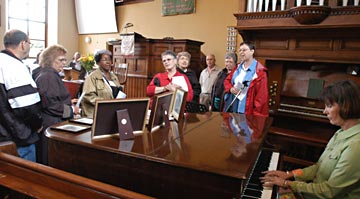
As Gail Herring of Sulphur Springs plays "Amazing Grace," a group of Texas Baptists join in song at Olney, the town where John Newton penned the beloved hymn.

“We have far too many Baptists who wear the label but do not act in a manner befitting the label.”

Through the years, Stookey said, he has been amazed at how few students could articulate Baptist distinctives. Churches have failed to communicate Baptist heritage to a new generation, he said.

Stookey suggested churches begin to reverse the situation by “revisiting the story” of Baptists through the centuries.

“History works best when it's personal,” Stookey said, and he encouraged churches to retell the stories, not only of famous Baptists and other believers, but also of local men and women who are “near and dear” to a congregation.

Such stories of believers who have gone before “helps to become a motivation to live out those convictions in the present,” Stookey said.

News of religion, faith, missions, Bible study and Christian ministry among Texas Baptist churches, in the BGCT, the Southern Baptist Convention ( SBC ) and around the world.


Cartoon

Posted: 8/05/05

Sunday, Aug. 14, 11:40 a.m.: Pastor Hangtime realizes his congregation beat him to the "all heads bowed; all eyes closed" invitation.

News of religion, faith, missions, Bible study and Christian ministry among Texas Baptist churches, in the BGCT, the Southern Baptist Convention ( SBC ) and around the world.


2nd Opinion: When should a child be baptized

Posted: 8/05/05

2nd Opinion:
When should a child be baptized?

By Roger Olsen

It's an age-old question for Baptists, Mennonites, Pentecostals and others who practice believer baptism. When is a person mature enough to receive water baptism? Most Anabaptists (Mennonites, Amish) wait until the candidate has had a profound religious awakening with sorrow for sin and repentance. They believe true conversion (as opposed to raising the hand to “receive Jesus as Savior and Lord”) cannot happen until after the onset of adolescence. Many reserve baptism for 16-year-olds.

In contrast, many Baptists and Pentecostals baptize children as soon as they ask for baptism, so long as they express faith in Jesus Christ. I have observed children as young as 6 and 7 being baptized in Baptist churches. But many Baptists call this “kiddie baptism” and compare it with infant baptism. Is a 6-year-old sufficiently mature to repent and trust in Christ alone for eternal salvation? Can a 7-year-old know what these concepts mean?

The Bible does not settle the issue. We wish it did. Nor do Baptist consensus statements give concrete guidance. When I first became a Baptist, I joined the American Baptist Churches, U.S.A. I discovered that most American Baptist pastors would not baptize anyone under 12. That has become a widespread consensus without formal policy.

But at age 10, my precocious daughter insisted she be baptized. She gave a glowing testimony of repentance and faith, and there was no doubt she had experienced conversion. Our American Baptist pastor refused to baptize her, and I respected that. His own policy was that candidates for baptism must be 12 or older. In general, I agreed with that. But my daughter's case seemed different. She showed every ability to articulate her experience and belief. So, with our pastor's permission, I baptized her myself during a Sunday morning service.

How young would I go with baptism of children? Since moving to the Southwest, I have become increasingly uncomfortable with a habit I observe among some law-enforcement officials. One seminary student doing his ministry internship with a jail chaplain told me he saw children as young as fourth grade (10 years old) in the county jail! I read in the newspapers that in some southern states (and possibly others) children as young as 10 can be and sometimes are prosecuted as adults. I believe this is a travesty. Children that young may commit crimes, but they should be dealt with in juvenile courts, and their sentences should be aimed at rehabilitation and not retribution.

This I believe about children and the law. What does that tell me about how I should regard children and baptism? It would seem inconsistent to believe that a child is not fully responsible for his or her crimes and yet at the same time believe that child can repent and receive Christ in a fully personal, responsible manner. Could the practice of baptizing young children contribute to a social tendency to treat them as little adults in the legal system?

As I have ruminated about this, I have come to the conclusion that for several reasons, it would be best to reserve water baptism until young people are of the age of legal accountability and that legal accountability (adult trial and sentencing) should be reserved until 16. In other words, I have come to agree with the traditional Mennonites and Amish–and probably with our own Baptist ancestors who came into contact with the Anabaptists in Holland and were strongly influenced by them.

Even if a child truly repents and believes on Christ at age 12 (or younger), he or she is not ready for full responsible church membership. Anyone younger than 16 can hardly be trusted with serving on a church committee or as a deacon. Traditionally, baptism ushers one into church membership. It is a public act of commitment. Baptism should follow a period of discipleship during which the candidate shows signs of Christian maturity. This was undoubtedly the practice of the earliest Christian churches of the Roman Empire. Finally, baptizing children younger than 16 implies that they are “little adults” who should be treated that way if they commit a crime. This leads to uncivilized and barbaric treatment of children in adult courts and jails.

I realize what a radical suggestion I am making, and I mean no offense to anyone who was baptized younger than 16. I am just such a person. I was baptized at age 10–like my daughter. But now I regret it. I wish my church had waited until I was older to baptize me. I barely remember the event, and I am not at all sure how meaningful it was to me. As I remember myself at age 10, I think I was a mere child and not yet ready to make a responsible act of commitment such as baptism.

Of course, I don't expect anyone to make such a drastic change in practice just because I suggest it! What I suggest is that churches give serious consideration to the matter and back up their pastors if they would rather wait to baptize children who walk the aisle to accept Christ before adolescence. Consider the consequences. Baptist churches are baptizing children younger and younger all the time. What next? Infant baptism? God forbid! And yet are we not already getting close to it by baptizing 6-year-olds?

Let's begin conversations about the matter in our churches and have the courage to say “wait” to those who want baptism too early.

Roger Olson is professor of theology at Baylor University's Truett Theological Seminary.

News of religion, faith, missions, Bible study and Christian ministry among Texas Baptist churches, in the BGCT, the Southern Baptist Convention ( SBC ) and around the world.


DOWN HOME: His ‘kingdom’ for a glass of iced tea

Posted: 8/05/05

DOWN HOME:
His 'kingdom' for a glass of iced tea

Here are two words for anybody who wants to make money and doesn't mind moving to England: “iced tea.”

That's right. Here are a few more: “T-shirts” and “enchiladas.”

Joanna, our youngest daughter, Molly, and I just got back from England, where we attended the 100th anniversary of the Baptist World Alliance. Had a terrific time.

Traveling far from home always is an exotic-yet-slightly-unsettling experience. Seeing how other people live is fascinating. Visiting sites you've read about in history books is intriguing. Meeting people from foreign lands is enlightening.

All that was true of our trip to England, or “the UK,” as locals call it. Besides spending five exhilarating days with Baptists from all over the planet, we got in a little sight-seeing in London. We ogled the Crown Jewels, including a diamond as big as a plum. In Westminster Abbey, I looked down and realized I was standing on top of Chaucer's grave. In an art museum, we saw one of van Gogh's sunflower paintings. And in the British Museum, we stood just a few inches from the Rosetta Stone, the key to interpreting all the hieroglyphics of ancient Egypt.

Eventually, however, what I really wanted was a nice, big glass of iced tea. Funny thing about the British. They practically invented tea, but they seem to think ice is as rare as, well, the Crown Jewels. So, you can forget about iced tea, Guvnah.

Don't get me wrong. I appreciate England to pieces, and we had a great, great time there. Baptists originated in England. Some of my kinfolks hailed from nearby Scotland and Wales. London is a beautiful, cosmopolitan city, whose people are as kind and gracious as its buildings are stately. On top of that, so much of our own national history springs from there that I've always felt a bond with those people, even before I met them.

But after awhile, a family from Texas starts craving the staples of life. That would be iced tea, of course, and enchiladas.

That's why I think an enterprising Texan could become the Next Big Thing in London. Just open a string of kiosks that sell strong tea (sweet and un-) in huge cups filled to the brim with ice cubes.

For one thing, all the U.S. tourists from the South and Southwest would pay great gobs of British pounds for iced tea. Maybe not on their first day there, but by days two and three, they'd start considering taking out a loan if they had to.

The other thing that would sell over there is good T-shirts. In America, we memorialize our vacations by buying T-shirts. Don't try that in England. You'll be disappointed by both selection and quality.

But an enterprising fashion entrepreneur could make a mint off American tourists, selling shirts that say things like, “I lost my head at the Tower of London” or somesuch.

You could even finance mission work with the proceeds. England is Baptists' birthplace and the home of foreign missions. Why couldn't iced tea fuel the next wave of missionaries?

— Marv Knox

News of religion, faith, missions, Bible study and Christian ministry among Texas Baptist churches, in the BGCT, the Southern Baptist Convention ( SBC ) and around the world.


EDITORIAL: There’s no place like home (in the BWA)

Posted: 8/05/05

EDITORIAL:
There's no place like home (in the BWA)

You can't sing “To God be the Glory” and cry at the same time. Well, maybe you can sing and cry simultaneously, but I can't.

That fact became clear during the opening moments of the Baptist World Centenary Congress. Baptists from around the globe stood to sing that grand old hymn. Instantly, 13,000 voices reverberated off the walls of the arena in Birmingham, England. We intoned adoration of our God.

But I didn't do my part. I tried earnestly. “To God, be the glory; great things he hath … ,” I started. Then my throat felt like I swallowed a tennis ball.

Through a blur of tears, I scanned the cavernous room, taking in the sight of sisters and brothers who share our legacy of faith. We speak a cacophony of languages. We reflect a palette of skin tones. We worship in enough styles to make the apostles' heads spin. And yet we share one Lord, one faith, one baptism.

knox_new

Soon, I gave up singing and simply enjoyed the moment–my first Baptist World Alliance congress. The character of all those faces. The passion of all those voices. The blessing of their sacrificial journey to celebrate the 100th anniversary of global unity in diversity.

Later, a friend confirmed I wasn't alone in tears. We practically finished each other's sentences as we described our reaction to singing with that lovely Baptist throng.

We're the same age–late 40s. We're from the United States. We feel cast out by the Southern Baptist Convention, which was our spiritual home when we were children, seminary students and young ministers.

For us–and for many other Americans–the Baptist World Alliance congress in England presented a wonderful new experience. For the first time, we attended a Baptist meeting of such size in which we felt wanted, needed and loved. To be sure, many of us have served in warm-spirited state Baptist conventions. And some have found a new home in the Cooperative Baptist Fellowship. But every other time we've been with 13,000 Baptists, we experienced rancor, strife and division.

You might say we're refugees of a denominational civil war. Or maybe theological-political orphans. But, thank God, we have found a home in the Baptist World Alliance.

The problem with describing this situation this way is it sounds as if we have embraced the BWA only because we've been forced out of one home and we're desperately seeking another. That's probably true to some extent. Baptists from the southern United States–even (shock!) Texas–are hard-headed. So, maybe we had to endure a quarter-century of strife in order to see a 100-year-old beauty right before our eyes. More likely, Romans 8:28 really is true: God is with us, working to bring good out of even the most horrific and painful experiences.

Actually, Texas Baptists are not new to the BWA. One of our revered forebears, George Truett, helped found the alliance in 1905. Many Texans have been involved through the decades. But this year, something bigger happened. The BWA accepted the Baptist General Convention of Texas and the Baptist General Association of Virginia into full membership. What an honor.

We share a rich heritage with world Baptists. The BWA represents our legacy. Also, the BWA advances the concerns General Secretary Denton Lotz articulated in Birming-ham–evangelism, relief and sustainable development, religious freedom and human rights, theological education and fellowship–the backbone of our Christian mission.

Of course, we know the BWA is not perfect; no organization is. And differences do exist. World Baptists are not agreed on such issues as women in ministry, the gift of speaking in tongues and the roles of their native governments in global affairs. But the BWA evidences a tremendous unity in diversity that may give us all our nearest taste of heaven on earth.

Moreover, the Baptist World Alliance offers Texas Baptists an identity we desperately need. Like my friend and me, the BGCT has been identified for a quarter-century by the conflicts and controversies that have plagued Baptists in the southern United States. BWA membership reminds Texas Baptists that God has more, much more, in store. We're part of a movement much larger than our “Baptist battles.” God has given us a global mission, and now we have a direct opportunity to join with Baptist sisters and brothers in more than 200 countries to fulfill our global calling and mission.

Someday, I will sing “To God be the Glory” without crying. Still, I will remember my trip to Birmingham and how it changed my life. I pray it will change the BGCT. Forever.

News of religion, faith, missions, Bible study and Christian ministry among Texas Baptist churches, in the BGCT, the Southern Baptist Convention ( SBC ) and around the world.


Texas Baptist Forum

Posted: 8/05/05

Texas Baptist Forum

Modes of baptism

While I respect Weldon Poise's beliefs regarding baptism (July 25), I offer the following for consideration:

First, Baptist commitment to immersion far pre-dates the rise of Land-markism in the early 1800s. Perhaps he has confused the issue of “alien immersion” with the question of immersion as the New Testament mode of baptism.

Letters are welcomed. Send them to marvknox@baptiststandard.com; 250 words maximum.

“If you allow fear to rule your life, the terrorists have already won.”

Beth Fogg
Former president of the Baptist General Association of Virginia, on why she and other Baptists refused to allow terrorist attacks to prevent them from attending the Baptist World Alliance's centennial congress in England

“We have no privacy anymore, but we are young again.”

Fletcher Kaiya
General secretary of the Malawi Baptist Convention, telling BWA centennial congress delegates about his home now that he and his wife have taken in 15 AIDS orphans

“Our religion may be personal, but it's not private. Jesus has to be Lord of the universe. … Christian truth is public truth. We are called to engage the world.”

Steve Chalke
President of Oasis Trust, a multifaceted benevolence agency, speaking at the BWA centennial congress on the need for Christians to address global problems

“As water is essential to life, so is salvation.”

Billy Kim
Outgoing Baptist World Alliance president, addressing the opening session of the BWA Centennial Congress

Second, baptism by immersion was not an item of contention in the 19th-century controversy over “hardshellism.”

Finally, I would clarify the story of John Bunyan. Yes, Bunyan did practice open membership, but was Bunyan a Baptist? When Henry Danvers challenged Bunyan on the issue of immersion, claiming Bunyan's views made him no Baptist at all, Bunyan refused to describe himself as a Baptist (see Bunyan's Peaceable Principles and True). Rather than trying to redefine Baptist theology, Bunyan honestly conceded that immersion is a Baptist distinctive even though it was a distinctive he himself did not hold.

Such theological frankness is refreshing.

Bart Barber

Farmersville

Love, but not sin

I have always tried to have an attitude of acceptance of all faiths that teach Jesus Christ. I have always believed that as one comes to know Jesus, he will lay down things that are not in Jesus' will, even if the church in which that person worships accepts them.

However, I am concerned that many preachers have chosen to preach only the love of God, and many who hear do not realize the consequence of their sins.

I fear some preach only enough of God to separate church members from some of their money and not their sins.

Where are the preachers of the gospel who help draw men to God as in past centuries?

Daniel Younger

Itasca

Church websites

I am amazed at how many churches are not aware that all Southern Baptist churches are on the Internet and have a free limited web page if they have submitted their Annual Church Profile or Vacation Bible School report.

This information needs to get out to churches. If a local church has their own web page, they need to update the sbc.net page.

The purpose was to make information available to persons relocating to another area, so they could learn about local Southern Baptist churches by searching according to ZIP code or city. Also, people on vacation could do the same.

George S. Kelly

Cedar Park

What do you think? The Standard affirms the longstanding doctrine of the priesthood of the believer and thus welcomes reader opinion on matters of interest to Baptists. Send letters to Editor Marv Knox by mail: P.O. Box 660267, Dallas 75266-0267; or by e-mail: marvknox@baptiststandard.com. Letters are limited to 250 words and may be edited to accommodate space. Only one letter per writer per quarter.

News of religion, faith, missions, Bible study and Christian ministry among Texas Baptist churches, in the BGCT, the Southern Baptist Convention ( SBC ) and around the world.


Northeast a ‘frontline ministry,’ missions leader insists

Posted: 8/05/05

Northeast a 'frontline ministry,'
missions leader insists

By Meghan Merchant

Communications Intern

Quaint white churches scattered across New England's green countryside present a deceiving indicator of the region's spiritual landscape. The average church there has about 40 people.

Only 4 percent of the population attends an evangelical church on any given Sunday, asserted Jim Wideman, executive director/treasurer of the Baptist Convention of New England, which has 235 churches.

Mary Hill Davis Offering for Texas Missions

“I see this as frontline ministry,” Wideman said, explaining that Christians–particularly evangelicals–are a minority in New England.

In Vermont, an unattended Vacation Bible School in a Waterbury park reminds H.B. and Jo Ann Graves, Texas Baptist church planters, that they still have a long way to go in reaching the town for Christ.

Hotdogs, puffed rice treats and a basket of playground equipment go uneaten and unused, despite the advertising and invitations the Graveses distributed in preparation for the morning event.

Situations such as this explain the discouragement ministers face in Vermont and the rest of the Northeast. Pastors lack Christian fellowship and experience loneliness, especially during the winter. But the Graveses said they rely on prayer, particularly from their home church in Texas.

“We have the basis of the Lord to stand on,” Mrs. Graves said. “That's all that keeps us going.”

According to a 2002 Gallup poll, Vermont is the nation's second-least-churched state. Theiss Jones, retired minister of music at First Baptist Church in Temple, sees the state as a “fertile field of missions in the United States.” He has returned to Vermont 10 times since 1995 and spent three months as an interim pastor there during a sabbatical from his church.

“It's very evident there's been a change in the impact of religion,” he said.

Failure to “make Christ real to all generations” and “maintain the vitality we have in Jesus Christ” shoulders some of the blame for this religious shift, Jones said, noting Vermonters have lost an entire generation in the churches.

However, the biblical geographical names found throughout Vermont and the rest of the Northeast allude to a time in the past when Christians impacted the culture. Jones pointed out references such as the Northeast Kingdom, Mount Horeb and Mount Abraham as evidence of a more religious time.

Texas Baptists provide financial support and much-needed resources to New England states through Impact Northeast, a partnership between six southern conventions and the Baptist Convention of New England, which will continue until 2007. The 2005 Mary Hill Davis Offering for Texas Missions includes a $30,000 allocation to Texas Partnerships initiatives in the Northeast.

Johnnie and Lahoma Loar, Mission Service Corps volunteers to Vermont, have witnessed the impact Texans have had through money, encouragement, prayers and short-term mission trips to their state. Church planters recently established a church in Chelsea. And the Graveses are becoming known in Waterbury as Christians. Their Texas accents often draw New Englanders' questions, giving them an opportunity to share their purpose for being in Vermont.

Since 2000, Green Mountain Baptist Association, which serves Vermont, has grown from 17 to 32 churches and from 605 to 1,200 members, the Loars said. Vermont Christians are “seeing changes in the spiritual climate,” Mrs. Loar explained. They hope one day Vermont will become the Bible Belt of New England, a transformation only God could take credit for, they said.

“God is at work here,” Loar said.

“He's bigger than the darkness in Vermont,” his wife added.

News of religion, faith, missions, Bible study and Christian ministry among Texas Baptist churches, in the BGCT, the Southern Baptist Convention ( SBC ) and around the world.


Vermont partnership positively impacts Temple church

Posted: 8/05/05

Volunteers from First Baptist Church in Temple work in partnership with Green Mountain Baptist Association in Vermont to sponsor a soccer camp.

Vermont partnership positively
impacts Temple church

By Meghan Merchant

Communications Intern

Members of First Baptist Church in Temple have long-standing relationships in Vermont. They know the names of roads, towns and people. And they returned to the state on a mission trip for the 10th consecutive year this July.

With the exception of one family, all participants have visited Vermont multiple times. People ask to sign up for the trip before it is even planned, and it is the first mission trip the church offers to fill up, said Kay Bacon, minister of missions.

Church members return year after year because of the people, said Cristi Paton, a member of First Baptist in Temple who has been to Vermont six times. “They're so hungry for Christian fellowship. It's a ministry through encouragement.”

Glen Hatch, the northeast ministry coordinator for Green Mountain Baptist Association, talks with Tanner Knox of Temple at soccer camp. (Photos by by Meghan Merchant)

During the past 10 years, members developed close relationships in the area with local Christian leaders and families who participated in the church's soccer camp. Vermont children look forward to seeing their soccer coaches and Texas friends, while area pastors rely on yearly support from the Temple group to refuel their energy and ministry.

“It's a great encouragement for people like me who do ministry here,” said Glen Hatch, the northeast ministry coordinator for Green Mountain Baptist Association. “It's a difficult task. … And when they leave, they just charge our batteries.”

This summer, the Texas group ran a youth soccer and character camp at a public school, conducted Bible camps in two small towns, performed manual labor for a New Hampshire church and held a prayer and encouragement time for mothers of the children at soccer camp. Partnering with a church in Piermont, N.H., the church also participated in a three-evening revival for local youth.

Hatch, a bivocational pastor and girls' soccer and softball coach, originally connected with the Texas church 10 years ago. Through his contacts with public schools in eastern Vermont, he arranged for the mission group to set up soccer and character camps on public school property, an unusual situation in the state.

Mission work in Vermont is a slow but sure process, participants in the ministry said. Vermonters are hardened by long winters and lack of Christianity, making ministry in the area difficult, Hatch said. It took the Temple group several years to develop friendships with people in Vermont, who initially were not trusting of an outside Christian group coming to their area. Now, Hatch's phone rings throughout the year with people asking when the Texans will come back.

The annual mission trip to the Northeast has impacted not only Vermonters, but First Baptist in Temple as well, changing the way the church views missions, Pastor Martin Knox said. The Vermont trip has caused members to ask more missions-related questions and work harder to fulfill the Great Commission.

Because of the high return rate of trip participants, members have developed closer relationships and watched each other's families grow up together. The trip has instilled an understanding of missions in the young people on the trip as well, Bacon said.

“We have a concept now of being a missional church,” Bacon said. “It has been another opportunity to reach out and go outside our walls.”

News of religion, faith, missions, Bible study and Christian ministry among Texas Baptist churches, in the BGCT, the Southern Baptist Convention ( SBC ) and around the world.


On the Move

Posted: 8/05/05

On the Move

Michael Armstrong to Providence Church in Little Elm as worship leader.

bluebull Timothy Askew to Mount Zion Church in New Home as pastor from Mount Zion Church in Clovis, N.M.

bluebull Jay Beerley has resigned as youth minister at First Church in Eastland.

bluebull Steve Buckland to First Church in Weatherford as pastor from Heritage Park Church in Webster.

bluebull Wiliam Campbell to First Church in Aransas Pass as pastor from First Church in Bangs, where he was youth minister.

bluebull Adan Cancino to Primera Iglesia in Aransas Pass as pastor.

bluebull Blake Chilton to The Village Church in Highland Village as youth minister.

bluebull Brad Dancer has resigned as pastor of First Church in Dawson.

bluebull Gary Davis to First Church in Atlanta as adminstrator.

bluebull Jim Dunn to First Church in Sheridan as pastor.

bluebull Kendall Durham has resigned as music minister at First Church in Bells.

bluebull John Enright to First Church in Roanoke as youth minister.

bluebull Tyler Frank to First Church in Donie as youth/student minister.

bluebull Greg Gasaway to First Church in Haskell as pastor from Central Church in Pampa, where he was minister of youth/music.

bluebull Jon Gipson to Providence Church in Little Elm as small- groups leader.

bluebull Grant Goodman has resigned as music/education/ad-ministration minister at First Church in Howe.

bluebull Keith Guthrie to First Church in Mexia as interim youth/student minister.

bluebull Ken James to Mosheim Church in Valley Mills as interim pastor.

bluebull Paul Johnson to First Church in Orchard as pastor.

bluebull Shane Kinnison to First Church in Waxahachie as pastor from Parkdale Church in Corpus Christi.

bluebull Ernest and Shawna Lopez to First Church in Coolidge as youth/student ministers.

bluebull Clinton Lowin has resigned as youth/student minister at Cornerstone Church in Corsicana.

bluebull Jess McCabe to First Church in Desdemona as pastor.

bluebull Hershiel McCarty to First Church in Ingleside as interim pastor.

bluebull Michael McMinn to Hagerman Church in Sherman as youth minister.

bluebull Brad Moreland has resigned as youth/student minister at Pettys Chapel in Corsicana.

bluebull Charles Moore to First Church in Jefferson as pastor.

bluebull Aubrey Perella to Second Church in Ranger as pastor.

bluebull Russell Polson has resigned as pastor at First Church in Newton.

bluebull Jerry Reed to Living Faith Church in Centerville as pastor.

bluebull Gleen Samuels to New Millennium Church in Lubbock as pastor from First Progressive Church in Lubbock.

bluebull Randy Samuels to First Church in Three Rivers as pastor from Mountain Valley Church in Howard, Colo.

bluebull Skipper Schexsnayder has resigned as minister of music/education at First Church in Newton.

bluebull Tommy Shaphard to Second Church in Lubbock as pastor for music and worship.

bluebull Cody Shouse to Cornerstone Church in Corsicana as youth/student minister.

bluebull Joul Smith has resigned as youth minister at First Church in Rising Star.

bluebull Kelby Sullivan to First Church in Breckenridge as youth intern.

bluebull Chris Thompson to First Church in Dickens as pastor.

bluebull Zack Tunnel to Bethel Church in Jefferson as pastor.

bluebull Jared Wellman to Powell Church in Powell as pastor, where he was interim.

bluebull David Wilson to Southcrest Church in Lubbock as pastor from Judson Church in Nashville, Tenn.

bluebull David Wingate to Walnut Creek Church in Azle as youth director.

bluebull Morgan Woodard to Peoria Church in Hillsboro as pastor.

News of religion, faith, missions, Bible study and Christian ministry among Texas Baptist churches, in the BGCT, the Southern Baptist Convention ( SBC ) and around the world.


Partnership links Kenyan college and Plainview church

Posted: 8/05/05

Fourteen members of First Baptist Church of Plainview and 14 Kenyan workers sit in front of the duplex they built at Kenya Baptist Theological College that will house visiting professors and female students. Members of First Baptist Church of Plainview who made the trip were David and Cathy Howle, George and Debbie Merriwether, Dustin and Courtney Williams, Caren Smith, Don Smith, Lori Flemons, Jorge Sanchez, Stan DeMerritt, Eddy Curry, Brandon Burrows and Rodney Cooper.

Partnership links Kenyan
college and Plainview church

By Jonathan Petty

Wayland Baptist University

PLAINVIEW–David Howle of Wayland Baptist University told the 14 volunteers who traveled to Kenya their mission was building–not just constructing a women's dormitory at a college, but building relationships.

First Baptist Church in Plainview funded the construction project at Kenya Baptist Theological College at a cost of more than $50,000.

Howle, director of Wayland's virtual campus, worked closely with the Kenyan college through its relationship with Wayland over the last several years. He approached Charles Mbugua at the college to ask about their needs.

Howle told Mbugua his Sunday school class at First Baptist in Plainview expressed interest in work going on in Kenya through Wayland and wanted to find a way to help.

George Merriwether perches on a ladder supported by (from left) Rodney Cooper, Caren Smith and Don Smith, while placing ceiling tiles.

Mbugua said the college needed a building to house women students. Female students currently stay at the Baptist conference center adjacent to the college, never knowing if they will have lodging from night to night due to availability.

Howle approached his class and the missions committee at his church about the project. The committee agreed it was a good idea and brought the plans before the church. The church, in turn, voted to purchase supplies, pay for labor and send a team to Kenya to help with the project.

The money came from a special missions account set up by the church with funds donated by the late Dorothy McCoy, emeritus professor of mathematics at Wayland.

The building was designed as a duplex with two bedrooms, two bathrooms, a living area, kitchen and washroom on either side. One side will be used to house visiting professors who are there to teach. The other will house female students.

Only four female students attend the college, but the building accommodates up to eight comfortably. Students attend the school for three weeks at a time.

A representative from the college told Howle the symbolism of what they did means more than they can ever understand.

“This states clearly that they are very interested in women understanding leadership,” Howle said. “That is primarily what (Kenya Baptist Theological College) is about–training leaders. For them, this is a significant step in saying they are about not just training men, but training women as leaders in the country.”

The group left for Kenya loaded down with painting supplies and a few other tools they intended to leave with local workers. Howle, who had been in contact with the construction group in Kenya, thought they would spend much of their time painting.

Plans changed, however, after receiving a letter from Mbugua–two days before departure–with a list of projects that needed to be completed.

“He listed a number of items that included painting, but a number of things that we really hadn't planned for,” Howle said. “He used the word 'fix' the doors and cabinets. I thought he meant attach the doors and attach the cabinets that were already built, but that wasn't entirely what he meant.”

Upon arrival, Howle and the Plainview team found the building had doors, but they had not been cut to size and did not have hinges or handles attached. As for the cabinets, Howle was pointed to a stack of lumber on the floor.

“I had been cabinet maker earlier in life, but it's a little bit of a challenge to make cabinets using a skill saw and pocket knife,” he said.

Still, the team dove in energetically.

“There were 14 of us and 14 Kenyan workers,” Howle said. “We just kind of worked together. We got all of the kitchen cabinets put in, the wardrobes or closets built, all of the doors put on, all of the ceiling panels put in place and the crown molding up.”

As the groups worked together, he said, they learned from each other.

“Their attitude is that whatever you are trained in, that is what you do. If there is something else that needs attention, you are not trained to do that, so you just leave it alone,” Howle said of the Kenyan culture.

“We ask, 'How can I learn to do whatever it is that needs to be done?' We have Stan DeMerritt, the university registrar, learning how to glaze windows. We have George Merriwether, an accountant, learning how to put in the ceiling panels.”

After watching the group work, the crew foreman told Howle that from their example, his workers could learn how to expand and not just focus on one thing.

“It was a good experience for them and a good experience for us to better understand their situation and their conditions,” Howle said. “By the third day, we had people who were feeling guilty because we were there working for free. That meant we were taking work away from these men who were paid only $3 to $5 a day.

“Some really close bonds were formed in the process. When we got ready to go home, it was hard.”

The building is all but finished, with a few small jobs and the painting remaining. One more thing the Plainview group will do, however, is have a plaque placed on the building in honor of McCoy.

“It will give a little history of who she was and her interest in missions and a statement or two of how that house came to be so that later students and other visitors will have some sense of the involvement there–that there is a bigger community that cares about their education,” Howle said.

News of religion, faith, missions, Bible study and Christian ministry among Texas Baptist churches, in the BGCT, the Southern Baptist Convention ( SBC ) and around the world.