Book Reviews

Posted: 9/02/05

Book Reviews

Gospel Tracks Through Texas by Wilma Rugh Taylor (Texas A&M University Press)

What did U. S. Christians learn about reaching people from the Russian Orthodox Church? The author says the use of converted railroad passenger cars to “chapel cars” in the 1880s on the Trans-Caspian railroad to reach the peoples of Eastern Siberia was the forerunner of 13 such rolling churches used in the western part of this country between 1891 and 1940.

In Gospel Tracks Through Texas, Taylor describes in intricate detail the mission work of chapel car Good Will between 1895 and 1903 to reach lost souls, to minister to believers, and to aid or establish churches in railroad towns and cities.

Chapel car Good Will was built with Catalpa wood to provide a rolling sanctuary approximately 52 feet in length and nine feet wide, with an Estey reed organ that also served as a pulpit, clerestory windows and a transom that read “God is Love.” The living space was 18×9 feet and had a coal bin for the “perverse” heater and a water tank with a small pump.

The cost of the 76-foot-long Good Will and six other chapel cars was underwritten by the American Baptist Publication Society, along with the Bibles, tracts, Scripture cards and Sunday school literature for free distribution.

With the explosion of rail towns and shops and yards in Texas, the Baptist General Convention of Texas requested a chapel car, although some were concerned about its origin from Northern Baptists.

What are you reading that other Texas Baptists would find helpful? Send suggestions and reviews to books@baptiststandard.com.

Railroad management supported the chapel cars with free transportation until World War I and usually “sided” the cars in a location accessible to trainmen, shop craftsmen and white-collar clerks for one of the two to four daily services. The Baptist concern with temperance in the use of alcohol was shared by company officials because the riotous lifestyle of workers was a threat to safety as well as detrimental to the well-being of their workforce.

Chapel car Good Will went into service in July 1895 at Denison in the MK&T yards during one of the heaviest rains, reportedly, in the town's history. The first missionary couple conducted services in the rain and mud at noon, evening and midnight for 10 days and reported 40 conversions.

The Good Will then began traversing Texas to such diverse locations as Texline and the XIT Ranch, Eagle Pass, Laredo, Rockport, Galveston, Tenaha and Marshall, with many stops between during the eight years of effective ministry in the Loan Star State.

Saloons and brothels frequently outnumbered churches and Baptists at many of the 107 reported stops in Texas. Nonetheless, the male missionaries went into saloons to invite people to attend the meetings, and they and their wives witnessed to some of the “soiled doves” and “distressed ladies of the night” that visited the car. Blacks were welcome in the services; however, few came in the sanctuary when whites were present.

The author complements the Good Will chapel car story with fascinating detail about Baptist concerns at that time in Texas, many state and railroad facts including the Galveston storm, and an unusual glimpse of the war in Cuba.

Readers will be enthralled with Nettie Stucker and Hollie Townsend, two of the missionary wives; surprised at the number of Bible translations, including Spanish, available for immigrants; and eager to see what happened if their town or city was visited by the chapel car.

Ken Livingston

Retired Human Resources Director Emeritus

Texas Agricultural Experiment Station

College Station

News of religion, faith, missions, Bible study and Christian ministry among Texas Baptist churches, in the BGCT, the Southern Baptist Convention ( SBC ) and around the world.


Baptist Briefs

Posted: 9/02/05

Baptist Briefs

Samaritan Ministry director honored. Baptist layman Wayne Smith, director of Samaritan Ministry in Knoxville, Tenn., was honored with a national award for his work in HIV/AIDS education. Smith received the national Ryan White Memorial HIV Education Award from the National Education Association at its conference in Los Angeles. The Tennessee Education Association nominated Smith for the award after he led a session about HIV education at the organization's spring staff development meeting.

Samaritan Ministry–a Cooperative Baptist Fellowship partner–works with community organizations to serve about 350 people by providing food, clothing and rent assistance; sponsoring an HIV support group at Central Baptist Church in Knoxville; and ministering to HIV-positive inmates in local prisons.

WMU appoints new staff. National Woman's Missionary Union has named Dianne Daniels as multicultural ministry consultant and Wendy Wakefield as sales and marketing manager for New Hope Publishers. Daniels taught high school Spanish in North Carolina 16 years. Prior to teaching, she and her husband, Bain, served as Southern Baptist missionaries in Colombia. Daniels also served on church staffs in Burlington and Greensboro, N.C. She holds a bachelor's degree and master's degree from the University of North Carolina in Greensboro and a master of divinity degree from Southeastern Baptist Theological Seminary. Wakefield previously worked as an advertising sales representative and marketing manager for Ingram Book Company in LaVergne, Tenn., and as operations manager of Independent Christian Catalogs in Nashville, Tenn. In 2003, Wakefield launched her own company, marketing keynote speakers and trainers for corporate America. She holds a bachelor's degree in advertising from the University of Western Kentucky.

News of religion, faith, missions, Bible study and Christian ministry among Texas Baptist churches, in the BGCT, the Southern Baptist Convention ( SBC ) and around the world.


Cartoon

Posted: 9/02/05

“He's not moving to the next row. I don't think we gave him enough. Do you have any more cash?”

News of religion, faith, missions, Bible study and Christian ministry among Texas Baptist churches, in the BGCT, the Southern Baptist Convention ( SBC ) and around the world.


DOWN HOME: Driving lessons: Count blessings

Posted: 9/02/05

DOWN HOME:
Driving lessons: Count blessings

It's a curse that reminds me of my blessings: Most days, the worst part of this job is getting to and from it.

Take this morning, please.

Somebody–the radio traffic reporters discreetly declined to say who–decided the construction crews working on the section of Highway 121 Bypass that crosses over Interstate 35W in Lewisville should keep on keeping on.

During rush hour.

“How,” you might ask, “could 17 bazillion commuters instinctively know this is a mistake of colossal proportions, while the only person who counts–perhaps a bureaucrat who comes in at 9 and doesn't have to commute to work–thinks it's a good idea?”

Great question. No answer. And I had more than an hour and a half in my car to ponder it this morning.

When our family moved back to Texas almost exactly a decade ago, we set five criteria for deciding where we would live:

bluebull Church.

bluebull Schools.

bluebull Affordable housing.

bluebull Proximity to family.

bluebull My commute.

Four out of five ain't bad.

God blessed us with the opportunity to raise Lindsay and Molly in a farm community that transformed into a suburb but retained its small-town feel. Likewise, we have been blessed to worship with and minister alongside the saints at First Baptist Church in Lewisville, as well as to watch our daughters rise up to, attend and graduate from Lewisville High School. We've enjoyed a lovely, comfortable home that still echoes with laughter and good times. And if we absolutely must live in an overgrown major metropolitan area, our parents have had a relatively easy time getting to us, and vice-versa.

Still, that commute. It just keeps getting longer.

No, the highway hasn't stretched. Not exactly. But too many people going too many places has stretched its capacity to the breaking point. So, the time required to get from Point A (home) to Point B (work) expands almost every month.

Who are all these people, and where did they come from? In my lucid moments, I realize they can ask the same questions about me. Like it or not, we're all in this together. (Well, not exactly together. If we were really together in buses or train cars, we'd be happier and get to work faster and use less fuel.)

To redeem the time, I usually spend my morning commute in prayer. Eyes wide open, of course, but praying.

This morning, I had trouble praying, because I was angry with the person who kept I-35 closed down and doubled my drive time. But then God reminded me of folks in New Orleans, who would be so grateful to wake up in a dry, cool, lighted home; drive on dry, unbroken roads; work in a dry, cool, lighted office. And I realized even a long commute is a blessing when it's safe.

–Marv Knox

News of religion, faith, missions, Bible study and Christian ministry among Texas Baptist churches, in the BGCT, the Southern Baptist Convention ( SBC ) and around the world.


EDITORIAL: As hearts break, aid Katrina’s victims

Posted: 9/02/05

EDITORIAL:
As hearts break, aid Katrina's victims

Which image tormented you the most in the wake of Hurricane Katrina? Brothers in Gulfport, walking through sticks that once framed their apartment. An old woman in a boat, evacuating her home. An elderly person sitting on a cot in the Superdome with a gaping hole in the roof behind her. People crouched on their rooftops, shingled islands in a muddy sea. Or floodwaters engulfing huge swatches of New Orleans, where life will not be “easy” for a long, long time.

I'm still haunted by the news clip of a distraught man describing the last time he saw his wife. Their home split between them. He tried in vain to pull her to safety, until she told him she was slipping away and he needed to take care of their children. The story overwhelmed both the widowed father and the reporter who interviewed him. By the time the clip was over, they both were weeping, along with millions of us whose hearts broke with his.

knox_new

If Katrina didn't break your heart, don't worry about suffering cardiac arrest. You don't have a heart in your chest. But for all of us who love New Orleans and its Creole charms, who have been mesmerized by the Gulf Coast's pristine beaches, who have even the remotest ability to empathize with suffering, Kristina is a tragedy of epic, heart-rending proportions.

Interestingly, I have not heard the question that echoes through every monstrous calamity: Why? When terrorists hijacked planes and rammed them into buildings, we asked why. When a mammoth wave wiped out much of coastal south Asia, we asked why. When a tornado levels a village, we ask why. When a young mother dies too soon, we ask why. We cannot comprehend the heart of darkness, the randomness of disease or the spontaneous-yet-isolated violence of nature.

But we don't ask why about the greatest hurricane in decades.These things happen. Anyone who can comprehend statistics and the enormity of time realizes every inch of the Gulf Coast eventually will get pummeled by every level of storm. Those are the odds. The time finally came for New Orleans and the central Gulf Coast. You don't blame God when hurricanes happen; they happen all the time. But if you have a soul, you suffer with the victims, even if they live in a vacation spot that often makes you envious.

Thankfully, I have not heard anyone describe this tragedy as God's judgment upon New Orleans. A few years ago, when the Mississippi River flooded parts of the Midwest, one prominent brother blamed American homosexuality for that calamity. Following his logic, I wondered why God punished Des Moines instead of San Francisco, New York and, yes, New Orleans, all much more noted for their gay scenes than the sedate capital of Iowa.

The Bible teaches us God's heart breaks for all of Katrina's victims. The Old Testament reveals God is on the side of widows, orphans and the dispossessed. Although people who fit that description live everywhere, the nation's greatest concentration of widows, orphans and dispossessed hail from that storm-ravaged region. In the New Testament, Jesus says his followers will be judged by how they serve the “least of these.” Who among us could be more “least” than those poor people who had no means to flee this storm?

Fortunately, Texas Baptist Men Disaster Relief volunteers were on their way, even as Katrina raged. Other Texas Baptists opened their doors to hurricane refugees.

All this costs money. And relief needs will go on for months. All of us should give sacrificially to shelter the homeless, comfort the suffering and feed the hungry. Normally at this time of year, I would be urging you to contribute to the Mary Hill Davis Offering for Texas Missions. We all need to support this offering like never before. Carolyn Porterfield describes that need on page 4. But this year, we need to dig deep to support Texas Baptists' response to Katrina's victims. Some have gone to render aid; others will follow. But all of us must support this effort. Please don't split your Mary Hill Davis Offering in half and give part to Texas missions and the other to disaster relief. At least double your gift, so that neither lacks for funds at this crucial time of spiritual and physical upheaval.

You can send your contributions–marked “Mary Hill Davis Offering” or “Katrina relief” and made payable to “Baptist General Convention of Texas” to the BGCT at 333 N. Washington, Dallas 75246-1798.

Disaster relievers are providing direct aid, plus hope found only in Christ. They embody the words of the psalmist: “God is our refuge and strength, an ever-present help in trouble. Therefore, we will not fear, though the earth give way, … though its waters roar and foam.”

News of religion, faith, missions, Bible study and Christian ministry among Texas Baptist churches, in the BGCT, the Southern Baptist Convention ( SBC ) and around the world.


Texans help tent church needing permanent facility

Posted: 9/02/05

Guellele Church in Addis Ababa, Ethiopia, meets under a tent.

Texans help tent church
needing permanent facility

By John Hall

Texas Baptist Communications

In 1984, hungry Ethiopians gathered beneath a large tent to get some much-needed food. More than 20 years later, hundreds of people regularly find their spiritual needs met under the same canvas roof.

About 300 people worship each Sunday beneath the tent as Guellele Church in Addis Ababa. Church members sit “rib to rib” next to each other to hear the gospel and sing God's praises, said Lauralee Lindholm, a Texas Baptist volunteer missionary. She and her husband, Ray, work with the congregation as Texas Envoys through the Texas Partnerships Resource Center.

A church largely comprised of people from another ethnic group use the tent on Mondays. A large group of laypeople attend a Bible school there as well, helping them grow deeper in their faith.

Guellele Church is not simply meeting the needs of its members. The church provides food and job training in an area where the average annual income is $150. Leaders are trying to strengthen families.

But there's a hole in this story. Actually, there are many of them–in the tent. After more than two decades of exposure to weather, the tent leaks.

Texas Baptist Men has agreed to construct a permanent building for the church, but the missions group needs $35,000 to do it. The Baptist General Convention of Texas through its Texas Partnerships Resource Center will provide some of the needed funds, and it has set up an account for donations to this project. The new structure will serve more people than the tent and provide better shelter from the elements.

The Lindholms hope 350 Texas Baptist churches each will give $100 to the project. Right now, the Addis Kidan Association is completely self-funded, having no international partners other than Windsor Park Baptist Church in DeSoto and the Lindholms.

In addition to raising money, the Lindholms are recruiting mission teams to work in the area in a number of settings, from teaching to nursing to job training.

The effort to build a new building has brought together other churches in the area, all of whom are praying for the congregation, said Ermias Zenebe, general secretary of the Ethiopian association.

Donations can be designated “Ethiopian Tent Church” and sent to BGCT Texas Partnerships Resource Center, 333 N. Washington Ave., Dallas 75246.

News of religion, faith, missions, Bible study and Christian ministry among Texas Baptist churches, in the BGCT, the Southern Baptist Convention ( SBC ) and around the world.


Hunger farm aims to raise consciousness

Posted: 9/02/05

For close to 30 years, the World Hunger Relief farm has operated as a learning laboratory for people of all ages.

Hunger farm aims to raise consciousness

By George Henson

Staff Writer

ELM MOTT–A 42-acre farm seven miles north of Waco seeks to combat hunger around the world–not so much by raising crops as by raising consciousness.

For close to 30 years, the World Hunger Relief farm has operated as a learning laboratory for people of all ages. Preschoolers come to the farm to learn about animals, plants and seeds, food that comes from animals and plants, and even how a composting toilet works.

Older children cover the same topics at a higher level and also learn about world hunger and economic justice.

Kristin Pierson, a former intern, transports a tray of seedlings for transplanting.

The farm draws up to 1,200 visitors a year in organized groups with reservations, and many more families and small groups just drop in.

“Educating these people is a significant part of what we do,” said Development Director Dale Barron. “Also, it allows us to demonstrate Christian hospitality, to stop what we're doing and show them around. Visitors are quite welcome.”

Some of the visitors who come to farm are from universities across the country. “They come and stay for a week and live in our dorms, and we work them like rented mules,” Barron quipped.

The staff of the nondenominational yet distinctly Christian organization look for opportunities to teach these visitors about more than agriculture and hunger.

“They are very welcome in our devotional times and meal times, where we pray, and over the course of the week, often we have the opportunity to share our faith,” said Executive Director Neil Rowe Miller.

The farm's staff teaches conservation methods and ways that people who live in nations with abundant resources can share with the rest of the world.

One instructional method is the “Living on the Other Side” program. Participants in the overnight program are asked to skip at least one meal before arrival at the farm so they can identify to some degree with what hungry people experience.

While they stay at the farm, they eat and drink only what is produced there. In addition to Bible studies and educational talks on hunger, participants also work in the fields and care for the animals.

Visitors stay in a house similar to dwellings in rural Nicaragua–no electricity or running water and no glass in the windows.

“They are quite quickly put into the lifestyle of what it is like to be hungry and poor and what the Christian response is for that,” Miller said.

The farm offers prospective agricultural missionaries a taste of the life they are considering through a one-year internship that provides intensive hands-on training in sustainable farming and animal husbandry.

Some interns come with their mission assignment already in place, but most receive their assignment during their internship.

Both the Southern Baptist International Mis-sion Board and Cooperative Baptist Fellowship have commissioned graduates of the internship program.

“I think this is a real good thing that they can come here rather than make a huge commitment and find themselves in West Africa and discover, 'This is not what I expected.' I think this is a real service we provide to the mission boards,” Miller said.

The farm seeks to incorporate only the tools the interns can expect to have on an assignment, so hand tools are the order of the day. And since pesticides and commercial fertilizers also probably will not be available, the farm practices completely organic techniques.

The farm produces vegetables, eggs, goat milk, honey, pecans and whole-wheat flour. Beef production is scheduled to begin later this year.

“One of the things that makes us unique is that we are a real working farm, and everything is either used here or sold commercially,” Miller said.

News of religion, faith, missions, Bible study and Christian ministry among Texas Baptist churches, in the BGCT, the Southern Baptist Convention ( SBC ) and around the world.


A baseball mascot’s faith–straight from the horse’s mouth

Posted: 9/02/05

Jim Tennison poses at Ameriquest Field with promotional giveaways depicting Rangers Captain and Dinger the Dinosaur-both of whom he has portrayed. (Photo by Ken Camp)

A baseball mascot's faith–
straight from the horse's mouth

By Ken Camp

Managing Editor

ARLINGTON–Jim Tennison can offer only a nonverbal Christian witness when he's in uniform at his workplace, but it's not due to timidity. It's because horses don't talk.

Tennison portrays Rangers Captain, the costumed mascot for the Texas Rangers baseball team.

“I'm an ambassador of good will for the team,” he explained. As Rangers Captain, he performs at all home games and selected games on the road, and he makes public appearances on behalf of the Rangers.

Rangers Captain performs at a ballgame. (Photo courtesy of Texas Rangers Baseball)

When it comes to choosing which appearances he accepts and which he rejects, Tennison keeps two things in mind–his personal Christian witness and his responsibility as a representative of the Texas Rangers organization.

“As a mascot–a public figure out in front of kids–people automatically measure you,” he said.

“Being a baseball team mascot can be a hot and frustrating job where ethics and morals can be overlooked since you can't talk in costume. Management wants a person they can trust to be an ambassador for the team. They want to know he won't make any lewd gestures, that he will consider what is appropriate in handling children and that he'll represent the team in deciding where to go.”

When he came to the Rangers, Tennison discovered public measurement is not limited to character issues. Standing 6 foot, 4 inches tall in stocking feet–and 6 foot, 8 inches in horse hooves–he is significantly taller than the team's previous mascot. In fact, the costume had to be altered substantially to fit him.

“Some people noted the Rangers mascot grew during the off-season,” he said. “But let the record show that while he gained height, he lost weight. Rangers Captain is steroid-free.”

When he's not wearing a horse suit in the Texas summer heat, Tennison–who holds an undergraduate business administration degree from East Texas Baptist University and a master's degree in sports administration from Mississippi State University–works in the team's front office as assistant to the promotions director.

In that capacity, he schedules musicians to perform the national anthem at Ameriquest Field, helps supervise employees who distribute promotional giveaways at games and manages the Jr. Rangers Kids Club.

In costume, the most direct expression of his faith Tennison can offer is occasionally signing autographs with an accompanying Scripture reference.

He enjoys the opportunity to be more direct in his front-office position.

“I hope my co-workers see (Christ) in my day-to-day dealings with them,” said Tennison, who attends First Baptist Church in Keller.

Tennison grew up in Orangefield, and he names two men as key influences on his spiritual development–his father, who was a teacher, coach and Baptist layman, and his high school youth minister, Vince Blankenship, who went on to become dean of admissions and marketing at ETBU.

“I know that I would not be where I am today if my youth minister had not taken our youth group to a camp at ETBU. His encouragement helped me to hear God's calling to attend the university,” he said.

“I am so proud of my days at ETBU because the professors and staff took the time to care and treat (students) as individuals. When I hear about other people going to schools and being in a class with 300 to 500 people, I am just appalled.”

Tennison came to ETBU on a theater scholarship, and he majored in marketing and minored in management.

“Looking back, it seems like I was preparing to be a mascot without even knowing it,” he said. “It combines my interest in drama, sports, marketing and business administration.”

Early in his career, he only knew he wanted to work in some capacity on the business side of a baseball team. His first big break came one day when he was working with the Lafayette Bayou Bullfrogs minor league team and the team mascot passed out.

“He had been the mascot for a hockey team, so he was used to working two or three days a week in an air-conditioned arena. In the Louisiana summer heat, he dropped like a fly during Game 6. And when he came to, he quit. That's when I was offered the job,” he recalled.

From there, he moved to the Carolina Mudcats before joining the big leagues as Dinger the Dinosaur, mascot for the Colorado Rockies.

Major League Baseball mascots form a small fraternity, and Tennison became friends with Patrick Titsworth, the previous Texas Rangers mascot.

“If a schoolteacher needs a mentor, he can look down the hall,” he said. “It's not that way with mascots. There are only a few of us in the business.”

When Titsworth died of a heart attack during the off-season, Rangers Promotions Director Sherry Flow contacted Tennison and offered him the position.

“I believe just saying I'm a graduate of a Texas Baptist university helped me get my job,” he said. “I think it gave me a foot in the door. I think the idea was, 'You can trust this guy to be a good ambassador for the team because he's an ETBU graduate.'”

Mike Midkiff of East Texas Baptist University contributed to this article.

News of religion, faith, missions, Bible study and Christian ministry among Texas Baptist churches, in the BGCT, the Southern Baptist Convention ( SBC ) and around the world.


Ministry seeks to rescue potential victims of sex trafficking

Posted: 9/02/05

Summer camps run by Texas Baptist volunteers are the highlights of the year for many Moldovan orphans like these girls. (Photos by Marla Rushing)

Ministry seeks to rescue
potential victims of sex trafficking

By Craig Bird

Baptist Child & Family Services

CHISINAU, Moldova–Homeless teenaged girls vulnerable to victimization by the international sex slave trade are the focus of a new ministry of Children's Emergency Relief International.

The Chosen for Life Project in Moldova aims to make a difference in the lives of teenage girls who are too old for the state orphanage system and are left homeless, said Steve Davis, executive director of Children's Emergency Relief International, the overseas arm of Baptist Child & Family Services.

These girls are prime targets for intentionally deceptive newspaper ads that promise high-paying secretarial or nanny jobs in Europe or the Middle East–just a few of the tactics being used by the organized crime syndicates that prey on them, Davis explained.

Volunteer Christina Gandy (right) became close friends with Eugenia last summer during her mission trip to Moldova with Children's Emergency Relief International.

Moldova provides an estimated 60 percent of the tens of thousands of women involved in prostitution rings throughout Eastern Europe.

“Chosen for Life is a transitional living program as distinguished from an independent living arrangement. It will be a residential program with a strong vocational component,” Davis noted.

Children's Emergency Relief International, which has worked in Moldovan orphanages since 1999, recently purchased an unfinished three-story house in Chisinau that will house 25 girls comfortably and serve as a center for another 50 who can access its services.

Grace House, as the 10,000 square-foot structure is being called, is the first of what the agency envisions as a network of transition houses scattered throughout the country, linked to local Baptist churches and with ongoing relationships with Christian volunteers from the United States.

Children's Emergency Relief International is involved in a campaign to raise $100,000 in response to a $50,000 challenge gift from Houston businessman David Weekley to complete and furnish the building.

First Baptist Church of Huntington contributed $35,000, and Trinity Baptist Church in San Antonio gave $15,000. Several individuals also have made substantial donations.

Volunteer Christina Gandy, from Curry Creek Baptist Church in Boerne, saw the complexity of the situation first hand during a Bible study at a Children's Emergency Relief International-sponsored camp this summer. During a Bible study in their cabin about Rahab the prostitute, she made the comment that prostitution was wrong.

“In the United States if you said something like that in Sunday school, no one would think much about it because it wouldn't apply to their lives,” she said.

“But the girls started interrupting and saying things like, 'But Rahab was providing for her family' and, 'It's not wrong if you doing it for your family and if it's all you have.' They were very serious–and they were all under the age of 13. That's what broke my heart. Some of them knew what it was like to have a mother in prostitution. It was survival. It was their life.”

Chosen for Life intends to break that cycle. As a result of relationships developed among Children's Emergency Relief International volunteers and the girls over the past six years, the agency already has a client base of girls who are or soon will be “in desperate need of shelter and training in marketable skills,” Davis explained.

Another key concept of Chosen for Life is a vocational “incubator” program that will form up to three companies during a two-year cycle, where the girls, working with the agency's Moldovan staff and local Baptists as well as American volunteers, will develop their own businesses. The goal is for the teams, upon graduation, to carry on the work independently.

The first such project, a sewing/quilting operation called Wonderfully Made will produce quilts and quilted products while adhering to a strict business plan.

A second opportunity already has girls and boys assembling chandelier crystals for Schonbek Worldwide Lighting at an anticipated monthly salary of $150 per worker, “which in Moldova is a decent wage,” Davis noted.

But as promising as the vocational and educational payoffs are, it is the spiritual promise that most excites Davis.

“We already have seen amazing results from the long-term sponsorships many of our volunteers have with orphans,” he ex-plained. “Most of these kids have never had an adult to love them, an adult they can trust, and they respond hungrily to that.

“In Chosen for Life, that type of relationship will be enhanced by professional mentorship and even more opportunities for them to see what faith in Jesus Christ means to their American friends, since part of each transition house will be housing for the volunteer teams.

“Then by linking the houses to local Baptist churches, there will be natural bridges to other Moldovan believers. I just can't get the feeling out of my head and my heart that this can be a key to evangelizing the entire country as these young women learn about faith as they learn job skills and move out into society and share that faith with others.”

News of religion, faith, missions, Bible study and Christian ministry among Texas Baptist churches, in the BGCT, the Southern Baptist Convention ( SBC ) and around the world.


Nation Building one life at a time

Posted: 9/02/05

Nation Building one life at a time

By Jenny Pope

Buckner Benevolences

About 108 million orphans live in Asia, Sub-Saharan Africa and Latin America, and the number grows exponentially each year due to the international AIDS epidemic, global aid experts insist.

Buckner Orphan Care International responds to basic human needs with Christian compassion such as providing food, diapers and medical care for Guatemalan (left) and Russian orphans. (Photos by Scott Collins & Misty Keasler)

"God loves every orphan in the world," said Mike Douris, vice president and general manager of Buckner Orphan Care International. "But we have to look at our ministry as one orphan at a time. We can't save and help every orphan, but we can help the orphans God directs us to and be faithful in doing that."

After 10 years of caring for orphans' needs internationally, Buckner has seen phenomenal growth in numbers of countries reached, volunteers participating and orphans who have experienced God's love through a simple pair of shoes or a comforting hug.

In 2004, more than 6,000 children in 35 orphanages received help through Buck-ner's programs, and more than 200,000 children received a new pair of shoes.

“We get requests every week from countries wanting us to pursue our ministry in their country,” Douris said. “Ministry opportunities are, unfortunately, growing due to the number of children affected by the AIDS virus, not only in Africa but also in India, Russia and China, as well.

Children in a Nairobi, Kenya, slum peer expectantly at Buckner volunteers.

“The biggest challenge for us in the next couple of years is to manage such tremendous growth and to find ways for our resources to match our opportunities.”

Buckner Orphan Care International began in 1995 when Russian officials ap-proached Buckner Baptist Benevolences and asked for help overcoming mounting problems in Russian orphanages. Now the agency serves children in Botswana, Bulgaria, China, Guatemala, Kenya, Latvia, Romania and Russia. Shoes for Orphan Souls, a national shoe collection–and the organization's largest source of humanitarian aid–reaches children in more than 40 countries.

Buckner's international program includes four major areas–program development, humanitarian aid, orphanage improvement and mission trips.

Program development is the foundation, as Buckner works to help countries develop alternatives to residential care. Buckner trains the orphanage staff and government agencies to work with children outside of an institutional setting, Douris explained.

“Our big emphasis with program development is deinstitutionalization of children,” he said. “In many of the former Soviet countries in Europe, the residential model has been the one primarily used to care for children. We're trying to introduce ways to prevent children from going into institutions and to promote placing these children into foster care families.”

Ken Hall, president and CEO of Buckner Benevolences, said the decision to hire nationals to direct each country's program was “the single greatest decision” the agency has made.

“Having someone locally in charge of the ministry helps Buckner assimilate and understand the culture more quickly and receive cooperation and assistance from the government, businesses and other faith-based organizations,” he said. “It also helps provide longevity, resisting potential changes that could occur from unpredicted circumstances like the terrorist attacks of Sept. 11.

“Our model works. Buckner takes the long-term view. Every place that we've established a ministry, we look at it as a long-term commitment.”

Another priority of Buckner's international ministry is humanitarian aid. More than $2.6 million worth of medicine and medical equipment, clothing, food and Vacation Bible School materials were sent to Buckner orphanages internationally in 2004.
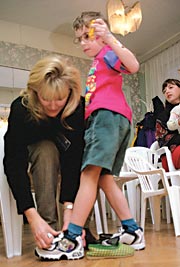
Buckner's Shoes for Orphan Souls drive puts shoes on the feet of children in more than 40 countries.

Shoes for Orphan Souls has distributed about 1.1 million pairs of shoes since Buckner assumed the drive in 1999. Each pair of shoes represents a child who hears the gospel and knows he is loved, said Shuan Hawkins, director of Shoes for Orphan Souls.

“People love to give shoes because they're something tangible, something they can put their hands on and know that they're going to make a difference in a child's life,” she said. “It means they're going to meet a physical need and that each child is going to receive the message that Jesus loves them.”

Orphanage improvement is another aspect of Buckner's international ministry and is fundamental to caring for children and showing them God's love, Douris said. He remembered an orphanage in Huehuetenango, Guatemala, located in the middle of a junkyard where children played amid glass, broken car parts and garbage.

“Where you place a child reflects how much you care for them and the value that you place on them,” Douris said. “We hope to improve their surroundings to reflect the care and love that they deserve. So wherever we go, construction projects are a big part of what we do.”

More than 700 people participated in international mission trips through Buckner last year, traveling to all parts of the world to help build or renovate facilities, lead Vacation Bible Schools and sports camps, or deliver new shoes.

Charles Risinger, recently retired from Eastman Chemical Company and a member of First Baptist Church in Longview, has traveled on three Buckner mission trips in the past two years–two with his church and one on his own. The personal interaction and relationships he's built with the children in Latvia have changed his life, he insists.

“Your faith gets stretched in a way that we don't allow it to stretch when we're at home,” he said. “You see how God makes things happen when you realize that it's just not humanly possible for you to have done it yourself.”

After spending a majority of his trip ministering to teenaged boys on the streets of Liepaja, Risinger re-called visiting a baby orphanage for the first time. One little girl would “melt” on his shoulders, wrapping her arms around his neck in un-abashed affection.

“I don't know what heaven's going to be like,” he said, “but the love that you get when you go to that place has got to be as close as you could possibly get.”

Buckner's latest challenge is developing programs in Africa to care for the 12 million children orphaned by the AIDS epidemic and the estimated 25 million who will be orphaned in the next five years.

This summer at the Cooperative Baptist Fellowship General Assembly in Grapevine, Buckner and CBF announced a new partnership called KidsHeart–an initiative that calls for the creation of five church-based development centers in Kenya and the financial underwriting of a group home, foster care program and preschool program in South Africa.
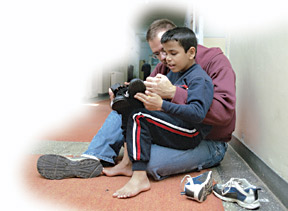
A Buckner Orphan Care International volunteer places shoes on the feet of a child living in a Romanian orphanage. About 700 volunteers will travel on Buckner-led mission trips this year.

While Buckner and CBF already have programs established in Kenya through the Baptist Center of Nairobi, this new partnership will reach out to more hurting children and lay the foundation for further growth, officials with both organizations believe.

“One of the most frustrating things for me is that I see the 40 children we have in care and the 29 we have in foster care, and I walk down the streets of Nairobi and see hundreds upon hundreds of kids who could use these services,” Douris said.

Shoe coordinator Hawkins constantly reminds herself of Ephesians 3:20, a passage “that talks about how God does exceedingly and abundantly more than we could ask or imagine,” she said.

“It's just amazing to see where we've been and what we've done, but as far as the future goes, I can't quantify it or give specifics. Our God is a big God, and he does incredibly big things. Obviously we want to reach as many children as we can, but to try and understand how the Lord is going to do that, it just blows my mind.”

News of religion, faith, missions, Bible study and Christian ministry among Texas Baptist churches, in the BGCT, the Southern Baptist Convention ( SBC ) and around the world.



Doors open to Christian business

Posted: 9/02/05

Doors open to Christian business

By Ken Camp

Managing Editor

DALLAS–The authentic witness of Christian laypeople who conduct business in a global market–in contrast to covert operations by clandestine missionaries who enter closed countries under the guise of “shell businesses”–represents a key strategy for 21st century missions, a Texas Baptist missions leader insists.

Many nations closed to missions often remain open to business, but leaders of those countries only want professionals who can provide real services and help stimulate economic growth, said Bill Tinsley, leader of WorldconneX, a missions network launched by the Baptist General Convention of Texas.

Providing expertise in cooperation with governments in closed countries has reaped spiritual rewards for Christian business professionals. This orphanage in Asia benefited from such a project.

In recent years, some Christian missionaries slipped into closed countries under the guise of businesspeople as covers for their real work of evangelism and church starting, he noted. But when the missionaries had no genuine business expertise, that approach often proved counterproductive.

“I've heard from missionaries who said that most of the time, they never felt comfortable misrepresenting themselves,” Tinsley said. “And when community leaders–especially government officials–realized they were misrepresenting themselves, it was detrimental to the integrity of their witness and to their effectiveness in sharing the gospel.”

In contrast, government leaders in some countries that reject traditional missions welcome productive businesses that operate on ethical, moral principles and treat their employees and customers with respect, he noted.

“There's new movement in missions–Great Commission companies doing business on the basis of the gospel rather than greed,” he said. “Owners of these businesses are committed to making a profit and making disciples.”

Governments also welcome Christians who can create infrastructure in developing nations–developing systems for communications, health care, child care and sustainable economic growth, he noted.

“This approach that some call 'nation-building'–working with the government–can be an open door as Christians build relationships and earn trust,” Tinsley said.

“An underlying idea is that there is value in Christians helping people have better lives, even if it never leads to evangelism. The hope is that eventually, in time, it will open the door to the gospel.”

Tinsley points to the example of a Houston layman who, as president of a wireless telephone company, was invited by the government in Guinea to help privatize the nation's phone system.

At age 70, he moved to Guinea for 18 months and earned the trust of high-ranking officials, including the predominantly Muslim nation's president and army chief of staff. Over the last 10 years, he was able to start a school and a church for refugees where the only place of worship previously was a mosque.

Recently, he also leased more than 250,000 acres from the government and is enlisting Christian farmers to sublease the property and start farms where they can provide jobs and training for unemployed people. Christians will have the opportunity to share their faith and disciple new believers while improving the quality of life and the economy in Guinea, Tinsley noted.

A connected world, global business and lay missions involvement are among the "new realities" Tinsley identifies in his book, Finding God's Vision: Missions and the New Realities.

“When God established the church, he gave all of his word and all of his work to all of his people to reach all of the nations,” he said, repeating the book's central theme and a philosophy that guides WorldconneX.

“Lay people are thinking about God's work in ways they have not done so before. They are asking how they can use their professions in missions,” he said.

In response, new missions organizations are emerging to help provide avenues for laity to fulfill their calling, and churches are returning to the forefront of mission, he asserted.

Traditional missionary-sending agencies will continue to play a vital role, but missionaries on the field may need to become mentors, trainers and resource people for lay people, he noted.

“Career missionaries are needed to make the connections, strategize with nationals and equip volunteers,” he said. “Typically, career missionaries are better trained at cross-cultural missions and indigenous missions. Volunteers sometimes can take their passion to the field but without adequate training.”

Career missionaries can help volunteers work strategically and effectively build long-term relationships with indigenous Christians, he noted.

Missions partnerships linking denominational groups or congregations will continue to be a point of entry into hands-on missions for some churches and their members, but others will enter missions through different channels, Tinsley predicted.

“I believe God is prepared to release greater resources for missions than our systems can contain,” he said.

News of religion, faith, missions, Bible study and Christian ministry among Texas Baptist churches, in the BGCT, the Southern Baptist Convention ( SBC ) and around the world.


Enter in front door

Posted: 9/02/05

Enter in front door

By John Hall

Texas Baptist Communications

Why sneak in the back door when the front entry works just fine?

That's the question a growing group of church leaders are asking as they do mission work around the globe, including nations often viewed as closed to Christian service. These ministers have found governments worldwide to be open to Christian help when approached appropriately.

Each congregation in the Glocalnet network begins by starting a relationship with a government official in a chosen nation. Over time, a church begins to know the needs of a nation and volunteers to help where it can.

Bob Roberts, pastor of Northwood Church for the Communities in Keller and Glocalnet founder, said congregations using this approach to international mission work specifically see a country's infrastructure–schools, medical facilities, businesses–as a place Christians can serve.

These foreign countries–many of them in the Third World–are eager to seize opportunities to improve themselves, even if it is with the help of an openly Christian group, Roberts said.

For example, Northwood recently learned through a government official about a need for a special-education curriculum in one of the countries it is serving, Roberts said. The congregation had a ministry for special-needs individuals and adapted that curriculum for the nation.

Northwood recently attained nongovernmental agency status in Vietnam, a designation that allows the congregation to talk openly about its work in a country where vocational missionaries are not named for security reasons.

The mission is practical, but it provides avenues for spiritual conversations, Roberts said. “We build relationships with people. They ask us about our faith.” As locals hear the gospel, some will convert to Christianity and provide the basis of a church in the nation.

Glocalnet leaders believe their approach acutely uses the talents of laypeople. Northwood has sent 200 people–mostly laypeople–in the past year to a particular country it has adopted. Trips typically last at least one week, and the church is developing long-term opportunities for members.

Laypersons can use their occupational skills in serving God on the other side of the globe. People in the pews have skills that vocational ministers lack, said Jonathan Atwell, pastor of CrossRoads Church in Haltom City.

“What is important to us is to involve our entire congregation in what we are doing around the world,” Atwell said.

Church leaders involved in Glocalnet believe Christ transforms lives, and people whose lives have been transformed have a transforming impact on other people–and even nations. But it takes time and patience.

Roberts believes it will take at least 30 years for congregations to see significant changes. That may seem like a hefty commitment, but slow development builds faithful people into the heart of a society and can lead to spreading of Christianity.

“Just like in our churches, we try to meet felt needs,” Atwell said. “It's the same there.”

News of religion, faith, missions, Bible study and Christian ministry among Texas Baptist churches, in the BGCT, the Southern Baptist Convention ( SBC ) and around the world.