Combat chaplain performs ‘spiritual triage’ in war zone

Posted: 9/30/05

Army Chaplain Joe Moffitt helps soldiers wrestle with fear, doubt and the pain of being separated from home and family.

Combat chaplain performs
'spiritual triage' in war zone

By Ken Camp

Managing Editor

NORTHERN IRAQ–Army Chaplain Joe Moffitt sees himself as a spiritual medic who offers healing to souls in trauma.

“I have found that pastoral care here is oftentimes more like triage, as compared to that in the church. There are times when you experience the traumatic in the church, but I am inundated with it here,” said Moffitt, pastor of St. John's Baptist Church in Virginia Beach, Va., who has served since last November as troop chaplain with the 463rd Engineer Combat Battalion north of Baghdad.

“The decisions these soldiers make on a day-to-day basis can get themselves or someone else killed or hurt. They deal with death and the possibility of it. They are separated from their families. And when their families are hurting, most often, there is nothing these guys can do about it.
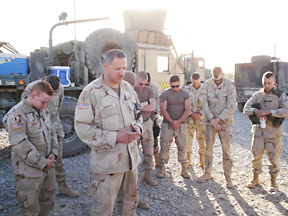
Chaplain Joe Moffitt prays with soldiers before they head into Tikrit on a mission.

“It is triage, helping these guys so they can continue to function in a combat setting. In the local church, for the most part, it is systematic growth with some trauma thrown in; here, it is mostly trauma that I am dealing with.”

Moffitt offers no easy answers. Rather, he offers to join the soldiers on the journey of discovering God in the middle of tough times.

“In a dry and weary land where there is no water, I try to help them find water. I give them permission to say what they feel. I help them articulate their thoughts,” he said. “Together, we look for God in the midst of the pain, and God is never far way.”

Moffitt, a graduate of Wayland Baptist University in Plainview and Baptist Theological Seminary in Richmond, Va., believes the common thread running through pastoral care–whether in a church in the United States or a military unit in Iraq–is building relationships.

“If you have a good relationship, if they know that you care about them and love them, they respond,” he said.

Military Chaplains
Chaplain serves military assigned to hurricane-ravaged area
Help families prepare for troops' return, chaplain urges
Combat chaplain performs 'spiritual triage' in war zone

Deep relationships with soldiers that can lead to meaningful spiritual discussions grow out of common experiences, said Moffitt, a Cooperative Bap-tist Fellowship-endorsed chaplain who served three years active duty in the Army before college and has continued in the Army Reserve.

“I share the danger with these guys. I live with them, I eat with them, I miss sleep with them, and I have earned the right to ask them about anything I want to ask them about,” he said.

“I have earned their trust, and because of that, I have had soldiers approach me with spiritual questions–and I have been surprised at some who have.”
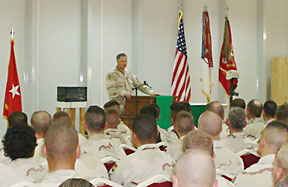
Moffitt delivers a message at a memorial service for a fallen soldier.

Certain moments of spiritual and emotional intimacy have left a profound impression on Moffitt: “Holding a soldier while he clings to me and weeps because his world has fallen apart. Standing in a group of my soldiers, touching one another, grieving for one of our comrades who was killed. Holding the hand and praying with a kid while waiting for a MEDIVAC helicopter–a soldier who has just had half his foot taken off by shrapnel, and he is angry because he never had a chance to fight the guys who did it.

“Rejoicing with a kid who has missed having his head taken off by half an inch. Holding a 3-year-old Iraqi girl who has had terrible things done to her and her family by insurgents. I will never forget her face. Being thanked by a teenage Iraqi boy for giving him a future. Having my cheeks kissed by an old man for being here.”

Soldiers wrestle with fear, doubt and the pain of being separated from home and family, and Moffitt has found it helpful to let troops know their chaplain shares the same feelings.

“They are tired, and I am, too. They have problems at home; I can relate. They are lonely; I am, too. At times, they struggle with fear. I struggle with that, as well, at times. They are angry and confused. I am oftentimes feeling it with them,” he said.

“I am a spiritual friend to these guys, and I walk with them through their pain. Often, I am experiencing it with them, and that is why it is so important that my relationship with God is right.”

In particular, Moffitt has found it difficult to be separated from his 2-year-old daughter, Jordan, and his wife, Kelli, who is expecting their second child in November. He last saw them in February when he was home on leave.

Moffitt feels grateful for the ministry his church provides to his family while he is serving overseas, and for the way deacons and retired ministers in the congregation have served in his absence.

“I cannot say enough for them, but because of them, I was able to focus on my duty, my soldiers, my calling because I knew that my family was in good hands,” he said.

Moffitt's call to active duty in Iraq came at a difficult time for St. John's Baptist Church, which had just started a $3 million building project. But Moffitt made it clear he was in the Army Reserve when the church called him as pastor.

“So, they knew the chances were high for me to be called up,” he said. “I have a great church, and they are very supportive. We live in a Navy town, so many of my parishioners are currently in the service, retired or prior service. They view this as a calling for me and for them. This is their way of supporting our nation.”

News of religion, faith, missions, Bible study and Christian ministry among Texas Baptist churches, in the BGCT, the Southern Baptist Convention ( SBC ) and around the world.


Right or Wrong? A covenant of trust

Posted: 9/30/05

Right or Wrong:
A covenant of trust

We are updating our church bylaws, and we want to include statements that reflect the expected behavior of our pastor, staff and members, too. Is this a good thing to do? What resources are available for developing these statements?

Since this is a column with an ethical intent, let me begin by unequivocally saying that including expected standards of behavior in your church bylaws is possibly a good idea and possibly a bad idea. Generally, bylaws are written to give broad guidelines of governance to your church. But most often, bylaws leave a little wiggle room for peculiar circumstances that occasionally arise in the give-and-take of dealing with people.

You may want to place general guidelines in your bylaws, addressing expectations of integrity, honor, kindness, responsibility and so forth. These ideas are clear enough in addressing expectations without being cumbersome or overly specific.

But bylaws are not the place to try to legislate minute, specific staff behaviors. For instance, 20 years ago, if you were attempting to legislate the behavior of your staff through the bylaws, who would have thought to include a provision limiting the amount of time staff could spend communicating with old friends on Instant Messenger? In my experience as a pastor, I have dealt with staff issues that were not technologically possible even 10 years ago.

Let me suggest a more practical solution. Think about creating a minister/congregation covenant. During last year's Baptist General Convention of Texas annual meeting in San Antonio, the convention received a report from a committee charged with creating a “'Code of Ethics for Baptist Ministers,' which could serve as a model for ministers, churches and Baptist institutions, … which reflect basic ethical obligations for ministry.” The final result is a publication titled Ministerial Ethics: A Covenant of Trust. This covenant is available free of charge from the BGCT Christian Life Commission.

The idea behind this covenant is that ministerial ethics not only concern and benefit the minister, but ministerial ethics benefit the church.

Together, the minister and the church covenant to respect and value the minister's various relationships, use of time, management of health, economic responsibilities, sexual conduct and role within the community. Upon addressing these issues, the minister and the church enter into a covenant in which each recognizes the value and the need for the other. This covenant also allows both parties to clearly understand one another in these sensitive issues.

Rather than waving a set of bylaws in the face of a failed minister, the minister and the church should act proactively to establish expectations and mutual trust from the beginning of a minister's tenure. Within the covenant, the church recognizes the value of time off and adequate compensation that help the minister avoid the pressures that often lead to failure. The minister gains the realization that personal behavior is genuinely public behavior that has impact upon the church and its reputation. Using the church bylaws to address general expectations is fine. But to encourage a healthy relationship between the minister and the congregation, consider mutually signing a church covenant. It's not only good for the minister; it's good for the church.

Stacy Conner, pastor

First Baptist Church

Muleshoe

Right or Wrong? is sponsored by the T.B. Maston Chair of Christian Ethics at Hardin-Simmons University's Logsdon School of Theology. Send your questions about how to apply your faith to btillman@hsutx.edu.

News of religion, faith, missions, Bible study and Christian ministry among Texas Baptist churches, in the BGCT, the Southern Baptist Convention ( SBC ) and around the world.


[The reader comments feature on this page will return as soon as we work out some bugs. Sorry for the inconvenience.]


BaptistWay Bible Series for Oct. 9: Entering the Promised Land takes commitment

Posted: 9/28/05

BaptistWay Bible Series for Oct. 9

Entering the Promised Land takes commitment

• Joshua 24:1-3, 13-25

By Ronnie Prevost

Logsdon Seminary, Abilene

Make up your mind! Fish or cut bait!

How many times have you heard those demands? How many times have you made them? There are many reasons some decisions can be very difficult to make. One is that life is full of choices.

Marketers cater to every detail and dimension of human preferences. The result has been—from cars to frozen dinners—a myriad and usually confusing number of options.

Another is that so many things vie for our attention and our allegiance. Some are, in and of themselves, good and healthy. Others are not so. Nevertheless, all and each call on us to give them the majority of our attention and place them at the top of our list of priorities.

Then, there are people who find commitment difficult. And that is what making a decision really amounts to—committing to one way over another. These people may be afraid to “put all their eggs into one basket.” Perhaps they unrealistically are waiting for “something better” to come along. They may fear the personal investment real commitment requires.

In the Scripture passage for this lesson, the Israelites had reached the point of decision.

In chapters 13-23 of Joshua, we read of Israel’s campaign of conquest by which they established their presence in Canaan. Striking through the middle of Canaan, they divided and conquered. Then the land was divided among the Israelite tribes.

After the allotment, we read Joshua’s farewell address in chapter 23. In that passage, Joshua reminds Israel of the many great works God had done on their behalf. He encourages them to follow in faith. And he cautions them against allying with those who do not worship the Lord.

Finally, in chapter 24, Joshua calls Israel together at Shechem, between Mount Gerizim and Mount Ebal. Shechem had been an important Canaanite urban and worship center and the site where the Canaanite god, Baal-berith (significant to this lesson meaning “lord of the covenant”) had stood.

But it also was a significant place for Israel. Genesis 12:6-7 tells us it was where God had promised Abram the surrounding land and where Abram had built an altar in response. Genesis 33:18-20 tells of Jacob buying land within sight of Shechem. He named the site “El Elohe Israel,” which meant either “God the God of Israel” or “mighty is the God of Israel.”

How appropriate that near El Elohe Israel—as we read in 24:1-13 —Joshua refers to God’s work on behalf of Israel, beginning with Abraham, through Egypt and the wandering, and, finally, into Canaan.

“Beyond the river” in 24:14 refers to the Euphrates River in today’s Iraq. That was the ancestral homeland of Abram/Abraham. The Lord had called their great forefather out of this area and the worship of many gods. In 24:14, Joshua also alludes to Israel’s exposure, during the many years of sojourn and bondage in Egypt, to the worship of the Egyptian gods.

Joshua was challenging Israel, in light of what the Lord has done in keeping his covenant/contract obligations, to choose whom to serve. It was as if to say: Abraham, Moses and many of your ancestors made their commitments. Now is the time for you to make your own.

Many “gods” were vying for the attention and hearts of the Israelites. However, Joshua was making the point that it was the Lord who had redeemed them. It was the Lord who had called them. It was the Lord who had preserved them. And it was the Lord who had done mighty works and won victories for them.

Joshua was challenging them, therefore, to commit to that same Lord God. He was saying to Israel, in other words, “Dance with who brung ya.” 24:15 shows Joshua’s leadership in his willingness to follow God regardless of what may have been the response of others.

Israel replied with words of commitment to worship and serve the Lord God who had freed and preserved them. But Joshua wondered if perhaps they had answered too quickly and too easily. Did they understand the challenges of their commitment? Could they, would they, persevere? Could they truly put away the foreign gods/idols as needed to fulfill their promise (v. 23)?

We should ask ourselves the same questions. The Lord who redeemed Israel redeemed us. He preserved them. He preserves us. Just as he had done great things for them, he has done great things for us. He called Israel to serve him. He calls us. And we, too, are challenged each day to decide whom we will serve.

Are we afraid of the commitment? (Listen, nothing better is coming along.) Or do we make those commitments too easily? Are we willing and ready to fully serve God as Lord of our lives? How is our commitment to God incomplete—what do we hold back? Will we put away all the things that keep us from a deeper commitment to God? How would complete commitment to God change our lives?

This is the challenge of faith: among all the “gods” vying for your heart, “choose for yourselves this day whom you will serve.”


Discussion questions

• What are some otherwise good and healthy things that you have put ahead of God in your list of priorities?

• How would your life be different if you put those away and returned God to his rightful place in your life?


News of religion, faith, missions, Bible study and Christian ministry among Texas Baptist churches, in the BGCT, the Southern Baptist Convention ( SBC ) and around the world.


Family Bible Series for Oct. 9: Experience God’s life-changing power

Posted: 9/28/05

Family Bible Series for Oct. 9

Experience God’s life-changing power

• Ephesians 1:18-23; 2:1-10

By Donald Raney

Westlake Chapel, Graham

Have you noticed that over the past decade or more, it has become somewhat hip to be “spiritual”? From the expansion of “spirituality” sections of bookstores to television programs and movies about the supernatural to open admissions by celebrities, our culture seems to be saturated with the quest for something beyond this physical existence.

This quest, of course, is nothing new. It has been a universal characteristic of humanity through the millennia of history that we have an inherent sense there is much more to reality than what we experience though our senses.

The history and continued presence of religion testifies to humanity’s quest to find, understand and connect with the supernatural power we know must be there. We hunger for this connection because we know there simply has to be something better—some place without all of the violence, pain and destruction we see every day.

Last week, we discussed how we were created for a specific purpose. We were not created to live lives overcome by the world and its troubles but were created to live holy lives in communion with the Creator. Yet God has not only called us to live according to his original plan, but God has provided us with all we need to fulfill that calling. Only through Jesus can we experience the life-changing power that satisfies that spiritual hunger within each of us.


Ephesians 1:18-23

Having laid out the reality of the believer’s inheritance through Jesus in the first part of chapter 1, the Apostle Paul expresses hope that his readers would truly understand the power of God available to each believer through Christ. Paul knew that while God had called those who believe to live holy lives, God also offered believers the full “riches of his glorious inheritance” and his “incomparably great power” in this life (vv. 18-19).

To demonstrate how great that power is, Paul reminded his readers of two specific demonstrations of that power in verse 20—the resurrection of Jesus and the elevation of Jesus to the right hand of God. In doing this, God raised Jesus to a position far above all worldly powers. Jesus maintains this position throughout the generations of human history.

This certainly would be good news to a people being daily persecuted by one of those worldly powers. God had placed even the power of Rome in subjection to Jesus. This clearly was an infinite source of power.

Verse 22 then tells us God did all of this “for the church.” This infinite source of power was thus available to believers. Believers did not then have to merely exist and strive through a life of trouble. The same power that had raised Jesus from death to a heavenly throne certainly could raise them to a new life within the blessings of God.


Ephesians 2:1-3

Many people today may well ask why anyone would need to rely on such a supernatural source of power. With all of our technological advancements, humanity has raised itself far beyond the primitive days of such reliance. Yet one need not look far to see that our technology has done nothing to deal with the morally fallen state of the human heart and of our world.

In Ephesians 2:1, Paul tells us that prior to a personal encounter with the power of God through Christ, every person is “dead” spiritually because of the presence of sin. Within such a condition, we are naturally powerless to do anything to fill the spiritual void we each feel.

Paul goes on to say that not only is our spirit dead, but the life we do lead in this world is lived in subjection to the “ruler of the kingdom of the air.” While Satan cannot force anyone to act in a certain way, his influence is so prevalent in this world that the natural inclination of humanity is to gratify all of the desires of the flesh. Those desires of our physical nature constantly are trying to take our focus away from the higher things of the spirit. Yielding to our natural tendency to satisfy those physical desires places us in a position of being objects of God’s wrath.


Ephesians 2:4-10

Yet because of the infinite depth of God’s love for humanity, God would not allow us to remain in that condition. God had created us to be in an intimate relationship with God. Sin had broken that relationship and left humanity unable to restore it. Thus in an act of boundless grace, God freely provided humanity with the pathway and the power to restore that relationship and thereby satisfy the deepest need of our lives. Salvation is possible only through the grace of God.

Paul emphasizes this in these verses as he uses the word “grace” three times. Our salvation is not based on any works or good deeds we might do. Yet this salvation does require that we make a conscious choice to accept God’s offer. We must exercise our faith in believing this message (v. 8). Once we take this step of faith, the great spiritual longing of our life is completely satisfied as this Jesus whom God has exalted showers us with the “incomparable riches of his grace (v. 7).


Discussion questions

• What other sources do people use to try and satisfy their spiritual hunger?

• How have you personally experienced the power of God in your life?

• How do you define “grace”?


News of religion, faith, missions, Bible study and Christian ministry among Texas Baptist churches, in the BGCT, the Southern Baptist Convention ( SBC ) and around the world.


Explore the Bible Series for Oct. 9: Peace with God is available for the asking

Posted: 9/28/05

Explore the Bible Series for Oct. 9

Peace with God is available for the asking

• Romans 5:1-11

By Trey Turner

Canyon Creek Baptist Church, Temple

Christians in the West are labeled when they talk about a sense of security in Jesus Christ. An interview with the contemporary entertainer Moby in the May-June issue of Relevant typifies how the Christian’s assurance is repudiated, probably because it is misunderstood.

He says, “The thing that has always boggled my mind is when someone feels confident that they’re saved. (I want to say to them) didn’t you read?” Moby continues comparing the self-assurance by the religious people in the temple while the tax-collector cried out pounding on his chest in shame.

In deference to Moby, Christians need to note the proper place of humility in their daily life, but the basis of salvation happens outside the believer—taking away anyone’s right to be proud. Christians can have peace with God because of the finished work of Jesus.

When considering the phrase “peace with God,” the book and tracts by Billy Graham come to mind. Graham’s gospel presentation is known for its simplicity, and he is known for peace and reconciliation; there could be no greater compliment to any person. A person can find peace with God, rejoice unashamedly and never worry that God will turn his back.


We have peace (Romans 5:1-2)

The Apostle Paul has finished telling how it is not necessary for a person to realize his or her need in order to be lost (1:18-20; 2:11-12; 3:9). All are unrighteous before God.

Henry David Thoreau is credited with a conversation in a biography where he is asked by an aunt, “Have you made your peace with God?” To which Thoreau responded, “I did not know we had ever quarreled, Aunt.”

Thoreau may not perceive a quarrel, but all people are separated from God and need the salvation he extends to them. Christ has provided the only acceptable means of salvation.

Now, Paul presumes the hearer or reader understands where the conversation has led. He is confident in the fact he has presented the need for Christ and can proceed with the discussion as if the reader or hearer is taking the next step in faith: “Since we have been justified through faith … we stand.”

Peace with God is established by Jesus Christ. It would not be right to presume Paul is talking about universal salvation as a result of Jesus’ death on the cross. One must receive the One who is that peace (10:9-11, 13)


We can rejoice (Romans 5:2-5)

Peace with God is a reason to rejoice. It is the future reality of God’s glory to be experienced one day. The word “hope” is not wishful thinking. This hope anticipates that which is sure but not yet a reality. Meanwhile, there is another reason for rejoicing. Extending the hope you have for the reality you anticipate, rejoice in the midst of suffering because of the progression of quality it adds to your soul. Paul promises believers they will not be disappointed. Suffering believers have the presence of God in the person of his Holy Spirit.


We are secure (Romans 5:6-11)

The basis of the believer’s security is the death and resurrection of Jesus Christ. Paul presents this amazing reason for assurance which can be seen in God’s commitment to sinful humanity while they were sinners. Paul rightly uses the word “we.”

Christians have a reason to rejoice in their security because God who loved his fallen creation, sent Jesus. God’s demonstration of love is this: Jesus died for the enemies of God. So, there is no justifiable reason a person would think God does not rejoice in that person’s developing faith.

God established the believer’s peace with God. How much more does the Christian life demonstrate power built on the miracle of new birth?


Discussion questions

• Why do some people have difficulty with the idea of someone being confident in his or her salvation?

• Describe the peace God gives in Jesus.

• What does someone need to know to have peace with God?

• Describe the joy that comes through suffering.


News of religion, faith, missions, Bible study and Christian ministry among Texas Baptist churches, in the BGCT, the Southern Baptist Convention ( SBC ) and around the world.


Cyber Column by Berry D. Simpson: Begging prayer

Posted: 9/30/05

CYBER COLUMN:
Begging prayer

By Berry D. Simpson

In West With the Night, Beryl Markham writes: “In Africa, people learn to serve each other. They live on credit balances of little favors that they give and may, one day, ask to have returned. In any country almost empty of men, ‘love thy neighbor’ is less a pious injunction than a rule for survival.”

In Karimoja, northeast Uganda, they beg from each other.

We were warned: “The Karimojong are always begging. You will be begged for money, for your watch, for your hat, for your sunglasses, for your clothes, for medicine and anything else they can think of.”

Berry D. Simpson

Most of the time, my wife, Cyndi, and I were so ignorant of the language we had no idea we were being begged. One time, we were walking back from church with English-speaking Martha, and three women were trying to talk to Cyndi. She asked Martha what they were saying, and Martha said they were begging for 100 shillings.

It was surprising on several levels. For one, we were being begged aggressively and had no idea it was happening. The other is that Martha, who was taking us around, didn’t intervene. If I’d been Martha, I would’ve told the women: “Leave my friends alone. Can’t you see they are guests?” But begging was so natural to her she saw no need to intervene. Neither did she seem embarrassed by the beggar’s behavior or upset at her. Martha was very matter-of-fact about the whole thing.

At the village of Nariwore. a young man who was serving as my interpreter noticed my watch and asked me to bring him one when I come back from America. He said, “Then we’ll be friends.”

On that same trip, Longo, who was carrying his stuff in a black plastic bag, asked me to bring him a backpack like mine when I come back to Africa. Back home, I might ask, “Where can I get one like yours,” but Longo expected me to furnish one for him. He said, “Then people will know we are friends because I have a pack like yours.”

Cyndi had her own story. Losilo asked Cyndi for her shirt. She was wearing a khaki long-sleeved backpacker’s shirt, and he wanted it. They never asked for my clothes; maybe my shirts were too sweaty. Or maybe because I was significantly larger than most of the guys and my shirts wouldn’t fit. Cyndi was actually about the same size as Losilo. She told him, “No, I want to keep this shirt.”

The thing is, we could’ve replaced anything we gave away easily and cheaply once we got home, and our giveaways would serve these Karimojong for many years. Why be so stingy and selfish? After all, we are rich Americans and have lots to share. But giveaways have hurt Africa as much as they’ve helped, and we didn’t want to upset the relationship between Jacob, a missionary living in Karimoja studying the language, and the Karimojong after we left. We’d be the generous benevolent Americans giving away all our stuff and feeling good about ourselves, leaving Jacob with the expectations for more and more and more.

One curious thing about begging: The Karimojong word for prayer is “akilip.” It means “to pray.” It also means “to beg.” It’s the same word.

I asked Jacob how this worked. He told me, the word “akilip” originally meant “to beg.” It was what ordinary citizens of the community would do when they asked the Big Men of the community for food, cattle or possessions. Historically, the Karimojong belief in God never went beyond the idea that the Creator was a Big Man with a storehouse of blessings, and in order to receive anything good from him, he must be begged. So they begged him, believing that just like the Big Men in the community, God might give to them. When Christians first entered Karimoja and started talking about prayer, the people said, “We already do that, and the word is ‘akilip.’” A new word never was coined.

At first, Cyndi and I thought that using the same word for prayer and begging was offensive, and Cyndi said, “Yikes, we need a new word!”

But the more we thought about it, the more we understood. What is prayer, really, but begging for God’s grace? Anne Lamott writes, “There are only two prayers: ‘Help me, help me, help me,’ and “Thank you, thank you, thank you.’” Sounds like begging, doesn’t it?

While we use words like “petitioning” and “adoration” and “praising” and “interceding,” it’s all pretty much about begging for grace from God. And, amazingly enough, it’s through that begging—praying—that we become friends with God.


Berry Simpson, a Sunday school teacher at First Baptist Church in Midland, is a petroleum engineer, writer, runner and member of the city council in Midland. You can contact him through e-mail at berry@stonefoot.org.


News of religion, faith, missions, Bible study and Christian ministry among Texas Baptist churches, in the BGCT, the Southern Baptist Convention ( SBC ) and around the world.


Add our scrolling headlines to your website or blog

Put scrolling headlines of our
RSS feed on your website, journal or blog

Provide your friends, clients, visitors or even curious drop-ins to your site with up-to-the-minute news from The Baptist Standard, the Texas Baptist NewsJournal.

We've teamed with Feedburner.com to provide a "feed animator" for your site. Simply copy and paste this html script below into the source of your page.

<a href="http://baptiststandard.com/"><img src="http://feeds.feedburner.com/TheBaptistStandard.gif" height="67" width="200" style="border:0" alt="The Baptist Standard"/></a>

It will display like this:

That's all there is to it.

Of course, you can always add our (Really Simple Syndication) feed to your RSS news reader with this url:

http://feeds.feedburner.com/TheBaptistStandard

News of religion, faith, missions, Bible study and Christian ministry among Texas Baptist churches, in the BGCT, the Southern Baptist Convention ( SBC ) and around the world.


Controversial Bible curriculum revised

Posted: 9/30/05

Controversial Bible curriculum revised

By Robert Marus

ABP Washington Bureau

WASHINGTON (ABP)–A group that encourages teaching the Bible as history and literature in the public schools has revised its curriculum, incorporating many of the changes recommended by an organization it characterized as “anti-religion extremists.”

In late August, the National Council on Bible Curriculum in Public Schools issued the revision–the second in seven months–of its teaching guide, The Bible in History and Literature.

National Council leaders released the revision at a Washington press conference, not long after the Texas Freedom Network issued a lengthy report contending the curriculum had serious constitutional and academic problems and less than three weeks after the Baptist Standard published an in-depth examination of the material.

“The best Bible curriculum in the country has just gotten better,” Mike Johnson said in introducing the changes. Johnson, a member of the National Council board, also is an attorney for the Alliance Defense Fund, one of several Religious Right groups with close ties to the National Council.

On Aug. 1, the Texas Freedom Network released a report on the March 2005 revision of the curriculum. Mark Chancey, a religion professor at Southern Methodist University in Dallas, wrote the report.

Among other things, the curriculum “on the whole is a sectarian document, and I cannot recommend it for usage in a public-school setting,” Chancey concluded. “It attempts to persuade students to adopt views that are held primarily within certain conservative Protestant circles but not within the scholarly community, and it presents Christian faith claims as history.”

The Supreme Court has said the Bible may be taught in a public-school setting, but only in regard to its role as an important literary and historical document. Government promotion of any particular faith's doctrine violates the First Amend-ment, the court has said.

In his 33-page report, Chancey pointed out several instances in which the curriculum and its recommended supplementary materials seemed to favor one particular doctrinal or interpretive viewpoint regarding the Bible.

At the time, National Council officials lambasted Chancey's report and the Texas Freedom Network. A statement still posted on the council's website labeled the network “a radical humanist organization” and said the group was “desperate to ban one book–the Bible–from public schools.”

It also said Chancey's report “cites several passages from the teacher's guide to the curriculum out of context, and clearly misrepresents the curriculum's contents and objectives.”

The statement concluded: “In spite of the dubious manner in which (Texas Freedom Network) has attacked the curriculum, (the National Council) acknowledges that no curriculum is ever perfect. In its quest to continually improve its curriculum, (the council) has already begun carefully reviewing the report for any legitimate concerns, such as typographical or citations errors, and will modify its curriculum as appropriate.”

Many of Chancey's recommended changes–including substantive ones–are reflected in the August revision.

For example, Chancey faulted the curriculum for assuming a Protestant view of the Bible in the material's first section, titled “Introduction to the Bible.” It had asserted that there are 66 books in the entire Bible and that Scripture has two major divisions–the Old Testament and the New Testament.

Jews do not accept the New Testament as part of the Bible. Therefore, it is accepted practice among biblical scholars to refer to the Old Testament as the “Hebrew Bible.”

In addition, Catholics and Eastern Orthodox Christians accept several books as part of the biblical canon in addition to those Protestants accept.

The revised curriculum now begins the section by saying: “The term Bible means 'books,' but refers to different volumes for different religions. For example, 'the Hebrew Bible' of the Jewish faith contains 24 books. … While the Old Testament of the King James translation and other Protestant Bibles contains 39 books, it consists of 46 books in the Catholic Bible.”

In another example, the new version removes a citation, presented as fact, of an urban legend that attempted to prove the historical veracity of a famous passage from the book of Joshua. It had suggested that teachers tell their students to take note “in particular the interesting story of the sun standing still in chapter 10. There is documented research through NASA that two days were indeed unaccounted for in time (the other being in 2 Kings 20:8-11).”

A statement on NASA's website says the agency never made any such claim.

Asked if such revisions to the teacher's guide came in reaction to Chancey's report, a member of the council's board said they were simply part of a continual revision.

“We're engaged in an ongoing effort to improve the curriculum, and certainly we considered the comments and criticisms that were made,” said Steve Crampton, an attorney for the Mississippi-based American Family Association. “But, if anything, I think that the Texas Freedom Network's efforts resulted in maybe hastening some of the work that was already under way.”

Campton refused to retract the council's earlier characterizations of its critics as “anti-religion extremists.”

“I think the lip-service paid by the Texas Freedom Network that they are not against the teaching of the Bible in general–they've never met a Bible curriculum they didn't dislike,” he said. “They have repeatedly taken the far-left banner and attempted to squelch virtually every effort to introduce religion into the public square that has come down the pike in Texas.”

Dan Quinn, a Texas Free-dom Network spokesman, said that isn't the case.

“In the first place, this is the only curriculum that we've actually had a chance to review, so it's kind of hard to imagine that every curriculum we've seen we've rejected,” he said.

Quinn also noted the network's stated purpose is to defend religious freedom and other civil liberties.

“I think, really, the curriculum that Mr. Crampton was defending was pretty clear evidence that he and the National Council have a fundamental misunderstanding of what religious freedom really means,” he said.

“It does not mean using the government to impose your own religious beliefs and values on others.”

Chancey said he appreciated the changes. “I'd like to strongly commend the council for making many of the changes that they did, and the new edition is definitely a step in the right direction.”

However, he added, there still are difficulties–particularly in the material's assertions about the Bible's purported role in American history.

“It still seems fairly clear that whoever's putting it together doesn't have a whole lot of background in the material, so I'm skeptical in its present form that this would make it through the review process of a separate publisher,” Chancey said.

Both Chancey and Quinn noted they support teaching the Bible in public schools, as long as it's done in an academically rigorous and constitutionally appropriate way. They pointed to a just-released curriculum, aimed at high-school students, from the Bible Literacy Project.

A statement on the Bible Literacy Project website says the curriculum was assembled according to the standards of a consensus statement on the Bible in public schools endorsed by a wide variety of evangelical, mainline Protestant, Jewish and other groups as well as the federal Department of Education.

The curriculum, released Sept. 22, also will be subject to scholarly review.

News of religion, faith, missions, Bible study and Christian ministry among Texas Baptist churches, in the BGCT, the Southern Baptist Convention ( SBC ) and around the world.


Dallas Baptists find apartments for evacuees

Posted: 9/30/05

Dallas Baptists find apartments for evacuees

By John Hall

Texas Baptist Communications

DALLAS–Murray Broden and Benny Hand are getting used to running out of time. The two men held out in their New Orleans homes as long as they could until Hurricane Katrina made the situation too dangerous to withstand.

They evacuated the city and ended up in a temporary shelter at the Dallas Convention Center with only a few trash bags of belongings.

Julie Leftwich of Cliff Temple Baptist Church in Dallas helps a victim of Hurricane Katrina find an apartment in Dallas.

They discovered just how temporary the shelter would be when city officials announced their goal was to move evacuees from the convention center to alternative housing in a matter of days.

Fortunately, they met volunteers from Dallas-area churches who located an apartment in Plano for them. It is a place to stay and possibly start their lives anew.

“It's like a blessing straight out of the sky,” Hand said.

Broden and Hand are among more than 1,500 people from the convention center and arena that volunteers with Dallas Baptist Association have placed in apartments.

The effort is the result of a long-running relationship between Barbara Oden, the association's multihousing consultant, and apartment complex managers. Soon after Hurricane Katrina struck New Orleans, managers called Oden looking for ways to help evacuees. Many volunteered apartments for evacuees.

Oden set up a table at Reunion Arena and began connecting people with places to stay. While many people said they feel like they have been bounced from person to person like a pinball, the associational volunteers' yellow shirts became easily identifiable with people who want to help.

Julie Leftwich of Cliff Temple Baptist Church in Dallas said she wants to make a difference in at least one person's life. “I'd like to say: 'You're in the right place. I've got you a place to get started.'”

Dallas Baptist Association wants to furnish each apartment through donations from Dallas-area churches, Oden said. The Baptist General Convention of Texas helped connect the association with 4,000 mattresses through World Vision.

Congregations are coming together to adopt apartment complexes with evacuees, Oden continued. Church members can help provide transportation and emotional and spiritual support for each displaced person.

Dallas Baptists' assistance brightened the spirits of Hand and Broden, who were all smiles just prior to leaving for their new home. Both said they would consider staying in the Dallas area. Their new life may be starting with an apartment from Texas Baptists.

“It's a great weight off our shoulders,” Broden said. “It's a blessing.”

News of religion, faith, missions, Bible study and Christian ministry among Texas Baptist churches, in the BGCT, the Southern Baptist Convention ( SBC ) and around the world.


New Orleans seminary receives diverse assistance

Posted: 9/30/05

New Orleans seminary
receives diverse assistance

By Greg Warner

Associated Baptist Press

NEW ORLEANS (ABP)–Seminaries across the theological spectrum offered help to New Orleans Baptist Theological Semi-nary, which temporarily moved operations from its flooded campus to a satellite site in Atlanta.

Theological schools as diverse as conservative Dallas Theological Seminary and liberal Union Theological Seminary in Richmond, Va., offered help, including waived tuition and streamlined enrollment, to students who want to transfer for a semester or a year.

Even Atlantic School of Theology in Halifax, Nova Scotia–2,817 miles away by car–offered to waive international fees for New Orleans' students.

Moderate Baptist schools, such as Baylor University's Truett Theological Seminary, Baptist Theological Seminary at Richmond, and Gardner-Webb University's M. Christopher White School of Divinity, have invited students from New Orleans to enroll temporarily while the school gets back on its feet.

The Richmond seminary is offering to pay tuition costs for students who enroll in web-based or on-campus courses until normal operations resume at the New Orleans campus. At least one student has accepted a similar offer from Truett Seminary.

Dan Aleshire, executive director of the Association of Theological Schools, wrote New Orleans President Chuck Kelley to relay the offers of help.

But officials at New Orleans hope to keep most of their students connected to the Southern Baptist school.

About 1,500 of the seminary's 3,400 students are enrolled in one of 17 extension centers across the Southeast, which means almost half of the student body can continue study uninterrupted.

The 1,900 New Orleans-based students are being encouraged to enroll in the Atlanta extension, where the seminary administration has moved temporarily, in other extension centers, Internet classes or other alternatives.

Although the New Orleans campus will be closed until at least January 2006, most of the scheduled classes will be conducted as “directed study” with Internet enhancements, a seminary official said.

“Therefore, all of our on-campus students can complete this semester and keep on track toward graduation,” Provost Steve Lemke said in a letter to Aleshire. “Although a few of our students have transferred to other institutions who generously offered free tuition and lodging, we hope to keep the overwhelming number of students enrolled at NOBTS through these diverse delivery systems.

“Although most of our academic buildings survived with only modest damage, all 40 of our on-campus faculty residences and many of our student apartments were flooded from between four feet to 10 feet, essentially destroying all the earthly possessions of many in our seminary family.”

Most of the damage to faculty and student residences will not be covered by insurance, Lemke explained.

Some churches and seminaries are offering free or affordable housing to seminary students left homeless by the flooding.

Among the seminaries offering various types of assistance are Virginia Protestant Episcopal in Alexandria, Va.;, Lutheran Theolog-ical Southern Seminary in Columbia, S.C.; Associated Men-nonite Biblical Seminary in Elkhart, Ind.; United Theological Seminary in Dayton, Ohio; and Lexington (Ky.) Theological Seminary.

Southwestern Baptist Theolog-ical Seminary welcomed the New Orleans faculty to its Fort Worth campus for a hastily scheduled retreat Sept. 9-11, during which the New Orleans faculty made plans to continue the fall semester.

At a Sept. 27 meeting, New Orleans Seminary trustees voted unanimously to keep the school in New Orleans, and they proposed adminstrative plans to restore the main campus to normal operations by August 2006.

News of religion, faith, missions, Bible study and Christian ministry among Texas Baptist churches, in the BGCT, the Southern Baptist Convention ( SBC ) and around the world.


Buckner evacuates two facilities

Posted: 9/30/05

Buckner evacuates two facilities

Officials with Buckner Children's Village and Calder Woods retirement community are working to restore the two Beaumont campuses so residents can return as soon as state and local government officials give the “all-clear” signal.

Buckner Baptist Benevolences administrators have assessed both facilities in the wake of Hurricane Rita. Buckner relocated nearly 300 residents, staff and staff families before the hurricane hit. The group rode out the storm at First Baptist Church in Lufkin.

Since then, senior adult residents from Calder Woods have been moved to Buckner retirement communities in Longview and Dallas. Residents, staff, staff families and victims from Hurricane Katrina living at Buckner have moved from the Lufkin church to Camp Buckner near Marble Falls.

Buckner staff who have examined the children's home and retirement campuses reported neither sustained structural damage. However, there was some water damage from rain blown under doorways by the hurricane's high winds.

Calder Woods suffered “relatively minor damage to shingles and some carports,” said Charlie Wilson, interim general manager of Buckner Retirement Services.

Plans are under way for repairs to begin at both locations as soon as crews can start work, said Lloyd McWilliams, vice president of facilities management at Buckner. Most repairs will involve removing and replacing damaged carpet, he noted.

As of press time, Buckner officials were uncertain about when residents will be able to return to Beaumont. They are monitoring information provided by local officials.

“Buckner will have our staff in position to make repairs and clean up as soon as we are allowed in,” Wilson said. “We anticipate being able to move residents back in as soon as city services are restored and it is safe for residents to return.”

While many of the Calder Woods care and administrative staff have relocated to Dallas with residents, Charles Duit, director of food services at Calder Woods, stayed in Lufkin to provide food for the children and families there, and he moved to Camp Buckner with the group.

Duit and two of his staff members supervised the feeding of about 200 people left at First Baptist in Lufkin, working alongside the church's cooking staff.

Along with the senior adults, about 210 people were relocated from Buckner Children's Village in Beaumont, including 60 children in residential care, 20 caregivers–and an extended family of 20 staying at the children's home who were evacuated from New Orleans three weeks ago. In addition, Buckner relocated 59 foster children and their foster families and 61 Buckner staff family members. The group currently is housed at Buckner Children's Home in Dallas.

Felipe Garza, vice president and general manager of Buckner Children and Family Services, said he is awaiting further word about when the group can return to Beaumont.

Buckner officials said projected financial estimates indicate the combined Katrina and Rita disasters will cost the ministry a minimum of nearly $600,000.

For Calder Woods families seeking information about relatives affected by the relocation, Buckner has designated a response hotline to answer questions. Families may call (214) 758-8031 or email dhorton@buckner.org for 24-hour response. In addition, Buckner is asking displaced employees in Beaumont and Southeast Texas to contact the corporate office at (214) 758-8091, or toll free at (800) 442-4800, ext. 8091.

News of religion, faith, missions, Bible study and Christian ministry among Texas Baptist churches, in the BGCT, the Southern Baptist Convention ( SBC ) and around the world.


Katrina evacuees marry in shelter

Posted: 9/30/05

Katrina evacuees marry in shelter

By Craig Bird

Baptist Child & Family Services

SAN ANTONIO (ABP)–Inspired by the Christian faith of those who cared for them, a couple who fled New Orleans got married in the shelter that became their home after Hurricane Katrina.

Barry McBride and Samantha Holmes lived together the past three years. After their daughter was born four months ago, they decided they wanted to get married as soon as they “could move to a better neighborhood where she would have a better life.”

That was before Hurricane Katrina. They could not have envisioned the journey that followed, enduring five nightmarish days in the New Orleans Conven-tion Center before relocating to San Antonio.

Members of Churchill Baptist Church in San Antonio, who also have been volunteering to work in the BCFS shelter for special needs victims of Hurricane Katrina, do double duty as wedding planners as they help Samantha Holmes dress for her wedding to Barry McBride. (Photo by Craig Bird)

Twelve days after the storm, they were married in the sanctuary of Churchill Baptist Church in San Antonio before 50 witnesses–church members, volunteer relief workers and fellow evacuees who also took shelter in the church's gymnasium.

“Together, we decided it was time for us to give our lives to God, and this seemed like the best place to do it, a place where we have been surrounded by Christian people,” McBride said.

“When Barronice was born last May, we started talking seriously about getting married,” McBride explained as he waited, red rose in his lapel, for the 10 a.m. ceremony to begin. “But we wanted to wait until we could be in a better place for her and for us.”

That goal seemed totally out of reach when the New Orleans levees broke and the east side of the city flooded. At times, the couple wondered if any of them would survive. But eventually they were transported to San Antonio, along with 12,000 other storm victims. Their daughter's young age caused them to be assigned to the Baptist Child & Family Services, which cared for special-needs evacuees.

Churchill Baptist, one of seven emergency shelters operated by the San Antonio-based Texas Baptist charity, gave the couple food, medicine, a safe place to sleep and a sense of “home.” The couple became friends with relief workers, many of them Churchill members, who had a Christian faith that appealed to them, they said.

So a week after fleeing New Orleans, they stood before Pastor Neil Bennett and exchanged vows. A local bridal shop provided the wedding dress. Three teenage boys, who had never met until that morning, struggled to figure out how to play Here Comes the Bride on guitars.

“I am glad Barry and Samantha realized they needed to be married,” Bennett said. “And I am pleased Churchill Baptist can play a role in that.”

Several church members told the couple they would continue to pray for them.

Before the wedding, Holmes made the rounds of the 100 cots at the shelter, inviting everyone to come.

Then, as she alternated between feeding Barronice and putting on makeup for the ceremony, she reflected on their new lives. “We have our own apartment we're moving into tomorrow, and we've both got jobs. I am so excited and happy.”

News of religion, faith, missions, Bible study and Christian ministry among Texas Baptist churches, in the BGCT, the Southern Baptist Convention ( SBC ) and around the world.