Advent Adventure: Churches capitalize on movie-sparked Narnia-mania

Posted: 12/16/05

About 800 members of University Baptist Church in Houston gather for a Narnia night, designed to introduce Christians to the fantasy world of C.S. Lewis as a prelude to Advent. (Photos courtesy of University Baptist Church in Houston)

ADVENT ADVENTURE: Churches
capitalize on movie-sparked Narnia-mania

By Ken Camp

Managing Editor

Alongside the greenery and candles usually associated with Advent, some churches this year are using lions, witches and wardrobes to help worshippers experience the Christmas story.

Drawing on images from Narnia–a mythical world created by author C.S. Lewis–these churches are leading members on an Advent journey from a cold land where it is "always winter and never Christmas" into a vibrant country where "the spell is broken" and believers encounter "deeper magic before the dawn of time."

Rachael Romans portrays Jadis, the White Witch, during a Narnia Night event at Houston's University Baptist Church. (Photo courtesy of University Baptist Church in Houston)

Congregations are capitalizing on renewed interest in The Chronicles of Narnia series of children's books, sparked by a new movie version of The Lion, the Witch and the Wardrobe.

As worshippers enter University Baptist Church in Houston, they pass through a cardboard wardrobe in the vestibule–provided by Disney and Walden, makers of the new Narnia movie–before they enter a sanctuary decorated with a winter theme.

When Lucy–one of the main characters in the story–entered Narnia, one of the first images that caught her eye was a lamppost in the middle of a snowy field. Similarly, a lamppost on the side of the sanctuary chancel captures the attention of churchgoers.

The decorations set the stage for a series of Advent sermons by Pastor Robert Creech that share titles with chapters from The Lion, the Witch and the Wardrobe.

“I've tried to avoid treating the book like an allegory,” said Creech, a Lewis fan who first read the Narnia series when he was in high school and more recently read the books aloud to his children.

“Narnia serves more as an introduction into the sermon, not as the basis for the sermon. The Narnia references drop off after the first part of the sermon, once I get into the Scripture.”

University Baptist introduced the Advent theme at a Narnia night that drew about 800 participants.

Kabu Katei was costumed as Tumnus the faun from the Narnia film.

Costumed actors portraying Jadis the White Witch, Tumnus the faun and other characters from Narnia offered refreshments such as Turkish delight, hot chocolate and tea–as well as a chance to take part in a drawing for free movie tickets.

Creech's wife, Melinda, wrote a 30-minute readers' theater version of The Lion, the Witch and the Wardrobe that was performed at the event to help introduce the story to people who hadn't yet read it.

Participants also received an Advent devotional guide the Creeches wrote that incorporated the Narnia theme into spiritual preparation for Christmas.

After learning about Narnia in the winter-themed fellowship hall, participants moved to a spring-themed chapel, where they learned about a variety of opportunities for ministry and missions involvement during the Christmas season.

University Baptist decided against using the Narnia emphasis overtly for outreach.

“It's mostly to help our folks think about their faith in a new way,” Creech said. “We didn't know how well people outside the church would connect with this. We're not treating the book like a tract.”

Leaders at Park Cities Baptist Church in Dallas likewise resisted the impulse to turn Narnia-mania into an exercise in child evangelism, but the church encouraged the community at large to attend its Narnia event, which attracted about 700 participants.

“We had people who are not affiliated with any church who came, along with ministers from other churches who came to observe the process and get ideas they could take to their churches,” said Minister to Children Tommy Sanders.

The Park Cities event offered children a chance to learn about Narnia through interactive games and activity centers in the church gym, while Pastor Jim Denison and Sanders met with their parents.
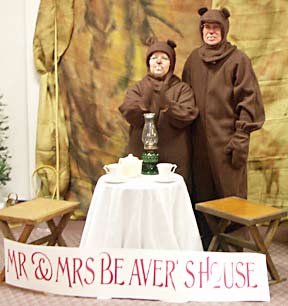
Rhena O'Neal and Don Parnell portray the Beaver family, characters from the Narnia books and film.

Sanders prepared a parents' guide and computer slideshow (both available on the Baptist Standard website) that provide background about The Chronicles of Narnia.

The materials are designed to help parents make informed decisions about how to approach the stories with their children–whether as simple adventure stories that teach moral lessons or as serious literature containing Christ-centered images.

“We didn't want to try to interpret the story as an allusion to the gospel for children,” Sanders said. “We wanted to equip parents.”

First Baptist Church in Athens has combined elements of education for Christians with outreach toward the unchurched. Pastor Kyle Henderson is preaching a series of sermons connected to themes in The Lion, the Witch and the Wardrobe, and church leaders are planning a Narnia party for children and youth.

In November, the church sponsored a training session for Sunday school teachers, parents and leaders from other churches to teach them about Narnia, help parents know whether the movie is age-appropriate for their children and explore ways the cultural conversation about Narnia can be used to discuss spiritual matters.

“We want to help people use the movie as a way to connect and talk about their faith,” Henderson said. “We want them to see how the movie allows them to talk in a neutral, nonthreatening way about the big issues, like why the world is broken.”

Narnia Resources:
Narnia Parents Guide (pdf file) and
Narnia PowerPoint presentation (download ppt file)
(Compiled by Tommy Sanders, Park Cities Baptist Church, Dallas).

News of religion, faith, missions, Bible study and Christian ministry among Texas Baptist churches, in the BGCT, the Southern Baptist Convention ( SBC ) and around the world.


Baptist churches learn to embrace Advent ritual

Posted: 12/16/05

Baptist churches learn to embrace Advent rituals

By Terri Jo Ryan

Special to the Baptist Standard

When Bill Hardage first “got” Advent after much Bible study more than a decade ago, he fell in love with the sacred season.

He was so smitten by the holy period leading up to the Feast of the Nativity, he even bought a $1,100 Advent stand for his congregation, Valley View Baptist Church in Longview, as a pre-Christmas gift.

Seven years ago, he moved 55 miles northwest, to Clearwater Baptist Church of Scroggins, and took his tradition with him. When he learned that his successor at Valley View found the gold-plated, six-foot tall stand with a large oval beaded glass ring for the wreath “a little heathen” and hid it in the closet, Hardage went to Longview to retrieve his gift for his new faith family.

And it has been put to good use ever since, he added.

“Baptists are a little short on ritual,” Hardage admitted. “Baptists have been missing out on something very important by skipping Advent. It adds to the season.”

From the Hanging of the Greens service, through the lighting of the candles by lay people each Sunday, to the poinsettia memorials that line the sanctuary to the addition of the Christ Candle to the Advent wreath on Christmas Eve, Advent enriches the souls of those longing for the light of the world, he said.

Advent, the four-week season of anticipation that precedes Christmas, means candles of purple and rose will be lit, wreaths displayed and evergreen boughs will be hung in sanctuaries.

Long a regular part of annual worship in Catholic, Episcopal and Lutheran churches, among others, Advent until recent years was as much a stranger to Baptist churches as a certain babe was in Bethlehem two millennia ago.

But no more.

“Advent leads the way in keeping time on a Christian scale, rather than use Hallmark or a secular calendar,” said Burt Burleson, pastor of DaySpring Baptist Church, a Waco congregation that bills itself as “sacred, simple.”

Raymond Bailey, pastor of Seventh & James Baptist Church in Waco, has been marking sacred time with Advent at least 20 years, the last 10 at Seventh & James, “to really identify with the universal church and feel a closeness with other Chris-tians across the centuries and faith expressions.”

Rob and Jill Reed with daughters Matalee and Morgan light a candle on the Advent wreath at Wilshire Baptist Church in Dallas. (Photo courtesy of Wilshire Baptist Church)

Not as old as the feast of Christmas itself, church historians say Advent may have originated in fourth century France and Spain, where a pre-Epiphany time of prayer and fasting likely was observed to prepare for baptisms of new believers conducted on the Catholic feast commemorating the baptism of Jesus. In the 11th century, the 40-day Advent period was shortened to the four Sundays before Christmas.

But after the Protestant Reformation, as some religious movements moved farther and farther from the Roman Catholic Church and its oldest traditions, Advent fell out of favor. An example of that historic lack of attention in Baptist churches to the season is that the Baptist Hymnal contains only eight Advent carols, versus dozens of Christmas carols.

“Pretty much it's Come, Thou Long Expected Jesus, and O Come, O Come, Emmanuel. That kind of shows you where Baptists are on Advent,” Burleson observed.

“We delay singing Christmas carols, to get in touch with the waiting, the longing for the light of the world. But it's hard to stay pure in this culture, when Target started playing We Wish You a Merry Christmas shortly after Halloween.”

DaySpring conducts the Hanging of the Greens–symbolic of the everlasting life Christians say is promised through Christ–on the first Sunday of Advent. The children are involved in lighting the candles each week and put Crismons on the tree.

“We want people to walk in and wake up to something different in the sanctuary,” Burleson said. Recovering the institution “is a way to counter the commercialization of Christmas. It's a way to be deliberately spiritual” during the secular frenzy.

Rooted in the Latin word adventus, meaning “coming” or “arrival,” Advent is a season of spiritual preparation both for Christmas, when Christians mark Jesus' birth, and for his second coming on Judgment Day.

Thus, its theological reach spans from the Old Testament's ancient messianic prophecies to the end of days. Advent articulates that sense of hope, of anticipation, that God has worked in history and will continue to work in history, said Bailey.

Scott Walker, pastor of First Baptist Church of Waco, said the congregation has observed Advent since 1993.

“We have an Advent wreath, which is lit by a family or individual every Sunday. We also have a Sunday when our children process in on the first hymn and bring with them the various characters of the manger scene and place them around the creche,” he said.

One of the church's Sunday school classes also produces a booklet of Advent devotional readings, written by various First Baptist members and mailed to all. “It allows us to share in a new and personal devotional thought” for each day of the Advent season, he added.

Lake Shore Baptist Church in Waco has printed its own member-written booklet of Advent devotionals since 1984, although the church marked Advent for several years before that, when Roger Paynter–now of First Baptist Church in Austin–was pastor.

Lake Shore Associate Minister Sharlande Sledge said their church's Advent guide has proven so popular through the years, it has gained a following outside Lake Shore's doors.

“Advent slows us down in the rush toward Christmas, and these devotionals put a pause into each busy day,” she said.

Pastor Dorisanne Cooper of Lake Shore said one of the most significant Advent traditions there is the creation of the annual banner. The 9-foot-long, 45-inch-wide banner of velvet and rich fabrics, designed by Pam Allen and assembled by a cadre of volunteer seamstresses, is more than mere decoration, Cooper said. “It's an integral part of our worship in this season.”

Sledge concurred. “We try to choose a theme that is reflective of the year past. In 2001, it was 'On Earth, Peace' with a ribbon-wrapped globe.”

The 2005 banner, “God's Love Made Visible,” is a reaction to the catastrophes in the human family that started just after last Advent–the Pacific tsunami, the summer hurricanes and the fall earthquake in Central Asia. The fabrics that form the central star on the banner come from parts of the world where Lake Shore has missions and represent the local community's numerous acts of kindness, she said.

Seventh & James also has pulpit hangings for Advent–as well as other church seasons, such as Epiphany, Lent, Easter and Pentecost–with costs underwritten by the Leuschner Fund and by an anonymous donor family.

Designed by Bill Doser of North Carolina with help from artist-consultant-finisher Bidwell Drake of Conroe, the paraments, elegant ornamental fabric hangings, are made by the same team of stitchers–Mary Ann Bennett of McGregor; Cynthia LaMaster of Chapel Hill, N.C.; and Mona Burchett, Jane Newsome, Rebecca Hartberg and Lu Treadwell, all of Waco–that were involved in the needlepoint project in the chapel at Truett Seminary on the Baylor University campus.

Broadway Baptist Church of Fort Worth began observing Advent in 1973 when John Claypool was pastor, said current Pastor Brett Younger. “Advent is a way of making room for Christ's coming in worship so that we will make room for Christ's coming in our own lives,” Younger said.

When everything around seems busy and hurried, Advent has a kind of solemnity and sacred quality, he added. For example, the services are more elaborate, with the lighting of Advent candles, parade of banners and festival music, such as the singing of Handel's Messiah.

“Our Advent theme this year is 'Let Every Heart Prepare,'” said Younger. The four Advent services include baptisms, parent-child dedications, communion, candles, carols, anthems, Scripture readings and sermons on Christ's coming according to each of the Gospel writers.

“We always choose a Christmas book to read together. This year we're reading The Lion, the Witch and the Wardrobe and renting a theater to see the new film,” Younger said.

“Different people love different aspects, but there's not much we could skip without someone being disappointed. For some, it's the procession of Advent banners on the first Sunday of Advent. For others, it's drinking sweet coffee in the sanctuary during communion at the Moravian Love Feast (Dec. 7). For many, it's crying at Silent Night at the candlelight communion on Christmas Eve.”

Mark Wingfield, associate pastor of Wilshire Baptist Church in Dallas, a congregation that has observed Advent for more than 15 years, said Baptist churches can engage in these practices without being “high church.”

“We don't speak of the Christmas season, which doesn't start until Dec. 24, but the Advent season,” he said.

The Advent theme for 2005 is “Comfort my People,” from Isaiah 40, a reflection of the year the world endured with numerous large-scale natural disasters, the strife of warfare and the need for God's people to respond in community, he noted.

This theme also links the fall hurricane relief work with the winter emphasis on the Cooperative Baptist Fellowship Global Missions offering and next year's launch of KidsHeart Africa–all attempts to help comfort God's children, Wingfield said. Wilshire also published an annual Advent devotional guide, a booklet of devotional thoughts written by Wilshire members.

What is new this year, said Wingfield, is the church hanging liturgical paraments. Displayed in the sanctuary, hanging off the columns on either side of the pews, they are made of cloth of a variety of textures. Purple for Advent while all await the arrival of the King, the paraments will be changed to white for Christmas Eve and Christmas Day, symbolizing the birth of the Christ child.

As a Baptist church that values Christian liturgy, Wilshire occupies a niche in the market as common ground for interfaith Christian couples, Wingfield added.

“A lot of people who come to Wilshire come from other Christian expressions, so to them Advent is old hat.”

News of religion, faith, missions, Bible study and Christian ministry among Texas Baptist churches, in the BGCT, the Southern Baptist Convention ( SBC ) and around the world.


Advent symbols explained

Posted: 12/16/05

Advent symbols explained

Advent centers on hope, peace, joy and love as Christians move through the season of waiting and looking forward to the feast of Christmas.

A common symbol for the season is the Advent wreath, a circular garland of evergreen branches signifying eternity. Arranged in the wreath are three purple candles and one pink candle. The first candle, purple, symbolizing hope, is lit on the first Sunday of Advent, the start of the liturgical year of the Christian calendar. Each week an additional candle is lit.

The second candle, also purple, represents peace. The third, a pink candle, is the shepherds' candle, symbolizing joy. The fourth candle is love.

The center candle of white, the Christ candle, is lit on Christmas Eve. The four candles of Advent lend themselves to Sunday themes like Old Testament prophets or the Gospel writers as well.

The purpose of the Christian year is to keep followers tied to the life of Christ. From its early days, Christian worship was connected to the theological significance of time.

Taking from its Jewish roots a pattern of feasts that recalled what God had done in history, Christian worship developed yearly, weekly and daily cycles for remembering and re-enacting what God continued to do through his Son.

The basic pattern, in place by the fourth century, has two main sequences. The pattern in both is preparation, feast and extension. The first sequence includes Advent (the beginning of the Christian year), Christmas and Epiphany. The second sequence includes Lent, Easter and Pentecost. The time between Pentecost and Advent, called Ordinary Time, is not marked by major times of celebration.

News of religion, faith, missions, Bible study and Christian ministry among Texas Baptist churches, in the BGCT, the Southern Baptist Convention ( SBC ) and around the world.


Book Reviews

Posted: 12/16/05

Book Reviews

The 13 Apostles by Preston Alford Taylor (Tate Publishing)

Preston Taylor has several published books with wide distribution in English, but predominately in Spanish. I predict this newest work will surpass the others in both sales and stature.

This is a book every pastor should have on his shelf, every seminary student should be required to study and every Sunday school teacher should have close at hand. It is one of the few books I would recommend that everyone should buy and read right now!

What are you reading that other Texas Baptists would find helpful? Send suggestions and reviews to books@baptiststandard.com.

He has compiled an enormous amount of historical material and into it integrated the perspective that comes from experience, a lifetime of study and a mature understanding of the grace of God and the Christian life. In addition, he has an easy-to-read style that draws the reader from page to page, filled with inspiring stories about the original apostles. He ends with a powerful challenge for each of us to take our place as we work to expand the kingdom of Christ.

Jerry Barker, pastor

First Baptist Church

Falfurrias

Cure for the Common Life: Living in Your Sweet Spot by Max Lucado (W. Publishing Group; available January 2006)

God designed us. He designed us according to his purpose. In that purpose, we discover the passion he has placed in our heart.

According to San Antonio pastor and best-selling author Max Lucado, we find our “sweet spot” when we live according to God's unique design, carry out his purpose for us, and fulfill that deep passion of our lives. Our sweet spot, a term from sports, is the “tailor-made task that honors God, helps others and thrills you.”

But if all this is true, how do we discover God's design in our lives? Lucado, using the work of Arthur F. Miller and Ralph T. Mattson of People Management Inc., advises us to “read your life backward” to discover your story that tells how and for what God created you.

The second part of the book gives a well-presented “ba-sics of the Chris-tian life.” In the third section, Lucado applies the idea of our sweet spot to daily life.

Over the years, I have found the concepts of Miller and Mattson insightful, practical and freeing. Lucado, a gifted communicator, takes those insights and shows step by step and Scripture by Scripture what it means to discover God's design of each of us.

Bill Blackburn, President

Partners in Ministry

Kerrville

Set Free by Forgiveness by Randall O'Brien (Baker Books)

Randall O'Brien, interim provost at Baylor University, explores the liberating, healing power of forgiveness in a highly readable book that combines scholarly insight, pastoral concern, storytelling skill and practical application.

From the book's first pages, O'Brien refuses to let readers off the hook. He begins by telling the story of Chris Carrier, a 10-year-old boy who was abducted, repeatedly stabbed with an ice pick, shot in the head and left for dead. Miraculously, the boy survived the ordeal and returned to his family, but the attack left him blind in one eye. Even more miraculously, years later, Carrier forgave his attacker, befriended him and led him to faith in Christ.

O'Brien unflinchingly challenges readers to recognize themselves as both sinned against and sinners. He calls on individuals to acknowledge their own capacity for evil and need for forgiveness, as well as recognize the practical and therapeutic benefits of offering forgiveness to others.

Perhaps O'Brien's greatest contribution lies in the way he draws helpful distinctions between unhealthy shame and healthy guilt and between unconditional, unilateral forgiveness and the difficult, reciprocal process of reconciliation.

Ken Camp, managing editor

Baptist Standard

Dallas

The Dominance of Evangelicalism: The Age of Spurgeon and Moody by David W. Bebbington (InterVarsity)

This volume is the second to be released in the projected five-volume History of Evangelicalism. David Bebbington sketches and evaluates the broad influences and impact of evangelicalism during the period 1850-1900. While not as readable as the first volume, I found his review of the impact of Dwight Moody-Ira Sanky on local-church worship interesting in light of the “worship wars” of our day.

Significant currents that move us to where we are today never happen in a vacuum. Bebbington helps to track how the Enlightenment and later Romanticism influenced the movement and the message. This volume also looks at the roots of the social gospel and the social impact within evangelicalism.

The author also highlights the variety of differences within the stream of evangelicalism during this period. This is a good primer for pastors and church members who are historically curious about some of the influences that make us what we are today.

Michael Chancellor, pastor

Crescent Heights Baptist Church

Abilene

News of religion, faith, missions, Bible study and Christian ministry among Texas Baptist churches, in the BGCT, the Southern Baptist Convention ( SBC ) and around the world.


Personal touch meaningful to Breckenridge residents

Posted: 12/16/05

Bob and Carolyn Holsomback, members of Colonial Hills Baptist Church in Tyler, try out one of the benches they rebuilt for the Breckenridge Village prayer garden. (Photo by Craig Bird)

Personal touch meaningful
to Breckenridge residents

By Craig Bird

Baptist Child & Family Services

TYLER–At Breckenridge Village, Bob and Carolyn Holsomback are making names–not for themselves but for the residents of the Baptist Child & Family Services facility for mentally handicapped adults. They also have made Christmas gifts, park benches, napkins, bluebird houses–and lots and lots of friends.

After Mrs. Holsomback made stockings for all the residents and staff last December, Development Director Linda Taylor insisted they come to a chapel service and distribute them personally.

“We were amazed at the response,” Holsomback remembered. “We had no idea how important it was to have their name on the stocking.”

A young man stroked Holsomback's cheek, repeating over and over, “You look just like my granddaddy.” Meanwhile, a young woman–usually non-verbal–kept looking back and forth between her stocking and Mrs. Holsomback. As she rubbed her fingers over the stitching, she kept saying, “That's me, that's me.”

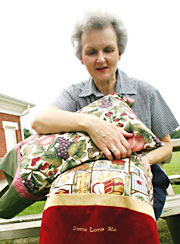
Carolyn Holsomback makes travel pillows for residents.

This Christmas, the couple from Colonial Hills Baptist Church in Tyler will give away travel pillows–again with each resident's name prominently displayed.

“We were looking for something that would specifically belong to them individually but something that they could use. This way when they are riding in the van or watching television, they can use it,” Mrs. Holsomback explained.

“I saw such a need after I first visited. The residents are special–just like the very young and the elderly in that they are so dependent on others to care for them. In our society, we give a lot of attention sometimes to people who don't need it so much, who aren't so dependent. But the more Bob and I are involved here, the more we are convinced that resources invested at Breckenridge get full value for the Lord's money. This is absolutely the best use of donations for God's work.”

Such total devotion belies the fact the Holsombacks' association with Breckenridge is only about one year old. The couple only visited the facility in fall 2004 because it was the site for a free concert by one of their favorite singers, Cynthia Clawson.

“That was the first time we ever visited,” Mrs. Holsomback recalled. “As usual, Cynthia was wonderful. But we were really touched by what we saw and heard about Breckenridge. We stayed after the concert to take a tour, but there were so many others doing the same that Linda asked us if we could come back another time.”

They not only came back three weeks later, but also brought along a cash contribution. They asked if there were projects they could undertake within their physical limitations and were asked to repair some picnic tables that had seen better days. That was just the starting point.

Mrs. Holsomback noticed Brecken-ridge had to rent tablecloths and napkins for dinners, so she made a supply, along with reversible runners for the tables–green for Christmas functions, maroon for general use. Holsomback took on the task of rebuilding the park benches for the prayer garden, searching for a supply of durable cypress wood. Mrs. Holsomback worried about the rough-cut slats. She warned her husband the Breckenridge residents “would have to wear leather britches to keep from getting splinters in delicate places.” He also decided to populate the campus with bluebird houses, both to extend the habitat of the rare bird as well as provide residents with the joy of hearing and seeing them.

Holsomback, the woodworker of the team, has a bad back that limits the sustained physical activity needed to do many maintenance jobs, but his slow and steady pace is efficient. Mrs. Holsomback has severely limited vision but does the sewing.

But they function as a team, literally. When Holsomback was fashioning the park bench slats, she operated the drill press. When Mrs. Holsomback began making the personal travel pillows for the residents and staff for this Christmas, he cut the material.

News of religion, faith, missions, Bible study and Christian ministry among Texas Baptist churches, in the BGCT, the Southern Baptist Convention ( SBC ) and around the world.


Christmas music playlist ranges from sacred to secular

Posted: 12/16/05

Christmas music playlist
ranges from sacred to secular

By Adelle Banks

Religion News Service

WASHINGTON (RNS)–It's that time of year again, when Silent Night or Jingle Bells greets you as you turn on the radio, walk into a shopping mall or head down a city street.

What you hear–whether traditional and religious or secular and contemporary–depends on where you are and on careful planning by the programmers, retailers and musicians who bring it to your ears.

There's even an organization that studies these musical matters.

Last year, Media Monitors began tracking the songs played by the 50 all-Christmas stations in the top 50 markets between Thanksgiving and Christmas. And though no religious tunes were part of its top 10 list of songs played on the mostly secular stations, a spokesman estimates that as much as 25 percent of the radio stations' Christmas library “may be religious in nature.”

He noted, however, that this could mean 10 different versions of Away in a Manger.

According to Media Monitors, the religious song heard most on the stations was Do You Hear What I Hear? performed by Whitney Houston, said Tom Zarecki, spokesman for the broadcast monitoring service based in White Plains, N.Y. It was followed by Josh Groban's rendition of O Holy Night and Bob Seger's version of Little Drummer Boy.

While largely secular radio stations aren't likely to play back-to-back religious songs, he said, there's likely to be one or two an hour.

“All programmers want to do is reach as many people as possible,” Zarecki said. “I bet there's no programmer that would ever want to be accused of removing all religious songs from a holiday format, because somebody would notice that … and that would be just an example of bad programming.”

Dana McKelvey, an “audio architect” with the Muzak music delivery company, said more mainstream retailers and restaurants are asking for holiday songs with religious references.

“Past years, they were very conscious of the uses of 'Jesus,' 'Jesus Christ,' 'O Holy Night,' anything that was directly related to religion,” said McKelvey, whose company is based in Fort Mill, S.C. “And this year, they're becoming more open to allowing that to play in mainstream stores.”

Religious retailers are even more particular, she notes: “They don't want just instrumental Christmas songs. They want songs performed by Christian artists.”

While a Baptist bookstore or a Catholic university store might play more religious music, it's understandable that large stores frequented by people of many faiths will play fewer sacred tunes for their customers, said Daniel Butler of the Washington-based National Retail Federation.

“You want them all to enjoy being in the store, but you don't want anybody feeling alienated,” said Butler, the federation's vice president of merchandising and retail operations. “So you tend to go with music choices … that will have a broader appeal with the customer base.”

Starbucks coffeehouses are featuring three holiday CDs that are being played and sold in their stores. Most of the tunes–which range from Elton John's Christmas Party to a compilation titled Baby, It's Cold Outside–are of the Rudolph and Santa Claus variety. But the compilation CD ends religiously, with Barbra Streisand's Ave Maria. The coffee company's version of the Vince Guaraldi Trio's A Charlie Brown Christmas includes What Child Is This? and Hark, the Herald Angels Sing.

While collections targeted for a broad audience sometimes include religious songs, even the most devout have long enjoyed some not-so-sacred tunes.

Richard Holz, music director for the Salvation Army's Southern Territory, said about 5,000 brass ensembles play from a standardized collection of Christmas carols, performing at kettles and other locations between Thanksgiving and Christmas.

In the last decade, when the The Salvation Army Carolers Favorites was updated, it included more secular songs.

“People enjoy hearing Rudolph, the Red-Nosed Reindeer or Santa Claus is Coming to Town,” said Holz, who plays tuba outside an Atlanta-area Sam's Club as well as at nursing homes. “You have these standards that you play that you mix in with the sacred carols.”

Christian radio, too, delves beyond the religious regulars.

“We do not ex-clude the more, if you will, fun titles, less-religious titles,” said Chuck Finney, the national program director for Salem Communica-tions' 13 contemporary Christian music stations. “But we play the ones that are consistent morally with the true meaning of Christ-mas.”

So, between The First Noel and Mary, Did You Know? a listener might hear Have a Holly Jolly Christmas or White Christmas.

“We wouldn't play Santa Baby,” he said, referring to the sultry song performed by Eartha Kitt.

Ace Collins, author of Stories Behind the Best-Loved Songs of Christmas, said a range of offerings–from O Holy Night to Rudolph, the Red-Nosed Reindeer–may be the most appropriate way to usher in the holiday.

“I think that's fair,” he said. “I think each of those songs brings to life the fabric of the season.”

News of religion, faith, missions, Bible study and Christian ministry among Texas Baptist churches, in the BGCT, the Southern Baptist Convention ( SBC ) and around the world.


Some churches say they’ll sing no carol before its time

Posted: 12/16/05

Some churches say they'll
sing no carol before its time

By Ken Camp

Managing Editor

The starting date and finish line for singing carols in church depend on whether a congregation follows the Christian calendar or the Hallmark calendar–and how constrained worship leaders feel by their choice.

Many churches begin singing carols immediately after Thanksgiving and sing as many favorites as possible before the poinsettias are removed from the sanctuary on Christmas.

Some churches that strictly adhere to the liturgical Christian calendar sing only Advent hymns–songs anticipating the birth of Jesus, such as O Come, O Come, Emma-nuel–until either Christmas Eve or Christmas day.

At that point, they continue singing carols until the Feast of Epiphany in early January–observed in some Christian traditions the 12th day after Christmas to mark the time when Christ's birth was revealed to the Magi.

Other churches straddle the middle ground–observing the four Sundays of Advent and recognizing the Christian calendar but not feeling tied down by it.

At First Baptist Church in Paris, Christmas carols begin the first Sunday after Thanksgiving, which usually coincides with the first Sunday of Advent.

This year, Minister of Music J.K. Weger has tried to group the carols and other elements of worship around the theme of the candle on the Advent wreath for that week–hope, peace, love and joy–building to the lighting of the Christ candle at a Christmas Eve service.

“Each year is different,” Weger noted, pointing to the different ways the church integrates various age groups into musical programs and worship services. But one constant remains: “We never sing Christmas carols after Christmas day.”

Similarly, First Baptist Church in Amarillo sings carols throughout the four Sundays of Advent, beginning with hymns of anticipation and hope and moving toward joy and celebration, said Minister of Music Lanny Allen.

Hymn selections, musical ensembles and orders of worship vary from one year to the next, he added.

While the seasonal decorations may remain on display in the sanctuary until the first Sunday of the New Year, the carols end at Christmas rather than Epiphany, he noted.

“We've come a long way just observing Advent,” Allen said.

Calder Baptist Church in Beaumont fully embraces the pageantry and symbolism of Advent, with worship leaders donning robes and stoles for the season.

“I love the colors, smells, bells and whistles of everything surrounding the season,” said Ed Wilson, associate pastor and minister of music.

Calder Church continues the celebration through Epiphany. But Wilson doesn't feel constrained to hold off on all carols until Christmas Eve–just the most celebrative ones.

“We begin the first Sunday of Advent and try to crowd in as many as we can, with medleys of two or three at each service,” he said. “We may get in six weeks of carols, if we're lucky.”

But in keeping with the church's commitment to the liturgical tradition, Wilson groups the carols thematically. He begins with the hymns of anticipation such as Come, Thou Long-Expected Jesus, and each week begins incorporating into the service more of the carols announcing and celebrating Christ's birth.

“I follow a timeline as we move closer to Bethlehem,” he said.

First Baptist Church in Abilene generally follows the Christian calendar, observing the four Sundays of Advent and building from the prophetic to the celebrative, but exactly how that takes shapes differs from one year to the next, said Minister of Music Todd Wilson.

Often, the musical choices are shaped by sermon topics and worship emphases, he noted. For instance, a December Sunday devoted to a global missions emphasis includes carols such as Go, Tell it on the Mountain.

Whether the church ends its yuletide celebration the Sunday nearest Christmas or whether it continues into January varies from year to year, depending on how much emphasis Pastor Phil Christopher decides to make of Epiphany in his sermons, he added.

“Our church seems richer because so many of our members come from more diverse denominational backgrounds than many Baptist churches I've known,” Wilson said, noting many are more steeped in liturgical traditions than most Baptists.

“We also benefit from the influence of Logsdon Seminary professors here. And I find that very refreshing, constantly making new discoveries.”

News of religion, faith, missions, Bible study and Christian ministry among Texas Baptist churches, in the BGCT, the Southern Baptist Convention ( SBC ) and around the world.


Unlikely allies defend ‘Merry Christmas’ greeting

Posted: 12/16/05

Unlikely allies defend 'Merry Christmas' greeting

By Andrea Useem

Religion News Service

WASHINGTON (RNS)–The movement defending Christmas as a Christian holiday has attracted some unlikely allies–religiously observant Jews and Muslims.

Their support bucks the assumption that religious minorities prefer a neutral approach to the season, desiring “Happy Holidays” instead of “Merry Christmas” at retail checkout lines or Frosty the Snowman over O Holy Night at public school concerts.

Motivations differ, with Jewish leaders calling retailers' omission of “Christmas” an ominous sign for a country that used to consider itself “Judeo-Christian.” Muslim leaders offer a more strategic reason–establishing firm ground on which to make their own holiday demands.

Daniel Lapin, an Orthodox rabbi and president of the Seattle-based group Toward Tradition, urges American Jews to support public Christmas celebrations. (Photo by Andrea Useem/RNS)

Scholars say the ballooning controversy and the unusual alliances taking shape illustrate the challenge an increasingly multicultural society faces trying to accommodate many religious expressions.

Islamic support for Christmas stems in part from religious doctrine. While observant Muslims can follow the teachings of the Prophet Muhammad in respecting Jewish and Christian holidays, they say they have little motivation to value Santa-based winter holiday celebrations.

When it comes to Christmas, “the more religious it is, the more acceptable it is to Muslims,” said Ahmed Bedier, director of the Council on American-Islamic Relations' Central Florida office.

But there also is the issue of Islamic self-interest.

Bedier's organization recently requested a school board near Tampa, Fla., include a one-day Muslim holiday alongside Christian and Jewish holidays. When the school board voted instead to scrap all religious holidays, Muslim groups–along with their Christian counterparts–protested. The holidays, at least the Christian and Jewish ones, were reinstated.

“We would like to see one standard applied in terms of recognizing religious holidays,” said Ibrahim Hooper, national communications director for the Council on American-Islamic Relations.

Muslims, he said, would welcome religious Christmas displays–for example at a public library–as long as Eid al-Adha, the upcoming Muslim holiday marking the yearly pilgrimage to Mecca, was recognized in the same space.

At a recent Washington news conference, a small group of Jewish leaders spoke in defense of public Christmas celebrations, framing the issue as a struggle between a Bible-believing culture and the dark, potentially anti-Semitic, forces of secularism.

“Jews and other non-Christians have a stake in maintaining morality, based on a Judeo-Christian ethic. The disappearance of Christmas undercuts that ethic,” said Don Feder, a former Boston Herald writer who founded Jews against Anti-Christian Defamation earlier this year.

While Jews once endorsed secularism as a safe alternative to Christian dominance, today they face a choice between “a sinister secular society on the one hand, and a society of benign Christianity on the other,” said Daniel Lapin, an Orthodox rabbi and president of the Seattle-based Jewish group Toward Tradition.

But Abraham Foxman, head of the Anti-Defamation League, dismissed the group's effort as part of a conservative political agenda. “The overwhelming majority of Jews are wedded to the separation of church and state,” said Foxman. Jewish leaders lining up to advocate for Christmas “want religion in government, setting morals.”

That some Jewish leaders are aligning with Christians, many of them evangelicals, is not surprising, said Keith Seamus Hasson, founder and chairman of the Washington-based Becket Fund for Religious Liberty.

“Observant Jews tend to be more open to religious expression in the public square, just like Christians in 'red states,'” Hasson said.

“Religious America breaks down along lines of fervency of belief, more than lines of theological content.”

Christmas is a contentious time because the secular idea that religion should be kept private collides head-on with “an essential human drive to celebrate in public,” said Hasson, author of The Right to Be Wrong: Ending the Culture War Over Religion in America.

“The question is: How do you celebrate your own beliefs, while allowing others to celebrate conflicting beliefs?”

Hasson's answer is that Christians should assert their right to celebrate in public, while acknowledging other groups the same right–the very argument that Muslim leaders advance.

When it comes to public schools, where disputes over religion often go to court, administrators and other decision-makers haven't gotten the balance right, said Charles Haynes, a senior scholar at the Freedom Forum's First Amendment Center.

“There is a trend in public schools to move away from the assumption that everyone celebrates Christmas. But sometimes the move goes too far and becomes an overreaction,” said Haynes, describing schools where nativity pageants are cancelled or Christmas carols eliminated. “The irony is that by trying to avoid controversy, (educators) have often created it.”

The same might be said of the retail arena, where marketing experts say corporations don't want to alienate non-Christian or nonreligious holiday shoppers.

Many department stores have dropped explicit references to Christmas because “it was considered safer to be neutral so as not to offend any particular customer group,” said Irene Dickey, a lecturer in the management and marketing department at the University of Dayton's School of Business in Dayton, Ohio.

Some conservative Christian groups have gone beyond voicing complaints. The American Family Association in Tupelo, Miss., said it rallied 600,000 supporters to boycott Target, because the retailer didn't use “Christmas” in advertising and in-store promotions. The group has similar complaints to make against a number of other popular nationwide retailers, ranging from OfficeMax to Sears.

News of religion, faith, missions, Bible study and Christian ministry among Texas Baptist churches, in the BGCT, the Southern Baptist Convention ( SBC ) and around the world.


Second Opinion: The cheering of Christmas

Posted: 12/16/05

SECOND OPINION:
The cheering of Christmas

By BO Baker

We all need the cheering of Christmas. It seems the whole world recently has experienced the heaviness of hurt, stain marks unabated, and questions that have struck in powerful forms of aftershock. Name a nation–any one will do–that has been exempt from the clash of swords, the heavy thunder of drums announcing new vistas of crime.

Yes, without question, we need the cheering of Christmas.

This passing year has been one of “saying goodbye” to many friends and loved ones of a lifetime. We grew up together with the treasury of the church around us. We have fought lest it be mocked, left in need of redefining. Far too many of our fellow travelers have exchanged the promises of God to provide “shoes of brass and iron” (Deuteronomy 33:25) for roads impassable … untenable. Millions of the fear-filled would gladly exchange their mechanical toys, their “wagons without wheels” for the promise of a cheering Christmas.

Heaven knows we need a divine visitation, a word from God. We need Jesus to make the difference–and oh, the difference he does make! It is true that the Master of Heaven and Earth does care, that he proved it by the nativity and offered his grace by way of a cross full of forgiveness. All this caught the listening ears of the World Maker, and Jesus turned to walk head-high out of the waiting place; then he brought it all tied together and loosed it on a lost world at Christmastime.

Let us call it the cheering–the cheering of Christmas.

If honest confession is “good for the soul” (and with that I most surely concur), then it is this cheering Christmas the believers most fervently desire. Pray tell, where else may we turn to find depth enough, power enough, hope enough and the strength of hands strong enough to hold us in the anxious anchoring of the soul? Come floods untamed, unsalvageable homes, rising water, the dread of family wakes has put the whole world on storm alert.

Apart from the Christian faith, there is little worth holding on to help us find a heart for tomorrow. Nothing save the holy gift of God–the cheering of Christmas.

BO Baker, a longtime Texas Baptist pastor and evangelist, has written a Christmas reflection for the Baptist Standard 30 consecutive years.

News of religion, faith, missions, Bible study and Christian ministry among Texas Baptist churches, in the BGCT, the Southern Baptist Convention ( SBC ) and around the world.


DOWN HOME A long walk into the future

Posted: 12/16/05

DOWN HOME:
A long walk into the future

The Big Day is nigh upon us.

By the time you read this, Aaron Britt Kahler, otherwise known as “The Most Fortunate Young Man in the Universe,” will have married our oldest daughter, Lindsay Michelle Knox.

Due to the persistent demands of publishing schedules, I'm writing this a few days before the big wedding. Still, I'm looking ahead, anticipating that day.

As Lindsay and I take our stroll down the aisle, I'll be thinking–sappy daddy that I am–about other walks we have taken.

As soon as we brought Lindsay home from the hospital, I enjoyed carrying her in my arms at bedtime, walking her to sleep. Any experienced parent will tell you that's a bad idea as far as swift movement to slumber goes. But it's a wonderful idea as far as getting to know that snuggly, cuddly bundle of joy who has just changed everything.

Later, her mother, Joanna, and I took other walks with Lindsay:

bluebull Stooped over for hours, her tiny hands grasping our forefingers, we walked above her as she learned to walk herself.

bluebull We walked 'round and 'round the fountain in our favorite mall in Nashville.

bluebull Early, early one morning, I walked with her in my arms as I deposited her with friends just before her baby sister was born.

bluebull Jo and I walked into class with her on her first day of school.

bluebull We walked beside her as she learned to ride a bike and rollerskate.

bluebull One Sunday morning, I walked with her into a baptismal pool.

bluebull We walked together on Florida beaches and in New Mexico mountains.

bluebull We walked to the car after ballgames.

bluebull We walked into church together.

bluebull We walked up the stairs to her bedroom to say goodnight.

bluebull A little more than three years ago, we walked Lindsay to her dorm room as she entered Hardin-Simmons University, just a few days before she met Aaron.

Jo and I have taken many of the best steps of our lives at Lindsay's side. I'll be thinking about all those walks as she and I walk down that aisle. And I'll be thanking God for all those walks, and this one too–for blessing me with the privilege of being the daddy of a young woman of grace and faith and warmth and intelligence and humor. With her, I'd walk anywhere.

Now, God has guided her to the man with whom she wants to walk the rest of her life. Sometimes, their path will be smooth and sometimes rocky. Often, it will be winding and uphill, through heat and rain and winter chill. But the splendor of vistas they will see from that path will, by God's grace, take their breath away.

And as they walk, I'll continue praying for them, as I've prayed for them since they were children (long before I actually met Aaron): That God would guide and guard them, and bless them with joy and health. More importantly, that God would infuse purpose and meaning into all the days of their lives. That they would see themselves and their world as God sees them.
–Marv Knox

News of religion, faith, missions, Bible study and Christian ministry among Texas Baptist churches, in the BGCT, the Southern Baptist Convention ( SBC ) and around the world.


EDITORIAL Have a Merry Christmas this year

Posted: 12/16/05

EDITORIAL:
Have a Merry Christmas this year

This season may be remembered as the time when Christians went ballistic over Christmas.

In the good old days, a sign proclaiming “Merry Xmas” would send many folks huffing. The abbreviation, infamously substituting “X” for “Christ,” prompted pointed-yet-benign counter-slogans, such as “Let's Keep Christ in Christmas” and “Jesus is the Reason for the Season.”

Back then, “X” marked the spot for “Christ,” retaining the word, if not spelling it correctly. Now, many folks would gladly accept the occasional “Xmas” sign or advertisement. At least when people say the word, they pronounce it right: “Christmas.”

knox_new

This year, “Happy Holidays” and “Season's Greetings” have become fighting words for many Christians. They're bound and determined other people, particularly merchants, better acknowledge the reason for this season and, by God, say, “Merry Christmas.” As you might expect, leaders of the Religious Right have jumped on the “Merry Christmas” bandwagon–or maybe they're leading the “Christmas” parade–boycotting stores that fail to post signs that include the word “Christmas” or forbid employees from saying, “Merry Christmas.”

All this isn't new, at least for people who live outside the Bible Belt. Twenty-five years ago this month, I made my first Christmas-season visit to New York City. I cheerfully went about wishing people a “Merry Christmas.” That's what folks from Borger, Dalhart, Perryton, Wichita Falls, Abilene and Fort Worth–all the places I'd spent Christmas–said this time of year. In return, I'd often receive a condescending look and a sneering “Season's Greetings” that told me I'd committed some sort of social blasphemy. Finally, I realized these people were Jews, and while I was celebrating Christmas, they were celebrating Hannukah. To them, my greeting excluded or belittled a significant event in their faith. And while I never understood why they didn't respond to my fervent “Merry Christmas” with a robust “Happy Hannukah,” I came to appreciate their religious convictions and my need to show respect.

This year feels different, however. Christians seem more on edge about “Merry Christmas.” They're cramming cyberspace with angry, in-your-face “Merry Christmas” e-mails. They're talking boycott. They're waging protests.

If you think about it, you know the tipping point in this “Merry Christmas” Fracas of '05: “Holiday Trees.” When some major stores changed the name of “Christmas Trees” to “Holiday Trees,” they pushed political correctness to its extreme yet logical conclusion–silliness.

This whole “Holiday Trees” phenomenon has been promoted by an illogical intention to avoid offending non-Christians. The reasoning goes like this: Christmas is for Christians. Many consumers are not Christians and might be offended by overt Christmas celebrations. Therefore, merchants should secularize the season so that it doesn't confront non-Christians. Ironically, key Jewish and Muslim leaders have sided with Christian protesters. They instinctively understand the importance of religious celebrations. And they affirm Christians' observance of Christmas, just as they seek protection for their own holy days.

While separation of church and state is proper (the First Amendment prohibits Congress from establishing religion and from interfering with the free exercise of religion), the separation of faith from life is absurd. Almost 400 years ago, Baptist Roger Williams established Rhode Island as the first religiously free colony in the New World. He guaranteed religious freedom for everyone, from Baptists to Catholics to Quakers to people with no faith whatsoever. Consequently, Baptists should be the first to wish others a Merry Christmas while also embodying the spirit that protects and affirms them when they wish upon us a greeting peculiar to their faith.

That said, I must admit I've been embarrassed by the behavior of many Baptists and other Christians this Christmas. While they have been correct on the point, they have been wrong in the practice of it. An angry, militant proclamation of “Merry Christmas” isn't very merry–or Christlike, for that matter.

At Christmas, we celebrate the birth of the One who came to seek and to save lost and hurting people the world over. If we observe Christmas with contentious, combative spirits, we undermine the central reason for God's Incarnation in Christ: “For God so loved the world that he gave his only begotten son, that whosoever believes in him should not perish, but have everlasting life.”

–Marv Knox is editor of the Baptist Standard.

News of religion, faith, missions, Bible study and Christian ministry among Texas Baptist churches, in the BGCT, the Southern Baptist Convention ( SBC ) and around the world.


Howard Payne launches new graduate degree

Posted: 12/16/05

Howard Payne launches new graduate degree

By Laura Johnson

Howard Payne University

BROWNWOOD–Howard Payne University–the only Texas Baptist school to offer an undergraduate degree in youth ministry–will offer a master of arts in youth ministry beginning in fall 2006.

At the annual meeting of the Commission on Colleges of the Southern Association of Colleges and Schools, the university learned the accrediting body had granted Howard Payne approval to add master's degree programs to its degree offerings for the first time in more than 30 years.

“Howard Payne University has an extensive network of youth ministers among its alumni. Our institution has a rich heritage in youth ministry, and this new program will provide us with opportunities to expand ministry initiatives to youth in our state, nation and beyond,” said President Lanny Hall.

“This will be an innovative and practical master's degree program with great potential.”

The master of arts in youth ministry will consist of 42 hours, including courses in biblical and theological studies, as well as practical coursework in youth ministry. To make the program accessible to youth ministers around the state, residency in the Brownwood area will not be required.

The graduate program will include courses such as church and personal financial management, ministering to youth and their families, researching youth culture and communicating with youth audiences.

In lieu of a thesis, the degree will require an internship.

“One of the strengths of the program will be the balance of biblical, theological and yet very practical instruction,” said Gary Gramling, dean of the School of Christian Studies.

“We believe that youth ministers must have a good grasp of biblical teaching and a solid theological base from which to minister. Yet they also need instruction and experience in practical areas such as youth culture, legal issues, church and personal financial management, and conflict management.”

Because of the varied expectations churches have regarding youth ministers, students training for ministry to youth need an educational option with balanced content, accessible delivery and practical application, Gramling noted.

“For example, they are often expected to understand the world of teenagers, be a team player on the staff, spend time with students, plan and execute youth ministry events, coordinate weekly youth Bible study and discipleship meetings, provide recreational opportunities and even drive the church bus,” he said.

“We are excited about what this degree will mean for the university, but we are especially hopeful that it will meet a need among Texas Baptists as an educational opportunity for those who feel that God has called them to youth ministry.”

News of religion, faith, missions, Bible study and Christian ministry among Texas Baptist churches, in the BGCT, the Southern Baptist Convention ( SBC ) and around the world.