Lawmakers may let casinos rebuild on land

Posted: 10/14/05

Lawmakers may let casinos rebuild on land

By Robert Marus

ABP Washington Bureau

JACKSON, Miss. (ABP)–The Mississippi legislature wants to let the floating casinos washed ashore by Hurricane Katrina rebuild on land.

Despite strong opposition from Mississippi Baptists and other religious groups, state senators voted 29-21 to give final approval to a bill aimed at reinvigorating an industry that provides about 15,000 jobs to Mississippi's decimated coastal region. The state's House of Representatives approved the measure just days earlier during a special legislative session called by Gov. Haley Barbour (R). Barbour also supports the bill.

“The Bible says you can't serve two masters–God and money. You'll hate one and love the other,” said William Perkins, editor of Mississippi Baptists' newspaper, after the Senate vote. “We believe the vote today proved that Mississippi does love money.”

Mississippi first legalized gambling in 1990–but only at barge casinos docked on the Mississippi River and the Gulf Coast. The practice is becoming a common way to get around laws against traditional land-based gambling.

Katrina's storm surge destroyed 13 casinos located in Gulfport, Biloxi and other coastal cities. The wind-driven waves tore many of the massive structures from their moorings, depositing them hundreds of yards inland.

Casino owners say they need permission to rebuild on dry land in order to minimize such losses in the future.

But Perkins and others argued that loosening the restrictions on casinos was yet another example of a powerful gaming industry gaining ground, inch-by-inch.

"Mississippi Baptists have been opposed to legalized gambling from the start, and each of us should be willing to contact our individual legislators … to let them know how we feel about the ever-expanding influence of the gambling/political complex in Mississippi," he wrote in the Baptist Record.

News of religion, faith, missions, Bible study and Christian ministry among Texas Baptist churches, in the BGCT, the Southern Baptist Convention ( SBC ) and around the world.


Odessa families find help at mission center

Posted: 10/14/05

Odessa families find help at mission center

By John Hall

Texas Baptist Communications

ODESSA–When Odessa-area families desperately need food, they turn to the Permian Basin Mission Center. Volunteers there simply want to make lives better.

The center, which grew out of First Baptist Church, provides food, clothes and furniture to about 65 people a day. Volunteers and staff members have served as many as 150 people in a day.

Whether center workers give out a box of food or a shirt, they want to meet a need in the name of Christ, Director Minnie Shipman said. “We hope to help these people.”

The Permian Basin Mission Center is one of many Texas ministries that receive funds from the Texas Baptist Offering for World Hunger, coordinated by the Baptist General Convention of Texas' Christian Life Commission.

Beyond meeting immediate needs, workers get the chance to share their faith. They regularly invite people to church. They also pray with people in need. Residents who have come for food also have found the Lord, Shipman said.

The opportunity to serve God by ministering to others keeps Shipman going. She was the volunteer coordinator for the center for two years before finally accepting a salary as director. The four paid staff members carry long hours, but they find motivation in the assurance they are working for God and the people he has placed in their path.

“That's who I'm working for, and that keeps me going,” she said. “I love these people.”

News of religion, faith, missions, Bible study and Christian ministry among Texas Baptist churches, in the BGCT, the Southern Baptist Convention ( SBC ) and around the world.


On the Move

Posted: 10/14/05

On the Move

Ken Cunningham has resigned as youth pastor at First Church in Coleman.

bluebull James and Laura Dickson to First Church in Bartlett as youth ministers.

bluebull Joe Dowdy has resigned as pastor of Frost Church in Frost.

bluebull Lynn Fontenot has resigned as pastor of Central Church in Thornton to start a church in Waxahachie.

bluebull Clayton Griggs to First Church in Groesbeck as pastor.

bluebull Scott Jones to First Church in Stockdale as pastor from Iola Missionary Church in Iola.

bluebull Steve McMeans to Indiana Avenue Church in Lubbock as pastor from Coggin Avenue Church in Brownwood.

bluebull Fred Meeks to First Church in Tulia as interim pastor.

bluebull Scott Reed to First Church in Point Enterprise as minister of music and students.

bluebull Brad Taylor to Central Church in Hillsboro as minister to students.

bluebull Davies Vanpool has resigned as pastor of Abbott Church in Abbott.

bluebull Nathan Wade to First Church in Hubbard as interim music minister.

bluebull Shelley Weaver to Lakeside Church in Granbury as minister to students.

News of religion, faith, missions, Bible study and Christian ministry among Texas Baptist churches, in the BGCT, the Southern Baptist Convention ( SBC ) and around the world.


Pastors view their families as healthy but under pressure

Posted: 10/14/05

Pastors view their families as
healthy but under pressure

NASHVILLE, Tenn. (BP)–Pastors see their own families as fairly healthy, although they believe their job means they don't spend enough time with their families and unreasonable expectations are connected with being the spouse or child of a minister, a study conducted for LifeWay Christian Resources revealed.

The study, which used a representative national sample of 870 pastors, showed eight out of 10 pastors currently are on their first marriage, while another 12 percent are divorced and remarried.

Ninety-three percent have children, including 43 percent who have adolescents and 50 percent who have only children 18 or older.

Fourteen percent are carrying on a family tradition in being the child of a minister.

Conducted by Ellison Research of Phoenix and published in a recent issue of LifeWay's Facts & Trends magazine, the survey revealed 93 percent of all pastors believe there is extra pressure being married to a minister (including 54 percent who strongly believe this); 91 percent feel there is extra pressure being the child of a minister (including 46 percent who strongly hold this belief); and 88 percent believe churchgoers often expect pastors' families to be better than other people's families.

In all three cases, Southern Baptist ministers particularly are likely to perceive extra pressure on their families.

Six out of 10 ministers say their role as a pastor leaves them with insufficient time for their families. Only 18 percent say the amount of time they get to spend with their spouse is at extremely healthy levels, while 10 percent said the same about the amount of time they get to spend with their children.

Even so, when asked to rate the health of their relationship with their spouse on a scale of 1 to 5, 47 percent of pastors give it the highest possible rating (a 5), while another 39 percent rate them at a 4.

Similarly, 44 percent of ministers rate the health of their relationship with their children at a 5, and another 42 rate it at a 4.

Overall, 26 percent of pastors rate the health of their family unit at a 5 and another 54 percent give it a 4 rating. Ministers who have been divorced report a less-healthy relationship with their children and the health of their family unit lower than do other pastors.

Although pastors see the health of their own families in a positive light, they often perceive problems with families of other clergy members. Just 3 percent say pastors' families in general in their denomination are extremely healthy, while another 26 percent rate it as a 4.

In fact, the average minister says 23 percent of the other Protestant ministers they know are having significant problems with their spouse or marriage, and 27 percent are having significant problems with their children.

With all of the extra pressure on pastors' families and the limitations on the time pastors get to spend with their families, 61 percent of ministers believe strongly that if there were a crisis in their family, they would receive the necessary support from their church. Another 33 percent feel only somewhat confident they would get the support they need, while 6 percent felt no confidence their church would support them in a family crisis.

Among other findings in the survey:

Only 3 percent of senior pastors have never been married. Among the 14 percent who have been divorced, 12 percent have since remarried, while 2 percent remain unmarried. Three percent have been widowed, with 2 percent having remarried and 1 percent remaining unmarried.

bluebull Almost nine out of 10 evangelical ministers are on their first marriage (88 percent), with 3 percent widowed, 8 percent divorced and only 1 percent never married. There is more diversity–and much more divorce–among mainline Protestant ministers, as 69 percent are on their first marriage, 7 percent have never been married, 1 percent have been widowed and 23 percent have gone through a divorce. The study was conducted among current pastors, so these figures would not include those who left the ministry after a divorce or the death of a spouse.

bluebull Just 8 percent of ministers have no children. Half have adult children but no adolescents, 22 percent have children under age 18 but not yet any grown children and 20 percent have a mixture of adolescents and adult children.

bluebull Following a parent into the ministry is equally common among evangelical and mainline pastors.

bluebull Evangelical ministers are more likely than mainline ministers to describe their relationship with their spouse as extremely healthy (49 percent to 37 percent). Also, pastors who have no children under age 18 are particularly likely to report a healthy spousal relationship (53 percent call it extremely healthy, compared to 35 percent among those with adolescents in the household).

bluebull Evangelicals also are more likely than mainline ministers to rate their relationships with their children as extremely healthy (46 percent to 36 percent).

bluebull Evangelicals feel more positively about the amount of time they get to spend with their families than mainline ministers. And pastors with children in the household have much more serious complaints about not spending enough time with their spouse.

bluebull Southern Baptists and Pentecostals particularly feel that “churchgoers often expect pastors' families to be better than other people's families.”

The sample of 870 Protestant ministers, which included only those actively leading churches, is accurate to within plus or minus 3.2 percentage points, according to Ellison Research. The study was conducted in all 50 states, using a representative sample of pastors from all Protestant denominations. Ellison said the respondents' geography, church size and denomination were tracked to ensure appropriate representation and accuracy.

News of religion, faith, missions, Bible study and Christian ministry among Texas Baptist churches, in the BGCT, the Southern Baptist Convention ( SBC ) and around the world.


Bible study on poverty and racism available

Posted: 10/14/05

Bible study on poverty and racism available

A New Orleans resident is distaught over the unimaginable conditions at the Morial Convention Center, temporary shelter established after Hurricane Katrina. (Photo by Newhouse News Service)

The Cooperative Baptist Fellow-ship has worked in partnership with the American Baptist Churches USA to produce a five-lesson Bible study addressing poverty and racism issues brought to light by Hurricane Katrina.

The study is available as a series of downloadable PDF documents accessible from the Fellowship's website, www.thefellowship.info.

Study topics include uncovering poverty, seeing the pain of poverty and racism, confession and repentance, and redemption and reconciliation. For more information, contact Rick Bennett at rbennett@thefellowship.info.

News of religion, faith, missions, Bible study and Christian ministry among Texas Baptist churches, in the BGCT, the Southern Baptist Convention ( SBC ) and around the world.


Faces of hunger and poverty

Posted: 10/14/05

Angela Jenkins screams, "Help us, please!" She was outside the Morial Convention Center in New Orleans, a shelter of last resort for New Orleans residents who lacked the means to flee the city when Hurricane Katrina approached. (Photo by Brett Duke/NEWHOUSE NEWS SERVICE)

Faces of hunger and poverty

By Ken Camp

Managing Editor

Hurricane Katrina and the plight of people from New Orleans forced many Americans to focus on an often-ignored image–the faces of fellow citizens trapped by poverty.

But some Texas Baptists wonder whether awareness of poverty in the United States will spark long-lasting compassion and inspire activism among Christians or fade away when the next big story comes along.

“I'm not by nature negative, but my sense is that Americans historically have never responded to poverty issues, unless there's sensationalism as a motivating factor,” said Jimmy Dorrell, director of the Mission Waco community ministry.
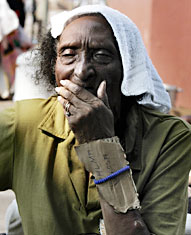
Velma Brosa, with her name on her arm, wipes her mouth after being fed a "meal-ready-to-eat" distributed by the military in a parking lot next to the Morial Convention Center in New Orleans. (Photo by Alex Brandon/NEWHOUSE NEWS SERVICE)

“Granted, this has been more in-your-face, and that may force us to look at it differently. But it seems like it's almost in our DNA. We respond to the immediate crisis, but we don't think about systemic issues. We'd rather give, feel good about it, and then it's over. It's a quick-fix mindset that's hard to overcome.”

Jim Young, director of the Baptist General Convention of Texas Missions Equipping Center, agreed.

“I fear we tend to respond to seen and felt needs, and when it's out of sight, it's out of mind,” Young said. “We dispense compassion a piece at a time in response to obvious needs rather than looking at ways to address long-term needs.”

In part, disregard for poor people arises because many American Christians seldom encounter them face-to-face, he noted.

“They blend into the background of our communities as we drive by, and they just become part of the landscape,” Young said. “It's a theological problem when we look at the poor and don't see the image of God the way we should. When we look at the least of these, we should see Jesus.”

But for those who became involved in ministry to evacuees, the experience “that made the people more than faces on TV” could have lasting impact, said Ginger Smith, executive director of the Baptist Mission Centers in Houston.

“The greatest challenge in communicating poverty in America is discovering a way to personalize it. When people move from a face to a person, they are able to understand situations better,” she said.

“Many volunteers who went into the shelters had life-changing conversations with people that days earlier had only been faces on TV. We (in Houston) had 200,000 neighbors that had lived through a horrific experience and were suddenly at our doorstep in need. The multitudes presented opportunities that could not be ignored.”

Christians quite rightly respond to needs of people hit by tsunamis and hurricanes, but many seldom consider the ongoing impact of poverty and hunger, said Joe Haag, who directs the BGCT Christian Life Commission's world hunger emphasis.

“Unlike the disasters which command media attention, hunger and poverty take their grim toll day-in and day-out, week after week, year after year–its victims largely out of sight and mind,” Haag said.

Many of these victims live in Texas, and a significant number are children, he noted.

“One out of 10 children under 12 years of age in Texas is hungry. Nearly a third of Texas' children are hungry or at risk of hunger,” he said. “These children miss meals, eat too little, have low-quality diets, or live in households which regularly seek emergency food assistance because they do not have the money to purchase the food they need.”

No state has a higher percentage of families experiencing hunger and food insecurity than Texas, Haag added.

“Nearly one out of six Texans lives in poverty, and Texans in poverty constitute just under one-tenth of the nation's entire poverty population,” he said.

Crowds formed long lines to enter the Louisiana Superdome as a last resort refuge when Hurricane Katrina approached. (Photo by Ted Jackson/ NEWHOUSE MEWS SERVICE)

Nationally, 10 percent of all households regularly experience hunger or the risk of hunger. That's 36 million Americans, including 13 million children, he noted.

“The child poverty rate in the United States is more than double that of any other industrialized nation,” Haag said.

The Texas Baptist Offering for World Hunger addresses immediate needs in Texas, the United States and in more than two dozen other countries by providing funds for established ministries that distribute food and provide essential services. But the offering also helps bring about lasting change by funding community development initiatives and job-training programs, he noted.

When a crisis occurs–such as the twin hurricanes that hit Louisiana, Mississippi and Southeast Texas–it places a special burden on community ministries that provide ongoing ministry to local people in need.

Houston's three Baptist Mission Centers merged two ministries into one site and turned its other center into a distribution point for local shelters.

“I had several reasons for not opening as a shelter, and one was that I couldn't imagine telling a community homeless man I knew by name that he couldn't stay in the shelter because it was only for people from Louisiana and Mississippi,” Smith said. “I felt like that would be more damaging in the long run of our ministry to choose who we serve.”

Baptist Mission Centers leaders and staff also did not want to “offer false hope in a time when many were left with such hopelessness,” she added.

Each month, the three Baptist Mission Centers in Houston provide food to about 3,200 people, including more than 450 senior adults; distribute clothing to more than 1,500 people; and involve 750 children, preteens, teenagers and young adults in ongoing programs.

“We serve the impoverished, and their needs did not change through this disaster,” Smith said. “Our initial commitment was to them and our community, which meant we had to maintain our ministry as it is.”

Even minor changes to the ministry, such as combining programs from one center into another center a half-mile away, had a negative short-term impact, she noted.

“We have seen significant reductions in our kids' programs, as they have a hard time going a half-mile for kids' club. We went from 50 kids to as few as four,” she said.

Apart from the physical demands, community ministry leaders also wonder about the economic impact recent natural disasters could have on donations to their programs.

“Among churches that opened their doors, housed people in their buildings and got to know them, it could have a long-term positive effect,” Dorrell said. “But the jury's still out. It could go the other way.”

Some potential donors may think they already have done their part for meeting human needs by giving to disaster relief, he noted. But many community ministries rely heavily on year-end gifts around Thanksgiving and Christmas to sustain them through lean months, he said. And weeks leading up to Thanksgiving have become the traditional time for emphasizing the Texas Baptist Offering for World Hunger.

CLC Director Phil Strickland hopes Texas Baptists will not just “take the money from one hand and give it to the other hand,” but instead will give sacrificially both to disaster relief and world hunger offerings.

“I celebrate every dollar that has been given to these incredible needs. I also believe that Baptist hearts are larger than we think, that in responding to one need we will not forget the other needs,” he said.

“Baptist hearts are tender to human needs right now. We have opened our pocketbooks, our institutions and our homes to those who need our help. Through our offering for world hunger, we can continue to show the world that we are a people who care deeply.”

For now, nonprofit community ministries that provide day-to-day programs to help people in need are taking a wait-and-see attitude, Dorrell said.

“Maybe what's happened will raise awareness about poverty and need. Or maybe people will think they already have given and don't have any discretionary money left,” he said. “We'll know the answer in a month or two.”

News of religion, faith, missions, Bible study and Christian ministry among Texas Baptist churches, in the BGCT, the Southern Baptist Convention ( SBC ) and around the world.


Proposition 2 defines marriage as union of man & woman

Posted: 10/14/05

Proposition 2 defines marriage
as union of man & woman

By John Hall

Texas Baptist Communications

AUSTIN–A proposed Texas constitutional amendment on the Nov. 8 ballot defines marriage as between a man and a woman, but it does not affect the civil rights of homosexuals, said Suzii Paynter, director of citizenship and public policy for the Baptist General Convention of Texas Christian Life Commission.

Texas law already bans homosexual unions, but proponents argue a constitutional amendment would protect the law from legal challenges.

As it will appear on the ballot, voters will vote for or against Proposition 2, which reads: “The constitutional amendment providing that marriage in this state consists only of the union of one man and one woman and prohibiting this state or a political subdivision of this state from creating or recognizing any legal status identical or similar to marriage.”

Though some proponents of the amendment are concerned a low voter turnout could sway the vote toward a minority viewpoint, Paynter believes the constitutional addition will pass easily.

Church leaders are mobilizing their congregations to get out the vote. Several pastors have called the CLC recently to discuss issues that will be on the ballot, she noted.

“We stand for the marriage amendment,” Paynter said. “We know our people will vote for it. People will get out and vote.”

In a letter to Texas Baptist pastors, BGCT Executive Director Charles Wade indicated the marriage definition matches the beliefs of the convention.

“Texas Baptists have taken a clear stand recognizing that homosexual behavior is a sin and that we absolutely believe that marriage is the union of a man and a woman who pledge their love and fidelity to one another,” he said.

Marriage is a key societal issue, Paynter said. Strong relationships undergird healthy marriages. Those couples are more likely to raise emotionally healthy children.

The CLC also is promoting Hope for Home, an initiative that encourages healthy families. People need to focus on strengthening the institution of marriage,” Paynter said.

“Marriage is no fairy tale,” she said. “There are so many people out there in our community that have been part of broken relationships and abusive relationships. We have a responsibility to heal families.”

News of religion, faith, missions, Bible study and Christian ministry among Texas Baptist churches, in the BGCT, the Southern Baptist Convention ( SBC ) and around the world.


Alaskan church’s hunger ministry gleans roadkill remains

Posted: 10/14/05

Paul Harrell leads a team that field dresses roadkill for a hunger ministry sponsored by Friendship Baptist Mission in Fairbanks, Alaska.

Alaskan church's hunger
ministry gleans roadkill remains

By Ken Camp

Managing Editor

FAIRBANKS, Alaska–Most people don't associate the words “roadkill” and “delicacy.” But in Alaska, roadside remains are moose, not possum or armadillo.

And for people living on the edge of poverty, wild game offers much-needed sustenance, whether the animal is killed by a hunter or by an 18-wheeler.

“There's generally a lot of good useable meat,” said Paul Harrell, a layman at Friendship Baptist Mission in Tanana Valley Baptist Association. “Trucks usually hit the moose in the front or the rear. We hope they don't hit it in the rear. That's where most of the good meat is.”

As leader of his congregation's roadkill salvage and gleaning ministry, Harrell works hard to make sure the meat doesn't go to waste but helps feed native people whose diet traditionally has included wild game.

Alaska's highway patrol, in cooperation with the state's fish and game commission, maintain a list of nonprofits they contact when they discover a moose that recently has been hit by a truck or other vehicle.

Friendship Baptist Mission in Fairbanks, Alaska.

“We're at the top of their list because they know we'll come, day or night, and provide a quick clean-up,” said Harrell, who is looking toward military retirement in the near future after 24 years of active-duty service in the Army.

A late-night phone call sometimes means he and his coworkers may spend up to three hours in 40 degrees below zero temperatures as they field-dress a carcass. And they work on the dark roadside close to high-speed traffic.

Frigid temperatures make the work difficult but help preserve the meat and keep away insects, Harrell noted. When the weather warms, he and other volunteers have other methods of repelling pests.

“We've done this at 65 degrees, and it's fine if we do it quickly,” he said. “I keep a 50-50 mix of Tabasco sauce and lemon juice handy to spray down (the carcass) so the flies won't land.”

The Texas Baptist Offering for World Hunger includes a $5,000 line item that would enable the roadkill ministry to buy a winch and boom, along with additional meat-processing supplies and equipment.

The winch would enable volunteers to lift a carcass that may weigh up to 1,500 pounds from road and move it to a safe location for field-dressing.

Harrell has turned his garage into a butcher shop, where he hangs the meat, allowing it to drain for a couple of days before he grinds it and packages it for distribution.

One large moose can provide up to 350 pounds of processed ground meat, he noted.

“It's a prized meat, particularly among the native elders,” he said.

“Some of the elders even want parts that others don't, like the head and the liver.”

Roadkill makes up only part of the church's benevolence ministry. Alaska's indigenous people also welcome the fresh salmon sportsmen from the church catch, the caribou they hunt and the wild blueberries they pick. The church also distributes more conventional canned goods and staples provided through an area food bank.

“Anyone who comes to ask for help, we serve,” Harrell said. “We have some people who live in the woods or on the streets who come to us. It's our way to open the door for ministry. It's a real witnessing opportunity.”

News of religion, faith, missions, Bible study and Christian ministry among Texas Baptist churches, in the BGCT, the Southern Baptist Convention ( SBC ) and around the world.


2nd Opinion: ‘One Family–One Mission’ in Austin

Posted: 10/14/05

2nd Opinion:
'One Family–One Mission' in Austin

By Albert Reyes

Serving as president of the Baptist General Convention this past year has been one of the greatest blessings and privileges of my life. I have learned that our Texas Baptist family is on mission all across our state, nation and world. Our 5,700 congregations, 23 institutions and BGCT Executive Board staff represent a powerful force for the gospel, for social justice and kingdom advancement, especially among the under-represented and the poor of our state. We have seen how Texas Baptists were mobilized to work together during the twin-sister hurricanes that hit the Texas and Louisiana shores.

Working with Charles Wade, our executive director, has been a wonderful experience. I have enjoyed working with him through governance and reorganization. He has done a fantastic job leading our Texas Baptist family. Marv Knox has covered this year's news with excellence. His prophetic voice and visionary leadership as a statesmen and editor have kept our focus on the news and the issues that make a difference in our work. I want to personally thank Marv for his friendship and for his ministry to us and for us. Vice presidents Michael Bell and Stacy Conner have been wonderful teammates this year.

The annual meeting of the Baptist General Convention of Texas, set for Nov. 14 and 15 in Austin, is designed to gather the Texas Baptist family and celebrate our mission together. Our theme is “One Family–One Mission.” I am praying that the tone and heartbeat of the annual meeting will accentuate our understanding of being family and will raise a new awareness of our mission together. Rather than limiting missions to one night during the annual meeting, I am hoping that the theme of missions will fill our hearts and minds in every session. I also am looking forward to the Weekend Fest events designed to appeal to younger Texas Baptists and folks who participate in the meetings and events before the opening session on Monday.

The annual meeting is just a few weeks away. Here are some suggestions for how you can help us celebrate “One Family–One Mission”:

bluebull Become a messenger. Your church has received a card indicating how many messengers your congregation is eligible to send to the annual meeting. Please fill out that card and return it in order to request your messenger cards. Ask your congregation to vote on you as a messenger to the annual meeting. If you are not able to come as a messenger, come as a visitor.

bluebull Invite the whole family. Your congregation may have a mission congregation. Please invite representatives of those missions to attend the annual meeting, too. We need their help to celebrate as one family with one mission.

bluebull Register at the annual meeting. Whether you are a messenger or a visitor, take time to register at the convention center. We want to have a record of your parti-cipation.

bluebull Help us remember. We are collecting names, information and photos of fellow Texas Baptists who have passed away this last year. You can help us honor those who have passed away by contacting Dennis Parrish at (214) 828-5100 or Dennis.Parrish@bgct.org no later than Oct. 28.

bluebull Be informed. We will vote on a new budget, vote on a second reading of the restated constitution and bylaws, and elect new officers. Take time to read the materials that have been sent to your church in preparation for the annual meeting. Read the Baptist Standard by obtaining a copy or viewing its website at baptiststandard.com for the latest information.

bluebull Pray. Let's pray that the Redeemer of history visits us during those days we are together in Austin. Pray for a spirit of unity and enthusiasm to be injected by the Spirit in all our sessions and meetings.

See you in Austin, soon!

Albert Reyes, president of the Baptist University of the Americas, is president of the Baptist General Convention of Texas.

News of religion, faith, missions, Bible study and Christian ministry among Texas Baptist churches, in the BGCT, the Southern Baptist Convention ( SBC ) and around the world.


Summit explores missions future

Posted: 10/14/05

Summit explores missions future

By Marv Knox

Editor

SAN ANTONIO–Texas Baptists must expand their perspective, broaden their biblical worldview, renew their emphasis on discipleship, and re-allocate their resources, ac-cording to participants in a “missions summit” Oct. 6-7.

Those im-peratives distilled the es-sence of “Ex-ploring Our Missions Future,” the theme of the summit, held on the campus of Baptist University of the Americas in San Antonio.

Albert Reyes, president of the university and president of the Baptist General Convention of Texas, convened the meeting, which involved 22 missions and ministry leaders from across the state. They included pastors, missions directors and missions strategists, professors, institutional presidents and BGCT staff, representing geographic, gender, age and ethnic diversity from across the convention.

Albert Reyes

Mike Stroope, missions professor at Baylor University's Truett Theological Seminary, served as moderator, and three strategists presented background papers on the future of missions.

Summit participants took a look at “the core strategic issues that will impact the future of missions for Texas Baptists,” Reyes explained. The goal of the meeting was to develop a framework and guiding principles for how Texas Baptists do missions.

After examining missions needs throughout Texas and around the world, as well as looking at how Christians are mobilized to spread the gospel, the group brainstormed to identify strategic missions issues facing Baptists. Ultimately, they narrowed their focus to four topics:

bluebull Develop a “kingdom perspective” for missions and understand how the church functions in a global context.

bluebull Examine how the church adapts to a view of the world based upon the Bible, functions as a community that reflects biblical principles, and trains and encourages Christians to travel the world in their professions and spread the gospel as they go.

bluebull Consider what roles discipleship and “spiritual formation” play in preparing Christians to see themselves as missionaries, wherever they live, work and travel.

bluebull Question how the BGCT needs to reallocate resources–including money, people, time and energy–to accomplish missions purposes.

Participants divided into four teams to examine the issues. Each team presented suggestions about how the issues could be developed so Texas Baptists can understand them more clearly and engage in missions more effectively.

Some of the participants will form a writing team, which will develop a set of recommendations for implementing ideas raised during the summit, Reyes reported.

The recommendations will be available at the Baptist University of the Americas, missional church and WorldconneX exhibits during the BGCT annual meeting in Austin, Nov. 14-15. They also will be available on the WorldconneX website, www.worldconnex.org.

The material should provide “a tool that can be useful to Texas Baptist churches, institutions, associations and the BGCT in their strategic (missions) planning,” Reyes said.

News of religion, faith, missions, Bible study and Christian ministry among Texas Baptist churches, in the BGCT, the Southern Baptist Convention ( SBC ) and around the world.


Teens show mixed attitudes on marriage

Posted: 10/14/05

Teens show mixed attitudes on marriage

By David Winfrey

Kentucky Western Recorder

PISCATAWAY, N.J. (ABP)–High-school seniors might be developing more pro-marriage attitudes for themselves, but they increasingly are more accepting of non-marriage arrangements for others, a recent report revealed.

The State of Our Unions 2005 is the seventh in a series of annual reports from the Marriage Project at Rutgers University.

The report cites a variety of other surveys and studies to describe American attitudes and trends concerning marriage, divorce, cohabitation and other family issues.

Citing a survey from Michigan, researchers report an increase in the percentage of high-school seniors who said they expect to stay married to the same person for life. But the poll also found a greater acceptance of people having children out of wedlock.

The “Monitoring the Future” poll found 68 percent of girls and 65 percent of boys expecting to get married said they very likely will stay married to the same person for life. That was up from 63 percent among girls and 54 percent among boys in 1990.

“At the same time, there is widespread acceptance by teenagers of nonmarital lifestyles,” the authors wrote.

The same survey found 56 percent of girls and 55 percent of boys agreed with the statement, “Having a child without being married is experimenting with a worthwhile lifestyle or not affecting anyone else.”

That was up significantly from 1980, when 41 percent of girls and 33 percent of boys agreed with the statement. While in 1980 “girls tended to be more traditional than boys on this issue, now they are slightly less so,” the authors noted.

Other findings of The State of Our Unions report included:

Americans have become less likely to marry. In 1970, there were 76 marriages per 1,000 unmarried women, according to U.S. Census data. By 2004, that had dropped to 40 marriages per 1,000 unmarried women.

bluebull Cohabitation has increased “dramatically” in the past 40 years. From 1960 to 2004, the number of unmarried couples living together has grown nearly 1,200 percent–from 439,000 couples to slightly more than 5 million, according to the U.S. Census.

bluebull The presence of children in America has declined since 1960, as measured by fertility rates and the percentage of households with children. The number of births per 1,000 women age 15 to 44 has dropped from 118 births in 1960 to 66 in 2003, according to the National Vital Statistics Report. The percentage of households with children has dropped from 49 percent in 1960 to 32 percent in 2000, according to the census.

“Other indicators suggest that this decline has reduced the child-centeredness of our nation and contributed to the weakening of the institution of marriage,” the authors wrote.

News of religion, faith, missions, Bible study and Christian ministry among Texas Baptist churches, in the BGCT, the Southern Baptist Convention ( SBC ) and around the world.


Fort Worth couple encourages missionary families

Posted: 10/14/05

Fort Worth couple encourages missionary families

By Lance Wallace

Cooperative Baptist Fellowship

CHIANG MAI, Thailand–Five years ago, when self-described “homebodies” Kimberly and Ross Tatum of Cross Point Fellowship in Fort Worth committed to volunteer with the member care and wellness ministry for Cooperative Baptist Fellowship Global Missions field personnel, they never imagined the experience would transform their worldview and give them an international platform for their profession.

Member care and wellness is the CBF Global Missions program of supporting field personnel by matching them with mental health professionals and physicians who volunteer their services.

“We were not the type who traveled all over the world,” said Mrs. Tatum, a licensed professional counselor and former school counselor. “But we prayed about it and felt like it was what God was calling us to do.”

“It has been an exciting way to get to support missions,” said her husband, a child and adult psychiatrist with a private practice in Fort Worth. “We're using our skills to encourage wellness in field personnel.”

After four international trips to work with field personnel, the Tatums experienced a first on their way to a team meeting in Thailand. This summer, they presented play therapy to a group of Thai parents at one of Bangkok's most prestigious schools.

Play is a way for children to act out their experiences or express their feelings, Mrs. Tatum explained.

“For children, toys are their words and play is their language,” her husband added. “It can have a great effect on the parent-child relationship.”

Through their connection with fellow Baylor University alumni working in Bangkok, the Tatums were invited to speak at the school in Bangkok. Expecting about 30 to attend, the Tatums spoke to more than 350 concerned Thai parents, as well as Thai health care professionals.

As member care and wellness volunteers, the Tatums stay in regular contact with field personnel across Asia to help them care for themselves so they can remain physically, emotionally and spiritually healthy in working among the most neglected in often-isolated areas.

Member care and wellness currently has a full complement of professionals volunteering their services and a waiting list of more who are willing to serve. Member care and wellness is staffed by a team of 12 volunteer counselor couples, including licensed professional counselors, psychiatrists and a professor of pastoral counseling. Field personnel also are served by five physicians, one dentist and one volunteer who focuses on serving children of field personnel.

In addition to the member care team, 25 more individuals form a network of resources for field personnel. These include professionals such as lawyers and financial experts who are available to answer questions and give advice when needed.

News of religion, faith, missions, Bible study and Christian ministry among Texas Baptist churches, in the BGCT, the Southern Baptist Convention ( SBC ) and around the world.