Supreme Court denies Wiccan request to pray at county board meetings

Posted: 11/01/05

Supreme Court denies Wiccan request
to pray at county board meetings

By Robert Marus

ABP Washington Bureau

WASHINGTON (ABP)—The Supreme Court has turned away a Wiccan who sought to deliver prayers at a Virginia county’s board meetings on an equal basis with Christian, Jewish and Muslim leaders.

The court declined to hear the case of Cynthia Simpson, formerly a resident of Chesterfield County, Va., Oct. 11. Simpson, a practitioner of the neo-pagan religion, had appealed an April decision by the 4th U.S. Circuit Court of Appeals.

In that ruling, a three-judge panel of the appellate court overturned a federal district judge’s finding that the county had acted unconstitutionally in allowing only prayers compatible with a “Judeo-Christian” concept of God. The lower court had agreed with Simpson’s argument that disallowing prayers from representatives of polytheistic or nontheistic religions violates the First Amendment.

At the time of the lawsuit, Simpson was a lay leader in a Wiccan congregation in the suburban county near Richmond. When she asked to be put on a list of those who could lead invocations at board meetings, the county attorney told her she would not be allowed, claiming, “Chesterfield’s nonsectarian invocations are traditionally made to a divinity that is consistent with the Judeo-Christian tradition.”

In ruling against Simpson, the appeals court cited the Supreme Court’s 1985 Marsh vs. Chambers decision allowing “non-sectarian” legislative prayers before the Nebraska legislature. Judge Harvie Wilkinson, writing the 4th Circuit’s opinion, said the content of the prayers Chesterfield County officials allowed was broad enough, and Simpson’ being barred from offering one was immaterial to the case.

“The Judeo-Christian tradition is, after all, not a single faith but an umbrella covering many faiths,” Wilkinson wrote. “We need not resolve the parties’ dispute as to its precise extent, as Chesterfield County has spread it wide enough in this case to include Islam. For these efforts, the county should not be made the object of constitutional condemnation.”

The judge went on to say the Marsh decision means governments have a wide latitude in dealing with religious expression in legislative contexts without offending the First Amendment clause that prohibits government establishment of religion. Government discretion is broader in those situations, Wilkinson wrote, than when government officials are dealing with religion in other contexts—such as public schools.

Wilkinson continued: “The Chesterfield policy of clergy selection may not encompass as much as Simpson would like, and were it to be applied beyond the ‘unique’ and limited context of legislative prayer, it may not encompass as much as (another Supreme Court decision on government-sponsored prayers) would require. But that context is all important, for if Marsh means anything, it is that the establishment clause does not scrutinize legislative invocations with the same rigor that it appraises other religious activities.”

At the time, a Baptist expert on church-state issues said the appeals court had decided the case wrongly. “The clearest command of the establishment clause, and even fundamental fairness, is that the state must not prefer one religion over another,” said Brent Walker, executive director of the Washington-based Baptist Joint Committee for Religious Liberty.

He stood by that assessment Oct. 12, but he noted the high court’s decision not to reconsider the 4th Circuit’s ruling doesn’t mean they disagree with Simpson’s argument. “The court doesn’t hear the majority of appeals it gets,” he noted.

In Simpson’s case, as in most cases it declines, the high court did not comment on its reasons for refusing to hear the appeal. It takes four of the nine justices agreeing that an appeal raises issues that merit a hearing before it can go on the court’s docket.

Simpson, who reportedly no longer lives in Chesterfield County, said the decision saddened her nonetheless. “Of course I was disappointed,” she told the Richmond Times-Dispatch.


News of religion, faith, missions, Bible study and Christian ministry among Texas Baptist churches, in the BGCT, the Southern Baptist Convention ( SBC ) and around the world.


Senate panel retains subsidies for food for the needy

Posted: 11/01/05

Senate panel retains subsidies
for food for the needy

By Robert Marus

ABP Washington Bureau

WASHINGTON (ABP)—After pleading from prominent religious leaders, a Senate panel has declined to recommend major cuts in a federal program that subsidizes grocery purchases for the needy.

On an 11-9 vote, the Senate Agriculture Committee approved a budget reconciliation plan to cut $3 billion from farm-subsidy programs and other federal entitlements. The food-stamp program—which falls under the committee’s jurisdiction—previously had been one of the areas where committee Republicans were seeking to cut spending by as much as $574 million.

However, when Sen. Saxby Chambliss (R-Ga.), the committee’s chairman, presented his version of the legislation to the panel, it did not include any cuts to food stamps.

A large group of religious leaders had urged Congress not to cut the program. In a letter to every congressman and senator, the leaders acknowledged that the agriculture committees in both chambers were under a mandate to cut $3 billion from their budget.

Nonetheless, they said, “Budget constraints do not release us from our obligation to care for poor and vulnerable people.”

The letter continued: “It would be a moral failure to take those cuts from the food-stamp program. The number of people experiencing hunger in the United States has been on the rise and our national nutrition programs are as important as they’ve ever been. The unprecedented destruction caused by Hurricane Katrina will force many more people to depend on the federal nutrition programs.”

Signers of the letter included leaders from Jewish, Muslim, Catholic, mainline Protestant and evangelical Protestant bodies. Among its Baptist signers were Cooperative Baptist Fellowship Coordinator Daniel Vestal, American Baptist Churches General Secretary Roy Medley, Alliance of Baptists Executive Director Stan Hastey and Baptist World Aid Director Paul Montacute.

Two of the letter’s signers held a conference call with reporters to draw attention to the upcoming vote—as well as the prospects that the House Agriculture Committee may still recommend a cut of as much as $1 billion in funding food stamps.

“I’m a fiscal conservative . I do not like the fiscal recklessness of the last few years,” said David Beckmann, president of Bread for the World. “But to try to save a few million dollars … by taking away food-stamp benefits is not the way to do it.”

The cuts are in response to conservatives in Congress demanding that billions be cut from the federal budget to partially offset the billions in extra federal spending on the Iraq war and hurricane relief.

Jim Wallis, an evangelical Christian and head of the anti-poverty group Call to Renewal, noted that, despite the budget strains, Congress already has separate plans to consider a further $70 billion in tax cuts later this year—on top of the trillions in tax cuts that have been approved since President Bush first took office in 2001.

“We must draw a line in the sand—a moral line in the sand against further service cuts for poor people and tax cuts for the wealthiest,” Wallis told reporters. “This is a moral issue now. This is a contradiction, and people around the country are feeling it.”

The food-stamp issue comes among wider debate regarding the total amount that will be cut from the federal budget. Another group of Christian leaders—including Hastey and leaders from several historically black Baptist denominations—sent a letter to members of Congress opposing an attempt in the House to cut federal programs by $50 billion.

The Senate has proposed $35 billion in cuts.

On the food-stamp issue, Wallis noted, opponents of cuts are not out of the woods yet. The bill now goes through the House Agriculture Committee. That panel’s chairman, Rep. Bob Goodlatte (R-Va.) has reportedly proposed as much as $1 billion in cuts to food stamps.

“Sen. Chambliss has shown real moral leadership here, but this is far from over,” Wallis said.


News of religion, faith, missions, Bible study and Christian ministry among Texas Baptist churches, in the BGCT, the Southern Baptist Convention ( SBC ) and around the world.


Cyber Column by Berry D. Simpson: Sunlight in the mountains

Posted: 10/28/05

CYBER COLUMN:
Sunlight in the mountains

By Berry D. Simpson

It was late Friday afternoon, and the view from the top of Bush Mountain (at 8,631 feet, the second-highest peak in Texas) was phenomenal. To the south, I could see the sun reflecting off the stainless steel monument on top of Guadalupe Peak. To the west, I saw the Chihuahuan Desert and vast salt flats 4,000 feet below my feet. On the northwest horizon, I could see snow-covered Sierra Blanca 110 miles away. And looking north, I could sight along the western escarpment of the Guadalupe Range, a severe cliff face that stretched on and on for miles. It was beautiful.

Berry D. Simpson

However, as I stood there taking in the scenery, it occurred to me that my day was still two miles from being over, and I had a problem. The only thing I could not see from my perch was the trail. I tried to find it, crisscrossing the mountaintop, hoping to intersect the trail, but I couldn’t find it. My legs were weary from the long day, and I was getting worried. All I could see around me were big rocks and thorny bushes and scrubby pine trees; I knew I didn’t have enough daylight left to bushwhack my way to the Pine Top campground before dark.

Standing with my hands hooked through the straps of my backpack, my prayer changed from, “Lord, help me make wise decisions,” to “Lord, help me find the trail,” a subtle but significant shift from abstract to real. And then, amazingly enough, I remembered a National Forest sign that said, “No Horses,” and why would they say that unless it was an intersection of some sort, and maybe I should go back and look. Sure enough, when I retraced back to the sign, I found my trail. Maybe that answered prayer was one the lessons for my trip. Maybe my praying needs to be more real.

Oswald Chambers wrote, “There are vast areas of stubbornness and ignorance the Holy Spirit has to reveal in each of us, but it can only be done when Jesus gets us alone. Jesus cannot teach us anything until we quiet all our intellectual questions and get alone with him.” Well, I was certainly alone with him now. I hadn’t seen anyone in a day and a half.

That morning got off to a slow start. I was camped down in a valley among the pine trees at the Tejas campground, and it was cold. I woke up to frost inside my tent, and all my water bottles were frozen. Even the T-shirt and long-sleeved pullover I’d worn the day before and laid out to dry overnight were frozen stiff like cardboard. At least my pen still worked. Before I left Midland, Cyndi made me promise to come home right away if the ink in my pen froze. It didn’t. I could stay in the mountains.

Saturday morning was much warmer and brighter. I got up early, anxious for the sun to raise my temperature so I could peel a few layers of clothes off before loading my pack and heading down the mountain. But the effect of the rising sun against the east face of the great mountain stunned me. It was a huge sunrise in the mountains. It was bright, brilliant, overwhelming, intense, warm, hot, clear, full of clarity, intense, awakening, purifying, convicting, humbling, revealing—an unmistakable reminder of God, the Lord of my life.

The eastern slopes of the Guadalupe Mountains are hard and stark and rocky and barren and stripped-down minimalist, but the sunlight didn’t care. Sunlight doesn’t need green forests or ocean waves or ancient redwoods to shine on so it can show off. Like God, sunlight carries its own brilliance; all it needs is something to touch.

As the shadows fell away and the sunlight crawled across the ground, all I could think about was Psalms: “This is too glorious, too wonderful to believe; I can never be lost to Your Spirit.” I was so overwhelmed, well, I would’ve fallen to my knees in praise, but the Guadalupe Mountains are too hard and pointy, and I still needed both knees to get down the Tejas Trail to my Jeep so I could drive home to Cyndi. I had to be practical in my worship, more like Martha than Mary. I hoped it was OK to protect my knees while worshipping God. Surely he understands.

In Out of the Question … Into the Mystery, Leonard Sweet writes: “We find the truth and reveal the hiddenness and mystery of God in Christ as we lose ourselves in the GodLife relationship. There is a time to leave words behind for a walkabout with Jesus of listening and seeing and adoring a world rimmed with sunsets and brimming with sunrises.”


Berry Simpson, a Sunday school teacher at First Baptist Church in Midland, is a petroleum engineer, writer, runner and member of the city council in Midland. You can contact him through e-mail at berry@stonefoot.org.


News of religion, faith, missions, Bible study and Christian ministry among Texas Baptist churches, in the BGCT, the Southern Baptist Convention ( SBC ) and around the world.


TOGETHER: Your church has a missions partner

Posted: 10/28/05

TOGETHER:
Your church has a missions partner

We will gather in Austin Nov. 14-15 for the 120th annual meeting of the Baptist General Convention of Texas. “One Family–One Mission” is our theme.

You want to be there, because your presence will help strengthen your church. There will be information you can use, inspiration that is contagious, ideas that help renew and strengthen your church, and friendships that will last through eternity.

wademug
Executive Director
BGCT Executive Board

We will focus on the Texas mission field, of course. But Texans never have been satisfied to evangelize Texas alone. As churches look for more ways to participate in world missions, Texas Baptists have several significant systems through which you and your church can be personally involved in state, national and international mission work.

The shrinking of the globe, the growth of world travel, the access to instant communication, the growing mission passion of so many of our members, and the desire to see and touch personally all are elements that have put our churches on the front lines of mission service. We are recognizing that seminary-trained missionaries are not the only resource we have to do missions. There is enormous missions potential for seminary-trained merchants, dedicated business laity and spiritually prepared professionals to be effective in sharing the gospel and facilitating the start of new communities of faith while working in nonchurch occupations anywhere in the world.

The BGCT can facilitate your church's involvement in missions. We can work with your church to call out, train, connect and encourage volunteers through our new LifeCall Missions ministry. We can work with you in responding to the needs in Mexico and along the Rio Grande through the River Ministry and our Enlace partnership with the Baptists of Mexico. We can work with your church in connecting you to mission opportunities in New Orleans; the Northeast United States; Washington, D.C.; Minnesota/Wisconsin; Germany; the Ukraine; Nigeria; and other locations through Texas Partnerships. We can work with your church in developing disaster relief teams through Texas Baptist Men.

We can work with your church in connecting your people to mission opportunities anywhere through WorldconneX. If you have church members who will be on assignment for job reasons and want to be equipped for and connected to mission work where they will be living, WorldconneX can help. If you have members who feel God has called them to short- or long-term mission service, you can connect them to the International Mission Board or Global Missions.

A new approach also is gaining interest. Your church can send missionaries directly by raising the necessary funds to keep them on the field. If you need other church partners in order to make this happen, WorldconneX will help you build those connections. In 2006, WorldconneX will create logistical services to help churches who wish to support their own missions personnel anywhere in the world.

Then there is the enormous good done through the Mary Hill Davis Offering for Texas Missions and the Texas Baptist World Hunger Offering. They provide us opportunities to express our faith and obedience to God's call as together we respond to great human suffering and incredible human potential. Every gift matters, and our gifts make a difference.

Texas Baptists are preparing for the future face of missions, and the BGCT is your partner in seizing this moment.

We are loved.

Charles Wade is executive director of the Baptist General Convention of Texas.

News of religion, faith, missions, Bible study and Christian ministry among Texas Baptist churches, in the BGCT, the Southern Baptist Convention ( SBC ) and around the world.


To China with Love

Posted: 10/28/05

Jay Chastain of First Baptist Church in Longview plays with a boy in a Chinese orphanage in Xinjiang Providence after Buckner Orphan Care International volunteers placed new shoes on all the children. Paige Chastain cuddles a handicapped infant in a Chinese foster home. (Photos by Scott Collins)

To China with Love

By Marv Knox

Editor

BEIJING, China–The little Chinese girl giggled and squealed as Sherman Hope held her hands, spinning her around, swinging her between his legs and lifting her into the air.

The girl demonstrated her sisterhood with American children and boys and girls all across the globe: If a little fun is good, a lot is great.

So, she refused to let the retired physician quit. On and on they played. Long after his arms tired, he continued smiling and laughing and lifting. And demonstrating the love of his heavenly Father to a little girl who never knew a father.

Jeff Jones (right) and Ken Hall of Buckner present new shoes to children in Tianjin.

“She weighed 40 pounds when we started and 70 when we stopped,” Hope said later, still grinning at the memory. Would he do it all over again? Absolutely.

Hope of Brownfield joined 18 other U.S. Christians on a mission trip to five orphanages in China Oct. 13-23. They participated in Buckner Orphan Care International's Shoes for Orphan Souls program, which has distributed about 1.2 million shoes to orphans in 43 countries since 1999. Theirs was one of 45 Buckner trips this year, involving about 740 volunteers.

Buckner Orphan Care International is a ministry of Dallas-based Buckner Baptist Benevolences, one of about two-dozen institutions affiliated with the Baptist General Convention of Texas.

For the volunteers who make the trip, the highlight of any visit to an orphanage is placing new shoes on the children's feet, then playing with them, helping them decorate frames for pictures the volunteers take of the children, and leaving small toys and other gifts.

In Changji, Judi Carmichael of Selma, Ind., quietly wept and Leslie Whitlock of North Richland Hills laughed as they helped disabled children into new shoes. A few moments later, Jay Chastain of Longview played ping pong with three new friends, while Kenton and Mary Keller of Atlanta, Ga., batted a beach ball with a couple of boys, and Laurie St. Denis of Sarasota, Fla., held a child in her lap, silently praying.

Day by day of the weeklong trip, the locations and the children changed, but the ministry and its purpose remained the same.

Barb Collier of Anderson, Ind., and a little friend prepare to take a picture.

“Why do we come?” Buckner President Ken Hall asked as he gave the volunteers an overview of the ministry on a tour bus just before it rolled up to the first orphanage, Changji Social Welfare Institute, in Xinjiang Province.

“First of all, we're here to love children,” Hall stressed. “We also come to encourage the workers, who love these children and labor in hard and demanding conditions.

“We want to build relationships with the group (of orphanages) and to earn credibility for our program. But we also come here to improve the conditions of these orphanages, to help them have money to do some things that need to be done.”

Buckner's relationship with child care workers in China began in 2000, when Hall and Mike Douris, vice president of Buckner Orphan Care International, traveled there to see what Buckner could do to help minister to the country's burgeoning orphan population.

Orphans have multiplied in China since 1979, when the government announced its “family plan” to control rampaging birth rates that have pushed the country to about 1.3 billion people–stretching its economic and agricultural systems to the breaking point.

In general, the plan limited each married couple to just one child. But two problems with the plan quickly surfaced.

First, Chinese culture historically values boys more than girls, since boys pass on the family name and sustain their parents in old age. So, many couples began abandoning–and sometimes aborting–baby girls.

Second, couples started seeing children with physical or mental handicaps as defective. Parents abandoned special-needs infants in order to try again for a healthy child.

And while the world adoption market has quickly taken in many healthy Chinese baby girls, the government must scramble to find a place for the children whose imperfections leave them unwanted.

That's why, for example, 92 percent of the children cared for by the city orphanage in Urumqi suffer from either mental or physical disabilities.

Still, that doesn't diminish them in God's sight, and neither should it devalue them in the eyes of Christians, said Jeff Jones, operations director for Buckner Orphan Care International.

“Every child counts,” Jones stressed. “Every one of these children deserves all that any child anywhere deserves.”

And the volunteers' time with the children can make a difference in young lives, he added. “This may be the only time someone directly loves one of these children. We're going to do everything we can to minister to these kids one-on-one with whatever time we're given.”

Buckner's opportunity to help Chinese children is growing steadily, Hall reported.

“We are in a country in transition,” he said. “We are trying in a quiet, gentle way to represent what it means to follow Christ. We don't have a long-term strategy, but simply to be faithful and see how things develop.”
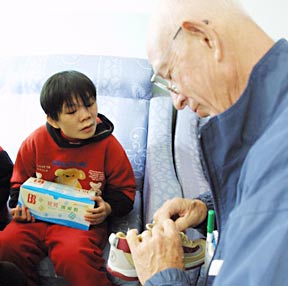
Sherman Hope of First Baptist Church in Brownfield shows Christian love to a child in a Chinese orphanage.

That concept reflects one of Buckner's guiding principles, he added: “Everything is long term.”

Child-care agencies must receive permission to work in China, and Buckner entered the Asian giant through its partnership with Fort Worth-based Gladney Center for Adoption, which owns a permit to arrange international adoptions of Chinese children.

But since Buckner's ministry extends beyond adoptions–particularly to institutional and foster care–it's consistently working on strengthening its ties to Chinese officials and the orphanages they operate.

“We're still learning in China,” Hall said, acknowledging the relationships with the reserved Chinese have come along slower than in other countries, such as Kenya, Romania, Latvia and Guatemala.

“But we're gaining tremendous credibility in China,” he added. “We're focusing on the underserved. And distinctively, we want to work with the government to promote quality child care that's culturally sensitive.

“The government is trying to improve its (child-care) system. With China's economic boom, poverty has become more pronounced. In contrast to the expanding middle class, the presence of the very poor is more visible than ever. The government is sensitive and trying to respond. We want to help them.”

Buckner's approach in China is to be available and ready, but not aggressive. In meetings with government officials responsible for child care, Hall repeatedly expresses appreciation for the opportunity to serve in China. He focuses on his host's strengths, on the ways they are succeeding with children. And while he is careful not to promise more than Buckner can deliver, he also pledges to respond to opportunities to expand the relationship.

“Since most (orphan) children won't be adopted, you try to improve their situation, so they can reach their full potential,” he added.

And if transitional programs for older teens don't develop, orphans will be pushed out into society at age 18 or 20, ill-prepared to care for themselves or hold down jobs.

So, Buckner works to strengthen orphanages and also move adoptions along, Hall noted. “Buckner's approach is to be sensitive to the orphanages and their needs, to help when asked, but not to interfere.”

And Buckner literally has been willing to take the long route to credibility. For instance, Buckner specifically asked to work with orphanages in Xinjiang Province–a three-hour plane trip across China from Beijing, in the remote northwest corner of the country, much closer to Mongolia and Afghani-stan than China's capital city.

“We've wanted to prove ourselves–to show our Chinese friends that we're willing to do the hard work of caring for children in far-off places,” Jones said, noting Buckner's philosophy echoes a statement on the lips of child-care leaders across China: “Everything is for the children, and for the children we will do everything.”

In addition to the obvious benefit–placing much-needed new shoes on children's feet–the Shoes for Orphan Souls program has provided Buckner with positive exposure to China's child-care leaders.

Feng Li Wei, director of the orphanage in the northeastern port city of Tianjin and newly appointed assistant director of social work and rehabilitation of disabled children nationwide, recently told Hall and the Buckner Shoes for Orphan Souls volunteers, “We have a famous saying in China, 'Everything begins with the foot.'”

Proving her point, Feng praised the Shoes for Orphan Souls program and then invited Buckner to conduct major training conferences for child-care workers from throughout the nation.

That vote of confidence thrilled Buckner leaders, confirming their decision to remain in China, despite slow progress at first.

“There have been times when we contemplated whether we should stay in China,” Jones said, acknowledging they had analyzed Buckner's return on investment in China.

“God continues to give us affirmation,” Hall added. “We struggled about a year and a half ago. But we decided we could not ignore the world's most populous nation that is becoming a super power in every way. We have a commitment to share our Christian witness and to advocate for Chinese children.”

Buckner's stepped-up relationship with Chinese leaders may lead to greater opportunities to serve the nation's children, he said. One possibility would be for Buckner to receive its own permit to process Chinese adoptions. Another would be the chance to take teams on extended visits in individual orphanages. This would give volunteers more time to build relationships with children and to express Christ's love for them directly.

And that's why the volunteers travel almost halfway around the globe.

“The word 'joy' comes to mind on a trip like this,” noted Chastain, whose first Buckner trip also was his first trip to China. “I feel we were in the right place, at the right time, doing the right thing. I feel God is in it.”

Barb Collier of Anderson, Ind., admitted she was disappointed when she learned the Chinese government does not allow Christian groups to teach Bible stories to Chinese children. “I wondered, 'How could we make a difference?'” she recalled.

But then she remembered the creation story in the Old Testament book of Genesis, where the Scripture says the Spirit of God “hovered” over the water. “So, I prayed the Spirit of God would hover over these children while we were with them. And I believe he did. I believe Buckner makes a difference every time.”

That's because “we're a people organization,” explained Hope, a longtime Buckner trustee. “It's what we do with people, by people that makes a difference.”

Buckner has “such a great vision for the children of China,” St. Denis added. “Their deepest desire for these kids is that they will find the hope we have in our Lord and Savior, Jesus Christ. … These children are banished on the edges of society, yet God has a plan for them.”

Quoting Scripture, she noted, God “'raises the poor from the ashes and seats them with the mighty and the kings.' God can do that for these children. He's a mighty, awesome God.”

For their part, Chinese leaders welcome Buckner volunteers with open arms and seem eager to explore new possibilities for partnership.

“Let's hope our friendship with our friends from Buckner lasts forever,” Feng told the Shoes for Orphan Souls team.

And from Buckner's perspective, “forever” could have eternal consequences for China's orphan children.

News of religion, faith, missions, Bible study and Christian ministry among Texas Baptist churches, in the BGCT, the Southern Baptist Convention ( SBC ) and around the world.


Right or Wrong? Sex with her boyfriend

Posted: 10/28/05

Right or Wrong?
Sex with her boyfriend

"My 16-year-old daughter just told me her best friend since they were in kindergarten has started having sex with her boyfriend. This girl's mother is a good friend of mine. Should I tell her what's going on?

"You'd better tell me!" That was the response from one of my good friends when she read this question. Never mind that she doesn't even have children yet. Every parent, at least in theory, wants to know what is going on in the life of his or her child.

And kudos to you that you have an open-enough relationship with your 16-year-old that she feels comfortable discussing her best friend's sex life with you. But now that you have this potentially explosive information, what do you do with it?

First, take the opportunity to do a little reinforcement with your own daughter. What a great opportunity to discuss God's plan for sex within a committed, marital relationship. Your daughter may roll her eyes in the typical "you're not telling me anything new" fashion, but never pass up an opportunity. It can be tempting to think that your child is the only one who will not be pressured to have sex in high school. Although you can continue to live in that dream world, it never hurts to keep the lines of communication on this subject open. We have a tendency to keep this subject so quiet that our teenagers are not prepared to deal with the temptations they face.

If possible, have this open, honest chat while your daughter's best friend is present. Chances are if she has been friends with your daughter for the past 10 years, it will not be any more uncomfortable to have this conversation with her than with your own daughter. Just because she's not your daughter doesn't mean you can't offer a little friendly parental advice. In a very nonconfrontational way, you may be able to address the questions, concerns and guilt that this friend is probably feeling. You do not need to be preachy. This would also offer a good opportunity for you to encourage your daughter's friend to talk about the subject with her own mother, which is the preferable solution to this dilemma.

If you cannot have a conversation that includes your daughter's friend, or you still are concerned for the friend's well-being, then a conversation with her mother may be in order. Proceed carefully, though. Your daughter's friend likely shared the information with her in confidence. Before you talk to your friend, explain to your daughter the reasons why you feel compelled to share this information. Confidentiality always is in tension with whether harm or well-being evolves from disclosure of information. Explain that you are not trying to get her friend in trouble, but that you need to help protect her. This gives your daughter opportunity to prepare her friend for what may be coming. At least you can potentially salvage both their friendship and the open relationship you have with your daughter. A little warning also offers your daughter's friend one last opportunity to personally share the information with her mother.

If you do come to a place where you have to broach this uncomfortable subject with your friend, be gentle. Remember, you would want to know if your own daughter was having sex, but you would probably fly off the handle if you had to hear it from someone outside the family. Encourage your friend to open communication lines with her own daughter. Be supportive in helping her to find a way to address the subject in a way that will bring restoration and healing.

Emily Row, program coordinator

Texas Baptists Committed

San Angelo

Right or Wrong? is sponsored by the T.B. Maston Chair of Christian Ethics at Hardin-Simmons University's Logsdon School of Theology. Send your questions about how to apply your faith to btillman@hsutx.edu.

News of religion, faith, missions, Bible study and Christian ministry among Texas Baptist churches, in the BGCT, the Southern Baptist Convention ( SBC ) and around the world.


Kirbyville church showers hurting community with kindness

Posted: 10/28/05

Young people hand out food at First Baptist Church in Kirbyville. The church became the primary place where people in the community found help after Hurricane Rita.

Kirbyville church showers
hurting community with kindness

By John Hall

Texas Baptist Communications

KIRBYVILLE–Before Hurricane Rita hit, Pastor Charles Burchett asked his church members to be “wells of refreshing.” After the storm, they let the waters flow.

First Baptist Church became a stabilizing force in Kirbyville, a town that only recently had clean running water and electricity restored. Long after the storm, gas stations and grocery stores in the community still were not completely functional.

Burchett expects chainsaw crews to be cutting down and removing trees from people's homes until the end of the year.

“We will be working in people's yards,” he said. “Priority one is getting trees off houses. We are working with elderly and poor who cannot get the trees off their houses.”

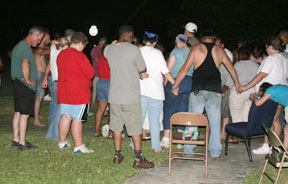
People gather for prayer at First Baptist Church in Kirbyville the night after Hurricane Rita moved through the area.

Local residents recognize First Baptist as the place to find help in Kirbyville. The Federal Emergency Management Agency set up at the church, providing food, ice and other supplies.

An Arkansas Baptist feeding team set up on the church's parking lot. Texas Baptists brought numerous supplies to help. Texas Baptist Men chainsaw teams also worked in the area.

Ted Elmore with the Baptist General Convention of Texas contacted Hilltop Baptist Church in Mount Vernon and told Pastor Van Patton that First Baptist Church in Kirbyville was in need of baby supplies. The request matched Patton's passion to help children affected by the recent hurricanes.

That night, Hilltop members brought First Baptist Church $5,000 in supplies. The BGCT reimbursed the congregation for its expense.

“Babies are my favorite subject when it comes to God's people. God put it on my heart to go help them,” Patton said.

First Baptist Church members gave food to people throughout the community. Members enlisted other churches to help them.

Once residents in town had their needs met, the church moved supplies to a location outside of Kirbyville to better serve people living in rural areas that had more needs.

Burchett's wife, Beverly, said church members demonstrated the Spirit of Christ in serving others. And it opened avenues to share the gospel.

Members freely talked about their faith and prayed with people as a result of their relief ministries.

“We have seen the wells of refreshing flow from our church,” she said. “The community's view of us is so positive.”

People need to have their physical needs met, but they need much more in trying times, Mrs. Burchett said. She can see this every time she looks at a person who drives to the church to pick up food.

“You can just see it in their eyes,” she said. “They need more than food. They need a touch from the Lord.”

Kindness from Christians is changing lives and an entire community, she commented.

“People have seen there is love,” Mrs. Burchett said. “We love them. We love each other.

“I believe our community will never be the same.”

News of religion, faith, missions, Bible study and Christian ministry among Texas Baptist churches, in the BGCT, the Southern Baptist Convention ( SBC ) and around the world.


Russian orphan still needs adoptive family

Posted: 10/28/05

Russian orphan still needs adoptive family

DALLAS–Oksana, a 13-year-old orphan from St. Petersburg, Russia, still needs a family after visiting North Texas last summer through Buckner Orphan Care International's “Angels from Abroad” program.

Oksana lived with a volunteer host family for two weeks as part of the “Angels” initiative, designed to help raise awareness about the needs of older children living in Russian orphanages and Buckner's programs to improve their lives.

The urgent nature of the adoption need is both physical and emotional, said Mary Ann Hamby of Buckner International Adoption, also an adoptive parent.

Oksana, a 13-year-old Russian orphan, needs a family to adopt her.

“Every day these children live in an orphanage, they are deprived of the resources, love and nurture a family provides. There is an urgent need to find families for children age 7 and older and also for sibling groups,” she said.

Oksana's host family described her as “sweet, helpful and considerate. She enjoys music and is especially nurturing with animals and young children. She's initially cautious with strangers but becomes fun-loving and silly when she gets comfortable. She's also very adventurous and athletic, and sometimes a bit mischievous, but in a playful way.”

For more information about international adoption, Buckner hosts several International Adoption Workshops throughout the year for interested families.

Upcoming workshops are scheduled Nov. 18 in Houston and Dec. 13 in Fort Worth.

For more information about Oksana or any other children available for adoption through Buckner, contact Sharon Hedrick at shedrick@buckner.org or call (866) 236-7823 toll-free. Buckner International Adoption's workshop correspondence video and free pre-application now are available online at www.bucknerinternationaladoption.org.

News of religion, faith, missions, Bible study and Christian ministry among Texas Baptist churches, in the BGCT, the Southern Baptist Convention ( SBC ) and around the world.


Fertility, not theology, cause of decline

Posted: 10/28/05

Fertility, not theology, cause of decline

By Greg Warner

Associated Baptist Press

CHICAGO (ABP)–The decline in membership of mainline churches over the last century had more to do with sex than theology, research by a trio of sociologists suggests.

The popular notion that conservative churches are growing because mainline churches are too liberal is being challenged by new research that offers a simpler cause for much of the mainline decline–the use of birth control. Differences in fertility rates account for 70 percent of the decline of mainline Protestant church membership from 1900 to 1975 and the simultaneous rise in conservative church membership, the sociologists said.

“For most of the 20th century, conservative women had more children than mainline women did,” three sociologists–Michael Hout of the University of California-Berkley, Andrew Greeley of the University of Arizona and Melissa Wilde of Indiana University–wrote in Christian Century.

“It took most of the 20th century for conservative women to adopt family-planning practices that have become dominant in American society,” the writers said. “Or to put the matter differently, the so-called decline of the mainline may ultimately be attributable to its earlier approval of contraception.”

While mainline churches could claim 60 percent of the total Protestant congregants in 1900, their share fell to 40 percent in 1960. Many religious observers and some sociologists attributed the drop–and simultaneous growth of conservative churches–to the lethargy of liberalism and the appeal of biblical certainty.

But simple demographics can account for almost three fourths of the mainline decline, the trio of sociologists said. “In the years after the baby boom, the mainline (fertility) rate declined earlier than did the rate of conservatives. Only in recent decades have the fertility rates of the two groups become similar.”

The researchers studied shifts in church membership from 1900 to 1975 and the accompanying differences in fertility rates between women in conservative churches–Baptist, Assembly of God, Pentecostal and the like–and mainline ones such as Presbyterian, Methodist, Episcopal and Lutheran.

They also created a demographic model that projected what would have happened to mainline and conservative memberships if the difference in fertility rates was the only factor influencing membership during the same period. “The answer is that it would look remarkably like it does in real life,” they concluded.

The trio also studied other factors that could have influenced the real-life shift in memberships. For instance, they looked at how many people switched from mainline to conservative churches during the period, and vice versa.

During most of the last century, more people moved from mainline to conservative churches than in the other direction. Conservatives were much more successful at retaining their church members, even when they married mainliners.

“The declining propensity of conservatives to convert to the mainline accounts for the 30 percent of mainline decline that fertility rates cannot account for,” they concluded.

The researchers investigated other possible causes for mainline decline–support for homosexual and abortion rights, a lower view of the Bible, a higher “apostasy” rate, and fewer conversions from outside the Christian fold. But they dismissed these other factors as irrelevant because none could produce numerical changes significant enough to explain the shift in church membership.

“Higher fertility and better retention thus account for the conservatives' rising share of the Protestant population,” they concluded.

However, the authors suggested, the trends underlying the mainline's decline “may be nearing their end.”

Fertility rates now are virtually the same between the two groups and will produce only a 1 percent decline in mainline membership over the next decade, they noted.

“Unless conservative Protestants increase their family size or mainline Protestants further reduce theirs, this factor in mainline decline will not be present in the future.”

Moreover, fewer people now are switching membership from mainline churches to conservative ones. While 30 percent of conservatives in the 1930s had come from mainline churches, only 10 percent of those counted among the conservatives in the early '90s had made the switch, the authors said.

That downward trend will continue–if only because there are fewer mainliners left to make the jump.

However, the sociologists cautioned, it could take 50 years before the conservatives' “demographic momentum” exhausts itself because people born during the conservatives' belated baby boom of the 1970s will be filling those pews for quite awhile.

News of religion, faith, missions, Bible study and Christian ministry among Texas Baptist churches, in the BGCT, the Southern Baptist Convention ( SBC ) and around the world.


New stem cell methods answer some questions, raise others

Posted: 10/28/05

New stem cell methods answer
some questions, raise others

By Robert Marus

ABP Washington Bureau

WASHINGTON (ABP)–Scientists have successfully tested two new methods designed to achieve the same ends as embryonic stem-cell research while avoiding the ethical controversy over the destruction of embryos.

The two methods are detailed in articles published on the website of the journal Nature. Both involve extraction of stem cells from embryos–highly valued for their potential to treat destructive diseases–without destroying an embryo that could otherwise grow into a healthy fetus.

Previously there was no definitive evidence such cells could be harvested without destroying the embryos that produced them.

Nonetheless, both new methods raise their own sticky ethical questions.

In the first study, two biologists from the Massachusetts Institute of Technology took nuclei from mouse skin cells and implanted them in unfertilized mouse eggs. The resulting bundle of cells was essentially a cloned mouse embryo–a method scientists have referred to as “therapeutic cloning.”

However, researchers Rudolf Jaenisch and Alexander Meissner disabled genes in the cells' nuclei that allow embryos to grow placentas and continue to develop. The alterations rendered the bundles of cells incapable of further development.

The scientists then extracted the stem cells from the disabled embryos. In the second article, a team of researchers from Advanced Cell Technology in Worcester, Mass., grew eight-cell mouse embryos and then removed one of the cells, called blastomeres.

They then extracted the stem cells from the blastomere, while the other seven cells went on to develop into “apparently healthy mice,” the Nature article said.

Scientists are optimistic, the journal reported, both methods could be replicated using human embryos.

The first new method raises the specter of human cloning, as well as issues about the precise moral status of the disabled embryo that is created.

“I think this is an artificial concept, and I'm not comfortable with it,” said Alan Trounson, an Australian reproductive biologist who has done work on stem-cell research. “You do an engineering step to essentially destroy the embryo so that you can then use it.”

“It is unclear whether such an entity should be considered not an embryo, or simply an embryo altered for self-destruction,” said Tony Perkins, president of the Washington-based Family Research Council, in his e-mail newsletter. Perkins' group, like many conservative religious organizations, is strongly opposed to stem-cell research that destroys human embryos, as well as human cloning.

But an advocate of the first method told Nature the embryos created are not ones with an ethical status. “You have the embryonic equivalent of brain death,” said William Hurlbut, a professor at Stanford University.

The second method, meanwhile, poses moral difficulties for two reasons. First, scientists don't know with a high degree of certainty if the removal of one cell at the embryonic stage will cause long-term developmental problems for the resulting human. Second, the removed blastomere destroyed in the process itself may have the potential to grow into an embryo.

“If you grow it in certain conditions, it could divide and differentiate to have the same properties as embryos,” said Yuri Verlinsky, head of the Reproductive Genetics Institute in Chicago, according to Nature.

News of religion, faith, missions, Bible study and Christian ministry among Texas Baptist churches, in the BGCT, the Southern Baptist Convention ( SBC ) and around the world.


TBM offers disaster relief

Posted: 10/28/05

TBM offers disaster relief

Eight Texas Baptist Men volunteers delivered water purification and cooking equipment to southern Mexico following Hurricane Stan, and two TBM emergency food service teams traveled to Florida to serve people affected by Hurricane Wilma.

Hurricane Stan made landfall south of Veracruz with 80 mph winds and destroyed at least 37,500 homes. The storm extensively damaged property in Chiapas, Veracruz, Guerrero and Oaxaca.

The Texas volunteers planned to show residents in the area how to use the cooking equipment and empower them to help their communities, TBM disaster relief leaders explained. Area residents were to be given water purifiers and trained in how to use them.

This ministry resulted from a request by the National Baptist Convention of Mexico through Dexton Shores, Baptist General Convention of Texas River Ministry coordinator.

“We've got thousands of people that are suffering great need, and as brothers and sisters in Christ, it's our desire to respond to that need as best we can,” Shores said. “The best way we can do that now is through the National Baptist Convention of Mexico.”

Hurricane Wilma made landfall Oct. 24 at Cape Romano, Fla., with sustained winds of 110 mph. The Texas disaster relief teams met at Marianna, Fla., for their assignments once the areas of greatest need were determined.

News of religion, faith, missions, Bible study and Christian ministry among Texas Baptist churches, in the BGCT, the Southern Baptist Convention ( SBC ) and around the world.


Underwood resists idea of potential Baylor presidential draft

Posted: 10/28/05

Underwood resists idea of
potential Baylor presidential draft

By Ken Camp

Managing Editor

WACO–Two groups representing past and present Baylor University faculty have written to the school's board of regents affirming Interim President Bill Underwood, and their leaders want the regents to retain him as interim for at least a full year.

At the same time, other Underwood supporters have raised the possibility of a campaign to draft him for the permanent president's post. But Underwood, who told the regents at their September meeting he wanted to remove his name from consideration for the permanent position, firmly insists he has not reconsidered.

“From the beginning of the presidential search process, I have thought that the best thing the committee could do would be to find a candidate to lead the university who has not been involved in any of the disputes we've had here. I think that's the best thing for the university,” Underwood said. “I am not a candidate for the presidency, and I will not be one.”

Underwood

Underwood became Baylor's interim president June 1, after Robert Sloan left the post to become the university's chancellor. During the last two years of Sloan's 10 years as president, the Baylor Faculty Senate twice gave him “no confidence” votes, and regents voted three times on Sloan's continued employment–once reportedly coming within one vote of removing him from the president's post.

At its mid-October meeting, the Baylor Faculty Senate voted 31-0–with one member absent and one abstention–to approve a statement affirming Underwood and his leadership.

“Over the past four months, he has demonstrated an attitude of acceptance and respect for all faculty members, provided sound and transparent leadership, encouraged and modeled administrative efficiency, and undertaken concrete and intentional actions toward healing the university community. Interim President Underwood has the respect and appreciation of the Faculty Senate,” said the motion of affirmation mailed to regents.

More than 200 former faculty and staff also signed a letter to regents commending Underwood.

Baylor's Retired Professors and Administrators Program sent the letter, which noted, “The last several years have been characterized by great difficulties and much tension within the Baylor family.”

The letter commended regents for selecting Underwood as interim president, adding, “We strongly endorse your decision to allow him to continue in the restoration of trust and confidence” at the university.

Underwood's “quiet, level-headed leadership” has “created a very large measure of stability and greatly enhanced campus morale,” the letter stated. “Since his becoming the interim president, the spirit of cooperation and fellowship among all constituents of the Baylor family have improved significantly. His knowledge of Baylor, his sincere churchmanship and his generosity of spirit are qualities which are proving invaluable to Baylor's future.”

Faculty Senate Chairman Eric Robinson and Baylor University Retired Professors and Administrators Program Director Rufus Spain insisted their organizations' actions were not part of any effort to draft Underwood for the presidency.

“We're not trying to tell the regents what they should do,” Spain said.

But both Robinson and Spain expressed their desire to see the regents give Underwood an extended interim of one to two years.

“I believe Bill Underwood has done a good job up to this time, and he needs to be interim for at least a year or so,” Spain said. “We've got to get things settled here before we'll ever be able to get a good man in here (for the permanent president's position). I think Bill Underwood is the right person to do it for the interim. Who the right person is beyond that is up for grabs at this point.”

Many faculty members would like to see Underwood as the permanent president, Robinson said.

“This being said, it is obvious that many senators–and faculty–would like to see him remain as interim for an extended time because he is doing a great job,” he added.

Faculty report “a more comfortable work environment” and improved morale this semester, he noted.

“There was some discussion in the senate about how President Underwood's approach to faculty governance, attempts at organizational transparency, general respect for faculty and staff, and realistic outlook should be a model for the type of person the regents seek for our permanent president,” Robinson said.

Most faculty members believe Underwood is leading Baylor in the right direction and contributing to the university's organizational health, he observed.

“In addition, most faculty members understand that as the university becomes healthier, the quality of our applicant pool will improve,” Robinson said. “Therefore, it makes sense to me for the regents to give President Underwood more time–one to two years–to continue as the interim so we can ultimately get the high-quality president that Baylor deserves.”

Underwood expressed confidence in the regents' presidential search committee, saying, “I don't think they feel the need to rush. I am willing to serve for however long it takes.”

However, he added he hoped it wouldn't be two or three years. “Hopefully, the search committee can find someone sooner than that who can unite Baylor,” he said.

In the meantime, he plans to continue working on the goals of Baylor 2012 and meeting with faculty and staff to create an open and trusting climate on campus. As a symbol of that desire for transparency and openness, Underwood even ordered one of the doors removed from the president's office.

“I think we've made a lot of headway in improving the spirit on campus,” he said.

News of religion, faith, missions, Bible study and Christian ministry among Texas Baptist churches, in the BGCT, the Southern Baptist Convention ( SBC ) and around the world.