Quilts for Moldova a labor of love for volunteers_11005

Posted: 1/07/05

Quilts for Moldova a labor of love for volunteers

By Craig Bird

Baptist Child & Family Services

SAN ANTONIO–Fran Dunkum, Pam Keith and Lisa Weldon autograph each of the quilts they make for an Eastern European orphanage with a heart instead of their names.

“We decided up front that we wouldn't put any writing or identifying information in the design because that isn't really important,” explained Dunkum, a cardiac nurse at Methodist Hospital in San Antonio and a member of Trinity Baptist Church. “But we made an unbreakable rule that each quilt has to have a plainly visible heart. Those kids know Jesus loves them, but they need to know that somebody else loves them too–and every time they see the heart, they will be reminded of that truth.”

So far, the three women have completed 45 quilts and handed them over to Baptist Child & Family Services for delivery to Moldova. Three more are nearing completion, and they have enough material to make at least another 60.

Lisa Weldon (left) and Pam Keith tie up individual quilts before packing them for shipment to orphans in Moldova. A heart is included on every quilt no matter the design to "show the child that somebody loves them" and is visible on two of the quilts. (Photos by Craig Bird)

And it's not just any material. Those scraps and remnants are the legacy of their friend, Donna Dickey, who taught them all to quilt and who died in mid-2003 after an eight-month battle with cancer.

“She was not able to complete a bridal quilt she was making for one of her daughters, so we asked if we could finish it,” Dunkum recalled. “Then we helped sort through her things. Quilters collect a lot of material, and she had been quilting for 25 years.” Dickey's husband gave each of them four or five large bags of pieces.

Naturally, the trio began discussing the best use of the material.

“Our first project after Donna made us fall in love with quilting had been to make quilts for the children of the New York City firemen who were killed on 9/11,” Dunkum said. “Then, suddenly, she was gone too. But we wanted to do something worthy of her.”

The women also felt a pull to help people outside traditional San Antonio projects. They wanted to find a place where there was great need and limited resources, and their search led them to Moldova.

Baptist Child & Family Services, through its Children's Emergency Relief International outreach, has worked with orphanages in the former Soviet republic several years. The cash-strapped government is hard-pressed to provide even minimal food and shelter. But the quilting trio never had heard of Moldova.

That changed last January, when Marla Rushing, who works with Baptist Child & Family Services' Great Starts program, spoke at Trinity Baptist Church about her recent trip to that country.

“She mentioned that the volunteers carried blankets to sit on in the dorms and that they wound up giving them all away,” Dunkum said. “The typical bedding is World War II vintage, worn thin and badly soiled.”

Fran Dunkum of Trinity Baptist Church in San Antonio prepares to pack a Christmas nativity-design quilt for orphans in Moldova.

By March, the process was under way. And in early December, the first shipment of 45 quilts was completed.

The initial quilts were scheduled to arrive in Moldova Jan. 5, along with 32 short-term volunteers working with Children Emergency Relief International. Most of the team members are from Crossroads Baptist Church in San Antonio. Others are from Trinity Baptist Church in San Antonio, Currey Creek Baptist Church in Boerne, Kingwood Baptist Church in Houston and others from churches in Tennessee and Missouri.

The women quilted independently most of the time because of work schedules. Keith took advantage of times her husband was out of town with his job and “a week waiting for my grandson to be born” to put her quilts together. During one week, she completed six quilts.

Dunkum did much of her work from 2 to 4 a.m. after coming home from her hospital shift. Weldon, Dunkum's daughter, carved out time “after my family was asleep and everything else I needed to do for them was done–after 11 p.m.” On her frequent visits with her mom, she would cut the squares while Dunkum pieced them together.

“Lisa is also our designated 'main pray-er,'” Dunkum said. “Pam and I really rely on her to pray for us to have the time and energy we need to keep going.”

About two-thirds of the first batch of quilts was machine-quilted by 78-year-old Margaret Hiestand, who lives on Lake Buchanan. The San Antonio women heard about her through a quilting magazine and decided to hire some of the work done.

“When I found out they were doing this for an orphanage, I offered to do it for free,” said Hiestand, a member of Buchanan West Baptist Church. “But they wouldn't hear of it since it is how I make my living. But they did let me donate the backing for the 30 quilts I've done so I could be a part of it too.”

Each quilt is unique, varying both in size and design. Some are even hand-tied. “We talked about trying to make them uniform, but we decided that since each child is different it would be OK if the quilt had distinctive personalities too,” Weldon explained. “And we know the Moldovan Christians who run the Children's Emergency Relief International program will give the right quilt to the right child.”

Steve Davis, executive director of Children's Emergency Relief International, has no doubt the children who receive the quilts will value them highly.

“The girls already enjoy doing needlepoint and often give volunteers dollies and other things they've made, so they appreciate the time, energy and love that go into gifts like these quilts. The winters there are bitterly cold, and the quilts will bring physical warmth as well as being constant reminders of the love that American Christians have for them,” he said.

“Beyond actual hugs, I don't know a better way to feel love than to be able to wrap yourself in someone else's love and prayers when you go to bed at night.”
News of religion, faith, missions, Bible study and Christian ministry among Texas Baptist churches, in the BGCT, the Southern Baptist Convention ( SBC ) and around the world.


More young adults waiting longer to get married_11005

Posted: 1/07/05

More young adults waiting longer to get married

By Greg Warner

Associated Baptist Press

WASHINGTON (ABP)–New data from the U.S. Census Bureau confirms young adults are waiting longer to get married. The result may be healthier marriages, some researchers insist.

Since 1970, the average age at which men marry for the first time rose from 25.3 years to 27.1, according to the bureau's Current Population Survey. The average marrying age for women rose from 20.8 to 23.2.

Also, the percentage of men age 30-34 who have never married has quadrupled since 1970, now accounting for about a third of men in the age group.

About one-fourth of women age 30-34 have never married, which is a fourfold increase from the 6 percent of 1970.

Sociologists who viewed the report said young adults are focusing more on their education and jobs than marriage.

An increase in cohabitation also is contributing to the postponement of marriage, they acknowledged.

Two researchers who direct the National Marriage Project at Rutgers University see some encouraging signs in the trends, however.

“There is a common belief that, although a smaller percentage of Americans are now marrying than was the case a few decades ago, those who marry have marriages of higher quality,” said David Popenoe and Barbara Dafoe Whitehead.

“It seems reasonable that if divorce removes poor marriages from the pool of married couples and cohabitation 'trial marriages' deter some bad marriages from forming, the remaining marriages on average should be happier,” the pair wrote in the 2004 study “The State of Our Unions.”

Popenoe and Whitehead, who studied attitudes about marriage among young men age 25-34, found that 80 percent of men view marriage favorably and are good candidates for matrimony.

“The men who are the best 'marriage bets' are those who are more traditional in their family and religious background characteristics and in their attitudes toward marriage,” the researchers said.

Their research showed the prime time for men to search for and marry their “soul mate” occurs roughly during the years between ages 25 and 30, and the meaning of marriage has changed for those men.

“Compared to earlier generations of men, young men today are less likely to equate marriage with becoming an adult,” the researchers said.

Neither do they view marriage primarily as a means to have children.

Instead, the researchers said, young men tend to marry in order to build a life with their “soul mates.”

Other recent studies have shown that Christian men and women are more likely to marry and tend to marry younger than the general population, perhaps because many Christians disapprove of cohabitation.

But Christians also divorce at a higher rate than the general population. According to a 2001 study by the Barna Research Group, 27 percent of born-again Christians have been divorced, compared with 24 percent of adults who are not born-again.

But Popenoe and Whitehead, in an earlier study, said the higher divorce rate among Christians has more to do with education than faith.

“Born-again Christians have a somewhat lower level of education than the population as a whole, and this educational level is very highly associated with divorce–the higher the education level, the lower the divorce rate,” Popenoe said.

“One reason is that people with a higher education level don't marry as young. And the age at marriage is extremely sensitive to the question of divorce–the younger you are when you marry, the higher the divorce rate.”

“There is a common belief that, although a smaller percentage of Americans are now marrying than was the case a few decades ago, those who marry have marriages of higher quality.”

David Popenoe and Barbara Dafoe Whitehead, directors of the National Marriage Project

News of religion, faith, missions, Bible study and Christian ministry among Texas Baptist churches, in the BGCT, the Southern Baptist Convention ( SBC ) and around the world.


Buckner, CBF Volunteers Celebrate With Orphans_11005

Posted: 1/07/05

Oliva Ober of Houston shares a smile with an orphan from the Baptist Children's Center in Nairobi, Kenya. (Photos by Scott Collins)

Buckner, CBF volunteers celebrate with orphans

By Scott Collins

Buckner News Service

NAIROBI, Kenya–Marlene Grant put her arms around Teresia Ngao and helped the little girl cut out figures of Mary, Joseph and baby Jesus.

A smile crossed Teresia's face as each character dropped to the table with the last cut. Grant smiled, too. Together, the Kenyan orphan and the Texas volunteer were telling the Christmas story.

Teresia and 76 other orphans from the Baptist Children's Center in Nairobi were joined by 29 volunteers from across the United States for a “Christmas in Africa” camp sponsored by Buckner Orphan Care International and the Cooperative Baptist Fellowship.

The camp, one of three hosted by Buckner in Kenya in 2004, provided an opportunity for 50 orphans from the children's center and 27 who live in Buckner-sponsored foster homes to interact with the American volunteers. Activities included crafts, recreation and Bible stories.

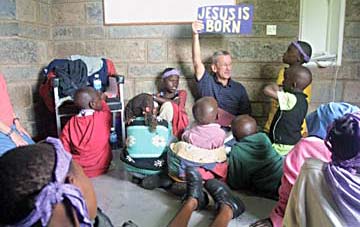
Volunteer Bob Hefner of Dallas (left) tells the Christmas story during a VBS camp with children from the Baptist Children's Center of Nairobi, Kenya.

The “Christmas in Africa” trip marked the 41st and final international mission excursion sponsored by Buckner in 2004. More than 700 individuals traveled overseas with Buckner during the year. Buckner President Ken Hall and CBF Coordinator Daniel Vestal, along with Global Missions Coordinator Barbara Baldridge also participated in the Kenya Christmas trip.

“It's so encouraging to return here and see how God is using Buckner, CBF and our Kenyan partners to make a difference in the lives of these precious boys and girls,” said Hall.

Dickson Masindano, director of Buckner Africa, said the orphans living at the center “really love the time they spend with the volunteers. It means so much to the children to know that people care enough to come from the United States and spend time with them.”

“We have people from all over the United States here, and they are using their talents and serving God and being faithful to what God has called them to do,” said Eraina Larson, international missions coordinator for Buckner. “The children have come alive with this group.

“I can really see a difference with the kids,” she added. “Even though our teams may have different faces each time, it's the same God working through each of us, and that's who the children are building a relationship with.

“Our hope is that God would use the people on the team and that they would be faithful to use whatever talents God has given them and that they would just be faithful and leave the work up to God” Larson said. “Our hope is that the kids would receive one-on-one attention so that there is someone hugging on them and that through that, our volunteers would be the love of God and not just tell the love of God.”

Beth Wilkinson, a volunteer from Norcross, Ga., puts shoes on a child's feet as part of the "Christmas in Africa" mission trip.

Grant, a member of Tallowood Baptist Church in Houston, said her passion to “serve God” motivated her to join the team. “I absolutely love children, and my heart was calling me to go do this.”

She said the highlight of working with the orphans is the appreciation they show to the Americans and to each other.

“They are so giving and so appreciative,” she said. “They take care of each other and the (Kenyan) workers are so wonderful and loving.”

Grant said she returns to Houston with a commitment to pray for the children and to get others involved.

"I'm going to remember their faces, and I'm going to put their names and their pictures on my refrigerator, and I'm also going to get my Sunday school department to pray for the children."

For volunteer Bob Hefner, who has made several international trips with Buckner along with his wife, Laura, returning to the children's home in Nairobi is a confirmation of the work Buckner, CBF and Kenyan Baptists are doing with the children.

“We have fallen desperately in love with these children,” said Hefner, who is a member of Park Cities Baptist Church in Dallas. “They are literally the most important children I have run across. They are bright, and they are hopeful, and they appreciate where they are and are anxious to succeed. They really want to show appreciation for the help they get and to just grow in their faith. They are extraordinary Christians.”

The Hefners believe the most encouraging aspect of their involvement with the Kenyan project is the progress they are seeing in the lives of the children.

“Today, as a consequence of the kind of gentle care they are getting at the home, we are seeing children walk around looking for ways to nurture the other children and to be of service to the others,” Hefner said.

CBF Coordinator Daniel Vestal participates in a song with the orphan children.

Hefner believes children in Africa “not just deserve our help, but they are exactly the 'least of these.' They are the most perfect example of what I believe Christ called us to do when he talks about helping children and helping the least of these. Some of these kids were found naked at age 3 and 4 and 5, wandering garbage dumps. It's impossible to describe.”

Hefner believes it is important to provide for the material needs of the children by “investing our funds in them, we can help them enormously.” But, he added, it is just as important to “be their servants–clean up after them, hold their hand and dry their tears, give them encouragement and talk to them about their futures. No child in this ministry will be stopped in terms of education because of lack of resources. Every child who comes through this institution will be given the opportunity to go as far as his intellect and his energy and his interests will take him.

“Being a part of that and being able for a few days just to be a servant to one that you owe nothing to is just what God called us to do, and I get a rich blessing out of it.”

Lynn and Sharon Robinson, members of First Baptist Church in Winnsboro, made the Christmas trip along with four other members of their church. They said the love of the orphan children was a “blessing” for them.

“They've got a lot of love,” Mrs. Robinson said. “They are amazing. They really love Jesus. They know the Lord, and they are a blessing to work with. We just wanted to give them something, and what they've done is give us more.”

News of religion, faith, missions, Bible study and Christian ministry among Texas Baptist churches, in the BGCT, the Southern Baptist Convention ( SBC ) and around the world.


Antiphony Conference challenges students with a call to ministry_11005

Posted: 1/07/05

Antiphony Conference challenges
students with a call to ministry

By Carla Wynn

Cooperative Baptist Fellowship

BIRMINGHAM, Ala. (ABP) — For five days, more than 250 college students wrestled with their response to God’s call to minister and the world’s cry for help during the inaugural Antiphony conference at the Wynfrey Hotel in Birmingham, Ala.

The event was sponsored by the Cooperative Baptist Fellowship, Baptist Theological Seminary at Richmond and Passport, a Birmingham-based organization that operates summer camps for youth and children as well as other ministries.

Julie Pennington-Russell, pastor of Calvary Baptist Church in Waco, told students the call to Christ comes above any vocational or ministry calling they might feel.

Julie Pennington-Russell, pastor of Calvary Baptist Church in Waco, listens as Colleen Burroughs of Passport speaks about answering God’s call and the world’s cry.

For students struggling to discern vocational calls, Pennington-Russell said the answer is often not quickly spoken. “The Holy Spirit sometimes takes a long time to say what’s worthwhile,” she said.

During the meeting, students were offered plenty of help in the discernment process. They had their choice of more than 25 different topical discussion sessions, called “chat rooms,” and were assigned to small “D-groups,” or discernment groups, where they grappled together with how to hear God’s call and overcome hurdles that prevent clarity in spiritual direction.

The conference attracted students for a variety of reasons. For some, it was not knowing what life after college graduation would bring. For others, it was a desire to ring in 2005 with friends. The second full day ended with a New Year’s Eve party. Some students came to reunite with former summer-missions teammates, and others came to meet like-minded people.

The missions component of the conference was enough motivation for Brevard College freshman Jakob Giese. “I came to learn about missions, but there’s a lot more here than I was expecting,” he said.

Pennington-Russell and Colleen Burroughs of Passport introduced the idea of an antiphony-style sermon, where ideas about calling were shared through a conversation between the two preachers.

But both women claimed no particular expertise. “I’m no shining call story,” Burroughs said.

Ministry was the last thing the former missionary kid had in mind after returning from Africa to attend college in America. “I really wanted to stick my head in the sand and be done with professional ministry,” Burroughs said. However, meeting her future husband, David, eventually changed her path, leading her to seminary and later to her current position as executive vice president of Passport Inc.

Pennington-Russell stumbled into her calling while attending Golden Gate Baptist Theological Seminary in San Francisco, Calif. Starting as a church’s music minister, she eventually became the church’s pastor.

“Call has come to me by degrees and by open doors,” she said. When hired by Calvary Baptist Church in Waco, she became the first female Baptist pastor in Texas.

In addition to in-house speakers, several people addressed the conference via video web-cams. Paul Brasden, co-pastor of a church start in Frisco, discussed what discerning God’s call has meant to him and the impact that call has had on his life and his family. While the specifics of a call might vary from person to person, being a disciple of Christ is the ultimate call, Basden said.

“He is the mentor. You are the apprentice,” he said. “Let him teach you how to be a kingdom citizen.”

For Carson-Newman College senior Ashleigh Smith, the video testimonies helped ease her anxiety about a future vocation. “Tonight made me feel affirmed that it’s OK not knowing. I think this conference will help me go in the right direction,” she said.

After a day of discussion about God’s call, students were challenged to understand the complexity of human need.

“Before you can respond with love to the world’s cry, you have to be able to identify where it is coming from and why,” said Burroughs, who illuminated a sample of current global needs, including the devastation of domestic violence, prostitution and HIV/AIDS.

Weaving the themes of the conference together, Burroughs said, “The unresolved tension of Antiphony is that God’s call and the world’s cry might actually be the very same sound.”

Students responded in a song by musical guest Ken Medema. “The cry of world will never end,” they sang.

Jesse Loper, one of CBF’s Global Service Corps personnel serving for three years in the inner city of New York, also joined the conference via web-cam to share his experience of the world’s cry. “The needs are overwhelming sometimes … but God equips us and enables us to respond to that (cry) the best we can,” Loper said.

Chat rooms covered topics including poverty, racism and the needs of women around the world. Students could learn about being full-time missionaries or meet people already practically transforming communities in need.

In a chat room concerning Christian mission and health needs, panelists discussed the necessity of ministering holistically. Frances Ford, health-care coordinator of Sowing Seeds of Hope in Perry County, Ala., said many Perry County churches had been unresponsive to their community’s needs, feeling “their concern should be about the soul and spirit.”

Ford said Sowing Seeds of Hope turned churches toward a more holistic approach, an idea that has resonated with April Coates, an Oklahoma State University sophomore. “If I’m going to go into missions, then I can’t just give them Jesus. I have to take care of the whole person,” she said.

Small-group discussion was the conference’s hallmark, allowing everyone a chance to share their ideas, said Graham Ashcraft, a 2004 graduate of Baylor University. “It’s not a lecture. It’s a conversation,” he said. “And it’s encouraging to see other people think the way you do.”

While each person’s call varies, Pennington-Russell told the students, they should aim beyond their expectations. “Jesus’ mission involved setting people free from a life too small. Whatever shape your answer takes, let it have some greatness in it,” she said.

Tom Graves, president of conference co-sponsor Baptist Theological Seminary at Richmond, echoed the challenge to greatness. “Your life needs to count for much. Dream for more, hope for more, expect more,” Graves said during worship Sunday. “Your life can really make a big, miraculous difference.”

News of religion, faith, missions, Bible study and Christian ministry among Texas Baptist churches, in the BGCT, the Southern Baptist Convention ( SBC ) and around the world.


CBF check will help start churches_11005

Posted: 1/07/05

CBF check will
help start churches

Phil Hester (right), director of church planting for the Cooperative Baptist Fellowship, presents a $60,000 to Abe Zabaneh, director of the Baptist General Convention of Texas' Church Multiplication Center. When matched dollar-for-dollar by the BGCT, the funds will help start two Texas Baptist churches–an Anglo congregation in Belton and an English-speaking Hispanic congregation in San Antonio

News of religion, faith, missions, Bible study and Christian ministry among Texas Baptist churches, in the BGCT, the Southern Baptist Convention ( SBC ) and around the world.


Ministry offers peace to people with HIVAIDS_11005

Posted: 1/07/05

Ministry offers peace to people with HIV/AIDS

By Lisa Jones

Cooperative Baptist Fellowship

NEW YORK (ABP)–“Peace be with you,” says Frank Tomaselli as he ends a conversation. But these words are more than a slogan to Tomaselli. They're a way of life.

Growing up in a household where his parents used insulting names instead of encouraging words, Tomaselli eventually began using drugs. As a result, he contracted HIV/AIDS.

Filled with fear about his past, Tomaselli recalled wondering, “How can God forgive me for all the things I've done to support my habit for years?”

Tomaselli found words of hope from a local priest who told him, “If God can forgive the 6 billion people in the world, he can forgive you.”

Four years ago, at a Bible study for an AIDS service organization, Tomaselli met Ronnie Adams, program director of New York City's Rauschenbusch Metro Ministries. Adams, who serves as a Bible teacher and volunteer chaplain for three HIV/AIDS service agencies, recalled the change in Tomaselli.

“He accepted that forgiveness and is a strong leader. He is a more effective missionary to the AIDS community than I am,” said Adams, a missionary of the Cooperative Baptist Fellowship.

Tomaselli wants to share the peace he found with others who have HIV/AIDS.

“I really love speaking about God to people, especially the lost,” said Tomaselli, who sees himself in the people he encounters. “My past is dead. When I see it, I know where I was.”

Tomaselli said his efforts are worthwhile “if I can preach to people with my own disease and they say, 'Wow, if he can do it, I want to be saved.'”

A native New Yorker who describes himself as reading at a second-grade level, Tomaselli learned the Bible by repeatedly listening to audiotapes for a year. Saying he felt like Moses–a man with a message but without the right words–Tomaselli prayed for guidance as he learned the Scriptures and studied devotional guides.

Without money to attend Bible school, Tomaselli enrolled in a correspondence Bible study course. Now, he teaches at Bible studies, filling in when Adams is out of town.

In his role as a volunteer chaplain, Adams visits the three HIV/AIDS agencies and offers spiritual help to some of the city's 100,000 people with HIV/AIDS. After working for Rauschenbusch Metro Ministries for nine years, he said, he has found the HIV/AIDS community is the most open to the gospel and to his ministry of all the work he does.

“It's a remarkable experience seeing folks living with a life-threatening disease and how they continue on with their life and grow in their Christian experience and Christian life and live a life worthy and full in the midst of living with AIDS,” he said.

Adams and other members of the Fellowship's HIV/AIDS Task Group envision having a network of churches ministering to people with HIV/AIDS, matching those congregations with CBF Global Missions field personnel like himself. The network would provide a source of communication, information and support for churches.

News of religion, faith, missions, Bible study and Christian ministry among Texas Baptist churches, in the BGCT, the Southern Baptist Convention ( SBC ) and around the world.


Former seminary president Honeycutt dies at 78_11005

Posted: 1/07/05

Former seminary president Honeycutt dies at 78

By Trennis Henderson

Kentucky Western Recorder

LOUISVILLE, Ky. (ABP)–Roy Honeycutt, retired president of Southern Baptist Theological Seminary, died Dec. 21, one day after suffering head injuries in a fall at his home in Louisville, Ky. He was 78.

Honeycutt, a noted Old Testament scholar, was elected president of Southern Semi-nary, also in Louisville, in 1982.

His 11-year tenure as president paralleled much of the controversy in the Southern Baptist Convention's conservative shift.

Roy Honeycutt

Many remember Honeycutt for one headline-making speech in 1984, when he declared “holy war” on the “hijackers,” a reference to fundamentalist leaders leading the effort to gain control of the Southern Baptist Convention.

Honeycutt immediately became a target in the controversy. As the seminary's board shifted to fundamentalist control, he came under increased pressure to resign. He retired in 1993, at age 67, three years earlier than he planned.

Bill Leonard, dean and professor of church history at Wake Forest Divinity School, joined Southern's faculty in 1975, the same year Honeycutt was named dean of Southern's School of Theology.

“In many ways, Roy was a bridge-builder,” Leonard recalled.

Honeycutt's efforts at bridge-building included working with the five other Southern Baptist Convention seminary presidents to draft the “Glorieta Statement” in 1986.

Adopted at the height of the SBC controversy, the Glorieta Statement declared the seminary presidents' commitment “to the resolution of problems which beset our beloved denomination.” But the document largely was ignored by conservative leaders, who already controlled most of the seminaries' boards.

Honeycutt was a graduate of Mississippi College, Southern Seminary and the University of Edinburgh, Scotland. Prior to being elected president in 1982, Honeycutt served as provost, theology school dean and professor of Old Testament at Southern. He previously was academic dean and chair of the Old Testament department at Midwestern Baptist Theological Seminary in Kansas City, Mo. He also was pastor of churches in Kentucky, Indiana and Mississippi.

Honeycutt and his wife, June, were longtime members of Crescent Hill Baptist Church in Louisville. In addition to his wife, he is survived by two children, Roy Lee and Mary Anne.

News of religion, faith, missions, Bible study and Christian ministry among Texas Baptist churches, in the BGCT, the Southern Baptist Convention ( SBC ) and around the world.


Sullivan praised as denominational statesman_11005

Posted: 1/07/05

Sullivan praised as denominational statesman

NASHVILLE, Tenn. (BP)–James Sullivan, Southern Baptist statesman and retired president of the Sunday School Board of the Southern Baptist Convention, died Dec. 27 at a Nashville hospice following a brief illness. He was 94.

Sullivan served as president of the denominational publishing house from 1953 until his retirement in 1975.

He was widely known as an authority on Southern Baptist polity and had been actively involved in denominational service since his first pastorate in 1932.

James Sullivan

“He was president at one of the most crucial times at the Sunday School Board during the civil rights struggles of the 1950s and '60s,” said Jimmy Draper, president of LifeWay Christian Resources, the agency that succeeded the Sunday School Board.

“He led in production of materials promoting the biblical view of human worth, regardless of race, and modeled his beliefs by providing an equitable work environment for a multicultural staff. He was my friend and supporter and a great statesman.”

Among a wide range of roles he filled was pastor of churches in Kentucky, Tennessee, Mississippi and Texas; president of the Tennessee Baptist Convention; and trustee of numerous Southern Baptist universities, seminaries and hospitals. He also served as vice president of the Baptist World Alliance.

Sullivan taught as guest professor at Southern Seminary and Boyce Bible School in Louisville, Ky., and at Mississippi College in Clinton following his retirement.

Sullivan wrote many articles and books, including “Your Life and Your Church,” with a distribution of more than a million copies, and “Baptist Polity: As I See It,” published by Broadman & Holman in 1998. The extensive overview of Baptist polity pulls from insights of Sullivan's 22-year tenure as president of the board.

A graduate of Tylertown (Miss.) High School, Sullivan's higher education included a bachelor of arts degree from Mississippi College; a master of theology degree from Southern Baptist Theological Seminary; and doctor of divinity degrees from Mississippi College and Campbell College in Buies Creek, N.C.

Sullivan's wife, Velma Scott Sullivan, preceded him in death in 1993. His daughter, Martha Lynn (James) Porch of Tullahoma, Tenn., died in 1999.

Survivors include a daughter, Mary Beth Taylor of Nashville; a son, James David Sullivan of Oxford, Miss.; seven grandchildren; and 14 great-grandchildren.

News of religion, faith, missions, Bible study and Christian ministry among Texas Baptist churches, in the BGCT, the Southern Baptist Convention ( SBC ) and around the world.


Kenya shoe distribution marks last step for 2004 Shoes for Orphan Souls drive_11005

Posted: 1/07/05

Kenya shoe distribution marks last step
for 2004 Shoes for Orphan Souls drive

By Scott Collins

Buckner News Service

NAIROBI, Kenya–Laughter, giggles and a lot of smiles filled the Baptist Children's Center of Nairobi as more than 70 orphan children received brand-new shoes and socks from Buckner Orphan Care International and a team of volunteers.

The Kenya distribution marked the culmination of the 2004 Shoes for Orphan Souls drive that saw Buckner collect more than 165,000 pairs of shoes for needy children around the world. Since taking over the shoe drive in 1999, Buckner has collected and distributed nearly 1.2 million pairs of new shoes.

Shoes and socks collected during the 2004 drive are being distributed to children in more than 40 countries around the world, from the United States to Russia and China.

Buckner President Ken Hall celebrates giving a new pair of shoes to Michael Ndaka during the "Christmas in Africa" mission trip. Hall and a team of volunteers presented new shoes to children from the Baptist Children's Center of Nairobi, Kenya, as part of the 2004 'Shoes for Orphan Souls' campaign sponsored by Buckner Orphan Care International.

Shaun Hawkins, director of SOS, said that while the numbers are staggering and the overall impact of the project continues to grow, the most important part of the annual drive is the impact a new pair of shoes has on an individual child.

“My first experience was here (Kenya) in April putting shoes on a little girl named Betty who had just been at the children's center for a few days, and I could see the difference in her the minute I put the shoes on her feet,” Hawkins said. “To come back now and see her as she continues to grow is just amazing.”

Hawkins said 2004 was “an incredible year of blessing and hope and excitement, not just for the children who receive the shoes, but for the ministry itself.”

And while Buckner has distributed more than 1 million shoes, Hawkins said SOS is continually flooded with requests from orphanages and other ministries around the globe for more shoes.

“We've still got so many new children, even here in Africa alone, so we're not even close to meeting all the needs. There are millions and millions of children who need shoes. It makes a difference.”

That difference, she added, “means love. It means someone is going to hug them and touch them. It means that someone cares for them. It means telling them about Jesus, and ultimately that's the greatest love they can receive.

“For every pair of shoes that is received on a child's feet, that's the gospel. It's a pair of Good News, and every child needs that.”

With the closure of the 2004 shoe campaign, Hawkins said Buckner already is gearing up for the 2005 drive. She said Buckner needs churches, Sunday school classes, civic groups, schools and others to join the project.


Specific ways to help Shoes for Orphan Souls

Donate a new pair of shoes and $20 for distribution

Become a shoe drive coordinator and lead a collection campaign
Volunteer to sort shoes for shipment around the world

Go on a shoe distribution trip with Buckner and help the children receive the new shoes and socks

Become a prayer advocate for Shoes for Orphan Souls

Additional information and resources is available on the internet at www.shoesfororphansouls.org or 1-877-7ORPHAN


Arkansas ruling overturns ban on gay foster parents_11005

Posted: 1/07/05

Arkansas ruling overturns ban on gay foster parents

By Robert Marus

ABP Washington Bureau

WASHINGTON (ABP)—A judge has overturned an Arkansas state policy banning the placement of foster children in any household with a gay adult, saying the state agency that created it had unconstitutionally overstepped its bounds.

Pulaski County Circuit Judge Timothy Fox ruled the Arkansas Child Welfare Agency Review Board could not enforce the policy because it has no authority under the Arkansas Constitution to regulate “public morality.”

The foster-care ban was the only one of its kind in the nation. But Arkansas law does not ban gays and lesbians from adopting children permanently.

Arkansas legislators gave the welfare agency the responsibility to “promote the health, safety and welfare of children,” Fox said. However, he added, the ban on gay foster parents and household members did nothing to further that goal, and that the ban was a bureaucratic attempt to influence public policy on issues that go beyond child welfare.

“The testimony and evidence overwhelmingly showed that there was no rational relationship between the … blanket exclusion (of households with gay members) and the health, safety and welfare of the foster children,” Fox wrote in the opinion accompanying his order.

The ruling came in a lawsuit filed by the American Civil Liberties Union on behalf of a gay Little Rock couple, a lesbian from Fayetteville, and a married heterosexual man from Waldron who has a gay adult son who sometimes lives at home. All were banned from serving as foster parents under the policy.

“Throughout this case, the state has relied on ugly stereotypes to deny children in the Arkansas foster-care system the chance of having the widest possible pool of foster families available to them,” said Rita Sklar, the ACLU of Arkansas’ director. “We’re very pleased that the court saw through these arguments and has recognized that gay and lesbian people can provide homes just as loving and stable as anyone else’s.”

However, while Fox found that the state had not proved living in a household with a gay adult present had any detrimental effect on children, his decision also did not turn on the main argument that the ACLU put forth. Their attorneys had argued the ban denied gay and lesbian Arkansans equal protection of the law. Fox said state law does not treat homosexuals separately from heterosexuals as a protected class of citizens, like women or ethnic minorities.

Kathy Hall, the state’s main attorney in the case, had argued that the kinds of children commonly put in foster-family situations need stability and normalcy in their lives.

“What we were talking about was the welfare category, and that’s the stress level, and that’s a huge category for these children,” Hall said, according to the Associated Press.

State officials have vowed to appeal the ruling, but Fox’s opinion noted that the legislature could act to give the agency the authority to resurrect the ban—or pass a law doing the same.

The policy on foster parents was established by administrators appointed by Gov. Mike Huckabee (R), who is a former pastor and a past president of the Arkansas Baptist State Convention.

While no other state bans gay foster parents, three states—Florida, Utah and Mississippi— have some sort of restriction on gay individuals or couples who want to adopt children. A federal appeals court recently upheld the Florida law in the face of a challenge to it, but that decision has been appealed to the Supreme Court.

News of religion, faith, missions, Bible study and Christian ministry among Texas Baptist churches, in the BGCT, the Southern Baptist Convention ( SBC ) and around the world.


Texas volunteers seek to rescue villagers from arsenic in water_11005

Posted: 1/07/05

Arsenic-laced water is damaging the lives of many in Mexico, including its emerging generations. Once the metal enters the body, it never leaves. The poison can lead to cancer. Texas Baptist Men is going to install purifiers that make the water safe for drinking.

Texas volunteers seek to rescue villagers from arsenic in water

By John Hall

Texas Baptist Communications

OJO CALIENTE, Mexico–In isolated villages of the Ojo Caliente region of Zacatecas, Mexico, children ride bicycles up and down small strips of concrete. Their friends spontaneously erupt in laughter during a soccer match on a small dirt field. Childhood here is continuous movement.

Unfortunately, that activity is damaging their lives. They get tired. They get thirsty. Then they slowly drink toxins that break down their bodies.

Tests revealed arsenic levels at least five times higher than what the World Health Organization considers safe–10 parts of arsenic per billion parts of water. The lowest level found in these isolated villages has 50 parts per billion. A neighboring village has 1,200 parts per billion. Levels vary at different times as the metal is washed through underground streams.

Arsenic takes its toll over time.Arsenic levels in a person build over time because the human body cannot eliminate the metal. A mother can pass it on to her developing baby.

A single drink of the water does not affect a person. Arsenic takes its toll over time.

The metal builds up in a person's body and slowly begins to cause damage. When the arsenic reaches a certain level, hair becomes brittle. Next, the tips of people's fingers and toes turn dark. The nervous system is damaged, and brain activity is affected. Eventually, dark skin lesions form. These can be seen regularly in Ojo Caliente.

By this point, a person can develop tumors. Lee Baggett, a medical missionary in Mexico, called arsenic the “slow toxin.” Arsenic levels in a person build over time because the human body cannot eliminate the metal. A mother can pass it on to her developing baby.

Texas Baptist Men volunteers are bringing hope to the area by partnering with Manos Hermanas, Baggett's nonprofit group. It was this group's tests that discovered the arsenic.

Both Texas Baptist Men and Manos Hermanas are partnering with the government of Mexico to test water in other areas. Texas Baptist Men now is planning to install one community water purifier in Santo Tomas de Venditos and 150 smaller water cleaners in homes across the area.

The large unit was to be installed in mid-December, but it was delayed at the Texas-Mexico border. This purifier will provide clean drinking water to about 5,000 people in five communities and boost the economy when it is installed, probably in February.

After the water runs through the filter, local residents employed at a water station will bottle and sell it for an affordable price. It will be given to impoverished people for free. The money raised will pay salaries.

Any profit from the water will be reinvested into the community through social projects such as improving sewer systems and building playgrounds.

The smaller units will provide clean drinking water in families' homes.

Early results of work with Manos Hermanas indicate the ministry's effectiveness. Manos Hermanas has brought communities together with local officials and Baptist mission teams to construct wells and outhouses. Each party provides some supplies, and church volunteers work alongside residents to finish projects.

“The people have the right to life,” said Rafael Calzado, president of the county of Ojo Caliente. “They have the right to health. If the people aren't healthy, the rest doesn't matter.”

Residents already are energized by the prospective project. They gather in large groups when Texas Baptist leaders examine and evaluate progress and possibilities. The gospel already has been shared in villages that had previously never heard it.

“We don't try to separate individuals or families from their community,” Baggett said. “We work with the whole community on their project.”

Leaders believe this approach to mission work and evangelism is the way to reach one of the least-evangelized states in Mexico. Less than one half of a percent of the state of Zacatecas is evangelical. There are eight evangelical churches in a state where about 6 million people reside.

“This is the 10-40 window of Mexico,” said Ananias Cruz, a missionary who works in the area. The 10-40 window refers to the area just north of the equator where the least number of evangelical Christians are found.

Those initial efforts have led to towns improving their sewer systems, playgrounds and wells. They also have opened the area to the gospel. Bible studies are beginning. Individuals are making faith professions. Cruz has helped start 22 churches in the last four years.

“You work with a guy for a week–spend time with them digging ditches,” Baggett said. “And then they invite you into their homes, and you can share the gospel with them over a cup of coffee. You first earn their respect. Then they want to listen.”

For more information about this effort, contact Texas Baptist Men at (214) 828-5350.

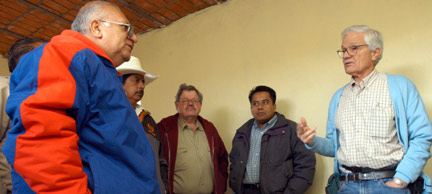
Lee Baggett (right), a missionary in Mexico, explains to Dick Talley (3rd from left) of Texas Baptist Men and local community leaders how a water purification project will benefit residents of villages near Zacatecas, Mexico.

News of religion, faith, missions, Bible study and Christian ministry among Texas Baptist churches, in the BGCT, the Southern Baptist Convention ( SBC ) and around the world.


Campbell remembered as compassionate, visionary leader_11005

Posted: 1/07/05

Campbell remembered as compassionate, visionary leader

DALLAS–R.C. Campbell, whose tenure as president of Buckner Baptist Benevolences spanned 31 years, died at his home Jan. 3 following a brief illness. He was 83.

Best known for leading Buckner through one of the greatest eras of growth in the agency's 126-year history, Campbell was elected as the fourth president of Buckner in 1963 at age 41. He retired in January 1994.

“Dr. Campbell's vision set the stage for Buckner to enter into the 21st Century prepared to minister to the challenges facing children and families,” said Ken Hall, who succeeded Campbell as Buckner's president. “His is a legacy of a builder whose tools were compassion, vision and courage.”

R. C. Campbell

While Buckner experienced numerous milestones during Campbell's tenure, one of his favorite accomplishments was the 1975 relocation of nearly 100 orphans and staff from the Cam Rahn Christian Orphanage in Vietnam to Buckner Children's Home in Dallas. The relocation, which received worldwide attention, included a harrowing escape from Vietnam as the country fell into the hands of communists.

Prior to his election as Buckner's president, Campbell served as pastor of three Texas churches–First Baptist Church of Alvarado, First Baptist Church of Gainesville and Calvary Baptist Church of Dallas.

A native of Chattanooga, Tenn., he was a graduate of Texas Wesleyan College and Southwestern Baptist Theological Seminary, both in Fort Worth, and received the doctor of divinity degree from Howard Payne Baptist University in Brownwood and a doctor of humanities degree from Dallas Baptist University.

Campbell was co-founder and president of the National Association of Homes and Services for Children and president of the Texas Association of Homes and Services for the Aging, Southwestern Association of Child Care Executives and Texas Association of Services to Children.

He chaired an advisory committee for the Texas Department of Human Services and was a member of the White House Conference for Children and Youth, Dallas County Committee on Aging and the Governor's Blue Ribbon Task Force on Aging.

He was honored with Southwestern Baptist Theological Seminary's Distinguished Alumnus Award in 1995, and the National Association of Homes and Services for Children recognized his work with the 1992 Samuel Gerson Nordlinger Child Welfare Leadership Award.

Campbell is survived by his wife of 57 years, Marilyn Ruth McFadyen, who he met while attending Texas Wesleyan College in 1945. Other survivors include his daughters and sons-in-law Gayla and Howard Crain of Irving, and Robbie and Larry N. Lehman of Tioga; grandsons Robert Crain and Ken Crain and wife, Amy; and granddaughters Laci Bracewell and husband Bradley; Lori Huff and husband Heath; and three great-grandsons.

Campbell was a member of Park Cities Baptist Church in Dallas.

News of religion, faith, missions, Bible study and Christian ministry among Texas Baptist churches, in the BGCT, the Southern Baptist Convention ( SBC ) and around the world.