Texas, Virginia conventions to be recommended for BWA membership_30705

Posted: 3/11/05

Texas, Virginia conventions to be
recommended for BWA membership

FALLS CHURCH, Va—The Baptist General Convention of Texas and the Baptist General Association of Virginia will be recommended for full membership in the Baptist World Alliance, the group’s membership committee reported March 9.

British Baptist Alistair Brown, who sits on the committee, said it is “the committee’s unanimous view that both be recommended” to the BWA General Council to become full member bodies of the worldwide umbrella group for Baptists. Brown’s report came during the BWA’s semi-annual Executive Committee meeting March 9 at BWA’s suburban Washington headquarters.

The BGCT and BGAV already are major financial contributors to the Baptist World Alliance, and both already have joined the North American Baptist Fellowship, one of BWA’s six regional groups. But the recommendation, if approved by the BWA’s General Council during its meeting in July, would mean the two state conventions would become members on the same level as the 200-plus national or regional Baptist groups that make up BWA’s membership. They would be the first U.S. state conventions to join.

“I’m delighted that the Baptists of the world were open to our application for membership,” said Charles Wade, executive director of the BGCT.

“We know that the Baptist people around the world serve Christ with great courage and faithfulness,” Wade said. “They will be an inspiration to Texas Baptists. And I believe that we can be an encouragement to them, as together we share the gospel and serve the people of the world.”

The moves by the two conventions come after the Southern Baptist Convention voted last year to leave the global fellowship.

“Both bodies express sadness at the withdrawal from membership from the BWA of the Southern Baptist Convention,” Brown told the assembled BWA leaders. “And they said that the withdrawal from the BWA had removed from them a means of fellowship with Baptists from around the world.”

BWA rules require that member bodies not be an integral part of any other Baptist denomination in their countries. Brown said the committee felt both BGAV and BGCT meet that requirement, noting, “Both grant freedom to churches to apportion giving to a variety of causes for missions work overseas.”

In other news, BWA leaders heard a positive financial report. Despite large reductions in the group’s budget over recent years—including a $425,000 annual loss as a result of the SBC withdrawal—the group’s revenue in 2004 was more than $500,000 greater than in 2003. And BWA came in more than $561,000 over budget for 2004.

Ellen Teague, BWA’s finance director, attributed much of that increase to generous giving by local churches. Last year, BWA began allowing local churches to become “associate members,” and more than 300 local churches— including SBC congregations— have sent contributions directly to BWA.


Compiled from reports by Rob Marus of Associated Baptist Press  and Ferrell Foster of Texas Baptist Communications.


News of religion, faith, missions, Bible study and Christian ministry among Texas Baptist churches, in the BGCT, the Southern Baptist Convention ( SBC ) and around the world.


BWA membership will reflect Texas Baptist’s heart, pastor says_30705

Posted: 3/11/05

BWA membership will reflect Texas
Baptist's heart, pastor says

By Ferrell Foster

Texas Baptist Communications

Texas Baptists have “a heart as big as God’s world,” said a San Antonio pastor, and they’re on track now to become an official part of the largest worldwide Baptist body— the Baptist World Alliance.

The BWA’s membership committee voted March 7 to recommend the Baptist General Convention of Texas for membership in the alliance. The final vote will come this summer at the BWA Centenary Congress in Birmingham, England.

Seeking membership in the BWA is “an extremely appropriate and necessary step to execute the vision that our Lord has given us,” said Charles Johnson, senior pastor of Trinity Baptist Church in San Antonio.

People throughout the world are “more interrelated and closely connected than ever before,” the pastor said. “Therefore, an organization like the Baptist World Alliance will help us to advance the cause of Christ among every nation.

“We Texas Baptists are becoming world Baptists,” he added.

BGCT President Albert Reyes said he is “very encouraged” and “optimistic” by the move toward BWA membership. “I can’t imagine a more strategic move or alliance.”

Membership in the BWA would indicate a “strong possibility” that Texas Baptists will be “at the center of God’s activity in the world for the next 50 years or longer,” Reyes said. “By taking the hands of our Baptist brethren around the world, we begin to become part of the family that God intends us to be.”

Reyes, who also is president of the Baptist University of the Américas in San Antonio, said both the BWA membership and the BGCT’s reorganization are bringing about possibilities of greater cultural diversity in Texas Baptist life.

“We have cultural blind spots that keep us from seeing the world as it really is,” Reyes said. “As we increase cultural diversity, we reduce the number of cultural blind spots.”

Ken Hall, immediate past president of the BGCT and president of Buckner Baptist Benevolences, also expressed excitement about the possibility of BWA membership. “I’m thrilled for the BWA and extremely excited for our state convention.”

“I think BWA will be good for Texas Baptists” by providing opportunities for “our perspectives to enlarge and grow as we interact with fellow Baptists around the world.”

Hall has been involved with the BWA through Buckner’s relationship with the world body. For Charles Johnson, it came about through two retired missionaries, Jerry and Francis Smyth, who introduced him to Tony Cupit, BWA’s evangelism director.

Johnson attended his first BWA meeting five years ago—the 2000 Congress in Melbourne, Australia.

“It was an indescribably powerful experience of Christian community,” Johnson said. “It was an incarnation of Christ’s great hope for us that we would in fact go into all the world. And we have done that.”

Johnson will attend the Centenary Congress in England this year, as many other Texas Baptists are expected to do.

The Baptist Standard and Texas Baptist Historical Collection are organizing tours of historic Baptist sites in England. Those tours will be prior to the Congress, which will be held July 24-31.

For more information about the tours, contact Wilcox Travel via telephone at 800-438-5828 or e-mail at bwatours@wilcoxtravel.com.

For details about the Congress, visit the web sites at www.bwacongress2005.org.uk or at www.bgct.org/bwa. Or call Coleen Brooks at (214) 828-5228 with the BGCT for a registration packet.


News of religion, faith, missions, Bible study and Christian ministry among Texas Baptist churches, in the BGCT, the Southern Baptist Convention ( SBC ) and around the world.


Tsunami relief in a ‘relay’ from immediate to long-term help_30705

Posted: 3/11/05

Volunteers start framing (left) on more permanent structures for tsunami refugees in Sri Lanka. The finished house (right) is ready for a family to move in.

Tsunami relief in a 'relay' from
immediate to long-term help

By Craig Bird & John Hall

Baptist Child & Family Services & Texas Baptist Communications

SRI LANKA (ABP)—Tsunami disaster relief is not a race between the tortoise and the hare. It’s more like a relay effort by the two.

Baptist groups that remain deeply involved in helping victims of the catastrophe insist the sprint to keep people alive by providing them emergency food and shelter has given way to the marathon of restoring the communities and hope wiped away by the wall of water Dec. 26.

“This looks like it will be a long term project, possibly lasting several years,” said Gary Smith, disaster relief off-site coordinator for Texas Baptist Men, which has had teams in Sri Lanka since early January.
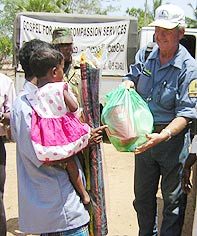
Emergency food aid is giving way to more long-term help in Sri Lanka.

“Our first crews concentrated on feeding and water purification. But now we are shifting to home construction and even building schools and other permanent structures. I think we will be rotating volunteers in and out of Sri Lanka into 2006, if not beyond.”

Karolyn Southerland of Alice, Texas, recently went to Sri Lanka as a volunteer to feed tsunami victims. She ended up cleaning wells contaminated by sea water. Nonetheless, she is eager to go back.

“I want to see if I can do more than I did the first time,” she said. “I don’t think a feeding unit will go, but maybe I can help build a house. Maybe I can help feed children. I’d go back in a minute.”

Every person who serves in Sri Lanka makes a difference, said Southerland, who went as a part of a Texas Baptist Men group.

“Those children won’t forget we were there,” she said. “The parents of the children won’t forget we were there.”

“There’s so much work that still needs to be done there,” she said. “Where the tsunami hit, the homes were shattered. We’re needed there to share, to care. It doesn’t matter if it’s a few months later.”

Some Sri Lankan families still rely on emergency food provided by Baptist aid workers, said Paul Montacute, director of the Baptist World Aid, the hunger and relief arm of the Baptist World Alliance.

Returning recently from the island nation off the southern coast of India, Montacute confirmed the need for more permanent housing for tsunami victims. The emergency tents provided for so many are proving to be too hot for the climate, he said, and people need to move into wood or block accommodations.

Sri Lankan Baptists plan to build temporary houses for about $300 each. Montacute pledged $60,000 to build 200. Hungarian Baptist Aid also is rebuilding homes, with the help of a $40,000 grant from BWA.

A tsunami-aid summit of relief groups and indigenous Baptists is scheduled for Bangkok in May, Montecute said, organized by Baptist World Aid and the Asian Baptist Fellowship, the BWA-related organization of 4.7 million indigenous Baptists in 55 Baptist bodies in Asia. “By working together, Baptists are able to achieve so much more”, said Montacute. “We are all trying to support the work of our indigenous Baptist groups in the affected areas.”

The challenge for many aid groups—Baptist and otherwise—is to make the appropriate use of personnel while practicing the best stewardship of an unprecedented outpouring of contributions.

The International Mission Board of the Southern Baptist Convention reports tsunami-relief donations have passed $10 million. The Baptist World Alliance has received $1.5 million and the Cooperative Baptist Fellowship $1 million. Some individual state Baptist conventions also have their tsunami-relief programs. The Baptist General Convention of Texas has received in excess of $1.19 million.

The task is overwhelming. The scope of the devastation stretches from Indonesia to the east African coast, with dead and missing numbering almost 300,000. Most of the money contributed to Baptist relief groups has yet to be disbursed, but eventually the funds will play out—likely before all the needs have been met, leaders say.

The money is both “a blessing and a responsibility to ensure that it is well used,” said Montacute. He said he hopes Baptists will resist “letting the media set our agenda” and won’t forget the tsunami victims when they fall out of the headlines.

“We need to get Baptists to see that needs exist throughout the years—seven days a week, 24 hours a day—and not just when something appears on television.”

So far, Baptist generosity has been unprecedented. The Baptist State Convention of North Carolina, which has sent at least 12 teams to work with the SBC, CBF, BWA and other Christian aid groups, surveyed its church members and found 69 percent of poll participants had made financial contributions to tsunami relief.

But relief workers will need patience to match the generosity. While some Christian groups have grabbed headlines with over-aggressive evangelism techniques, most Christian groups agree now is a time to build relationships, not churches.

In many Asian countries, including Sri Lanka, Christians live and work in a cultural mix that includes centuries-old expressions of all other major world religions. There is widespread suspicion among those majority religions that Christian groups are only using tsunami aid as cover to “steal” needy individuals from their traditional faiths in exchange for houses, jobs and food.

“It is hard because many of us didn’t have experience in countries that aren’t open to the normal ways of sharing our faith,” said Kevin Dinnin, president of Baptist Child & Family Services.

“When our assessment team was in Sri Lanka in January, I did what I always do and asked if I could pray for every (refugee) camp we went into. But one of the camps was Muslim and I didn’t know that. When I bowed my head, the leader of the camp got very upset and chased all the children away from us. It took awhile but I finally convinced him that I was not trying to steal the children but sincerely wanted to ask God’s grace and care for them.”

In such a situation, Dinnin said, the Apostle Paul’s advice that “we be ‘all things to all men that some might be saved’ takes on new meaning. And we find out sometimes it’s harder to ‘testify’ to our faith in a living Lord by being kind and loving and forgiving when you can smell death all around you, when you are sleep deprived, and when it seems like all the mosquitoes in the world are feasting on you, than it is to pull out a New Testament and share scriptures.”

It’s a good thing he feels that way because Baptist Child & Family Services has accepted what may the longest of the long-term projects involving Baptists—partnering with the Sri Lankan government to organize and administer the country’s first foster-care program.

“We have been asked by national and regional government leaders to set up a pilot program, initially involving approximately 50 children, as well as train Sri Lankan government staff in how to do child-care and even fund a government employee who will be the liaison between our work and the government,” said David Beckett, Sri Lanka director of BCFS’s overseas arm. “The government leaders see the need but have such limited resources. I admire their wisdom and their courage in asking us to help them in this area.”

Baptist Child and Family Services has employed a Sri Lankan native who has a graduate degree in counseling to help draft the procedures for the program, which is expected to get underway next month.

“The initial estimates of 10,000 orphans proved to be extremely overstated,” Beckett said. “And some non-Christian aid groups are resisting our program because they say all the orphans have been placed in homes. But you often have a grandparent or a single mom already living near the poverty level trying to find the energy and resources to care for children they suddenly are responsible for. And there is no system to support them-or to protect the children-in place. The government wants to do the right thing and we want to help.”

That sentiment is found among Baptist volunteers all across the tsunami area, whether they are doing medical exams, cleaning out wells, or helping fishermen acquire new boats.

The tortoises and the hares are working together.


News of religion, faith, missions, Bible study and Christian ministry among Texas Baptist churches, in the BGCT, the Southern Baptist Convention ( SBC ) and around the world.


House passes bill to let religious charities discriminate in hiring_30705

Posted: 3/11/05

House passes bill to let religious
charities discriminate in hiring

By Robert Marus

ABP Washington Bureau

WASHINGTON (ABP)—The House of Representatives has passed another bill giving religious charities the right to discriminate in hiring, even when they receive federal funds.

On a largely party-line vote of 224 to 200, the chamber passed the Job Training Improvement Act. The legislation is a reauthorization and extension of a federal job-training program that has been around since 1982. It funds local organizations that help provide unemployed people with marketable job skills.

The program’s original authorizing legislation barred organizations receiving grants under it from discriminating on the basis of religion, race, gender and other categories. The new bill deletes those protections only for religious providers, and only on the basis of religion.

The 1964 Civil Rights Act already allows churches and synagogues to discriminate in hiring for most positions on the basis of religious principles. However, the courts have not definitively settled the issue of whether religious groups retain that right when hiring for a position wholly or partly funded by tax dollars.

“The bill turns back the clock on decades of civil rights protections in our job training programs. This is simply wrong,” said Rep. Dale Kildee (D-Mich.), debating the measure on the House floor.

But the bill’s supporters said churches and other religious job-training agencies would be unable to maintain fidelity to their mission if not given the right to hire workers on a religious basis—even when using tax dollars.

“Our nation’s faith-based institutions have a proven track record in meeting the training and counseling needs of our citizens,” said Rep. John Boehner (R-Ohio). “Why would we want to deny them the opportunity to help in federal job-training efforts?”

Rep. Bobby Scott (D-Va.) offered an amendment that would have restored the bill’s original 1982 language barring grant recipients from discriminating on the basis of religion. It failed on a 239-186 vote. Fourteen of his fellow Democrats crossed the aisle to vote against Scott’s amendment, while only three Republicans supported it.

The vote came just a day after President Bush spoke strongly of such provisions as essential to his plan to fund more social services through churches and other religious organizations.

“I want this issue resolved,” Mr. Bush said, in a speech to about 250 religious leaders invited to a White House conference on the faith-based plan. “Congress needs to send me the same language protecting religious hiring (rights) that President Clinton signed on four other occasions. And they need to do it this year. And if we can’t get it done this year, I’ll consider measures that can be taken through executive action.”

Bush was referring to several other federal social-service programs containing similar religious-hiring provisions that Congress passed and Clinton signed into law between 1996 and 2000. However, Clinton’s administration made it their policy not to give grants directly to churches and other pervasively religious providers, thus rendering the hiring provisions moot.

Bush, however, has aggressively pushed a comprehensive plan to fund social services through houses of worship. Although the effort as a whole failed in Congress, Bush has slowly implemented parts of the plan via executive orders and other administrative actions.

Bush’s allies in the House have also attempted piecemeal implementation of the plan in various bills, such as the Job Training Improvement Act, authorizing individual grant programs. The House passed a similar version of the bill in 2003, but could not agree with the Senate on it.

The bill is H.R. 27. It now goes to the Senate, where it will likely face stiff opposition.


News of religion, faith, missions, Bible study and Christian ministry among Texas Baptist churches, in the BGCT, the Southern Baptist Convention ( SBC ) and around the world.


Woman’s love for Mexican villagers led to role as liaison for handmade quilts_30705

Posted: 3/11/05

Woman's love for Mexican villagers led
to role as liaison for handmade quilts

By Ken Camp

Managing Editor

More than 20 years ago, Mickey Burleson and her husband, Bob, began helping women in an isolated Mexican village improve their quality of life by marketing their handmade quilts to buyers in Texas.

La Caldera quilts became sought-after treasures by Woman’s Missionary Union leaders who browsed the bookstore at the annual Texas Leadership Conference in Waco, and they began to fetch top dollars at an annual pre-Christmas craft show in Salado.

In the last two decades, Mrs. Burleson estimates the women of La Caldera have made and sold close to 5,000 quilts.

Times and circumstances have changed, and she wants to hand off the ongoing responsibility of marketing the quilts to someone else.

“We feel led to do other things at this point, but I still have a heart for these women,” she explained. “Love for the people is in our blood now. But I can’t carry the responsibility any more.”

Working with the women of La Caldera always has presented challenges, but whoever takes over the reins from Mrs. Burleson will confront different problems than those she and other volunteers first encountered in the early 1980s.

At that time, the people of La Caldera lived in a dusty village in the northern Chihuahua desert, eight hours by car from the nearest town. Men made a meager living by harvesting the wax from candelilla plants, while their wives tended small gardens and made piecework bedspreads from scraps.

Mrs. Burleson and other volunteers from First Baptist Church in Troy noticed the primitive beauty of those simple homespun bedcovers, and that prompted them to create a cottage industry that soon thrived.

Church volunteers provided the women with a quilting frame and other supplies, and then Mrs. Burleson marketed the villagers’ first seven quilts at craft fairs in Central Texas. The quilts were so well-received, the women of La Caldera began to expand their operation.

Initially, WMU groups throughout Texas donated scraps for the women to use, and members of First Baptist Church of Troy supplied them with additional frames and hooks. Later, Texas volunteers advanced the women the supplies they needed, with the understanding that the cost of those raw materials—purchased  at wholesale prices from bedding manufacturers and mills—would be deducted from their proceeds once the quilts sold.

“We wanted them to become independent,” Mrs. Burleson explained.

Over the last 10 years, the women of La Caldera averaged sales of 300 quilts a year.

Along the way, volunteers from First Baptist Church in Troy—joined by members of churches in Moffatt, Bellmead, Temple, Lorena, Morgan’s Point, San Antonio and Abilene—made regular mission trips to La Caldera three times a year. Working through the Baptist General Convention of Texas’ River Ministry, the Texas Baptists provided medical, dental and optometry clinics, built a church and school for the village and conducted Vacation Bible Schools.

“As we had the opportunity to get to know them, and they came to know the Lord, the women came to feel loved by him and by us. They just blossomed,” Mrs Burleson said.

But in recent years, the people of La Caldera have scattered. The market for candelilla wax dried up, and goat herds failed. Then the Mexican government sold the public land on which the families had been living to a private company, and the villagers were forced to move.

Many former residents of La Caldera relocated to colonias surrounding Ciudad Acuna and Muzquiz. Husbands and older sons work long hours in assembly plants for about $60 a week.

“They’re making more money than when they were in the outback, and they have electricity and running water—even  if it comes to them in a hose,” Mrs. Burleson said. “But the families also have expenses they didn’t have when they lived in the village, and they don’t have the same support systems.”

Although the former residents of La Caldera live up to four hours away from some of their former neighbors and distant relatives, they have managed to stay in contact, start a church in one of the colonias and continue their cooperative quilting venture.

“The women have taken such pride in their work, and they enjoy doing it,” Mrs. Burleson said. “They want to continue to be able to work in their homes.”

Lack of a centralized location for the quilters will be one challenge faced by anyone who agrees to take on the challenge of coordinating the program, she noted. But the women desperately need someone in the United States with business experience to help them.

“The problem with just dropping the program because we feel called to retire is that the quilters themselves would have a very difficult time selling their quilts in Mexico for what they are worth,” she said.

“They would also have a difficult time getting raw materials, as good quality fabrics are hard to come by in the areas where they live, and even those of lesser quality are more expensive than they are here.

“It would be sad to see them unable to profit from the wonderful skills many of them have developed and the talent they have demonstrated. Furthermore, we have come to deeply love and admire these women, and we would hurt with them and for them if we left them with no opportunity to make decent earnings from their work.”

Mrs. Burleson can be contacted at 5101 Berger Rd., Temple  75501 or by e-mail at micnbob@vvm.com.

“We will be more than happy to work with any group during the transition period. If they want to do things the same way we have, that’s fine, and we’ll be glad to teach them,” she said. “But we are quite aware that there are probably better ways to carry out the ministry, and we would say, ‘More power to you,’ if they wanted to try something new.”


News of religion, faith, missions, Bible study and Christian ministry among Texas Baptist churches, in the BGCT, the Southern Baptist Convention ( SBC ) and around the world.


Carolyn Ratcliffe’s journey to Wayland religion faculty filled with challenges_30705

Posted: 3/11/05

Carolyn Ratcliffe's journey to Wayland
religion faculty filled with challenges

By Jonathan Petty

Wayland Baptist University

PLAINVIEW—If someone had asked Carolyn Ratcliffe 40 years ago what she intended to be doing at this stage in her life, she would have gladly replied, “making quilts and baking cookies.”

Somewhere along the line, however, her life took what she considers a divinely inspired detour, leading to her current position as assistant professor of religion at Wayland Baptist University.

“This is not exactly what I intended to do with the rest of my life,” she explained, sitting behind a large desk in a small office stacked wall-to-wall with books.

Carolyn Ratcliffe

In fact, when she first attended Texas Tech University straight out of high school, Ratcliffe had only one thing in mind—get married. She met her future husband, Ted, during her first year at Tech. The two were married, and she left school to raise a family.

“I accomplished at school what I intended to accomplish, and that was get married,” she said. “I never intended to go back.”

Four years later, Ratcliffe was on her way to visit her mother. As she topped a hill near Dickens, she felt a clear sense of direction, clear as a voice telling her to go back to school and complete her degree.

“When I arrived in the Lubbock, the first thing I said to mother was, ‘I’m going back to college,’” she said.

She completed her degree in education in 1966 but never entered the classroom as a teacher. Ratcliffe spent the next 20 years rearing her children. It wasn’t until her daughter, the youngest of four children, politely asked her not to join the PTA board during her high school years that Ratcliffe started feeling “rather useless.”

“I remember praying and asking God what I should do with the rest of my life. The kids didn’t need me anymore,” Ratcliffe said.

A few weeks later, as she and her husband were attending a worship service at Highland Baptist Church in Lubbock, she again sensed that guiding voice.

“It was just so clear,” she said. “‘Go back to school and teach my word in college.’ When I walked into church that morning, that was the farthest thing from my mind.”

As Ratcliffe attended the evening service, she listened to a guest speaker preach about Jonah running from his Nineveh. The preacher that night was Gary Manning, religion professor at Wayland.

“That sort of sealed it for me,” she said.

At age 45, Ratcliffe decided to return to college, entering the master’s program at Wayland. After finishing her master’s work in 1989, Ratcliffe applied to the Ph.D. program at Baylor University.

Although she was eventually accepted by Baylor, Ratcliffe was beginning to see some underlying resistance to her calling from Christians who believed women should not teach men in a religious setting.

Taking seminary courses between her time at Wayland and Baylor, Ratcliffe said she was always the only woman in the class.

 “Everyone was trying overly hard to be nice to me,” she said. “But the professors were all very accepting, with the exception of one.”

Ratcliffe said she took one course under a prominent professor that she enjoyed very much. On the last day of class, she walked up to him to tell him how much she enjoyed the class.

 “He looked at me seriously and said, ‘We have enjoyed having our one token female student in the class,’” she said. “I had never even said enough in class for him to even know my heart.”

Ratcliffe said she found the statement “interesting,” especially from someone in his position. But she didn’t let that deter her. It wasn’t the first time she had heard something negative about her intended career choice.

 “Everyone told her, given the situation, that she shouldn’t be doing this because there will never be a job for her,” explained Fred Meeks, chairman of the religion division at Wayland. “Jobs in religion are by far the toughest to get. But she was going through with her calling.”

Meeks, who taught Ratcliffe as she worked on her master’s degree, watched her progress through the Ph.D. program at Baylor. By the time she completed everything but her dissertation, Meeks had been promoted to division chair and was looking for an adjunct faculty member to teach courses at Wayland’s Lubbock campus. Meeks asked Ratcliffe if she would be interested in teaching some courses, and she jumped at the opportunity.

Ratcliffe was awarded her doctorate in 1995 and continued to teach as an adjunct professor at Wayland, a position she held seven years.

“She was teaching regularly four to five courses a semester,” Meeks said. “Finally, I went to the administration and said it was not ethical for us to be using someone to teach full time and not give them faculty status.”

Meeks explained that was at a time when there was a lot of controversy in the Southern Baptist Convention, and every move was viewed under a microscope.

“Wayland was taking a big risk,” Meeks said. “Not only to employ a woman teaching in the religion department … that was risky enough. The seminaries had used women to teach church history and things like that, but not Bible courses.”

Meeks said Wayland’s administration didn’t hesitate, offering Ratcliffe full-time faculty status in 1999. Meeks said, to his knowledge, there has been no resistance to Ratcliffe. In fact, she has been asked to teach at various associational meetings, as well as the Pastors’ and Laymen’s Conference that Wayland hosts every February, and she was just named 2004-05 recipient of the favorite professor award as voted on by Wayland students of all academic backgrounds.

Ratcliffe said she has always felt accepted at Wayland and hopes she can now be a role model for young women who feel called to the ministry.

“I tell them to toughen up and understand that their call is from God and not from human beings, and that they have to follow what God has told them to do,” Ratcliffe said. “Church history is full of individuals who followed God and paid a price for it. I tell them they are going to find some resistance in some areas. Although, I think by the time my generation dies off … there will be a day where there will be no resistance, but we have to get rid of us old dead-heads first.”


News of religion, faith, missions, Bible study and Christian ministry among Texas Baptist churches, in the BGCT, the Southern Baptist Convention ( SBC ) and around the world.


‘Storying’ and a slower pace reaching Ugandan villagers_30705

Posted: 3/11/05

'Storying' and a slower pace
reaching Ugandan villagers

By Sue Sprenkle

International Mission Board

KAABONG, Uganda—Looking up from his daily chores, a village elder saw a group of men in the distance picking their way across the dry, rocky terrain. The presence of a stranger among them attracted his attention, but he continued working.

A few days later, he saw the same group walking and talking with the stranger.

“Again and again and again I saw this group of men walking past my village,” Longole said. “I had to know what their purpose was.”

So, one day, he went early to the walking path and sat waiting for the men to pass. When International Mission Board missionary John Witte and two companions came upon Longole, they stopped to chat.

“What happens when you pass by?” Longole asked.

Witte, a Texan from First Baptist Church in Midland, said he walked from village to village teaching about God.

Without hesitation, the village elder responded: “Is it so important that you should share with me and my village? We will listen.”

Witte, together with other two men from the area, soon began teaching the Bible through chronological Bible storying in the village of Kajiri. As the group began learning the Bible through oral stories, Longole said it was the first time he had heard Jesus’ name.

One year later, Longole and many others made their faith in Jesus Christ known at a special ceremony drawing together surrounding villages to celebrate the end of the first round of chronological Bible storying. The small group was baptized in a makeshift baptistry—a canvas bathtub filled with water.

The baptisms marked the special day when everyone gathered to eat and retell all of the Bible stories they had learned during the past year. The villagers also performed songs, dramas and dances they made up depicting the different Bible stories.

Longole and other new Christians noted God sent his word to them through a messenger “on foot.” Witte walked from village to village to model how to plant churches in a way reproducible by the Dodoth people, who live in the remote northern province of Uganda. There are not many cars in this area, nor many bicycles. Most people walk from place to place.

“I learned earlier in my career that when I drove my car, it modeled that was the best way to plant churches,” Witte said. “So, when I asked the guys I had been discipling to start planting churches, they couldn’t do it because they didn’t have a vehicle. They were not willing to walk. After all, the teacher never walked.

“When I started walking to villages, the people saw that they could walk to another village and teach them a story.”

Witte admits that initially this method is slow in getting churches started. However, in this part of Uganda, the Dodoth are getting a vision for telling others about Christ. Longole explains that telling someone about Christ is as easy as walking down the path to the next village.

“One time, I went to visit another area. I walked there. I took a tape of Bible stories to listen to while I was gone for the night,” he said. “I sat outside playing the tape and people gathered all around me to listen. I heard them saying, ‘This is true. This is true.’

“They asked me to come back and to teach them more truths. Now, I walk there to tell them the stories that I’ve learned in my own village. God changed my heart, and he is changing their hearts. I will keep walking to other villages to tell them about the word of the Lord.”


News of religion, faith, missions, Bible study and Christian ministry among Texas Baptist churches, in the BGCT, the Southern Baptist Convention ( SBC ) and around the world.


Influence of Decalogue on U.S. law debated_30705

Posted: 3/11/05

Influence of Decalogue on U.S. law debated

By Robert Marus

Associated Baptist Press

WASHINGTON (ABP)—The Supreme Court is considering the constitutionality of government displays of the Ten Commandments, and one local official thinks he knows why such displays are legal.

“American law is all about God,” said Allan Watson, mayor of Monroe County, Tenn. Watson, a member of First Baptist Church in Madisonville, Tenn., is fighting a legal battle to keep a display of the commandments in the county’s courthouse. The dispute is on hold pending the outcome of two similar cases argued before the high court.

In a more nuanced way, many other defenders of Decalogue displays assert the legality of such monuments — saying the commandments played such an integral role in the formation of Western legal codes that commemorating them in courthouses or other government buildings is natural.

 “Justices of this court, decisions of lower courts and the writings of countless historians and academics have long recognized the significant influence that the Ten Commandments have had on the development of American law,” wrote Acting Solicitor General Paul Clement in a brief submitted to the Supreme Court. Clement, representing President Bush’s administration, was arguing in favor of Ten Commandments displays in the McCreary and Pulaski County, Ky., courthouses.

Likewise, during oral arguments before the Supreme Court March 2 on that case and another Ten Commandments case, some members of the high court themselves made similar statements.

“Of course it (our system of laws) stemmed from the religious beliefs of those who came to the United States,” said Justice Steven Breyer, addressing the attorney for the group suing for the Kentucky display’s removal.

And the Kentucky counties included an explanatory document in their display, claiming “The Ten Commandments provide the moral background of the Declaration of Independence and the foundation of our legal tradition.”

But those presumptions may be incorrect, according to some church-state and history experts.

“On the contrary, the historical record reveals that: the influences on early American law are largely secular; any early religious influences declined during the nation’s founding; the American government’s central founding documents have nothing to do with the commandments; and, to the extent that the Ten Commandments’ non-religious precepts are consistent with current law, those precepts are universal (and even predate the Ten Commandments),” wrote David Friedman, representing the American Civil Liberties Union of Kentucky in their lawsuit against the counties, in his brief to the high court.

In fact, according to Yeshiva University law professor Marci Hamilton, early American law grew almost entirely out of English Common Law—which, in turn, was pre-Christian in its origins.

“The development of the Common Law grew out of the Roman Empire,” she said. “So, the notion that you can identify at one point in time the primary influence any one set of commands had on our law—it’s just indefensible.”

Hamilton, a Presbyterian, specializes in church-state law and American history. She once served as a law clerk to Justice Sandra Day O’Connor, a moderate who is considered a crucial “swing vote” on church-state cases.

Hamilton said a quick reading of the commandments themselves makes her case. The first five laws—demanding the worship of God alone, barring graven images, prohibiting taking God’s name in vain, observing the Sabbath, and honoring one’s parents “so that thy days may be long upon the land which the Lord thy God giveth thee”—are explicitly religious in nature.

And, she noted, although the last five commandments —banning murder, adultery, theft, perjury and covetousness —aren’t explicitly religious, many of them have parallels in virtually every other legal system in the history of humankind. That includes law codes, such as the famous Code of Hammurabi, that predate the Decalogue.

“There are all these different influences that contributed to what we have now,” Hamilton said, “and this attempt to own the culture” by asserting that one religious tradition was the primary or even a significant source of the laws “is indefensible—it’s hubris, unfortunately.”

Hamilton’s argument is similar to those found in friend-of-the-court briefs submitted in the case—including one that University of Texas Law School professor Doug Laycock penned for the Baptist Joint Committee for Religious Liberty.

But Brigham Young University law professor Brett Scharffs said that, even given those considerations, the Ten Commandments still are an important symbol of the development of law in the Western tradition. Though American law may not show a direct linear descent from the Decalogue, he said, “I think the Ten Commandments are very much in the background in the creation of the American government as an example of lawmaking or lawgiving.”

They are important to legal history, Scharffs asserted, because “Moses as a lawgiver is an important early example of what law is or what law means.”

However, he acknowledged, there’s a reason that the Code of Hammurabi and the Seven Pillars of Islam aren’t commemorated in scores of government buildings around the nation like the commandments are.

“I think the people who donate (such monuments) are interested in communicating the religious message. I think they’re making a point about what they believe to be eternal and important,” Scharffs said. “So, if we’re going to say they’re going to be displayed because of their historical significance, I don’t think it’s a really accurate account of the reason they’re displayed.”

Connie Davis Bushey contributed to this story


News of religion, faith, missions, Bible study and Christian ministry among Texas Baptist churches, in the BGCT, the Southern Baptist Convention ( SBC ) and around the world.


Newspaper profiles faith of Judge Roy Sparkman_30705

Posted: 3/10/05

Newspaper profiles faith of Judge Roy Sparkman

By Erin Curry

Baptist Press

WICHITA FALLS, Texas (BP)–Roy Sparkman has developed a reputation as an honest, fair district judge who expects sufficient preparation from those who bring cases to his courtroom in Wichita Falls.

Last fall, the Texas Lawyer newspaper portrayed him as someone whose Christian faith helps him measure with a straight stick.

“I was a little surprised that so much of the article focused on my church membership, Christian background and concerns lawyers may have had concerning that aspect prior to my taking the bench,” said Sparkman.  “At the same time, I took it as a compliment that they believed I had lived my life in such a manner that they knew I was a Christian and sought to live by Christian principles.”

The article said Sparkman is a “bottom-line, big-picture person” who doesn’t want to waste anyone’s time in the courtroom.

 “He runs a tight ship,” Stephen Bjordammen, a lawyer familiar with Sparkman’s style, told Texas Lawyer. “When he says 8:30, you need to be there at 8:30. When he says, ‘Let’s take a 10-minute break,’ it’s a 10-minute break.”

Sparkman, 53, was a trial lawyer for more than two decades and won the bench for the 78th district in 2000.

Stephen Briley, a lawyer in Wichita Falls, told Texas Lawyer he was concerned before Sparkman took the bench that he would not be fair because “he is a conservative, a Republican and a lifelong defense lawyer.” But his assessment changed after watching Sparkman at work.

 “You get a fair shake in Roy’s court,” he said.

Once the article was published, Sparkman said he received feedback from several friends who agreed with the positive statements made about him. Some Christian friends appreciated the fact that his faith was included.

 “I got the impression that some people were encouraged by the fact that a Christian could stand on principle, yet still make it in the legal world and be respected both as a professional and as a Christian,” he said.

Sparkman, a deacon at First Baptist Church in Wichita Falls, said the foundations of his faith were laid by parents who taught him the importance of daily devotions, church attendance and other keys to a close walk with God.

“I seek to have a quiet time daily, attend church regularly, teach a Sunday school class for newlyweds and pray daily for wisdom in the decisions I make,” he said.

As a judge, Sparkman often makes decisions that deeply impact people’s lives, such as which parent will be allowed to raise a child, whether someone will go to prison for the rest of his life or whether someone will experience financial ruin as a result of his ruling.

“In my mind, all of those types of decisions necessitate a foundation of values and a source of wisdom that is much deeper and more encompassing than what the world can offer,” he said. “Through the experiences over the years, the confidence and assurance that I have received through my faith and staying in the Bible and receiving regular Bible teaching have proven invaluable in going through difficult days, difficult challenges, difficult decisions and even sometimes attacks on my faith.”

Sparkman recalled an experience from his time as a practicing attorney when both sides had fought aggressively in court and his client had won. The opposing counsel then told Sparkman, “And I thought you were supposed to be a Christian.”

 “That was a very personal attack to me, it hurt deeply, and yet I did not believe I had done anything ‘un-Christian,’ so I ultimately took it as a compliment that the lawyer thought that was the worst thing he could say to hurt me,” Sparkman said.

In 1992, a defeat after his first run for district judge caused him to rely even more intently on God, Sparkman said. The loss was public, he was mentally and physically tired, and he started immediately to second-guess and wonder why God would allow him to lose after he felt led to run.

 “I still had my faith, but I found myself discouraged,” he said. “At that point, God brought me to Isaiah 40:31, ‘… but they who wait for the Lord shall renew their strength, they shall mount up with wings like eagles, they shall run and not be weary, they shall walk and not faint.’”

Over time, Sparkman realized that the loss was in fact something positive because more time in private practice benefited him financially, he was able to accomplish some things professionally that he would not have done as a judge, and the path was cleared for him to run unopposed in 2000.

 “Through that verse I was able to wait until another time and be renewed, and things worked out better than I could have imagined,” he said.

While he said he does not feel worthy of being made an example of, Sparkman acknowledged the need for more Christians in the marketplace, those who will stand up for Christ in the midst of a society that questions their faith—sometimes aggressively.

“In that greater context of where many Christians perceive our society and nation today, not so much as a compliment to me, but in general, I think Christians are very excited to see Christians that have managed to succeed in some challenging areas like the legal field but still maintain integrity and Christian principles,” he said.


News of religion, faith, missions, Bible study and Christian ministry among Texas Baptist churches, in the BGCT, the Southern Baptist Convention ( SBC ) and around the world.


Hestorff says less is more in ministry to ‘Millennials’_30705

Posted: 3/10/05

Hestorff says less is more
in ministry to 'Millennials'

By Lance Wallace

Cooperative Baptist Fellowship

ASHEVILLE, N.C. (ABP) — Sometimes the best way to minister to youth is by offering them less, said veteran youth minister Sam Hestorff of Bayshore Baptist Church in Tampa, Fla.

Youth ministry often contributes to the overwhelmingly busy lives of young people, Hestorff said.

He advised youth at his church to do more by doing less. He reduced youth time on Wednesdays to 30 minutes and started a study hall with church members as tutors.

Citing statistics from his doctoral research at Fuller Theological Seminary, Hestorff said Millennials —the generational cohort that includes today’s youth—average 70 hours a week of school and extra-curricular activities.

“They are getting so fragmented, so compartmentalized, that they don’t see how it all fits together,” Hestorff said. “The object of adolescence is to figure out who they are. They don’t have any time to sit down and figure out who they are.”

This time crunch causes teens to give up church and youth group activities. By reducing the time required of Bayshore’s youth, he said, he actually increased their involvement. “At least I get to see them now,” Hestorff said. “Before, they weren’t even coming on Wednesdays.”

During a recent workshop devoted to youth ministry, sponsored by the Cooperative Baptist Fellowship, Hestorff cited social trends among Millennials, those born between 1980 and 2002. He applied the trends to ministry, offering ways to shape church programs for youth in a contemporary setting.

“In the ‘80s, if you built it, they came,” said Hestorff, who is also the president of Professional Ministry Consultants Inc. “It’s not true any more.”

Hestorff identified six trends: Millennials are too busy, all alone, stressed out, believers in relative truths, remaining in the period of adolescence longer, and connecting to peers through “clustering.”

Bayshore has a small-group-based model in which the teens have a group meeting in a home each week led by adult volunteers. Hestorff said the smaller group attracts young people because they are more accountable to their peers, and the groups are formed around natural affinities. And by utilizing volunteers, Hestorff has expanded his ministry.

“The church-growth movement killed the church,” Hestorff said. “As a result of that, we have church hopping. The attitude is ‘I’m going to the biggest and best thing out there.’“

The loneliness trend springs from feelings of parental and institutional abandonment, according to Hestorff. To combat it, churches and parents must not abdicate their responsibilities just because teens complain about them. Parents and youth ministers must stay involved in the lives of teenagers, Hestorff said.

The isolation Millennials feel, plus their busyness, leads to overwhelming stress, the third trend Hestorff identified. “This is the first generation of kids who are suffering from stress-related illnesses.”

Their stress comes from school, biological sources and family conflict, Hestorff said. Effective youth ministers have to deal with a range of stress that may come from all three sources.

The Millennials’ worldview is much broader than that of teens even 10 years ago. Hestorff pointed to the influence of the Internet and a media-driven culture that is more multicultural, multireligious and multisensory. All of these inputs make it difficult for a teenager today to accept one, universal truth.

“When I was growing up, I barely knew anyone who was Methodist,” Hestorff said. “Now kids have friends who are Muslim. That’s how they come up with the attitude of ‘your truth may not be my truth.’“

With the onset of puberty getting earlier and earlier and the age of adulthood moving later and later, Millennials will spend a longer time in this uncertain age of adolescence than previous generations, Hestorff said.  From a programming standpoint, churches have to see this trend and reach out to young adults across the full age range of 10 to “twentysomething.”

The final trend is how Millennials run around together. Hestorff called the new method of peer-group selection “clustering.” It begins at mid-adolescence and the goal is to be accepted. A cluster is usually no more than five to eight students and tends to be gender specific. A cluster is formed around a similar self-concept and parental attachment, Hestorff said.

“Kids are no longer looking for a group to hang around with,” he said. “They are looking for families.”


News of religion, faith, missions, Bible study and Christian ministry among Texas Baptist churches, in the BGCT, the Southern Baptist Convention ( SBC ) and around the world.


Court rules funding OK for Americorps students to teach religion courses_30705

Posted: 3/10/05

Court rules funding OK for Americorps students to teach religion courses

By Robert Marus

ABP Washington Bureau

WASHINGTON (ABP)—A federal appeals court has ruled in favor of a program that is part of President Bush’s plan to fund social services through religious charities.

The U.S. Appeals Court for the District of Columbia Circuit ruled the Corporation for National and Community Service does not violate the First Amendment by allowing college students teaching in the AmeriCorps program to choose to teach at religious schools—even if they teach religion courses.

A three-judge panel of the court unanimously overturned a lower court’s decision that said the practice creates the appearance of government endorsement of religion, even if program participants obey regulations that require them not to count the time they spend teaching religion.

The appeals court also ruled that a $400 fee the government program pays the participating schools is legal, even if the money goes directly to a religious school.

“Individual participants who elect to teach religion in addition to secular subjects do so only as a result of ‘their own genuine and independent private choice,’“ wrote Circuit Judge Raymond Randolph in the court’s opinion.

“The AmeriCorps program creates no incentives for participants to teach religion. They may count only the time they spend engaged in non-religious activities toward their [1,700] service-hours requirement,” he continued. “And if they do teach religious subjects, they are prohibited from wearing the AmeriCorps logo when they are doing so.”

The decision was the result of a lawsuit that the American Jewish Congress filed against the Corporation for National and Community Service—the AmeriCorps program’s sponsoring organization—and the University of Notre Dame, which operated an AmeriCorps program that placed students in Catholic schools.

Last year, U.S. District Judge Gladys Kessler ruled the program unconstitutional, because a “reasonable observer” would conclude that the AmeriCorps teachers had governmental imprimatur for all subjects they taught, even if they didn’t count the religious classes in their hours. She also said the direct government payments to religious schools violate the First Amendment.

But the appeals court said AmeriCorps has sufficient safeguards in place to assure that government money is not being spent on religious instruction, and that the payments to religious schools come as a result of the private choice of the AmeriCorps program participants rather than direct governmental action.

“This is a key victory for the faith-based and community initiatives, but even better it’s an extraordinary victory for the poor children who are served,” said Jim Towey, director of the White House Office of Faith-Based and Community Initiatives in a conference call with reporters shortly after the decision was handed down.

But a spokesman for a group that opposes Bush’s plan and filed a friend-of-the-court brief in the case said there are plenty more legal battles ahead over the issue.

“This is one skirmish in a much larger legal battle, and there are other cases pending in courts around the country that will give us a much better picture of where the judges stand on this issue,” said Joe Conn of Americans United for the Separation of Church and State. “The AmeriCorps program, it seems to me, is set up quite differently from most faith-based programs. … So, this just isn’t going to be a good test.”

News of religion, faith, missions, Bible study and Christian ministry among Texas Baptist churches, in the BGCT, the Southern Baptist Convention ( SBC ) and around the world.


Kim refuses to criticize SBC’s alternative to BWA_30705

Posted: 3/10/05

Kim refuses to criticize SBC's alternative to BWA

By Trennis Henderson

Kentucky Western Recorder

WILLIAMSBURG, Ky. (ABP)—Korean pastor Billy Kim, president of the Baptist World Alliance, declined to criticize a Southern Baptist plan to bring “like-minded Baptists” together to form an alternative to BWA.

Kim said there are enough human needs around the world for all Baptists to address. Concerning a planned July meeting in Poland between Southern Baptist Convention leaders and sympathetic Baptist groups, Kim said, “Let’s pray for them. … We hope they can help other struggling Baptists around the world. We don’t want to alienate any Baptists for any personal reason.”

Last June, the Southern Baptist Convention withdrew its membership and financial support from BWA, an international fellowship of 210 mostly national Baptist unions. Southern Baptist leaders complained the alliance is too influenced by “liberal” Baptists, including the rival Cooperative Baptist Fellowship, which recently gained BWA membership.

Southern Baptists set aside some of their financial support withdrawn from BWA—until recently $425,000 a year—to establish an alternative organization of “like-minded” Baptists worldwide.

Southern Baptist leaders confirmed the July meeting in Poland, which conflicts with BWA’s 100th anniversary celebration, but downplayed its importance.

“To call the meeting with some of the European Baptist leaders an ‘organizational’ meeting would be a mischaracterization,” said Morris Chapman, president of the SBC Executive Committee.

BWA General Secretary Denton Lotz called the Poland meeting “a slap in the face to Baptists in the rest of the world.”

Kim, a conservative widely praised by SBC leaders, said Baptists around the globe “ought to be working together to help out struggling Baptists who are in the minority.”

Kim, who retired in December after 45 years as pastor of Central Baptist Church in Suwon, South Korea, will conclude his five-year presidency of BWA this summer at the Baptist World Congress in England.

“The places I’ve been, they’re very, very positive about BWA, and they also are still working with the Southern Baptist Convention,” he said.


News of religion, faith, missions, Bible study and Christian ministry among Texas Baptist churches, in the BGCT, the Southern Baptist Convention ( SBC ) and around the world.