




Posted: 11/11/05
Mystery of God only answer
for serious evangelicals
By Jeffrey MacDonald
Religion News Service
WACO (RNS)–As a Baptist preacher, Randall O'Brien knows the Bible says natural disasters can be signs of God's judgment. But he's not preaching anything of the sort, not even in a year marked by earthquakes, floods and hurricanes.
Instead, he's joining other evangelical Protestant leaders in offering an answer that would have been almost unthinkable for a Bible-believing preacher even one generation ago. Despite all he knows from Scripture, O'Brien proclaims God to be a mystery, at least when calamity occurs.
| Randall O'Brien |
“I don't know why bad things happen to innocent people,” said O'Brien, interim pastor at Columbus Avenue Baptist Church and interim provost and chair of the religion department at Baylor University. “There's something very worshipful about saying that God is God, and I'm not.”
What O'Brien illustrates is a growing admittance of puzzlement in evangelical circles. That has prompted some religion scholars to wonder if understandings of God–and religious authority–might be undergoing some subtle but significant revisions among one of this country's largest and most influential religious groups.
Across the country, evangelical leaders are finding themselves challenged to explain what insurers eerily call “acts of God.” Sunday sermons reflect on hurricanes hitting the Gulf Coast, mudslides in Guatemala, floods in New England and an epic earthquake in Pakistan.
Evangelicalism “is a movement that vests people with authority when they can convince (others) that they have something strong and powerful and effective to say,” said Joel Carpenter, provost of Calvin College in Grand Rapids, Mich., and a historian of American religion.
“So, yeah, you're giving up something when you say, 'Look, folks, this is just mysterious. And yes, as a careful student of the Scripture, I search and search, and I find the biblical writer is pointing to mystery as well, pointing to trust as the answer, (rather than) relying on my own understanding.'”
For at least 250 years, Carpenter said, evangelicals have placed a premium on understanding things of God as a crucial sign of an individual's salvation. Carpenter says anyone unsure of personal righteousness, especially in the 18th and 19th centuries, would likely hear from an evangelist: “If you can't be more certain than that, then maybe you ought to doubt your salvation, and you can settle that today” by surrendering to Jesus Christ.
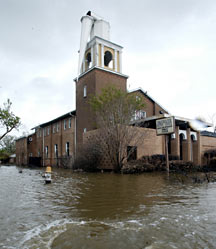 |
| Floodwaters deluge the neighborhood around New Orleans' Edgewater Baptist Church on Paris Avenue following Hurricane Rita. |
The point, Carpenter emphasized, was that “God really is going to make things clear to you, all kinds of things.”
Through the decades, scholars say, this notion of the saved as knowledgeable in all things godly has allowed little room for divine mystery.
But evangelical leaders today increasingly are admitting a lack of answers.
Jerry Falwell recently wrote in his newsletter, Falwell Confidential: “What is the biblical significance of all these global disasters which have befallen us recently? The honest answer is, I do not know.”
Falwell's open befuddlement is a shift for a fundamentalist Baptist preacher who infamously said the Sept. 11, 2001, attacks were divine judgment for “throwing God out of the public square.”
Perhaps the days are fading, Carpenter suggested, when evangelicals “think they have power to convince and persuade (only) as long as they have power to explain.”
Meanwhile, hunger for the mysterious seems to be growing, scholars say, especially among young adult evangelicals. They flock to the simple chanting of Taize-style services and inhale incense in the Orthodox, Roman Catholic and Anglican churches they've joined.
And they welcome books pondering God's mysterious side from writers such as Donald Miller and James Emery White, according to Jana Riess, religion book review editor at Publishers Weekly magazine.
“I certainly think,” said Riess, “some of the younger generation (of evangelicals) are interested in letting God be mysterious and are comfortable with that.”
As they ponder life's uncertainty in a post-Sept. 11, disaster-prone world, evangelical leaders are daring to speak of mystery even beyond the weather.
“All evangelical leaders today are dealing with much more sophisticated clienteles and are themselves theologically more nuanced” than in decades past, said David Edwin Harrell, professor emeritus of history at Auburn University in Auburn, Ala., and an expert on evangelical leaders of the 20th century.
“Neither for their own personal theologies nor for their customers are they going to offer the old-time, one-dimensional view of God and of truth. … There is something afoot, clearly, and that is that these are people who are looking in a broader and different way at God and his working from what many early evangelicals (in the 1940s and '50s) would have.”
In prior times, evangelicals wouldn't have hesitated to interpret a hurricane as God's judgment on sin or God's last-chance call to repentance, Harrell said. By contrast, leaders who have made such comments beyond the walls of their churches this year have generated headlines and unwanted publicity.
Those who desire a better way, therefore, must either rethink their beliefs or embrace the mystery of a loving God who somehow allows the innocent to suffer, said Richard Mouw, president of Fuller Theological Seminary in Pasadena, Calif.
“There's an embarrassment over the glibness of the past in which some of our leaders were so sure, you know, why 9/11 hit or so sure New Orleans got it because of its decadence and lifestyle,” Mouw said. “In many ways, these leaders, in order to really have the respect of the rank and file, need to not sound so glib and sound wiser in their willingness to encourage people to live with the mystery.”
For O'Brien, the irony of doing so has been sweet. By admitting he lacks answers to certain questions, he says, his authority as a trustworthy source in the eyes of church members actually seems to grow.
In this, he gets rewarded for forgoing the posture of “father who knows best” and instead embracing his role as an equal, that is, as “brother, sister, fellow struggler … pilgrim on the way.”
Still, Carpenter expects resistance to the doctrine that God is vastly mysterious, especially from the worlds of Christian commerce and para-church ministries. That's because quick answers attract more of an audience than those who marvel without immediate clarity, he commented.
“There's less market for that kind of expression out there in the world of religious consumption,” Carpenter said. “American culture isn't wired for that. It's wired for self-help.”
Mouw expects December's The Chronicles of Narnia film, marketed to Christians by Disney, to further fuel the still-burgeoning evangelical affair with wonder. But, he predicts, some will grow uneasy along the way.
“Insofar as the attraction of evangelicalism is that we've provided easy answers and allowed people to feel very comfortable in a universe where they have things pretty well figured out, it takes a much more mature faith (to live with mystery) and fewer probably will be able to handle it,” Mouw said.









We seek to connect God’s story and God’s people around the world. To learn more about God’s story, click here.
Send comments and feedback to Eric Black, our editor. For comments to be published, please specify “letter to the editor.” Maximum length for publication is 300 words.