



Posted: 7/22/05
Each congregation encouraged
to discover its own voice
By Ken Camp
Managing Editor
WACO–Churches can defuse worship wars by learning to recognize their own voice, a Baptist university professor and a minister of music agree.
| (Photo courtesy of Fotosearch/BrandXPictures) |
A person can learn to speak a new language and remain true to his identity, but if he tries to mimic the pitch and tone of a native speaker, it seems fake and mocking, said Terry York, associate professor of Christian ministry and church music both in Baylor University's School of Music and Truett Theological Seminary.
Likewise, churches can learn to sing a new song–try a new musical style, change instrumentation or incorporate new media into worship–but they need to do it in their own voice, York said.
“Discover the voice of your congregation. There's room for anything that can be a legitimate expression of worship if it's sung in that voice,” he said. “Where churches get in trouble is when they try to imitate someone else's voice.”
York ex-plores that idea in a new book he wrote along with David Bolin, minister of music at First Baptist Church in Waco. The Voice of Our Congregation: Seeking and Celebrating God's Song for Us will be released in August by Abingdon Press.
Any congregation's voice is not the unison hum of a single note but the “voice of many waters,” Bolin said. “It's not a solo voice. It's many voices in harmony, like a choral piece sung in parts.”
Rather than joining in that anthem in their own voice, some churches yield to the temptation of mimicking the voice of another church that may be drawing larger crowds, York and Bolin agreed.
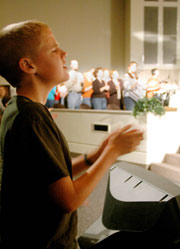 |
| A young boy worships during a revival at a church near Nashville, Tenn. Photo by Lindsay Stavish/BP |
Churches stumble when they try to imitate what works in another congregation instead of using the gifts God has given them, York said. “It's chasing after success instead of following behind Christ. Discover who you are and what God has gifted you to be. Plan ac-cording to the giftedness of those whom God has given you, not ac-cording to who has the most people showing up.”
Church leaders fail to be good stewards when they look enviously at the numerical growth of other churches instead of looking within to discover their own gifts, Bolin noted. “It's about looking at what God has given us, taking what he has placed in our hands and asking what we are going to do with it.”
That includes incorporating the gifts and talents of new members into worship, and it means being open to new developments within the congregation as members grow in their spiritual walk, he added.
“If we really are God's workmanship, that means he is continuing to work with us, and there's a tension evident as he is molding and making us,” Bolin said.
Without change–adding new songs to the congregation's repertoire, incorporating new instruments into worship and allowing new people to exercise their gifts–a church grows stagnant, York said.
“To maintain life, there has to be transition,” he said.
York offered several principles to help worship leaders guide churches through transition:
 |
 Know your own story. Examine the church's history to understand how it became what it is now. Understand the key events that shaped the character of the congregation. A change in worship style may reflect a new chapter in that story, but “what we do now must not dishonor the story of who we have been,” York said.
“It doesn't mean there has to be a locked-in repetition to the worship services; it just means if there's something new, it has to make sense here. It may be a new song or different instruments, but it has to make sense for these people in this place. Is this us, or is it not?”
 Listen to the people. If worship leaders try to take the church in a particular stylistic direction, pay attention to the response of lay people who love the church and who want what is best for its future. “Trust the Holy Spirit to speak to the priests in the pew as much as the priest in the pulpit,” York said. “Trust the community under the steeple.”
Keep scorecards out of the sanctuary. When church members hold differing opinions about worship style, discuss those differences honestly, but limit the discussion to the fellowship hall and the conference room. “We cannot let Sunday morning become a gauge for who is winning and who is losing,” York said.
Hunt for treasure. “If you could only stick two or three things in your pocket before getting on the boat, what would they be?” York asked. Have church members representative of every age group identify the songs and other elements of worship they value most. Discover the common threads running through those different pieces of the tapestry. “Preserve the treasures in a way that honors community,” he said.
Give and take. If some members want to incorporate something new into worship that others resist, find out why they object and how it might be made acceptable. That could mean taking a familiar hymn and singing it in a contemporary arrangement at a different tempo.
It might mean singing a contemporary praise chorus with guitars and drums, but turning down the volume on the amplifiers and singing so the words can be understood. “When we come together in community, it's not about me. It's about us,” York noted.
Mix and mingle. If divisions over worship style seem to develop along generational lines, make sure worship isn't the only cross-generational activity on the church calendar. Schedule mission projects, Bible studies, retreats and fellowship gatherings that bring together every age group in the church.
Be patient. Avoid a “manufactured urgency,” York suggested. Take time to understand the context and culture of the community. “Slow down and love the people,” he said. “In time, you'll find you can make a withdrawal, but you don't have to go bankrupt in the process.”











We seek to connect God’s story and God’s people around the world. To learn more about God’s story, click here.
Send comments and feedback to Eric Black, our editor. For comments to be published, please specify “letter to the editor.” Maximum length for publication is 300 words.