





Posted: 10/14/05
Diverse Baptists pledge to
become watchdogs for social justice
BATON ROUGE, La. (ABP)–Leaders of four Baptist groups representing almost 5 million Baptists in the United States met with Louisiana elected officials in Baton Rouge to find ways to fight the poverty brought to light by hurricanes Katrina and Rita.
The Baptist leaders said they will serve as watchdogs for justice and try to prevent further exploitation of the poor as relief efforts turn into recovery in the storm-ravaged Gulf area.
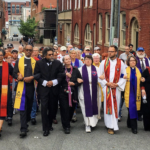
| Representatives of four Baptist groups met with elected officials in Baton Rouge, La., to explore ways to combat poverty brought to light by recent hurricanes. (Photo by Associated Baptist Press) |
“Katrina un-earthed a very ugly secret in our country,” said Roy Medley, general secretary of the American Baptist Churches USA, with 5,800 churches and a membership of 1.5 million. “How can we work toward an America that is more just and more fair?”
Medley was joined by representatives from the Progressive National Baptist Convention, the Coopera-tive Baptist Fellowship and District of Columbia Baptist Convention.
They met with Baton Rouge Mayor Kip Holden and State Sen. Sharon Weston Broome, as well as representatives of Habitat for Humanity and local pastors whose churches have served as shelters during the evacuations.
During the two-day meeting at New Light Missionary Baptist Church, the Baptist leaders committed to initiate long-term efforts to address poverty and prevent discrimination on the basis of race and class in the delivery of relief and recovery assistance.
“We are listening to hear what needs we can meet,” said Daniel Vestal, national coordinator of the Fellow-ship, which counts 1,850 churches with a total membership of about 500,000.
Baton Rouge officials estimate the city grew by 215,000 people virtually overnight–nearly doubling the city's population–after Hurricane Katrina hit the Gulf Coast Aug. 29. About 8,000 people still are in shelters, and 37 churches are providing assistance. The largest denomination providing disaster relief in the Gulf region is the Southern Baptist Convention, which was not represented at the meeting.
Mayor Holden thanked those organizations providing relief.
“The hearts are so big, the efforts are great, and you will never be forgotten for your efforts,” he said. But he asked those gathered not to focus their efforts solely in Baton Rouge. “There are people who are suffering more than we are.”
The list of 37 local churches was divided among the four Baptist organizations represented, and each group encouraged its affiliated congregations to adopt the Louisiana churches.
Leaders from the four Baptist bodies will meet again before the end of the year to plan the next steps of their response to poverty.
The Progressive National Baptist Convention, represented at the meeting by Tyrone Pitts, general secretary, is an association of 1,800 churches with a membership of 2.5 million.
The District of Columbia Baptist Convention, represented by Jeffrey Haggray, executive minister, is a convention of more than 60,000 members in 150 congregations, which is affiliated with several national denominations.
The leaders agreed poverty amplifies the tragic consequences of natural disasters on many citizens.
“Poverty wears a particular color in this country,” Medley noted.
“How do we take this moment to determine the Christian responsibility so that all people can help in harmony? This poverty points to the role of race in our country. How do we deal with the issue in a way that brings healing and grace? We do not want this poison to reach into future generations.”
“We don't want people to return to poverty,” Broome said. “If we are going to rebuild, we have to rebuild holistically.”
Empowering pastors is important because they can connect and earn the trust of the displaced people, she added. “I believe the government does not have all the answers. We need to work together in community.”









We seek to connect God’s story and God’s people around the world. To learn more about God’s story, click here.
Send comments and feedback to Eric Black, our editor. For comments to be published, please specify “letter to the editor.” Maximum length for publication is 300 words.