


Posted: 10/29/04
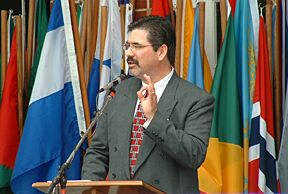
| Jerry Dailey, pastor of Macedonia Baptist Church in San Antonio, emphasizes the vital importance of cooperation and diversity in missions. (Russ Dilday Photo) |
Speakers sound alarm: Respond to needs of changing world
By Marv Knox
Editor
SAN ANTONIO–Christians need to ask, “So what?” to determine how they should love and engage the world, Albert Reyes told participants at the We Love Missions Conference in San Antonio.
The question and its corollaries echoed throughout the three-day conference, sponsored by Cooperative Baptist Fellowship Global Missions and Trinity Baptist Church, the host congregation.
Alarms have gone off to warn U.S. Christians the world is changing rapidly, said Reyes, president of Baptist University of the Americas in San Antonio. He cited the Chinese youth rebellion at Tiananmen Square, the fall of the Berlin Wall and the implosion of the Soviet Union, as well as the 9/11 terrorist attacks on the United States.
Another alarm came from conference speaker Phillip Jenkins, Reyes added.
 |
| Albert Reyes |
Jenkins, historian and author of “The Next Christendom,” described the shifting “center” of Christianity from Europe and the United States to the Southern Hemisphere.
“Christianity is a religion born in Africa and Asia, and in our lifetime, it's going home,” Jenkins said. “By 2025, half of all Christians will live in Africa and South America. The center will be in Africa. …
“The most important thing right now is to understand the shape of Christianity,” he added. “We don't need to take the faith to (the Southern Hemisphere); they have faith. We need to take them the health and wealth and skills of the West.”
U.S. Christians' sense that they are the strength of world missions is out-dated, Jenkins said. “We live now in the greatest age of missions. But it's not coming from the North to the South. It's coming from the South to the South, from the South to the North,” with African, Asian and South American churches producing an increasing number of missionaries.
“The alarm went off. … This is a different world,” conceded Reyes, vice president of the Baptist General Convention of Texas and nominee for the convention's presidency. “The question is, 'So what?'”
The stakes are enormous, he warned, noting if U.S. Christians don't change their missions involvement, “we will miss the most dramatic shift in Christian history in our lifetimes.”
Reyes offered four keys to engaging missions creatively.
First is vision. “When you look out there (in the world), what is your reaction?” he asked. “Is it fear–fear that you won't be in control?”
U.S. Christians can fear they will be a minority or they won't be the center of Christendom, but that is the wrong attitude, he advised. “You can feel fear or faith. This is the most exciting time to be alive.”
A second response is collaboration. “We need to work with people we didn't even think we needed,” he said. Poor Christians in other parts of the world don't have wealth, but they provide culture, language, passion and other assets for reaching the world for Christ.
“Look at Hispanic, African and Asian congregations and decide how we will collaborate,” he challenged. For example, Hispanics have many cultural, linguistic and physical links to the Arabic world and could be the link to reaching Muslims with the gospel.
Christians also need to focus on relationships, Reyes said. “We need to build connections with people who didn't know they mattered.”
Finally, missions-minded Christians must respond with resources, supporting others who may be better situated to accomplish missions tasks, he said.
 |
|
Bill Tinsley (right), leader of WorldconneX, explains to exhibit hall visitors how the missions network can link Christians to missions opportunities around the world. |
“We're talking about power and control of resources,” he said. “How are we going to resource people who don't have (material) resources? Are we going to be brave enough to give away what we don't own anyway?”
Throughout the We Love Missions conference, participants heard a barrage of missions challenges:
 Ken Hall, president of the Baptist General Convention of Texas, called attention to the world's need by telling a story from Winnie the Pooh in which Eeyore, the donkey, falls into a river. “Eeyore says, 'Pooh, if it isn't too much trouble, would you mind rescuing me?'” Hall recounted.
Christians must focus on rescuing a world in need, he insisted. Unfortunately, Baptists often tend to think the church exists for them, missing the command to take the “Good News” to all nations, he lamented. “Our chief task is evangelism, missions, direct involvement in the lives of people.”
He also challenged Baptists not to be isolated but to join in partnership with other Christians doing authentic ministry in a world of need.
“It grieves me that often we Christians look at what separates us instead of what unites us,” Hall said. “Let me say how strongly I affirm the Cooperative Baptist Fellowship and its ministries. As a Texas Baptist, let me say it is beyond time to figure out ways to work with others to do better the task of rescuing the perishing.”
 Migration is bringing the world directly to Christians, said Ann Woolger, a missionary among international refugees.
In 16 years, refugees from 64 countries have passed through the halfway house she operates in Toronto, Canada, Woolger reported.
“I have seen God loving the world. … The world is arriving here in North America, here in Texas. The world is here. The nations are among us.”
Anne Burton, a Texas native serving as a Cooperative Baptist Fellowship missionary at the University of Southern California, echoed a similar theme.
“There are opportunities right here in our midst,” Burton said, noting international students attend colleges and universities throughout the nation. In her situation, about 95 percent of them come from non-Christian cultures.
International students who become Christians return to their homelands carrying the gospel, she noted.
Unfortunately, many people never have had an opportunity to receive and understand the gospel, stressed Dick Hugoniot, president of Wycliffe Bible Translators.
Of the world's 6,000 languages, 2,737 do not have any Scripture portion, he said.
Wycliffe hopes to translate at least some part of the Bible into every language by 2025, Hugoniot said. “The Great Commission has not changed. We are to go into all the world–into every language group. … The mission sounds impossible, but I tell you, God is going to accomplish the impossible.”
Cooperation is vital to missions accomplishment, insisted Jerry Dailey, pastor of Macedonia Missionary Baptist Church in San Antonio and president of the Texas Baptist African-American Fellowship.
“Your church can't reach everybody by itself,” Dailey said. “We need white churches. We need black churches. We need Hispanic churches. We need Vietnamese churches. One can't do it.”
Missions is part of God's plan, both for the world and for the church, said Charles Wade, executive director of the Baptist General Convention of Texas.
“God values us–loves us–so much that he did not want to spend an eternity apart from us,” Wade said.
He recited the key to missions he learned from Tillie Burgin, director of Mission Arlington, a citywide missions/evangelism enterprise: “Keep telling the (gospel) story, and hang out with the people.”
Another key is taking missions personally, said Phillip Williams, vice president for church and community development at Buckner Baptist Benevolences.
“Missions is personal; it's power-packed,” Williams said. “Go where God says to; make a difference. Someone is dying. Will you make missions personal to you? It's personal to me.”
Alcides Guajardo, president of the Hispanic Baptist Convention of Texas, shared those sentiments: “I love missions because I have a commission from the Lord. Our commission is very personal. It's very direct. He sent you, and he sent me. That's why I love missions. He sent me.”
The personal nature of missions often involves sacrifice, noted Patty Lane, director of intercultural initiatives for the Baptist General Convention of Texas.
She told about a person who gave a friend a beautiful seashell for a present. When the recipient noted they lived a long way from the ocean and the giver, a poor person, must have walked an extremely long way to retrieve the shell, the giver simply replied, “The walk is part of the gift.”
Lane recounted sacrificial ministries by Filipino and Congolese churches and another congregation whose home country is closed to the gospel.
“Missions is about giving our walk,” she said. “God not only transforms us; that's how he transforms the world.”
Bill Tinsley, director of WorldconneX, the BGCT's new missions network, picked up on the transformational theme.
That idea began with Jesus' call for repentance–for spiritually changed lives, Tinsley said. “We cannot embrace God unless we repent. … We must be transformed–our lives, our churches, our communities, our cities, our nations, the world.”
Daniel Vestal, the CBF's coordinator, presented a three-part challenge for missions.
“We're going to fulfill the Great Commission only when we give a dialogical witness,” Vestal said. “We've got to listen and learn, then give an authentic witness, and God does the rest.”
Christians also validate their witness through “suffering love,” he added. “How do we handle our own pain and suffering in the world? What do you do with your own pain–avoid it, anesthetize it or embrace it? God will use your pain to transform you into Christ's likeness.”
And Christians must depend upon the power of the Holy Spirit, he added. “We are at a time when we may come upon a great harvest, not because of what we're doing but because of the work of the Holy Spirit.”
Love is a powerful missionary tool, said Craig, a missionary whose last name was not used because he works in an Islamic country.
He told about a Muslim neighbor who wanted to argue about the Bible versus the Koran and Christianity versus Islam. But the way to reach his neighbors is not to out-argue them; it is to love them, he said. "We want to be known as Christians–people who love God and love others," he explained. "We need more workers. There aren't enough people like us out there."
Bruce Greer, a Dove Award-winning composer and concert artist, affirmed that idea. “If we're to win the world, we've got to love it,” he reminded participants in a song.
God is working among impoverished people along the Mexico-Texas border, reported Jorge Zapata, border ministries coordinator for Buckner Children & Families Services of South Texas, which serves residents of colonias–unincorporated towns and villages–up and down the Rio Grande.
“There's a revival going on in the colonias,” Zapata said. “God has been transforming people.” For example, Buckner Border Ministries volunteers have repaired 60 houses in the region, and “every home where we have repaired, every member of the family accepted Jesus as Lord and Savior.”
Baptists are saving people from starvation around the world, said Paul Montacute, director of Baptist World Aid, the relief arm of the Baptist World Alliance.
He recounted stories of hunger-relief ministry in Rwanda, Sarajevo, Kosovo and along the Burma/Thailand border. “Baptists are loving, caring for others,” he said.
But Montacute challenged what has become, for some, conventional wisdom: “Short-term (mission) trips might not always be best. With just a tithe of the airfare, we could make a significant impact on world hunger.”
The Old Testament prophet Micah offered a practical guide for modern Christians concerned about missions, suggested Barbara Baldridge, the CBF's co-coordinator of Global Missions.
Noting Micah called on God-fearing people to enact justice, love mercy and walk humbly with others, Baldridge said, “If we can do that, I think we can know we're on mission.”
Christians today cannot dodge their responsibility for missions, stressed Bill Shiell, pastor of First Baptist Church in Knoxville, Tenn., who served as master of ceremonies for the conference.
Citing Russian novelist Leo Tolstoy, he said: “The most important time is now. It is the only time we have power, in this convergence of the past and the future. … It's our turn. We are the church now.”
Lance Wallace and Craig Bird contributed to this story.








We seek to connect God’s story and God’s people around the world. To learn more about God’s story, click here.
Send comments and feedback to Eric Black, our editor. For comments to be published, please specify “letter to the editor.” Maximum length for publication is 300 words.