





Posted: 5/28/04
Religious freedom in Afghanistan
& Iraq endangered, panel says
By Robert Marus
ABP Washington Bureau
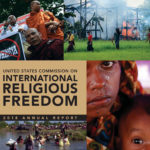
WASHINGTON (ABP)–The future of religious freedom in the rebuilt Afghanistan may be in grave danger, and the United States should avoid similar problems as it rebuilds Iraq, a federal panel's annual report concluded.
Promoting religious freedom in Afghanistan and Iraq has been “a major focus” of the United States Commission on International Religious Freedom for the past year and half, Commissioner Nina Shea said.
The commission is an independent and bipartisan federal panel charged with monitoring religious-liberty conditions worldwide. The commission also is empowered, under the terms of the 1998 International Religious Freedom Act that established it, to make foreign policy recommendations to the administration regarding religious freedom.
“This is not a theoretical matter but a very real concern in both Afghanistan and Iraq,” Shea, director of the Washington-based Center for Religious Freedom, told reporters.
She noted that, despite the United States' overthrow of Afghanistan's theocratic Taliban regime and installation of an interim government, Afghan secularists and moderates are increasingly “on the defensive.”
The commission's report noted deficiencies in Afghanistan's newly adopted constitution that may undermine its theoretical protections for religious freedom.
“Though the constitution provides for the freedom of non-Muslim groups to exercise their various faiths, it does not contain explicit protections” for the right to religious freedom “… that would extend to every individual,” it said.
In addition, the commission pointed out, Afghanistan has two more constitutional problems that pose risks to religious freedom–a “repugnancy clause” that bars any laws “contrary to the beliefs and practices of Islam” and provisions for the country's judicial system that have been interpreted to allow it to enforce Islamic law in some cases.
The report noted the country's chief justice has told commissioners he rejects the concepts of equality of the sexes and freedom of expression and religion.
“With no guarantee of the individual right to religious freedom and a judicial system instructed to enforce Islamic principles and Islamic law, the new constitution does not fully protect individual Afghan citizens against, for example, unjust accusations of religious 'crimes' such as apostasy and blasphemy,” the report said.
“Arrests and imprisonment for alleged blasphemy … have already occurred in the new Afghanistan,” Shea said.
The commission's report recommended that, among other things, United States officials give greater support to moderate elements in Afghan society and assign to the U.S. embassy in Kabul personnel solely charged with monitoring the status of religious freedom and other human rights in the nation.
Likewise, Shea said, the commission is concerned the United States “ensure what happened in Afghanistan does not happen in Iraq” as that nation rebuilds under U.S. control.
Shea noted religious-freedom advocates had some success in getting guarantees for individual religious freedom included in Iraq's interim constitution. However, it still contains a clause similar to the Afghan one disallowing any laws or practices contrary to Islamic principles.
Among the commission's recommendations were for the U.S. administrator in Iraq, Paul Bremer, “to appoint a team of advisers … to advise on religious affairs and to monitor human-rights violations” and for U.S. officials to advocate for language in the country's permanent constitution that would more explicitly protect individual religious freedom and other human rights.
In response to questions about prisoner abuse violations in United States-run Iraqi prisons, commissioners said only that they have been recommending, for more than a year, U.S. personnel be assigned to monitoring human-rights abuses in the country.
The report also reiterated the commission's recommendations, first announced earlier this year, that Secretary of State Colin Powell designate 11 nations as “countries of particular concern,” or CPCs, under the terms of the International Religious Freedom Act.
The nations are Burma, North Korea, Eritrea, India, Iran, Pakistan, China, Saudi Arabia, Sudan, Turkmenistan and Vietnam.
The law enables the State Department, if it follows the panel's recommendations, to enact a number of sanctions against a nation designated a country of particular concern.
According to the commission, those countries were singled out because of “systematic, ongoing and egregious violations of religious freedom that (their) governments are responsible for or have tolerated.”
The commission was divided on India, with a minority of commissioners feeling that toleration of religious-freedom violations at the hands of some local and regional Indian governments did not rise to the level of CPC recommendation.
Those three commissioners filed a dissenting opinion recommending that India be placed on a separate “watch list” of nations with religious-freedom problems that are not dire enough for CPC designation.
The commission issued its report the day before Indian voters decisively defeated candidates from a far-right Hindu nationalist party in parliamentary elections.
Other nations the commission has named to the watch list include Belarus, Cuba, Egypt, Georgia, Indonesia, Laos, Nigeria and Uzbekistan.
This is the fourth time the commission has asked the State Department to declare Saudi Arabia and Turkmenistan as CPCs.
However, the department has not yet heeded the commission's recommendations.
Both Saudi Arabia and Turkmenistan have been considered close allies of the United States in the global war on terrorism. Nonetheless, as the State Department's own religious freedom report from 2003 noted, “religious freedom does not exist” in oil-rich Saudi Arabia. As the commission's report said, “The Saudi government forcefully bans all forms of public religious expression other than that of the government's interpretation of one school of Sunni Islam.”
Michael Young, the commission's chairman, expressed another continuing frustration of the panel.
Even when the State Department has declared a country a CPC, he said, it hasn't taken any policy steps to promote religious freedom beyond measures the United States has “already taken in the past” to correct other problems in those nations.









We seek to connect God’s story and God’s people around the world. To learn more about God’s story, click here.
Send comments and feedback to Eric Black, our editor. For comments to be published, please specify “letter to the editor.” Maximum length for publication is 300 words.