Not clear yet, but BGCT vision is emerging, consultant says_51704

Posted: 5/14/04

Not clear yet, but BGCT vision is emerging, consultant says

By Marv Knox

Editor

Although it's not clear yet, a new vision for the Baptist General Convention of Texas is coming into focus, according to the consultant who is helping the convention develop that vision.

The BGCT's “revisioning” process has produced both common themes and critical issues, and a vision will emerge from those ideas, reported Sherrill Spies, an organizational consultant who works with church groups and other nonprofit organizations.

The process began about three months ago. Supported by the convention's officers, BGCT Executive Director Charles Wade named four revisioning teams–one comprised of lay leaders, two groups of pastors plus a sampling of BGCT staff. Those teams each met three times during March and April. They studied the convention, talked with peers and reported their concerns and dreams for the statewide body.

Representatives of BGCT institutional leaders, directors of missions, Executive Board staff managers, and college and seminary students also contributed in one-day visioning sessions.

Even though the groups functioned independently, they achieved remarkable consensus, said Spies, a member of First Baptist Church in The Woodlands with a doctorate in complex organizations.

“All of them agreed the BGCT exists because of the churches and their desire to do together what they cannot do alone,” she said. “They know the BGCT is here to serve the churches, and not the other way around.”

Spies pointed to six common themes expressed by the revisioning participants:

Customer focus. “The BGCT will focus on being an effective partner to churches as they act to fulfill the vision that God has for them,” she said, noting the convention must collaborate and network to help strengthen and empower churches.

Similarly, the services offered by the convention must be solution-based rather than program-based.

bluebull Vision & purpose. A vision–which comes from God–is crucial to developing Texas Baptists' identity, Spies explained. But “the groups want the BGCT to articulate a clear vision that encourages churches to get connected with the BGCT, other churches and organizations to do kingdom work,” she added.

“They're saying (to the BGCT): 'Tell us who you are and what you're doing. And then we can get on board.'”

bluebull Connectivity. “The BGCT must provide the infrastructure and processes for connecting churches to resources, other churches, institutions and other organizations,” she said, noting the theme emerged repeatedly.

For example, pastors indicated they want the BGCT to provide Internet chat rooms, where they can build friendships and share ideas.

Among other infrastructure, revisioning participants called for geographically disbursed resources–locating them closer to churches across Texas rather than centralized in the Baptist Building in Dallas. They also asked for a telephone call center that would provide easier access to resources, services and products. And they requested evaluation and guidance regarding non-Baptist materials and resources aimed at churches.

bluebull Evaluation and accountability. “The (BGCT) services, programs and ministries will be evaluated, and the Executive Board staff will be accountable to the convention and the churches,” Spies said.

bluebull Innovation and creativity. Over and over again, participants suggested the BGCT should create a think-tank for researching and developing cutting-edge ministries and methods, as well as for spotting trends and preparing Texas Baptists to thrive in an ever-changing climate.

bluebull Governance. This is a focus on the BGCT, not the churches, Spies said, noting, “We are studying ways to make our governance simple and more effective.”

The BGCT's complex structure–particularly the central organization, with a huge Executive Board and myriad commissions, coordinating boards, committees and subcommittees–has been criticized for being cumbersome for years.

The revisioning participants also highlighted numerous critical issues facing the convention and the churches, Spies said.

“We must have an identity for Texas Baptists,” she reported. “There is a great need for vision for our churches, associations and our state convention.”

And while churches and associations are free to develop their own individual identities, they look to the convention for a common identity that helps define their character and purpose, she said.

Credibility and accountability also are key issues, Spies said. “Our leadership must be moral and effective. Our words must match our actions. Our stewardship must be biblical and wise. And our missions and ministries must be monitored and evaluated.”

In addition, diversity dominated the list of critical issues, she added. “Our churches vary in size, traditions, styles, populations, location, region and more. The big question is: How can the BGCT provide effective services and products to meet the needs of these diverse churches?”

Part of that diversity is reflected in the symphony of languages spoken by Texas Baptists, she observed, stressing the importance of providing services and resources “in the languages of the people.”

Similarly, the teams agreed Baptists must “be aware of and embrace the people groups in Texas,” she said.

Churches should reflect the communities they serve, and BGCT leadership should reflect the diverse population of Texas, the teams agreed.

And noting the demographic forces at work in Texas, they recommended “comprehensive strategies for advancing kingdom work among Hispanic populations,” she said.

They also urged several developments that specifically impact congregations, Spies reported.

“We need to rediscover a sense of community in our churches,” she acknowledged. Also, “how can churches be true to God's word and be relevant in today's society and communities?”

A paramount concern is sharing the gospel across Texas, Spies stated, noting the revisioning teams observed: “We are not seeing enough people come to know Jesus Christ as Savior and Lord. We are not keeping up with the population growth in Texas. We are trading members more than reaching the unchurched.”

Through all the discussion, the teams did not reach a consensus on the BGCT's relationship to the Southern Baptist Convention.

“Those who want to cut all ties and those who want to find appropriate ways of partnering could not agree on suggestions for actions,” Spies said. “We will continue to study this question and seek feedback from churches.”

Now that the revisioning teams have completed their work, Wade has appointed a strategic planning committee to carry the process forward. The strategy committee will review information from the revisioning teams, as well as responses from listening sessions to be held statewide. It also will evaluate previous and current BGCT strategies and program effectiveness, and identify and learn from the convention's internal and external “stakeholders,” Spies said.

Ultimately, the committee will draft a BGCT strategic plan. It will include mission and vision statements, as well as priorities and strategies for achieving them.

The revisioning teams were supportive of the BGCT and thankful for the ministries it provides, Spies said. “At the same time, they expressed the thought that the time for change is now in order to meet the challenges of the era.”

However, the specific nature of that change is yet to be determined, she said, insisting, “Nothing is decided.”
News of religion, faith, missions, Bible study and Christian ministry among Texas Baptist churches, in the BGCT, the Southern Baptist Convention ( SBC ) and around the world.


Most Protestant ministers tell pollsters they like NIV above all other Bibles_51704

Posted: 5/14/04

Most Protestant ministers tell pollsters
they like NIV above all other Bibles

PHOENIX, Ariz.–A newly released study shows the New International Version of the Bible is the translation most likely to be used by Protestant ministers in their work

Thirty-one percent preferred NIV, followed by the King James Version at 23 percent, the New Revised Standard at 14 percent, the New King James at 13 percent and the New American Standard at 10 percent.

Together, these five Bible versions represent nine out of 10 Bibles ministers rely on most, even though there are dozens of other versions available.

The study was conducted for Facts & Trends magazine–a publication of LifeWay Christian Resources–by Ellison Research, a full-service marketing research firm in Phoenix, Ariz.

The research was conducted among a representative sample of 700 senior pastors of Protestant churches throughout the United States.

Preferences vary considerably among different types of churches. Pastors of smaller churches, and pastors who are 60 or older, more often lean toward the traditional King James Version. The King James Version is also the favorite of ministers in the southern United States.

The New International Version is strongest in the Midwest and the western United States, while the New Revised Standard has its greatest popularity in the Northeast.

Much of the geographic difference is due to differing strengths of certain denominations in various regions of the country, and the fact Bible preference differs strongly by denomination.

Methodists tend to rely either on the NIV (45 percent) or the NRSV (38 percent).

Those two versions also are dominant among Lutheran ministers, but in reverse order (48 percent NRSV, 23 percent NIV).

Southern Baptist ministers are split almost equally among four versions: 26 percent NIV, 25 percent New King James, 23 percent King James and 22 percent NASB.

Other Baptist ministers (American Baptist, Conservative Baptist, General Baptist, etc.) are strongly on the side of the King James (51 percent), with the NIV a second-place finisher (24 percent).

Pentecostal and charismatic ministers are similar; 45 percent rely most on the King James, while 23 percent prefer the NIV.

Ministers tend to select their top Bible versions based on the perceived accuracy of the translation (40 percent), its readability (16 percent), their preference for its language style (14 percent), and its solid reputation (13 percent).

Very few said the main reason they rely on a specific version is because their congregation prefers it or their denomination requires it.

The top reasons for using the NIV are readability and preference for the language style.

The New King James is preferred for a variety of reasons, the most common of which is accuracy, the survey revealed.

Those who prefer the KJV like it for its accuracy and its solid reputation.

The NASB is preferred primarily due to its accuracy.

In the study, ministers were also asked to rate 12 different Bible versions for members of their congregation to use. They used a five-point scale, from poor to excellent. Versions rated included the Contemporary English Version, Holman Christian Standard Bible, King James Version, Living Bible, The Message, New American Standard Bible, New Century Version, New International Version, New King James Version, New Living Translation, New Revised Standard Version, and Today's New International Version.

Among all Protestant pastors, the version most likely to be rated as excellent by pastors is the NIV (rated as excellent by 42 percent of ministers), followed by the New King James (33 percent), the NASB (32 percent), the King James (31 percent), and the NRSV (23 percent).

The Bible versions ministers are most likely to recommend against for their congregation include the Living Bible (26 percent), Today's New International Version (which is not the same as the NIV­18 percent), The Message (15 percent), and the King James Version (15 percent). The King James is the only one among the 12 included in the study to be listed as one of the most recommended and least recommended.

The research also points out that many ministers lack familiarity with the broad range of Bible versions available today. Versions which are unfamiliar to at least one out of every four ministers include the brand-new Holman Christian Standard Bible (65 percent), the New Century Version (55 percent), Today's New International Version (37 percent), the Contemporary English Version (31 percent), the New Living Translation (30 percent), and The Message (28 percent).

Which versions ministers would recommend differ strongly by denomination. For instance, the New Revised Standard is considered excellent by 60 percent of Methodists, but only 5 percent of Pentecostals; the Holman Christian Standard Bible would be strongly recommended by 20 percent of Southern Baptists, but virtually no Lutherans.

News of religion, faith, missions, Bible study and Christian ministry among Texas Baptist churches, in the BGCT, the Southern Baptist Convention ( SBC ) and around the world.


Bible drill contestants take Scripture into hearts and minds_51704

Posted: 5/14/04

Bible drill contestants take Scripture into hearts and minds

By John Hall

Texas Baptist Communications

DALLAS–Some contestants practiced before church, some after. Some memorized passages in their bedrooms, others in their basements. All spent many hours with their Bibles.

In the end, a few were victorious in the statewide Baptist General Convention of Texas Bible drill and speaker competitions.

Lauren Vick of Plymouth Park Baptist Church in Irving looks for a verse while practicing before the BGCT Bible drill competition.

Tanner Shirley of First Baptist Church in Atlanta won the junior high school Bible drill competition. Robert Scott of Tabernacle Baptist Church in Ennis and Elizabeth Rasmussen of First Baptist Church in Belton tied for second.

Lensie Mabry of Selden Baptist Church in Stephenville and Patrick Walker of First Baptist Church in Tenaha won first and second place, respectively, in the senior high school Bible drill competition.

Emily Burkhead of First Baptist Church in Cleveland won the youth speaker competition. Anna Daub of First Baptist Church in Brownwood placed second. The top finishers earned partial scholarships to their choice of Baylor University, East Texas Baptist University, Hardin-Simmons University, Howard Payne University, Wayland Baptist University or the University of Mary Hardin-Baylor.

Shirley and Burkhead will move on June 1 to the national finals in San Antonio. About 1,600 people from more than 250 churches participated in the regional events for all three competitions.

Cynthia Sargent and Libby Connel of First Baptist Church in Clyde and Cicily Smith of Berea Baptist Church in Fort Worth took the top three spots in the BGCT youth essay contest.

Sargent won $500 for herself and $500 for her church's youth ministry. Connel earned $300 for herself and $300 for her church's youth ministry. Smith won $200 and a matching sum for her church.

Bible drill contestants are quizzed on a series of key Bible verses. They are to locate some passages, memorize others and use still others to answer questions about life issues such as alcohol use.

Speakers were judged on the composition and presentation of a topic that helped them express their faith.

The competition helps young people internalize Scripture, Mabry said. The memorized biblical message continually impacts the actions of the competitors. That is more important than winning, she added.

“There's nothing to lose by it,” she said. “Even if you blow it, you know the verse. It stays with you.”

Mabry and Walker said the fellowship among competitors at their church and at the statewide competition in the Baptist Building made practicing enjoyable. They got to laugh with and get to know others in their church during long practice sessions.

Mabry said she particularly enjoyed creating songs with her fellow church members that helped them remember different passages.

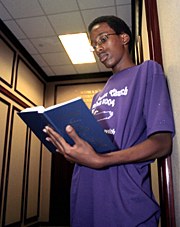
John Stevenson of Westside Baptist Church in Killeen reads a passage before the statewide competition.

Burkhead spoke of trusting God to help her dreams and goals become reality. She talked about God's faithfulness in fulfilling the promises he made throughout the Bible.

She practiced with her mother every night leading up to the competition and received some coaching from her father, Howell Burkhead, pastor of First Baptist Church in Cleveland.

Daub said the hardest part of the speaker competition happens after her effort is finished. Then she has to back up those words with her life.

The speaking contest helps prepare young people to respond to questions about their faith, Burkhead said. Christians should be prepared with thoughtful answers about their faith.

“I think it's very good practice for general life,” she said.

Dickie Dunn, director of discipleship in the BGCT Bible Study/Discipleship Center, said each of the competitors performed excellently and believes the knowledge they gained will make them stronger Christians and church members.

Bible drill “is a good thing because it helps us memorize God's word and apply the meaning and message to everyday life,” he said.

News of religion, faith, missions, Bible study and Christian ministry among Texas Baptist churches, in the BGCT, the Southern Baptist Convention ( SBC ) and around the world.


Baptist Briefs_51704

Posted: 5/14/04

Baptist Briefs

Indiana pastor to be nominated for SBC 2nd VP. Mark Stephen Hearn, pastor of Northside Baptist Church in Indianapolis, will be nominated for Southern Baptist Convention second vice president during the SBC's annual meeting June 15-16 in Indianapolis. Charles Sullivan, former executive director-treasurer of the State Convention of Baptists in Indiana, will nominate Hearn. Hearn has held vice presidential posts in both the Indiana and Georgia state Baptist conventions. He serves as a trustee for LifeWay Christian Resources. Hearn joins John Hays of Jersey Baptist Church near Columbus, Ohio, in the running for SBC second vice president.

Texas representatives named to SBC committee. Southern Baptist Convention President Jack Graham appointed as the two Texas representatives on the SBC committee on committees members of churches uniquely aligned with the Southern Baptists of Texas Convention. Graham named Paul Cheek from Kentucky Town Baptist Church in Whitewright and Eric Hankins from Galloway Avenue Baptist Church in Mesquite. Both churches are identified on the Southern Baptists of Texas Convention website as uniquely aligned with the convention that broke away from the Baptist General Convention of Texas. The SBC committee on committees has 70 members, two from each of the 35 state or regional conventions qualified for representation on SBC entities. The committee's key responsibility is to nominate members of the committee on nominations, which nominates trustees to serve on the various SBC national entities.

Annuity Board video available in three languages. The Southern Baptist Annuity Board has produced a retirement planning video in Spanish and Korean, as well as English. The 15-minute video highlights the benefits of the Church Annuity Plan, a 403(b) retirement plan designed exclusively for Southern Baptist ministers and church employees. Vietnamese and French Haitian versions of the video should be available this summer. Free copies of these videos are available by calling the Annuity Board at (800) 262-0511. Callers can also request translation assistance through this toll-free number.

Centurymen to perform Washington concert. The Centurymen, a 100-voice men's chorus comprised of Baptist ministers of music from across the United States, will perform a June 29 concert at Constitution Hall in Washington, D.C. They will share the stage with the Broadway Inspirational Voices, a gospel ensemble of actors who perform in stage musicals, and the Nashville Children's Choir.

Dallas pastor named distinguished alum. Mac Brunson, pastor of First Baptist Church in Dallas and chancellor of Criswell College, has been named a distinguished alumnus of Southwestern Baptist Theological Seminary. Brunson, who became pastor of First Baptist Dallas in 1999, is immediate past president of Southern Baptist Convention Pastors' Conference. Claude Cone, executive director of the Baptist Convention of New Mexico, also will receive the award for his 19 years of service in that state. He previously was pastor of churches in Slide, Crandall, Howe, Denison, Lubbock and Pampa. Other recipients are Paul K.S. Kim, pastor of Berkland Baptist Church in Cambridge, Mass., and Ronnie Floyd, pastor of First Baptist Church in Springdale, Ark. The awards will be presented at the seminary's national alumni luncheon, held in conjunction with the SBC annual meeting in Indianapolis.

Missouri Baptists name interim exec. The Baptist General Convention of Missouri has named as its interim leader the former executive director of the convention from which it broke away. The convention named James Hill interim executive director, effective June 1. Hill was executive director of the Missouri Baptist Convention from 1998 to 2001. He currently is president of RDI Consulting and Resource Churches in Jefferson City, Mo. H.K. Neely, a former university administrator, has led the Baptist General Convention of Missouri since it was formed two years ago.

News of religion, faith, missions, Bible study and Christian ministry among Texas Baptist churches, in the BGCT, the Southern Baptist Convention ( SBC ) and around the world.


Volunteers help church building committees visualize their dreams, plans_51704

Posted: 5/14/04

Volunteers help church building
committees visualize their dreams, plans

By George Henson

Staff Writer

DETROIT–Shirley Wright draws dreams.

She and her husband, Travis, may be the best friends a building committee ever had. And the price is right, too–they say they work for God, so the church doesn't owe them a thing.

For a little more than a year, the Wrights have traveled from their rural Northeast Texas home to points across the state helping put a visual representation to the dreams of building committees.

They are Mission Service Corps volunteers through the North American Mission Board.

Shirley Wright shows the building drawings she and her husband provide for churches.

A message by Cecil Deadman from the Baptist General Convention of Texas Missions Equipping Center helped them realize that even though they were retired, they still could put their talents to use for God's kingdom.

He had been a NASA engineer, and she had been a building consultant and certified kitchen planner experienced in putting homeowners' dreams on paper.

As building consultants, the Wrights were a new type of Mission Service Corps volunteer.

“They didn't have anybody like us, so they had to think about it for awhile,” Mrs. Wright said with a grin.

But for the last year, the Wrights have met with the building committees of about 20 churches and have helped more than a dozen get a better picture of what they want.

So far, they have helped design church sanctuaries and kitchens, a camp kitchen and dining room and a parsonage renovation.

They first thought about launching a building consultant ministry after helping their own church, Leesville Baptist Church in Leesville, develop visual plans for its family life center and youth building.

Wright said one of the most important things they do is help churches think through what they are wanting so that the reality matches their dreams.

“A lot of times someone, sometimes two or three people will have made sketches of what they want. We may look at it and tell them, 'You can have all this, but you really don't want this room next to this one,” he said.

“Traffic is the key,” Mrs. Wright added. “How people are going to move through the building is very important.”

Another thing the Wrights stress is the importance of meeting or surpassing building codes.

“Many country churches don't think they have any building codes or think they can just ignore them,” she said.

Mrs. Wright said one of the most important things the couple does is help the committee reach a consensus.

“Each person has ideas, and we help put them together into one building. We try to get them to look at the question, 'What does this church need to grow?'”

“Sometimes she acts as a referee, and they really do need an outside person to do that,” her husband added.

They also provide churches with information on the steps of the building process provided by the building and facilities office of the Baptist General Convention of Texas, attend seminars on changing building codes and make a special effort to stay up- to-date on handicapped accessibility.

Mrs. Wright makes talking with churches about accessibility to the handicapped a priority.

“If they are not considering accessibility for the handicapped, that's my first project, because a handicapped accessible church is a friendly church. And it really doesn't cost much to do if you do it up front. It's much more expensive to come back and add later,” she said.

Once the committee has an idea of what it wants, Mrs. Wright uses her drawing skills to give them a visual representation of what it could look like.

“Sometimes they make gobs of changes, but that's fine. We're working for God, so it doesn't matter to us if we're working for this church or that church.”

Once church leaders decide they like the look of what Mrs. Wright has drawn, the couple help them find an architect.

“An architect takes the plan and makes working drawings from them, but by this time we've probably saved them at least $2,000,” she said. “I'm not an architect and can't do what an architect does, but I can do a lot of preliminary things an architect won't do or will charge a large fee to do.”

The Wrights continue to help the churches even at that point.

“We're developing a list of soft-hearted architects,” she said with a smile.

The Wrights say they are thrilled to be helping Texas Baptist churches. “This has become my life,” Mrs. Wright said. “As long as we're breathing, we're going to do this.”

She sees what they do not as a job or service as much as a ministry.

“I know I do better work than I ever did when this was my business. There's no time pressure, and as a volunteer, I only have to please God. I have a different boss now, and he is a genius. Think about the engineer God is, so much creativity and imagination. And I get to work for him. It's just wonderful.”

News of religion, faith, missions, Bible study and Christian ministry among Texas Baptist churches, in the BGCT, the Southern Baptist Convention ( SBC ) and around the world.


SURVIVOR: Mandy Biggs, ‘Chemo Chick’_51704

Posted: 5/14/04

SURVIVOR:
Mandy Biggs, 'Chemo Chick'

By George Henson

Staff Writer

CEDAR HILL–Karen Biggs vividly remembers the moment she and her husband, Ray, told their 13-year-old daughter she had cancer.

“I walked into the room behind Ray so that I could hide. I was really emotional, and I didn't want to upset Mandy,” she recalled.

Cancer survivor Mandy Biggs of Hillcrest Baptist Church in Cedar Hill poses beside her "Chemo Chick" letter jacket. Her story is included in a new book, "True, Vol. 1: Real Stories About God Showing Up in the Lives of Teens." (George Henson Photo)

She stayed in her hiding place as her husband told their youngest daughter tests had shown she had Hodgkin's lymphoma, and a string of tumors trailed from her neck into her chest.

She stayed there nestled in her husband's shadow until she heard Mandy's reply: “It's OK. I've prayed for this.”

That brought her mother immediately to forefront. “What do you mean you prayed for this? You prayed to have cancer?” she asked.

“And she told me, just as calm as she could be, 'No, but I have been praying for God to give me a stronger testimony, and I think this is how he's going to do it,'” her mother remembers.

That was four years ago, and Mandy still is boldly sharing the testimony of how God gave her peace and comfort in a time of trial.

Mandy–a member of Hillcrest Baptist Church in Cedar Hill–doesn't sugar-coat her story and admits to struggles, primarily feelings of abandonment by friends. But she is adamant about God's care every step of the way.

Her story is one of 52 included in the book “True, Vol. 1: Real Stories About God Showing Up in the Lives of Teens.”

The book, compiled by Irene Dunlap, co-author of three “Chicken Soup for the Soul” books, allows teens to share their faith experiences with other teenagers. The book's purpose is “to encourage teens and young adults in their faith,” Dunlap said.

That's exactly what Mandy was doing, even while she was fighting cancer.

In addition to sharing her testimony with nearby youth groups, she also answered invitations from churches in Odessa and Shreveport to speak to their youth groups.

Mandy, an athletic eighth grader who played both softball and volleyball at the onset of her cancer, first became aware of a problem when she started feeling tired and run down after a school day. Then she noticed a lump in her neck.

The initial diagnosis was a thyroid problem, and the medication shrank the lump for a little while. Then it returned even larger.

After tests confirmed Mandy had cancer, Biggs told the doctors he thought the news should come from him–not that he in any way wanted the job.

“This was my baby, and it was the worst thing you could ever think of having to say to your daughter,” he recalled. “But I didn't want it to come from them.

“We found out later that it wasn't a death sentence, but we didn't know that at the time.”

Mandy recalls having a peace about her illness from the moment she heard the words.
“I think God was kind of preparing me, because in the weeks before, I had kind of been getting the feeling that I had cancer. I just had a peace about it from the very beginning. I just kind of had this overwhelming feeling that if I just stay focused on him this is all going to be OK,” she said.

Her parents agreed and said her strength quickly began to transfer to them.

“I just felt this aura around her–that God was in control,” her father recalled. “It was kind of like getting hit up side the head with the worst news you can think of and a few minutes later knowing it was going to be all right.”

While going through the chemotherapy, it often didn't seem that way. No matter what medicine she was given, Mandy had a dramatically adverse reaction. Each dose made her so sick she had to be hospitalized for days.

“Her treatment didn't follow any of the normal protocols, and they had to develop a new plan,” Mrs. Biggs recalled.

“Every time they changed the drug they were giving her, we would read about the possible side effects, and they told us, 'Don't read that; it almost never happens that way.' But with Mandy, it did. Every time, she had a severe reaction, and what was supposed to be a couple of hours in the hospital turned into a few days.”

Biggs marvels at his daughter's self-assurance during that time. “For awhile there, the chemo took her hair, and she was bald as a cue ball, but she went to school that way. She never wore a hat or a wig or anything,” he said.

Despite the difficulty of the chemotherapy regimen, the eight months of treatment was successful, and three years later, she remains cancer-free.

Although she was told she would never be able to be involved in athletics again, this year she played first base for Duncanville High School's softball team. Across the back of her letter jacket is emblazoned a nickname given by one of her nurses–Chemo Chick.

Mandy said she heard about “True, Vol. 1” through her youth minister, who helped her edit her testimony after she had written it. She wanted to tell her story, she said, to honor the request she first made of God.

“I asked God in the beginning for a stronger testimony so that it could have a greater impact on people, and I might as well use it, even with people who I will never meet,” she said.

Biggs said the ordeal has strengthened the faith of the entire family. “The amazing thing was to see how God used it so obviously and so often,” he said.

Mandy said the greatest lesson she took from the experience is that God is in control.

“I think by going through it, I was forced to rely on God. I was so independent and stubborn, and I still am, but I realized that this was something I had no control over. I've learned that there are a lot of things I have no control over, but it's OK, because God does,” she said.

Her father said he saw God raise up an outgoing minister of his love in his daughter, even when she was so sick herself.

“When she was in the hospital, and she was never an outgoing person but a kind of a shy tomboy, she would take her IV pole and go to other kids' rooms. She was older than most of them and would play with them and talk with them.

“The nurses began to notice, and after awhile they would come down and tell her when-ever a new kid was admitted,” Biggs recalled. “Mandy's an incredible witness. We'd never seen do that before, and she hadn't done it before. That's what came out of this, and she has been doing it ever since.”

One of the ways Mandy has sought to minister was to baby-sit the daughter of a woman with cancer. The girl's mother thought Mandy might be able to deal with some of her daughter's questions and emotions. That girl, Rachel, is now Mandy's younger sister. Rachel's mother died, and the Biggs family has adopted her.

“God always does his best at the worst times,” Biggs said. “We were all really new Christians when this all began, and it just catapulted our faith. God had us in his hands that entire time and just carried us through.”

The Biggs family have copies of the book, “True, Vol. 1,” available for $13. For information, call (972) 291-3608.

News of religion, faith, missions, Bible study and Christian ministry among Texas Baptist churches, in the BGCT, the Southern Baptist Convention ( SBC ) and around the world.


Care for dying requires ‘watchful medicine,’ ethicist insists_51704

Posted: 5/14/04

Care for dying requires
'watchful medicine,' ethicist insists

By Ferrell Foster

Texas Baptist Communications

SAN ANTONIO–The Christian's view of sickness and death should be understood in the light of resurrection, and that understanding should lead toward a “watchful medicine” in caring for the dying, ethicist Allen Verhey said.

Verhey, professor of religion at Hope College in Holland, Mich., spoke to the annual Baptist General Convention of Texas Christian Life Commission conference.

Ethicist Allen Verhey tells the Texas Baptist Christian Life Conference that Christian views on death and suffering must be understood in light of the resurrection.

The Christian belief in resurrection does not deny the pain and reality of sickness and death, but it insists on “another and a better destiny,” he said. “Death is not the last word.

“God's good future makes its power felt, not where the dying cling desperately to life, nor where the dying are deliberately killed, but where dying is faced with courage and accompanied by care.”

Courage and care are part of what Verhey calls watchful medicine. In the face of death and dying, Scripture calls for heroic discipleship, patient endurance, hopeful rejoicing in the midst of grief and care for the sick.

Verhey began his lecture by quoting the Apostles' Creed, an ancient confession of the church, saying: “I believe in … the resurrection of the body, and the life everlasting.”

That Christian belief, however, does not deny the reality of death, he said.

“Death is real, and it is a real evil. It is intimate with sickness and suffering,” which are its “forerunners and messengers.”

Death, sickness and suffering can alienate people from their own bodies, their communities and God, he said.

“We are embodied selves, not ghosts,” he said, pointing to how people “live and love in the world” through their bodies. “We eat, work, play and worship in our flesh.”

Sickness reminds a person of his connection with his body while at the same time causing alienation from the body.

Ironically and tragically, Verhey said, “death makes its power felt in a hospital and in the sort of medicine which is technologically oriented to biological survival. … Patients are sometimes reduced to their pathology.”

A sick person is alienated from community, as well. “We are communal selves, not isolated individuals,” he said. “Death threatens separation and removal, exclusion and abandonment. Sickness comes as the forerunner and messenger of this alienation.”

“Death makes its power felt” in four ways related to community, he said.

bluebull Sick people are removed or separated from those with whom they share a common life.

bluebull Disease monopolizes attention so much it leaves no space or energy for other tasks.

bluebull “Fear of being abandoned is not met by the presence of others who care.”

bluebull “Medicine neglects a person's community and a patient's voice.”

Sickness also can threaten a person's relationship with God. “Death threatens any sense that the one who bears down on us and sustains us is dependable and caring,” Verhey said. “It threatens abandonment by God and separation from God.”

To the dying person, death can seem to have the last word. “And the horror of it is not simply the termination of existence, but the unraveling of meaning, the destruction of relationships and the lordship of chaos,” he said.

Christians, however, face a different ending. Christians “insist that death is not the last word, that the last word belongs to God, that the last word is not death but life, not suffering but shalom.”

That confidence is grounded in the story and the faithfulness of God, Verhey said.

Jesus is the center of the Christian story. Jesus came “announcing the good future of God, and he made its power felt in works of healing and in words of blessing.”

The church has carried on that story, but “it is not yet that good future,” Verhey said. “The creation and the Christian still wait and watch and pray for it.”

While that good future is awaited, Verhey said, Scripture calls believers to watchfulness.

“Heroic discipleship” requires that “sometimes life must be risked and death accepted,” Verhey said. “Sometimes suffering must be endured or shared for the sake of God's cause in the world and for the sake of our own integrity. The refusal ever to let die and the attempt to eliminate suffering altogether are not signs of watchfulness but of idolatry.

“And if life and its flourishing are not the greatest goods, neither are death and suffering the ultimate evils,” he continued. “They need not be feared finally, for death and suffering are not as strong as the promise of God.”

Watchfulness also requires patience, Verhey said. Patience helps a person realize that “because God is God and Jesus has been raised,” sickness and suffering signal human limits and dependence on God. “At those limits and in that dependence, God may still be trusted.”

Verhey spent more time on the next aspect of watchfulness–lament and joy.

In lament, “suffering and grieving find a voice addressed to God,” but it is confident in God's faithfulness.

If people are to cope with and recover from suffering, “they must find words to express their pain,” Verhey said. “Lament does not disallow the sorrow. To look to God is not to look away.”

But there is more than lament. There also is joy. Christians are “ready to celebrate merrily the outrageously good news of God's good future, ready to dance with delight wherever God's future makes its power felt in this sad world.”

Watchfulness finally expresses itself in care for the sick and dying. Verhey took this final point from Matthew 25, where Jesus says a person ministers to him when he feeds the hungry, gives drink to the thirsty, welcomes the stranger and cares for the sick.

The story is an “elegant reminder to caregivers that the presence of God is mediated to them through their patients,” Verhey said.

“It is an elegant witness to the humility appropriate to caregivers. There is no place here for messianic pretension. If anyone is messiah in this parable, the patient is. The caregiver is not messiah.”

Watchful medicine requires a watchful community, Verhey said. Such a community “will not abandon the sick and the suffering to medicine, nor will it abandon caregivers to their technology.”

News of religion, faith, missions, Bible study and Christian ministry among Texas Baptist churches, in the BGCT, the Southern Baptist Convention ( SBC ) and around the world.


Violent retribution should be unthinkable to Christians, pastor maintains_51704

Posted: 5/14/04

Violent retribution should be
unthinkable to Christians, pastor maintains

By Ferrell Foster

Texas Baptist Communications

SAN ANTONIO–God made peace with mankind through Jesus' “nonviolent self-sacrifice rather than violent retribution,” and that is how Christians should make peace with others, said Dallas pastor George Mason in stating his opposition to capital punishment.

Mason, pastor of Wilshire Baptist Church, spoke to the Texas Baptist Christian Life Conference, sponsored by the Baptist General Convention of Texas Christian Life Commission.

George Mason, pastor of Wilshire Baptist Church in Dallas, discusses his ideas on ethical issues with participants at the Texas Baptist Christian Life Conference in San Antonio.

Christian belief and practice should “shape us into the kind of people that would make penalizing people with death sentences so inimical to the gospel that we could never find ourselves advocating for capital punishment in public life,” Mason said.

Capital punishment is an outward expression of a dominant culture's need for order and stability, he said. But Christ and his church are built on forgiveness and transformation.

“Forgiveness is the new law of the church that bears witness to the coming kingdom of God and provides at the same time all the stability we need” to attest to God's goodness, he said.

Forgiveness in Jesus Christ is the “ground of our relations with one another, the starting point for our enactment of justice and the imaginative source for our vision of human transformation.”

Conservative and liberal churches are guilty of two different errors, Mason said. Conservatives can become “preoccupied with social power and the need to see society hold people accountable for their sins.” Liberals can neglect to recognize that sinners need to be transformed into the image of Christ by “adopting the practices of the gospel” that would lead toward participation in the “new creation.”

Scripture offers a third way, a gospel way, rooted in the forgiveness of God through Christ and the transformation of people. Two Christian practices, baptism and the Lord's Supper, reflect that gospel way, he said.

Mason reminded participants Jesus was an unjust victim of capital punishment and that the early church suffered from it, as well. When Christianity became the official religion of the Roman Empire under Constantine, Christian views toward capital punishment changed.

“After gaining power and protection from the state, the church came to read the Bible differently,” Mason said. “Suddenly, Old Testament texts that authorized capital punishment for a diverse number of crimes seemed to provide rationale for such support.”

When the church turned to the state, rather the gospel, in developing its views of justice, its focus changed in interpreting Scripture, he said. “Now the church came to be the chief authorizer of concern for order and stability.”

Such an approach “closes off the transformative dimension of the new creation that Christ inaugurated,” Mason said. “The church's identification with the victim and concern for justice among the most vulnerable” lost its power because “now the church itself was not the most vulnerable.”

“Jesus' words about neighborliness and concern for the marginalized and the stranger were obscured by the need to justify the privileged place of the church in the society.”

A similar condition is evident today in the United States, Mason said.

“The church is failing to provide sufficient evidence that there is a third way to deal with injuries against each other,” he said. “The lack of attention given to disciplines of grace that must be practiced in our relationships impoverishes our witness to anyone outside the church. …

“God holds us accountable for what we do with our forgiveness.”

News of religion, faith, missions, Bible study and Christian ministry among Texas Baptist churches, in the BGCT, the Southern Baptist Convention ( SBC ) and around the world.


Another View: A new network for doing missions_51704

Posted: 5/14/04

ANOTHER VIEW:
A new network for doing missions

By Bill Tinsley

God's vision always has been the spark that ignited missions. But the world in which we carry out God's vision has changed.

To create an effective missions entity for the 21st century, we must understand the world in which we live. Here are seven significant changes that are re-shaping the context of missions.

We live in a world of 24/7 global communication. The world is wired for instant communication from virtually any point on the globe. On my recent trip to Guatemala, I found Internet cafés on the streets of Antigua. In Columbia, I found a waiting line for Internet access at the hotel business center and called home on a cell phone.

Bill Tinsley
“In this new world that is being created around us, we must all be 'world-connectors,' helping one another connect for God's vision in this day and age.”

bluebull We are witnessing the largest population migration in history. Only 8 percent of the world's population lived in cities in 1900. Today, more than one-half the world's population live in urban areas. Houston is home to more than 100 ethnic and cultural groups. The Polish population in Chicago is larger than Warsaw. Sao Paulo, Brazil, with 16 million people, has over 1 million Japanese.

bluebull The world operates as a global economy. Companies are transnational. This month, Global Spectrum conducted The Edge conference in Houston “where profession, passion and God's purpose connect.” The conference drew mostly young professionals who are looking for ways to connect their skills to serve God around the world. Few of these twentysomething professionals are waiting to be sent. They are anxious to go!

bluebull The center for Christianity is shifting from the West to Latin America, Africa and Asia. According to author Philip Jenkins, “By the year 2050 only one Christian in five will be non-Latino and white, and the center of gravity of the Christian world will have shifted firmly to the Southern hemisphere.”

bluebull There are now more than 3,000 evangelical mission agencies and entities such as Wycliffe, Youth With a Mission, Frontiers, Pioneers and many others in addition to the International Mission Board and Cooperative Baptist Fellowship. Our churches and people are already connecting with many of these for missions opportunities.

bluebull Churches are reclaiming the front line of missions. Many are sending mission teams. Some are adopting people groups. Last fall, I listened as a church planter in Wisconsin stated his church's vision “to plant a church on every continent in the world.” Last week, John Durham, pastor of First Baptist Church in Irving, told me of their 6-week-old nonprofit organization called Salvation Safari, designed to outfit backpackers going into remote regions of the world to share the gospel.

bluebull The laity are being released and empowered. We are witnessing a release of God's people for missions unparalleled since Acts 8. Church members want to be engaged in missions, and they want to go. Missions is no longer the province of the seminary graduate and the professional clergy.

If we believe God is in control of history, we must believe these changes have not occurred by accident. God is re-shaping the world so that his purposes can be achieved.

WorldconneX, the new missions network created by the Baptist General Convention of Texas, responds to these changes by “connecting God's people for God's vision.” We first ask: “What is God's vision for your life? What is God's vision for your church?” Then we ask, “How can we help you fulfill God's vision?”

To do this, we are creating four frameworks for connections, PeopleconneX, ChurchconneX, BaptistconneX and GlobalconneX.

PeopleconneX helps people make the right connections to fulfill God's vision for their lives on either a short- or long-term basis. For those interested in short-term missions, we will help them connect with opportunities that fit God's vision. For those seeking long-term missions, we will connect them with a “connector/coach” who will help them take the next steps to fulfill God's vision for their lives.

ChurchconneX helps churches move to the front line of missions. We are creating learning environments and networks where “front-line” churches can learn from each other and discover how to more effectively engage in world missions.

BaptistconneX brings together our Baptist institutions and entities for collaboration and cooperation with national Baptist leaders around specific projects and specific regions in the world.

GlobalconneX will strengthen and expand existing global networks in various regions of the world. At the same time, we will spark new networks that are needed to accomplish God's vision for missions.

WorldconneX is not about our staff or our office, although God has given us some of his most gifted people in Stan Parks, Carol Childress, Frank Dang and Michelle Colon. In this new world that is being created around us, we must all be “world-connectors,” helping one another connect for God's vision in this day and age.

Pray for us. And pray that God will create connections for his people called Texas Baptists so that his vision will be fulfilled.

Bill Tinsley is the leader of WorldconneX

News of religion, faith, missions, Bible study and Christian ministry among Texas Baptist churches, in the BGCT, the Southern Baptist Convention ( SBC ) and around the world.


DOWN HOME: He got far more than he deserved_51704

Posted: 5/14/04

DOWN HOME:
He got far more than he deserved

They call this “silver,” but I'd say that's undervaluing the event by cosmic proportions.

Next week, the former Joanna Jarchow and I will celebrate our 25th wedding anniversary.

I know what you're saying: “But, Marv, you're impossibly young. You must've only been 5 when you got married.”

Thanks; you're so kind. And insincere.

MARV KNOX
Editor

We were 22. And only 13 days out of Hardin-Simmons University.

I wanted to marry this girl a couple of years earlier. Boys being boys, I was “ready.”

But our parents prevailed. My dad appealed to reason: “Look, son, you've got the rest of your life to be married. Enjoy college; then get married.” Her dad was more persuasive: “If you kids get married before Jo graduates, the purse strings will be cut. If you're old enough to get married, you're old enough to pay your way.”

I just love those guys, and they were right. We enjoyed dating through college and grew to love each other more along the way. (And we got to know each other very well. We went undefeated in every Sunday school social “Newlywed Game” in at least three states.)

Now, I can hardly believe we've been married 25 years. A quarter-century. Seems like the day before yesterday when I turned and watched her walk down the aisle.

Since then, we've done a load of living. We've moved into 10 apartments, duplexes and houses. She's followed me to seven jobs. We've raised two daughters and made a zillion friends. We've been members of six churches (one twice), driven 11 cars, been to the beach at least nine times and owned two dogs.

Numbers and places and events can't total the sum of 25 years of marriage. If I were to list all the ways my wife soothed my soul, this paper could not contain them. So I won't even try.

But I'll tell you this: A joyful marriage is a divine blessing. And for me, it's undeserved.

I didn't deserve the courageous girl who sat me down, more than two years before we wed, and said, “Make up your mind.”

I didn't deserve the young woman who promised, “Wherever you go, I go.”

I didn't deserve the faithful companion whose fierce fidelity is a steady rock.

I didn't deserve the soulmate whose constant conversation has guided all my days.

I didn't deserve the confidant who calms my fears and stokes my dreams.

I didn't deserve the mother who birthed two beautiful daughters and raised them to be wise, godly and delightful.

I didn't deserve the smart adviser who has thought up our best decisions.

I didn't deserve the best friend who has made me laugh the last moment of the evening more times than I can count.

I didn't deserve the ray of sunshine who greets me each morning with a kiss.

I didn't deserve her, but I'm grateful. To God and to Jo.

News of religion, faith, missions, Bible study and Christian ministry among Texas Baptist churches, in the BGCT, the Southern Baptist Convention ( SBC ) and around the world.


Editorial: Abu Ghraib pornography presents warning about power_51704

Posted: 5/14/04

EDITORIAL:
Abu Ghraib pornography presents warning about power

Right now, we all remember why we teach our children to avoid pornography. Pornography debases human beings for whom Christ died. It treats people created in the divine image as objects, and thus it blasphemes God. But the most crippling aspect of pornography–at least to the voyeur–is its ability to crowd out all other images. It replaces beauty with revulsion and nobility with scandal.

So, we should not be surprised that the porn we have seen from Abu Ghraib prison in Baghdad reflects the genre. Naked prisoners stacked in a pyramid. A naked Iraqi, grimacing in fear, taunted by dogs. Another, also naked and on a leash, mocked by a young female soldier. Vile and degrading, the images sear themselves into our minds' eyes, shoving aside the beautiful and noble images we cherish when we think of our nation.

The “heart of darkness” is a void and desolate place, a place where even “good” people can descend.

Those pictures from Baghdad should not reflect negatively on the tens of thousands of heroic U.S. troops who are serving courageously and sacrificially in Iraq. They are risking their lives to ensure democracy for people who live half a globe away. By all accounts, the deplorable behavior at Abu Ghraib does not represent the vast majority of military personnel.

But those pictures do reflect negatively on America, whether we like it or not. We see ourselves as vanguards of liberty and human rights, defenders of the powerless, champions of the underdog. But there, for the world to see, are pictures of U.S. troops humiliating and terrorizing Iraqi prisoners. They're ugly–literally and symbolically.

Like porn that has preceded it, the filthy pictures from Baghdad will pop to mind at the most inopportune times. How will we feel when we sing the National Anthem or recite the Pledge of Allegiance but see a leashed Iraqi at the feet of a woman soldier? In the coming decades, how many Americans will die as their attackers remember a pile of naked prisoners?

Some among us would like to banish these pictures and all talk of them. (And don't we all wish we'd never seen them?) But they are there, and we must learn from them.

More than a century and a half ago, French philosopher Alexis de Tocqueville said: “America is great because she is good. And if she ever ceases to be good, she will cease to be great.” These pictures remind us we must not assume our goodness nor take our greatness for granted. When we look at those picures, we wonder about both.

Of course, we could write many books on Americans' goodness. We could recite stories great and small. Of individual acts of kindness and heroic acts of mercy. Of rebuilding nations after devastating wars and removing evil dictators. Of stepping into harm's way when other nations sit on their hands. Of sacrificing to take humanitarian aid to people who would kill us, given the chance.

But those pictures. They remind us of what novelist Joseph Conrad called the “heart of darkness.” It is a void and desolate place. A place where even “good” people can descend. Ironically, they are most vulnerable when they feel most invincible.

The Apostle Paul described the human condition: “All have sinned and fall short of the glory of God.” Each of us sins, and each of us is capable of new and as-yet-unimagined sin. Lord Acton warned about a particular temptation to sin: “Power tends to corrupt, and absolute power corrupts absolutely.” This admonition is appropriate for America, the world's sole surviving superpower. We want to compare ourselves favorably with the “axis of evil,” the truly demonic leaders of totalitarian states. But seduced by unparalleled power, even baby-faced soldiers can commit barbaric acts of inhumanity.

The Abu Ghraib pornography should shock us into taking stock of our national will and integrity. We will be judged not by what we say, but by what we do. We will be judged not by the sadism of tyrants but by the lofty standards we have set for ourselves. That may not seem fair, but we are the ones who have set the rules.

On a personal level, those images from Baghdad should present each of us with a cautionary picture of the seductive power of evil. Few among us would imagine any of those U.S. soldiers would behave so badly under normal circumstances. But given power and opportunity in a climate of extreme anger, they debased themselves.

Prison Fellowship President Mark Earley cites alarming results from separate studies at Stanford and Yale universities. Given power and authority in a no-rules climate, students quickly inflicted barbaric pain on others who had no power. Each of us must acknowledge that tendency toward depravity. We must guard against abusing any power we possess. We must pray we never see or treat others as objects, as anything less than creatures made in God's image.
–Marv Knox
E-mail the editor at marvknox@baptiststandard.com

News of religion, faith, missions, Bible study and Christian ministry among Texas Baptist churches, in the BGCT, the Southern Baptist Convention ( SBC ) and around the world.


LifeWay Explore the Bible Series for May 23: Mature Christians should provide an example_51704

Posted: 5/14/04

LifeWay Explore the Bible Series for May 23

Mature Christians should provide an example

Titus 2:1-15

By David Morgan

Trinity Baptist Church, Harker Heights

New Christians need guidance. They do not instantly know how to live godly lives when they begin the lifelong journey of learning what it means to be Christ's disciple. Developing Christian character and conduct takes time. New believers can expect Christians in the community of faith to steer them toward Christ-likeness.

Guiding principle for behavior (2:1)

The church on Crete was struggling. False teachers endangered it. Resisting these threats required Titus both to teach sound doctrine and live an exemplary life. Christians sometimes pause to learn “doctrine.” They fail to understand that such teaching focuses on the practical side of living. True teaching aims for the spiritual well-being and Christ-like behavior of believers. Godly behavior then becomes its own witness to the transforming power of God's grace.

Behavior of various groups (vv. 2-10)

Paul singled out five distinct classes of people for advice–older men, older women, younger women, younger men and slaves. Christian behavior for all can be summarized as exercising self-control, being reverent, honoring God's word, preventing damaging accusations against the church and making the gospel attractive.

The “older men” may have been designated church leaders. That they were older surely gave them influence. “Temperate,” “worthy of respect” and “self-controlled” suggest the need to control excesses and demonstrate behavior that secures a high reputation from others. Being sound in “faith,” “love” and “endurance” echoes 1 Corinthians 13. Faith is personal commitment to God. Love is personal commitment to others. Endurance generates persistence in tough times. This steadfastness arises from the Christian hope that God is working all things to accomplish his purpose.

study3

Older women with holy behavior are tasked to teach younger women those things necessary for Christian homes. Resisting the temptation to tear down or slander others modeled Christian conduct.

In Paul's day, the primary responsibility of women was as wives and mothers. Young women learned their duties from older women. “Young” may suggest a newlywed. Younger women would honor God by protecting the faithfulness of the marriage bond, providing a good home environment and exhibiting goodness (“kindness”) in behavior. Such conduct would bring no dishonor to their family or the church.

Paul appealed to Titus to teach the young men to be “self-controlled,” perhaps because some young men tend to be impulsive. Titus may have been a young man himself, since Paul urged him to model godly behavior. Pure motives and not personal gain should motivate Titus in his actions.

“Soundness of speech” means more than simply true proclamation. It includes all actions. To be “sound” would be to eliminate unfair criticisms that might bring disrepute on the church. The opponents may have been either Christian or unbelievers. Paul reminded Titus how important it was to live a life no one could criticize.

Slaves comprised a large segment of both the Roman population and the early church. An attempt to abolish slavery would have proved futile. Instead, Paul instructed slaves (and masters in other passages) on how to relate to one another in Christ.

Christian slaves possessed new freedom in Christ. Slave and master worshipped and ate together in the church. Paul instructed slaves not to use this freedom as an excuse for not serving their masters, but instead to serve their masters more faithfully. Such willing service would honor Christ and perhaps attract others to the Savior.

Rationale for Christian behavior (vv. 11-15)

Christians live “in the meantime,” between the first and second comings of Jesus. Mentioning “God our Savior” (v. 10) may have reminded Paul of a hymn, prayer or confession that recalled the gracious work of God in Christ. Paul viewed the work of Christ in its totality–birth, life, death and resurrection. “Grace” specifically refers to God's unmerited favor by which he redeems humanity. The verb “appeared” stressed that grace happened in history. The word suggests a dramatic appearance. Christ appeared to make salvation available to every person without consideration of gender, ethnic background or economic status.

Christians expect “the glorious appearing of our great God and Savior, Jesus Christ” when God will bring all things to his appropriate climax and conclusion. Christians live with an assurance of a final completion of their salvation.

While Christians wait, God's grace teaches them to renounce passions not from God. Christians enter God's kingdom by a grace continually transforming them. Christians' lives should please God in a world hostile to God.

Jesus secured redemption. The word “redeemed” was often used in ancient times to indicate the freeing of a slave. Christ freed Christians from enslavement to sin as he gave himself for them. Jesus also came to cleanse sinners into a people as his own unique treasure. God's grace frees believers from the power of sin.

Question for discussion

bluebull How should the redeemed live?

News of religion, faith, missions, Bible study and Christian ministry among Texas Baptist churches, in the BGCT, the Southern Baptist Convention ( SBC ) and around the world.