Children find hope for a new school year at backpack bash_90604

Posted: 9/03/04

Children find hope for a new school year at backpack bash

By Miranda Bradley

Texas Baptist Children's Home & Family Services

ROUND ROCK–Like a child on Christmas morning opening a present, Jessica peeked into her brand-new backpack and pulled out all its contents.

“I've never had all this stuff for school before!” she exclaimed, smiling. “It's so exciting.”

Jessica receives a backpack filled with school supplies, provided by HOPE, a program of Texas Baptist Children's Home & Family Services.

Hers was just one of more than 50 backpacks stuffed with supplies at HOPE's Backpack Bash. Children at the Chisolm Trail Apartments in Round Rock flooded into a room that displayed each bag, complete with nametag.

“My daughter was worried she wouldn't get anything for school,” said Cindy Boldt, a resident at Chisolm Trail. “When I went to pick her up today, she was so excited this was the day.”

HOPE–Healthy Opportunities that Protect and Empower–is one of many Texas Baptist Children's Home programs that received donations from surrounding communities.

In HOPE's case, a newly established organization decided one of its main focuses would be philanthropy. The 25-member Round Rock Business and Professional Women's Group decided one of its first orders of business was to choose a charitable organization and establish an ongoing relationship.

“We wanted to make sure these kids were taken care of,” said Sheri Marshall, president of the women's group. “The backpacks were just the beginning.”

The group plans to sponsor gifts and support for Thanksgiving and Christmas, as well, she noted.

Another program has been helping TBCH children go back to school in style for six years. The Worthwhile Bible study class at Second Baptist Church in Houston collects a mission offering to help programs such as the Back-to-School Drive.

“Each Christmas, our members bring an envelope with a donation for our mission fund,” said Joyce Biederstadt, a member of the class. “It's important to us to do hands-on mission work.”

Their dedication paid off at the Texas Baptist Children's Home Family Care Program back-to-school luau. Not only did the class help 35 children receive backpacks bursting at the seams with supplies, but they also lent a hand with dinner.

“We were in the kitchen cooking,” Biederstadt said. “I thought the children's reactions (to the backpacks) were just wonderful.”

The Worthwhile Class also assists with related ministries such as Miracle Farm in Brenham and Gracewood in Houston.

Both Family Care and HOPE share a common bond–single parents. While some two-parent households are assisted through HOPE, a nonresidential apartment outreach program, most are single parents struggling to make ends meet. Family Care is a residential TBCH program that helps single mothers and their children.

“We estimated it costs around $100 per child to get everything for school,” said Linda Martinez, Family Care's intake coordinator. “I had to run around all over town searching for everything because the lists are so specific.”

Each child needed certain colors of notebooks, certain sizes of manila paper, highlighters, pencils, markers, crayons and plastic bags.

Still rifling through her bag, Jessica notices a crisp, new dictionary.

She opens it excitedly and flips the pages. Looking up at one of the HOPE staff, she seems thoughtful, as if all this receiving is too much for her. Then she smiles.

“I can give it to my mom,” she says. “She'll like that.”

News of religion, faith, missions, Bible study and Christian ministry among Texas Baptist churches, in the BGCT, the Southern Baptist Convention ( SBC ) and around the world.



Texas offers theology students multiple-choice answers_90604

Posted: 9/03/04

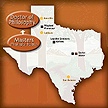
Click for larger versions of these maps showing Texas Baptist education ministries.

Texas offers theology students
multiple-choice answers

By Ken Camp

Managing Editor

Thirty years ago, when a Texas Baptist minister spoke of going to “the seminary,” nearly everyone assumed he would load a moving van and head for Fort Worth.

Today, a Texas Baptist who feels God's calling to ministry might just as likely move to Waco, Abilene or San Antonio–or stay in the community where he or she already is serving a church.

Obviously, some ministerial students choose to leave the state to study at one of the five Southern Baptist Convention-supported seminaries outside Texas, at one of the new Baptist divinity schools created in recent years or at a non-Baptist seminary.

Others stay in Texas but attend non-Baptist schools ranging from the conservative Dallas Theological Seminary to more liberal mainline schools like Brite Divinity School at Texas Christian University or Perkins School of Theology at Southern Methodist University.

Add to the mix the SBC-supported Southwestern Baptist Theological Seminary in Fort Worth–the oldest and largest Baptist seminary in Texas–and the new B.H. Carroll Theological Institute.

But even for students who remain in Texas and want to attend a school related to the Baptist General Convention of Texas, the menu of options has grown so complex the BGCT printed a “theological education locator” as a navigational tool. The roadmap guides potential students through their choices, from certificate of ministry courses to advanced graduate studies.

Options at BGCT-related schools

The BGCT Theological Education Committee, created by the convention seven years ago, has worked with BGCT-related institutions to develop multiple options for students at various educational levels and in diverse locations, said Royce Rose, BGCT director of theological education.

“The committee, made up of Baptist ministers and laypersons from around the state and representatives from each of the 11 theological education programs at the universities, has focused its attention on making quality, biblically based, historically Baptist training available to every minister in Texas at whatever level of study they need,” Rose said.

Baptist University of the Americas in San Antonio provides special developmental programs for students with limited English skills, as well as a program that allows students to earn a high school equivalency diploma.

Howard Payne University in Brownwood, East Texas Baptist University in Marshall and the University of Mary Hardin-Baylor in Belton offer 18 one-hour ministry courses leading to a certificate in ministry. The courses are available at the schools' main campuses and at off-campus centers. Students who want to continue their education can transfer those credits toward an associate or bachelor's degree.

Wayland Baptist University in Plainview, Dallas Baptist University, Howard Payne University and East Texas State University offer 64-hour associate degrees, and those credits can be applied toward the 128 hours required for a bachelor's degree.

Those four schools–along with Baylor University in Waco, Hardin-Simmons University in Abilene, Houston Baptist University, the University of Mary Hardin-Baylor and Baptist University of the Americas–offer bachelor's degree programs designed specifically for students preparing for ministry.

At the graduate level, Dallas Baptist University, Houston Baptist University, Hardin-Simmons University's Logsdon School of Theology and Wayland Baptist University offer master's degrees in ministry studies. Wayland provides graduate-level studies in ministry at sites in Lubbock, Amarillo and San Antonio, as well as in Plainview.

Logsdon and Baylor's Truett Theological Seminary offer master of divinity degrees, as well as other related graduate degrees through the universities of which they are a part. Truett also offers the doctor of ministry degree.

Distinctive purposes, niches

The two seminaries related to BGCT-affiliated universities–Truett and Logsdon–each has its own carefully defined purpose and distinctive niche.

“Our mission is to be the premier Baptist seminary of the world,” said Truett Seminary Dean Paul Powell. “We want to train the emerging generation of ministers. We're not in competition with anybody else. We know who we are and what we're capable of becoming.”

With 400 students and 15 full-time faculty already, Powell is convinced Truett is poised for growth.

Logsdon School of Theology, on the other hand, expects to enroll no more than 115 students this fall, including remote sites–at Lubbock in a cooperative venture with Wayland Baptist University and at Corpus Christi in cooperation with the South Texas School of Christian Studies.

Having a student enrollment that barely tops triple digits is fine with Logsdon Dean Tommy Brisco, who says some students choose Logsdon because it offers a level of individualized instruction not possible at some larger schools.

“Dialogue and interaction at the graduate theological level is crucial. We don't want to get 25 or 30 people in a classroom,” he said. No classes are larger than 15 students, and Logsdon will offer a class with as few as five students.

“We believe with the size we are, it's easier to do spiritual formation,” Brisco added. “Chapel experiences are really family experiences. We're still at a size where students can dialogue around the lunch tables with speakers.”

Both Logsdon and Truett emphasize the importance of mentoring programs, but they define the terms differently.

At Logsdon, each incoming student is assigned to a professor who works with the student on spiritual formation, academic advancement and professional development, both inside and outside the classroom.

“It's an ongoing process of spiritual and intellectual formation,” Brisco said.

Likewise at Truett, professors are expected to work individually with students, but each student's mentor is a practitioner in a local church.

“Each student spends one full semester under the tutelage of an experienced minister on the church field,” Powell said.

As opposed to the field experience requirements in some schools that provide limited interaction with experienced ministers and a narrow field of experiences for student ministers, Truett has made efforts to “put teeth into” its mentoring program, he said.

“Each student must do everything a pastor does at least once,” such as officiate at a wedding, conduct a funeral, baptize someone and lead the church in observing the Lord's Supper, he explained. Then students must put together a notebook on their experiences.

“The student comes out of the experience with the equivalent of a homemade pastor's manual,” Powell said.

Leaders of Logsdon and Truett agree each of their schools benefits from being related to a liberal arts university.

“We do allow–and even encourage–students to take advantage of courses outside the Logsdon seminary curriculum,” Brisco said.

In addition to taking classes at Hardin-Simmons in subjects ranging from business administration to psychology, students also can “double-dip” by attending conferences and guest lecture series offered by either the school of theology or the university, Brisco added.

Powell echoed the same view about his school, saying, “One of the advantages of Truett is the cross-pollination that takes place and the students' ability to take courses in other disciplines.”

Truett Seminary offers courses in worship and Christian education, and students can take concentrations in a variety of disciplines, but the seminary offers only two degrees–the master of divinity and the doctor of ministry.

“We want them to have a good knowledge of the Scriptures. Ministers of education and ministers of music ought to have a good theological background,” Powell said.

Students who want the academic preparation leading to a doctor of philosophy degree are referred to the Baylor University religion department. Truett has its own faculty separate from the university's religion department.

Logsdon, on the other hand, is the religion department at Hardin-Simmons University. Logsdon offers both a master of divinity degree and a master of arts in religion, as well as a master of arts in family ministry in cooperation with the university's psychology and counseling department.

Clear mission, clear choice

Southwestern Seminary in Fort Worth offers advanced degree programs in Christian education and church music and training opportunities for laity through its leadership development center. But President Paige Patterson is convinced the school must place greatest emphasis on what he believes is its founding mission.

“The major responsibility for Southwestern Seminary continues to be the training of the next generation of pastors, missionaries and evangelists,” he said.

The numbers reflect that commitment. Of nearly 3,000 students enrolled in Southwestern Seminary last spring, more than half–1,772–were in programs in the School of Theology. Another 879 were in the School of Educational Ministries and 134 in the School of Church Music, with the remainder in lay studies and certificate programs.

Students select Southwestern Seminary in part because of its “great heritage,” but primarily because they want a school with high academic standards and an evangelistic, missionary zeal, Patterson said.

Earlier this year, the seminary's board of trustees voted to approve a School of Evangelism and Missions, and Patterson hopes to see it launched by the fall 2005 semester.

“This is a school that is returning to its roots in terms of its strong emphasis on every student being involved in personal witness and as a missionary,” he said.

“We are working toward having every student on a Third World mission field sometime while he or she is here. My preference would be that they have to sleep in hammocks, fight off cobras and tarantulas, and eat rice three times a day. I want them to be out of their comfort zone. I want them to be in a situation where their prayer life alone sustains them, and where they see God doing the impossible.”

Unlike BGCT-related schools such as Truett and Logsdon, professors at Southwestern Seminary must sign a statement affirming the 2000 Baptist Faith & Message.

The SBC confession restricts the pastor's role to men, calls on wives to be submissive to their husbands and deletes a reference declaring Jesus Christ to be the criterion for biblical interpretation.

“A Baptist school ought to advocate Baptist positions,” Patterson said.

Women in ministry

Southwestern and the BGCT-related theological education schools clearly part company on the matter of training women for teaching and preaching roles.

“The Scriptures are crystal clear about it. In the church of God, a woman is not to be placed in a teaching or ruling position over men,” Patterson said.

Women are eligible for admission in any degree program at Southwestern Seminary, “contrary to the popular conventional wisdom out there,” he said. Only faculty–not students–are required to sign a confession of faith, and students may hold positions contrary to the 2000 Baptist Faith & Message.

But if a woman believes she is called to be pastor, she should come to class fully aware she will hear a different view advanced by the professor, he said.

“We believe there are biblical positions that have to be advocated,” he said. “And, of course, we have very different convictions on the gender roles, and she would have to be prepared to hear that. We believe all views ought to be taught, and some views ought to be advocated.

“She would read the womanist theologians here, but then we're also going to show her why that dog won't hunt and also give her a thorough evangelical alternative. So she'd have to be prepared to live with that.”

In contrast to the “touchy-feely shallow stuff” taught in many women's conferences, Patterson wants to see women trained at Southwestern as biblically grounded teachers of women.

He believes the New Testament restricts women from teaching men in church, but that does not necessarily extend to other settings, such as the seminary classroom.

“I would say it would be rather inconsistent, however, of a theological institution like ours to view that a woman should not be pastor of a church, and then put her in a teaching role where she's teaching systematic theology or preaching or pastoral ministries or something of that nature,” he said.

“So that won't happen here. There are certain areas of the faculty that will be men only.

“We can't dictate to them, but we counsel women to give themselves to the teaching of women,” he said, noting his wife, Dorothy, is on the theology faculty but exclusively teaches women.

In contrast, Truett and Logsdon place no restrictions on women preparing for ministerial roles.

“The Lord brings to us whomever he wills,” Powell said. “It's the church's job to call people to staff positions. We're not trying to tell God or the churches what to do. We take the ones God sends us and those whom the churches recommend.”

Baptist congregational church polity demands that seminaries respect the judgment of churches, Brisco added.

“We assume churches are capable of recognizing gifts and calling, and we take their recommendations at face value,” he said. “That's the genius of Baptist polity. God calls. Churches affirm. Seminaries equip. I can't think of a more Baptist way to do it.”

Launching new initiatives

Truett, Logsdon and Southwestern seminaries all have plans for new initiatives in the not-too-distant future.

Truett Seminary offers four pastors' conferences each year as continuing education opportunities for ministers–a general-interest preaching conference and specialized conferences for Hispanic, African-American and bivocational pastors. And the seminary will offer two unusual courses during its abbreviated January term, between the fall and spring semesters.

“One is a course in entrepreneurial leadership and general business,” Powell said.

“It's designed to help pastors become good leaders by teaching them business practices such as how to read spreadsheets, learning about liability insurance and learning something about real estate. It will be taught by people from the business world who have firsthand experience.

“Another course is on the art of persuasion–taught by a trial lawyer and a preaching professor. The purpose is the same, whether you're a trial lawyer or a preacher. It is to win a verdict, not just to convey information.”

Truett also is exploring the possibility of online courses and certificate-level classes in the Dallas area and the Rio Grande Valley.

Logsdon School of Theology already offers classes in Lubbock and Corpus Christi and is exploring the possibility of expanding to El Paso, Brisco said.

Logsdon also cooperates with Texas State Technical College to provide theological instruction for students in its missionary aviation program.

Brisco said he hopes to explore educational opportunities for military personnel stationed at Dyess Air Force Base.

Southwestern Seminary will launch an undergraduate college–“no later than the fall of next year,” Patterson said.

“We're not trying to be a general liberal arts institution. … As we understand our assignment (from the SBC), it has to do with the churches. Whatever we do, even at the college level, has to be with regard to people who plan to give their lives to the ministry of the churches.”

The college will offer a biblical studies major and a “great books” intensive reading program for students who major in the history of Western ideas, he explained, insisting the college is not in competition with Dallas Baptist University, Criswell College or any other undergraduate school in the area.

“We wish them all well as long as they are in the service of the King,” he said.

As far as other innovations are concerned, Patterson categorized as “absurd” rumors that Southwestern Seminary plans to segregate classes male and female, institute a rigid dress code for students, or do away with the ethics or church history programs at the seminary.

“It's difficult for me to believe those rumors are not malicious,” he said.

Southwestern will continue to adjust to changing realities–such as offering master of divinity courses in Spanish and taking steps to make the faculty more ethnically diverse.

The seminary will be “a servant institution” for Texas churches affiliated with either the BGCT or the Southern Baptists of Texas Convention, Patterson said.

And it will continue to play an important role in preparing ministers for those churches–no matter now much some people point to changes in church life, he insisted.

“My persuasion would be that things have not changed as much as people think they have. I do not see any time in the foreseeable future when our churches will not need pastors who have availed themselves of theological training.”

News of religion, faith, missions, Bible study and Christian ministry among Texas Baptist churches, in the BGCT, the Southern Baptist Convention ( SBC ) and around the world.


B.H. Carroll Institute takes ‘back-to-the-future’ approach to theological education_90604

Posted: 9/03/04

B.H. Carroll Institute takes 'back-to-the-future'
approach to theological education

By Ken Camp

Managing Editor

ARLINGTON–Leaders of the B.H. Carroll Institute see their institution as filling a distinctive niche in seminary education.

“Our distinctive is formation for ministry within the context of the local church,” said Carroll Institute President Bruce Corley. “It's a seminary without walls. Students do not come to us. We go to them.”

But that doesn't mean the institute is an online school or correspondence school, he added.

“The heart of the structure is a nexus of teaching churches,” he explained. Currently, the institute has seven teaching churches in the Houston, Dallas/Fort Worth, Bryan/College Station and San Antonio areas, and its leaders plan to add another five soon.

“The teaching church provides the opportunity for face-to-face classroom instruction. It's a mix … of intensive interpersonal instruction with online support,” Corley said.

In some respects, the institute offers a “back-to-the-future model” of theological education, he added.

“In the late 19th and early 20th centuries, theological education was initiated by pastors among their protégées,” Corley said.

The institute believes it can bridge the “widening gap between the seminary campus and the local church” through its teaching church approach, he added. Residential seminary campuses try–not always successfully–to recreate the sense of community and fellowship that already exists in local churches and that is essential for spiritual formation, Corley said.

“Spiritual formation should be done in the congregation,” he said. “We've embedded education in the ongoing life of the church. We've never believed you could do formation for ministry online. But neither do we believe it can be done effectively in a seminary by a professor who has been out of day-to-day church life for five years or more.”

The institute capitalizes on a wealth of untapped resources, Corley observed, saying 60 percent of church facilities go unused most of the time during the week, and half of the qualified theological educators are not teaching.

Online resources supplement the instruction provided by pastors and other ministers in teaching churches.

“We are building the best theological e-library in the world,” Corley said. Eventually, the institute will make available tens of thousands of digitized theological reference works on the Internet.

But the institute has no plans to build a residential campus, he added.

“We are targeting people who will not relocate to a residential campus and dislocate their families–people who want to stay on the job and learn to minister through those jobs in the context of the community where they are,” he said.

News of religion, faith, missions, Bible study and Christian ministry among Texas Baptist churches, in the BGCT, the Southern Baptist Convention ( SBC ) and around the world.


Two Hardin-Simmons staff go from marketplace to campus_90604

Posted: 9/03/04

Leland Harden (left), director of communications at Hardin-Simmons University in Abilene, visits with Forrest McMillan, dean of students, as they walk across campus. Harden came to the HSU staff after 20 years as an entrepreneur in the tech field. (Ferrell Foster Photos)

Two Hardin-Simmons staff go from marketplace to campus

By Ferrell Foster

Texas Baptist Communications

ABILENE–Thousands of students graduate each year from Texas Baptist universities. Years later, some of them come back.

Jimmie Monhollon and Leland Harden are two such graduates. After years in the marketplace–one in the world of high-level federal economic policy and one in the realm of high-tech entrepreneurship–both followed God's “call” to return.

Hardin-Simmons University in Abilene got them both.

Harden, the entrepreneur, came back to his alma mater. Monhollon, the economist, came back to Baptist academia a little further down the road from his alma mater, Wayland Baptist University in Plainview.

Their stories are similar, yet different.

Harden, 41, returned to Hardin-Simmons this year after a 20-year sojourn to Manhattan and San Francisco. Monhollon, 71, came to Abilene in 1995 after almost 40 years in places such as Richmond, Va., Charlotte, N.C., and Baltimore, Md.

Monhollon is teaching business and economics to a new generation of achievers. Harden is helping the university develop an integrated marketing strategy.

During the past 20 years, Harden helped start several companies, including Media Link, Cybernautics, Giftcertificates.com and New Canoe.

“I started companies, went after my dream,” he said.

But his first start-up happened in his hometown of Abilene. While a student at Hardin-Simmons, Harden began a lawn-mowing company and hired his friends. At one point, he was supervising five crews and was clearing $4,000 a month. After graduation and the demise of the lawn mowing company, his income actually declined.

Entrepreneurs are “never seeing difficulty, but always seeing opportunity,” he said.

“That's what entrepreneurs instinctively do.”

That same spirit of entrepreneurship led Harden to write three books about marketing using leading-edge technologies, including a business bestseller, “New Results: Web Marketing that Works.”

He saw a new opportunity earlier this year while back in Abilene to receive Hardin-Simmons' Outstanding Young Alumni Award. He felt God calling him to return to Abilene to help his alma mater develop an integrated marketing strategy to “get the message about Hardin-Simmons out.”

Harden believes all of his experiences in business have prepared him for what he's doing now. His wife, Elise, helped him see in Psalm 23 how God had been at work. Harden now looks on the past 20 years as “God leading me in round-about paths to get me at the right place.”

Jimmie Monhollon teaches a business class at Hardin-Simmons University in Abilene. He came to the university after a career as a research economist in the Federal Reserve banking system.

After four months on the job, Harden calls his work at Hardin-Simmons “the most rewarding experience in my life. … I've done well before. Now I have the opportunity to change lives.”

Monhollon did well in the business world, as well. He didn't plan on a career in the Federal Reserve System; he planned to teach.

After graduating from Wayland, Monhollon earned an interdisciplinary master's degree from the University of Wyoming, and he became enthralled with economics. That led to a doctorate in economics from Vanderbilt University.

“My intention was to go into academic life, preferably at a Baptist school,” Monhollon said. But he “couldn't find exactly the school I wanted.”

A friend suggested he spend a “couple of years” as a researcher in the Federal Reserve system. He followed that advice, but a couple of years stretched into 34 years, minus a one-year stint teaching at the University of Illinois.

As a research economist, he helped “formulate and execute monetary policy” for the nation.

Eventually, he moved into management as senior vice president in charge of operations at the Fed's Charlotte branch and then to the same position in Baltimore. Then, in 1980, Monhollon became first vice president and chief of operations for the Federal Reserve Bank in Richmond, one of 12 scattered across the country.

His retirement from the Fed in 1995 finally led to Monhollon doing what he planned 35 years earlier.

Dick Maples, a “college buddy” and longtime Texas Baptist leader, connected Monhollon with Craig Turner, then academic dean at Hardin-Simmons and now president.

Monhollon loved what he saw at the university and, in the fall of 1995, became a professor of economics and finance. He became dean of the business school in 1999, a job his son, Michael, took over about a year and a half ago.

The senior Monhollon, however, stayed in the classroom teaching.

He has two objectives with his students. First, he teaches, “you've really got to be competent.” Second, he seeks to convey the importance of a “sense of calling.”

“You can be called to the business world as well as to being pastor of a church,” Monhollon said. “There's a real opportunity for Christians in the workplace.”

Both Monhollon and Harden have illustrated that understanding. Now both are trying to help a new generation of students prepare for the workplace.

News of religion, faith, missions, Bible study and Christian ministry among Texas Baptist churches, in the BGCT, the Southern Baptist Convention ( SBC ) and around the world.


Williams resigns as Baptist Laity Institute head; program’s future ‘up in the air’_90604

Posted: 9/03/04

Williams resigns as Baptist Laity Institute
head; program's future 'up in the air'

By Ferrell Foster

Texas Baptist Communications

DALLAS–After five years at the helm of the Baptist Laity Institute, Dan Williams has resigned as president.

Williams, 51, announced his resignation during the institute's August board meeting. It is effective Sept. 30.

The institute began in 1999. At that time, it needed someone with an “entrepreneurial spirit” to move it from the idea stage to an active, “charging forward” ministry, Williams said.

Dan Williams

Now the institute is ready to move into another phase with a leader more attuned to management, he explained.

Five years ago, there was no advanced theological education designed specifically for Texas Baptist laypeople.

The Baptist General Convention of Texas responded by creating the Baptist Laity Institute and hiring Williams as president.

Williams “started with nothing” and developed the institute into what it is today, said John Cash Smith, chairman of the institute's board and a member of First Baptist Church in Orange. The institute has created curriculum for nine courses that can be taught throughout the state by trained “mentors.”

“These courses are like an advanced college or graduate school seminar,” Smith said.

Now that the institute is established with curriculum and a course structure, it needs to enter a new phase, Smith said.

The Baptist Laity Institute needs a leader to “market it and develop money,” and Williams and the board “recognized we are in a different situation,” he explained.

“It was a very emotional thing when (Williams) announced his resignation,” Smith added. “Everyone deeply appreciates what he has done.”

As for the institute's future, Smith said: “It's very, very up in the air. I'm sure it's going to continue. I'm not sure in exactly what form.”

More than $1 million has been invested in the institute, and the number of classes doubled this year, he added.

BGCT Executive Director Charles Wade praised Williams' passion for developing lay leaders.

“Texas Baptists owe a debt of gratitude to Dan Williams for his pioneering effort to establish advanced theological education for our local churches,” Wade said.

Keith Bruce, coordinator of BGCT institutional ministries, said Williams “led in crafting the organizational structure, developing the basic curriculum and implementing the initial program and course offerings” of the institute.

“There has been consistent growth in the number of people participating in … programs and many individual testimonies of how this process has positively impacted the lives of participants,” Bruce said.

In the five years of Williams' leadership, the institute grew into a statewide theological education effort that this year will offer more than 50 classes with more than 400 people enrolled. Class size is limited to 12 students.

The institute “raises the level of expectation for learning and ministry involvement for lay people,” Williams said.

The institute's annual operating budget is $305,000. Two-thirds of that amount comes from funds allocated by the BGCT Administrative Committee, and the remainder is from individual donors and foundations.

“I'm so excited” about the institute, Williams said. “I've seen the transformation in churches and individual lay members. I've seen an amazing transformation in staff members when they see their lay members turned on and turned loose to minister.”

Linda Cross, vice president of the institute, will “carry on the work during the coming months of transition,” said Royce Rose, director of the BGCT theological education office.

“A record number of classes are scheduled for this semester in 21 locations in Texas and other states.”

Williams has no specific plans for the future.

“My wife (Anita) and I felt it was time for a change in vocational direction but still feel very committed to and called to local-church enhancement,” he said.

They are members of First Baptist Church in Richardson, a suburb of Dallas.

Rose encouraged churches interested in offering laity institute classes to call the laity institute for more information.

The web site is www.tblaity.org, and the phone number is (214) 820-3935.

News of religion, faith, missions, Bible study and Christian ministry among Texas Baptist churches, in the BGCT, the Southern Baptist Convention ( SBC ) and around the world.


Houston-based online program offers theology classes for church planters_90604

Posted: 9/03/04

Houston-based online program offers
theology classes for church planters

By John Hall

Texas Baptist Communications

HOUSTON–Church planters worldwide will no longer have to leave their calling temporarily to receive specialized theological training, thanks to SemiNEXT, an online educational program being developed by Houston-area Baptist leaders.

This fall, organizers are unveiling the initial courses connected to SemiNEXT, which can be accessed at www.seminext.com.

The offerings include Old and New Testament as well as a theology class.

The courses are tailored to meet the needs of church planters who have other jobs but would like some theological training to strengthen their ministries, said Alan Brehm, SemiNEXT executive director.

Each class consists of five units made up of six web pages apiece, and students can work at their own pace.

Participants will be able to dialogue through online communication such as e-mail and discussion rooms. Courses eventually build to a certificate, but no seminary credit is given.

SemiNEXT is the latest example of a changing paradigm in higher education, where organizations take courses to students rather than waiting for young people to step on campuses, organizers of the program note. Secular and religious groups are creating online programs to serve target audiences.

The goal for SemiNEXT is to provide sound training and improve ministries through conversations, Brehm said.

“We're not a seminary,” Brehm said.

“We're targeting people who already have degrees and perhaps even careers, so a seminary degree isn't really that important to them. We're a virtual learning community that intends to meet face-to-face as well.”

Organizers already have developed partnerships with the Baptist General Convention of Texas and Union Baptist Association and are looking to start relationships with groups that work with younger generations of ministers.

The program has gained some recognition from believers worldwide because it is the latest development of Leader's Edge, a Union Baptist Association effort to support church planters that started in the mid-1990s. Church planters in Texas, the United States and several countries around the world have contacted Brehm.

“Many people want a high-quality accelerated theological education but are at a place in life where traditional seminary is impractical or unavailable,” said Robert Creech, pastor of University Baptist Church in Houston and one of the founders of Leader's Edge.

“After a branch of the postmodern seminary opened in Austin, I began to dream beyond simply duplicating groups of teachers and curriculum.

“What if we could create a web site that would facilitate an online community where discussion and learning could take place?”

News of religion, faith, missions, Bible study and Christian ministry among Texas Baptist churches, in the BGCT, the Southern Baptist Convention ( SBC ) and around the world.


Baptist University of the Americas holds strategic role, president maintains_90604

Posted: 9/03/04

Baptist University of the Americas holds
strategic role, president maintains

By Ken Camp

Managing Editor

SAN ANTONIO–Baptist University of the Americas leaders believe God has a strategic role for their institution in a state where Anglos no longer claim majority status.

“Our mission is the formation, from the Hispanic context, of cross-cultural Christian leaders, both male and female,” said Baptist University of the Americas President Albert Reyes, noting 40 percent of the student body is female.

“The Hispanic context is the point of departure for us,” Reyes continued.

Albert Reyes

“We ask of everything, 'How does this take on incarnational value in a Hispanic context?' And Anglos, African Americans and others increasingly are attracted to that because they want to know how to relate in the changing demographic reality, in light of population trends.”

Baptist University of the Americas equips students to cross cultures–a mandatory requirement for Great Commission Christians in the 21st century, Reyes insisted.

“We are preparing cross-cultural Christian leaders to share the presence of Christ,” he said.

Baptist University of the Americas offers an intensive English language program for students who lack English skills, a college-preparatory curriculum for students who are need help academically before entering a bachelor's degree program, and even a high school equivalency program for students who need to earn a GED.

“We say: 'If God is calling you to ministry, then we are going to open every pathway we can for you. If God calls you, our answer is yes,'” Reyes said.

While the school is “not driven by ACT, SAT or any other test scores,” he noted Baptist University is attracting a growing number of students “who could enter any of our universities and excel. But they are drawn to BUA by the uniqueness of our context–our focus on cross-cultural ministry and mission.”

Baptist University of the Americas' student body includes representatives of 15 countries, including nine Latin American nations.

"We're becoming a place where people from the Third World find they have a real affinity with us," Reyes explained. "It's a non-Western perspective–not exclusively Hispanic, but consistent with Third World culture."

Baptist University of the Americas offers a bachelor of arts in biblical theological studies and is accredited by the Association of Biblical Higher Education.

“We consider ourselves a theological university, not a liberal arts university or a seminary. That is something new in higher education,” Reyes explained.

“I do not see us becoming a liberal arts university,” he continued.

“I do see us enlarging our course offerings to equip students in multiple ways for vocational ministry.”

News of religion, faith, missions, Bible study and Christian ministry among Texas Baptist churches, in the BGCT, the Southern Baptist Convention ( SBC ) and around the world.


BGCT, Richmond seminary offer online classes for ministers of small churches_90604

Posted: 9/03/04

BGCT, Richmond seminary offer online
classes for ministers of small churches

By John Hall

Texas Baptist Communications

BELTON–The Baptist Theological Seminary at Richmond is partnering with the Baptist General Convention of Texas bivocational/smaller membership church development office to offer specialized online classes tailored for ministers of small churches.

This fall, the seminary will offer courses on the biblical foundation for bivocational ministry, an introduction to team building and leadership, as well as social dynamics in ministry as the initial classes in a certificate program. Experienced Texas Baptist bivocational ministers will facilitate each online course.

Kim Siegenthaler, program coordinator for the seminary's school of Christian ministry, said the classes are an effort to meet small-church ministers' desire for theological education without giving up their pastorates.

The program allows ministers to become better equipped for God-given tasks at their own pace, Siegenthaler added. Students can work around their schedule in doing homework and studying.

Bob Ray, director of BGCT bivocational/smaller church development, said the courses will be contextualized to Texas bivocational ministry as the teachers draw on their years of bivocational experience.

The partnership is the latest cooperative effort between the seminary and Texas Baptists. The school also is working with the Baptist University of the Americas to produce an online Hispanic certificate program and with the Texas Baptist Laity Institute to develop online courses designed to equip laypeople.

All three programs are part of the seminary's vision of taking training to congregations, not relying on churches to send members and leaders to the school, Siegenthaler said.

For more information, visit www.btsr.edu.

News of religion, faith, missions, Bible study and Christian ministry among Texas Baptist churches, in the BGCT, the Southern Baptist Convention ( SBC ) and around the world.


San Marcos Baptist Academy makes major changes this year_90604

Posted: 9/03/04

Cren Naivar (right) helps student Eric Quintanilla prepare “Scooter” for a show as part of the animal husbandry program at San Marcos Baptist Academy.Ferrell Foster

San Marcos Baptist Academy makes major changes this year

By Ferrell Foster

Texas Baptist Communications

SAN MARCOS–Students and faculty alike describe San Marcos Baptist Academy as a family–nurturing, supportive, caring and helpful.

Despite the warm feelings, enrollment at the residential secondary school has declined in recent years. So the academy called in an outside consultant to evaluate its program.

As a result, the 97-year-old school made changes this semester.

bluebull The military program is no longer mandatory for boys.

bluebull A program to help students with “learning differences” has been expanded.

bluebull The academy's advisory program has been enlarged to include all full-time employees working with assigned students on an almost daily basis.

San Marcos Baptist Academy has 206 students in grades six through 12–three-fourths living in campus dormitories and the rest being "day students." The school is supported through the Baptist General Convention of Texas' Cooperative Program.

For years, many people viewed the academy as a military school, said Vic Schmidt, president since 2001.

“We didn't see ourselves as a military school,” but others perceived it that way, he said.

“I've seen it always as a Christian school” with three programs–academic, military and athletic, said Byron Robinson, who has taught 37 years at the academy.

With this year's changes, the academy still has a Junior ROTC military program. Boys must be in the program at least one semester, but girls are not required to be involved.

One of the visible changes on campus is how the students dress. Military-style uniforms have given way to polo shirts with khaki pants or plaid skirts.

A less visible change related to the military is seen in the boys' dorm. It no longer functions as a military residence hall with ranking upperclassmen having special duties. The boys' housing is organized by halls with dorm directors and resident assistants, just like the girls' dorm.

The change in approach regarding the military has been difficult to swallow for some alumni and long-time supporters, Schmidt said.

He hopes they will understand the change was not based on a “whim” but on information derived from the independent study and on the need to increase enrollment.

Leadership training, a major component of Junior ROTC, will continue to be stressed with all students, Schmidt said.

The corps of cadets at the school numbers about 80, he added.

Kameron Allison, a junior day student from San Marcos, said he likes the Junior ROTC change, because the new uniforms “feel more casual.”

Garrett Day, a senior resident student from Sugar Land and a Junior ROTC battalion commander, preferred the old military approach but said the new way “benefits others,” so he understands the need for the change.

While San Marcos Academy turns away from some its past identity, it has its sights set firmly on becoming known for something else–its learning skills program.

Children learn in different ways, said Margo McClintock, director of the program.

The academy helps students determine their preferred learning styles and then fashions programs that help them learn.

For instance, analytic learners do best with details and sequential information, while global learners want “the big picture” and react quickly. Traditional classroom teaching favors analytic learners, McClintock said.

That's just one example of different learning styles.

The academy's learning skills program seeks to help students who struggle with the limitations of traditional teaching.

It already had been a part of the academy's academic approach, but this year the school added two more staff members, Tom and Keri Rhodes, to work with McClintock.

The academy also provided extra training on learning styles for all its teachers prior to the start of classes, Schmidt said.

McClintock said students will give an “amazingly different kind of response” to testing when learning styles are understood and appropriate help is given.

Thirty-two of the academy's 206 students are in the learning skills program this fall, including honor students.

Jojetta Steptoe, a senior from Houston, is one student who benefited from the precursor to the learning skills program when she came to the academy two years ago.

“My grades are a lot better, and I got more help than I was getting in other schools,” she said.

Another new effort, the school's advisory program, is one of special interest to President Schmidt. Every full-time employee is involved, he said. “Student advising is just as important as the primary job” of an employee.

Advising involves being with students during devotional times and chapel services, visiting them in their dorm and contacting parents to keep them informed of their child's progress or needs.

The connection between students and adults showed up in comments from several students.

“Everybody cares about you a lot,” said Adelita Ayala, a junior resident student from Tabasco, Mexico. The teachers “all know who you are and what kind of person you are.”

Eighth grader Rachel Blewett, from Kingsbury, boiled everything down to its simplest. The academy is “really cool,” she said. “The teachers are really nice, everybody's nice. … It's really fun.”

While the academy has gone through some tough times, including running “deficits the past few years,” it still is debt- free, Schmidt said.

“We are working for a zero-loss budget,” he said.

The academy needs about 20 more students this year to reach that level, and enrollment remains open and more students are expected.

The need to grow enrollment motivated this school year's changes, but there are deeper motivations, as well.

The academy is a ministry, Schmidt said. “We're helping a lot of kids, both Christian and non-Christian. … You don't have to be here long” before the ministry aspect becomes apparent.

Schmidt remembered the words of a long-time academy employee, the late Katherine Schultz. The president quoted her, saying: “When you first come to the academy, it can sometimes get under your skin. But if you stay here for any length of time, it will get embedded in your heart.”

News of religion, faith, missions, Bible study and Christian ministry among Texas Baptist churches, in the BGCT, the Southern Baptist Convention ( SBC ) and around the world.


Academy staff see themselves as missionaries_90604

Posted: 9/03/04

Academy staff see themselves as missionaries

By Ferrell Foster

Texas Baptist Communications

SAN MARCOS–Devon Banta gets paid to be a teacher, but she also sees herself as a missionary.

Banta recently started her second year of teaching at San Marcos Baptist Academy, a residential secondary school supported through the Baptist General Convention of Texas' Cooperative Program.

When she came to the school, she thought she was just coming to teach. After getting settled in, she changed her mind.

Devon Banta, a teacher at San Marcos Baptist Academy, helps a student understand an assignment. (Ferrell Foster Photo)

“We are missionaries,” Banta said, referring to teachers and other workers at the school.

Since many of the students are not Christians or don't come from Christian homes, the academy becomes a flesh-and-blood Christian testament, especially for international students, faculty members noted.

“Sharing God's love and our Christian commitment is one of the main reasons we're here,” explained Margo McClintock, director of the academy's learning skills program.

Byron Robinson, a teacher at the academy for 37 years, said it's important that academy students understand the Christian concepts being taught along with the academic lessons.

“It's a treasure that you can give to the kids that they would not receive otherwise,” he said. And it provides “inner strength and inner hope” a student might not have otherwise.

“This is not a school to me,” Robinson said. “It's a community, a family. … The students I teach become like my own children, grandchildren.”

Banta says it simply: “I love my students.” Because of that love, she spends “a lot of time with my kids.”

Academy President Vic Schmidt noted the faculty and staff serve as role models for the students.

“We live Christian lives, and our kids know that,” he said.

News of religion, faith, missions, Bible study and Christian ministry among Texas Baptist churches, in the BGCT, the Southern Baptist Convention ( SBC ) and around the world.


LifeWay Explore the Bible Series for Sept. 12: Make sure there is room for Christ in your life_90604

Posted: 9/03/04

LifeWay Explore the Bible Series for Sept. 12

Make sure there is room for Christ in your life

Luke 2:1-52

By Pakon Chan

Chinese Baptist Church, Arlington

The birth of Christ

The Israelites looked forward to the coming of the Messiah for hundreds of years. God had promised them a Savior, but they had no room for him when he was born.

Indeed, people need a Savior who can bring peace and hope to this world. Like the Israelites, they are so busy with so many things they never give any attention to Jesus' message. People still struggle for peace and hope.

The reason the message of the birth of the Messiah was brought to the shepherds was because of their simple life. They had room for it. Matthew's gospel tells us, “All this took place to fulfill what the Lord had said through the prophet: The virgin will be with child and will give birth to a son, and they will call him Immanuel–which means, God with us” (1:22-23).

study3

Jesus is the Son of God. He is God himself, incarnated to bring the good news of reconciliation to those who believe in him. Augustine is right, and people cannot find peace and joy unless they find God.

The root problem of all problems in this world is our estrangement from God, the Creator of all human races. This estrangement confuses our identity and image, so that we have problems knowing ourselves. This estrangement also twists our relationships with people, nature and the Creator, thus filling the world with conflicts and hatred.

Worst of all, these problems cannot be solved by our efforts alone. We need to be forgiven and to reconcile with God. Jesus is the message of forgiveness and reconciliation from God. This is the reason why the angel told the shepherds he had good news for them, and that good news would bring great joy to all people (2:10).

Good news for all people

We have entered into a new era where people talk almost about everything from a global perspective. We start to realize all people stand on the same earth and under the same heaven. However, when we come to the topics of faith and religions, tribal influence is still obvious. We are Chinese, so we do not need a western god, some say.

In the Bible, we learn from the first book that our God is the God of all people. God has called Abraham to be the father of all nations. God has a plan for all people. God wants to save all people through his son Jesus Christ. Simeon was a righteous and God-fearing man, and was waiting for a savior to save his people (2:25). But when he saw this child Jesus, he was touched by the Holy Spirit to proclaim that the salvation through Christ was for all people (2:31). This is the very motivation of the Great Commission to call Christians to preach the gospel to all nations.

Jesus not only is the Savior for Israelites and Americans, he is the Savior for all people regardless of culture and ethnicity. Through knowing and accepting Jesus, people will know the will of God (2:32).

Jesus also will restore the glory of his people Israel, for they were the first bearer of this good news (2:32). God has used this group of people as a medium to bring forth the Savior to all mankind. We should appreciate the Jews in this regard, but Jesus did not just come for the Jews. We thank God for the truth that we all can have hope and joy in Jesus.

His childhood

We thank all the gospel writers who gave us clear and accurate records of Jesus' life and work. Jesus Christ is not a mythical person. He had a human birth from the womb of a woman, even though his conception was divine and extraordinary. Jesus had his childhood. He lived about 30 years with his parents to fulfill his human responsibility as a son before the beginning of his ministry.

There are not many descriptions about his childhood and upbringing. This chapter in the Gospel of Luke gives a very vivid and important description, which serves as a summary and a remark of his childhood. Luke uses two similar phases to describe Jesus' childhood: “The child grew and became strong; he was full of wisdom, and God's blessings were upon him” (2:40); and “Jesus grew both in body and in wisdom, gaining favor with God and people” (2:52). Jesus lived a perfect life physically, mentally and spiritually; therefore, he is our Savior, and as a sacrifice accepted by God for our sins (Romans 3:25-26).

Jesus was in the temple

What does a 12 year old know about faith and religion? Jesus was just a 12-year-old child, but he had discussions with Jewish teachers and amazed them with his wisdom and intelligent answers (2:47). In Jesus' conversation, we find he was fully aware of his identity as the Son of God. He responded to his parents, and said: “Why did you have to look for me? Didn't you know that I had to be in my Father's house?” (2:49).

Twenty years later, he cleaned the temple with a whip and called the temple the “house of prayer” (19:45-46). The temple in Jesus' time was corrupted and had lost its spiritual function. Jesus came to rebuild the temple by replacing it with his own body so people can meet God in him through faith.

Discussion question

bluebull Does the knowledge of Jesus change your life?

bluebull What will you do if you realize that the good news is for all peoples?

News of religion, faith, missions, Bible study and Christian ministry among Texas Baptist churches, in the BGCT, the Southern Baptist Convention ( SBC ) and around the world.


LifeWay Explore the Bible Series for Sept. 19: Like John the Baptist, draw people to Jesus_90604

Posted: 9/03/04

LifeWay Explore the Bible Series for Sept. 19

Like John the Baptist, draw people to Jesus

Luke 3:1-38

By Pakon Chan

Chinese Baptist Church, Arlington

John the Baptist may be considered the greatest preacher because his preaching was so powerful it drew people to him. People “were waiting expectantly and were all wondering in their hearts if John might possibly be the Christ” (3:15).

John was ordained by the Lord in his mother's womb to be God's servant by preparing people's hearts before the coming of the Messiah (1:14-17). He not only preached repentance and prepared people's hearts, but also lived a unique lifestyle to prepare himself for his mission. He consecrated himself to live a life separated from the secular world (Matthew 3:4; Luke 1:15). His preaching was powerful because his life reflected his word.

Why is our preaching not heard and our witness without power? It is not because we do not have a powerful message. The message itself always is powerful, but our lifestyle does not reflect the word and preaching. If people do not observe a difference in a Christian's lifestyle, they will wonder why they should listen to his preaching. We need more preachers and Christians like John the Baptist to prepare themselves first, in order to prepare people's hearts for the Lord.

The warning

The preaching of John was very bold and blunt. He was by no means running a show to entertain the audience. He was “preaching a baptism of repentance for the forgiveness of sin” (3:3). When people were coming to receive his baptism, he condemned them: “You brood of vipers! Who warned you to flee from the coming wrath?” (3:7). He boldly pointed out their sins.

study3

The people of Israel thought their religion and tradition could save them. They told themselves that as long as they could keep the religious rituals and traditions, they were all right and deserved God's blessings. After all, they were the descendants of father Abraham.

John warned them against relying on Abrahamic descent. He reminded them, “Out of these stones God can raise up children for Abraham” (3:8). What is the use of religion if we do not commit our life to it? Why does God want to spare us if we have no heart in him and his commandments? “The ax is already at the root of the trees, and every tree that does not produce good fruit will be cut down and thrown into the fire” (3:9).

The fruit of repentance

A fruit tree is of no use if it cannot bear any fruit, and it does not matter how gorgeous it may look. A true repentance has to have observable effects in one's life and lifestyle. When people heard John's preaching and understood the seriousness of this message, they asked John: “What should we do then?” (3:10). John's answer was simple–live a life according to God's commandments. The core of God's commandments is to love God and people. When we love God and people, we will do our duties, be fair and care for others. We also will live in peace and be content with a life free from selfishness and envy.

God has already told us what to do when we repent: “To act justly and to love mercy and to walk humbly with your God” (Micah 6:8).

John's baptism versus Jesus' baptism

John clearly understood the baptism he preached was very different from the baptism Christ would give. John could only baptize people with water. The act of baptizing with water is only a ritual that signifies a person's repentance and their moral effort of doing good. Water has no power to transform a person's life. John's baptism was meaningful only if people repented with determination of observing the laws and bear good fruits.

Christ's baptism is very different from John's baptism, for Jesus would baptize people with the Holy Spirit and fire. This baptism was a life-giving act. The Spirit would give life to those who received it (John 6:63). Later, Paul expounded this baptism in the light of Jesus' death and resurrection, by telling us “we were therefore buried with him through baptism into death in order that, just as Christ was raised from the dead through the glory of the Father, we too may live a new life” (Romans 6:4).

The fire of this baptism symbolized the power of purification and judgment. Through this baptism people will be purified and claimed as righteous. This baptism also has served as a judgment to judge their faith in Christ (Malachi 3:2).

The same question was asked by people after they heard Peter's preaching: “'Brothers, what shall we do?' Peter replied, 'Repent and be baptized, every one of you, in the name of Jesus Christ for forgiveness of your sin. And you will receive the gift of the Holy Spirit'” (Acts 2:37-38). Baptism is the first fruit of repentance, and it is very meaningful if our repentance is genuine and our life bears good fruits.

Discussion question

bluebull Re-examine your baptism experience to see if it reflected your repentance.

bluebull Does your life witness your repentance?

News of religion, faith, missions, Bible study and Christian ministry among Texas Baptist churches, in the BGCT, the Southern Baptist Convention ( SBC ) and around the world.