Toothbrushes needed in Afghanistan_110104

Posted: 10/22/04

Toothbrushes needed in Afghanistan

By John Hall

Texas Baptist Communications

Baptists are sending toothbrushes and toothpaste to a Baptist General Convention of Texas-endorsed chaplain who will use the supplies to teach hygiene to Afghan children.

Army Chaplain Carron Naber has been working with young people in a Bagram, Afghanistan, school. She mentioned to Reba Gram in the BGCT Chaplaincy Relations Office that she needed at least 5,000 toothbrushes and tubes of toothpaste to teach the students in 16 villages. If she receives more, she would distribute them among the Afghans.

Gram quickly began spreading the word, and several hundred toothbrushes have been sent. BGCT Executive Board staff members donated nearly 200 toothbrushes by Oct. 14. A dentist donated almost 250 toothbrushes. Several Dallas-area churches have become involved.

Texas Baptists can collect and ship these items directly to Naber. Her mailing address is Carron A. Naber, 125TH Signal, APO AE 09354. Do not identify her as a chaplain on the package.

News of religion, faith, missions, Bible study and Christian ministry among Texas Baptist churches, in the BGCT, the Southern Baptist Convention ( SBC ) and around the world.


Around the State_101804

Posted: 10/15/04

First Church in Orange recently presented a check to provide tuition, fees and books for two students at the Baptist University of the Americas. Abraham Garcia of Sonora, Mexico, and Adriana Oviedo of Hutto were the recipients. Presenting the check to Arnie Adkison, vice president of development, were deacons and missions committee members Weldon Townsend, Preston Nichols and Don Ball. “Baptist University of the Americas is the most important learning institution in Texas as far as reaching the Hispanic community,” Townsend said. “If we don't train leaders and lay people now, we will miss the window of opportunity we have.”

Around the State

bluebull The Central Texas Book Club of the University of Mary Hardin-Baylor will discuss “The Idea of a Christian College” by Arthur Holmes at 7 p.m. in the Lucile Capt Amphitheater Oct. 26. Panelists will include Bill Tanner, associate professor of computer science; Steve Oldham, assistant professor for Christian studies; David Guess, assistant professor for music; and Harry Sweet, assistant professor for management and marketing.

bluebull Joe Alcorta, professor of Spanish and coordinator of minority relations at Hardin-Simmons University, has written “A Collection of Hispanic Proverbs and Sayings.” The 161-page paperback has 10 chapters on proverbs relating to love, business, good advice, spiritual matters, time, food, family and friends, money and other topics. He joined the faculty in 1971.

bluebull East Texas Baptist University Director of Development Larry Wickham has been awarded the professional designation of certified fund raising executive by CFRE International. Wickham, a bivocational pastor at Midway Church in Tyler, joined the university staff in 2002.

bluebull Dee McFarland has been promoted to general ledger manager in the controller's office of the Baptist General Convention of Texas. She had been general ledger accountant for the BGCT since 1997. She is a member of First Church in Kaufman.

Hardin-Simmons University's Richardson Library underwent a first-floor renovation recently. New floor tile was laid in the public part of the first floor, an original library typing room was remodeled into an office for the theology librarian; and the former Duffy Auditorium has been remodeled into the Duffy Theological Center. Shown before the theology bookshelves that now are housed on the first floor are (l-r) Alice Specht, dean of libraries; Teresa Ellis, theology librarian; Tommy Brisco, dean of the Logsdon School of Theology; and David Thompson, a student working on a master of divinity degree.

bluebull Houston Baptist University has announced new appointments to its faculty, including Lisette Barton, instructor in nursing; Valerie Bussell, assistant professor in psychology; Lawrence Clark, assistant professor in English; James Furr, associate professor of Christianity; Lorraine Killion, assistant professor of kinesiology; and Robert Linder, interim director of the School of Music.

bluebull David Brewer of First Church in Odessa and Harry Wooten of Royal Lane Church in Dallas were among the ministers of music honored with awards of distinction by the National Religious Music Week Alliance.

bluebull Abilene Association will hold its annual meeting at Elmcrest Church in Abilene Oct. 18. Broadview Church in Abilene will be recognized as church of the year. Pastor David Cason will accept a plaque honoring the congregation. Price Mathieson, pastor of Lawn Church in Lawn for 29 years, will be named pastor of the year. C.V. Blake, pastor of young adults, median adults and men's ministry at First Church in Abilene, will be honored as the staff member of the year. Juanita Reeder of South Side Church in Abilene will be named lay person of the year. The annual sermon will be brought by L.W. Hutchinson, pastor of Mount Sinai Church in Abilene.

Anniversaries

bluebull Whitecreek Church in George West, 25th, Sept. 26. Richard Mayberry is pastor.

bluebull Jeff Todd, 20th, as minister of music at Ovilla Road Church in Red Oak, Oct. 1.

bluebull Porfirio Bas, fifth, as pastor of Primera Iglesia in Lubbock, Oct. 1.

bluebull Kenneth Winchester, 25th, as pastor of Pleasant Valley Church in Post, Oct. 1.

bluebull Ivy Fendley, 10th, as minister of education at Mount Olive Church in Paris, Oct. 4.

bluebull First Shiloh Church in Williamson County, 150th, Oct. 9. Larry Givens is pastor.

bluebull First Church in Queen City, 125th, Oct. 16-17. Mike Lovely is pastor.

bluebull Ruben Perez, fifth, as pastor of Primera Iglesia in Slaton, Oct. 17.

bluebull Lino Castaneda, fifth, as pastor of New Jerusalem Mission in Sherman.

bluebull Benny Mayo, 40th in the ministry. While most of those years of service have been as minister of education and administration, he currently is minister of senior adults at Southwest Church in DeSoto.

Retiring

bluebull Dillard Wilbanks, as associate pastor/minister of education and program administration at Travis Avenue Church in Fort Worth, Sept. 5. He had served the Fort Worth church 10 years. He had previously served at First Church in Houston and First Church in Jonesboro, Ga.

bluebull Danny Cowart, as minister of education at Fairview Church in Sherman. He served the church 14 years. He previously served Woodland and Woodforest churches in Houston.

bluebull Bob Bade, as associate to the general secretary of the International Baptist Convention in Frankfurt, Germany. He previously served churches in Mississippi, Texas and Missouri as associate pastor, and in Darmstadt, Germany, as pastor. He has been in the ministry 35 years. He and his wife live in Burleson raising Haflinger horses. He is a part-time chaplain at Huguley Medical Center in Fort Worth.

Deaths

bluebull Eugene Shipley, 78, Aug. 16 in Fort Worth. He was a minister 50 years, 25 of those as pastor of Cedar Shores Church in Morgan. He was preceded in death by his son, Timothy. He is survived by his wife of 57 years, Mary; daughter, Elizabeth; and son, Jonathan.

bluebull Ora Nadine Robinson, 75, Sept. 15. She was the wife of Texas pastor Alvin Robinson, who preceded her in death in 1989. He was pastor of First Church in Brenham from 1965 to 1979. Later he served as chaplain of the Richmond State School. She is survived by her daughter, Glenda Kay Burleson; and sons, Keith and Mark.

bluebull Elizabeth Baugh, 87, Oct. 1 in Abilene. She was executive director of the Abilene YWCA 35 years. She was a 1937 graduate of Hardin-Simmons University. She received the school's distinguished alumni award in 1986. She was preceded in death by her husband, Worth, in 1976.

bluebull Bob Hitt, 80, Oct. 3 in Abilene. Hitt was active in civic organizations including serving on the boards of Hendrick Medical Center and Hardin-Simmons University. He served as chairman during his final term on the board. The university bestowed on him distinguished alumnus status, and he also earned the John J. Keeter Award for alumni service to the university in 1994. He was ordained as deacon at South Side Church in Abilene, and he continued his service at First Church in Abilene, where he was a member at the time of his death. He was preceded in death by his brothers, Doyle and Joe Lee; and sister, Wanda McCuiston. He is survived by his wife of 57 years, Marilyn; daughters, Elizabeth Barber, Janet Murray, Mary Nell Harrington and Nancy Haddox; sister, Barbara Harris; 10 grandchildren; and three great-grandchildren.

Events

bluebull Friendship Church in Weatherford dedicated its family life center Oct. 17. A lunch and tours were part of the festivities. Toby Easley is pastor.

bluebull First Church in Dallas voted Oct. 3 to begin construction on a 220,000-square-foot addition. The $44 million Criswell Center will become the main entrance to the church. The eight-story facility will include educational space, a bookstore and café, a dining/conference hall, two chapels, a large atrium and fellowship mall, staff offices and prayer tower. Groundbreaking has been set for March 2005, with completion expected for mid to late 2006. Mac Brunson is pastor.

bluebull West Main Church in Alice honored Gladys Johnson for 50 years of work with preschoolers Oct. 10. She said during a time of testimony that she never was told as a child that Jesus loved her. After a neighbor invited her to church and she received Christ as her Savior, she began working in the preschool area to be sure someone told them that Jesus loved them.

bluebull First Church in Kennard will dedicate its sanctuary Oct. 31. A luncheon will follow the morning service. For more information, call (936) 655-2173. James Durham is pastor.

bluebull The 100th anniversary of the Dallas Woman's Missionary Union will be celebrated Nov. 1 at The Heights Church in Richardson. Dellanna O'Brien, former executive director of national WMU, will be the guest speaker for the event, which will begin at 9:30 a.m., when a complimentary breakfast will be served. Registration will continue through Oct. 27 at (214) 319-1175. To meet the needs of women who cannot make the daytime event, a program will be held that evening at First Church in Allen, beginning at 6:30 p.m. Missionary KayLyn McGowan will be the guest speaker. Dinner will be available for $7 with reservations made by calling (972) 562-5818.

Ordained

bluebull Myung Kyo Lee to the ministry at Abilene Korean Church in Abilene.

bluebull Warren Buxton to the ministry at Wynnewood Church in Dallas.

bluebull Erskine Anavitarte to the ministry at Ferris Fellowship in Ferris.

bluebull Chance Horner, Brent Fine and Vance Burrow as deacons at Clearfork Church in Hawley.

bluebull Bill Green as a deacon at Pawnee Church in Pawnee.

Revivals

bluebull Olden Church, Olden; Oct. 18-20; evangelist, Ted Elmore; pastor, Ron Bostick.

bluebull Clearview Church, Marshall; Oct. 24-27; evangelists, Wade and Jennifer Burleigh; pastor, Dan Brown.

bluebull First Church, Devers; Oct. 24-28; evangelists, The Cherrys; pastor, Harry McDaniel.

bluebull Tolar Church, Tolar; Oct. 31-Nov. 3; evangelist, Malcom Ellis; music, Sherman and Tammy Aten; pastor, Armo Bentley.

A reunion of missionaries to Mexico gathered 176 people (above) to Gambrell Street Church in Fort Worth Oct. 9. They came from Texas, Virginia, California, Alabama, Tennessee, Florida, Mississippi, New Mexico and Mexico.

News of religion, faith, missions, Bible study and Christian ministry among Texas Baptist churches, in the BGCT, the Southern Baptist Convention ( SBC ) and around the world.


Texas Baptist Forum_101804

Posted: 10/17/04

Texas Baptist Forum

Convention overhaul

I am so excited about the reorganization of the Baptist General Convention of Texas.

I commend and affirm the leadership and bold visionary efforts of our officers, Administrative Committee and executive director! They realize that if we as Texas Baptists want to impact our world for Christ, changes must be made now.

E-mail the editor at –Marv Knox
E-mail the editor at marvknox@baptiststandard.com

The Executive Board's approval of the mission, vision, values and priority statements is a great first step for Texas Baptists. I look forward with anticipation for these statements to be put into a workable form.

The proposed changes concerning the Executive Board are long overdue. Anyone who has ever served on the Executive Board and stayed awake during the process is well aware of its impotency.

In its current system, the Executive Board makes decisions that often are ignored by well-meaning individuals, coordinating boards and others. Many times, the current system is a waste of resources, energies and time; not to mention poor financial stewardship.

David Currie is correct when he says, “The new system greatly strengthens the board's authority and influence” and, I might add, its effectiveness. It's about time for an overhaul; my rubber stamp is just about worn out.

We pastors need to take our own advice: “What is good for the body is what is best for the body.”

Pete Freeman

The Woodlands

Inconsistent approach

Help me understand what I am missing in regard to Morris Chapman's opposition to the Baptist World Alliance fund-raising appeal to individual churches (Oct. 4).

When the BGCT proposed budget changes a few years back, my church got a letter from Chapman criticizing the change and suggesting that my church designate a higher portion of its gifts to the Southern Baptist Convention instead. If SBC policy states that “in no case shall any convention entity approach a church for inclusion in its church budget or appeal for financial contributions,” then it would seem Chapman violated that policy then.

Now, a non-convention agency, the BWA, wants to speak directly to my church, but he doesn't want that to happen.

I get appeals in the mail every day from Christian organizations all over. Does Chapman intend to block those appeals as well? I doubt it.

If SBC leadership chooses not to participate with Baptists worldwide through the BWA, so be it, but Chapman should not interfere with my church's right to hear from the BWA and to freely support its work.

Morris Chapman and the SBC do not own the franchise to First Baptist Church, Pleasanton–Jesus does!

Bill Fowler

Pleasanton

Time of innocence

I would take exception to Tom Ehrich's rather dismal and cynical view of the 1950s (Sept. 20).

Having lived every one of my teenage years in the '50s, I can speak from experience and tell anyone who was not lucky enough to have lived as a young person during that 10-year time frame that it was one I would go back to in a heartbeat. The pros far outweigh the cons, hands down.

Kids today have to contend with more violence and classroom disruption today than 50 years ago. They have to worry about guns, knives and drugs being brought to school. Teen pregnancy is a much too common occurrence today, so common that many communities have set up special schools to accommodate them.

Our biggest problems in the '50s in school were running in the halls, throwing spitballs and talking in class. Contrast slipping off and having a beer or smoking a cigarette way away from home or school with alcohol consumption today by young people. Cigarettes pale in comparison with smoking pot and doing hard drugs.

I could go on and on and make my case, but I am sure time and space will not allow for it, so I will close with just one more thought: Compared to today, the '50s were a time of innocence–in the music, in the schools and in my community, which for me was Pineville, La.

T.H. Holloway

Amarillo

God & man

Let God be God, and let man be man. God became a man in Jesus, but let not man become God.

God cannot be limited to a system of theology.

God cannot be put in a theological box. God works in ways beyond the recognition of man.

All that can be known about God is not recorded in the Bible, is not limited to the contents of the Bible, is not limited to a system of theology.

The Jews had put God in a theological box and crucified their Messiah. So can we.

The Jews could not be restored to repentance, having fallen away. Can we?

Ernest V. May Jr.

Livingston

Poll prayer

God promises, “If my people, who are called by my name, will humble themselves and pray and seek my face and turn from their wicked ways, then will I hear from heaven and will forgive their sin and will heal their land” (2 Chronicles 7:14).

In 1990, a group of teens gathered around a flagpole to pray for their schools. Little did they know God would turn their humble meeting into an international movement called See You at the Pole. This was the 15th year that millions gathered around flagpoles to pray for their schools.

Adults could learn a lesson from these kids and gather to pray. I challenge Christians to commit to See You at the Poll–the election poll.

Christians should pray and vote. Before voting, pray that God will help you vote according to his will and not according to party or opinion polls. Pray for every voter who will vote in your polling place and every candidate. Pray for forgiveness of personal and national sins and for God to send the greatest revival America has ever seen. It's the most important thing you can do for America.

Every church should be involved in the election process by actively encouraging voter registration and voting. On election day, all church vans should be offering free rides to the polls for anyone who needs them. Every Christian from age 18 to 118 should practice their God given right–pray and vote.

See you at the poll!

Doug Yount

Jacksonville

Jesus' party

God is not a Republican or a Democrat.

Jesus got a lot of second-guessing from conservatives who didn't understand that people with different views were still includable to walk with him.

One of the reasons this country was founded was to avoid mixing political arguments with religious beliefs. This previously resulted in wars and persecutions of all sorts.

Jane Crawford

Seabrook

Church & state

Frankly, I am disturbed by the political overtures based on “faith-based initiatives.” I am unalterably opposed to the possible intermingling of tax money with (private and parochial) school assistance … that sounds so inviting and well-meaning.

I am further disturbed by pressures to allow pastors to endorse specific candidates, political parties and other issues of direct political interest.

Many think they are doing the Lord's will by imposing their perceptions of how the country should be run. They have no conception of the meaning of the separation of church and state.

The opinions herein expressed are my own, and I realize many of my friends and others have differing points of view.

Happily, we live in a nation that permits expressions of opinion.

Bill Chafin

Amarillo

Absolute garbage

I was appalled when I read the letter by F.A. Taylor that you chose to print, in which he said he didn't understand how a person could be a Christian and a Democrat (Sept. 20).

How desperate the editor of the Baptist Standard must be to fill space to stoop to printing such absolute garbage as this.

I am ashamed of you and suggest you go back to school to learn how to edit a Christian newspaper.

I write not for my church, but for myself, a Christian, a Baptist and a Yellow-Dog Democrat.

J.J. Harryman

Bedford

Voting values

A neighbor told me he was a diehard Democrat. I told him I didn't understand what that meant. He said, “It means that even if Satan himself was running for office under the Democratic ticket, I would vote for him!” Wow!

Yes, the environment, health care, jobs, public education and the war in Iraq are important. But they should not be put on the same level as murdering babies or the homosexual agenda. I wouldn't call murdering thousands of babies a day in this country “a speck in my brother's eye” (Luke 18:16).

Some great nations in the past were destroyed from within by homosexuality. Is that what will happen to America? I pray not (1 Corinthians 6:9).

Some call me a legalist. Well, if that means standing up for God's word and not taking it out of context, then I am one.

I heard a brother in Christ say, “If you have a problem with God's word, take it up with him.”

Henry Bean

Wingate

Conflated issues

I am less than amused by the conflation of religion and politics by certain of our Republican brothers and sisters.

Let me tell you how you can quickly identify such conflated Republicans: First, if Christ were here today and declared himself a Democrat, conflated Republicans would berate Jesus in the same manner as he was berated by the Pharisees and Sadducees of his day. “Love your enemy? Pay taxes? What a bleeding-heart liberal!”

Second, if Satan declared himself a Republican, these party adherents would fall all over themselves trying to make him the secretary of defense–“Now we will show those (insert favorite pejorative) what for!”–or the secretary of health and human services–“Get those lazy (insert second favorite pejorative) off welfare!”

Finally, without tongue in cheek, it is not hard to understand how a Christian can be a conflated Republican–sad, but not hard.

Ron Jackson

El Paso

Different day

I didn't read F.A. Taylor's letter about Jesus and politics, but it obviously hit some nerves (Sept. 20). I was a Christian and a Democrat for many of my adult years. I never voted straight ticket; I voted for the candidate who most reflected my values. (He is representing me, is he not?) I could not tell any difference between the parties as far as moral values were concerned.

Today is a different day, however.

How can a person who is aligned with biblical principles vote for a party that is diametrically opposed to almost everything the Bible teaches about values?

I don't believe God is going to judge a person's Christianity on his political party. Surely no reasonable Christian would believe that he will. But the Bible says when we lose our saltiness we are going to be trampled underfoot by the world.

Hello! Looks to me like that's what's happening to Christians in this country, and much of it is the result of sitting on the sidelines while the liberals run the ball down the field.

Wake up, Christian! Mark your ballot for the men and women who will take a stand against immorality.

Anson R. Nash Jr.

Corpus Christi

Political salvation

The old people taught us that the Anti-christ would sit upon the throne of the church and that it would be an empty framework, a shell–a military, economic, political and spiritual entity, void of the Spirit of the Lord.

If conservatism and their newly evolved party deny the kingship and headship of the Lord Jesus Christ over his church and hand it over to the Republican party and its champions, we will have that military, economic, political and spiritual entity that is a framework, a shell, the one that is void of the Spirit of the Lord.

And that is exactly the direction that we are going when we are told we must be a Republican to be saved.

Jesus Christ saved my soul, and anybody's soul that is saved is saved by him. Salvation by faith in the Lord Jesus Christ through grace is where it is at, and that is where I stand–on the Rock–faith in the redemptive power of the one that died on the cross for my sins: The Lord Jesus Christ of Nazareth.

Bonnie Parvino

Avinger

Support the BWA

After helping lead the Southern Baptist Convention to rebuke the Baptist World Alliance for alleged liberal doctrine that was never substantiated and to dominate any entity that violates the narrow precepts of Nashville nuance, Morris Chapman stood in the ranks of those who thought it wise to withdraw from any relationship with Baptists around the world.

Now he has the audacity to complain that the BWA is reaching out to those Baptists who resented this action by seeking financial support (Oct. 4).

Southern Baptists elected to sever a long and meaningful association with a global family of Baptists and after having done so, evidently think that their definition of ethics is also superior to the BWA and attempt to find fault with those who attempt to monkey with the money!

Chapman urges us to believe BWA fund-raising violates some “policy” that affects the Cooperative Program. In a failed attempt to usurp, intimidate and control this group, SBC leaders decided they could do a better job of global representation and led a few thousand voters to decide for many million non-voters to walk out!

When grace is gone and love has left, our churches need to support the BWA. And if that means taking money from the coffers of SBC control, so be it!

Edward Clark

Danville, Ky.

'Womanist' theologians

I’m glad to see Southwestern Baptist Theological Seminary is so forward thinking!

Southwestern President Paige Patterson says of a woman who believes she is called to the pastorate, “She would read the womanist theologians here” (Sept. 6).

This is a great step forward for Southwestern in allowing its women students who feel God’s call to the pastorate a chance to read womanist theology. When I was at Southwestern, Renita Weems and other African-American feminist theologians weren’t even mentioned in my classes. It is commendable that Patterson allows, and even seems to encourage, women to read womanist theology, the expression of the feminist theological thought from the perspective of African-American women.

I wonder if the other Baptist schools in Texas have Weems and other womanist theologians on their reading lists.

Kevin Griffith

Grand Prairie

Use contemporary music to reach the lost

I read the “worldly church” letter (Sept. 6). I am constantly reminded that Jesus told us to go into the world and reach the lost.

The lost are not going to hear his message if they won’t stop at the radio station or church where they think only “old timers” or “squares” are located. Those producing and playing contemporary music have learned that if people will listen, they will hear the message.

While I fit both of these musical descriptions, my preference would be old hymns and classical music. Southern gospel is too contemporary for my tastes. But the message in the current hip-hop and rap gospel is not designed to reach me; it is there for those lost souls who have never heard our golden-oldies of hymns.

Jesus didn’t insist that the old traditions be the only traditions. We have done that to ourselves. He met with the sinners and told the traditionalists that they had to go out into the world to reach the lost, not sit back and wait for them to come to us.

Contemporary artists have heard the call and have the right idea. Besides, I suspect that when “Ode to Joy” first came out, there were those who complained about how the church was going downhill with these new songs.

Oliver W. Harbison Jr.

Elgin

Stop labeling people

I find F.A. Taylor’s words (Sept. 20) highly offensive. I am a Democrat and proud to be one.

Perhaps if Taylor would read Matthew 25:31-45, he would find a rather lengthy discourse on what Jesus would do, then or now. For Taylor to say, tongue in cheek or not, that he cannot understand how a Christian can be a Democrat demonstrates anything but a Christ-like spirit.

It’s time for folks to stop, to cease and desist from labeling people

Un-Christian because they do not agree with their own person political positions.

Barbara Kent

Fort Worth

Danger of dialogue with Muslims

Muslims who participated in Houston Baptist University’s Jesus in Islam Symposium purported to tell us “what really happened to Jesus after his crucifixion” (Sept. 6)? Don’t we already know the answer to that?

I realize we need to witness to Muslims, but do we not risk validating their false beliefs with this approach?

Gene Rowell

Cedar Hill

Lesson in Baptist polity

Seems to me Morris Chapman needs a refresher course in Baptist polity.

When the convention voted to leave the BWA, that was a convention decision, not a local-church one.

As a free and autonomous local Baptist church, we are free to choose where we send our money and with whom we associate. The boys in Nashville need to remember who pays the bills up there.

Michael L. Simons

Cleburne Texas

Be open when choosing a pastor

Are churches and pastor-search committees tying the hands of the Lord? I have come to terms that many churches are tying the hands of the Lord.

I was so glad when First Baptist Church in Houston called Gregg Matte. I thought other churches would open their minds and see what a person can do when he is called to preach. I have received so many letters saying that because I do not fit what the church wants they would not even give me a second thought.

The other thing is that I am in Missouri, and Texas is so far away.

I have been trained in the intentional interim ministry, but churches seem to tie the hands of the Lord here as well. If a man has no Seminary, no previous experience or lives far away, do not apply.

I hope if you are looking for a pastor, you will turn it over to the Lord and ask him to place the man he has for your church. Please do not look at his education or at his experience. If he does not have the experience that the church wants, take the step of faith and let the Lord work not only in life of the church but in the life of the pastor.

Fred Stroman

Lees Summit, Mo.

What do you think? Submit letters for Texas Baptist Forum via e-mail to –Marv Knox
E-mail the editor at marvknox@baptiststandard.com or regular mail at Box 660267, Dallas 75266-0267. Letters must be no longer than 250 words. They may be edited to accommodate space. Only one letter per writer will be published in any three-month period.

News of religion, faith, missions, Bible study and Christian ministry among Texas Baptist churches, in the BGCT, the Southern Baptist Convention ( SBC ) and around the world.


Women’s ministry in The Woodlands prayerwalks public school hallways_101804

Posted: 10/15/04

Women's ministry in The Woodlands
prayerwalks public school hallways

By George Henson

Staff Writer

THE WOODLANDS–“Prayer changes things” may sound like bumper-sticker theology, but a group of Houston-area women took the truism to heart, and it's become the impetus behind their new ministry.

The women's ministry team at First Baptist Church in The Woodlands is praying in the halls and cafeterias of two local schools in what they hope will become a farther-ranging ministry.

Their effort is an outgrowth of the women's ministry focus for the year–First HOPE. “The 'first' obviously comes from it being a ministry of First Baptist Church in The Woodlands, and the 'hope' is an acronym for 'Heaven Opens Possibilities for Everyone,'” women's ministry Coordinator Sharon Shackleford said.

Prayerwalking at the schools dovetails into that objective perfectly, said Kay Carlyle, a member and past coordinator of the women's ministry team. “This will be our flavor of the year–that everyone can have a means to serve the Lord. Prayerwalking is one of the ways women can do that.”

Prayerwalking became a focus of the women's ministry after several of the women went on a Celtic mission trip with prayerwalking as a focus. Shackleford said the trip to Wales opened her eyes to the possibilities of praying onsite for public school teachers and students.

The women have access to two schools, where they can pray as they walk the halls and open areas. They do not interrupt classes or activities, and they wear special name badges so they are not security concerns.

“You wouldn't know what these people are doing by just looking at them,” Shackleford said. “We are just walking and praying for patience and wisdom for teachers, that they would be kind and just show the love of God in all they do.”

Prayer is directed primarily to the needs of teachers, because they set the stage for what goes on in the classroom, she said.

“We do pray that the children would be attentive and receptive to the kindness of the teachers and feel the fruits of the Spirit as it is evidenced in their teachers. The fruit of the Spirit is one of the best things we can demonstrate for our children.”

The two campuses also have a box where teachers can place their concerns for the prayer team.

“We can't call it a 'prayer box,' but when the teachers let us know of specific concerns they have, we can definitely make those things a matter of prayer,” Shackleford said. “There may even be opportunities for us to help with a meal or some financial gift. We just want to let the teachers know that there are people who care about them and pray for them.”

On days when special testing or other activities make walking the halls inconvenient, the women walk the perimeter of the school grounds, she said.

While the ministry has partnerships with two schools, they are not the only two schools that are prayed for, she pointed out.

“We encourage the women to pray for the schools and teachers of their children in their homes. They can be effective prayer warriors there as well,” she said.

The important thing is to pray, Shackleford said.

“One of the things I learned on my mission trip is that you talk to God about people before you talk to people about God,” she said.

News of religion, faith, missions, Bible study and Christian ministry among Texas Baptist churches, in the BGCT, the Southern Baptist Convention ( SBC ) and around the world.


Baylor engineers seek appropriate technology for Third World_101804

Posted: 10/15/04

Baylor engineers seek appropriate
technology for Third World

By Judy Long

Baylor University

WACO–Two-thirds of the world's people focus most of their energy on surviving until the end of the day. But some Baylor University engineering students and faculty want to help change that by developing and encouraging the use of appropriate technology in developing countries.

Walter Bradley, distinguished professor of engineering, has led in creating an interdisciplinary center at Baylor for appropriate technologies.

“In many underdeveloped parts of the world, people have neither the resources nor the infrastructure to utilize technology from the developed world. We propose to help them by developing technology that is appropriate to their local needs and resources,” Bradley said.

John Pumwa (left) and Walter Bradley of Baylor University inspect a distiller used to convert coconut oil into diesel fuel.Jason Raddin

Bradley envisions employing resources from a wide spectrum of disciplines–engineering, computer science, chemistry, biology, geology, environmental sciences and business, as well as cultural anthropology and entrepreneurship–to improve life in developing countries.

The concept of helping Third World countries identify and develop appropriate technology is gaining enthusiasm among Baylor students.

Two engineering students–sophomore Leah Richter from Corpus Christi and junior Lindsay Mack from Newport, Ark.–recently founded Engineers With a Mission, a student organization aiming to impact developing countries.

Richter and Mack, along with faculty sponsor Brian Thomas, a member of Highland Baptist Church in Waco, tentatively are planning the organization's first project next summer in Papua New Guinea.

Richter looked at other mission organizations on campus, but she wanted to participate in a group where she could use what she was learning in the classroom in a missions setting. She also checked out engineering organizations on other campuses but couldn't find the group she wanted.

“We also looked into several different organizations that already did engineering work in developing countries, but none were faith-based. One even had a clause saying you couldn't go in their name with a religious purpose,” Richter said.

“I know engineering is my calling from God. It's what I'm supposed to do, and I wanted to find a way to start using it for ministry and mission work.”

Her quest was satisfied when Thomas, a lecturer in electrical engineering, brought together several students with a similar interest.

“Talking to students, I saw their interest in an organization that practiced engineering mission work, so we got together and formed this group,” Thomas said.

Thomas was among 22 Baylor professors who traveled to northern Iraq last December to conduct education seminars for the faculty at Dohuk University. Seeing the need in an economically depressed country ignited his desire to help.

“The trip to Iraq planted a seed for me. Seeing a non-western culture spurred me to do more.”

Thomas said he is motivated to see a change, not just in the developing country, but also in his students.

“We've adopted a motto for the club: When you've done it unto the least of these, you've done it unto me,” Thomas said, referring to Jesus' teaching in Matthew 25.

“I hope, while serving people in developing countries, demonstrating God's love in a tangible expression, to transform the lives of the students, so they will see their careers as an option for service. We're cultivating in them skills to be used to satisfy a calling and empower them for a life of service, not just to make money. If we can alter their perspective by just 10 degrees, it will make a big difference over the period of their careers.”

The proposed project in Papua New Guinea came about through John Pumwa, a visiting professor at Baylor. Pumwa, deputy head of the department of mechanical engineering at Papua New Guinea University of Technology, is developing an alternative fuel plan that converts his country's abundant coconuts into biodiesel fuel to meet a critical energy need.

Pumwa, who completed doctoral work in mechanical engineering at Texas A&M University in 1997, is the son of early converts of Papua New Guinea's first Baptist missionaries.

He landed at Baylor for his sabbatical year almost by accident. While looking for a school where he could conduct his research, he came across Baylor's website and saw Bradley's name in the engineering department. It turned out to be the same Walter Bradley from whom he had taken classes at Texas A&M.

When he contacted Bradley, they agreed Pumwa's sabbatical leave provided a unique opportunity for them to work together on a project in appropriate technology for Papua New Guinea and establish a long-term relationship with Baylor and his university.

While Pumwa explores ways to process coconut oil into biodiesel fuel, he would like an economist to conduct a macro-economic analysis in Papua New Guinea to be sure his plan is affordable.

Pumwa is recommending an agreement between the Papua New Guinea University of Technology and Baylor to train Papua New Guineans in engineering, business, economics and other disciplines so they can take their skills home to improve their country.

Because Papua New Guinea has a mountainous landscape, isolated people groups lack access to electricity, roads or a good source of fuel.

“But they do have a lot of rain, so if they harness the falling water, they could use it in small-scale hydroelectric generation. A micro-hydroelectric generator–a really small device about the size of a dishwasher–would produce a reliable source of electricity for them,” Thomas said.

Bradley was praying for direction on how to get started in the appropriate technology area when Pumwa called him, and he sees the Papua New Guinea prospect as a providential opportunity for Baylor.

He interprets the numerous biblical commands to serve the poor as a call to action for engineers and scientists who have knowledge that can help the developing world.

“As a Christian university, Baylor is uniquely positioned to respond to the call to serve the world's poorest. We hope to obtain funding from the United Nations development program eventually, but the work has to begin with funds from private sources at Baylor and from other concerned Christians,” Bradley said.

News of religion, faith, missions, Bible study and Christian ministry among Texas Baptist churches, in the BGCT, the Southern Baptist Convention ( SBC ) and around the world.


Straining muscles baptizing no hardship for Daisetta pastor_101804

Posted: 10/15/04

Pastor Kenny Rawls has baptized more than 10 percent of Daisetta’s population in less than a year—118 people in a town of 1,100.

Straining muscles baptizing
no hardship for Daisetta pastor

By George Henson

Staff Writer

DAISETTA–Kenny Rawls' ailment is the kind some Baptist preachers would boast about having. He strained muscles baptizing so many people.

In fact, he has baptized more than 10 percent of Daisetta's population in less than a year–118 people in a town of 1,100.

When Rawls first came to fill the vacant pulpit at First Baptist Church of Daisetta two years ago, his family of five comprised one-third of the worshippers. By the time the church called him as pastor about five months later, attendance had grown to just under 40.

“But they still had the faith to call a full-time pastor, not knowing if they could pay one,” he recalled.

And Rawls had enough faith to accept the call to his first pastorate, even though he knew his family would have to make a significant change in their lifestyle.

“We didn't really have a game plan other than to love the people and pray for God's guidance,” he said.

While the church was on a gradual growth trend, baptizing 17 in 2003, its real turn-around came when it adopted the FAITH evangelism strategy last January. At a kickoff event for FAITH training, Rawls expected a couple of people to enlist immediately. Instead, 40 people signed up. Thirty completed the training and began to share their faith in the community.

FAITH uses Sunday school as an organizational tool for evangelistic outreach.

“It was overwhelming. That was a major turning point for our church. When people catch the vision of what God is doing, look out,” Rawls said.

The FAITH teams worked so well, 45 people had been baptized by the end of August.

In September, the Heaven's Gate and Hell's Flames evangelistic drama team came to Daisetta. While First Baptist Church had grown to an attendance of about 120, the congregation still was smaller than most of the churches where the drama is performed.

“It cost us about $3,800 to bring them here, and we spent probably another $1,500 on advertising. That's a lot for our little church. It's also something where you could get a pastor fired,” he said, chuckling. “It was a risk.”

It seemed even riskier when Rawls talked to other pastors who had invited the production to their churches. They told him the event sparked a large number of decisions, but few lasting commitments.

But Rawls had seen the Heaven's Gate production while he was singles minister at Calvary Baptist Church in Beaumont years before, and he thought it might be what Daisetta needed.

“Our FAITH teams had been out on the streets and had met a lot of people who just wouldn't be reached without something like this,” he said.

During the four-day production, 1,053 people came to the church, and 253 made professions of faith in Jesus Christ and 90 rededicated their lives.

“And what's neat is that they came back,” Rawls said. The Sunday following the dramatic event, members and guests packed the church's sanctuary. When pews filled, ushers brought in extra chairs, and people stood along the walls until 308 people made their way in.

Part of the reason so many came back to the church on Sunday may have been an innovation First Baptist used in conjunction with the dramatic production.

Rawls said 83 people made professions of faith in Christ the first night of the drama, and many made inquiries about baptism.

The church's baptistery was used in the production, so it was unavailable for baptisms. But after the pastor mentioned the situation to a church member, the layman arranged for a portable swimming pool to be on the church lawn a few hours later. The local fire department sent a pumper truck to fill the 5,000-gallon pool in time for services the second night. Some people saw the pool being filled and were baptized before the second service began.

Any teenagers baptized had to have permission from a parent on the premises or in writing. “We made sure all of these people knew what they were doing. We didn't leave out the stops of wanting to do this the proper way,” Rawls said.

He was proud of the people who showed up that night, not expecting to be baptized but did so in whatever they happened to be wearing. One woman was baptized in her business suit.

“How much courage does it take to get into the water in street clothes? That's bold,” he said.

While Heaven's Gate generally is aimed at a teenage audience, in Daisetta most of the people who made professions of faith were adults, including an 80-year-old grandfather.

“We were trying to get them to take their commitment to Christ one step further,” Rawls said. “Stepping into that pool one at a time and confessing Jesus as Lord was a little different than making a mass rush to the altar and then disappearing out the door a few minutes later. Maybe this made it a little more real.”

The additions have excited the congregation, he said. The hard part has been to expand the Sunday school leadership enough to accommodate all the new arrivals.

Space also presents a problem. Classes now meet in different corners of the sanctuary and in the pastor's office. But the congregation is too excited to mind any inconvenience.

“They're overjoyed. This is so far past my ability or any of our abilities. This is simply God,” Rawls said. “I can't even get my teeth around that we've baptized 118.”

The church is even revisiting plans to build a family life center as a place for youth to congregate. Twenty-three years ago, the church considered it and decided it was too expensive. New excitement has brought the idea again to the forefront.

The church's sign in its front lawn sums up Rawls' feeling about everything that is happening in the church that held only a few more than a dozen people not long ago. It simply says, "WOW!"

News of religion, faith, missions, Bible study and Christian ministry among Texas Baptist churches, in the BGCT, the Southern Baptist Convention ( SBC ) and around the world.


Dallas Baptists work with Habitat to breathe new life into neighborhood_101804

Posted: 10/15/04

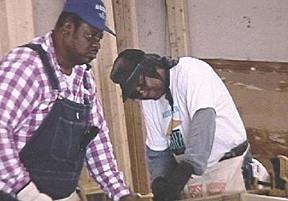
Gerald Davis, Cecil Deadman and Marla Bearden of the BGCT staff and Ray Breeding of Cornerstone Baptist Church replace a screen door during a Habitat for Humanity renovation workday.

Dallas Baptists work with Habitat to
breathe new life into neighborhood

By John Hall

Texas Baptist Communications

DALLAS–After getting their feet wet with an earlier Habitat for Humanity effort in South Dallas, Texas Baptists are getting their hands dirty as they pull out hammers and nails and go to work on a second project to help revitalize part of a community.

Dallas Baptists have come together to build and renovate homes as part of a Habitat for Humanity effort to reinvigorate an Oak Cliff neighborhood.

Area Baptists provided meals for volunteer builders working on a Habitat project in the same community earlier this year.

Texas Baptists are involved in building eight of the 11 homes volunteers are constructing. The Baptist General Convention of Texas Missions Equipping Center and City Core Initiative have partnered with Dallas Baptist Association and the Oak Cliff Network to sponsor one of the homes. Wilshire Baptist Church, Cliff Temple Baptist Church and Park Cities Baptist Church also are sponsoring building projects.

Pastor Willie Smith of Bible Way Baptist Church in Dallas and Pastor Calvin Jackson of True Believers Baptist Church in Dallas participate in a Habitat for Humanity project.

True Believers Missionary Baptist Church, Bible Way Baptist Church, Faithway Fellowship Baptist Church, Miracle Temple Missionary Baptist Church, New Covenant Baptist Church, New Creation Bible Church and Cornerstone Baptist Church have partnered with other Christian congregations on three houses.

Texas Baptists are renovating homes in the area as well. BGCT Church Missions and Evangelism Section staff members spent a day mowing grass, painting and maintaining several homes and anticipate more work days in the future.

The construction has created excitement in the community, said Willie Smith, pastor of Bible Way Baptist Church. Residents are looking forward to new neighbors who will move into the homes.

The Oak Cliff Network hopes to build on that energy, Smith said. Churches are sponsoring a communitywide revival this month. Smith wants to start a neighborhood crime watch group and community association as well. Baptist volunteers are pleased to be part of an effort to improve their surroundings, he said.

“It means a whole lot,” the pastor said. “We feel like we're contributing to our community firsthand.”

Gerald Davis, consultant for the BGCT Missions Equipping Center, said this effort is helping congregations connect with the families who will move into the homes. The cooperation also promotes an image of the church as a group of caring, helping people.

Residents will be able to point to new and renovated homes as signs of Christian love, Davis said. They will see tangible evidence of God's work.

“I would like to see what can happen when a group of people come together with a prayer to see God's presence clearly,” he said. “God's glory will be present in the transformation of this community.”

It is important that BGCT staff members are involved in this project as well, Davis continued. Ventures to change a community for the better in Christ's name connect with the BGCT's new mission statement, which calls on the convention to help churches transform lives.

“It's a divine opportunity that God has placed before us,” he stressed.

News of religion, faith, missions, Bible study and Christian ministry among Texas Baptist churches, in the BGCT, the Southern Baptist Convention ( SBC ) and around the world.


House vote on marriage amendment falls short of two-thirds_101804

Posted: 10/15/04

House vote on marriage amendment falls short of two-thirds

By Robert Marus

ABP Washington Bureau

WASHINGTON (ABP)–The U.S. House of Representatives has followed the Senate's lead, defeating a proposed constitutional amendment that would ban marriage–and, arguably, marriage-like benefits–for same-sex couples.

A House version of the Federal Marriage Amendment proposal failed to receive the necessary two-thirds vote for passage, though it did receive a majority of 227 to 186. Twenty-seven Republicans joined most Democrats in voting against the amendment, while 36 Demo-crats crossed the aisle to vote in favor of it.

A similar proposal failed a procedural vote in the Senate in July, when supporters of the marriage ban failed to muster a simple majority.

Many observers had predicted the House vote would fail, and the earlier Senate failure led many Democrats to accuse Republicans of playing election-year politics with the bill. Even if it had passed the House, its defeat in the Senate means the amendment almost certainly would have gone nowhere until next year.

Many opponents of the proposal said it was designed to make election-year life difficult for moderate Democrats who oppose the amendment on principle. Prominent Religious-Right organizations have announced they will give heavy weight to House members' votes on the amendment when compiling election-year “scorecards” to hand out in churches.

But several recent court decisions on gay-rights issues forced the House leadership's hand, some Republicans argued.

“Many of us in the House would prefer not to have this debate,” said House Majority Leader Tom DeLay (R-Texas). “The question of the future of marriage in this country has been forced on us by activist judges, legislating from the bench.”

DeLay referred specifically to a 2003 decision by the Massachusetts Supreme Judicial Court that legalized same-sex marriage in that state. As a result, the commonwealth became the first in the United States to grant marriage licenses to same-sex couples.

DeLay and other opponents of same-sex marriage argued that federal lawsuits ultimately would lead to the invalidation of laws banning same-sex marriage in other states–meaning a federal constitutional amendment is the only way to prevent the legalization of gay marriage nationwide.

The amendment's opponents, however, cited the arguments of many legal scholars who said that, if enacted, the amendment could ban not only marriage, but civil unions and other marriage-like legal relationships designed to protect gay couples and their children.

The amendment, as proposed, reads: “Marriage in the United States shall consist solely of the union of a man and a woman. Neither this Constitution, nor the constitution of any state, shall be construed to require that marriage or the legal incidents thereof be conferred upon any union other than the union of a man and a woman.”

Gay-rights and civil-libertarian groups said the final vote vindicated their work against the amendment.

“President Bush and the Republican leadership looked down the barrel of the biggest defeat for anti-gay extremists ever,” said Laura Murphy, director of the American Civil Liberties Union's Washington office. “They played fast and loose with the Constitution in a cheap election-year ploy, and they lost. Like the Senate did before, the House today said that discrimination has no place in the Constitution.”

But the proposal's supporters vowed to bring it up again in the next Congress. “This is only the beginning, I'm telling you, because this body will protect marriage,” DeLay said, to rare applause from the House visitors' gallery. “We will take it from here, and we will come back, and we will come back, and we will never give up.”

News of religion, faith, missions, Bible study and Christian ministry among Texas Baptist churches, in the BGCT, the Southern Baptist Convention ( SBC ) and around the world.


Filipino church teaches members to adopt missional lifestyle_101804

Posted: 10/15/04

Members of First Phillipine Baptist Church in Houston participate in a recent Vacation Bible School. The congregation partnered with the youth group from Tallowood Baptist Church for the effort. Partnership is one of the hallmarks of missional churches, said Milfred Minatrea, who recently wrote a book on the subject.

Filipino church teaches members to adopt missional lifestyle

By John Hall

Texas Baptist Communications

HOUSTON–Actively involved Christians may spend seven hours a week inside church walls. That leaves 161 hours a week they aren't in church.

Shouldn't believers live out their faith around-the-clock, wherever they are?

Howard Dagohoy, pastor of First Philippine Baptist Church in Houston, is answering the question with a firm “yes” by equipping members to share the gospel through day-to-day words and deeds.

He is one of a growing numbr of church leaders who are encouraging Christians to live “missionally”–intentionally following God's purpose to share the gospel and make disciples through everyday action.

Living missionally is “being a missionary where you are,” Dagohoy said. “You don't have to go far. You are a missionary at the workplace, at school–wherever you are.”

That takes different forms in different congregations, said Fred Ater, consultant for the Baptist General Convention of Texas Missional Church Center. One congregation may help teachers understand what they can and cannot say about their faith in school. Another may help individuals turn their hobbies into ministries.

At Higher Dimension Church in Houston, members are involved in discipleship classes, where their faith becomes more mature. Members are encouraged to read the entire Bible at least once a year. Church leaders are preparing members to impact their neighborhoods by strengthening their faith and encouraging them to be bold in a community with drugs and prostitution, said Olus Holder, the church's overseer of pastoral care.

“It's going really well,” Holder said. “The people are thirsty for the word of God.”

Leaders admit it is difficult to define a missional church, because churches are continuously evolving and honing their work on the missional journey, but it is about mirroring the mission heart of God.

“When the church as a whole moves to the heartbeat of God, they will see not only the grace God gives, but the responsibility,” Ater said.

As church members begin seeing the world they live in as a mission field, attitudes and cultures change, said Milfred Minatrea, director of the Missional Church Center.

The traditional marks of an active Christian lifestyle appear, he added.

Believers start to recognize the non-Christian people around them and naturally share the gospel with them, Minatrea explained. Christians are obedient to the Scriptures, which they hold in high esteem.

With that, the culture of churches changes, he continued. Rather than focusing on bringing people in, congregations look to release people into areas where they can have the most impact for Christ. They start churches. Members function as staff. They strengthen other Christian efforts.

“The missional church is not a program or process,” said Minatrea, author of “Shaped By God's Heart.”

“It is a paradigm. It is another way to see what the church is to be.”

Missional churches focus on penetrating communities, not “staying afloat” with adequate membership to support themselves, Ater said. Each member is a missionary that can help change the world for God. A global vision includes local ministry. Laypeople have the greatest impact, not church staff members.

“I think we are at a hinge moment in history,” Minatrea said. “Very few generations live at the hinges. I'm convinced we are moving from the era of the ordained to the era of the ordinary.”

News of religion, faith, missions, Bible study and Christian ministry among Texas Baptist churches, in the BGCT, the Southern Baptist Convention ( SBC ) and around the world.


Convention presidents address African-American preachers_101804

Posted: 10/15/04

Convention presidents address African-American preachers

By Ken Camp

Managing Editor

WACO–Attitude problems, personal pain and arrogance in the pulpit present obstacles to effective preaching, presidents of three predominantly African-American conventions told a conference at Baylor University's Truett Theological Seminary.

Presidents Stephen Thurston of the National Baptist Convention of America, Inc., Melvin Von Wade of the National Missionary Baptist Convention of America and Major Jemison of the Progressive National Baptist Convention headlined the seminary's inaugural African-American preaching conference in Waco.

“There are individuals who have the gift (of preaching) but don't have the right attitude,” said Thurston, pastor of New Covenant Missionary Baptist Church in Chicago. “The gift becomes fruitless because of the lack of an adequate attitude.”

Stephen Thurston

Thurston compared the attitudes three biblical characters showed toward Christ: King Herod, who wanted Jesus killed; the nameless innkeeper, who allowed Mary and Joseph to spend the night in his stable; and Simeon, who responded with thanksgiving when Mary and Joseph brought Jesus to the Jerusalem temple for circumcision.

Herod–who instructed the Magi to tell him the location of the Christ-child, falsely claiming he wanted to worship the Messiah–demonstrated a hostile attitude born out of insecurity.

“If there is a harboring of hostility within us, it is because of our own insecurity,” Thurston said, challenging preachers to “bring lives and lips together” into a consistent testimony.

The innkeeper, on the other hand, demonstrated an indifferent attitude. While he provided some shelter in the stable for Mary and Joseph, he could have done better for a pregnant woman who was about to deliver a baby, Thurston insisted.

“Many of us bring this attitude of indifference into the pulpit,” he said. “We're right down the middle–not for anything, not really against anything. … Like that unnamed innkeeper, we are indifferent. We compromise the word of God with the sins of men, so we will not declare the iniquities that are present and real.”

In contrast to Herod's wrong attitude and the innkeeper's bad attitude, Simeon demonstrated a right attitude, he noted. Luke's Gospel says Simeon was “in the Spirit,” and that is where preachers find the power to preach with authority, Thurston said.

Some pastors find it hard to preach with power and minister effectively because they are trapped in a “cul-de-sac of despair,” said Wade, pastor of Mount Moriah Missionary Baptist Church in Los Angeles.

“Somebody here is in an avalanche of agony, a conglomeration of calamity, a litany of losses, a maze of misery, a plethora of problems, a series of sufferings,” he said. “Somebody here has been seized and taken into custody by trouble.”

Drawing his text from Psalm 116, Wade described the depression of a person who feels as if he is being pursued relentlessly like a hunted prey or as if the narrow walls of a grave are closing in on him.

“The good news is that whenever you are trapped, you don't have to go to pieces if you're a child of God,” he said. “When trouble comes, you have a powerful option more potent than your predicament, and that is the privilege of prayer.”

Willingness to suffer and serve are essential to effective ministry, said Jemison, pastor of St. John Missionary Baptist Church of Oklahoma City.

“When suffering comes, it can be the best time of your ministry,” he said. “It is there God gives you history to deal with the present realities of your tomorrows.”

Citing the example of the martyr Stephen in the New Testament book of Acts, Jemison urged the ministers to be suffering servants rather than allowing hunger for prestige, power and position to eat away like termites at their ministry.

“We are just ordinary people whom God has elevated to render some extraordinary service to those who are the least, the last and the left out,” he said.

Featured speaker Bill Lawson, founding pastor of Wheeler Avenue Baptist Church in Houston, sounded a similar note at a banquet that kicked off the three-day conference.

“There has been a message sent down from heaven, and that message needs to get to every human being on earth,” he said. “Preaching is the central purpose for which the church has been created. But I said preaching, not preachers. … God builds his church on the preached word, not on the preacher.”

Michael Evans, director of African-American ministries with the Baptist General Convention of Texas; Joseph Parker, pastor of David Chapel Missionary Baptist Church in Austin; and noted Baptist pulpiteer Joel Gregory of Fort Worth served as the steering committee for the preaching conference, which organizers intend to be an annual event.

News of religion, faith, missions, Bible study and Christian ministry among Texas Baptist churches, in the BGCT, the Southern Baptist Convention ( SBC ) and around the world.


BaptistWay Bible Series for Oct. 24: ‘Good grief’ produces repentance, not regret_101804

Posted: 10/15/04

BaptistWay Bible Series for Oct. 24

'Good grief' produces repentance, not regret

2 Corinthians 7:5-16

By Todd Still

Truett Seminary, Waco

We have all said and done things and then had second thoughts. So did the Apostle Paul. Sometimes, upon further reflection, we conclude we said or did the wrong thing. Other times, we gaze in life's rear-view mirror and determine we said or did the right thing after all.

This is the way Paul felt about the so-called “tearful epistle” he had written to the Corinthians. Although he had been sorry he had written the letter because it had grieved the congregation, their grief turned out to be profitable (2 Corinthians 7:8). That the church not only mourned over but also repented of its sin turned Paul's regret into rejoicing (v. 9). The assembly's “good grief” brought Paul no small amount of relief.

Our text for this week's lesson picks up where Paul left off in 2:13. After a sustained and substantive aside, if 2:13-7:4 may be accurately described as such, Paul continues in 7:5-16 to inform the Corinthians of what happened to him after he left Troas and moved on to Macedonia. Although the apostle had ministry opportunities in Troas, Titus' delay in returning to Paul produced an anxiety in Paul that precluded him from walking through open ministerial doors (2:12-13).

Such anxiety on the part of the apostle should disabuse us of the notion that Paul was a saint cast in cold marble. In an effort to reconnect with his gentile coworker Titus, Paul departed Troas for Macedonia. Titus apparently was the courier of the now-lost letter that Paul wrote to the Corinthians “out of much distress and anguish of heart.”

Despite a change in location, Paul continued to experience affliction. Disputes from without and fears from within kept the apostle from finding rest (v. 5). The apostle's acute anxiety was generated and sustained by his concern for his ministerial colleague, the spiritual health of the Corinthian assembly and his desire for a restored relationship with them. For Paul to be at peace, Titus would need to come to him in Macedonia with a positive report from Corinth.

In verse 6, Paul informs the Corinthians that was precisely what happened. In the midst of his affliction, God comforted Paul through the arrival of Titus. Furthermore, that the Corinthians had comforted Titus and had told him of their ongoing commitment to Paul and his ministry prompted the apostle to rejoice even more (v. 7).

At his arrival, Titus informed Paul his now-lost letter had caused the Corinthians grief, albeit temporarily. It was not their grief that brought Paul relief and prompted him to rejoice, but the repentance that resulted from their grief.

In verse 9, Paul depicts the grief that led to their repentance as “grief according to God.” Moreover, the apostle regards “godly grief” as gain. It is a “good grief” because it produces repentance and not regret. If “grief according to God brings about repentance which results in salvation,” “worldly grief brings about death” (v. 10).

In verse 11, Paul reflects further on the positive repercussions of “godly grief” upon the Corinthians. It produced within the fellowship a spiritual earnestness and enthusiasm. They demonstrated a desire to take sin seriously and to repair ruptured relationships with one another and the apostle. So much so that Paul declares, “At every point you have proved yourselves guiltless in the matter.” Although we would like to know more about the “matter” of which Paul speaks, the apostle does not want to grind an axe. In fact, Paul shows no more willingness to harp on their sin than God does on our confessed sin (1 John 1:9).

It is probable that Paul has in view in verse 11 the “matter” he mentioned earlier in the letter (vv. 5-11). Even so, the apostle insists in verse 12 he did not write his “tearful epistle” to the Corinthians in order to attack his detractor or to defend himself. Rather, he wrote so the church might be led to renew their commitment to him as their apostle before God (v. 12).

Paul reiterates here the comfort he has experienced from their having done so. He also underscores the joy he has derived from Titus' warm reception among and fond affection for the Corinthians (v. 13). Like a proud parent, Paul had boasted about the church to Titus. Like a concerned parent, Paul wondered if he had been overconfident (v. 14).

Titus' overwhelmingly positive field report from Corinth (v. 15) prompted Paul, in so many words, once again to display a picture of the congregation and to ask those gathered around him, “Have you seen my spiritual children in Corinth lately?” (v. 16). Perhaps those meant to admire the assembly's picture responded by saying, “Good grief, Paul, give it a break.” To which Paul could have said, “Grief truly can be good if it is godly grief. Have I told you about my spiritual children in Corinth lately?”

Discussion questions

bluebull Can you recall a time when “good grief” ultimately had a good result in your life?

bluebull Do believers have a responsibility to their spiritual children's growth?

News of religion, faith, missions, Bible study and Christian ministry among Texas Baptist churches, in the BGCT, the Southern Baptist Convention ( SBC ) and around the world.


BaptistWay Bible Series for Oct. 31: Exercise financial generosity for sake of others_101804

Posted: 10/15/04

BaptistWay Bible Series for Oct. 31

Exercise financial generosity for sake of others

2 Corinthians 8:1-21

By Todd Still

Truett Seminary, Waco

Second Corinthians is laden with transitions. Yet another shift occurs in the epistle at 8:1. Fortunately, the apostle sticks with this particular topic two entire chapters. The subject Paul considers in 2 Corinthians 8-9 is what we call the Jerusalem Collection.

Although Paul refers to this offering for needy believers in the “holy city” elsewhere (1 Corinthians 16:1-4; Romans 15:25-32), this is the only place in his surviving letters where he ponders over and elaborates upon various aspects of the collection in any degree of detail. In this lesson, we will consider the apostle's instruction in 8:1-21; next week, we will focus our attention upon 9:6-15.

Having expressed his complete confidence in the Corinthians (7:16), Paul now is prepared to put his trust to a test in a most tangible way as he calls the congregation to contribute to the collection. The apostle already had instructed the church regarding this offering (1 Corinthians 16:1-4) and was eager to secure their support for what Paul considered to be an immensely important project. Paul thought this ministry not only would assist needy Jewish Christians in Jerusalem, but also would serve as a material sign of Gentile believers' spiritual indebtedness to the Jewish people (Romans 15:27).

The apostle begins by placing before the Corinthians the positive response of the Macedonian churches to the collection (vv. 1-5). Although Paul does not name the precise locales of the congregations in northern Greece to whom he refers, he probably at least has the Philippian and Thessalonian fellowships in view. Paul informs the Corinthians of the Macedonian Christians' generosity even in the face of adversity and poverty (v. 2). The apostle reports these churches gave voluntarily, sacrificially and enthusiastically to this ministry for the Jerusalem saints (vv. 3-4). Having been graced by God and having given themselves to God, Paul indicates these believers were eager to grace others through their giving (vv. 1, 5).

Encouraged by the Macedonians' liberality, Paul enlists Titus and two other now-anonymous “brothers” to ensure and secure the Corinthians' support (vv. 6, 16-24). The apostle wants to make certain the Corinthians' contributions come to fruition. He is anxious that their commitment to the collection will flag and they will fail “to put their money where their mouth is” (vv. 10-11). In an attempt to shore up their commitment, Paul not only appeals to the Macedonians, but he also enjoins the Corinthians to excel in giving to this need even as they excel in other areas of the Christian life and experience (v. 7).

Although it appears Paul is engaged in some “spiritual arm-twisting” here, his purpose for applying this gentle apostolic pressure should be recognized. He is not appealing to the Corinthians for his own selfish gain; on the contrary, he is urging them to exercise financial generosity for the good of other believers. By doing so, they will exhibit spiritual sincerity and charity (v. 8).

In the course of encouraging the Corinthians to demonstrate genuine love by giving ungrudgingly, Paul appeals to the example of Christ. In one of Paul's most poetic and profound passages, we read: “For you know the grace of our Lord Jesus Christ, that though he was rich, for your sake he became poor, in order that you might become rich by his poverty” (v. 9). Paul's point is penetratingly clear–even as Christ has given on our behalf, Christians should give on his behalf.

By encouraging the Corinthians to contribute to the collection, Paul is not asking that they impoverish themselves. Neither is he, like some modern-day proponent of the “health and wealth gospel,” suggesting they should be unduly burdened so Jerusalem believers might live in lap of luxury. Rather, he is calling them to give out of their present abundance in response to a present need. Should the tables be turned, those on the giving end would appreciate being on the receiving end. Paul is advocating in these verses, then, fiscal as well as spiritual generosity so there might a fair balance and interdependence (vv. 12-14).

In promoting this perspective, Paul appeals to the Israelites' experience of gathering manna in the wilderness in keeping with the Lord's instructions (v. 15). Because they worked cooperatively and shared freely, those who gathered more than an omer had nothing left over, and those who gathered less than an omer had no lack (Exodus 16:16-17).

The apostle's instruction was a word on target not only for comparatively wealthy Corinthians but also for comparatively wealthy North American Christians. Honestly, most of us are more like the “rich fool” and “Lazarus” in Luke's parables than we are like Jesus. In general, we value getting over giving, hoarding over helping and stockpiling over sharing.

In rounding out this chapter, Paul tells the Corinthians precisely who he is sending their way to collect their offering for “the relief of the saints” (vv. 16-24). As he does so, he indicates why he is collecting this “grace” in the first place, namely, “for the glory of the Lord and to show our good will” (v. 19).

Paul also notes he has involved other persons in gathering and delivering the collection so he might safeguard himself against potential slanders from detractors (v. 20). The apostle's aim in carrying out his ministry was to do that which was right not only before the Lord, but also before humanity (v. 21). Let us pray this type of integrity and transparency will mark our lives and ministries.

Discussion question

bluebull If your giving isn't cheerful, should you keep your tithe?

News of religion, faith, missions, Bible study and Christian ministry among Texas Baptist churches, in the BGCT, the Southern Baptist Convention ( SBC ) and around the world.