On The Move_110804

Posted: 11/05/04

On the Move

Olin Boles to Central Texas Area as interim director of missions.

bluebull Kelly Burkhart to Baptist Temple in Houston as pastor from First Church in Riesel.

bluebull Mickey Chitwood to Ephesus Church in Jewett as minister of music.

bluebull Bob Craig to Calvary Church in Brenham as interim pastor.

bluebull Richard Davidson to Mildred Church in Corsicana as minister of music.

bluebull Rick Davis to First Church in Royse City as intentional interim pastor, not pastor, as previously reported.

bluebull Terry Gayle to Open Range Cowboy Church in Whitney as pastor.

bluebull Michael Hale to First Church in Hillsboro as minister to youth.

bluebull Wes Hinote to Leona Church in Leona as music minister.

bluebull Shannon Hopkins to First Church in Teague as youth minister.

bluebull Kevin McSpadden has resigned as pastor of Belmore Church in San Angelo to be a chaplain at Baptist Memorials Ministries there.

bluebull Richard Ray to First Church in Wink as pastor from Living Faith Church in Buffalo.

bluebull Jerry Reed to Living Faith Church in Buffalo as interim pastor.

bluebull Jimmy Reynolds has resigned as high school minister at First Church in Sulphur Springs.

bluebull Bill Roe to Bosque Association as director of missions from First Church in Morgan, where he was interim pastor.

bluebull Vernon Scott has resigned as minister of music at Colonial Hills Church in Cedar Hill.

bluebull Jeff White to First Church in Wichita Falls as children's recreation coordinator, where he had been children's ministry intern.

bluebull Rick Wood to First Church in Plains as music minister.

News of religion, faith, missions, Bible study and Christian ministry among Texas Baptist churches, in the BGCT, the Southern Baptist Convention ( SBC ) and around the world.


Cybercolumn by Brett Younger: Jesus & our churches_110804

Posted: 11/05/04

CYBERCOLUMN:
Jesus & our churches

By Brett Younger

Jesus wouldn’t recognize:

Heated, fiberglass baptisteries. Rivers are better symbols than bathtubs.

Grape juice at communion. What, exactly, does Welch’s represent?

Pictures of Jesus. Do the artists know what Jewish people look like?

Brett Younger

DaVinci’s “Lord Supper.” Why are they all on the same side of the table?

“Walking the aisle.” There’s not a single instance of “walking the aisle” in the New Testament.

The “plan of salvation.” There is no “plan of salvation” in the Bible; there is a “person of salvation” who reveals and offers God’s grace.

Timid Sunday school lessons that don’t upset anyone. After teaching Sunday school in Nazareth, the class tried to throw Jesus off a cliff.

Age-graded classes. Wouldn’t it be helpful to learn from people who aren’t our age?

Requiring someone from another Christian tradition to be re-baptized. Baptists didn’t show up until 1,600 years after Jesus.

“Robert’s Rules of Order.” What were they thinking when they let this into the church?

Steeples. Towels are a more biblical symbol of servanthood, but it’s hard to picture a 40-foot towel on top of the building

But Jesus would love:

Worshipping in Spirit and truth. Lifting our hearts to God.

Congregational singing. Joining our souls in celebration.

Listening for God’s voice. This is essential in following Christ.

Prayer groups. Sharing concerns and dreams.

Vacation Bible School. Gloriously noisy children and gloriously patient teachers.

Adults asking hard questions. Opening our minds to Mystery

Children hearing the stories of faith. Learning that they are their stories, too.

Disciples that share their lives. Lifelong sisters and brothers.

People who hug. Twenty-first century “holy kisses.”

Those who visit the homebound. Remembering the elderly is radically Christ-like behavior.

Mission trips;. More fun than Disneyland and cheaper, too.

Class parties. Jesus came “eating and drinking.”

Sunday lunches and Wednesday suppers. Would you want to go to a church that didn’t eat together?

Habitat for Humanity. Carpenters, in particular, appreciate this one.

People who know their way around hospitals. “I was sick and you took care of me …”

People who remember prisoners. “… in prison and you visited me …”

Food pantries. “… hungry and you gave me food …”

Clothing rooms. “… naked and you gave me clothing …”

Smiling greeters. “… a stranger and you welcomed me.”

Jesus wouldn’t recognize everything at our churches, but there is so much that must make Jesus smile.

Brett Younger is pastor of Broadway Baptist Church in Fort Worth and the author of “Who Moved My Pulpit? A Hilarious Look at Ministerial Life,” available from Smyth & Helwys (800) 747-3016.

News of religion, faith, missions, Bible study and Christian ministry among Texas Baptist churches, in the BGCT, the Southern Baptist Convention ( SBC ) and around the world.


Storylist_110804

Storylist for 11/08/04 issue

GO TO SECTIONS:
Texas       • Baptists      
Faith       • Departments      • Opinion       • Bible Study     


Baptists bring brighter smiles to children's faces

Some churches use lengthy pastor search as chance to rediscover identity, purpose

Reyes offers suggestions for dealing with pastor shortage in Hispanic congregations

Isolation, economics make it hard to find pastors in some rural areas

Faith sustains military couples seeking to adopt

Mothers who place babies with Buckner find help at retreat

Senior adults reveal spiritual needs through stories with deep meaning, chaplain says

Chaplain offers exercises to help ministers relate to effects of aging

Co-workers should be honored, not manipulated, chaplaincy director says

Former NAMB chaplaincy director transfers his endorsement to BGCT

Hispanic McAllen church launches English-speaking mission

Not just Español in Hispanic churches

Midland missionary serves in Uganda

Falfurrias church sees itself as missional, and it wants everyone to know it

Texas Baptist Missions Foundation marks 20 years of mission funding

Young Brownwood woman adopts African lifestyle to share Christian faith

Busy preachers face temptation to plagiarize ready-to-preach sermons

When the preacher confesses, people listen, Miller insists

Southwestern Seminary proceeds with plans to launch college; names new vice president

Texas Baptist Men work with Brazil's leaders to form faith-based disaster relief network

TBM Retiree Builders remodel three British churches to meet accessibility requirements

Wayland marks 20 years of making a mark in San Antonio

Low-income mentally ill people find hope at the Well

On the Move

Around the State

Texas Tidbits


DEEP IN THE HEART OF TEXANS: Demographic guru Steve Murdock


Previously posted
Christian illusionist uses stunts to present gospel message


Southeastern Seminary audit yields suggested procedural improvements

Missouri Baptist Convention files new suits against five agencies than changed charters

Louisiana College violated accrediting body's standards and internal policies, study says

Baptist Briefs


Woman won't rest until every orphan has a clean bed


Evidence shows plague of slavery persists in northwest Africa

Christian tourists begin returning to Holy Land after four-year hiatus

Evangelical women begin to speak out about depression


Personal morality beats social justice at the polls

Voters in 11 states approve bans on same-sex marriage

Students involved in religious life report better emotional health, research shows

Three teens out of 10 took part in missions, ministry

Ethnic 'niche' Bible study groups attract university students

Call to kill terrorists 'in the name of the Lord' sparks outcry

Most community foundations fund faith-based social services, study shows

Right to Life researchers critique abortion study


Texas Baptist Forum

Classified Ads

On the Move

Around the State


DOWN HOME: 25th Reunion Blessing recalled

EDITORIAL: 'Moral values' should mean more than sexual ethics

TOGETHER: Urge lawmakers to do what is good

ANOTHER VIEW: Marketplace impacts global missions

Texas Baptist Forum

Cybercolumn by Brett Younger: Jesus and the churches


BaptistWay Bible Series for Nov. 14: Commended by Christ, committed to the Corinthians

LifeWay Explore the Bible Series for Nov. 14: Fundamental facets of a fulfilling prayer life

LifeWay Family Bible Series for Nov. 14: The Creator rules the whole of his handiwork

See articles from previous issue 11/01/04 here.


BGCT board approves mission, vision, values & priorities_100404

Posted: 10/01/04

BGCT Executive Board member Randall Scott, pastor of Immanuel Baptist Church in Paris, recommends the board postpone a decision about a change in the convention's structure.(John Hall Photos)

BGCT board approves mission, vision, values & priorities

By Marv Knox

Editor

DALLAS–The Baptist General Convention of Texas Executive Board overwhelmingly approved a set of mission, vision, values and priority statements to guide the convention's work in coming decades.

But board members postponed a vote on constitutional amendments that would change the convention's governance structure–a step BGCT observers say is necessary to implement the approved changes.

The 234-member board ratified the guiding statements with only one dissenting vote during its fall meeting, Sept. 28 in Dallas. Then the board voted by about a 60-40 margin to defer action on the constitutional questions to a called meeting, set for Oct. 26.

The votes marked the latest step in a yearlong process designed to chart the convention's course well into the 21st century. If approved, the package of proposals would provide the most significant BGCT reorganization in about 50 years.

See related stories:
BGCT board approves mission, vision, values & priorities

BGCT Executive Board approves $47.38 million budget recommendation

Excerpts from the BGCT Mission Statement

The mission, vision, values and priority statements will be presented to messengers to the BGCT annual session in November for their affirmation. Constitutional changes require ratification at two successive annual sessions and could become effective following the 2005 meeting.

Speaking before the Executive Board began its discussion, BGCT President Ken Hall affirmed the proposed changes.

“Our God is a great and faithful God,” said Hall, president of Buckner Baptist Benevolences. “God expects us … to have great expectations for what he is doing and will do.”

The proposals are “recommendations regarding a new day–so we may be faithful to this and future generations,” Hall said.

The proposals do not reflect negatively on how the BGCT has operated up to now, he stressed. “God has blessed us with good present and past leaders.”

But the context in which the convention functions is changing rapidly, and that change demands creative and courageous response, he added, noting, “It's time for us to adapt ourselves again to the present generation and to the opportunities of the future.

“The proposals are an affirmation of what has gone before. They're not change for change's sake. But we're making change so we might be better, serve more and make a difference in the lives of more people.”

BGCT Executive Director Charles Wade expounded the importance of the proposed mission, vision, values and priority statements for the convention's future.

Collectively, the statements describe “what it is we believe God has called us to be and to do,” Wade said.
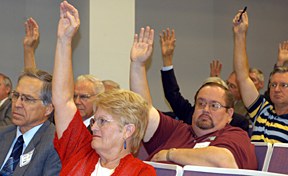
BGCT Executive Board members vote whether to postpone a decision on the governance plan proposed by convention leaders.

Throughout the spring, as the first groups began to work on “revisioning” and reorganizing the convention, the words “reconciliation” and “transformation” repeatedly surfaced, Wade said, noting they appear consistently throughout the four guiding statements.

He read from the New Testament books of Romans and 2 Corinthians, where the Apostle Paul talks about the vitality of Christian transformation and reconciliation.

Wade then read the mission statement: “The Baptist General Convention of Texas encourages, facilitates and connects churches in their work to fulfill God's mission of reconciling the world to himself.”

That statement focuses on “three great verbs,” he said. “It is not the work of the convention to reconcile the world to Christ; it is the work of the churches. … We are helping the churches do this task” by encouraging, facilitating and connecting them for that purpose.

Wade read all the statements to the Executive Board (see sidebars). They provide a guide for helping churches to be transformational and reconciling, he said.

“We want to see lives changed. We want to make a difference,” he insisted.

During discussion on the statements, several board members offered suggestions for changing the wording. Wade asked them to present their “wordsmithing” suggestions in writing, noting a committee could work out minor details.

“If you agree on the thrust of this, then perhaps we can deal with the substantive issue: This is what we ought to do,” he told the board, which then approved them with only one dissenting vote.

But the board showed more diverse opinions as it considered the constitutional changes.

The core of those changes consists of a major reorganization of the BGCT's governance structure.

Chief among the changes is a proposal to decrease the size of the Executive Board from 234 members to less than 100.

Currently, each of the BGCT's 114 affiliated district associations is represented by at least one member on the Executive Board. Under the proposed system, the state would be divided into 30 geographical sectors of 50,000 resident church members each.

Each sector would receive three Executive Board members. The board also would include about seven to 10 ex-officio members.

The Baptist General Convention of Texas encourages, facilitates and connects churches in their work to fulfill God's mission of reconciling the world to himself.
—BGCT mission statement

The constitutional changes also would eliminate the convention's two coordinating boards, which act as liaisons to the BGCT's schools and human welfare ministries; its two commissions, which give direction to Executive Board staff programs; and the Administrative Committee, which serves as the convention's finance, personnel and review committee.

All those functions would be assigned to new Executive Board committees. To accomplish that work, the Executive Board would meet for two days three times a year, replacing the current three half-day meetings. And the convention would pay travel expenses for Executive Board members; current members attend at their own expense.

While advocating the changes, Wade affirmed what has gone before.

“One of the things I've known about the Executive Board–we've gotten a lot of good done,” he said, praising the “incredible leadership” of both board members and staff through the years.

“But a 230-plus member board makes it impossible for a truly governing board to function,” he added. “Members have no opportunity to shape the development of the ideas, of the proposals” that come before them.

And because of the diffused structure, with various components of the convention reporting to various boards and commissions, accountability suffers, he noted.

The proposed changes would offer several benefits to the convention, Wade said.

“The Executive Board becomes the governing board. It sets direction and policies,” he explained. “It also increases accountability to the convention.”

By streamlining governance and bringing oversight of functions under direction of Executive Board committees, the changes would eliminate the need for extra groups and reduce costs, he said.

With representation based on church membership in the statewide sectors, the board could more closely reflect the convention's demographic diversity, he added. And with the convention paying travel expenses, a broader range of people would be able to serve.

The proposals would allow for advisory groups from across the state, which would “provide input, feedback and ministry involvement,” he said. And plans call for reassigning BGCT staff so they will be “dispersed closer to the associations and churches.”

During discussion, several board members pleaded for more time to consider the proposed changes.

“I would love to have more time. I only got the material about five days ago,” said Randall Scott, pastor of Immanuel Baptist Church in Paris, who moved to postpone the vote to the called meeting in late October.

At least six board members questioned the wisdom of reducing the size of the board from 234 to less than 100.

They expressed concern that the board would become less representative of all Texas Baptists, that the board could become “exclusive” and that churches from rural parts of the state would lose representation.

Others asked for more information about how the changes would impact the work of the State Missions Commission and the Christian Life Commission, as well as how the proposals would impact staffing of the Baptist Building in Dallas.

Wade promised to provide more information to board members at least 10 days in advance of the Oct. 26 meeting.

“I am not at all frustrated by your desire to come back” to consider the constitutional changes, he told the board. “In fact, it's probably the appropriate thing to do.”

News of religion, faith, missions, Bible study and Christian ministry among Texas Baptist churches, in the BGCT, the Southern Baptist Convention ( SBC ) and around the world.


Articles on BGCT Reorganization_110104

Posted 11/01/04

Articles on BGCT Reorganization


Ken Hall: BGCT is a 'work in progress' (11/17/03)

BGCT's 2004 challenge: Align budget with priorities (11/17/03)

BGCT leaders affirm reorganization (1/26/04)

BGCT must change to avoid continued decline (1/26/04)

Revisioning process to move BGCT forward, put controversy behind, leaders tell board (3/8/04)

BGCT Revisioning team members (3/8/04)

Not clear yet, but BGCT vision is emerging, consultant says (5/17/04)

BGCT leaders hopeful, encouraged by early stages of revisioning process (5/17/04)

BGCT strategy committee named (5/17/04)

Churches front and center in proposed BGCT strategic plan (9/6/04)

BGCT president considers proposed reorganization dramatic but overdue (9/6/04)

'04 decisions will impact decades (9/20/04)

Executive Board will consider streamlining BGCT governance (9/20/04)

Reorganization will help BGCT meet Texas churches' needs, leaders agree (9/20/04)

BGCT board approves mission, vision, values & priorities (10/4/04)

The BGCT Mission Statement: Vision, Values, Priorities (10/4/04)

BGCT leaders maintain proposed changes won't narrow participation (10/18/04)

Executive Board recommends changes in governance; rejects efforts to postpone (11/1/04)

BGCT president, executive director will answer questions at workshops (11/1/04)

Explanation by Wesley Shotwell (10/26/04)

Constitution Comparison (10/26/04)


Emotional, spiritual support available to parents of special-needs children_110104

Posted: 10/29/04

Jim DeHoog, chaplain for Mission Road Ministries in San Antonio, points a group of parents of special-needs children to places they can find emotional and spiritual support.

Emotional, spiritual support available
to parents of special-needs children

By John Hall

Texas Baptist Communications

MOUNT LEBANON–Emotional and spiritual support for parents of special-needs children is all around, but they have to take advantage of those opportunities, a chaplain who ministers to mentally challenged people stressed.

Parents can find help in universities and web sites, but particularly in churches, said Jim DeHoog, chaplain for Mission Road Ministries in San Antonio.

“Sunday school and Bible study groups are areas where (parents) can find support,” he said during the Baptist General Convention of Texas Special Friends Retreat, partially funded by the Mary Hill Davis Offering for Texas Missions.

A pair of special-needs adults take time for crafts during the Baptist General Convention of Texas Special Friends Retreat. Participants later would put together hygiene bags that will be shipped to Russian orphans.

Echoing the experiences of many parents, DeHoog explained Christians wanting to help is not the same as people doing it. Believers may wish to serve, but too often they are afraid of doing something wrong with the child. They need help understanding how to care for someone with special needs. That's where parents can help.

“We have needs for emotional support, and sometimes the church and people around us don't know how to meet the need,” he said. “We need to educate others.”

That educational process may take an extended time, but DeHoog encouraged parents to commit to it. If people are dedicated to helping, they can greatly benefit parents.

Many communities are starting groups for parents of special-needs people, he noted. Those groups can be good places for parents to network with others. If a town does not have such a group, parents may want to start one, he suggested.

Some universities have special education programs that require students to attain practical experience with special-needs people, DeHoog added. Those schools typically either work with a group or start their own efforts to provide an avenue for that service.

Numerous web sites are tailored specifically to parents of special needs children, DeHoog said. They include chat rooms, literature, book reviews and message boards that provide parents a gathering place.

“I know it doesn't express the emotion,” he said. “You can't hear the emotion, but they can be helpful.”

A pair of special-needs adults take time for crafts during the Special Friends Retreat. Participants later would put together hygiene bags that will be shipped to Russian orphans.

News of religion, faith, missions, Bible study and Christian ministry among Texas Baptist churches, in the BGCT, the Southern Baptist Convention ( SBC ) and around the world.


Hardin-Simmons provides opportunities for Boneheads who dig dinosaurs_110104

Posted: 10/29/04

Hardin-Simmons provides opportunities
for Boneheads who dig dinosaurs

By George Henson

Staff Writer

ABILENE–These boneheads are anything but what their name suggests.

Boneheads and Junior Boneheads are high school and middle school gifted students who are working with students and professors at Hardin-Simmons University to deepen their knowledge of paleontology.

A part of that partnership was a 500-mile trip to the Big Bend region for a dinosaur dig.

The students learned how to dig, wrap, transport and prepare specimens for casting.

Hardin-Simmons students Ryan Nanny , Mark Muhr and Matt Hinds provide the labor at a dinosaur dig in Terlingua.

Some of those specimens weigh up to 200 pounds, so they also learned the value of working as a team, organizers noted.

Kim Cheek, a teacher at Wylie Middle School in Abilene and sponsor of the Junior Boneheads, said the experience of camping out and working in the field was invaluable.

“The kids have told me that in the past when a teacher has taught on a subject, it's been read a chapter and answer the questions,” she said.

“The program gets them out of the classroom and into a hands-on experience.

“It becomes much more than print on a page.”

Working with the adults also reminded the children that learning is a lifelong experience, she added.

That is just what Mark Ouimette, associate professor and chair of the geological sciences department at Hardin-Simmons, wants to hear.

“Part of what Hardin-Simmons gets out of this program is a little exposure with the kids,” he said.

“It's a platform that area school kids might use to see what kinds of things Hardin-Simmons is involved in.

“But the most important part is to create an excitement about learning that will lead them to want to go to a university somewhere, whether it is here or somewhere else.”

The Grace Museum in Abilene has closed its “Dinosaurs of Texas” exhibit, and the Boneheads are moving their work to the paleontology lab at Hardin-Simmons.

Once everything is moved and in place, they will begin working on some of the bones they have uncovered in their digs.

The Junior Boneheads are changing their focus to minerals and will take a three-day field trip to Carlsbad Caverns National Park in southeastern New Mexico to see minerals there and learn how they are formed.

After they return to Abilene, they will work as docents for the Grace Museum's newest exhibit that features large minerals collected during the '60s and '70s by the chairman of Pennzoil.

They also will participate in museum activities such as the Rock-o-Rama, where area residents can bring in strange rocks for identification.

News of religion, faith, missions, Bible study and Christian ministry among Texas Baptist churches, in the BGCT, the Southern Baptist Convention ( SBC ) and around the world.


CBF revenues top $24 million in past year_110104

Posted: 10/29/04

CBF revenues top $24 million in past year

By Greg Warner

Associated Baptist Press

ATLANTA (ABP)–The Cooperative Baptist Fellowship finished its 2003-04 fiscal year with revenues of $24.26 million, the highest-ever annual total.

The record total included undesignated contributions of $8,869,883, designated gifts of $8,709,160, and a global missions offering of $5,738,222–each one an all-time high.

The Fellowship spent $19.6 million of that revenue during the fiscal year and left a revenue overage of $4.7 million, most of which is designated for global missions.

However, the undesignated contributions–which fund partner organizations like seminaries and CBF's own non-missions programs–were $136,876 below budget expectations.

Cost-cutting allowed the Fellowship to end the year with revenues $5,845 above expenses, however, finishing in the black for the first time in three years.

Rusty Brock, a pastor from Ardmore, Okla., and chair of the council's global missions team, said the Fellowship spent $12,255,636 on global missions in 2003-04, including designated and undesignated funds.

The Fellowship benefited from several large donations designated for missions–including anonymous gifts of $5 million and $1.8 million–but those funds will be depleted in 2006 and must be replaced in order to maintain the same level of missions activity, Brock said.

Speaking at the CBF Coordinating Council's fall meeting, Fellowship Coordinator Daniel Vestal called CBF's recent acceptance into membership of the Baptist World Alliance, an international fellowship of Baptist bodies, “a very important moment for us.”

The Southern Baptist Convention, historically BWA's largest member, pulled out the group in June largely because it granted membership to the Fellowship, which is comprised mostly of moderate former Southern Baptists.

Vestal pointed out there are 16 million Southern Baptists but 17 million other Baptists in North America. He called for a revitalization of the North American Baptist Fellowship, one of the BWA's regional organizations, which he said could be the focal point for “a new day for Baptists in North America.”

The Coordinating Council expects to hear a recommendation during its February meeting from the Baptist World Alliance Task Force, which is studying ways to increase CBF funding of BWA.

Also expected in February is the long-awaited report of the Partnership Study Committee, which is re-evaluating CBF's relationships with and funding of partner ministries. Committee Chair Charles Cantrell, a lawyer from Mountain View, Mo., presented the committee's statement of “guiding principles” for partnerships.

The statement says CBF is committed to ministry through partnership with autonomous organizations rather than establishing its own institutions. Those partnerships are voluntary, based on mutual trust and respect, and characterized by caring, accountability and mutual sacrifice for a shared mission.

Cantrell said the committee also is developing a set of general guidelines for partners and a specific statement on CBF's relationships with theological schools, which account for the largest portion of its partner funding.

The partnership study is expected to produce funding changes, but Cantrell said no changes will take effect until the 2006-07 fiscal year.

In his coordinator's report, Vestal voiced his desire for the Fellowship to be more ethnically diverse. While more diverse than most Baptist groups in the South, the Fellowship needs to do better, he said.

“I believe it was in the heart of this movement from the beginning, in our DNA from the beginning,” he said.

The Fellowship supports ethnic networks to involve Asians, Hispanics and African-Americans in the organization.

Vestal confessed he does not know how to increase diversity, but added: “We're going to have to take some risks. We're not going to be able to keep doing things the way we've been doing things.”

Vestal admitted to failure in making the Fellowship more diverse, but he pledged: “We're not going to quit. We're going to fund some things differently. Our staff is going to look different. But I believe much of our future is in the multiethnic area.”

News of religion, faith, missions, Bible study and Christian ministry among Texas Baptist churches, in the BGCT, the Southern Baptist Convention ( SBC ) and around the world.


Baptist researcher’s apartment ministry study yields unexpected findings_110104

Posted: 10/29/04

Baptist researcher's apartment ministry
study yields unexpected findings

By John Hall

Texas Baptist Communications

FORT WORTH–Apartment ministries may not reduce crime rates the way advocates previously expected, but that doesn't mean they are ineffective, a Baptist researcher insists.

The ministries may be giving residents hope where it didn't exist before, she maintains.

Recent doctoral research by Tomi Grover, restorative justice consultant with the Baptist General Convention of Texas Missions Equipping Center, revealed calls to the police remained steady during an 18-month period in complexes with church-sponsored ministries.

Her research also showed a decrease in phone calls to the police during an 18-month period in complexes without ministries.

This runs contrary to many people's thinking that apartment ministries decrease the number of calls to police, but does not indicate ministries are not effective, said Grover, whose work recently was named the best research project of the year by the Southern Baptist Research Fellowship.

Residents with a sense of hope are more likely to call for police assistance, according to Tomi Grover, restorative justice consultant with the Baptist General Convention of Texas Missions Equipping Center.

She believes her report does not indicate crime rate fluctuations, but it shows increasingly bold residents where developed ministries are functioning. Ministries are creating an environment where people believe they can make a difference. Individuals are feeling valued and believe cooperation with each other, managers and police officers can create better lives, Grover said.

“Overall, a sense of community development helps people feel a part of the community and helps them care about their neighbors and their managers,” she said.

Conversely, residents in apartment complexes without ministries lose hope for improvement, Grover added. They do not believe the police can make a difference and are less likely to call for police assistance.

These findings have several implications for church work, Grover said. When congregations evaluate their ministry, they need to look at more than professions of faith in Christ to determine effectiveness, she insisted. It is important to bring people to Christ, but churches also need to analyze the entire situation.

Congregations should note crime rates, quality of life and worldview as well, she continued. Correctly discipling individuals will affect each of the aspects. That means outreaches should address each of those issues.

“It's not just about Bible study or social-recreational ministry,” she said. “It's about the whole person. When you start addressing the whole person, you address the whole community.”

Grover noted her research encourages further studies in this area. She would like to see a study covering a longer period of time than 18 months. Assessing the types of crime committed could be helpful, she said.

News of religion, faith, missions, Bible study and Christian ministry among Texas Baptist churches, in the BGCT, the Southern Baptist Convention ( SBC ) and around the world.


After two years in a tent, church moves indoors_110104

Posted: 10/29/04

After two years in a tent, church moves indoors

By John Hall

Texas Baptist Communications

FAIRLIE–Cross Trails Cowboy Church led Hunt Baptist Association in baptisms last year while meeting in a tent. Now members are imagining what can happen as they have moved into new facilities.

The congregation's ministry grew to serve about 300 people each Sunday in worship during its two-year stint beneath a tent. At times, members sweated through services. Other times they shivered.

Often they shed tears of joy as the church baptized more than 50 people, said Pastor Shannon Moreland.

“The Spirit of the Lord was there,” he said.

HOW IT USED TO BE—Pastor Shannon Moreland (right) and Lay Pastor Greg Horn stand in a tank of water in 2003, ready to begin a baptismal service at Cross Trails Baptist Church.

If the early numbers are any indication, it seems the same Spirit must be in the church's new facilities, which include a sanctuary, a roping arena for outreach events and classrooms for Bible study. About 400 people attended the first service in the new setting.

Expectant mothers, women with young children and senior adults turned out for the initial service because they could sit in the air conditioning rather than under the hot tent, Moreland noted.

“Everybody wanted to come and check it out,” he said.

The congregation looked forward to the first indoor service for more than a year as it waited for the new facilities to be completed.

The church appears to be starting in these buildings where it left off in the tent. Moreland already has conducted the church's first indoor baptism in more than two years–though he continued to use a horse trough, just as he had done when the church met under a tent.

Cross Trails sold its tent to another cowboy church developing in Brazoria County.

It worked for Cross Trails, and Moreland believes it can work in Brazoria as well.

“God will bring people,” he said. “It doesn't matter what the elements are.”

News of religion, faith, missions, Bible study and Christian ministry among Texas Baptist churches, in the BGCT, the Southern Baptist Convention ( SBC ) and around the world.


Only God is worthy of worship; all else is idolatry, music professor maintains_110104

Posted: 10/29/04

Only God is worthy of worship; all else
is idolatry, music professor maintains

By Craig Bird

Baylor University

WACO–Agendas, even holy agendas, are not worthy of worship, Terry York is convinced. And when something else–anything else–takes God's place as the focus of the church's worship, it violates God's commandment against idolatry.

A secondary, but still tremendously hurtful, result of even well-intentioned idolatry is that believers can be split into warring camps in what should be a joining of hearts and minds to praise God–thus violating Jesus' prayer and commandment that Christians “be one.”

In the recent past, and still continuing today, Christians attacked each other “in a shark-feeding frenzy in the name of worship, relevance and evangelism” as they fought about the right style and emphasis and aim of the worship hour, he said.

Christian musician John Michael Talbot gestures for emphasis as he leads a workshop about Christian contemplation during the Hearn Symposium at Baylor University.

Now, as he looks at an increasingly bitter and divided political America, he fears the day is rapidly approaching when voter preferences will divide not only congregation from congregation but generate splits within churches–when the wrong bumper sticker on your car will shut you out from fellowship with other Christians with opposing bumper stickers.

York, a professor of Christian ministry and church music at both Baylor University and Truett Seminary, challenged worship leaders to focus their church's services in accordance to the clear teaching of Scripture, both to honor God and to protect his bride, the church, as part of Baylor's “Music and Worship in an Emerging Culture” symposium.

“I want to make the parameters very clear,” he noted before leading a breakout session entitled “America's Worship Wars: The Road Behind, the Road Ahead.”

“I am a U.S. Marine who took an oath to defend my country in 1967 that has not been revoked. The names of two close friends are on the wall of the Vietnam Memorial. We were recruited by my dad the same day. We went through boot camp together, and I carry their memory with me everywhere. My family reunions look like Marine Corps rallies there are so many of us.

“That being said, we still need to admit that God meant what he said about not putting anything above him in worship. We need to speak the prophetic word to our congregations before we cease being what we were called to be–a place that contrasts the politics of heaven with the politics of the world–and becomes just another arena where the politics of the Democrats and the politics of the Republicans do battle.”

He drove his point home by holding up two items. The first was a stained-glass cross, clearly imprinted with the stars and stripes of the United States flag. The second was a paperback Bible–with an American flag cover.

See Related Stories:
Emergent Church church "rebooting" music and worship for a new generation, speakers say

Rigid worship agendas can become idolatry, York says

Speakers predict sermons will change in next wave of postmodern worship

“Our job is to love people who react to these things in totally different ways,” he explained. “Both those who look at them and say 'amen' and those who see them and say 'God help us' need to feel freedom to come into the house of God, stand beside each other as loving brothers and sisters and worship their Creator and Savior.”

To show that he practices what he preaches, he told of an e-mail he received asking if he could provide the words to a song titled, “God is on Our Side.” He replied, “Is that a Christian song or a Muslin song?”

Admittedly, “That was not the most polite response, but it allowed us to begin a helpful discussion.”

He repeatedly admitted he was presenting a difficult challenge, especially in the aftermath of Sept. 11 and the on-going wars in Iraq and Afghanistan. But as worship leaders, “You have been called to a task you can't do in your own strength,” he stressed.

The Sunday after the terrorist attacks on the United States, York's pastor called on him to lead one of the prayers during a special service.

“I said something like this,” he remembered, “'God, it is impossible for us to love the people who did this–please remind us that you do love them.' Afterward, one of our members, a survivor of Pearl Harbor, would have beaten me with his cane if he could have gotten up fast enough–and out of my respect for him, I would have let him. I understand the emotion and the pain. I share the emotion and the pain. But if we let the focus get off God and his love, we commit idolatry.”

One suggestion York made was to separate the issues by time.

“This year, July 4 fell on a Sunday in the middle of war time,” he said.

“You obviously need to reference that but not focus on it. Far better would be to have a separate gathering to express patriotism on the Saturday before or the Monday evening after July 4. That allows us to honor our country in a proper and respectful way while still giving God the honor due him, and only him, when we gather as his church on Sunday morning.”

News of religion, faith, missions, Bible study and Christian ministry among Texas Baptist churches, in the BGCT, the Southern Baptist Convention ( SBC ) and around the world.


Emergent church signals change in preaching, not just music, speakers say_110104

Posted: 10/29/04

Emergent church signals change in
preaching, not just music, speakers say

By Craig Bird

Baylor University

WACO–Maybe the pulpit is a safe-house in the worship wars–at least for now.

In the past half-century, evangelical worship has seen a lot of changes. Music styles have morphed, orders of service have flip-flopped, chalk talks gave way to PowerPoint presentations and pew Bibles and fill-in-the-blank sermon outline forms have appeared. In some cases, the lectern has disappeared, and the speaker has “dressed down.”

But overwhelmingly, the preacher still delivers a 20- to 30-minute uninterrupted soliloquy, most often with three points. It's a lecture format, intended to inform and inspire.

However, in the postmodern-influenced emergent church–which the New York Times has called the possible “next big wave of evangelical worship”–even sermons could be changing.

Chris Seay, pastor of Ecclesia in Houston and a frequent commentator on postmodernism and religion on national television, preaches during the closing session of the Hearn symposium at Baylor University.

“I don't think we will have master orators much longer,” predicted Chris Seay, pastor of Ecclesia in Houston and a frequent commentator on postmodern culture. “Art, dance and music are new forces that will play increasingly larger roles” if the church is to be relevant to the Millennials, today's teens and young adults.

The postmodern person “celebrates experiences” and wants to “engage all the senses,” he explained. “They have shorter attention spans, and they process information differently from earlier generations. They learn through narrative–stories–and the visual is very important.”

Pastor/author Brian McLaren agreed. “We're facing a transition from the familar/normal to something less formal. Songwriters and music publishers play important roles in the theological formation of a congregation–even more than the pastor. I'm pretty sure people don't catch themselves humming the sermon during the week.”

Two other strong emphases in postmodern Christian worship–the desire for community and the desire for contemplation–also are apt to influence the preaching, several session leaders at Baylor University's “Music and Worship in an Emerging Culture” symposium agreed.

“For a long time, church has been a place to go–but you could go and sit in the same seat for years and never know the person who sat in front of you,” said Sally Morgenthaler, author and founder of Sacra-mentis.com. “But this generation wants to be connected, to each other and to God. The preaching experiences will need to contribute to that by being about worship instead of evangelism. The gathered church worships. The scattered church is involved with its community and showing what it means to be a Christ follower.”

Contemplation and meditation may invade the sermon. “I'm convinced that sermons need intentional silences in them,” said Hulitt Gloer, professor of preaching and Christian Scripture at Baylor's Truett Seminary. “I need to invite people not just to listen to what I say but to what God is saying. It's a radical idea to listen more than we speak so they (the congregation) will know they are to be actively engaged.”

See Related Stories:
Emergent Church church "rebooting" music and worship for a new generation, speakers say

Rigid worship agendas can become idolatry, York says

Speakers predict sermons will change in next wave of postmodern worship

If the emergent church model is accepted, preaching will shift from the linear style to the storyteller–like Jesus, who spoke in parables.

“I pretty much preach one-point sermons,” said Louie Giglio, director of Choice Resources. “My goal is to give them one image to take away with them that will help them live their life the rest of the week. And it's all about story, inviting them into God's story, telling about others who joined God's story. They aren't hungry for information–they hunger to know that there is a God who loves them.”

The perception of pastors also will change as the role shifts from spiritual example to a fellow traveler. “I think of it as all of us going into a cave together and sharing what we've discovered with our pickaxes,” said Julie Pennington-Russell, pastor of Calvary Baptist Church in Waco. “It's not like where you tie a Scripture to a chair and beat it with a rubber hose for 20 minutes to see what you can get out of it.”

The foundation of community also allows the pastor to speak the uncomfortable prophetic word.

“We have to be double agents, amphibians who are loyal to our community but also willing, when necessary, to turn on our community when it needs to be challenged. Promoting community and harmony can't keep us from saying the hard things that need to be said,” McLaren said.

But those hard things will have a fair hearing “if we've held their hands in the hospital and been with them through hard times as well as good times,” Pennington-Russell added.

Absolute honesty also makes people more willing to hear the hard things,” Seay argued. “We do a disservice to the gospel when we make the people in the Bible out to be better than they were and we pretend to be better than we are,” he explained.

“If we're honest about Abraham pimping his wife–and teaching his son to do the same thing–then the person sitting in the pew can realize, 'Hey, I'm not as bad as Abraham, so maybe God really can love me.' If he knows his pastor uses non-theological language when he stubs his toe–but still keeps trying to follow God, then he will understand he can too–even when it's hard.”

News of religion, faith, missions, Bible study and Christian ministry among Texas Baptist churches, in the BGCT, the Southern Baptist Convention ( SBC ) and around the world.