Pledge to ‘one nation under God’ spurs debate_20904

Posted: 2/06/04

Pledge to 'one nation under God' spurs debate

By Adelle Banks

Religion News Service

WASHINGTON — The Bush administration is at the head of a long line of individuals and organizations urging the U.S. Supreme Court to declare the Pledge of Allegiance constitutional.

“The reference to a 'Nation under God' in the Pledge of Allegiance is an official and patriotic acknowledgment of what all students–Jewish, Christian, Muslim or atheist–may properly be taught in the public schools,” said Solicitor General Theodore Olson in a brief filed on behalf of the federal government.

The government is a party to the case to be heard by the high court later this year.

In addition, at least two dozen friend-of-the-court briefs have been filed in the case, with politicians, veterans, religious legal groups and educational associations weighing in on the attention-getting topic of whether schoolchildren should say “under God” in a daily pledge to the flag.

The case began when atheist Michael Newdow sued an Elk Grove, Calif., public school district saying his daughter should not be led by a public school teacher in saying such words. The 9th U.S. Circuit Court of Appeals agreed with him in a June 2002 ruling that has sparked much controversy.

Supreme Court arguments in the case have not yet been scheduled and are not likely until after mid-March.

At least one organization, Americans United for Separation of Church and State, intends to file a brief supporting Newdow and asking the high court to uphold the appellate decision.

“The public schools are places where all students should feel welcome,” Americans United legal director Ayesha Khan told Religion News Service. “We believe that the appeals court correctly concluded that government shouldn't be mandating a religious message in this Pledge of Allegiance. The pledge has served its purposes for decades before the words 'under God' were ever added to it.”

Most of the organizations filing briefs with the high court opposed Newdow's position and argued that the pledge is a patriotic rather than a religious statement. But many had additional concerns.

The solicitor general argued that Newdow's case should be dismissed because he lacks standing due to his parental situation. His daughter spends most of her time with her mother, who does not object to her reciting the pledge.

The Bipartisan Legal Advisory Group of the House of Representatives noted in its amicus brief that the words “under God” were added in 1954 to differentiate the United States from the communist Soviet Union.

“In the attempt to distinguish between the two countries, the legislators focused on the fact that the founders of this nation were theists, whereas the founders of the Soviet Union were nontheists,” the group said.

Others from Capitol Hill added to the stack of briefs filed in the high court, including the Republican members of the Senate Subcommittee on the Constitution, Civil Rights and Property Rights.

That group was among those citing the other national documents that refer to God–such as the country's anthem and motto.

“Logic and reason dictate that these commonplace and customary references to the Almighty … do not establish an official state religion in violation of the First Amendment, any more or less than does the reference to God that is contained in the Pledge of Allegiance,” the subcommittee members argued.

In a brief filed on behalf of almost 70 Senate and House members, the American Center for Law and Justice argues the pledge should not be endangered because Newdow is offended by it.

“The First Amendment affords atheists complete freedom to disbelieve; it does not compel the federal judiciary to redact religious references in patriotic exercises in order to suit atheistic sensibilities,” said the center founded by religious broadcaster Pat Robertson.

That group also contended the First Amendment does not prevent the recitation of the pledge or other historical documents that reflect the country's religious heritage.

The ACLJ said such recitations–along with the singing of Bach's choral arrangements and African-American spirituals– would become “constitutionally suspect” in public school curricula if the appellate decision is upheld.

In the education realm, the National School Boards Association and the National Education Association both filed briefs supporting the California school district.

The school boards association said merely eliminating the words “under God” from the pledge would create rather than solve problems.

“Such parsing invites and practically guarantees future litigation against school districts in matters of educational programming,” it argued.

The NEA quoted from its policy stating that it does not believe the words “under God” in the pledge threaten the principle of separation of church and state.

Numerous groups that focus on the intersection of religion and law argued the First Amendment is not diminished by the pledge's basis on a historical belief in God's role in the founding of the country.

“It cannot be unconstitutional for America's children to be reminded of the divine source of America's rights, laws and nation,” said Liberty Counsel in a brief with the organization WallBuilders and author William J. Federer. “If it is, then God help us.”

The Catholic League for Religious and Civil Rights viewed the battle over the pledge as part of a movement to remove public references to God.

“It will effectively impose an official atheism on an essentially religious people,” the league argued in a brief filed jointly with the Thomas More Law Society.

The National Jewish Commission on Law and Public Affairs, a group of volunteer lawyers advocating for the Orthodox Jewish community, said the pledge's divine reference is not an official endorsement of any particular faith.

“It is, rather, the expression of what has always been acknowledged by humankind–that man's destiny is shaped by a supreme being,” the Jewish group argued.

The Knights of Columbus, the Catholic fraternal organization that in 1954 first suggested “under God” be added to the pledge, cautioned that upholding the Ninth Circuit ruling would turn the American theory of rights “on its head” and “represent an earthquake in our national ethos.”

Focus on the Family, Family Research Council and Alliance Defense Fund, in a joint amicus brief, voiced similar sentiments:

“Removing the phase 'under God' would constitute an absurd repudiation of America's heritage,” they wrote.

News of religion, faith, missions, Bible study and Christian ministry among Texas Baptist churches, in the BGCT, the Southern Baptist Convention ( SBC ) and around the world.


Analysts debate meaning, existence of voters’ ‘religion gap’_20904

Posted: 2/06/04

Analysts debate meaning, existence of voters' 'religion gap'

By William Bole

Religion News Service

(RNS)–One sign of how religion is factoring in presidential politics is that on the eve of the Jan. 19 Iowa caucuses, Democratic candidate Howard Dean was not in Iowa.

He was worshipping in Plains, Ga., with the town's most illustrious Sunday school teacher, Jimmy Carter.

With the former president praising him as a “fellow Christian,” Dean was hoping to boost his appeal among churchgoing Americans as well as the Democratic Party faithful. His prayers in Georgia, however, did not rescue him from defeat in Iowa.

According to a number of observers, Dean and other Democrats realize they have a problem with religious voters.

The phenomenon has been dubbed the “religion gap.” The gap is basically between weekly worshippers and the Democratic Party. The most frequent churchgoers have been voting Republican in recent presidential contests.

However, the statistical picture of religious voters is as complex as America's spiritual landscape.

For one thing, the religion gap disappears, even reverses, when pollsters look at the voting habits of people who go to church a tad less frequently than every week. In addition, there is barely a gap when researchers apply other measures of religiosity, like belief, prayer and Bible reading.

“The religion gap is very real, and it's been developing for a long time,” said John C. Green, a political scientist at the University of Akron who has spotlighted this gap in several studies.

Talk of a religious divide in electoral politics is based on studies of voting and church attendance, he said.

But other surveys, using other measures of religiosity, are less conclusive.

“If you look at basic beliefs, yes, Republicans do tend to be a little more traditional in their religious beliefs than the Democrats, but the gap is not very big at all,” said Green, referring to polls in which people are asked if they agree with certain statements of faith.

There are many more religious believers than weekly worshippers, and studies of this wider population have not found a very visible religion gap.

“So it's a worship attendance difference,” Green specified. “When you talk about belief measures, or private religious behavior like prayer or Bible reading at home, there is a bit of a gap, but it's pretty small.”

The electoral picture is not even altogether clear when it comes to regular or frequent churchgoers. The 2000 election tells part of the story.

According to exit surveys, Bush won 56 percent of the vote of those who said they attend religious services once a week, while Gore took 41 percent of this tally.

However, those who reported attending religious services “a few times a month” swung in the opposite direction. Their vote went to Gore, by a 51-45 ratio over Bush.

The generic poll numbers might also obscure differences between faith groups.

Among Protestants and especially evangelicals, there is a large and growing gulf between regular churchgoers and the Democrats. But the pattern does not hold well with Catholics.

“There is a (religion) gap among Catholics as well, but it is not nearly as wide as it is among Protestants,” said Mary E. Bendyna of Georgetown University's Center for Applied Research in the Apostolate, in Washington.

For example, Protestants who reported attending church once a week handed Bush 64 percent of their vote in 2000, compared to Gore's 34 percent, according to the exit surveys.

Even the “few-times-a-month” Protestants went decisively for Bush, by a 55-40 ratio.

Among committed Catholics, the leanings in 2000 were far less clear.

Weekly Catholic Mass-goers supported Bush by a seven-point margin, in contrast to the 30-point margin among their Protestant counterparts. When it came to Catholics who reported going to Mass a few times a month, the trend was exactly reversed. Those Catholics chose Gore by a seven-point margin.

Recent polling by the Pew Research Center for the People and the Press indicates that the religion gap persists.

Bush still enjoys a distinct advantage among active churchgoers, especially those who report going to church more than once a week.

But this gap is no wider than it was between Bush and Gore, and has actually narrowed somewhat among once-a-week churchgoers, according to a Pew survey in November that pitted Bush against a hypothetical Democrat.

Taking a longer historical view, analysts say there have been decisive shifts at the intersection of faith and politics. Some call it a religious realignment in the electorate.

“It used to be that if you were a mainline Protestant and you went to church a lot, you were almost certainly Republican, or were pretty reliably a Republican voter even if you didn't call yourself a Republican,” said Scott Keeter, the Pew Research Center's associate director.

“On the other hand, if you were in the tradition that we now call evangelical, you might very well have been a Southern dweller, in which case you would have been a Democrat.

“And of course, if you were a Catholic, you probably were a Democrat,” said Keeter, alluding to the Northern, blue-collar roots of most Catholics.

Today, mainline Protestants feel free to stray into the Democratic camp, evangelicals are largely congregating in the Republican tent, and Catholics are “classic swing voters,” he said.

Much has changed over the decades, and pollsters note much could change this year. The gap between the devout and the Democrats could grow, especially if the issue of gay marriage becomes pivotal.

Meantime, some researchers are advising political observers and commentators not to read too much into findings of how weekly worshippers intend to vote.

As Green put it, “Some people are over-interpreting the numbers.”

News of religion, faith, missions, Bible study and Christian ministry among Texas Baptist churches, in the BGCT, the Southern Baptist Convention ( SBC ) and around the world.


Let Christians become society’s key storytellers, Seay says_20904

Posted: 2/06/04

Let Christians become
society's key storytellers, Seay says

By Ferrell Foster

Texas Baptist Communications

RICHARDSON–Christians reflect the Creator, and it's time for them to claim their place as the primary storytellers in today's culture, a postmodern pastor told the Texas Evangelism and Missions Conference.

Chris Seay, who is pastor of both Ecclesia Community Church and West End Baptist Church in Houston, said Hollywood and its secular storytellers have supplanted the historic importance of Christian artists.

But he encouraged believers in Jesus to reflect the creative spark God has given them.

Chris Seay calls for creativity.

“We've become a people not of the story but of the propositions,” Seay said in critique of much Christian communication. Today, however, believers need to “tell the story of God in creative and beautiful ways.”

“This story of Christ is a romance,” he continued. “He chooses to love and pursue us” despite sin and rebellion.

Seay showed short films made by members of Ecclesia and others for an annual film festival sponsored by the church.

One re- created the story of Jesus with children as most of the main characters, including Christ. Another mirrored the biblical book of Ecclesiastes in a contemporary setting by reflecting the seeming futility of life. Yet another, without words, showed how one man's patient, unseen efforts led to saving the lives of two other men.

Some of the films were funny, some dark. Most were several minutes long, one less than a minute. They all provoked thought and pointed toward deeper meanings, Seay said.

In evangelizing people today, believers need to make several transitions, he asserted.

bluebull Recognize that the Christian's role is to be provocative. “We've got to enter into a dialogue where we don't quickly provide all the answers to questions they're not even asking yet,” Seay said.

Believers must “poke 'em in the eye with truth,” he said. “We're meant to provoke, to create a response in people.”

That does not mean manipulating people, he explained.

“The burden is on us. … We should naturally” tell the “beautiful, wonderful story.”

bluebull Be open to transformation. Christians often read the Bible only to gain knowledge and are not asking God to change them, he asserted.

The Bible is not meant to be thrown at people, Seay said. God “would say to us, 'Yes, I gave you this Bible, but pull your heads out of it … and do the things I told you to do.'

“We have forgotten too often that this is about Christ,” Seay added.

bluebull Remember it's all about grace.

Christians need to re-examine their attitudes about the sinful behavior of non-Christians, he maintained.

“We just don't get the gospel,” Seay said.

Christians are “preaching and teaching morality” rather than faith, he asserted.

“We've become so focused on behavior” that “we've forgotten faith and grace,” he said.

“There is no power to change apart from Christ,” Seay said.

Once people come to Christ “they are empowered to change.”

bluebull Live the gospel. Incarnation is important in evangelizing the lost, Seay said.

It refers to “God dwelling among people and living the truth.”

People are like renters passing through.

“We have an 80- to 90-year lease on this place,” and Christians have to be about the incarnate work, Seay said.

“How can we do it at arm's length? … Christ gets up close.”

News of religion, faith, missions, Bible study and Christian ministry among Texas Baptist churches, in the BGCT, the Southern Baptist Convention ( SBC ) and around the world.


Spiritual issues of interest to college students more than profs, study says_20904

Posted: 2/06/04

Spiritual issues of interest to college
students more than profs, study says

LOS ANGELES (ABP)–Most American college students are more interested in discussing spiritual matters than are their professors, preliminary results from a massive nationwide study suggest.

Late last year, researchers at the University of California at Los Angeles' Higher Education Research Institute released results from the third year of a four-year study. The study has tracked the spiritual activities and attitudes of 3,680 undergraduate students at 46 colleges and universities across the United States since they enrolled in the schools as freshmen in 2000.

The preliminary results show that while more than two-thirds of the students “demonstrate a substantial level of religious engagement and commitment,” only 8 percent of the students reported their professors encouraged classroom discussion of spiritual matters.

Well over half–62 percent–of the students said their professors never encouraged such discussion.

Nonetheless, 39 percent of the students said their spiritual beliefs had been strengthened by “new ideas encountered in class.” Only 9 percent of the students said their religious beliefs had been weakened by ideas encountered in class.

More than three-quarters of the students reported discussing religious or spiritual matters with their friends.

The students also showed a steep decline in attending religious services over the years since beginning college. In 2000, 52 percent of the students reported frequent attendance at religious services. By 2003, that percentage had declined to 29.

However, the percentages of students counting it an “essential” or “very important” goal to integrate spirituality into their lives, develop a meaningful philosophy of life, and serve others in need increased significantly during the same period.

In addition, the percentage of students who counted being financially comfortable as an “essential” or “very important” goal in life declined from 71 percent to 63 percent during the three-year period.

The survey is being funded by the John Templeton Foundation. It involves students from different types of colleges, including public, private and religious schools of varying size, prestige and selectivity in admissions.

News of religion, faith, missions, Bible study and Christian ministry among Texas Baptist churches, in the BGCT, the Southern Baptist Convention ( SBC ) and around the world.


Houston’s Super Bowl visitors hear the gospel_20904

Posted: 2/06/04

Houston's Super Bowl visitors hear the gospel

By John Hall

Texas Baptist Communications

HOUSTON–In the shadow of the grand Super Bowl extravaganza, Texas Inner City Evangelism team members found small actions can have the greatest impact.

Eight volunteers distributed 35,000 pieces of Christian literature during Super Bowl week. They were trying to start spiritual conversations so they could share the gospel with people living in the inner city, attending Super Bowl-related events and enjoying church functions.

John Shelton, a member of the Texas Inner City Evangelism Team and pastor of the Church on the Lot in Dallas, witnesses to a man in downtown Houston.(John Hall Photo)

Nearly 300 people professed Jesus Christ as Lord because of the team's efforts. Each new Christian will be connected to a local church.

God makes “divine appointments” between Christians and non-Christians, several team members said.

However, believers must share the gospel when those meetings occur if they expect non-believers to embrace the Christian faith, they added.

If Christians faithfully pray and study Scripture, they will hear God telling them to share, said Mike Martin, an ICE team member who now lives in Nashville. What to say emerges from a close relationship with God.

“I know my role in the body of Christ is an evangelist,” Martin said. “It's just natural for me to present Jesus born of a virgin, died on a cross and rose again.”

The gospel impacts people's lives, said John Shelton, pastor of Church on the Lot in Dallas and ICE team member.

Visible changes in individuals' demeanor sometimes occur when people first hear Jesus' message.

People begin to share their struggles with alcoholism and drugs. Some speak of broken families and relationships. Others are looking for hope.

“We read about changing lives in the Bible,” said Wayne Shuffield, local church consultant for the Baptist General Convention of Texas Center for Strategic Evangelism. “We say God can do it. But we are still amazed when it happens.”

While passing out tracts downtown, Shelton encountered a cold homeless man standing next to a convenience store. When Shelton started talking to him, the man asked Shelton to join him for a cup of coffee.

As the pastor drank the coffee, the man brought a homeless friend to him. Shelton led that man to Christ and gave him a Bible.

The event seemingly sparked a chain reaction, and four people made professions of faith in the next 20 minutes.

The initial homeless man distributed gospel tracts and shared his faith for the rest of the afternoon.

Other outings do not produce such visible results, but team members said they are laying the groundwork for others to share the faith.

The small act of handing out a tract can make an eternal difference, they said.

“There was a time I wasn't a big tract fan, but I've seen too many work,” Shelton said. “A lot of people haven't heard the simple presentation of the gospel.”

News of religion, faith, missions, Bible study and Christian ministry among Texas Baptist churches, in the BGCT, the Southern Baptist Convention ( SBC ) and around the world.


Houston-area Baptists score big with Super Bowl outreach_20904

Posted: 2/06/04

A child looks on a "M.T. Head" and "Sweet P." make a balloon dog for him during a sports carnival at Cloverleaf Baptist Church, near Houston. The sports carnival was one of many evangelistic events planned in conjunction with the Super Bowl. (John Hall Photos)

Houston-area Baptists score
big with Super Bowl outreach

By John Hall

Texas Baptist Communications

HOUSTON ­The Super Bowl has spring-boarded many athletes to international fame. Texas Baptists used the event to point people to something more important.

Several thousand Texas Baptists in the area sought to share the gospel with non-Christians by holding sports carnivals, volunteering in Super Bowl activities and throwing game-watching parties in the area.

Many Baptists helped behind the scenes of Super Bowl-related events and looked for opportunities to share Jesus' message.

Some assisted National Football League officials. Others stuffed evangelistic material in bags placed on seats in Reliant Stadium, where the game was held. Still others worked at the NFL Experience, an event meant to help fans understand the game better.

Eleven East Texas Baptist University students took digital photos of people enjoying the weekend festivities. They uploaded the images to www.joepix.com, where individuals could retrieve their pictures and read the gospel.

The effects of the cooperative effort will live on in changed lives long after the Super Bowl hoopla, according to Wayne Shuffield, local church evangelism consultant for the Baptist General Convention of Texas Center for Strategic Evangelism.

“A game brings the world to Texas, and Texas Baptists have stepped up in a united way to carry the message of Christ throughout the Houston area,” Shuffield said. “That's impressive to me.”

A crowd gathers in front of the George R. Brown Convention Center site of the "NFL Experience." ETBU students and other Texas Baptists milled through the crowd, sharing the gospel.

Volunteers routinely said the uniqueness of ministering around the Super Bowl presented an opportunity they could not miss. The massive influx of people from around the world offered a chance for workers to have a worldwide impact.

The Super Bowl Evangelism Project also allowed volunteers to experience the atmosphere around the game.

“I'm doing it because it's fun, and we're serving the Lord,” said Rebecca Adams, an ETBU sophomore. “It's the Super Bowl. It's something to remember.”

But workers remained focused on their evangelistic mission. They commonly spoke of wanting to share the gospel and impact people around them.

“We enjoy working with the community,” said Rachel Moss of Autumn Creek Baptist Church in Houston. “It shows we care and in turn shows them God cares.”

In all, more than 75 Baptist General Convention of Texas-affiliated churches in the Houston area held an evangelistic event or had members volunteer. Those efforts saw nearly 300 recorded professions of faith. About 90,000 pieces of Christian literature were distributed.

In addition to spreading the gospel, church leaders also felt they were breaking stereotypes by showing non-believers Christians can have fun. Aaron Dallas, minister of evangelism at Brookhollow Baptist Church, hopes the church's block party modeled Christian ways to celebrate.

“We're trying to reach those in our neighborhood, and we're trying to show the children how Christians get together and have a good time,” Dallas said. “A lot of people have their preconceived notions of church being a stiff-necked place. We're here to show them we can have fun.”

The party, attended by more than 1,500 people, also allowed the congregation to knock down beliefs that churches are judgmental rather than caring, said DeMonica Smith, who serves as one of the church's ministers of recreation.

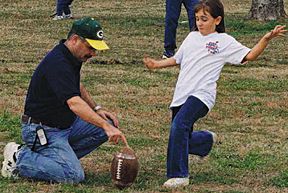
A "punt, pass and kick" competition at Grand Parkway Baptist Church in Sugar Land draws a crowd to the Houston-area church. The event was one of many evangelistic outreach activities during the days leading up to the big game.

“It's important for them to see we are Christians. We love each other,” she said. “We have fun.”

A block party at the Gano Baptist Mission Center provided an event tailored for children, said Kit Lowrance, who directed the gathering.

The effort also served as a lead-in to a Super Bowl watch party the next day at an affiliated mission center.

“We're using this to jump-start our Super Bowl party tomorrow, when the gospel will be clearly presented during halftime and decisions will be made,” Lowrance said.

Leaders of Cloverleaf Baptist Church, just east of Houston, used a similar method in their work. The church held a three-day revival followed by a Saturday sports carnival and a Sunday watch party to reinvigorate their congregation and evangelize people around them.

The congregation's Sunday attendance has dwindled to about 45 after drawing 600 in the past.

Some residents in the surrounding neighborhoods told ministers they did not realize the church still is functioning.

The flurry of activity sparked the community's interest as about 200 people attended the church's Saturday party. Children's smiles and laughter filled the brisk winter day.

“I hope it lets the people in this area know we are reaching out,” Pastor Allan Hughes said. “It seems like the rest of the world has forgotten this place. God hasn't forgotten this place.”

News of religion, faith, missions, Bible study and Christian ministry among Texas Baptist churches, in the BGCT, the Southern Baptist Convention ( SBC ) and around the world.


Texas Baptist Men show Christian love to Iranian refugees in tent city_20904

Posted: 2/06/04

Texas Baptist Men show Christian
love to Iranian refugees in tent city

By Ken Camp

Managing Editor

From hurricanes in Latin America to famines in Africa and Asia, Texas Baptist Men volunteers have been some of the first responders among faith-based disaster relief providers over the last three decades.

But the Texas Baptists who recently returned from Iran were glad an Alabama group had paved the way for them.

A 15-member Texas Baptist Men team, along with three Baptist volunteers from Georgia, worked Jan. 12-20 at a refugee camp on the outskirts of Bam.

The crew cooked meals and provided medical care for displaced residents of the earthquake-ravaged city.

A massive quake the morning after Christmas left three-fourths of the ancient city in ruins.

The volunteers served under the auspices of a non-governmental agency recognized in Iran.

'God with us' disaster relief

They followed an Alabama Baptist disaster relief team. Since “Ala” sounded like the Iranian word for God, “ba” like “with” and “ma” like “us,” the group became identified locally as “God with us disaster relief.”

Fortunately for the Texans who came behind them, the Alabama group lived up to their lofty name and earned a solid reputation in the region.

When the Texas Baptists arrived in Iran, they initially received a cold greeting from a stern governmental worker, according to team leader John LaNoue of Lindale.

But when he told the official they were related to the “Ala-ba-ma” group, “it was an open door,” LaNoue said.

The Texas Baptists worked in a 341-tent refugee camp that housed more than 1,700 people.

“There was not one empty tent in the camp,” LaNoue recalled.

“There may have been three tents with one person in them, but there were some with as many as 14 in them.”

Making a statement

The Texas Baptist Men team cooked more than 3,000 meals and 5,000 cups of hot tea each day for the camp, plus an additional 1,000 meals daily for another camp that was being established nearby.

The volunteers worked 14-hour days, cooking rice, lentils and occasional helpings of lamb in massive four-foot-wide pots.

“Our men ate what the people in the camp ate, but they never sat down to eat until all the people had been served,” LaNoue said.

“It was a powerful statement to those people.”

Through interpreters, LaNoue learned that many of the people in the camp were asking: “Why have these old men come to help us? We see them working when we get up in the morning and working when we go to bed at night.”

While the crew included one 36-year-old volunteer and a 41-year-old doctor, the average age was 63. The oldest volunteer was 78.

“I called them the 'over the hill gang,' but they're on the side of the hill that knows how to do the work,” said LaNoue, who is just a few months shy of 70.

One image that indelibly branded itself on LaNoue's memory was an old Iranian man in Bam climbing to the top of the rubble where his house once stood, removing one brick at a time. He repeated that process for hours each day.

“One brick was all he could carry at one time. He was trying to find his family, who were entombed there.”

While the residents of the refugee camp publicly expressed a growing love and appreciation for the American volunteers, the Texas Baptists remained under close scrutiny by governmental officials.

Some crewmembers were interviewed up to three times a day by authorities who wanted to know why they had come to Iran.

“We told them we had not come because of politics, but because our hearts were broken by the tragedy of the people,” LaNoue said.

“We told them God loved the Iranian people so much, he had instructed us to come help them.”

When asked, the Texas Baptists identified themselves as Protestant Christians, but they were careful not to be perceived as proselytizing.

“We're Christians. Nobody talked about it much, but everybody knew it,” LaNoue said.

Looking back on the experience, he added, “My prayer for the people of Iran is that they will have the opportunity to recognize the truth, that God will bless them with the knowledge of himself … that their physical needs will be met in such a way that they will come to recognize the Giver of good gifts.”

Texas Baptists can contribute financially to the disaster relief project by designating checks “Iranian relief” and sending them to Texas Baptist Men, 333 N. Washington, Dallas 75246-1798.

Texas Baptist Men cooked more than 3,000 meals and 5,000 cups of tea daily for a refugee camp on the outskirts of Bam, Iran.

News of religion, faith, missions, Bible study and Christian ministry among Texas Baptist churches, in the BGCT, the Southern Baptist Convention ( SBC ) and around the world.


Smith nominated as TBM director after serving as long-term interim_20904

Posted: 2/06/04

Smith nominated as TBM director
after serving as long-term interim

By John Hall

Texas Baptist Communications

Texas Baptist Men's personnel search committee will nominate interim director Leo Smith as the organization's executive director when the TBM board of directors meets Feb. 27 at Latham Springs Baptist Encampment.

The nomination culminates a year-long search for a director following the resignation of Jim Ferguson in 2002. The process included praying, reviewing TBM history and interviewing several candidates.

Leo Smith

Smith accepted the interim executive director's position in February 2002, after resigning as the organization's president. The retired pastor has served TBM in a variety of roles for about 25 years.

Smith's leadership of Texas Baptist Men and passion for men's ministry make him the ideal candidate to be executive director, said Kevin Walker of Fort Worth, chairman of the search committee and current TBM president.

“As God revealed himself, the committee came to the conclusion that Leo Smith was the person that God has gifted and prepared to lead Texas Baptist Men. Brother Leo has demonstrated an understanding of spiritual leadership as he has directed TBM through this interim period,” Walker said.

“His leadership has been confirmed by his work within Texas Baptist Men, BGCT staff and the relationships that the organization has with other great commission groups.”

Smith, a member of South Park Baptist Church in Alvin, indicated he is honored by the nomination to lead an organization about which he is passionate.

“I'm very humbled about being nominated,” Smith said.

“I've been working with Texas Baptist Men ever since Bob Dixon came to serve the Brotherhood department of the BGCT. I have a great love for Texas Baptist Men. I've seen God move in marvelous ways as he uses the men literally around the world. To think of leading the organization is an awesome challenge.”

The next executive director will lead TBM as the group attempts to work with volunteers from churches affiliated with the Baptist General Convention of Texas and the Southern Baptists of Texas Convention.

Many Texas Baptist Men members, including several key leaders, are members of SBTC congregations.

Leaders of the breakaway convention said they would start their own disaster relief organization if Texas Baptist Men would not have a relationship with their churches.

Smith tabled a 2002 motion to enter into a “fraternal relationship” with the newer convention, but the group voted to adopt the relationship in February 2003 while explicitly reaffirming its unique connection with the Baptist General Convention of Texas.

TBM offices are located in BGCT facilities, and the convention pays for TBM's operating budget and some ministries.

The TBM executive director serves on the Baptist General Convention of Texas Leadership Council.

Though some SBTC-affiliated churches funnel money to Texas Baptist Men for ministry, the group is not in the SBTC budget.

Many of the other details of the relationship with the newer convention continue being outlined.

The SBTC has started its own retiree builders group.

At the last TBM board meeting, the board instructed its leaders to create a committee to study when the TBM convention should be held.

Smith said he intends to “maintain the integrity of the organization with both conventions,” while retaining a unique relationship with the BGCT.

Closer to his heart, Smith seeks to strengthen men's ministries in churches across Texas. His first priority is filling a position that will work to strengthen men's ministry in congregations.

“My real desire is for people to know Texas Baptist Men as a group of men who have a deep love relationship with God more than men who build churches and do disaster relief.”

“As God revealed himself, the committee came to the conclusion that Leo Smith was the person that God has gifted and prepared to lead Texas Baptist Men.”

Kevin Walker, president, Texas Baptist Men

News of religion, faith, missions, Bible study and Christian ministry among Texas Baptist churches, in the BGCT, the Southern Baptist Convention ( SBC ) and around the world.


Texas Tidbits_20904

Posted: 2/06/04

Texas Tidbits

Brueggemann to lecture at Truett. Old Testament scholar and noted author Walter Brueggemann will present the Parchman Lecture series March 9-11 at Truett Theological Seminary in Waco. His lectures will be presented at 3 p.m. daily in the seminary chapel and are open to the public. For more information, contact Roger Olson at (254) 710-6654.

Joel Gregory

Gregory and Seay share pulpit at Wayland. Joel Gregory, former pastor of First Baptist Church of Dallas, and Chris Seay, pastor of Ecclesia Community in Houston, will headline the 83rd annual Panhandle Pastors' and Laymen's Conference, Feb. 23-24 at Wayland Baptist University. Gregory will lead the conference Bible study, focusing on restoration and reconciliation. Seay will preach on bridging the generations in the church. A special session for Hispanic pastors and laymen will be held at 6 p.m. on Feb. 23 in Brown Chapel on the Wayland campus. Al Guajardo, president of the Hispanic Baptist Convention of Texas, will speak. For more information on the conference, call (806) 291-1165.

UMHB schedules retirement seminar. The University of Mary Hardin-Baylor and the Annuity Board of the Southern Baptist Convention will co-sponsor an investment and retirement seminar for ministers Feb. 26 in the Mabee Student Center on the UMHB campus. For more information, contact the church relations office at UMHB at (254) 295-4620 or email wmuske@umhb.edu.

Baylor provost honored. David L. Jeffrey, provost and vice president for academic affairs at Baylor University, has received the lifetime achievement award from the Conference on Christianity and Literature. The conference is an international organization allied with the Modern Language Association that encourages scholarly exploration of the relationship between literature and the Christian faith.

Howard Payne plans social justice center. A $500,000 gift from Bettie and Robert Girling of Austin will enable Howard Payne University to renovate its historic Coggin Academy building as the headquarters for a new Center for Social Justice. The center will be an undergraduate multi-disciplinary program involving the social work, sociology, psychology and criminal justice departments and the legal studies program. Built in 1876, the Coggin Academy building is the oldest school building in continuous use west of the Mississippi River.

Hardin-Simmons honors young alums. The chairman of the Texas Railroad Commission and an Internet commerce expert have been named Hardin-Simmons University's Outstanding Young Alumni. Victor Carrillo, a 1986 Hardin-Simmons graduate, is a former Taylor County judge who was appointed to the Railroad Commission by Gov. Rick Perry. Leland Harden, a 1984 graduate, is vice chancellor of institutional advancement at New Canoe University and a senior-level executive in Internet commerce. The awards will be presented Feb. 12.

DBU receives foundation gift. Dallas Baptist University has received a $250,000 gift from the Andersen Foundation of Minnesota for a new building project. The International Student Center will serve as a multi-use activity and learning center, including offices for the intensive English program, classrooms, computer-equipped study areas and a lounge for international students.

Baylor diamond leads off. Ferrell Field at Baylor Ballpark, home of the Baylor baseball team since 1990, was spotlighted as the stadium for the month of January in this year's Baseball America's Great Parks Calendar. The Waco stadium was the only collegiate ballpark to be included in the calendar. The magazine selected the Bears' diamond as the third-best collegiate stadium in the nation last year. The stadium features red brick and exposed green steel beams.

DBU enters partnership. Dallas Baptist University has entered a strategic partnership with the Graduate Institute of Applied Linguistics that will enable DBU students to earn a minor or concentration in linguistics. The partnership also will allow the institute's international graduate students to participate in the intensive English program at DBU prior to beginning their course work with GIAL. The institute offers training in applied linguistics and language development, including linguistics, ethnology, language assessment, literacy and Bible translation. Linguistic classes tentatively are scheduled to begin in the fall 2004 semester.

HSU prof named to national exam committee. Michelle Dose, head of the chemistry and physics department at Hardin-Simmons University, has been appointed to a national committee that writes standardized examinations covering material included in most first-semester general chemistry courses. She was named to the committee by the American Chemical Society Division of the Chemical Education Examinations Institute. The exam the committee develops will be available for use by colleges and universities around the nation in the fall of 2006.

Foundation grant boosts Wayland music lab project. A $50,000 gift from the Helen Jones Foundation of Lubbock will help fund an electronic music laboratory at Wayland Baptist University. The grant covers half of the funds needed for the project, which includes installation, faculty training and use of a 15-keyboard SoundTree technology/keyboard lab. The Jones Foundation was established by Helen DeVitt Jones in 1984 from profits from her family's share of the Mallet Ranch in Hockley County. For information on the ongoing campaign to raise funds for the music lab, contact the Wayland University development office at (806) 291-3427.

News of religion, faith, missions, Bible study and Christian ministry among Texas Baptist churches, in the BGCT, the Southern Baptist Convention ( SBC ) and around the world.


Together: Repentance offers sin’s only remedy_20904

Posted: 2/06/04

TOGETHER:
Repentance offers sin's only remedy

Worshipping the past few weeks in an African-American church in Missouri City, a Hispanic church in north Houston and an Anglo church in Seagoville, I have experienced both the joy and the seriousness of worship. God is good all the time. I cherish what I see him doing in the lives of Texas Baptists.

When we worship, we offer ourselves heart and soul to God. Everything in us is touched when we enter fully into his presence.

One often-neglected part of worship is the call to confess our sin before God that we might be forgiven and renewed.

CHARLES WADE
Executive Director
BGCT Executive Board

Isaiah has given us an example of confession in the midst of worship. “Woe to me! I cried I am ruined. For I am a man of unclean lips, and I live among a people of unclean lips, and my eyes have seen the King, the Lord Almighty” (Isaiah 6:5).

Like Isaiah, we must recognize our predicament and our sin–a view of ourselves we avoid as much as possible. We can look in the mirror of our own egos, and by rearranging certain patterns, we make ourselves appear amazingly attractive. Depending on our motivation, looking in mirrors can be a helpful reality check or it can be an excuse for constructing a façade.

Some of us who attend worship regularly want to go away feeling all is well in the earth. We want a God who is all-forgiving and will control things the way we want them controlled. We want to believe it doesn't matter who we are or what we do, as long as we express our love for God. We'd prefer a God who won't ask us to be responsible for our thoughts and behavior. We'd prefer a God who doesn't require us to look within for the sin that needs rooting out.

But if we do not turn our eyes inward to search the paths of our walk, we miss the cleansing and renewing that worship can bring to our lives.

In true worship, it can feel as though the heavens open and God appears.

We see our emptiness. We come face to face with our prejudice, guilt, pride, unloving spirit, critical attitude, jealous ways, greediness, laziness, lack of concern for hurting people and indulgence in destructive diversions of the flesh. We confront our carelessness for being poor stewards of the life God has given us. Unless we are willing to admit our sin, we journey through life in denial and arrogance.

Experiencing the holiness of God through worship illuminates our sin and unworthiness and awakens us to the glory reflected in a holy God. Facing the truth of our condition frees us to respond in humility to God's call to be his servants.

We don't get rid of sin and guilt by ignoring our wounds, pretending we aren't bitter and unforgiving, or rationalizing our wrongdoing by saying we aren't as bad as some people.

When our hearts condemn us and guilt lives in our souls, there is only one remedy for the sickness. Seeing the love and mercy of God, we must turn repentantly from our sin and sorrow, trusting him for forgiveness.

Healing and renewal come only through the forgiveness of Jesus Christ who loves us while we are sinners, just like we are.

“If we confess our sins, he is faithful and just to forgive us our sins and purify us from all unrighteousness” (1 John 1:9).

We are loved.

News of religion, faith, missions, Bible study and Christian ministry among Texas Baptist churches, in the BGCT, the Southern Baptist Convention ( SBC ) and around the world.


West Texas children’s choir warms up to idea of making a difference_20904

Posted: 2/06/04

West Texas children's choir warms
up to idea of making a difference

By John Hall

Texas Baptist Communications

VALERA–The weather may be cold, but some West Texans are staying warm because of a children's choir that set out to make a difference in its community.

Valera Baptist Church children's choir members recently collected several bags of shirts, pants and jackets for a nearby benevolence ministry.

The project offered children a way they could touch their community in a tangible way, said Reta Beck, the pastor's wife and one of the group's leaders.

And the children became excited about the effort. They reminded their parents about it for weeks leading up to the date when the clothes were to be donated. They went through their clothes looking for anything that did not fit or they no longer wore.

The project helped the children become more aware of the needs around them, according to Maricela Morris, who has 6-year-old and 8-year-old boys in the choir.

“They realized there's more to life than what we do every day,” she said. “They know people get sick. They know people need clothes.”

Collecting clothes was how the church participated in M.A.D. (Making a Difference) For Christ, a Baptist General Convention of Texas effort to involve families and groups in community ministries.

Church members were excited when they learned about the choir's ministry during a worship service, said Larry Beck, pastor of Valera Baptist Church.

“It was a great opportunity to do hands-on ministry,” he said. “They did a great job with it.”

Choir members were encouraged by this effort, Reta Beck added. They are looking forward to future service projects.

“I think it made them feel really good,” she said.

News of religion, faith, missions, Bible study and Christian ministry among Texas Baptist churches, in the BGCT, the Southern Baptist Convention ( SBC ) and around the world.


State Department names chief violators of religious liberty worldwide_20904

Posted: 2/06/04

State Department names chief
violators of religious liberty worldwide

By Rob Marus

ABP Washington Bureau

WASHINGTON (ABP)–The State Department's annual report on the status of religious freedom across the globe includes some familiar faces among its chief offenders.

According to the recently released report, China, Burma and North Korea remain among the world's most egregious and systematic violators of religious liberty. Meanwhile, several nations with close ties to the United States–such as Saudi Arabia, Uzbekistan and Israel–continue to repress their citizens' religious freedom either through overt legal oppression or through unequal enforcement of laws that, on paper, protect religious freedom.

Highlighting five broad categories of ways in which nations suppress religious freedom, the report's executive summary listed nations that exemplify each:

Totalitarian or authoritarian regimes that attempt to control their citizens' religious belief or practice. Nations such as North Korea, Burma and Cuba continue to “regard some or all religious groups as enemies of the state because of the religion's content, the fact that the very practice of religion threatens the dominant ideology …, the ethnic character of a religious group or groups, or a mixture of all three,” according to the report.

bluebull Governments that exhibit official hostility toward minority or unapproved religions. Countries like Iran, Saudi Arabia and Uzbekistan, “while not necessarily determined to implement a program of control over minority religions, nevertheless are hostile to certain ones or to factions of religious groups identified as 'security threats.'”

bluebull Governments that neglect in some cases to prevent discrimination against, or persecution of, minority religious groups. In states such as India, Egypt and Indonesia, the report says, “governments have laws or policies to discourage religious discrimination and persecution but fail to act with sufficient consistency and vigor against violations of religious freedom by non-governmental entities or local law-enforcement officials.”

bluebull Nations with legislation or policies that single out specific religions for discrimination. According to the report, Belarus, Israel and Russia are countries that “have implemented laws or regulations that favor certain religions and place others at a disadvantage.”

bluebull Nations with otherwise robust democracies that officially stigmatize religious minorities by “wrongfully associating them with dangerous 'cults' or 'sects.'” The report notes that government officials in many Western European nations–such as Belgium, France and Germany–have doggedly investigated minority groups such as Scientologists, even though their members or officials have not been found to have committed any crimes.

The report also noted that religious liberty “does not exist” in Saudi Arabia. It also said that the Saudi government in 2003 “continued to enforce a strictly conservative version of Sunni Islam and suppress the public practice of other interpretations of Islam and non-Muslim religions.”

John Hanford, U.S. ambassador-at-large for international religious freedom acknowledged that Saudi Arabia “has been very close to the threshold” for being designated a Country of Particular Concern, a designation reserved for gross violators of religious freedom. But rather than apply that label, the State Department has chosen to work with the Saudis toward improvements in religious freedom, he added.

Hanford also said, although Saudi law officially represses all religions except for a strict interpretation of Sunni Islam, other countries with more liberal laws on religious rights nonetheless repress their citizens' religious freedom far more violently than does Saudi Arabia.

The U.S. Commission on International Religious Freedom has repeatedly recommended CPC designation for Saudi Arabia, and the State Department has repeatedly declined to confer it on the oil-rich kingdom, which has long had close ties to the U.S.

Hanford expressed concern about French President Jacques Chirac's support for a ban on Islamic headscarves and other public expressions of individual religious belief in French schools. Noting Chirac's declaration that the French principle of official government secularism is “non-negotiable,” Hanford said, “our hope is that religious freedom is non-negotiable as well.”

Ongoing development of Afghanistan's new constitution also concerned Hanford, particularly a clause in the first public draft of that document providing no Afghan law could be contrary to the principles of Islam.

“Who is going to interpret this clause, and how?” Hanford asked. “We want to be sure that we don't end up with 'Taliban lite'.”

The annual report is in its fifth year since the International Religious Freedom Act established both Hanford's office and the independent Commission on Religious Freedom.

News of religion, faith, missions, Bible study and Christian ministry among Texas Baptist churches, in the BGCT, the Southern Baptist Convention ( SBC ) and around the world.