It’s a full house at the Walls’_22304

Posted: 2/19/04

Full House

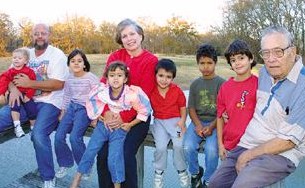
Life at the Walls household near Quinlan is a family affair as Larry and Meg (left and center in right photo) have opened their home. The Wallses started with Buckner Baptist Benevolences as foster parents. Eventually, they began adopting needy children and ended up with a whole new family. Meg Walls' father, Harley Watkins, (far right) lives next door to the family's 10-acre home site. She says the setting is perfect for their ever-growing family, giving the children plenty of room to play. (Scott Collins Photos)

News of religion, faith, missions, Bible study and Christian ministry among Texas Baptist churches, in the BGCT, the Southern Baptist Convention ( SBC ) and around the world.



Peace in Israel requires ‘transforming initiative,’ pastor tells Jewish group_22304

Posted: 2/11/04

Peace in Israel requires 'transforming
initiative,' pastor tells Jewish group

By Craig Bird

Special to the Baptist Standard

SAN ANTONIO—Unequivocal support for Israel as "the last, best hope for democracy, justice, righteousness, liberty, dignity, and peace in a war-weary land" doesn't translate into automatic opposition to the legitimate needs and dreams of Palestinians, a Baptist pastor recently told a Jewish congregation.

Lasting peace will come to Jerusalem—or Gaza—only when people are faithful to the clear commandments of the God of Israel and honor the Jews' "gift of monotheism" to the world, Charles Johnson believes. And he cites the prophet Elisha as his witness.

Rabbi Barry Block (left) and a member of Temple Beth-El greet Charles Johnson (right), pastor of Trinity Baptist Church in San Antonio.

Rabbi Barry Block originally invited Johnson, pastor of Trinity Baptist Church in San Antonio, to speak at Temple Beth-El about "Why Christians Support Israel." But Block readily agreed when Johnson asked to enlarge to topic to "Why Christians Support Israel—and Care About Palestinians Too."

Block admitted the issue is emotional—which makes it all the more vital that people of good faith listen to and learn from each other.

"Truth be told, many Christians who love and support Israel oppose actions of the Israeli government that they feel are wrong," Block said. "And more truth be told, some Jews are not interested in hearing about the complications caused if the concerns of Palestinians are considered."

About 350 people, including numerous Jewish War Veterans wearing their JWV hats and a scattering of Baptists, attended the Shabbat service. Congregational prayers, responsive readings and songs accepted Johnson's message during the 90-minute service.

"Wholeheartedly" affirming his solidarity with the state of Israel, Johnson distanced himself from those whose support for Israel "seems to be predicated on the condemnation—even eradication—of Palestinians.

"Perhaps it is easier to get worked up into a rampage of division than to be reasoned into a path of peace," he noted. "But we all know in our hearts which choice the God of Israel would have us make."

The world—and Christians—are indebted to Israel for the unifying principle of monotheism—a "wonderful vision of the Fatherhood of God" to replace the regional, nationalistic and naturalistic gods "created in the image of human passions and apprehensions" which "fomented division, disunity and fear," Johnson said.

"Israel was the first to understand that we all spring from the same source, we are all brothers and sisters," he explained, decrying an "insidious teaching coming, God forbid, even from some Christian pulpits that folks of other faiths do not seek the same God that Christians seek. We see preachers in America and preachers in Afghanistan saying basically the same thing: God belongs to my nation, my people, my point of view only."

He urged listeners to remember that "God has a center, but he has no circumference," so that "while it is true that some are closer to the center of God than others" no one who is seeking him is "outside the boundary."

Democracy, which values the identical equality of peoples and fairness of opportunity, grew directly from the concept of monotheism and the practical application of that truth by the prophets of Israel who insisted the rights of the poor and powerless be protected and honored by the government, Johnson insisted.

He urged freedom- and liberty-loving Jews to introduce a "surprising, transforming initiative" into the downward, out-of-control spiral of violence pitting suicide bombers against military strikes.

Johnson told an Old Testament story recorded in 2 Kings chapter 6. One day, the people of Jerusalem awoke surrounded by a Syrian army. When God struck the invading soldiers blind the king twice asked the prophet Elisha if it would be all right with God if his army slaughtered the confused and helpless Syrians. But, against all military and political wisdom, Elisha said it would not. Even more astonishing, Elisha ordered the Israelites to give their would-be murderers food and water—and then release them unharmed.

"But the really amazing part of this story is in the last line that reads: 'and the Syrians came no more to raid the land of Israel,'" Johnson said.

Elisha's wise counsel "changed the entire outlook and perspective of the opposing nation toward its foe," he pointed out. "And it is such a surprising, transforming initiative that Israel must imagine and present into the calculus of chaos now controlling the situation in Jerusalem and Gaza and the West Bank."

His faith in God and in the nation of Israel allows Johnson to have "every full conviction that a workable, just peace can and will be established in the Middle East.

"At present voices of extremism and division seem to have seized the momentum," he said. "But this will not persist. There will arise prophetic voices of moderation and reason from both the Israeli and Palestinian sides that will advocate the clear will of the people to secure a lasting peace."

News of religion, faith, missions, Bible study and Christian ministry among Texas Baptist churches, in the BGCT, the Southern Baptist Convention ( SBC ) and around the world.


Memorial Church marks memorable day with time capsule_22304

Posted: 2/19/04

Memorial Church marks memorable day with time capsule

By George Henson

Staff Writer

BAYTOWN–February fifth Sundays only come around three times a century, and at least one member of Memorial Baptist Church in Baytown believes they should be memorable.

Brian Nethery recalls the last one vividly. It was high attendance Sunday, and the 10-year-old boy was thrilled to pose for a panoramic congregational photo that would be placed in a time capsule for 28 years, when Feb. 29 would fall on a Sunday again.

Newspaper accounts of the service record that members were asked to sign a historical scroll and place it in the time capsule to be opened Feb. 29, 2004.

That date is fast approaching.

Members of Memorial Baptist Church in Baytown posed for a 1976 photo preserved in a time capsule, scheduled to be opened Feb. 29.

Memorial is again going to make the day special. All three staff members serving the church when the time capsule was sealed in 1976 are expected to attend–Pastor Ed Thiele, Minister of Education George Nielsen and Minister of Music Bill Baker.

Nethery, still a member of the church, was the first to recall the 1976 event and is spearheading this year's commemoration.

The event made a bigger imprint on him than most. “Even my parents and their friends didn't remember at first,” Nethery said.

Finding the time capsule was a challenge, but eventually it was located.

Once again, the church has prepared items for a time capsule to be opened in 2032. Another photo of the congregation will be taken, and other written, photographic and video records will be placed in the time capsule.

A catered lunch will follow the service. Reservations can be made at (281) 427-1725.

While memory of the initial event may be a little foggy for some, Nethery believes recalling the day has importance. Pastor Brad Hoffman agrees.

“Part of the importance is to be able to celebrate the heritage of the church,” he said.

“This is a great opportunity to celebrate the past ministry of Memorial Baptist Church while focusing on the church's continuing ministry to the community in the future.”

News of religion, faith, missions, Bible study and Christian ministry among Texas Baptist churches, in the BGCT, the Southern Baptist Convention ( SBC ) and around the world.


Students stick to prayer at start of each school day_22304

Posted: 2/11/04

Students stick to prayer at start of each school day

By George Henson

Staff Writer

DALLAS—Some schoolchildren may use daily classroom moments of silence to pray for all "A's." Park Cities Baptist Church in Dallas created a cheat sheet to help them do it.

Last year, the Texas Legislature mandated a moment of silence in public schools at the beginning of each day.

The children's ministry at Park Cities Baptist Church developed a tool to help children use the time wisely, said Tommy Sanders, minister of childhood education.

"I have children in public schools and volunteer in public schools a lot, and it's been my experience that children don't know what to do with that time," he said.

The church distributed stickers that children can adhere to their assignment folders or notebooks to guide them as they pray.

"We knew there were a lot of acrostics to guide prayer out there, but we wanted to do something new," Sanders said. "Boys and girls often want to get A's in school, so we thought we would give them something to go along with that idea.

The stickers point students to words beginning with "A" such as adore, admit, appreciate, ask and amen, and they offer suggestions about how they could be incorporated into prayer.

For example, for the word "ask" the child is told: "Think about those who are sick or have other needs. Pray for needs you have. Remember to pray for your family, friends and teachers at school."

Each child at church was provided with one sticker, but some have asked for more to give to friends, Sanders said.

The idea has been well-received, especially by parents.

"Most of what we have heard has been from parents, and they have been so encouraged that their children now can make better use of this time," he said.

News of religion, faith, missions, Bible study and Christian ministry among Texas Baptist churches, in the BGCT, the Southern Baptist Convention ( SBC ) and around the world.


Church brings sound of music to young people in small East Texas town_22304

Posted: 2/11/04

Steve Richardson instructs Zachary Dillahunty with his trumpet (left) and Kim Sharp teaches Landon Parker on the piano at the community music school sponsored by Central Baptist Church in Livingston.

Church brings sound of music to young
people in small East Texas town

By George Henson

Staff Writer

LIVINGSTON—Central Baptist Church of Livingston is bringing the gift of music—and the sweet melody of Christian love—to young people in a small East Texas town.

Music Minister Joel Salazar knows well the plight of students in the area who had to drive many miles for music lessons. His wife drove 90 minutes each direction so their daughter could attend violin lessons in The Woodlands.

"She had a wonderful instructor, but when you think of the time and expense of a drive like that each week for three years, there just had to be a better way," Salazar said.

He also knew his family wasn't the only one facing the problem. "Most people have to travel at least an hour to find instructors of certain instruments," he said. "I have been here for 13 years, and people always ask me: 'Do you know someone who teaches piano or guitar or some other instrument?'"

He came to see the problem as an opportunity for ministry.

In September 2002, Central Baptist Church launched its school of the arts. The school brings instructors to the church, allowing students to meet in a central location near their homes.

The first year, 61 students enrolled. Ten instructors offered guitar, electric guitar, banjo, electric bass, mandolin, harmonica, piano, organ, trumpet, percussion, violin, viola and cello lessons.

Some instruments have a waiting list for lessons. Classes also are offered now in flute, saxophone, oboe and clarinet.

This year, 91 students have registered. Of that number, 23 are adults, while children ages 6 to 12 make up the bulk of the students with 38. Forty students are members of church, but 17 students have no church affiliation.

Salazar thinks so many students without church affiliation is a great asset of the program.

"This is a wonderful way to let them see who we are," he said. "We use every opportunity offered us to show charity and love to our students as well as our instructors."

Almost all of the instructors are praise and worship leaders from churches not only in Livingston, but also Lufkin, Jasper, Trinity, Liberty and Huntsville.

Students hail from Livingston, Coldspring, Leggett, Oakhurst, Goodrich, Onalaska, Cleveland, Shepherd, Dallardsville and Trinity.

Classes meet on Mondays from 4 p.m. to 10 p.m., with each student receiving a 30-minute private lesson. Each student pays $50 per month for classes. For some instruments, the church supplements the teachers' pay so quality instruction can be maintained.

"The church has been very gracious and understands that the musical education of a child is important and takes a commitment," Salazar said. The church's subsidy of the lessons is $525 per month this year. The money for the subsidy is collected through a banquet and special gifts from members.

In addition, a Sunday school class, Women on Mission, and an anonymous church member have given $1,755, providing three full scholarship and one partial scholarship for students who cannot afford to pay.

The benefit to the church is obvious, Salazar said. All of the members of the praise band that plays for the church's Wednesday night youth meeting are students of the school.

"Before our school was in existence, it was difficult to find youth who were instrumentalists, so our adults were helping play. With over 30 children and youth taking guitar, piano and percussion, we are seeing a resurgence of players being trained for God's service today and in the future," he said.

Students are learning so quickly that a second night with longer lessons for advanced students probably will be added soon, he said.

Salazar also is using the concept as an outreach tool at the Hispanic mission Central Baptist Church sponsors. He takes an hour out each Monday to go the mission, where he teaches piano, organ, guitar, bass and percussion. He also helped the youth prepare a drama for Christmas.

"It was the first time they had done anything like this, and it was a success in that we had one come to Christ as a result of the drama," he said.

"A young couple who had just started coming to church joined us in the drama. They had been living together and came to know Christ, got married, and the wife came down this past Sunday to be baptized due to their involvement in the play."

Youth involvement at the mission has increased dramatically as well.

"Both at the church and the mission we are seeing a lot of kids who maybe have never really been involved in sports or anything like that, and this gives them something besides Nintendo to excel in," he said.

"This has just been a wonderful ministry for not only the people in our church, but for the community as well.

"People ask me if I would do this in a different setting, and I say, 'Of course.' This allows us to touch people we ordinarily would not get to."

News of religion, faith, missions, Bible study and Christian ministry among Texas Baptist churches, in the BGCT, the Southern Baptist Convention ( SBC ) and around the world.


Cibolo church learns more than just history lesson from tabernacle replica_22304

Posted: 2/11/04

Cibolo church learns more than just
history lesson from tabernacle replica

By George Henson

Staff Writer

CIBOLO—Israelites who carried the tabernacle through 40 years of wilderness wanderings probably never expected it to end up in South Central Texas, just outside Cibolo.

Of course, Moses' fingerprints are nowhere to be found on this tent or its contents. But the replica is made to the exact dimensions dictated in Exodus, even though some materials have been changed—anodized aluminum in place of gold, for instance.

Cibolo Valley Baptist Church set up a replica of the Tabernacle on its property.

Watching the tabernacle being constructed on property behind the Cibolo Valley Baptist Church gave pastor Gene Tone a new respect for the Israelites.

"I watched them put it up and watched them raise the walls, and I have a new appreciation for Moses and those folks," Tone said.

"I can't imagine them traveling around the desert carrying that tabernacle and putting it up and taking it down maybe 30 times in 40 years. That took a great deal of dedication to the Lord."

The tabernacle is the property of Teen Missions International, a youth missions agency headquartered in Florida.

"We have some families whose teenagers have gone off on mission trips with Teen Missions International and we learned about the tabernacle through those families," Tone said.

Church leaders saw photographs of the tabernacle, found out more information about it, and decided it "had some real value for the church," he said.

Cibolo Valley Baptist Church paid $3,500 to prepare the site for the tabernacle, but Tone said it was worth it. The tabernacle replica inspired the church to study the significance of the place where the Hebrews believed God made his presence known.

"Most of our people have gone through it now, and they have a greater awareness that the tabernacle was the shadow of Christ," he said.

In combination with a FAITH outreach emphasis and a growing population in the area north of San Antonio, the tabernacle gave his church members a conversation -starter for inviting people to the church, he said.

The tabernacle also gave the church a much greater visibility in the community. "Our church sat over here for 20 years and has never done much advertising. We were here, but no one knew it. Now they do."

Suggested donations of $9 for adults and $7 for children ages 6-11 to tour the tabernacle help support the Teen Missions International ministry to AIDS orphans and street children throughout Africa. More than 13 million orphans inhabit sub-Saharan Africa, most of their parents dead of the AIDS epidemic.

Tour guides describe different aspects of the tabernacle and the ways they foreshadow the coming of Christ. Tours begin on the hour from 9 a.m. to 6 p.m. Monday through Saturday, and from 1 p.m. to 6 p.m. on Sundays. Almost 1,500 people have toured the tabernacle since its arrival in November. It will be at the Cibolo church, on FM 1103 just off Interstate 35, until April 30. For group reservations, call (210) 566-3388.

News of religion, faith, missions, Bible study and Christian ministry among Texas Baptist churches, in the BGCT, the Southern Baptist Convention ( SBC ) and around the world.


Exemption loss presents Kingsville church a taxing dilemma_22304

Posted: 2/11/04

Exemption loss presents Kingsville church a taxing dilemma

By Ken Camp

Managing Editor

KINGSVILLE—A small South Texas church could owe up to $10,000 in back taxes on two church-owned properties unless a county authority restores the facilities' tax-exempt status.

Kleburg County Tax Assessor Tina Flores removed the property tax exemption on two buildings owned by University Baptist Church in Kingsville—a house where the church's youth minister lived and a former nightclub the church was using for a variety of community outreach ministries.

The residence was used for youth Bible studies and as an editing studio for the church's tape and cable broadcast ministry, as well providing lodging for the student minister, said Jerry Tanner, pastor of University Baptist Church.

The other building was "a beer joint that went bankrupt and that had been donated to us to use for religious purposes," Tanner explained. The church used it for community classes ranging from aerobics and martial arts to sculpture and archery.

New Hope Baptist Church, an African-American congregation, also has been meeting for Sunday worship at the multi-purpose facility for nearly two years, since its previous building was destroyed by a storm.

Tanner contested the denial of tax exemption by the tax appraisal district but said officials told him the residence was ineligible for tax exemption because the youth minister was a college student, not an ordained or licensed minister.

The multi-use facility was denied tax-exempt status because it was used for a Christian exercise program, and a tax-exemption would give the not-for-profit aerobics program an unfair competitive advantage over other local, for-profit exercise facilities, he said.

"I'm an ex-pilot for the U.S. Air Force, not a lawyer," Tanner said. "I have no legal background, but I can read. And I've read the property tax code and the laws that apply."

The Texas tax code says a house is tax-exempt if it is "used exclusively as a residence for those individuals whose principal occupation is to serve in the clergy of the religious organization."

The code also says real estate owned by a church is tax-exempt if it is "used primarily as a place of regular religious worship, and is reasonably necessary for engaging in religious worship."

It stipulates that using the property "for occasional secular purposes other than religious worship does not result in loss of the exemption if the primary use of the property is for religious worship and all income from the other use is devoted exclusively to the maintenance and development of the property as a place of religious worship."

Tanner maintained both facilities owned by University Baptist Church should have qualified for tax-exempt status, and he appealed the tax-exemption denial to the appraisal district's board.

One board member for the appraisal district called for the tax exemption on the two church-owned properties to be reinstated in December, but she was voted down 3 to 1.

"We're looking at a $10,000 bill if we can't lick this," Tanner said, noting that would be about 10 percent of the small church's annual budget.

Flores was reluctant to discuss the issue because the church still has the option of bringing legal action. She noted her office had been "going round and round" with the pastor about the issue for about three years, trying to give the church time to come into compliance with her understanding of the tax code.

But Flores confirmed the church-owned house was denied tax-exemption because the resident was not an ordained pastor.

"I'm a lay minister myself in the Catholic Church, so I know how important lay ministers are. The service they render is good, and the church wouldn't be able to go on without them. But they're not the pastor," she said.

Flores contacted the State Comptroller's office to verify that the tax-exemption was limited to pastors and ordained clergy, she said.

Tanner disputed the charge that the church's youth minister was not clergy. "My understanding of the law is that if a congregation treats you as clergy, you are clergy. The person who was living in the house was hired under the clergy bylaw of our church," he said.

Since the youth minister moved, the church has used the facility as a headquarters for its ministry to singles. Ironically, Flores noted that the facility would qualify for tax-exempt status now, if the church could present evidence that it was being used for that purpose. But that would not affect the back taxes owed for the time when it was a residence.

"There is a garage apartment in back and we already exempted that portion of the property because it's being used by the church for a clothing ministry for the poor," she pointed out.

Concerning the multi-purpose facility, Flores maintained the building was used for non-church functions a majority of the time.

"We looked at the area and saw posters for jazzercize and karate classes," she said. Flores commented it didn't look like a place of worship, and the church did not present clear evidence that it was being used for that purpose.

Tanner refuted the assertion the multi-purpose building was a commercial property, as well as the allegation he failed to provide evidence the facility was used for worship.

Participants in the Christian aerobics class paid only a nominal fee for utilities and upkeep of the facility, he said, and even that payment was inadequate to meet expenses.

Regarding the fact another congregation used the facility for worship once a week, Tanner said the appraisal district faulted the facility for not looking like a church building or posting a noticeable sign identifying the facility as a church.

"So we have a county board telling us how a church should advertise and what its facility should look like," Tanner said.

C.L. Foley, pastor of New Hope Baptist Church, lives in Brownsville and said he cannot say for sure how the facility is used six days a week. But he has no question about its religious use on Sundays.

"It doesn't have to look like a church with a steeple and all that," he said. "It's where we worship and fellowship. … Whenever we meet, it constitutes a church."

News of religion, faith, missions, Bible study and Christian ministry among Texas Baptist churches, in the BGCT, the Southern Baptist Convention ( SBC ) and around the world.


Semester missions helps confirm Wayland student’s calling_22304

Posted: 2/11/04

Students from Clark University and other schools in Worcester, Mass. (left), enjoy a game of Scrabble during the “Ignite” coffeehouse held as a ministry of the Worcester Collegiate Christian Network. Wayland senior Steve Howe (right, center) enjoys dinner with two Christian student leaders at Clark University, freshman Kevin Vagen, left, and sophomore Heidi Kaufmann.

Semester missions helps confirm
Wayland student's calling

By Teresa Young

Wayland Baptist University

PLAINVIEW–For many college students, putting off their final semester before graduation would be unthinkable. But for Steve Howe, it was simply a matter of following God's call.

Howe, a senior religion major at Wayland Baptist University, returned in January from a semester missions venture in Massachusetts. A native of Buda, Howe spent his semester on the other side of the desk, serving as a collegiate minister at Clark University in Worcester, Mass.

The idea for the trip came last spring after a guest speaker at a Wayland worship service spoke on the need for ministry workers in New England, specifically Connecticut.

"I'd never really thought about that area, but I really felt like God was laying it on my heart," Howe said. Although he'd be putting off his last semester of school—delaying graduation by six months–Howe said he "kept feeling like God wanted me there."

He registered with Go Now Missions, a project of the Baptist General Convention of Texas student ministries office and planned to go to Connecticut. No positions in that area were available. But with Howe intent on his calling, the Baptist Student Ministries office found a position for him in Massachusetts.

During his semester at Clark, Howe was one of four collegiate ministers affiliated with the Worcester Collegiate Christian Network, working with seven of the 12 universities in the town.

Howe had been active in the BSM at Wayland and was familiar with its programs and ministries, but he said the experience was an eye-opener for him.

"There was no real program there like we're used to. Here, we rely heavily on our programs to get students to come hear the message," he said. "Without programs, though, it forces you to get out where all the students are."

To that end, Howe said his typical day involved spending a few hours in the cafeteria visiting students and building relationships. In the afternoons, he'd set up in the common areas and play his guitar. At first, he questioned his effectiveness, but he later realized the methods were necessary in a culture so different from his own.

"People would come up eventually and ask me why I wasn't in classes or what I was doing, and I got a chance to say, 'Funny you should ask. …' and tell them a little about what I was there for," Howe said.

He helped lead a biweekly service called "Ignite," which rotated between university campuses in order to involve more students. Sometimes the service followed a traditional worship format. Other times it was styled like a coffeehouse or a discussion session. He also held a Bible study on campus one night a week, featuring topical lessons relevant to students.

But in retrospect, Howe said one of the most effective evangelistic tools employed was holding jam sessions in one of the campus dorms, playing along with one of the Christian student leaders.

Between their sets of secular music and popular tunes, Howe said, they'd sneak in a worship song or two, which was a "very non-threatening presentation of the gospel." The sessions gave them a chance to visit afterward with curious bystanders or dorm residents.

The biggest lessons Howe learned involved realizing how differently religion is viewed in different parts of the country.

"Some are really jaded toward Christianity because they see some who are supposed to be Christians but don't live like it," he said. "At Clark, they're pretty liberal and open-minded, which just means they'll listen to what you say, but they don't want you to push anything on them.

"Absolute truth is not a popular idea to talk about, so we had to be really tactful when we presented the gospel. God really convicted me about my mindset about other religions and having a greater sensitivity toward people who aren't Christians."

The semester confirmed a calling to collegiate ministry Howe had felt for some time, but he said God reworked his ideas of what that entailed. He also had to realize numbers in ministry are not what count, and God has bigger plans than humans can accomplish alone.

"You walk in thinking that you're going to do all these great things, but I think I came away receiving more than I gave away," he said. "God really reduced me to the place where I realized I'm just a guy trying to reach out and not judge people."

Howe found solace in knowing that he had helped disciple student leaders on the Clark campus who will make an impact long after he's gone. But he hasn't completely ruled out the idea of returning to the area when he graduates in May. And whether he chooses that route or opts to continue his education at seminary, Howe believes God has given him a new passion for college ministry.

News of religion, faith, missions, Bible study and Christian ministry among Texas Baptist churches, in the BGCT, the Southern Baptist Convention ( SBC ) and around the world.


French ban on religious symbols sparks international outcry_22304

Posted: 2/12/04

French ban on religious
symbols sparks international outcry

By Ken Camp

Managing Editor

France's lower house of parliament has voted overwhelmingly to prohibit students from wearing "conspicuous" religious symbols in public schools, sparking an outcry from religious liberty advocates in the United States.

The French National Assembly voted 494 to 36 on Feb. 10 to ban "signs and dress that conspicuously show the religious affiliation of students." The measure goes to the French Senate next month. If approved, it would take effect in September.

Debate in France over the issue has continued for about 15 years. In 1989, two girls were kicked out of a school near Paris for wearing head scarves, and many others have been expelled since then.

If France implements the ban on religious wear in schools, it could violate international commitments the country has made, said Michael Young, chairman of the United States Commission on International Religious Freedom.

The European Convention on Human Rights, endorsed by France, guarantees the rights of individuals to "manifest religion or belief, in public as well as in private," Young noted in a statement released prior to the French legislature's vote.

"Increased immigration in France in recent years has created new challenges for the French government, including integration of these immigrants into French society, as well as problems of public order," he said.

"But these challenges should be addressed directly, and not by inappropriately limiting the right to freedom of thought, conscience, religion and belief. The French state's promotion of its understanding of the principle of secularism should not result in violations of the internationally recognized individual right to freedom of religion or belief."

The French assembly's decision is "an outrageous violation" of the United Nations Universal Declaration of Human Rights, said Richard Land, president of the Southern Baptist Convention's Ethics and Religious Liberty Commission and a member of the U.S. Commission on International Religious Liberty.

The international commission has called on the U.S. State Department to protest the action, he noted. The only realistic hope for preventing this "appalling law" from being implemented would be if France received pressure from the world community and other European nations, he said, pointing to the measure's popularity in French opinion polls.

The action sends an "ominous signal" that France is seeking not only a secular state that is neutral toward religion, but also the advancement of an enforced secular society "where secularism become the preeminent value," Land said. "It appears the French government is frightened of any vibrant expression of religious faith and wants it to be suppressed in the public square."

Secularists in the United States likewise want to silence religious speech in the American public square, he added. "France is not the only place that has secularists."

The French National Assembly's vote to ban religious symbols in public schools is "an unfortunate decision borne out of a lot of political considerations and the desire to create a secular culture and what some in this country would call a naked public square," said J. Brent Walker, director of the Baptist Joint Committee on Public Affairs, a Washington, D.C.-based religious liberty group.

But while some in the Religious Right have equated church/state separation in the United States with hostility toward religion, the National Assembly's decision shows the French notion of church/state separation is "a whole different ballgame" from the United States' version, he said.

In the U.S., church/state separation safeguards free exercise of religion, he stressed. "In the United States, students are allowed—and should be allowed—to wear religious symbols and express themselves and their religious beliefs, as long as those expressions are not disruptive. … If the far Right wants to see a truly secular, naked public square, look at the French situation."

The National Assembly vote signals "religious liberty is at risk in France," according to Phil Strickland, director of the Baptist General Convention of Texas Christian Life Commission.

"I cannot imagine how the French government finds a compelling reason to tell religious schoolchildren what they can or cannot wear," Strickland said, adding government has no business promoting religion or prohibiting religious expression.

"Will the next step be to prohibit voluntary prayer in schools? The flip side would be what some in the U.S. promote—for the state to require students to pray government-approved prayers. That would be truly scary," he said.

While the French vote bans all "conspicuous" religious garb—Jewish skull caps and Christian crosses, as well as Muslim head scarves—some argued the measure was directed primarily at Islamic and Sikh immigrants. The danger of any minority religion being singled out always exists, and it should serve as a cautionary word to the U.S., Walker noted.

If American public school students were prevented from wearing religious symbols, it would be "wrong and unconstitutional if it were done across the board. It would be doubly wrong and unconstitutional to single out any particular religious group," he said.

Nobody in the United States can "get inside the head" of the French legislators and judge their motivations with certainty, but it appears "an underlying discrimination against Muslims" prompted the National Assembly vote, said Derek Davis, director of the J.M. Dawson Institute of Church-State Studies at Baylor University.
"It disturbs me if, in fact, that was the motivation," he said. "I'm glad I'm not a Muslim woman living in France."

News of religion, faith, missions, Bible study and Christian ministry among Texas Baptist churches, in the BGCT, the Southern Baptist Convention ( SBC ) and around the world.


ETBU guaranteed cost plan will lock in expenses_22304

Posted: 2/19/04

ETBU guaranteed cost plan will lock in expenses

By Ken Camp

Managing Editor

Students who drop out of college often cite finances as the key reason, but the real problem is inability to plan for cost increases, administrators at East Texas Baptist University believe.

That realization prompted ETBU to adopt a guaranteed cost plan to “lock in” students' tuition, fees, housing and meal costs for four years, said Bob Riley, president of the Marshall school.

ETBU had been considering changes in its rate structure for several years, Riley said. But declining enrollment last fall spurred leaders at the school to accelerated action.

ETBU President Bob Riley announces his school's guaranteed cost plan at a news conference in Marshall.

University representatives questioned non-returning students about what led to their decision to withdraw from school, and financial considerations topped the list.

“We determined it really was a financial planning issue, so we started looking at guaranteed cost plans at other schools to see what we could learn,” Riley said.

Guaranteed cost plans have become increasingly popular in higher education in recent years. Last month, for instance, Howard Payne University trustees approved a guaranteed tuition program, effective in the fall 2004 semester. At that point, the block tuition rate per student would be locked in at $5,500 for as long as a student is enrolled full-time for consecutive fall and spring semesters and progressing toward a degree.

“We used the best of all the models we could find in putting together our guaranteed cost plan,” Riley said. “The distinctive thing about our plan is that it includes all four pieces–tuition, fees, room and board. As far as we know, there's nobody else in Texas doing it that way.”

The ETBU plan locks in tuition, most fees, housing and meals at $7,850 per semester before any scholarships or grants are applied. The guarantee, effective this fall, extends for eight semesters, providing a student takes 12 to 18 hours per semester.

Students taking fewer than 12 hours or more than 18 will be charged an hourly rate. The guaranteed cost does not include music fees or other similar fees applicable to certain programs.

The plan also allows a student enrolled full-time for the academic year to take a three-hour course during the May, June or July term at no cost.

This permits a student who drops back to a minimal 12-hour class load one semester to “catch up” in the summer and stay on schedule for graduation in four years, Riley noted.

It also makes participation in the university's international study program more affordable and achievable, if students can enroll in a three-hour travel study course at no cost other than for travel expenses, he added.

Surveys at some large state schools recently showed students taking an average of five and one-half years to complete an undergraduate degree. But ETBU administrators believe a four-year bachelor's degree should be completed in four years, and a college education should not create an unreasonable financial burden for families, Riley said.

“We want students to be able to leave here in four years with a degree in hand and with a minimal amount of money owed in student loans,” he said.

News of religion, faith, missions, Bible study and Christian ministry among Texas Baptist churches, in the BGCT, the Southern Baptist Convention ( SBC ) and around the world.


True Vine Baptist Church growing like kudzu, baptizing 120 in 10 months _22304

Posted: 2/12/04

True Vine Baptist Church growing
like kudzu, baptizing 120 in 10 months

By George Henson

Staff Writer

SAN ANTONIO—True Vine Baptist Church has grown like kudzu, nourished by the richest of sources—its baptismal waters.

Pastor Jesse Grice started the church in his home in 1993. But the congregation soon outgrew his living room, and it moved to a storefront facility.

Last April, the 95-member church moved to its first permanent facility. Since then, the church has baptized more than 120 new believers in Jesus Christ.

Recently, the church added an early worship service. Combined attendance at the two Sunday morning services averages about 270.

"There's no other explanation other than the grace and power of God," Grice said. "We try to preach messages that touch people's hearts with the love of Christ, but it's God's power that is making the difference."

The church is located on the west side of San Antonio about two miles from Sea World. The area is booming with new residential areas, Grice said, and his church is concentrating on meeting the new families.

"We're consciously not going after people who already have church homes, so these new families are perfect because most of them either don't have a church or have moved away from it," he said.

Growth in attendance indicates most of those who are baptized are remaining faithful. "We're working very hard to close that back door of the church, so to speak," Grice said.

New members go through a five-week course in which they not only learn more about their new found faith and church, but also their responsibilities as a Christian.

True Vine traditionally has been an African American church, but that is changing as Anglos, Hispanics and Asians are now a part of the congregation.

Grice said that presents no problem. Instead, seeing people come to know Christ on a regular basis has brought a sense of excitement to the congregation.

"We come expecting God to do something and he does as each week more people come to know Jesus as Savior. "

Many who become Christians make their profession of faith outside the context of a Sunday morning worship service, Grice said.

"For example, a woman came to me one Sunday and said she wanted to talk to me about being baptized. Well, when she came for her appointment she brought her three children—ages 12, 14 and 16. Before we were through talking, all three of them made professions of faith and were baptized too," Grice recalled.

"We're just preaching the gospel. God is doing the rest."

News of religion, faith, missions, Bible study and Christian ministry among Texas Baptist churches, in the BGCT, the Southern Baptist Convention ( SBC ) and around the world.


Get small to make big campus impact, college students told_22304

Posted: 2/13/04

Get small to make big campus
impact, college students told

By Ferrell Foster

Texas Baptist Communications

GRAND PRAIRIE—Small groups make a big impact on college campuses—one life at a time, ministry leaders recently told a student conference.

More than 400 college students learned the power of getting small at a Feb. 6-7 Small Groups Conference at The Oaks Baptist Church in Grand Prairie. The Center for Collegiate Ministry of the Baptist General Convention of Texas sponsored the event.

Four things make small groups special—relationships, unity around a common purpose, strength in the body, and personal and spiritual growth, said Chris Sammons, Baptist Student Ministry director at Hardin-Simmons University in Abilene.

Dave Jobe, pastor of Willow Bend Church in Plano, talks to students during the Small Groups Conference, Feb. 6-7.

"God truly has created us to live in community," Sammons said.

Relationships allow people to share their lives, and it's much easier to build relationships in small groups than in large ones, he added.

Building small group relationships starts with the leader, he said. That person is not just a facilitator.

"Your task is to invest yourself" into the lives of group members, he explained.

People in small groups must spend time together and share experiences outside of the weekly group setting, Sammons continued. He suggested having lunch together, going to a movie, shopping, playing sports, doing a ministry project, going to games and taking a "road trip" just to get away.

Students often are quick to end relationships. he warned. "The semester ends and so does our small groups and our relationships."

That's not how it should be done. "Relationships take time. They're not microwaved; they're slow-cooked," Sammons said.

Small group relationships enable members to strengthen one another. "We are most naturally meant to live and serve in small groups," Sammons said. "We are best able to fight the tough battles when we depend on others to hold us up."

Finding time and making the necessary commitment can be difficult. "Everybody's busy," he said. "We must seek to respect people's time, but seek to establish a commitment from group members."

Students join in prayer.

Conflict also can arise. It comes from a variety of causes—poor communication, insecurities, misunderstandings, "personal baggage" and others. But conflict is not a bad thing if group members can grow through it, Sammons said.

To handle conflict in small groups, he suggested students pray, value the person, speak directly to people and don't seek to win every fight.

Dave Jobe, pastor of Willow Bend Church in Plano, encouraged the students to follow Jesus' model and "draw the circle" of relationships bigger in their lives, but do it one person at a time. Don't focus on the masses, concentrate on individuals, he emphasized.

Building a small group the way Jesus would do it requires dependence on the Holy Spirit, Jobe said, because inner transformation of people's lives will not occur unless the Spirit is truly at work.

Jesus' ministry also indicated the importance of discerning God's timing, Jobe said. Group leaders should pay attention to what's going on in the lives of "that little flock in your life."

Jesus modeled the importance of staying the course. "We cannot quit," no matter what obstacles arise, Jobe said. When Jesus calls a person to follow him, that means having to "walk through, at some time or another, the same obstacles he did."

News of religion, faith, missions, Bible study and Christian ministry among Texas Baptist churches, in the BGCT, the Southern Baptist Convention ( SBC ) and around the world.