




Posted: 6/11/04
After 50 years, Gallup passes
his poll on to next generation
By G. Jeffrey Macdonald
Religion News Service
SOUTH HAMILTON, Mass. (RNS)–For the past half century, the Gallup Poll has been phoning strangers, asking personal questions and then telling the world what Americans believe on topics from prayer to haunted houses and the afterlife.
The Gallup Poll's fascination with religion and spirituality has had little to do with the usual rationale for polling–a client's need to accrue market research data. Instead, the polling giant has been probing the inner life of Americans for a far more personal reason–the boss wants to see souls saved.
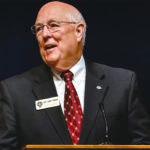
| George Gallup Jr. delivers the commencement speech at Gordon- Conwell Theological Seminary. Gallup, who is retiring after 50 years as a pollster, believes “the most profound purpose of polls is to see how people are responding to God.'' Photo courtesy Gordon Conwell Theological Seminary. |
“The most profound purpose of polls is to see how people are responding to God,” George Gallup Jr. said after giving the spring commencement speech at Gordon-Conwell Theological Seminary. “When I ask a question on these subjects, what I'm always trying to find out is: 'Are we doing the will of God?'”
After 50 years in the family business, Gallup finally has traded his pollster's cap for quieter days in retirement. Although he plans to remain influential in the business and active in its outreach projects, he will no longer craft the questions or write the analyses that have earned him opportunities to give weekly public speeches and author 16 books.
Before stepping aside, however, Gallup seized the chance to share more than the latest survey data with a graduating class of soon-to-be evangelical pastors. After rattling off a few significant figures, he went where he never goes in his official analyses, adding a sermonic spin that tells where his heart has been all along.
“The world knows a lot about Jesus, but do they know him?” Gallup asked the commencement crowd. “It is for the churches to seize this moment, to take the vague spirituality of the day and turn it into a faith that is solid and transformative.”
Gallup, now 74, could have been a priest at age 24. He explored the calling then while volunteering at an Episcopal church in Galveston.
But he came to believe the enterprise founded by his father in 1935 “could be a ministry.” So upon graduation from Princeton University with a degree in religion, he went to work beside his dad as an assistant editor. Primary task–write good questions.
Over the decades, the polling enterprise transformed from a wonkish interest practiced by a smattering of eccentrics to a dominant force in American marketing and politics.
All the while, Gallup was writing questions that would take the nation's pulse on crucial issues–abortion, gun control, the Vietnam war. Through times of peace and tumult, however, he never lost interest in also “measuring” what he understands to be the work of the Holy Spirit.
For instance, at the start of this new millennium, Gallup has found that 50 percent of Protestants feel uncertain of their salvation. On one level, Gallup infers from this a generally anxious society, but on another level, he sees the effects of neglected teachings on the sufficiency of God's grace through Jesus Christ.
“Churches have neglected what they should be all about, and that's discipleship,” Gallup said in an interview. “Therefore, there is no transformation. People look at churches, and they don't see lives being changed. The core is getting mushy. … Anything that doesn't lead to Jesus should be cast off.”
Gallup's passion for his Savior and unrivaled access to the ordinary person's mind have carved for him a unique position among evangelicalism's celebrity personalities.
Just as the movement reveres Franklin Graham as evangelist, Charles Swindoll as preacher and Chuck Colson as top dog for prison ministries, so also does George Gallup Jr. enjoy a bit of royal status as evangelicalism's foremost statistician and researcher, the one who feeds front men precious facts they need to know about believers and potential converts alike.
“The more you know about your audience, the more effective you can be in communicating the gospel,” said Robert Coleman, professor of evangelism and discipleship at Gordon-Conwell Theological Seminary. Gallup “always seems to be ahead of the curve, to know what's coming in the future. … It shows how God has gifted people in many different ways. His is a ministry as a gifted pollster.”
Where Gallup stands out further is in shaping a secular domain as well as a religious one. Unlike mainstream journalism and science, where researchers generally are expected to approach their subjects with disinterested objectivity, polling has evolved to presume the questioner has certain interests at stake.
Gallup, say his colleagues, has shown how methodology can be rigorously objective without disenfranchising the researcher of his or her deepest concerns.
“It's essential for there to be a human and interested component to survey development,” said Nancy Belden, president of the American Association for Public Opinion Research.
“When George Gallup Jr. brings an interest in religion and spiritual life to his research, he is going to ask questions that are enlightened by his own thinking. It should not be a source of bias but of improvement to the questions. He's shown how that can happen.”
In retirement, Gallup plans to engage the broader side of his interests, which include playing trumpet, tinkering with a 1923 Packard and traveling with his wife, Kingsley. Yet more time to spare also means more time for Christian service, as he plans to keep writing books and leading seminars on the vast potential for small-group ministries.
As for the Gallup Poll's future, questions on religion and spirituality are sure to continue, Gallup said, under leadership that shares a keen interest in the topic.
Frank Newport is editor-in-chief of the Gallup Poll and vice president of the Gallup organization in Princeton, N.J. His father, John Newport, served more than 40 years as a philosophy of religion professor and administrator at Southwestern Baptist Theological Seminary.
And because George Gallup Jr. still carries his pocket-sized notebook, for scribbling down survey questions that might come to him at any hour of day or night, his ideas might even find their way into a questionnaire now and then.
“The inner life is the new frontier of survey research in coming years,” Gallup said. “We know so little about mystical experiences, yet the religious dynamic is perhaps the most powerful of all in American culture. This is a way to unite our country on a deep level and produce a more peaceful world.”








We seek to connect God’s story and God’s people around the world. To learn more about God’s story, click here.
Send comments and feedback to Eric Black, our editor. For comments to be published, please specify “letter to the editor.” Maximum length for publication is 300 words.