forestburg_60903

Posted: 6/06/03

Builders roll in to Forestburg
with witness on wheels

By Jo Gray

Special to the Standard

FORESTBURG–When 23 motor homes and travel trailers pulled in to Forestburg recently, the locals took notice. In a community of about 400 residents, the arrival of so many strangers immediately became the topic of discussion at the post office and general store.

Shortly after a sign was erected on Highway 455–the main street through this small Montague County town–smiles were seen and answers revealed. The visitors were members of the Texas Baptist Men Builders. They had come to help construct an addition to the local Baptist church.

Ed Adolfson (above) operates an electric saw while Wayne Simpkins looks on. At 81, Adolfson is the head carpenter for the volunteer group.

Setting up camp on a large dirt parking lot directly across the street from First Baptist Church, the men and women said they had come to serve God.

“We're all called to serve, and this is lots better than sitting home in the rocking chair,” said Wayne Simpkins, state coordinator of Texas Baptist Men Builders.

He and his wife, Rena, live in Byrn but are on the road about half the year.

The retired teacher said he got involved with the group about 13 years ago and has helped build 145 to 150 churches–churches that would not be able to have adequate facilities without the free labor provided by Texas Baptist Men.

“I never know how many will show up,” Simpkins said of the builders. “I don't always have as many as I think we need, but apparently the Lord thinks we have enough. We get it done.”

This is the third time some of these volunteers have set up camp in Forestburg to help the small Baptist congregation. The first time was after the church building burned in 1989. The second time was in 1998, when a new education building was constructed and the fellowship hall was expanded.

The average age of the worker is the mid-70s, Simpkins said.

Pointing to an elderly man working an electric saw, he added, “Ed Adolfson is our head carpenter. He's 81.”

Adolfson, like a few of the other regulars, is called on when Simpkins schedules the work to be done in any Texas community that deals directly with church construction.

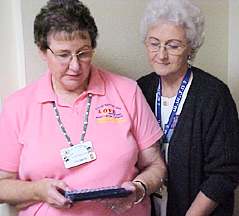
Rena Simpkins and Peggy Rast check for prayer requests on Simpkins' hand-held computer prior to the women's Bible study and prayer meeting.

“I send five men out,” Simpkins said, listing the assignments given to each: “I send a plumber, an electrician, a carpenter, a spiritual leader and someone to set up the camp.”

By the time the other rigs roll into town, electrical outlets and water connections have been prepared at each campsite. And a washer and dryer have been placed near the center of the campsite.

Before each day's work, the men and women gather for a morning devotional. Then the walls start to go up, electricity and plumbing are installed, and the 6,700-square-foot space begins to take shape.

In two weeks of work, the volunteers transformed a metal shell into a building 70 percent finished.

Large rectangular cut-outs in the back wall of the interior marked the place for a new pipe organ to be installed. The 700-pipe Wickes organ has been donated by a former member, John David Dill of Denton, in memory of his late grandfather, Lewis Eldridge.

The new and larger worship space will help prepare the congregation for more growth, said Dale Hudspeth, building chairman. “A lot of people are moving in here from the Metroplex.”

News of religion, faith, missions, Bible study and Christian ministry among Texas Baptist churches, in the BGCT, the Southern Baptist Convention ( SBC ) and around the world.


gambling_legislature_60903

Posted: 6/06/03

Gambling expansion a bust; social services suffer

By Ken Camp

Texas Baptist Communications

AUSTIN–Legislators generally held the line against gambling expansion in the just-ended session, according to representatives of the Texas Baptist Christian Life Commission.

But legislators cut programs benefiting the state's poorest and most vulnerable citizens in the process of balancing the state budget, added Phil Strickland, director of the Texas Baptist moral concerns and public policy agency.

“Every vote they cast was a stroke of the brush, painting a picture of what Texas will look like in years ahead,” he said. “In some ways, it's a good picture. But in others, it's tragic.”

Despite efforts by about 900 registered gambling lobbyists, lawmakers rejected most bids to expand legalized gambling in Texas. Proposals to legalize casino-style video terminals at Texas racetracks, to allow video gambling on Indian reservations and to permit local casinos in specific venues such as the Astrodome failed.

One exception was the approval of Texas participation in the multi-state Powerball lottery. Legislators approved the proposal when it was added as an amendment to a key education bill in the final hours of the session. Efforts by Rep. Robert Talton, R-Pasadena, to strike the amendment proved unsuccessful.

Proponents of the bill claimed the high-jackpot lottery could generate more than $100 million for state coffers, a projection that Weston Ware of Texans Against Gambling labeled “ludicrous.”

“Powerball is just robbing Peter to pay Paul,” he said. “Over two or three years, it's simply not going to generate the kind of significant income that its supporters claim. People who already are playing the lottery will just move their money, spending it on Powerball instead of whatever they're playing now.”

Gambling opponents also suffered a setback when legislators denied continued funding to operate a toll-free number for compulsive and problem gamblers. Gambling interests benefit by not having the hard data on gambling addiction or the stories of human suffering generated by the hotline, said Suzii Paynter, director of citizenship and public policy for the Christian Life Commission.

But for the most part, gambling promoters stumbled in this session. Gambling expansion ironically failed due both to the opposition of some Republican leaders and the walkout of many House Democrats, Paynter observed.

The “Killer D's,” as they became known, temporarily relocated to Oklahoma to deny House Republicans a quorum and kill a redistricting proposal engineered by U.S. Rep. Tom DeLay, R-Sugar Land. As a result, they also allowed other bills to die, including key gambling proposals.

“There was no parting of the Red River, but the Oklahoma Exodus resulted in a history-making week at the legislature,” Paynter said. “The exodus forced the redistricting bill to die in the House as deadlines ticked by. And at least seven pro-gambling bills fizzled in their House committees.”

Legislators spent much of the session struggling to pass a balanced budget. They approved a $117.4 billion spending plan that cut human services by denying budget increases and tightening eligibility requirements.

“The end result is 170,000 kids no longer eligible for the Children's Health Insurance Program and up to 100,000 losing Medicaid,” Strickland said. “That means at least a quarter-million children losing access to health care.”

Medicaid changes also will result in 7,800 low-income pregnant women losing health care, according to the Health and Human Services Commission.

Legislators cut funding for home health care for the elderly by 15 percent. And flat budgets or small increases in other human-care areas actually will result in decreased services as the number of people in need continues to increase, Strickland added.

Ken Hall, president of Buckner Baptist Benevolences, noted his agency's child and family services unit will be hit with about a 3.5 percent reduction in reimbursement for its care of children.

Prison chaplains also fell victim to budget cuts. The final spending plan cut the annual budget for chaplains in the Texas Department of Criminal Justice by one-third.

Other key legislative actions included:

bluebull Campaign ethics. A reform measure supported by the Christian Life Commission appeared dead several weeks ago but was revived in the final hours of the session.

“There are 52 excellent ethics reforms in it,” Paynter said, pointing especially to provisions regarding disclosure and conflict of interest. She identified Rep. Steve Wolens, D-Dallas, and Lt. Gov. David Dewhurst, R-Houston, as “the white-hat guys” who rescued that bill at the last minute.

bluebull Tort reform. After intense negotiations to reconcile differences between House and Senate proposals, lawmakers approved a bill capping medical malpractice lawsuits.

The compromise bill allows claimants to obtain up to $250,000 from medical personnel for pain and suffering, and it permits them to sue no more than two hospitals or nursing homes for punitive damages for a maximum of $250,000 each.

A related bill, supported by Texas Baptist child and family services agencies, protects the endowments of faith-based long-term care providers from lawsuits.

Mary Stephens, vice president for Buckner Retirement Services, said Paynter's efforts and a resolution about the issue passed by messengers to the 2002 Baptist General Convention of Texas proved valuable in persuading legislators to secure the protection care providers needed.

bluebull Vouchers. Proponents of tax-funded vouchers for students in religious schools aggressively pushed their agenda in the early weeks of the session, but they retreated after legislators soundly defeated a voucher proposal for “virtual charter schools.”

That proposal would have provided vouchers for home-school students using an online curriculum. Former U.S. Education Secretary Bill Bennett, who heads a company that sells the program, came to Austin to promote the measure.

bluebull Abortion. Lawmakers passed a bill mandating a 24-hour waiting period and requiring physicians to share information about fetal development with patients before performing abortions.

In a somewhat related move, legislators approved a prenatal protection bill. That measure establishes criminal and civil penalties for a third party who injures or takes the life of an unborn child against the mother's wishes.

bluebull Moment of silence. Legislators approved a bill requiring public school children to observe a moment of silence and to say the Pledge of Allegiance at the beginning of each school day. The bill specifically states that the 60 seconds of silence can be used for prayer, meditation or quiet reflection.

bluebull Drunk driving. Lawmakers added a $100 surcharge to other penalties for people convicted of driving while intoxicated. The funds will be earmarked for emergency medical services and trauma care facilities.

bluebull Criminal justice. Legislators approved a legal defense fund for poor people, using Texas Bar Association dues and other fees paid by lawyers to finance the program.

bluebull Capital punishment. Efforts to enact a moratorium on capital punishment, to create life without parole as a sentencing option for juries, and a requirement that members of the state's Board of Pardons and Parole conduct a conference call about capital cases before voting on an execution order all failed.

News of religion, faith, missions, Bible study and Christian ministry among Texas Baptist churches, in the BGCT, the Southern Baptist Convention ( SBC ) and around the world.


growth_60903

Posted: 6/06/03

Survey says there's no cure-all for church growth

By Leslie Scanlon

Religion News Service

LOUISVILLE, Ky. (RNS)–Sometimes when a congregation's having trouble, folks look for the quick fix. By changing the music or moving to the suburbs or adding new programs, they think, everything will be OK.

But researchers involved in a large-scale study of U.S. congregations have found there's no one secret to success. Strong congregations can be large or small, urban or rural, and there's no simple formula for what works. But they say congregations that want to become extraordinary need to develop multiple strengths–to figure out what they do best, and to focus on those things.

The U.S. Congregational Life Survey is the largest profile of worshippers and their congregations ever produced in the United States–a survey of more than 300,000 worshippers from more than 2,200 congregations, taken in April 2001 as part of a broader body of research done in the United States, England, Australia and New Zealand. The congregations surveyed came from more than 50 faith groups, including non-denominational and Pentecostal congregations, Protestants and Catholics, Greek Orthodox, Jews, Buddhists and the Church of Jesus Christ of Latter-day Saints.

Cynthia Woolever, director of the U.S. Congregational Life Survey, argues that congregations can't legitimately use their size (“We're too small”) or affiliation (“We can't grow because our denomination is losing members”) as a reason not to be strong and vibrant.

The survey found examples of successful congregations of all sizes, in cities and in rural areas, in many different situations–leading Woolever and her colleagues to conclude, “Churches just really have to say, 'What's going to work for us in our location with the people who are here?'”

Among the most recent findings of the survey, as explained by Woolever:

Size does not determine a congregation's success. “Meaningful worship happens in congregations of all sizes,” not just those with the resources to put on what Woolever called “the best show.” In fact, people are more likely to participate actively in small congregations–to attend a Bible study or hold a leadership position, for example–than in bigger ones.

bluebull Conservative congregations and those that are historically black tended to do better on a number of measures than did mainline Protestant and Catholic churches. Conservative and historically black congregations were more likely to be places that helped people grow spiritually, where people found worship to be meaningful, where they actively participated and felt a sense of belonging.

bluebull Mid-sized congregations–those whose worship attendance was between 100 and 350–were given the best ratings in caring for children and youth. Catholic parishes scored the lowest in this, and conservative Protestant churches the highest.

bluebull Several factors seemed to predict growth. The strongest predictors for whether a congregation would get bigger were if the congregation did a good job caring for children and youth, had high levels of participation in small groups and other activities, and seemed welcoming to new people.

bluebull People who attend small congregations are more likely than those from mid-size or larger congregations to say they're growing spiritually and to feel empowered to use their gifts and talents for leadership. People also report a strong sense of belonging in small congregations.

bluebull Worshippers who are younger than the average age of those attending worship also have a strong sense of belonging, and “the sense of home is particularly important to younger people,” Woolever said. Congregations whose members are younger also tend to do a better job caring for children and teenagers.

bluebull When focusing on the community–everything from being involved in community service to voting and making charitable contributions–“size doesn't matter,” but mainline Protestant congregations have the strongest community focus, as do congregations with older worshippers, Woolever said.

bluebull Small congregations, conservative Protestant churches and historically black congregations have the strongest record of faith-sharing–placing the strongest emphasis on talking to others about their faith, inviting people to worship and reaching those with no connection to a congregation.

News of religion, faith, missions, Bible study and Christian ministry among Texas Baptist churches, in the BGCT, the Southern Baptist Convention ( SBC ) and around the world.


hall_ken_60903

Posted: 6/06/03

Ken Hall to be nominated for
BGCT presidency at Lubbock convention

By Marv Knox

Editor

DALLAS–Ken Hall, president of Buckner Baptist Benevolences, will be nominated for president of the Baptist General Convention of Texas when it meets next fall.

Jim Denison, Hall's pastor at Park Cities Baptist Church in Dallas, announced he will make the nomination when the BGCT convenes in Lubbock Nov. 10-11.

Ken Hall

“I am convinced that Dr. Hall is God's man to lead Texas Baptists in the coming year and that the Lord will use him to guide us to our greatest potential for the kingdom,” Denison said.

“Under his leadership, Buckner has become the premiere global missions organization in Baptist life, connecting churches and ministries across the state to missions opportunities around the world,” Denison added. “He will guide us to the global significance Texas Baptists wish to embrace in this new century.”

Buckner, a ministry of the BGCT, will celebrate its 125th anniversary in 2004. It offers child and family services in 22 communities and operates five retirement facilities across the state. It also provides support services for domestic and international adoptions and partners with groups to minister to orphans overseas.

Hall has been Buckner's president for 10 years, following a career as pastor of Texas Baptist churches.

Hall's leadership reflects the breadth of that experience, Denison noted.

“He has pastored some of the greatest churches in Texas Baptist life,” he said. “He knows the institutional work of Texas Baptists intimately. His leadership at Buckner has embraced the ethnic diversity and possibilities of our state. He is known and respected by Baptists across our convention. He will articulate our vision with clarity and motivate and energize our people to its fulfillment.”

Hall would be willing to serve as president because “I genuinely love the BGCT,” he said. “In this era of denominational change, the BGCT is the most functional denominational system. I believe in the BGCT, and I'm committed to it and its institutions and auxiliary ministries.”

He also agreed to be nominated because fellow pastors and others whom he respects and loves asked him to do it, he added.

In addition to Denison, some of those encouragers included longtime colleagues such as Pete Freeman, pastor of First Baptist Church in The Woodlands, and Rodney McGlothlin, pastor of First Baptist Church in College Station.

Hall is the right candidate at the right time because of his vision, Freeman said.

“Ken would bring a fresh and different perspective, being the head of a major Baptist institution,” he explained. “His previous pastoral and denominational experience would be invaluable to us.

“Ken knows and understands who we are as Texas Baptists and has a good perspective for where we ought to be in the future in relation to missions and evangelism. He understands where Texas Baptists need to be if we're going to be relevant.”

McGlothlin echoed that theme.

“As far as I'm concerned, Ken has been doing missions all along–doing it and not talking about it, not politicizing it” he said. “Buckner has led the way in facilitating ways for Texas Baptist churches to partner with other churches, with associations, state conventions and anyone else who's willing to cooperate. We have to find ways to connect and partner with others.

“Baptists and missions ought to be like a river flowing to the ocean–we'll find a way to get there, find a way to do it.”

Texas Baptist history offers ample precedent for a denominational agency president to serve simultaneously as state convention president.

Buckner Baptist Benevolences' founder and first president, R.C. Buckner, led the BGCT for 19 years. Three Baylor University presidents, Rufus Burleson, Samuel Palmer Brooks and Abner McCall, held the BGCT post while leading the convention's largest university. And two presidents of Southwestern Baptist Theological Seminary, Lee Scarborough and E.D. Head, also accomplished the feat. Several other BGCT presidents either previously served as agency leaders or later took the helm of institutions.

Although 38 years have passed since McCall last held dual presidencies, Hall acknowledged the time may be right again.

“In an era when we're trying to redefine ourselves as a state convention to our constituency, in many ways our institutions are our churches' greatest denominational treasures,” he explained. “So, if I can encourage churches and institutions to support the BGCT, then, hopefully, I can give some credibility at this point.”

Although Hall noted he's not running for office and doesn't have a campaign platform, he said he intends to support the new world missions network being founded by the BGCT. While not touted as a missionary-sending organization, the new network is being described as a mechanism for offering Texas Baptists and their churches unique opportunities for conducting mission work worldwide.

“This is where we are,” Hall said of the network, which has not yet been named or staffed. “We need to be talking about collaborative partnerships with the BGCT rather than focusing on what used to be. It is a new day.”

The change in doing missions has been prompted in part by controversy with the Southern Baptist Convention, whose two missions agencies have drawn disfavor with some Texas Baptists, Hall acknowledged. But part of the reason for the change is a “cultural shift” that has led many churches to desire more hands-on missions participation, he added.

“The BGCT is out front on this,” he said. “It's not about control, but about cooperation, appreciation and collaboration.”

One hallmark of a Hall administration would be encouragement, he predicted.

“We need to be affirming each other,” he said. “That's my spirit, to be an affirmer. … I want to be a consensus builder and inclusive in the way we do things.

“I don't have an agenda other than listening to the people, defending who we are and getting people on board. … I'd love to make it possible for a lot of our people who felt on the outside to be on the inside.”

Pointing to what he perceives to be a change in the BGCT's response to the conflict that has divided Southern Baptists for more than two decades, Hall said: “I think, honestly, we've seen a shift in our leadership–toward who we are rather than what we're against. I want to keep that process going.”

One of Hall's presidential goals would be “to communicate a spirit of inclusiveness, of defining for the churches in our family our strengths,” he said. “The leadership of our convention believes all people deserve to be treated with dignity and honor and to hear the good news of Christ. That's who we are. … We're still preaching the uncompromised truth that God loves all people.”

Hall also would work to help Texas Baptists understand the strength of the BGCT. “We are an unbelievably strong denomination. Sometimes our people perceive us as being weak and (they) retreat, when that's absolutely false.

One of the key issues facing Texas Baptists is “redefining ourselves to our churches as a viable, necessary part of the kingdom advance,” Hall said.

“The biggest problem we have right now is that churches and individuals think the denomination is obsolete and not necessary. Rather than being unnecessary, the whole issue of collaborative ministry between churches and faith-based programs and ministries is the best example of what kingdom advance is,” he explained. “And advancing God's kingdom on earth is the mission of believers.”

Prior to becoming Buckner's president in 1994, Hall was pastor of First Baptist Church in Longview. Previous pastorates included Crestview Baptist Church in Midland, Eastwood Baptist Church in Gatesville and Riverside Baptist Church in Stephenville.

He has been a director of the Baptist Standard, chairman of the BGCT Committee on Committees, and member of the BGCT Executive Board and Resolutions Committee. He is a deacon at Park Cities Baptist Church.

He is a graduate of the University of Texas at Tyler, earned master's and doctor's degrees from Southwestern Seminary, and is an honorary alumnus of Truett Seminary.

He and his wife, Linda, have two adult children.

News of religion, faith, missions, Bible study and Christian ministry among Texas Baptist churches, in the BGCT, the Southern Baptist Convention ( SBC ) and around the world.


hispanic_nominees_60903

Posted: 6/06/03

Four to be nominated for
Hispanic Convention presidency

By Marv Knox

Editor

Four pastors are expected to be nominated for president of the Hispanic Baptist Convention of Texas when it convenes in San Antonio June 22-24.

Baldemar Borrego, Alcides Guajardo and Angel Vela recently announced their candidacies. They join David Tamez, whose candidacy was announced earlier.

The new president will succeed Antonio Estrada of Houston, who will conclude three years as HBC president at the end of the San Antonio meeting.

Borrego, pastor of Iglesia Bautista Nueva Esperanza in Wichita Falls, was the HBC's first vice president from 1999 to 2001.

He currently is president of the HBC's Pastors' Conference. He has been a regional consultant for Texas Baptists' River Ministry.

Borrego is a member of the American Association of Christian Counselors, as well as founder and president of Family Integration Ministry.

He has broadcast on the radio for five years and also was a pioneer of Spanish television ministry in Wichita Falls.

He is a graduate of Hispanic Baptist Theological School in San Antonio. He and his wife, Aleida, are the parents of four children.

Borrego said the primary reason he is willing to serve as convention president is “to continue the work that has been done by the steering committee and the implementation team.” In 2001, the convention approved a 13-part strategic plan that is designed to develop leaders, make resources available to churches and help each church customize ministry to its community.

“I believe it is the right track for Hispanics in Texas,” Borrego said. “The plan is going to work fine; we're going to invite every church in the state to become participants. Some have only been a spectator, but with involvement, we can turn Texas upside down for Christ.”

He affirmed the contributions of leaders who have guided the convention through the years. “We are where we are because of their dedication and their constancy in the Baptist work,” he noted. “I have seen their tears, but also I have seen their joy when they see what has been accomplished, knowing that their work for the Lord has not been in vain.”

Borrego said he would use his presidential influence to “promote a dignified pastoral image, support a truthful unity among the Baptist churches in Texas and start implementing this program, that's going to work for every church in Texas.”

bluebull Guajardo, pastor of Primera Iglesia Bautista in Beeville, has served in a variety of denominational and church ministry positions and was a Southern Baptist home missionary 31 years.

Prior to becoming pastor of the Beeville church in 1996, he worked on the staff of Union Baptist Assiciation in the Houston area as Hispanic missions leader, missions development director and ministerial training director.

Guajardo also has served on the staffs of the Greater Orlando Baptist Association in Florida; LifeWay Christian Resources in Nashville, Tenn.; El Paso Baptist Association; Corpus Christi Baptist Association; and Hispanic Baptist Theological School. He has been pastor of Primera Iglesia Bautista in Pasadena and was pastor of several mission congregations while he was a student in college and seminary.

He earned degrees from the University of Corpus Christi, Southwestern Baptist Theological Seminary and Golden Gate Baptist Theological Seminary.

He has written for numerous denominational periodicals and translated other materials. He and his wife, Frances, have written for Nuestra Tarea, a missions magazine in Spanish published by the Southern Baptist Woman's Missionary Union.

The Guajardos have three daughters and 11 grandchildren.

One of Guajardo's motivations for serving as HBC president is gratitude. “If it had not been for the denomination, I would not have a college degree and a seminary education,” he explained. “I have had an opportunity to serve at many levels in four associations, and I owe so very much to my denomination, which has given me all kinds of opportunities. Now, to the extent that I can, I would like to be able to give back.”

Guajardo also would appreciate a chance to serve “on the other side of the fence” after a career as a denominational worker, he added. “In the past, I had opportunity to consult and advise denominational leaders and help them do their work. Now, if I have the opportunity, I am able to become personally involved in leading, working with and advising people who are doing the work.”

He additionally would like to be able to “express my views (about Hispanic ministry in Texas) to people for whom those views would helpful,” he said.

As president, he would rely on his background in education to prepare pastors for effectiveness and train leadership for Hispanic churches, he said.

Guajardo also wants to see Hispanic churches “provide more resources necessary for the Baptist General Convention of Texas than we ever have before,” he said. “I think we can do a lot more to help support the BGCT in every way possible, but primarily financially.”

bluebull Vela, pastor of Iglesia Bautista Westway in El Paso, is the HBC's current first vice president.

He is a native of Durango, Mexico, and immigrated to the United States with his wife, Delia, and their seven children in 1972. They are naturalized U.S. citizens.

He has been a pastor since 1977 and has been a full-time pastor for the past 12 years. Previously, he served bivocationally, driving buses while also leading churches in El Paso and Pecos.

That experience gave Vela a special sensitivity for the lives and ministry of bivocational ministers, he said.

In addition to his service as an HBC officer, Vela has been moderator of El Paso Baptist Association, where he's also been president of the Hispanic fellowship and served on committees.

Mrs. Vela has been president of the HBC pastors' wives' organization and has been chairperson of the Women Reaching Texas evangelism emphasis.

Vela earned a business administration degree in Mexico and also graduated from Southwestern Seminary.

Vela said he would want to use his experience to enhance the relationship between the Hispanic convention and the BGCT, Cooperative Baptist Fellowship, Convencion Nacional de Mexico and Union Bautista Latino Americana, as well as with the associations of churches statewide.

His experience as HBC first vice president would give him “the opportunity to continue the great job the president and the officers have done this far,” he said.

He also wants to place an emphasis on serving churches by helping their pastors. “My concern is the well-being of pastors and their families, because when the pastor is well taken care of, that's a sign of a healthy church, that in turn will produce healthy associations and consequently a healthy convention,” he said. “And when that happens, unity will be achieved as well.

“The situation of most of our pastors in Texas is very precarious, and we as convencion must do something to alleviate this problem, and we need to start at home first.”

bluebull Tamez, pastor of Primera Iglesia Bautista in Tyler, has traveled widely in Spanish-speaking countries, training pastors.

He has been pastor of churches in Fort Worth and Tyler. He also has been professor of pastoral ministries at Seminario Teologico Bautista Mexicana, as well as director of the Christian education department and teacher at the Instituto Evangelistico de Mexico, both in Mexico. He has led pastor-training conferences in Argentina, Cuba, Honduras, Israel, Mexico, Nicaragua and Spain.

He has been a missions promoter for Tarrant Baptist Association in Fort Worth and president of the Hispanic Baptist Fellowship in Fort Worth and the East Texas Hispanic Baptist Fellowship.

He is a graduate of the Instituto Politecnico Nacional in Mexico and Southwestern Seminary in Fort Worth. He is a doctoral candidate at the University of Liverpool in England and Trinity Theological Seminary in Indiana.

He and his wife, Ruth, have three children.

Tamez said he is not seeking the presidency but will feel blessed to serve if elected.

“I am not looking for this, but I am looking to do the will of God, and if this is his will, I am available to serve in this position,” he said. “I believe in a sovereign God, and my life and ministry are in his hands.”

As president, Tamez would focus on his longtime calling to train and equip pastors for ministry, he said.

“I have a passion for pastors, and since the beginning of my ministry, the Lord has used me to minister with pastors,” he said. “Our convention has a vision to partner with the Mexican Baptist Convention and train pastors. … One of the strongest needs is to develop the leadership, to train the pastors in order to lead the people.”

One of his goals would be to help unify Hispanic Baptists, Tamez said.

“Our churches are struggling with problems, and one of the main problems I can see is unity,” he explained. “We need to learn to work together for the sake of the gospel. If we want to impact our communities, state and the uttermost parts of the world, we need to learn to work together to accomplish goals.”

News of religion, faith, missions, Bible study and Christian ministry among Texas Baptist churches, in the BGCT, the Southern Baptist Convention ( SBC ) and around the world.


hsu_brazil_60903

Posted: 6/06/03

Members of the Hardin-Simmons University vocal ensemble Simmons Classic recently toured Brazil, where they not only performed but learned about the people and places of Brazil. Here, a guide leads them through a narrow passageway in a slum or favela in the Brazilian town of Olinda. Retired missionaries Dale and Sue Carter of Abilene traveled with the students, adding to the educational value of the experience. Students found the favelas of Olinda and Sao Paulo eye-opening.

HSU ensemble visits Brazil

ABILENE–Students from Hardin-Simmons University were well-received in Brazil on a recent tour where they performed chamber music, contemporary Christian music and jazz.

The 10-member ensemble known as Simmons Classic was led by Loyd Hawthorne, professor of church music.

Dale and Sue Carter, retired Baptist missionaries who are members of First Baptist Church in Abilene, traveled with the group and served as translators.

The group spent a week performing concerts in Saõ Paulo, Recife and the community of Olinda. They sang in English with the exception of one piece that was sung in Portuguese.

In Recife, the ensemble sang for a full audience at the Baptist Seminary. To their surprise, the composer of the piece they performed in Portuguese was in the audience and was thrilled to hear his composition.

In Sao Paulo, they performed at a fund-raiser for Oasis Ministries, a British-Brazilian Baptist organization that helps educate children and train adults for the job market.

The city of Sao Paulo was overwhelming to the West Texans, reported John Richardson of Abilene. It is the third-largest city in the world, with a population of more than 20 million. The sight of the favelas, or Brazilian slums, especially touched him, he said.

“Houses are stacked upon houses in valleys with high-rise luxury apartments looking down on them from the hilltops–a true image of the social structure in the city,” he said.

In the community of Olinda, they visited a church and the favela's church-sponsored school, where they distributed school supplies sent from a women's group at First Baptist Church of Abilene.

Michael Austin, a senior from Dumas, said because of the interaction with the Brazilian people he now realizes that “the body of Christ isn't just my home church or American denominations–it's also all the people who sat in a hot, humid, and packed-out church to worship with us as one family through Jesus Christ.”

News of religion, faith, missions, Bible study and Christian ministry among Texas Baptist churches, in the BGCT, the Southern Baptist Convention ( SBC ) and around the world.


meyer_60903

Posted: 6/06/03

FATHER KNOWS BEST:
Philanthropist Paul Meyer

By Lacy Elwood

Special to the Standard

WACO–Instead of receiving gifts this Father's Day, Waco multi-millionaire Paul Meyer wants to give a few to his five children and 15 grandchildren–in the way of 294 pages of inspiration.

Meyer, founder of Success Motivation, a Christian-based motivational company, spent three and a half years writing his book “Unlocking Your Legacy: 25 Keys for Success.” The book chronicles the Christian attitudes Meyer wishes to pass on to his children, a series of chapters he considers to be his legacy.

Paul Meyer and his family

“Remember,” Meyer tells his children, “you're a Christian, and you're a Meyer. Act that way.”

For the Meyer family, acting like their 75-year-old father means living the values of integrity, honesty, discipline, love and faith in God. Meyer said he wrote the book to encourage his family to incorporate those values in their lives and also to encourage others to leave a legacy of their own.

Meyer bases the book around 25 keys to success, beginning with the “most imperative,” love. “Everything of value must start somewhere,” he wrote, and love is where every good legacy begins.

Other chapters cover “The Rise and Fall of Discipline,” “Laughing at Life,” and “Living Life with an Attitude of Gratitude.”

Meyer, a member of First Baptist Church of Woodway, writes at length about the importance of prayer. He became a Christian at 16, and he begins each day in prayer, sometimes for a few minutes and sometimes for hours.

Meyer also discusses the principle of trust in great detail in key 10, “My Word is My Bond.”

There, Meyer hits upon an aspect of trust unfamiliar to many Americans. When he makes promises, deals or even just simple agreements, he relies solely on a handshake and another person's word.

“I just shake hands with people and trust them,” he explained. “I'm suspecting of somebody that wants a contract. If he's going to cheat me later, he'll cheat me now.”

And any promises he makes are almost immediately written down, told to his wife Jane and put in a safe deposit box. At the end of each year, Meyer sorts through his promises, and those that have not been fulfilled are added to his will.

People trust him, he said, because he actually follows through with his promises and does what he says he will do.

Although his lawyers call him crazy, Meyer continues to sign deals with a simple handshake. He buys antique cars over the phone without ever seeing what he's buying and even bought an apartment complex for $1 million in a deal signed on the back of a restaurant place mat.

Even though he has run across people whose word could not be trusted, he still insists on believing in his fellow man's handshake.

“I ask God to protect me from people who want to take advantage of me, but I have been taken advantage of,” Meyer said. “But I had a pair of pants shrink up on me once, and I didn't quit wearing pants.”

His positive attitude, which he considers part of his inheritance from his parents, has carried him from a 19-year-old life insurance salesman to the owner of one of the largest companies in the world. After selling $1 million in insurance in 60 days, he set the goal to eventually sell the same amount in just one day. Others quickly picked up on his motivating attitude and suggested he teach courses in positive selling.

The courses turned into Success Motivation. Meyer claims he retired at age 70 but also admits he works just as hard at age 75 as he did when he was 45. Since his retirement, Meyer has written three books and numerous booklets and serves as the president of the Paul Meyer Family Foundation, an organization that supports his love of giving to others.

“There is no joy in the world like the joy of giving,” Meyer said.

He told the Dallas Morning News that it disturbs him that more people don't use their wealth to help others, especially Christians. Meyer began tithing in his 20s, but after hearing Christian businessman R.G. LeTourneau speak about donating 90 percent of his income to the church, he realized his endeavors weren't quite enough.

Since its inception in 1984, Meyer's foundation has donated more than $43 million, mostly to Central Texas charities and residents. Frequent recipients include Waco's Boys and Girls Club, Baylor University and the Passport to Success Foundation.

Through Passport to Success, the Meyer family has enabled thousands of disadvantaged youth and young adults to attend college. Meyer's program since has influenced several other Waco families to start college programs of their own.

“I've got a heart for kids and education because I didn't get to go to school,” Meyer explained.

Regardless of education, status, beliefs and background, everyone has a legacy to leave behind, Meyer said.

“Write down the attributes you want to pass on to your family, not just what you're going to do with your life, but the things inside of you that you want to pass on,” he advised. “Think about how you want to be remembered, and start living your life that way now.”

News of religion, faith, missions, Bible study and Christian ministry among Texas Baptist churches, in the BGCT, the Southern Baptist Convention ( SBC ) and around the world.


namb_women_60903

Posted: 6/06/03

Navy chaplain will ask messengers
to overturn NAMB policy on women

By Craig Bird & Greg Warner

Associated Baptist Press

ATLANTA (ABP)–The Southern Baptist Convention's shift to endorsement of female chaplains only if they are not ordained seriously undermines the spiritual effectiveness of all ordained military chaplains, according to one of the Navy's top chaplains.

Capt. Al Hill, a lifelong Southern Baptist and a 25-year veteran chaplain, said June 3 that a motion will be presented at the June 17-18 Southern Baptist Convention to reverse the policy now practiced by the North American Mission Board, the SBC's chaplain-endorsing agency.

“Regardless of Capt. Hill's views of ordination, most Southern Baptists do not consider ordination necessary for ministry,”
–NAMB spokesman Martin King

The policy, approved by NAMB trustees in February, permits women to be endorsed as chaplains in the military and elsewhere only if they are not ordained. The policy is aimed at appeasing conservative critics who oppose the ordination of women. Rather than not appointing any female chaplains, as some would prefer, NAMB contends ordination is not necessary for chaplains.

“Regardless of Capt. Hill's views of ordination, most Southern Baptists do not consider ordination necessary for ministry,” said NAMB spokesman Martin King.

Hill, director of the training and education division in the Navy Chief of Chaplains Office, met for two hours May 28 with John Yarbrough, NAMB vice president for evangelization–a meeting the chaplain said was conducted in “a spirit of graciousness and openness.” Hill said he left the meeting optimistic NAMB trustees would reconsider their February action, which he said is opposed by most Baptist chaplains in the Navy.

Instead, Hill said June 3, the trustees' chaplains commission declined a recommendation from Yarborough to place the issue on the agenda of the full trustee board meeting in October. Members of the commission said they would discuss the issue further at their August meeting and decide if it would be placed on the October agenda, Hill said, but that is too long to wait.

“I am surprised and disappointed,” Hill said. “They may or may not choose to recommend full board action, but waiting to find out is an unacceptable option. Their decision makes it necessary to present a motion on the floor of the convention in two weeks that will force the trustees to address the issue before the next convention.”

King, the NAMB spokesman, said the agency's policy was designed to honor the SBC's opposition to women pastors while not eliminating ministry by women.

“The North American Mission Board supports women in chaplaincy in positions that are not the equivalent of a senior pastor,” King said. “We renew our pledge to stand with any female Southern Baptist chaplain who is discriminated against because she is not ordained.”

But Hill and others say the NAMB policy is impractical. In the armed services, the position of chaplain cannot be separated from the role of pastor, Hill said, and neither can female chaplains minister exclusively to female soldiers and families, as one NAMB trustee suggested.

Moreover, “to endorse anyone who has not been ordained is to proclaim the ordination of all Southern Baptist military chaplains as unnecessary and irrelevant,” Hill added. “It is to strip all of us–in one stroke–of the sign and seal of our spiritual authority as ministers of the gospel of Jesus Christ, and to do this to us while we labor in a vineyard more difficult to harvest than any local Southern Baptist church, where the infrastructure acknowledges and enhances the spiritual authority of the pastor.”

The NAMB policy does not intersect well with military culture, Hill said.

By law, there are no positions of senior pastoral leadership that are “off-limits” to women military chaplains, he pointed out. “A woman, ordained or unordained, is expected to fulfill the same pastoral role as her male counterpart, from the first day in the military to her last.”

All military chaplains, “preach the gospel, perform baptisms, provide communion, lead worship, teach the Bible, conduct weddings and funerals, visit in hospitals and jails, around the world, at sea and in the field, in peacetime and in war,” he explained.

Additionally rank, not gender, determines who is “in authority” in the military, he said. For example, he noted that a woman is the current Air Force chief of chaplains.

Hill also warned that the NAMB policy “removes Southern Baptist chaplains from the ranks of all other mainstream Christian denominations and aligns us squarely alongside Christian Scientists and Mormons, two religious groups that do not require ordination for endorsement for military chaplancy.”

Three months ago, Hill e-mailed 134 active-duty Navy chaplains endorsed by NAMB. Through May 27 he had received 40 replies and “had talked with another 12 to 15 in person.” Though specific objections vary, Hill said, none of more than 50 chaplains he has surveyed supports the NAMB policy in any way.

Late last year, NAMB dismissed Bob Vickers as director of its chaplaincy evangelism unit, reportedly because he did not enforce the ban on ordained females stringently enough.

NAMB's policy change and the dismissal of Vickers, who came up through the ranks of military chaplaincy himself, have sparked increased applications at other Baptist endorsing agencies. Both the Baptist General Convention of Texas and the Cooperative Baptist Fellowship have experienced increased inquiries and applications for chaplaincy endorsements in recent months.

News of religion, faith, missions, Bible study and Christian ministry among Texas Baptist churches, in the BGCT, the Southern Baptist Convention ( SBC ) and around the world.


northlake_dean_60903

Posted: 6/06/03

Pastor and music minister have been
singing from the same page for years

By George Henson

Staff Writer

GARLAND–Few churches have pastors stay for 25 years. The same could be said about ministers of music.

Northlake Baptist Church in Garland has both, however. Pastor Bob Dean celebrated his 25th anniversary April 25, and Minister of Music Lynn Christie served the church a quarter of a century as of June 1.

Two things have kept this ministry team together so long, they report: A definitive sense of God's calling to the church and the fact that they like one another.

The church was just over a year old when it called the two young men in 1978. It had been started by about 20 families from Orchard Hills Baptist Church in Garland on land purchased by the Baptist General Convention of Texas and Dallas Baptist Association.

“We were only 25 and 26 years old,” Dean recalled. “This church took a chance on two really young guys.”

The two had met in 1973 at the Baptist Student Union state leadership conference. Dean was BSU president at Baylor University, and Christie was his counterpart at North Texas State University. Dean also was state BSU president and presided at the meeting; Christie was the conference worship leader.

The two maintained the connection when Dean became pastor at Northlake. When the church decided to hire a worship leader, Dean immediately thought of Christie.

By that time, both men were married to women they also met through the BSU.

Despite the passage of time, both men have committed to remain learners.

“My greatest fear is that we get in a rut,” Christie said. The church helps guard against that by providing the staff with scheduled sabbaticals in which continuing education is a major part. The staff also jointly discusses current books related to ministry.

“The challenge is to stay fresh and to carry out the vision,” Dean said. “The work of the kingdom of God is too important not to do it well.”

“We've already demonstrated we can work in harmony,” Christie agreed, “but the struggle is to keep it fresh.”

Keeping it fresh doesn't mean chasing every new ministry fad and forgetting the vision of reaching people for Christ, however.

“From Day 1, Bob has exemplified and held out that same vision, and we are seeing that vision come to fruition,” Christie asserted. “Not many of those original 20 families that came out of Orchard Hills are still here, but the vision has remained the same.”

Methods have changed, Dean said. “Needs of people have changed. The style of worship has changed. We are constantly trying to target the needs of our community and find the best way to minister to those needs.”

Growth in the church necessitated a recent building program, providing the church with a larger sanctuary and a gymnasium. Using the gym to reach children in the community through the Upward Basketball program, and an expanded Easter production permitted by the additional worship space are two ways the church has continued to try to reach its community. The church also sponsors a Hispanic mission.

While their long ministry association is a boon to them, Dean admits it may could be off-putting to new staff members.

“We really try to share leadership and really have moved into more of a mentoring role with the rest of the staff,” Dean said. “We also try to show them the value of longevity in one church, because we think there is a real benefit in that.”

The lessons must be taking. Youth Minister/Administrator Chris Trent has been on staff six years, and Children's Minister Jennifer Evans has been at Northlake five years. While not approaching Dean's and Christie's tenures, both terms are beyond the average.

The spirit of the church also contributes to the ministers' success, they said.

“Our kids love this place, and not all ministers' kids can say that,” Christie said. “One of the greatest gifts either of us have been given is to raise our kids in a happy church.”

News of religion, faith, missions, Bible study and Christian ministry among Texas Baptist churches, in the BGCT, the Southern Baptist Convention ( SBC ) and around the world.


nyc_volunteers_60903

Posted: 6/06/03

Volunteers needed to build new housing for volunteers

NEW YORK (BP)–In the past, exorbitant hotel prices took a bite out of efforts to recruit Baptist volunteers for ministries in the Big Apple.

Soon, the problem of hotel rooms running $200 or a more a night and local churches far too small to serve as overnight hosts will be solved.

Jill Pittman removes debris from the basement of the Park Slope Ministry Center in Brooklyn, N.Y., a project to house missions volunteers. Pittman, a US/C-2 missionary and University of Kansas graduate, is serving with the Metropolitan New York Baptist Association. (Jim Burton/BP Photo)

A corner building in the Park Slope neighborhood of Brooklyn that once housed a funeral home, dentist's office and a drugstore is being converted into living space for up to 50 volunteers at a time.

The move mirrors efforts in other major metropolitan areas to create buildings dedicated to housing mission volunteers.

One of the first such buildings was dedicated in the Boston area several years ago with assistance from longtime missions supporters Ira and Betty Kraft of South Carolina.

Now, in addition to the project in New York City, buildings to house mission volunteers are to open in Cochrane, Alberta, Canada, and San Juan, Puerto Rico.

Building the housing for volunteers, however, is dependent on volunteers, with aggressive efforts currently under way to enlist construction teams.

“These projects won't work without a commitment of volunteers,” said Jim Burton, director of volunteer mobilization for the Southern Baptist Convention's North American Mission Board. “We're hoping to have teams of 10 to 12 volunteers per week at each work site until they're done.”

The Brooklyn effort was made possible through Enduring Hope, a comprehensive plan of long- and short-term relief efforts funded by about $3.5 million contributed through Southern Baptist entities in the aftermath of the Sept. 11, 2001, terrorist attacks.

Shane Critser, volunteer coordinator for New Hope New York, dumps debris from the renovation project. A Kentucky native, Critser was working with other volunteers on the first phase of a nine-month project to open a center for housing missions volunteers. (Jim Burton/BP Photo)

“New York Baptists believe relationships as much as anything will help them recover and heal from that experience, so they wanted a place to house volunteers,” Burton said. “With this building, we're talking about individuals being able to go and volunteer in New York and stay for $100 for a week, which is unheard of.”

The building was acquired at a below-market price, and volunteers working at the site are helping save about $200,000 in labor costs for renovations. When finished, the site will have sleeping accommodations for 25 men and 25 women.

In Canada, the Canadian Convention of Southern Baptists is building a two-story 50-by-110-foot addition to its offices that will house a total of 36 people in beds–50 if sleeping-bag space is included. Dining facilities will handle 80 people.

The Puerto Rico structure will house about 50 people in a 40-by-80-foot concrete block building on the campus of the Puerto Rico Baptist Theological Seminary. This project is made possible by a missions offering from World Changers, a NAMB-sponsored student mobilization ministry.

Construction volunteers interested in assisting with the projects may call (800) 462-8657.

News of religion, faith, missions, Bible study and Christian ministry among Texas Baptist churches, in the BGCT, the Southern Baptist Convention ( SBC ) and around the world.


onthemove_60903

Posted: 6/06/03

On the Move

Roy Canada has completed an interim pastorate at Westlake Chapel in Graham.

bluebull William Dawson to First Church in Loving as pastor from Dry Valley Church in Lodiburg, Ky.

bluebull Julian Gonzales to First Mexican Church in Kenedy as pastor.

bluebull Cindy Graves has resigned as minister to college and university students at First Church in Waco.

bluebull Jeff Jackson has resigned as pastor of Olden Church in Olden.

bluebull Jerry Jacobs to First Church in Tulsa, Okla. as minister of education/discipleship from First Church in Kingwood.

bluebull Loren Johnson to Lone Oak Church in Snook as interim pastor.

bluebull Joel Sanders has resigned as pastor of Necessity Church in Caddo.

bluebull Brenda Shuttlesworth to First Church in Conroe as minister to children; she had been interim there.

bluebull Danny Souder to Forest Avenue Church in Sherman as interim pastor.

bluebull Fred Teague to Westlake Chapel in Graham as pastor.

bluebull Rob Tucker to First Church in Brownwood as interim minister of music.

bluebull Tim Watson to First Church in Longview as pastor from First Church in Canton.

News of religion, faith, missions, Bible study and Christian ministry among Texas Baptist churches, in the BGCT, the Southern Baptist Convention ( SBC ) and around the world.


pakistani_60903

Posted: 6/06/03

Pakistani Christians under
increased threat, activists warn

By Robert Marus

ABP Washington Bureau

WASHINGTON (ABP)–Pakistan's minority Christians are under increasing threat because they are lumped together with America in the minds of Islamic extremists, according to a leading Christian human-rights activist in the country.

The Pakistani leader, who chose not to have his name revealed for fear of repercussions against him and his family, spoke with reporters in Washington, D.C.

Akram Duurrani, chief minister of the North West Frontier Province, attends the assembly session in Peshawar June 3, while Islamic fundamentalists ruling the NWFP in Pakistan said they would segregate universities and urge men to grow beards after imposing traditional sharia law. (REUTERS/Faisal Mahmood Photo)

He appeared in a special invitation-only press briefing arranged by the United States Commission on International Religious Freedom. The man was in Washington to meet with commission representatives as well as administration officials and advocacy groups regarding religious freedom in Pakistan.

“The religious minorities of Pakistan–especially the Christian minority–fear attack,” he told reporters. Islamic extremists often think they are engaging in holy war by attacking local Christians, he said. The extremists “think that, by attacking and killing Pakistani Christians, they are taking revenge against the West and America.”

There has been a dramatic rise in anti-Christian and anti-Western violence in the nation since U.S. and coalition forces began military activities in neighboring Afghanistan after the terrorist attacks of Sept. 11, 2001.

Besides the highly publicized 2002 kidnapping and murder of Wall Street Journal reporter Daniel Pearl–who was forced by his killers to “confess” his Judaism on videotape–more than 20 major incidents of violence against individual Christians or Christian churches, institutions or communities have been documented by the All Pakistan Minorities Alliance.

The most recent took place May 5, when a bomb exploded at a Christian hospital in the nation's Northwest Frontier Province–the location of many of the incidents.

Altogether the attacks have killed about 40 Christians and injured more than 100. The most-publicized incidents include an October 2001 gun assault during Sunday morning mass at a Catholic church in Bahawalpur that left 16 dead and a March 2002 bombing that killed five worshippers at the Protestant International Church in Islamabad.

Government officials have not successfully prosecuted anyone in the anti-Christian attacks.

The commission has noted many official abuses of religious freedom under the government of Pakistan's head of state, Gen. Pervez Musharraf. Among them are a law that makes blasphemy against Islam a capital offense and court rules that create unequal treatment between Muslims and other religious minorities in both civil and criminal cases.

Because of these and the seeming unwillingness to prosecute Muslims for crimes against Christians, the commission asked the State Department to declare Pakistan a Country of Particular Concern–a diplomatic designation for particularly severe violators of religious freedom. So far, administration officials have declined to label Pakistan as such.

The Pakistani leader also pointed to evidence of a rise in crimes against Christian women in the months since the U.S. began build-up for the war in Iraq. In particular, women and girls–some as young as 9–have been beaten, kidnapped, gang-raped, disfigured and forced to convert to Islam at gun- or knife-point, he said.

The man said one 9-year-old Pakistani Christian girl named Razia Masih, who worked as a live-in maid in the home of a Muslim family, was beaten and tortured when news of the U.S. attack on Iraq reached the household. When she took her case to court, “She was told by the (judge), 'You are Christian and infidel, and we will take revenge on you for bombing of Iraqi children,'” the leader said.

Felice Gaer, chair of the Commission on International Religious Freedom, said those examples were “disturbing evidence” for why the commission asked the State Department to designate Pakistan a country of concern.

News of religion, faith, missions, Bible study and Christian ministry among Texas Baptist churches, in the BGCT, the Southern Baptist Convention ( SBC ) and around the world.