Cosby visits Baylor, but critics still aren’t laughing_90803

Posted: 9/5/03

Cosby visits Baylor, but critics still aren't laughing

By Mark Wingfield

Managing Editor

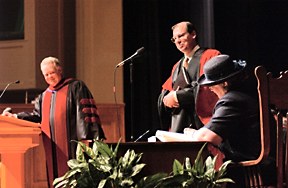
WACO–Comedian Bill Cosby came to Waco Sept. 4 to cheer up the Baylor University community, but critics of the athletic department, president and the university's 10-year vision continued to find little to laugh about.

Cobsy, who spoke in the university's Ferrell Center last year, volunteered to donate his time to help console Baylor students in the wake of basketball player Patrick Dennehy's summer murder.

Waco business leaders and Baylor alumni presented Baylor President Robert Sloan a $1 million check during a rally Aug. 29. Shown are Sammy Citrano, Russell Trippet, Clifton Robinson, Sloan, Willard Still, Jim Stewart and Ted Getterman. (Duane A. Laverty, Waco Tribune-Herald Photo)

Meanwhile, both critics and supporters of the administration remained busy beating the drum for their causes.

A group called Friends of Baylor University held a pep rally Aug. 29 to show their support for the university and President Robert Sloan. The group was formed by Waco businessman Clifton Robinson, according to the Waco Tribune-Herald.

“One thing is crystal clear: Issues of personality cannot dictate the future of Baylor University,” he told the crowd of about 100 supporters. “It is imperative that all voices be heard and public opinion not be swayed by a small vocal minority with a different agenda.”

To refute the assertion of critics that donations to Baylor are decreasing, the group presented Sloan with a check for $1 million to be added to the university's endowment.

A group called the Committee to Restore Integrity to Baylor countered the next day with an advertisement in the Tribune-Herald expressing “no confidence” in Sloan's leadership.

Spokesman for that group was Gale Galloway, an Austin businessman who was chairman of the Baylor board of regents when Sloan was elected president in 1995.

“We did a great disservice in putting Robert in that job, because he didn't have a single day's experience running an organization,” Galloway told the Waco newspaper.

Faculty groups continued to express both support and criticism for Sloan as well.

One day after a member of the Faculty Senate announced plans to call for a vote of no confidence in the president, he was removed from the elected body on a technicality.

Ben Kelley, dean of engineering and computer science, the area in which Faculty Senate member Henry Walbesser teaches, drew attention to a previously overlooked rule in the senate's governing documents. Walbesser was ousted from the senate because he had missed four meetings during the academic year.

Ironically, Walbesser missed the meetings because he was on sabbatical doing research, a fulfillment of the new demands on Baylor professors for which some have criticized Sloan.

The Faculty Senate is to meet Sept. 9, and some faculty said they still would call for a vote of no confidence in the president, even if Walbesser is not allowed to participate.

However, some professors reported they felt pressured by their deans not to speak out against the president or to vote against him in the Faculty Senate.

While as many as 100 faculty members rallied behind the president in a formal event kicking off the new school year and flooded regents with e-mails and faxes supportive of Sloan, an alumni critic said she thinks the effort was coordinated.

Bette Miller, daughter of former Baylor President Abner McCall, cited an email sent Aug. 21 from a Baylor administrator to all tenure-track faculty. That e-mail urged the newer faculty members to “send an e-mail titled: VOTE OF CONFIDENCE” and copy a short message: “As a Baylor family member, I would like to take this opportunity to voice my 'vote of confidence' for President Robert Sloan and his administration.”

The administrator's solicitation provided e-mail addresses for regents and urged faculty to “highlight these e-mail addresses and paste them into the 'To' section of your e-mail.”

This “explains why the regents are receiving 'hundreds' of faxes/e-mails in support of Sloan,” Miller charged. “Of course, we also ask our loyal opposition members to write the regents, but there's an important difference–we're not their employers, with control over their job security, raises, tenure, assignments, etc.; and we don't have the capability of checking their outgoing e-mail to see if they've complied with our requests.”

Sloan supporters within the faculty and administration have said privately for several months that they believe former Baylor President Herbert Reynolds has been a driving force behind criticism of Sloan, although Reynolds has kept publicly silent on the matter.

Reynolds broke that silence in a late-August interview with the Tribune-Herald, however.

The newspaper asked Reynolds if he is behind the persistent criticism of Sloan from alumni and faculty. He acknowledged that over the past eight years he has been contacted by “hundreds of individuals concerning Baylor's leadership and direction.”

He did not become actively involved in the cause until last fall, he said, when “I decided I was not going to sit by and watch Baylor undergo a transformation engineered by a small coterie of individuals who, in my opinion, want to impose their own particular worldview on Baylor.” This worldview, he charged, “will lead to a more autocratic milieu, a violation of individual soul competency that has been the bedrock of Baptist principles for centuries, and a general loss of freedom and personal volition in both religious and academic matters.”

While fending off criticism of the athletic program, the president and the 10-year vision, Baylor regents faced criticism on yet another front as the new school began.

Some Baylor alumni and Sloan critics charged the self-perpetuating board stood on the brink of electing former Southern Baptist Convention President Ed Young to the board. The speculation reached such a pitch that one of Baylor's biggest benefactors, John Baugh, wrote a letter to regents Chairman Drayton McLane expressing his concern.

Although not naming Young, pastor of Second Baptist Church in Houston, Baugh wrote that he had “information from several credible sources” that the board's nominating committee intended to recommend “one or more prominent fundamentalist preachers” to become regents.

Young has been a leader of the fundamentalist movement within the SBC, the movement that a decade ago caused the Baylor board to declare itself self-perpetuating. Then-President Reynolds and the board leadership feared a takeover of the university akin to the changes then happening at SBC seminaries.

The story appeared in the Tribune-Herald and the Fort Worth Star-Telegram and was picked up by the Baptist website EthicsDaily.com. Young did not comment to any of the media outlets.

Sloan and Baylor spokesman Larry Brumley both denied Young was being considered for the board.

“I have never heard Ed Young's name mentioned by any of our regents in connection with a place on Baylor's board,” Sloan told EthicsDaily.com. “I don't know how some of these rumors get started. I'm kind of amazed at these things.”

Brumley called the story a “malicious rumor” that is “totally baseless.”

On the legal front, Dennehy's father filed a lawsuit against the university, alleging his son intended to expose improprieties in the Baylor basketball program, leading to “violent threats” against him and a cover-up that resulted in his murder.

Patrick Dennehy Sr. seeks unspecified damages against the university, Sloan, McLane, former Athletic Director Tom Stanton, former Coach Dave Bliss, assistant coaches Doug Ash and Rodney Belcher, Assistant Athletic Director Paul Bradshaw and Baylor booster William Stevens.

News of religion, faith, missions, Bible study and Christian ministry among Texas Baptist churches, in the BGCT, the Southern Baptist Convention ( SBC ) and around the world.


Baylor team assesses needs for educational aid in Iraq_90803

Posted: 9/5/03

Baylor team assesses needs for educational aid in Iraq

By Judy Long

Baylor University

WACO–A Baylor University team hopes to help Iraqis chart a new course for higher education.

Three Baylor professors and an alumnus recently returned from a nine-day assessment trip to two Iraqi universities.

Bill Mitchell, director of Baylor's Center for International Education, Bill Baker, Arabic language professor, and Mark Long, director of Baylor's Middle East studies program; were accompanied by Dick Hurst, a medical doctor and Baylor graduate from Tyler.

Baylor professor Mark Long poses with some of the Kurdish people the team visited in Iraq.

They traveled to northern Iraq in response to a request from the president of Dohuk University. Baylor and Dohuk signed an exchange agreement in 1996, but no activity followed during Saddam Hussein's years in power.

Mitchell, Baker and Long all are retired U.S. Air Force officers. With Hurst they made the five-hour drive to Dohuk from Diyarbakir, Turkey, through remote areas of southeastern Turkey and northern Iraq, crossing through the Habur Gate checkpoint. The professors have a command of a variety of the region's languages, including Turkish, Arabic and Hebrew.

A robust city of 250,000, Dohuk lies in the Kurdish sector of Iraq and claims Dohuk University, a school of 3,000 predominantly Kurdish undergraduate and graduate students. The school organized initially with medical and agricultural faculties in the 1960s, then expanded to liberal arts.

The Baylor team conducted needs assessments for Dohuk and Mosul universities and made initial contact with the presidents of Salahaddin University in Irbil and Sulaimani University in Sulaimani, a city named for King Solomon.

At each of the universities, the team met professors, often American-trained, who were limited by a lack of books, journals and other educational materials.

Baylor is looking at how it can make a humanitarian educational contribution to the reconstruction effort in Iraq, Mitchell said. “The higher education system was essentially destroyed by events preceding and following the war. Saddam allowed it to become politicized and corrupt, then campuses were physically destroyed by vandalism after the war by the Iraqi criminal element.

The group at a checkpoint entering Kurdistan.

“They need support in curriculum development and facilities, equipment, library support, infrastructural support–virtually every area,” he added.

One telling sign of dictatorial rule could be seen in the university's libraries, which the team noted were smaller than many educated Americans keep in their homes.

“If Texans just took duplicate books off their shelves and sent them to Iraqi schools, it would be a wealth to the institutions,” said Baker, who grew up as the son of Baptist missionaries to northern Israel.

“Any help we could give them would be welcomed and greatly appreciated,” he noted. “We have so much, and they have so little.”

Officials at Dohuk were proud to claim being the first Iraqi university to have an exchange agreement with a U.S. university.

Of the universities the team visited, Mosul University, 50 miles southeast of Dohuk, suffered the most from vandalism attacks. During the unrest, vandals looted and set fire to the school's computer lab, a tactic Long said was used to destroy records of Saddam's supporters. The university owned more than 4,000 computers before the war, but because of looting, they lost all but 500, including everything in the computer center. Fewer than 25 home computers donated by professors now comprise the computer lab.

The professors talked with the lab's director, who told them he watched 25 years of his life perish the night looters set fire to the computer center.

“For the Baylor team, the trip was both heartbreaking and energizing,” Long said. “The devastation and poverty broke our hearts. But we found the resilience of the Iraqi people and their desire to partner with Baylor University in helping rebuild higher education in the country to be extraordinarily encouraging.”

The group saw active Christian churches throughout the region meeting with missionaries supported by Texas Baptists. In one village, an impromptu outdoor worship service evolved as Kurdish villagers gathered around the team and began to pray and sing.

When they returned to the U.S., the team met with key administrators at Baylor to discuss ways to help Iraqi schools.

The needs are so extensive the first task for Baylor is to prioritize them, Mitchell said. “We are working with the administration to determine what should be addressed first, and we are communicating with the various deans and department heads to determine exactly what kind of support we can offer in various academic areas.”

“There is, unquestionably, a difficult road ahead, but I am confident Baylor and other American universities will be part of a remarkable transformation in Iraq,” Long said.

Baylor will have a chance to get the word out to other American universities about Iraq's educational needs this fall. On Sept. 23 and 24, Mitchell will report to the Mid-America Universities International Conference, an annual meeting of directors of international education and coordinators of international programs, to be held at Baylor this year.

He also will report to the Consortium for Global Education, an association of private colleges and universities, in Abilene Sept. 25-26.

News of religion, faith, missions, Bible study and Christian ministry among Texas Baptist churches, in the BGCT, the Southern Baptist Convention ( SBC ) and around the world.


Sloan welcomes students, vows to stay put_90803

Posted: 9/5/03

Sloan welcomes students, vows to stay put

By Jenny Hartgraves

Special to the Standard

WACO–Robert Sloan has no intention to resign as Baylor University's president, despite the desire of some Faculty Senate members to seek a vote of “no-confidence” in his leadership, he told reporters Aug. 21.

Even if the Faculty Senate passes such a vote at its Sept. 9 meeting, the decision ultimately rests with the university's board of regents, he said.

As controversy has mounted at Baylor over the summer–ranging from discontent over the university's direction, faculty hiring and tenure decisions, the disappearance and death of a basketball player and revelations of misconduct by the men's basketball coach–Sloan repeatedly has noted that he serves at the pleasure of the regents and plans to keep pursuing his vision for Baylor as long as they want him to lead.

At a media conference scheduled before Sloan welcomed new students to campus, more than 100 faculty members attended to show support of the president and his policies. Baylor has about 560 tenured or tenure-track faculty members.

“I've heard and felt the overwhelming support of the majority,” Sloan said, adding that the reported call for a vote of no confidence was “only representative of a small group.”

Sloan also announced the launch of an online alumni-support network, www.friendsofbaylor.net, founded by an independent group desiring to highlight positive aspects of Baylor's Vision 2012, the Sloan administration's long-range plan for the university.

After Sloan addressed the media, he met with new students and their families at the President's Picnic on the campus quadrangle.

“These have been difficult days for our nation and campus,” he told the incoming students. “But today we're celebrating what I think is the first of the greatest years of your life.”

Sloan praised the faculty and pledged his commitment to make Baylor the “finest possible education you can receive.” He encouraged students to grow both personally and spiritually.

“Think about your faith,” he urged, “and discover God's calling on your life.”

Julie Naugher, 18, said she was thankful to arrive at Baylor despite the controversy.

“People in the dorms were talking about Dr. Sloan and everything that's happened,” Naugher said. “But for the most part, everyone's excited to be here and ready for school to start.”

Jenny Hartgraves is a Baylor senior majoring in journalism. She served this summer as an intern with the Baptist Standard.

News of religion, faith, missions, Bible study and Christian ministry among Texas Baptist churches, in the BGCT, the Southern Baptist Convention ( SBC ) and around the world.


BRAIN TRUST: Survivor returns to children’s home _90803

9/5/03

BRAIN TRUST:
Survivor returns to children's home

By Miranda Bradley

Texas Baptist Children's Home

ROUND ROCK–Kip Osborne thinks he's lucky to be the new campus life supervisor at Texas Baptist Children's Home in Round Rock.

But he also thinks he's lucky to be anywhere at all.

The Osborne's wedding day in 1995.

Osborne previously worked for the Baptist General Convention of Texas agency from 1991 to 1994 as a specialist with at-risk and runaway youth. He left to pursue a master's degree at Baylor University.

His life flipped upside down in 1995, however, while working as an elementary school music teacher. A persistent headache forced him to ring the front office from his classroom. But as he reached for the call button, he collapsed, knocking out his front two teeth and leaving a room of third graders afraid he was dead.

When he woke up in the hospital, he was told he had a brain tumor.

Osborne recently had become engaged to his girlfriend, Lisa, and they were planning a wedding the next month. But Osborne wondered if he would live to walk to the altar.

An initial surgery revealed a colloid cyst that was immoveable through suction. The next step was major brain surgery–including the possibilities of either dying on the table or being left in a vegetative state the rest of his life.

“Just then, Lisa came in and said she didn't want to go through another surgery without being my wife,” he recalled. He warned her of the risks ahead, but she was undaunted.

The hospital staff agreed on a short reprieve, and the courthouse waived the normal 48-hour waiting period for a marriage license. The couple were married four hours later.

“God called me to marry you,” Mrs. Obsborne had said, and it turned out God had much bigger plans ahead for the couple.

The surgery went beautifully. As Osborne awoke from the anesthesia, he began singing “If I Only had a Brain” from “The Wizard of Oz.”

The Osborne family today includes Kip and Lisa, Victoria, Heath and Emilie.

He was released just before Thanksgiving, arranging to stay with his in-laws until he fully recuperated. On the way to Thanksgiving dinner, however, Osborne collapsed in the hallway. He was rushed to the hospital again, this time with a 107-degree fever. He had contracted bacterial meningitis during his surgery.

His church family at Bosqueville Baptist Church in Waco, where he was music minister, was allowed rare access into the hospital's Intensive Care Unit, where they prayed steadfastly around Osborne's hospital bed that night until he began to recover.

“Doctors couldn't explain what happened,” he reported. “They were sure I was a goner. When I went to thank the doctor who cared for me, he said he wasn't the one to thank. 'God did this,' he said, and I believe him.”

Eight years later, the Osbornes have come full circle. They are parents to three healthy children–Victoria, 4, Heath, 2, and Emilie, 19 months.

He continued working in music at several churches in the Waco area. When the position at Texas Baptist Children's Home opened, he had just received a promotion through the McClennan County juvenile probation office as director of training.

“When I told my wife about the position at the children's home, she said, 'I've always known you would want to go back to TBCH because of the way you look when you talk about it.”

Along with his new position, Osborne continues to minister to others through music and his story of survival. Others with brain tumors call him for encouragement and advice.

What he tells them is simple.

“I tell them to have people pray for them. What that experience taught me is God is with us, and there is nothing beyond his control. With him, there is nothing too big for you to handle.”

News of religion, faith, missions, Bible study and Christian ministry among Texas Baptist churches, in the BGCT, the Southern Baptist Convention ( SBC ) and around the world.


Baptist Briefs_90803

Posted: 9/5/03

Baptist Briefs

Georgia convention moving. The Georgia Baptist Convention has sold its building and property in northeast Atlanta to Mercer University for $12 million. The five-story building sits on a 25-acre site adjoining the Atlanta campus of Mercer, which has its main campus in Macon. The 200,000-square-foot building is about 40 years old. The convention plans to move to a new facility in suburban Gwinnett County.

New Southwestern Baptist Theological Seminary professor Dorothy Patterson signs the faculty roster in an Aug. 26 chapel service, signifying her agreement with the 2000 Baptist & Faith Message. Looking on are her husband, President Paige Patterson, left, and Provost Craig Blaising.( Richard McCormack/SWBTS Photo)

bluebull Dixons return to Spain. David and Susie Dixon, former International Mission Board missionaries to Spain, are returning to Spain in a new role. The Dixons, who have Texas roots, were among 14 missionaries fired by the IMB for refusing to sign the 2000 Baptist Faith & Message. In an Aug. 21 letter to friends and supporters, the Dixons announced David Dixon has been called as pastor of Immanuel Baptist Church in Madrid. The part-time pastorate will allow Dixon to continue teaching at the Spanish Baptist Seminary, where he previously served under IMB appointment.

bluebull CBF aids burned-out Gypsies. After an accidental cooking fire led to a Banjara Gypsy community disaster in Hyderabad, India, Cooperative Baptist Fellowship mission workers James and Robbi Francovich used $2,300 in economic development funds to aid the Banjara in a unique way. They offered to pay half the cost of a new bicycle or bicycle rickshaw for anyone who could sign a contract to pay the remaining half within four months. The bicycles are a key source of the Banjara's daily income. The venture provided 26 bicycles and 30 bicycle rickshaws. Banjara pastors have worked as rickshaw drivers for several years as an outreach opportunity.

bluebull Country Crossroads goes satellite. FamilyNet Radio's syndicated weekly program "Country Crossroads" will debut on XM Satellite Radio this month. The program will air Sundays at 11:02 p.m. and 7:02 p.m. during the Bill Mack Sunday Show on Channel 171, the Open Road Channel. The XM delivery system enables listeners to tune in all over the country. XM currently has more than 692,000 subscribers and is on pace to have 1.2 million by 2004. FamilyNet is a ministry of the Southern Baptist Convention's North American Mission Board.

bluebull FamilyNet wins award. The FamilyNet Radio Christmas special, "Our Country Christmas," has won a Gabriel Award under the category of religious radio program in national release. The one-hour holiday special is available to radio stations for airing this year. Hosted by legendary country and bluegrass artist Charlie Daniels, "Our Country Christmas" features music from popular country artists such as Aaron Tippin, Martina McBride, Joe Diffie, Lonestar, Mark Chesnutt, Randy Travis, George Strait, Lee Ann Womack, Alan Jackson and Alison Krauss.

bluebull CBF medical rates to rise. The Church Benefits Board of the Cooperative Baptist Fellowship has announced a 28 percent increase in medical insurance rates due to rising health-care costs and claims experience. CBF endorses PremierHealth through CIGNA HealthCare for medical and dental care.

bluebull Liberian aid given. Baptists around the world have been responding to pleas for help from Liberian Baptists. Baptist World Aid, the relief and development arm of the Baptist World Alliance, has received monetary donations from many parts of the world and is working with Baptist groups sending practical relief. These supplies will be used at the Liberian Baptist Convention compound and seminary, where hundreds of homeless people are living, and at Baptist churches in rural areas throughout Liberia. The Baptist convention has about 250 churches and 60,000 members. Donations to support Baptist relief work in Liberia may be sent to Baptist World Aid at 405 N. Washington St., Falls Church, Va. 22046.

News of religion, faith, missions, Bible study and Christian ministry among Texas Baptist churches, in the BGCT, the Southern Baptist Convention ( SBC ) and around the world.


Bush affirms faith in interview_90803

Posted: 9/5/03

Bush affirms faith in interview

WASHINGTON (RNS)–President Bush reaffirmed his reliance on his faith in an interview with Ladies' Home Journal and attributed his concern about AIDS policy to his reading of the Bible.

“Just living this life–when you realize that there is an Almighty God on whom you can rely–it provides a great comfort,” the president told former White House speechwriter Peggy Noonan in a Q-and-A interview for the magazine's October issue.

“That's why I read every morning, the Bible and Scriptures and Charles Stanley devotionals. It matters a lot to me personally.”

Stanley is pastor of First Baptist Church of Atlanta and a former president of the Southern Baptist Convention.

Bush told Noonan he thinks those who are not particularly religious should not fear those who are.

“The Bible talks about love and compassion and to whom much has been given, much is required,” he said. “That's really a lot behind my passion on AIDS policy, for example.”

The president went on to declare his belief in a pluralistic society. “I believe people can choose whatever religion they choose,” he said.

“It's not my job–nor the government's–to dictate religion. On the other hand, I would hope it would give people great comfort to know there's a religious person holding the office.”

Bush also said he thinks there probably have been and probably will be presidents who do not share his viewpoint on faith.

“From my perspective, however, I know that belief in God and prayer, and prayers of people on our behalf, make a huge difference,” he said.

News of religion, faith, missions, Bible study and Christian ministry among Texas Baptist churches, in the BGCT, the Southern Baptist Convention ( SBC ) and around the world.


Five Baylor regents call on board to fire Sloan_90803

Posted: 9/9/03

Five Baylor regents call on board to fire Sloan

By Mark Wingfield

Managing Editor

Five regents of Baylor University have called on the board to terminate the service of President Robert Sloan.

The request was issued in a letter made public Sept. 8. The five regents reportedly informed Sloan of their plan earlier in the day.

As he has throughout a summer of controversy, Sloan showed no sign of bowing to his critics. Baylor spokesman Larry Brumley told the Waco Tribune-Herald Sloan has no plans to step down.

The letter is signed by former board Chairman John Wilkerson, chairman of the board of Wilkerson Storage in Lubbock; Carl Bell, a financial adviser from Dallas; Mary Chavanne-Martin, a businesswoman from Houston; Toby Druin, editor emeritus of the Baptist Standard who now lives in Waxahachie; and Jaclanel McFarland, an attorney from Houston.

See report on controversy over the Baylor 2012 plan from our 7/14 issue.

All five are Baylor alumni.

Regents Chairman Drayton McLane, owner of the Houston Astros, released a brief statement in response to the letter: "The right way to handle this issue is through regular board meetings. So I'm extremely disappointed that this letter was delivered first to the news media and then to the Baylor board of regents. All of this will be reviewed and debated carefully later this week at the board meeting. Board members will be able to convey their concerns, then look at the true facts and make a decision. This is the correct and right process as opposed to trying to spin stories in the media. I look forward to our board meeting on Friday."

The letter was released one day before Baylor's Faculty Senate was considered likely to entertain a motion to vote no confidence in Sloan's leadership. The results of the Faculty Senate vote, if any, are to be reported at a 6 p.m. news conference in Waco Tuesday.

The board of regents is scheduled to meet Thursday and Friday of this week.

Druin said the five announced their intentions publicly prior to the regents' meeting "to get it out so that it's not kept under the cloak of an executive session."

Some regents, particularly those opposed to Sloan's leadership, have complained in the past that the board does too much of its work in executive session and that too much control is exerted over what regents can talk about publicly.

"All of us are concerned about the inviolability of the executive session, and we want to honor that," Druin said. "But we want the regents and the public to know that we are trying to address this issue. We think it's the Baylor family's business."

The five expressed "sincere regret" in asking for Sloan's immediate termination and noted, "We have not come to this decision lightly."

The two-page letter references the summer scandal involving the death of Baylor basketball player Patrick Dennehy and alleged cover-up of NCAA violations by former Coach Dave Bliss. But it points to other issues as more fundamental concerns about Sloan's leadership.

"There is a great and unrelenting unrest among the Baylor family over the implementation of Vision 2012," they stated. "As regents, we voted for and have continued to support Vision 2012, including its goal that Baylor achieve tier one status as a patently obvious Christian institution."

The problem, the letter explains, is in the implementation of the vision. Specific concerns cited include:

Creating a two-track system for faculty, distinguishing those who will pursue the new imperative of research from those who will focus on classroom teaching. They report some people have perceived this to emphasize "research to the detriment of teaching."

"Heavy and uneven-handed methods in seeking a particular kind of Christian professor." Critics among regents, alumni and faculty have complained that a narrow, unwritten litmus test is being applied to faculty hiring and promotions and that Baylor is increasingly hiring professors with ultra-conservative ideologies.

"A shift to bonded indebtedness rather than a pay-as-we-go plan of campus construction." Baylor 2012 calls for a more than $200 million in new construction, much of which already is under way on the Waco campus.

"Exorbitant tuition increases." To implement Baylor 2012, the university moved to a flat-rate tuition that started off with a 29 percent jump and is projected to increase about 8 percent per year until 2012.

These issues "have alienated a broad spectrum of Baylor alumni, who were already reeling from a lack of support of an independent Baylor Alumni Association," the five regents declared.

The Sloan administration angered loyal supporters of the independent alumni association last year by creating its own internal alumni service unit, taking over some of the former duties of the alumni association and drastically reducing funding for the alumni association. The move was necessary to communicate regularly with all Baylor alumni, not just the 25 percent who are members of the alumni association, the administration said.

The five also cite "many other questions about President Sloan's leadership style, which we discussed at the previous meeting in July."

Any part of that meeting that involved discussions of Sloan's leadership was held in executive session. At that meeting, regents declined to proceed further with an investigation of McFarland, on allegations reportedly brought by the administration that she had interfered with an on-campus drug sting.

After the July meeting, regents issued a brief statement saying the initial inquiry had been warranted but that insufficient evidence existed for formal charges to be filed.

McFarland contended at the time that the charges against here were trumped up because she had become a vocal critic of Sloan's leadership.

In this week's letter, the five regents said Baylor "has been given a black eye that will require a long time to heal. We feel a major step in the process of healing would be a change of leadership at the top."

In recent weeks, other groups publicly have expressed both support and criticism for Sloan. One pro-Sloan group pledged $1 million as a show of support. Three former board chairmen called for Sloan's resignation.

Supporters say Sloan has the backing of a majority of the faculty and alumni, while critics say the opposite is true. No reliable data exists to prove either point.

The Baylor board has 36 members, one-fourth elected by the Baptist General Convention of Texas and three-fourths elected by the board itself.

How many of those board members would vote for Sloan's dismissal could not be ascertained. However, in the past Sloan has enjoyed strong support from a majority of the board.

Nor is it clear what kind of majority would be required to remove the president, since Baylor officials have refused requests to provide copies of their governing documents.

"The 31 other regents are extremely capable people who have heard the same things we have heard, and we just want them to examine their consciences and feelings and their love for Baylor and act accordingly," Druin said.

A vote against Sloan should not be construed as a vote against Baylor 2012, he emphasized. "Each of the signees of this motion is for 2012. We are also firmly behind Baylor's designation as a Christian institution."

Despite current challenges, Baylor will survive, Druin predicted. "I believe firmly in the resiliency of the university. It's endured a lot in the past–I'm not sure anything quite of this nature. But Baylor will go on."

This story will be updated throughout the day as new information becomes available.

News of religion, faith, missions, Bible study and Christian ministry among Texas Baptist churches, in the BGCT, the Southern Baptist Convention ( SBC ) and around the world.


Baylor conflict of interest charges ‘baseless’ auditor says_90803

Posted: 9/16/03

Baylor conflict of interest
charges 'baseless' auditor says

By Mark Wingfield

Managing Editor

WACO–Charges that some members of the Baylor University board of regents have conflicts of interest are "completely baseless and unjustified," according to the university's internal auditor.

The assessment was delivered to reporters at the conclusion of a news conference Sept. 12 related to the board meeting.

Prior to that meeting, amid calls for President Robert Sloan's termination from the Faculty Senate, some regents and some alumni, two media outlets raised questions about the objectivity of the board to make such a decision.

Some board members, the reports suggested, might have conflicts of interest that could color their action.

The Dallas Morning News first raised the issue in an article published Sunday, Sept. 7. Potential conflicts of interest also were discussed in an editorial published on the Baptist website EthicsDaily.com two days later.

The Morning News article, written by staff writer Linda Wertheimer, noted, "Some Sloan critics contend that the deck is stacked in the president's favor because of what they consider conflicts that impair the impartiality of some of the 36 regents."

The article cited four examples, including regent Duane Brooks, pastor of Tallowood Baptist Church in Houston, who is the brother of Baylor Chief Financial Officer David Brooks; regent Wes Bailey, who owns a Waco insurance company that underwrites Baylor insurance policies; regent Jim Turner, president of the Dr Pepper/Seven Up Bottling Co. in Dallas, which has an exclusive contract with the school; and regent Brian Harbour, pastor of First Baptist Church of Richardson, who teaches adjunctively in Baylor's Truett Seminary.

The EthicsDaily.com editorial mentioned "a number of conflicts of interest on the board," including those referenced by the Morning News and others. One regent "attends the school's seminary," author Robert Parham wrote. "Other regents allegedly have adult children on the school payroll. Still others have significant financial interests in the school."

Both the Morning News and EthicsDaily.com indicated attempts to contact the regents with potential conflicts of interest. However, both reported that only Turner responded. Both quoted him as saying his company gives back to Baylor in donations more than his company makes off its contract with the university.

Parham's editorial criticized a "culture of denial and deception" at Baylor. "The administration's attitude about conflicts of interest is to deny the problem with the deflective reasoning that the regents disclose their conflicts annually and are good people who do the right thing," he wrote. "If this is the case, the school's leadership deceives itself about how relational and financial pressures can cause morally good people to make morally compromised decisions."

Three-fourths of the Baylor board is selected by the board itself, and one-fourth is selected by the Baptist General Convention of Texas.

Baylor spokesman Larry Brumley provided a copy of the five-page policy to the Standard. It was given with a requirement that the Standard not share it with any other media outlets.

Brumley said the regents are required to disclose annually any conflicts of interest they may have. Those reports are given only to the board, he said, and are held as confidential information.

This practice is spelled out in the regents' policy, which says the annual declarations of conflicts of interest are to be given to the board's audit committee.

The policy provides two "general rules." The first is that Baylor will seek competitive bids in business transactions.

The second is that the university "shall refrain from entering into any financial, business or other transaction with a regent or a member of his or her immediate family or with any entity or individual in which any such person has a financial interest or management responsibility, inasmuch as such transaction might involve a potential conflict of interest."

The policy also allows the audit committee to make exceptions to these two rules in cases where the committee believes such a transaction would be in the university's best interest. The policy does not require public disclosure of cases where exceptions are made.

However, the policy warns regents that they "should follow the biblical admonition to avoid even the appearance of impropriety" because "the results of a perceived impropriety may become, over time, more disruptive or damaging than an actual transgression."

The BGCT policy regarding conflicts of interest and eligibility for service on BGCT-elected boards states: "Trustees must not be related in the third degree by birth, adoption or marriage to each other or to the chief administrators of the institutions on which board they serve." Chief administrators, the policy says, include the chief executive officer, chief financial officer, chief accounting officer and chief operating officer.

The policy statement adds a definition of third-degree relations, noting exclusion of parents, brothers, sisters, grandparents, nieces, nephews, great-grandchildren.

That BGCT policy would impact regent Duane Brooks, who is the brother of Baylor Chief Financial Officer David Brooks.

According to published accounts in the Baptist Standard, Duane Brooks was elected to the Baylor board by BGCT messengers in November 1999 and began serving on the board June 1, 2000. In November 2002, he was elected to a new full term that will expire in 2006. According to information on Baylor's website, David Brooks began work as the university's chief financial officer Oct. 1, 2000.

Duane Brooks, contacted by the Standard for comment, said he would prefer to comment after the current storm of events at Baylor has died down.

David Brooks told the Morning News he thinks critics of Sloan are raising such issues now because they've been unable to remove the president. "This group of dissidents is attacking regents individually. Where was the concern three years ago?" he asked.

Allegations of regents' conflicts of interest are among a variety of issues to be investigated by a newly appointed committee of the regents. It will be chaired by Dale Jones, a retired director and vice president of Halliburton in Dallas. Other members are Bill Brian, an attorney from Amarillo; Bobby Dagnel, pastor of First Baptist Church of Lubbock and a doctor of ministry student in Baylor's Truett Seminary; Sue Getterman of Waco; David Sibley, a former Republican state senator from Waco; and Harold Cunningham, Baylor's retired chief financial officer, who lives in Crawford.

The news release issued Sept. 12 declared there are no conflicts of interest on the board.

"It is not a conflict of interest to care about Baylor, have children or friends at Baylor, make charitable donations or to be involved in community activities that touch the university," said Juan Alejandro, director of internal audit and management.

He cited several examples:

Regent Joe Coleman has two children who work for Baylor, and he may represent the university in a future lawsuit, Alejandro noted.

"We looked at the pay records, and Mr. Coleman's children are being paid wages comparable to others in their positions," he added. On the issue of representing Baylor in the lawsuit, Alejandro said, Coleman will not participate in regents' discussion of it, and he did not participate in the decision to hire the firm.

Regent Turner has a exclusive contract to distribute soft drinks on campus.

"That contract was awarded in August 1997 through a competitive bid process, three years before Mr. Turner came on the Baylor board," Alejandro said. "Their bid providing revenue to Baylor was several million dollars higher than the other bid. In late 2000, the athletic department recommended an extension of the exclusive vending-rights contract, which was executed in December of that year."

Regent Bailey is president of a family-run company that has the university's insurance contract. He also teaches adjunctively in the business school.

"Mr. Bailey's insurance agency has served as the university's broker since the late 1960s, well before he came on the board," Alejandro explained. "Furthermore, the university has historically employed an independent insurance consultant every three to four years to evaluate Baylor's total insurance program–both coverage and pricing–and the work his firm performs on behalf of the university. Regarding the class being taught, he is being paid the same as other similar positions, and Mr. Bailey plans to donate his after-tax income to the endowment."

Bailey released his own one-page statement, asserting that he is "in compliance" with Baylor's conflict-of-interest policy. Bailey also noted that his father, who is chairman of the insurance company, served on the Baylor board for 18 years. During that time, he not only sold insurance coverage to Baylor, but he was appointed by then-President Herbert Reynolds as the university's adjunct risk manager.

Regent Harbour also teaches adjunctively at Baylor, within Truett Seminary. He has taught there since 1994, the year before he was elected to the board, the news release said. "His salary is consistent with other adjunct faculty at Truett, so there is no conflict of interest."

Regent Brooks, brother of the university's chief financial officer, presents "no violation of the university's conflict of interest policy," Alejandro reported. However, he added: "We understand that there may be an issue regarding compliance with the (BGCT's) own conflict of interest policy in this case, and the university will be working the BGCT to resolve that matter."

Alejandro's internal audit department, according to the university's organizational chart, reports directly to President Sloan but also carries a dotted-line relationship under the supervision of David Brooks.

News of religion, faith, missions, Bible study and Christian ministry among Texas Baptist churches, in the BGCT, the Southern Baptist Convention ( SBC ) and around the world.


Baylor Faculty Senate urges regents remove Sloan_90803

Posted: 9/10/03

Baylor Faculty Senate urges regents remove Sloan

By Mark Wingfield

Managing Editor

WACO–Baylor University's Faculty Senate passed a resolution of no confidence in university President Robert Sloan Sept. 9, urging the board of regents to remove him.

Sloan, who has been criticized throughout the summer by segments of the faculty and alumni, greeted reporters cordially after learning of the Faculty Senate vote, vowing he has no plans to step down.

The resolution of no confidence, adopted on a 26 to 6 vote in closed session, says Sloan's administration "has produced a chilling work environment, a climate characterized by distrust, anxiety, intimidation, favoritism, as well as profound concerns about the sanctity of academic freedom and professional standards."

It continues: "But above all else, this climate is marked by fear–fear of losing one's job, one's hope for tenure, a promotion, a pay raise or a friend, over an opinion or activity that might be labeled 'disloyal' or 'not mission-friendly' by a representative of the administration."

Such a culture, the resolution contends, is "incompatible with our Christian faith and our noblest Baptist traditions."

The resolution cited a poll of faculty and staff conducted by the administration last spring, as well as "an avalanche of faculty grievances, as evidence of discontent.

"Faculty confidence in President Sloan's leadership methods and direction has eroded to a point where only a personnel change at the top can begin to restore the trust, common purpose and faithful cooperation within and among Baylor's constituencies," the resolution declares.

The internal survey found differences of opinion about the administration and the university's direction between older, tenured faculty and newer faculty in tenure-track positions. Less than one-third of tenured faculty expressed confidence in the university's direction, while more than two-thirds of tenure-track faculty expressed confidence in the university's direction.

Under a 10-year vision for the university, called Baylor 2012, new faculty hires are brought on with mandates to engage in research. Older faculty have been given a choice of participating in the new standards or continuing under the terms of their initial employment that emphasize classroom teaching.

Older faculty have complained that the new hires are receiving significantly larger salaries and faster promotions than faculty in the teaching-emphasis category. Sloan said in an interview with the Baptist Standard this summer that promotions and raises are evenly distributed and are not preferential to the research faculty.

Some faculty members and alumni continue to dispute Sloan's assertions, however.

Both pro-Sloan and anti-Sloan forces have claimed to have the backing of a majority of the faculty, which numbers more than 560 tenured and tenure-track members and perhaps 800 when adjuncts and lecturers are added in. In reality, no conclusive data exists to prove either side's point. The university currently has no mechanism to poll the entire faculty on a vote of confidence in the president, other than through the Faculty Senate, whose members are elected by their peers.

Six representatives of the Faculty Senate talked with reporters after their nearly four-hour meeting Sept. 9.

About an hour later, Sloan met with reporters in an impromptu news conference. He expressed appreciation for the seriousness of the Faculty Senate deliberations but declared the senate is "only one important venue for faculty to express themselves."

He recalled receiving a standing ovation and other shows of support from faculty at larger meetings within the last month. "It was very clear there was strong support for the provost and myself," he said.

While not "irrelevant," the Faculty Senate is not representative of the full faculty's sentiments, Sloan asserted.

He denied the senate's assertion that a culture of fear exists among faculty, noting the senate itself felt free to meet and debate their opinions and pass a resolution.

"On our campus, people are encouraged to speak their minds, encouraged to express new ideas," Sloan said.

The senate representatives, on the other hand, told reporters they took the vote of no confidence with full realization they could experience reprisals.

"I don't think we can begin to convey to you how difficult a decision this was for us," said Charles Weaver, professor of psychology and immediate past chairman of the Faculty Senate. "It cost all of us a tremendous amount of sleep … and caused us to look inside ourselves and make certain this is what we believe to be in the best interest of the university."

Asked specifically if faculty senators were concerned about retribution, Weaver replied, "It would be disingenuous for us to say no."

A faculty member opposed to the senators' vote expressed concern, however, that divisions within the faculty will reach new lows.

"These kinds of all-or-nothing proposals polarize, remove the common ground," said Barry Harvey, assistant professor in the university's Great Texts program and a vocal Sloan supporter. "A change of leadership is not going to bring healing."

Pro-Sloan faculty plan a campus rally Sept. 10 at 4 p.m. to demonstrate their support for the president, said Harvey, who made himself available to media representatives gathered for more than two hours in a waiting area as the faculty senate met.

Harvey accused the senate of peddling "half-truths" and of not faithfully representing their constituencies. Further, he predicted the Faculty Senate's vote would have no bearing on the board of regents.

Faculty Senate representatives acknowledged the regents may not remove the president or be swayed at all by their resolution.

"All we can do is what we can do," said Senate Chairman Joe Cox, professor of management.

Eric Robinson, assistant professor of educational psychology, noted the rarity of a Faculty Senate at any major university passing a vote of no confidence in the president. The scarcity of similar cases to draw on makes it impossible to predict an outcome, he said.

However, he cited the case of another Baptist school, Gardner-Webb University in North Carolina, where last fall the faculty passed a vote of no confidence in President Chris White, who had been accused of changing the grade of a star athlete to keep him eligible to play. That school's trustees initially ignored the faculty vote and supported the president. But about a month later, the president was pressured to resign.

Sloan reiterated his previous statements that he serves as the pleasure of the board of regents and that he believes he has strong support from the board.

Despite the vote of the Faculty Senate and the announced intention of five regents to seek Sloan's firing later this week, the president said he anticipates remaining in his post.

"You don't solve problems by running from them. I am committed to being Baylor University's president."

He characterized the senators' no-confidence vote as yet another symptom of dealing with change.

"There are people clearly who are unhappy with the change that's going on on campus. In our world, we have to move forward. Much of this is about change. Every university, in order to keep up with these dramatically changing times, must be willing constantly to improve itself."

The faculty senators said their action had nothing to do with the basketball scandal that has engulfed Baylor this summer.

"The word 'basketball' was never mentioned" in the deliberations, Cox said. "We're an academic unit. We're dealing with academic issues."

Later, another reporter asked the senators if they would be holding such a news conference were it not for the basketball scandal.

"We'd be here anyway," Cox answered, and then another senator quickly added, "But you wouldn't be here," noting the intensity of media attention generated by the basketball in proportion to academic issues.

The faculty senators also rebuffed charges that their body is not representative of the full faculty.

All 32 members of the Faculty Senate were elected by their peers in open contests, said Secretary Eric Rust, associate professor of history.

The Faculty Senate includes 16 members from the College of Arts and Sciences, the university's largest college; six from the Hankamer School of Business; three from the School of Education; two from the School of Music; and one each from engineering and computer sciences, libraries, nursing, Honors College, law school, Truett Seminary and retired faculty.

"In the most recent faculty elections, more than 50 percent of the Baylor faculty voted for their senators," he said. "So any statement to the effect that this body is not representative of the Baylor faculty, I would find curious."

He further explained that in the last election within the College of Arts and Sciences, 18 candidates vied for six senate openings. "If you look at the list of candidates, you would find at least two among those who would represent the view that would be very pro-administration. Those two individuals ended up tied for ninth. The faculty of arts and sciences chose eight others over them."

News of religion, faith, missions, Bible study and Christian ministry among Texas Baptist churches, in the BGCT, the Southern Baptist Convention ( SBC ) and around the world.


Baylor regents will meet behind cclosed doors_90803

Posted: 9/11/03

Baylor regents will meet behind cclosed doors

By Mark Wingfield

Managing Editor

WACO–When regents of Baylor University meet Friday to consider the future of President Robert Sloan, and conduct other routine business, they will meet entirely behind closed doors.

None of the regents' meeting will be open to observers, according to Baylor media coordinator Lori Scott-Fogleman.

Media representatives have been told they must gather in a conference room on the first floor of Cashion Academic Center on campus after 9 a.m. The regents will begin meeting at 8 a.m. in another undisclosed location.

A media advisory from Scott-Fogleman explains: "Baylor media relations staff will bring regents to the media room for any announcement related to regent action."

On Tuesday, President Robert Sloan criticized the Faculty Senate for meeting in closed session to take a vote of no confidence in his administration.

"I think they should be more open about their processes," he told reporters. "I think the Faculty Senate should be challenged to evaluate the way they hold their elections. I think they should be challenged to have open meetings. I think it's very important that the sun shine in on all of what they do. So again, openness is very important on the part of the faculty, on the part of the staff, on the part of the entire Baylor family."

A reporter then asked Sloan if he would advocate the same openness for the board of regents, which normally meets in executive session, and for release of key governing documents, such as the bylaws, that the university's general counsel has declared confidential.

He responded: "Some of the documents are by policy confidentially held. Baylor University conducts its meetings, the overwhelming bulk of our meetings are not done in executive session. … I suspect newspaper boards and magazine boards and corporate boards for television also have executive sessions. That's important in any institution's life. … I think we have a very open process."

Asked again if he thought the Faculty Senate should held to a higher standard of openness than the board of regents, Sloan said: "They should abide by standards at least as high. … I think our board has a very positive record of openness and disclosure in the whole universe of private institutions."

News of religion, faith, missions, Bible study and Christian ministry among Texas Baptist churches, in the BGCT, the Southern Baptist Convention ( SBC ) and around the world.


Baylor regents talked freely to reporters after closed-door meeting _90803

Posted: 9/16/03

Baylor regents talked freely
to reporters after closed-door meeting

By Mark Wingfield

Managing Editor

WACO–At the Sept. 12 news conference where Baylor University regents Chairman Drayton McLane announced the board's strong support for President Robert Sloan, he was flanked by 34 of his fellow regents, many of whom stayed afterward to talk with reporters.

That was a change from previous regents' meetings, where only McLane was authorized to speak to reporters and regents who broke that mandate were chastized. This time, even regents who dissented with the majority vote favoring Sloan were given freedom to tell their side of the story.

One other factor did not change, however. The entire regents' meeting, which started at 8 a.m. and ran until about 1 p.m., was conducted behind closed doors. Media representatives and other observers waited in a classroom on the first floor of Cashion Academic Center, while the regents met in an undisclosed location.

While personnel matters, namely Sloan's performance as president, reportedly dominated the meeting, the board also dealt with more routine business. According to university news releases, the board raised tuition, approved a new degree program and received a report from an internal auditor on alleged conflicts of interest on the board.

None of that business was conducted in open session.

In contrast, the committees and Executive Board of the Baptist General Convention of Texas generally operate in open session, except for personnel matters. Likewise, trustees of the Southern Baptist Convention's seminaries and mission boards also conduct most of their business in open session.

Public universities, such as Texas A&M or the University of Texas, are required by law to conduct board meetings in the open.

Three days prior to the Baylor board meeting, President Sloan criticized Baylor's Faculty Senate for meeting in closed session to take a vote of no confidence in his administration.

"I think they should be more open about their processes," he told reporters. "I think the Faculty Senate should be challenged to evaluate the way they hold their elections. I think they should be challenged to have open meetings. I think it's very important that the sun shine in on all of what they do. So again, openness is very important on the part of the faculty, on the part of the staff, on the part of the entire Baylor family."

A reporter then asked Sloan if he would advocate the same openness for the board of regents and for release of key governing documents, such as the bylaws, that the university's general counsel has declared confidential.

He responded: "Some of the documents are by policy confidentially held. Baylor University conducts its meetings, the overwhelming bulk of our meetings are not done in executive session. … I suspect newspaper boards and magazine boards and corporate boards for television also have executive sessions. That's important in any institution's life. … I think we have a very open process."

Asked again if he thought the Faculty Senate should be held to a higher standard of openness than the board of regents, Sloan said: "They should abide by standards at least as high. … I think our board has a very positive record of openness and disclosure in the whole universe of private institutions."

The same week, the Baptist Standard sought a copy of the university's policy on conflicts of interest for regents. The university's general counsel would not allow that policy to be released publicly, however.

After an inquiry from the Standard and publication of an online article describing the refusal to release the document, Baylor spokesman Larry Brumley provided a copy of the five-page policy to the Standard. It was released with a requirement that the Standard not share it with any other media outlets.

This summer, as regents conducted an investigation of one of their members on charges of wrongdoing, the Standard and other media outlets sought copies of the university's bylaws to ascertain what procedure would be followed. The university refused to disclose its basic governing document, calling it a privileged document.

The Standard finally obtained one paragraph from the bylaws, again with the admonition that the paragraph could not be shared with any other media outlets.

Likewise, when the Standard earlier reported on the Baylor administration's statement that the university had completed its prior fiscal year with a financial surplus, the supporting data could not be found in the university's published audit. The data to show that surplus, the Standard was told, appeared only in the university's internal "operating budget," which is a confidential report.

News of religion, faith, missions, Bible study and Christian ministry among Texas Baptist churches, in the BGCT, the Southern Baptist Convention ( SBC ) and around the world.


Regents vote their confidence in Sloan’s presidency_90803

Posted: 9/15/03

Regents vote their confidence in Sloan's presidency

By Mark Wingfield

Managing Editor

WACO–Rather than firing President Robert Sloan as five members of the board of regents and the Faculty Senate had asked, the 36-member board passed a vote of confidence in Sloan's leadership Sept. 12.

Before regents went into their closed-door meeting, five regents announced their intent to ask the board to fire Sloan because of unrest among faculty and alumni. When the board emerged nearly five hours later, they stood jointly before reporters to announce instead the vote of confidence, adopted 31-4. One regent left the meeting early and did not vote.

The motion to terminate that had been previously announced by regents John Wilkerson, Carl Bell, Mary Chavanne-Martin, Toby Druin and Jaclanel McFarland apparently was not put to a vote.

Presented with a negative possibility, the board decided instead to vote on a positive motion, Regent Charles Overby explained in an interview after a regents' news conference.

"We expressed our confidence in Robert Sloan, his leadership and his vision," Overby said. "That was the decisive vote. It wasn't that we didn't allow the other vote."

The vote should settle questions of Sloan's leadership, Overby said. "This vote is unambiguous. The issue of the leadership of Baylor University is no longer in question. This in effect starts the second term of Robert Sloan."

Regent Toby Druin, editor emeritus of the Baptist Standard, confirmed he was the one person among those initially calling for Sloan's firing who changed his mind.

"I was the one who jumped ship," he said. "It was just after hearing Sloan's pledges to try to remain open, I tried to put as positive a face on it as I could."

Druin confirmed that Sloan made pledges to the board about what he would do in the days ahead. What those pledges are was not spelled out in the news conference.

Regents Chairman Drayton McLane, owner of the Houston Astros, told the Fort Worth Star-Telegram the regents will be overseeing Sloan's presidency to ensure he works with the Faculty Senate and other groups that have been critical of him.

"We're going to monitor Robert," he told the paper.

At the news conference, McLane announced three committees would be appointed to investigate specific issues raised by critics.

One is a regents' review committee, which will examine issues such as faculty concerns, the alumni association and academic issues. It will be chaired by Will Davis of Austin. Other members are Stan Allcorn of Abilene, Jay Allison of Frisco, James Bowden of Waco, Steve Carmack of Hinton, Okla., Phil Lineberger of Sugar Land, Laree Perez of Corrales, N.M., Donell Teaff of Waco and Walker Harman of Dallas.

An audit review committee will study concerns that have been raised about tuition increases and school finances, as well as alleged conflicts of interest among board members. It will be chaired by Dale Jones of Dallas. Other members are Bill Brian of Amarillo, Bobby Dagnel of Lubbock, Sue Getterman of Waco, David Sibley of Waco and Harold Cunningham of Waco.

A legal issues committee will examine pending litigation. Its members are Joe Armes of Dallas, Joe Coleman of Richmond, David Sibley of Waco and Jaclanel McFarland of Houston.

In calling for Sloan's removal Sept. 8, the five regents were joined in separate but similar actions by the Faculty Senate, three former chairmen of the board of regents and the editorial board of the student newspaper, the Lariat.

Large numbers of other faculty, however, had expressed strong support for Sloan, several times holding public rallies. Some student groups also rallied for the president.

The Lariat editorial was written on majority opinion of the seven-member editorial board, on a 4-3 vote.

Sloan has been under attack by an array of critics for months. The dispute gained national attention this summer due to the media spotlight of a basketball scandal. However, the alumni and faculty critics of Sloan's administration have focused mainly on academic concerns.

They have criticized the implementation of the university's 10-year strategic plan, Baylor 2012, for its $246 million bond debt, emphasis on hiring research-focused faculty at higher salaries than existing teaching-focused faculty and for alleged vindictiveness in treatment of faculty. When the administration essentially defunded the university's independent alumni association, more fuel was added to the fire.

The Faculty Senate, in its vote of no confidence in Sloan's leadership Sept. 9, cited a "chilling work environment, a climate characterized by distrust, anxiety, intimidation, favoritism, as well as profound concerns about the sanctity of academic freedom and professional standards."

The five dissenting regents, in their letter calling for Sloan's termination, cited faculty unrest, "heavy and uneven-handed methods in seeking a particular kind of Christian professor," the debt and "exorbitant tuition increases."

To implement Baylor 2012, the university moved to a flat-rate tuition that started off with a 29 percent jump and is projected to increase about 8 percent per year until 2012.

In the news conference after the regents' meeting, McLane acknowledged "there has been a lot of discussion" about Sloan's leadership.

"There has been some controversy, lots of discussion," he said. "That's part of the Baptist faith. There has been spirited debate in the last few months."

However, the board "had a vote reaffirming the leadership of Robert Sloan," McLane reported. "We feel very strongly about his leadership."

Sloan spoke briefly to reporters, noting this has been "a very long and hot summer, and I have to say the entire experience has been a very humbling experience."

He thanked the board "for this very strong reaffirmation of me today, not only of me but of the 2012 vision. … I will do everything within my power to reach out to all the Baylor family, faculty, staff, students, alumni. It's important for all of us to work together.

"The most important thing right now is to move forward, to make sure the Baylor family stands together."

Asked how he intended to smooth things over with his critics, Sloan replied: "I want to make every effort to establish lines of communication."

He talked of holding listening sessions with senior faculty and others. "I want to make sure their voices are heard."

Asked what he had learned, Sloan answered: "I have learned from this and relearned the importance of communication. Communication means first and foremost listening."

News of the board meeting make page one headlines in major newspapers across Texas the next day, and both critics and supporters of the president sounded off in news releases, letters and paid advertisements.

The Committee to Restore Integrity to Baylor, an anti-Sloan group, released a statement calling the regents' action "a sad day for Baylor University."

Rather than settling the matter, the regents' action "served only to prolong the divisiveness that has plagued the Baylor family" because the damage cannot be repaired without new leadership, the statement said. It was signed by the three former board chairmen who previously called for Sloan's termination–Glenn Biggs of San Antonio, Randy Fields of San Antonio and Gale Galloway of Austin–as well as Gracie Hatfield Hilton of Arlington, Bette McCall Miller of Dallas, Ronnie Rogers of Dallas and Joe Ross of Fort Worth.

Meanwhile, Baylor alumnus Harold Riley of Austin took out ads in major Texas newspapers the day after the regents' meeting to tell those opposed to Sloan it's time to give up the fight.

"I wanted them to understand I would not be supporting Baylor at the same level of commitment if anything happened to Robert Sloan," the insurance executive told the Star-Telegram. Riley has given millions to Baylor and has pledged an additional $15. He also has been a major benefactor to Southwestern Baptist Theological Seminary in Fort Worth, where he gave $6 million to name the seminary new Leadership Development Complex in honor of his former pastor, Ralph Smith.

Waco businessman Clifton Robinson, who started "Friends of Baylor" as a pro-Sloan group, told the Waco Tribune-Herald he was encouraged by the regents' action.

His group recently presented Sloan with a $1 million check for Baylor's endowment as a show of support. It also distributed bumper stickers and other spirit wear declaring support for Sloan and hired a public relations firm to help get out their message.

"We have said from the very beginning that the support is broad and the dissension is the minority," he told the Waco paper. "We think the sleeping giant has now spoken."

News of religion, faith, missions, Bible study and Christian ministry among Texas Baptist churches, in the BGCT, the Southern Baptist Convention ( SBC ) and around the world.